Topological Phase Transitions
A topological phase transition is a parameter-driven change between phases that cannot be connected while preserving the gap, locality, and every symmetry or structural assumption used to define their topological distinction. In a clean noninteracting band problem, the usual route is a bulk band closing followed by reopening with a different invariant. That picture is powerful, but it is not a universal definition: a disordered transition can be governed by delocalization, an interacting transition can involve a many-body level crossing or a Green-function zero, and a symmetry-protected distinction disappears if the protecting symmetry is relaxed.
The logical order matters:
- declare the class of Hamiltonians and the gap notion;
- identify the invariant or obstruction within that class;
- locate where the assumptions defining it fail;
- evaluate the invariant on both gapped sides;
- test boundary and response consequences without mistaking them for the definition.
A minimum in a spectroscopic gap is therefore not, by itself, a topological transition. Nor is band inversion, an isolated zero-bias peak, a surface-like state, or a sign change in one fitted parameter. The claim becomes topological only after the phases on the two sides are distinguished within a stated framework.
This page owns the mechanisms by which topology changes: clean gap closing and reopening, invariant transfer, Dirac critical theories, disorder and interaction qualifications, and the logic of experimental tuning. Quantum Phase Transitions owns general quantum critical scaling, universality, finite-size analysis, and Kibble–Zurek physics. Chern Numbers in Band Theory owns lattice invariant algorithms. Bulk–Boundary Correspondence owns interface modes and domain-wall solutions. Individual phase pages own material-specific classifications and evidence.
Required background. Topology in Quantum Matter supplies the deformation and invariant logic, and Quantum Phase Transitions supplies scaling, thermodynamic-limit, and finite-size language.
Helpful background. Chern Numbers in Band Theory supplies the clean band-invariant transfer model; the relevant endpoint phase owners supply the branch-specific classification and evidence.
Scope and Convention Ledger
Section titled “Scope and Convention Ledger”Unless stated otherwise:
- is a real control parameter and is a transition value;
- the system is at zero temperature and in the thermodynamic limit;
- a band Hamiltonian is Hermitian and periodic over the Brillouin zone;
- projects onto a fixed-rank occupied subspace;
- the Fermi energy lies in the relevant bulk gap when an insulating response is claimed;
- Pauli matrices act in a two-band orbital or pseudospin space;
- Pauli matrices act in Nambu space when a Bogoliubov–de Gennes Hamiltonian is used;
- “gap closing” is always qualified as direct, indirect, mobility, quasiparticle, or many-body;
- an invariant at the critical point is not assigned unless a separate gapless classification is explicitly introduced.
The topological label is relative to a class. Two Hamiltonians may be distinct while time-reversal symmetry is enforced and connected after it is broken. Two free-fermion phases may become equivalent after interactions are admitted. A mobility-gapped disordered phase may remain topological even though the spectral density of states is nonzero. These are not contradictions; they are changes in the equivalence relation.
What Must Fail at a Topological Transition
Section titled “What Must Fail at a Topological Transition”Consider a continuous path , , inside a declared space of local Hamiltonians. Suppose throughout the path that:
- the relevant ground state or occupied subspace is separated by a nonzero gap;
- the protecting symmetries are preserved;
- the Hilbert-space structure and dimensionality used by the classification are unchanged;
- locality and any other defining constraints remain valid.
Then a discrete topological invariant cannot change continuously. Because a continuous map from a connected interval to a discrete set is constant,
Equivalently, if , at least one premise must fail. The main escape routes are:
| Route | What fails | Typical diagnostic |
|---|---|---|
| Direct band transition | occupied and unoccupied bands touch at some | vanishing direct gap and a critical band crossing |
| Gapless intermediate phase | no globally gapped phase exists over a finite interval | semimetallic nodes, Fermi surfaces, or extended states |
| First-order transition | competing many-body ground-state branches cross | discontinuity and a thermodynamic ground-state degeneracy |
| Disorder-driven transition | the mobility gap closes even if a spectral gap is absent or ambiguous | localization length diverges; transport states delocalize |
| Interacting transition | the many-body gap closes, or a Green function becomes singular through a zero | neutral collective mode, level crossing, pole, or zero |
| Symmetry-relaxing detour | the protecting symmetry is explicitly or spontaneously lost | the symmetry-based invariant ceases to apply |
| Classification change | interactions, drive, non-Hermiticity, or enlarged degrees of freedom alter the admissible class | old labels identify no obstruction in the new class |
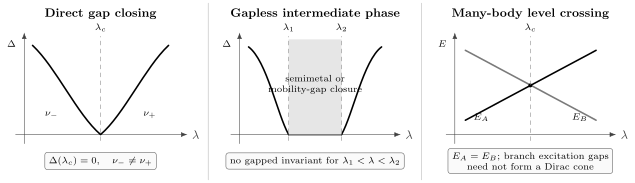
Three common routes through a topological transition. A clean direct transition closes the bulk gap at one parameter value. In three-dimensional inversion-asymmetric systems, or in other settings with insufficient symmetry to pin a direct critical point, a gapless interval can intervene. At a first-order transition, two many-body ground-state branches cross even though the excitation spectrum within either metastable branch need not form a Dirac cone.
First order is still a gap closure
Section titled “First order is still a gap closure”It is tempting to say that every topological transition must produce a massless quasiparticle. That is too strong. Let and be the extensive ground-state energies of two locally stable phases. At a first-order transition,
and the identity of the global ground state jumps. The many-body gap between the lowest two thermodynamic branches vanishes at , although the quasiparticle gap computed separately about either branch can stay finite. A discontinuity, hysteresis, or phase coexistence is compatible with a topological change; it is not the same critical mechanism as a continuous Dirac transition.
Symmetry can remove the obstruction
Section titled “Symmetry can remove the obstruction”Suppose two symmetry-protected topological phases differ by only while a symmetry group is enforced. A path that breaks may remain gapped:
This does not change inside its domain. Instead, is undefined along the detour. The canonical classification and boundary consequences of this statement are developed in Symmetry-Protected Topological Phases.
Gap Closing and Reopening
Section titled “Gap Closing and Reopening”“The gap closes” is incomplete unless the gap is named. Several inequivalent quantities appear even in a noninteracting crystal.
Direct and indirect band gaps
Section titled “Direct and indirect band gaps”For occupied bands ordered by energy, define the minimum direct gap
and the indirect gap
The occupied-band projector remains isolated at every momentum when . Its vector bundle and band invariant can therefore remain mathematically defined even if . But at the corresponding filling, electron and hole pockets overlap and the material is not a bulk insulator. Quantized insulating response then requires additional care and generally fails.
A clean band-topology change at fixed occupied rank requires
somewhere in the Brillouin zone. An indirect-gap closure alone can produce a metal without changing the eigenvectors or their invariant. Conversely, a direct closing at an energy far from the chemical potential need not describe a transition of the actual many-electron ground state at fixed density.
Spectral, mobility, and many-body gaps
Section titled “Spectral, mobility, and many-body gaps”In a disordered system, crystal momentum is unavailable. A spectral gap is an interval containing no eigenvalues. A mobility gap can exist when eigenstates in an energy interval are Anderson localized even though the density of states is nonzero. Quantized transport and a noncommutative or real-space invariant can survive localized in-gap states. The disorder-driven transition occurs when extended states cross the Fermi level or the localization length diverges, not necessarily when the disorder-averaged density of states first becomes nonzero.
For an interacting system with ground-state energy ,
is the many-body gap in a specified symmetry and boundary-condition sector. Charged single-particle spectroscopy probes only part of this spectrum. A neutral collective excitation can become gapless while the electron addition and removal gaps remain finite. Topological order may change when an anyon becomes soft and condenses, a process invisible to a one-electron band gap.
Reopening is necessary, not sufficient
Section titled “Reopening is necessary, not sufficient”In a direct clean transition, a reopened gap is the point at which an invariant becomes definable again. It does not establish that the invariant changed. A nontopological avoided crossing, two successive inversions, or a closing between unoccupied bands can all close and reopen a spectral feature without changing the occupied phase.
The reliable test is
with chosen so that both sides are demonstrably gapped and the same classification assumptions apply. Only establishes an invariant-changing transition.
Finite systems do not literally close
Section titled “Finite systems do not literally close”At finite size, momenta are discrete and states with the same exact quantum numbers usually avoid crossing. A nominal critical gap can remain of order
or be exponentially small at a first-order transition. Boundary modes can also introduce low-energy levels unrelated to the bulk critical point. Locate the transition using periodic boundaries when possible, track the appropriate symmetry sector, and extrapolate several sizes. The general methodology belongs to Finite-Size Scaling in Numerical Many-Body Physics.
Codimension predicts possible routes
Section titled “Codimension predicts possible routes”A generic two-band Hermitian Hamiltonian can be written
The two bands are degenerate only when
These are three real conditions. In spatial dimensions plus one control parameter, the generic degeneracy set has dimension
provided no symmetry removes or constrains components of .
- In two dimensions, isolated points in are generic. A single tuning parameter can therefore reach a direct point transition.
- In three dimensions, the degeneracies generically trace lines in . Fixed- slices can contain Weyl nodes over a finite interval, producing an intervening Weyl semimetal.
- In one dimension, an unconstrained two-band crossing is not generic with only one control parameter. Chiral, inversion, particle-hole, or another symmetry can reduce the codimension and pin a transition.
This counting is local, not a complete phase classification. Kramers degeneracy, inversion, nonsymmorphic symmetry, and multi-band structure can force crossings or make several nodes appear together. Murakami’s analysis of three-dimensional time-reversal-invariant systems gives a central example: with inversion symmetry, a direct transition can occur at a high-symmetry momentum, whereas without inversion a gapless intermediate phase is generic. Weyl and Dirac Semimetals owns the stable-node classification.
How an Invariant Changes
Section titled “How an Invariant Changes”The invariant does not drift through fractional values in a gapped family. Instead, it is constant on each connected gapped region and undefined at the singular set separating regions.
Projector continuity
Section titled “Projector continuity”For a two-dimensional occupied projector , one representation of the first Chern number is
If the direct gap remains open, the spectral projector can be written as a contour integral of the resolvent,
where encloses the occupied spectrum but no unoccupied eigenvalue. The same contour can be chosen locally in , so varies smoothly. Differentiating with respect to gives a total derivative over the Brillouin torus; its integral vanishes. Thus
through every smooth gapped interval. At a band touching, the contour is pinched, becomes singular, and the proof no longer applies.
Berry monopoles in extended parameter space
Section titled “Berry monopoles in extended parameter space”Near an isolated two-band closing in two dimensions, treat
as a three-dimensional parameter. The degeneracy is a source or sink of Berry curvature in this extended space. Enclose it by a small sphere . Its integer charge is
With orientations chosen consistently, Stokes’ theorem relates the flux to the Chern numbers on slices above and below the degeneracy:
Topology is therefore transferred through the critical degeneracies. Lattice symmetries may force several monopoles to occur together, and their charges can add or cancel. Counting gap-closing points without their charges is not enough.
Z₂ transitions
Section titled “Z₂ transitions”For a time-reversal-invariant insulator, the strong index changes only when the occupied Kramers bundle becomes singular or time-reversal symmetry is abandoned. If inversion symmetry is also present, the Fu–Kane parity criterion reduces the diagnosis to inversion eigenvalues at time-reversal-invariant momenta :
Here is the parity eigenvalue of one state from each occupied Kramers pair. A band inversion that exchanges opposite-parity Kramers pairs at one flips the product. Two such exchanges can cancel modulo two.
The shortcut is valid only while inversion symmetry holds. Without inversion, parity labels do not exist, and a transition can occur through gap closings at generic momenta related by time reversal. Wilson-loop flow, a sewing-matrix invariant, or another gauge-consistent method must then be used. “Band inversion” without the symmetry labels and global product is not a calculation.
Winding and Pfaffian changes
Section titled “Winding and Pfaffian changes”In chiral one-dimensional systems, a winding number changes when the off-diagonal Bloch block becomes singular. In a translationally invariant class-D superconductor, a convenient invariant can be written schematically as
A sign change requires a vanishing Pfaffian and hence a zero-energy Bogoliubov quasiparticle at an invariant momentum, subject to the basis and particle-hole conventions defining . In disorder, the same phase can be diagnosed through a reflection-matrix invariant rather than crystal momentum. Topological Superconductors gives the phase-specific definitions.
Dirac Mass Models
Section titled “Dirac Mass Models”Dirac Hamiltonians are the local normal forms of many continuous topological transitions. They isolate the bands and momenta that become soft, expose the relevant mass parameter, and predict scaling near the clean critical point. They do not by themselves supply the ultraviolet completion needed for an integer lattice invariant.
An anisotropic two-dimensional cone
Section titled “An anisotropic two-dimensional cone”Let
where is measured from a critical momentum and changes sign. The eigenvalues are
The direct gap and correlation length scale are
If and interactions or disorder do not renormalize the fixed point, then and . These exponents belong to this clean free-Dirac theory, not to every topological transition.
For the lower band, the Berry curvature is
Integrating the continuum cone over the entire plane gives
The half-integer value is a regulator warning, not a legal isolated-band Chern number on a compact Brillouin zone. A lattice completion supplies other cones or high-momentum structure. The robust local statement is the jump:
The total lattice change is the sum over every critical cone, with its velocity orientation and mass slope included.
A two-valley mass ledger
Section titled “A two-valley mass ledger”For two valleys , write a local form
The valley orientations are opposite, so the lower-band Chern number takes the regulated form
up to the ordering and orientation convention for the valleys. If both masses have the same sign, their half-contributions cancel. If their signs differ, they add to an integer. In the Haldane model, a sublattice potential and a time-reversal-breaking next-nearest-neighbor hopping compete in . A phase boundary occurs when one valley mass vanishes.
This ledger explains why the experimental Haldane simulator could map a transition by observing a gap closure at one Dirac point, but Chern Numbers in Band Theory remains the canonical home for the full lattice invariant and numerical phase diagram.
Three-dimensional Dirac criticality
Section titled “Three-dimensional Dirac criticality”A minimal symmetry-constrained four-band model can take the form
where mutually anticommuting matrices obey
Its spectrum is
with degeneracy fixed by the symmetries and representation. Inversion and time reversal can pin a direct transition at a high-symmetry momentum. If inversion is broken, additional symmetry-allowed matrices may split the Dirac point into Weyl nodes and replace the isolated transition by a Weyl-semimetal interval. The phrase “the Dirac mass changes sign” is therefore meaningful only after listing the allowed masses.
Ideal semiconductor–superconductor nanowire
Section titled “Ideal semiconductor–superconductor nanowire”A widely used continuum Bogoliubov–de Gennes model is
At , the spin–orbit term vanishes. The four eigenvalue magnitudes reduce to combinations of and , so the ideal-model gap closes when
In the single-subband model, the side
is the topological regime supporting Majorana end modes for an open, sufficiently long wire. This criterion is a model-level phase boundary, not a stand-alone experimental diagnostic. Orbital magnetic effects, multiple subbands, electrostatic inhomogeneity, disorder, interactions, finite length, and collapse of the parent or induced superconducting gap can alter the phase diagram and imitate individual spectroscopic signatures.
Disorder-Driven Transitions
Section titled “Disorder-Driven Transitions”Disorder changes both the language and the transition mechanism. Momentum-space Berry curvature is no longer fundamental, and a clean band gap need not survive.
Mobility-gap protection
Section titled “Mobility-gap protection”Localized states do not carry charge across a macroscopic sample. Consequently, a Chern phase can retain a quantized Hall response when localized eigenstates fill what would have been a clean spectral gap. The invariant can be formulated using:
- twisted boundary conditions and many-body Berry curvature;
- noncommutative geometry in the thermodynamic limit;
- real-space Chern markers in sufficiently homogeneous bulk regions;
- the Bott index for finite aperiodic samples;
- scattering or reflection matrices at the Fermi energy.
These diagnostics answer related but not identical finite-size questions. Their convergence, boundary sensitivity, and disorder averaging must be checked.
At a plateau transition, extended states carrying topological charge move, merge, or cross the Fermi energy. The localization length diverges as
where the universality class depends on symmetry and dimensionality. A finite density of localized states at does not by itself destroy the phase; a mobility-gap closure does.
Topological Anderson phases
Section titled “Topological Anderson phases”Disorder need not only destroy topology. In models with quadratic corrections to a Dirac Hamiltonian, a random potential can renormalize the effective mass and drive a clean trivial system into a quantized-conductance regime. This is the topological Anderson-insulator mechanism. It should not be summarized as “disorder creates a clean band inversion” without qualification:
- weak-disorder effective-medium theory can describe mass renormalization;
- stronger disorder requires localization diagnostics;
- finite conductance plateaus can be contact- or size-dependent;
- sufficiently strong disorder ultimately localizes the relevant states or destroys the mobility gap.
To establish a disorder-driven topological transition, compute a real-space or scattering invariant and a localization observable, not only the disorder-averaged spectral function.
Average gaps can mislead
Section titled “Average gaps can mislead”The disorder-averaged Green function may show a smooth or apparently reopened gap while rare regions supply low-energy states. Conversely, broad spectral weight can obscure a mobility gap that still protects quantized transport. Report at least:
with finite-size and sample-to-sample uncertainty. No one item substitutes for the others.
Interaction-Driven Transitions
Section titled “Interaction-Driven Transitions”Interactions replace the occupied-band bundle by a many-body ground-state structure. Free-fermion invariants can remain useful diagnostics in weakly correlated regimes, but their domain must be stated.
Many-body invariants and gap closings
Section titled “Many-body invariants and gap closings”For a two-dimensional interacting insulator on a torus, impose boundary twists
If the ground state remains isolated over the twist torus , its Berry curvature defines a many-body Chern number:
Changing requires a singularity somewhere on this twist torus. The closing need not occur at periodic boundary conditions in a small numerical sample. This is one reason a single finite-size spectrum can miss the transition.
Green-function poles and zeros
Section titled “Green-function poles and zeros”For interacting fermions, topological invariants can sometimes be expressed through the full single-particle Green function . A noninteracting transition is associated with a pole at zero frequency: an excitation energy vanishes. Interactions allow another singular route, a zero of , equivalently a divergent self-energy. The topological index can then change even without a pole signaling closure of the single-electron spectral gap.
When is nonsingular and the required assumptions hold, the topological Hamiltonian
can reduce the invariant calculation to an effective band problem. It is not an excitation Hamiltonian, and its eigenvalues are not a quasiparticle spectrum. Near Green-function zeros, symmetry breaking, fractionalization, or ground-state degeneracy, the shortcut can become singular or incomplete. A many-body invariant and direct diagnostics of the low-energy sector take priority.
Interactions can reduce a classification
Section titled “Interactions can reduce a classification”Admitting interactions can identify free phases that were previously distinct. The canonical example is the one-dimensional BDI Majorana chain: the free integer classification reduces to with interactions. Phases whose free indices differ by eight can be connected along a symmetry-preserving gapped path through a strongly interacting region.
No invariant has mysteriously changed without a transition. Rather, the free integer was not an invariant of the enlarged interacting class. Before searching for a critical point, ask whether the endpoint phases remain distinct under the interactions being allowed.
Intrinsic topological order
Section titled “Intrinsic topological order”Transitions between intrinsically topologically ordered phases are not generally band inversions. A bosonic anyon can become gapless and condense. Anyons with nontrivial mutual statistics relative to the condensate become confined, while others may be identified or split, producing a new topological order. Other transitions are first order or pass through an extended gapless phase.
The closing object is an emergent excitation, not necessarily an electron. Ground-state degeneracy, modular data, topological entanglement signatures, and anyon content are the relevant descriptors. Topological Order owns that framework, and Anyons and Braiding owns the quasiparticle language.
Finite temperature
Section titled “Finite temperature”Band parameters and response functions can evolve across a temperature-tuned crossover, and a symmetry-breaking transition may alter a topological band structure. But a ground-state topological quantum phase transition is defined at . At nonzero temperature:
- thermal carriers spoil exact insulating quantization;
- coherence and quasiparticle lifetimes can be shorter than probe scales;
- mixed-state topology requires a separately defined framework;
- a measured “critical temperature” may mark symmetry breaking rather than the zero-temperature topological boundary.
Extrapolate the control-parameter phase boundary toward zero temperature and separate thermodynamic, transport, and spectroscopic criteria.
Experimental Tuning
Section titled “Experimental Tuning”Experiments rarely tune an abstract Dirac mass directly. They tune a laboratory parameter that changes several Hamiltonian terms at once.
| Control knob | Terms commonly affected | Principal confounders |
|---|---|---|
| Quantum-well thickness or layer number | confinement, orbital ordering, hybridization | roughness, parallel channels, thickness inhomogeneity |
| Composition | spin–orbit coupling, lattice constants, orbital energies | alloy disorder, chemical-potential drift, phase separation |
| Pressure or strain | hopping, crystal field, symmetry, bandwidth | structural transitions, nonhydrostatic strain, contact changes |
| Gate voltage or displacement field | chemical potential, inversion breaking, layer polarization | trapped charge, inhomogeneity, changing carrier density |
| Magnetic field or exchange | Zeeman energy, time-reversal breaking, orbital coupling | Landau levels, gap suppression, magnetic domains |
| Periodic drive | effective hopping and masses in a Floquet description | heating, micromotion, nonequilibrium occupation |
| Optical-lattice parameters | sublattice offset, tunneling phase, geometry | trap averaging, nonadiabatic band transfer, calibration error |
The correct effective parameter must be inferred or calibrated rather than assumed linear over an entire phase diagram.
HgTe/CdTe quantum wells
Section titled “HgTe/CdTe quantum wells”Bernevig, Hughes, and Zhang predicted that increasing HgTe quantum-well thickness reverses the ordering of electron-like and heavy-hole-like subbands near a critical thickness of about for the modeled heterostructure. The normal and inverted regimes carry different two-dimensional indices. König and collaborators then observed the quantum spin Hall regime in inverted wells, with edge-dominated transport behavior.
This example illustrates a strong evidence chain:
- confinement provides a physically calibrated tuning parameter;
- a multiband model predicts the ordering change and invariant;
- normal and inverted wells lie on opposite sides;
- edge transport appears in the predicted regime;
- magnetic-field and device-geometry tests constrain alternative conduction paths.
The phrase “critical thickness” is material- and structure-specific, not a universal constant.
Tunable Haldane model with ultracold atoms
Section titled “Tunable Haldane model with ultracold atoms”In the cold-atom realization of the Haldane model, a sublattice energy offset breaks inversion symmetry while circular lattice modulation creates complex next-nearest-neighbor tunneling and breaks time reversal. These controls tune the two valley masses separately. Momentum-resolved interband transfer identified a vanishing gap at one Dirac point on the phase boundary, while transverse drift under an applied force probed Berry-curvature effects.
This is unusually clean because the microscopic knobs and effective lattice Hamiltonian can be calibrated. Even there, finite force, Landau–Zener transfer, trap averaging, and Floquet micromotion affect the observed drift. Agreement among gap spectroscopy, the calibrated Floquet model, and the response map is more persuasive than any one observable.
Composition-tuned topological insulator
Section titled “Composition-tuned topological insulator”Angle-resolved photoemission on reported an evolution from a trivial regime through a gap-closing region to a surface state with spin texture on the topological side. Composition changes spin–orbit-coupled band ordering, but it also introduces alloy disorder and shifts energies. The interpretation therefore relies on the combined evolution of bulk bands, surface dispersion, and spin texture rather than the word “inversion” alone.
This case is a useful template for spectroscopy claims: resolve the bulk closing as directly as experimental resolution permits, distinguish surface from bulk spectral weight, and compare both sides to a symmetry-consistent invariant calculation.
Semiconductor–superconductor devices
Section titled “Semiconductor–superconductor devices”Magnetic field and gate voltage tune and in the ideal nanowire model, suggesting the boundary
In a device, however, the same magnetic field changes orbital motion and suppresses superconductivity, while the gate reshapes subbands and tunnel barriers. A zero-bias conductance feature alone does not show that the bulk gap closed and reopened, nor that a nonlocal topological phase formed. A credible transition study seeks correlated evidence from both wire ends, bulk-gap evolution, length and field-angle dependence, and a realistic electrostatic and superconducting model. The phase-specific experimental-status discussion remains in Topological Superconductors.
Pressure and gapless intermediate phases
Section titled “Pressure and gapless intermediate phases”First-principles work on noncentrosymmetric BiTeI predicted a pressure-induced transition from a trivial Rashba semiconductor to a topological insulator. Because inversion is absent, the generic route can pass through a narrow Weyl-semimetal interval rather than one fourfold-degenerate critical point. Pressure simultaneously alters lattice constants, orbital hybridization, and possibly crystal structure, so structural characterization is part of the topology claim.
The lesson is general: if symmetry and codimension predict an intermediate gapless phase, fitting all data to a single critical Dirac mass can erase the very physics being tested.
An Evidence Ladder for Tuned Transitions
Section titled “An Evidence Ladder for Tuned Transitions”A mature experimental or computational claim should answer the following questions.
1. What is being tuned?
Section titled “1. What is being tuned?”State the measured laboratory control and the effective Hamiltonian parameters it changes. Include calibration uncertainty and unintended changes in density, symmetry, disorder, or temperature.
2. Which gap is relevant?
Section titled “2. Which gap is relevant?”Specify direct, indirect, mobility, quasiparticle, or many-body gap. Identify the momentum, boundary twist, symmetry sector, or localization diagnostic at which it closes.
3. Are both sides phases?
Section titled “3. Are both sides phases?”Demonstrate finite gapped or mobility-gapped intervals on both sides, not merely two points near a noisy minimum. In finite systems, perform size scaling.
4. Does the invariant change?
Section titled “4. Does the invariant change?”Compute or measure a defensible proxy for the invariant on both sides using the same conventions. A local band inversion is not a global invariant.
5. Do independent consequences agree?
Section titled “5. Do independent consequences agree?”Check boundary spectral flow, quantized or symmetry-constrained response, pumping, entanglement, or defect quantum numbers as appropriate. These should agree with the invariant but need not each be independently decisive.
6. Have alternatives been tested?
Section titled “6. Have alternatives been tested?”Exclude ordinary metallic crossover, structural phase change, symmetry breaking, contact artifacts, trivial bound states, heating, disorder percolation, and chemical-potential motion where relevant.
A compact claim table is often more honest than a single label:
| Statement | Appropriate status |
|---|---|
| A model predicts a closing and invariant change | theoretical prediction |
| A calibrated simulator maps the closing and response | controlled realization |
| Spectroscopy resolves inversion and candidate boundary states | spectroscopic evidence |
| Transport is consistent with a protected response | transport evidence |
| Several independent probes and invariant calculations agree | convergent evidence |
| One nonunique feature appears | candidate signature, not confirmation |
Numerical Workflow
Section titled “Numerical Workflow”For a clean lattice model :
- sample the entire Brillouin zone and compute ;
- refine the mesh near candidate minima rather than trusting a coarse-grid nonzero gap;
- identify symmetry-related nodes and fit a local Hamiltonian;
- compute the invariant on stable gapped points on both sides;
- verify convergence under mesh refinement and gauge-independent discretization;
- use a strip or slab only as a consistency check for the boundary spectrum;
- test perturbations that preserve and break the claimed protecting symmetries.
For a disordered or interacting model:
- replace momentum invariants by twisted-boundary, real-space, scattering, or many-body diagnostics;
- scale system size and average distributions, not only means;
- distinguish spectral and localization gaps;
- inspect all relevant charge, spin, parity, and topological sectors;
- compare periodic and open boundaries to separate bulk criticality from edge levels;
- track entanglement, correlation length, and response where feasible;
- test whether the endpoint phases remain distinct in the enlarged interacting class.
Common Mistakes
Section titled “Common Mistakes”Calling every band inversion topological
Section titled “Calling every band inversion topological”An inversion can occur between bands with unsuitable symmetry labels, away from the occupied gap, or twice so that a change cancels. Compute the invariant globally.
Reporting only a reopened gap
Section titled “Reporting only a reopened gap”Reopening restores the conditions under which an invariant may be assigned. It does not say which value is obtained.
Confusing direct and indirect gaps
Section titled “Confusing direct and indirect gaps”A direct gap protects an occupied-band bundle; a positive indirect gap is needed for a conventional band insulator at fixed filling. State both when they differ.
Assigning an invariant at the critical point
Section titled “Assigning an invariant at the critical point”The gapped-phase invariant is generally undefined exactly where the occupied subspace is singular. Characterize the critical node by charge, symmetry, or field theory instead.
Treating a continuum half-integer as a lattice Chern number
Section titled “Treating a continuum half-integer as a lattice Chern number”A single Dirac cone omits ultraviolet data. Use its change across a mass sign reversal, then restore every cone and the lattice regulator.
Assuming interactions merely renormalize the mass
Section titled “Assuming interactions merely renormalize the mass”Interactions can create neutral critical modes, Green-function zeros, first-order transitions, fractionalization, and classification reductions.
Using density of states as a localization test
Section titled “Using density of states as a localization test”A mobility gap may coexist with finite density of localized states. Compute a localization or transport diagnostic.
Inferring bulk topology from one boundary feature
Section titled “Inferring bulk topology from one boundary feature”Trivial surface resonances, quantum-dot levels, and accidental Andreev states can appear in a gap. Establish the bulk phase and the stable aggregate required by bulk–boundary correspondence.
Ignoring the protecting symmetry along the tuning path
Section titled “Ignoring the protecting symmetry along the tuning path”If the symmetry is broken, the old invariant may cease to exist and a gapped detour may connect the endpoints.
Fitting a direct transition when codimension predicts an interval
Section titled “Fitting a direct transition when codimension predicts an interval”In three-dimensional inversion-asymmetric systems, an intervening Weyl phase can be generic. Search for nodes over a parameter interval.
Exercises
Section titled “Exercises”1. Constancy of the Chern number
Section titled “1. Constancy of the Chern number”Let be a smooth fixed-rank projector on a two-dimensional Brillouin torus. Show that
is independent of . Explain exactly where the argument fails at a band touching.
Solution
Write . Using , one obtains
and can rearrange the variation into an exact form:
The Brillouin zone is a torus without boundary, so Stokes’ theorem gives
At a band touching, no smooth fixed-rank spectral projector separates occupied and unoccupied states. The resolvent contour defining is pinched, so the differentiability premise fails and the exact-form argument cannot be continued through the singular point.
2. Berry flux of an anisotropic Dirac cone
Section titled “2. Berry flux of an anisotropic Dirac cone”For
integrate the lower-band Berry curvature over the plane and determine the change when goes from negative to positive.
Solution
The lower-band curvature is
Set and . Then
Therefore
for a negative-to-positive mass change. Each side is half-integer because the continuum plane is not the compact lattice Brillouin zone. Only the summed, regulated lattice result is an integer invariant.
3. Codimension and an intermediate Weyl phase
Section titled “3. Codimension and an intermediate Weyl phase”Use the two-band form to count the generic dimension of the degeneracy set in for . Why can a three-dimensional inversion-asymmetric topological-insulator transition occupy a finite parameter interval?
Solution
A degeneracy requires the three equations
The extended parameter space has dimension , so the generic degeneracy set has dimension
Thus it is absent without extra symmetry for , consists of isolated points for , and consists of curves for . A curve in can intersect each fixed- three-dimensional Brillouin-zone slice at isolated Weyl nodes over a finite range . The nodes are created, move, and annihilate at the interval endpoints. Inversion or another symmetry can instead force a higher-degeneracy direct critical point.
4. Direct versus indirect closure
Section titled “4. Direct versus indirect closure”Suppose the top valence band and bottom conduction band have
on a one-dimensional Brillouin zone. Find the direct and indirect gaps. For what is the isolated two-band projector well defined, and for what is the system an insulator at one filled band?
Solution
At the same momentum,
so
The conduction minimum is , while the valence maximum is . Hence
The valence eigenstate remains separated from the conduction eigenstate at every when , so a fixed-rank band projector can be defined. A chemical potential can lie between all valence and conduction energies only when . The interval has a direct band separation but an indirect overlap, so at one-band filling the ground state is metallic.
5. Two Dirac valleys
Section titled “5. Two Dirac valleys”Take two valleys with
and
Map the phases as is varied at fixed .
Solution
There are transition points at
For , both masses are negative and . For
while , giving . For , both masses are positive and . Each transition closes one valley gap and changes by one. Reversing the valley orientation or the sign convention for reverses the reported Chern sign but not the phase-boundary locations.
6. Nanowire transition criterion
Section titled “6. Nanowire transition criterion”At , diagonalize the ideal nanowire Hamiltonian
Show when a zero eigenvalue occurs.
Solution
commutes with the Nambu-sector operator . Choose eigenvalue . The Nambu operator has eigenvalues
Thus
A zero occurs when
or
This derivation locates the ideal bulk closing. It does not prove that a real finite device satisfying a fitted inequality has Majorana end modes; the model assumptions and nonlocal phase diagnostics must also hold.
7. Diagnose three transition claims
Section titled “7. Diagnose three transition claims”Classify the missing evidence in each claim:
- a disordered sample develops finite density of states at , so topology is declared destroyed;
- an interacting calculation finds no single-particle gap closure, so the invariant is declared unchanged;
- an inversion-broken three-dimensional model is sampled at only one momentum and one , revealing an avoided crossing, so no transition is declared possible.
Solution
- Density of states does not distinguish localized from extended states. A mobility-gap, localization, real-space invariant, or transport calculation is required.
- The many-body gap may close in a neutral sector, the ground state may cross first order, or the Green function may acquire a zero. Compute a many-body invariant or inspect the full low-energy spectrum and Green-function singularities.
- Without inversion, codimension can favor a Weyl-semimetal interval. Search the full Brillouin zone across a finite parameter range for symmetry-related nodes rather than forcing one direct critical point.
8. Audit an experimental claim
Section titled “8. Audit an experimental claim”An experiment tunes pressure, observes a minimum in resistivity, and fits an optical absorption edge that decreases and then increases. The authors call this a topological phase transition. Design a minimum follow-up program.
Solution
A defensible program should:
- determine the crystal structure and symmetry across pressure, including coexistence and nonhydrostatic strain;
- identify whether the optical feature is a direct or indirect bulk gap and resolve its momentum dependence where possible;
- track carrier density and chemical potential so a metal–insulator crossover is not mistaken for band topology;
- calculate an invariant for measured structures on both gapped sides, with uncertainty in lattice parameters;
- search for an intervening Weyl or other gapless phase if inversion is absent;
- test boundary states or a topology-linked response on the predicted side;
- reproduce the transition under pressure cycling and in multiple samples;
- compare against structural, excitonic, magnetic, and disorder-based alternatives.
The existing observations are consistent with a closing and reopening but do not yet establish that the two gapped sides have different topology.
References
Section titled “References”- D. J. Thouless, M. Kohmoto, M. P. Nightingale, and M. den Nijs, “Quantized Hall Conductance in a Two-Dimensional Periodic Potential,” Physical Review Letters 49, 405–408 (1982), doi:10.1103/PhysRevLett.49.405.
- F. D. M. Haldane, “Model for a Quantum Hall Effect without Landau Levels: Condensed-Matter Realization of the ‘Parity Anomaly’,” Physical Review Letters 61, 2015–2018 (1988), doi:10.1103/PhysRevLett.61.2015.
- Q. Niu, D. J. Thouless, and Y.-S. Wu, “Quantized Hall Conductance as a Topological Invariant,” Physical Review B 31, 3372–3377 (1985), doi:10.1103/PhysRevB.31.3372.
- B. A. Bernevig, T. L. Hughes, and S.-C. Zhang, “Quantum Spin Hall Effect and Topological Phase Transition in HgTe Quantum Wells,” Science 314, 1757–1761 (2006), doi:10.1126/science.1133734.
- M. König et al., “Quantum Spin Hall Insulator State in HgTe Quantum Wells,” Science 318, 766–770 (2007), doi:10.1126/science.1148047.
- S. Murakami, “Phase Transition between the Quantum Spin Hall and Insulator Phases in 3D: Emergence of a Topological Gapless Phase,” New Journal of Physics 9, 356 (2007), doi:10.1088/1367-2630/9/9/356.
- X.-L. Qi, Y.-S. Wu, and S.-C. Zhang, “Topological Quantization of the Spin Hall Effect in Two-Dimensional Paramagnetic Semiconductors,” Physical Review B 74, 085308 (2006), doi:10.1103/PhysRevB.74.085308.
- J. Bellissard, A. van Elst, and H. Schulz-Baldes, “The Noncommutative Geometry of the Quantum Hall Effect,” Journal of Mathematical Physics 35, 5373–5451 (1994), doi:10.1063/1.530758.
- J. Li, R.-L. Chu, J. K. Jain, and S.-Q. Shen, “Topological Anderson Insulator,” Physical Review Letters 102, 136806 (2009), doi:10.1103/PhysRevLett.102.136806.
- C. W. Groth, M. Wimmer, A. R. Akhmerov, J. Tworzydło, and C. W. J. Beenakker, “Theory of the Topological Anderson Insulator,” Physical Review Letters 103, 196805 (2009), doi:10.1103/PhysRevLett.103.196805.
- T. A. Loring and M. B. Hastings, “Disordered Topological Insulators via -Algebras,” EPL 92, 67004 (2010), doi:10.1209/0295-5075/92/67004.
- R. Bianco and R. Resta, “Mapping Topological Order in Coordinate Space,” Physical Review B 84, 241106(R) (2011), doi:10.1103/PhysRevB.84.241106.
- V. Gurarie, “Single-Particle Green’s Functions and Interacting Topological Insulators,” Physical Review B 83, 085426 (2011), doi:10.1103/PhysRevB.83.085426.
- Z. Wang and S.-C. Zhang, “Simplified Topological Invariants for Interacting Insulators,” Physical Review X 2, 031008 (2012), doi:10.1103/PhysRevX.2.031008.
- L. Fidkowski and A. Kitaev, “Effects of Interactions on the Topological Classification of Free Fermion Systems,” Physical Review B 81, 134509 (2010), doi:10.1103/PhysRevB.81.134509.
- F. A. Bais and J. K. Slingerland, “Condensate-Induced Transitions between Topologically Ordered Phases,” Physical Review B 79, 045316 (2009), doi:10.1103/PhysRevB.79.045316.
- G. Jotzu et al., “Experimental Realization of the Topological Haldane Model with Ultracold Fermions,” Nature 515, 237–240 (2014), doi:10.1038/nature13915.
- S.-Y. Xu et al., “Topological Phase Transition and Texture Inversion in a Tunable Topological Insulator,” Science 332, 560–564 (2011), doi:10.1126/science.1201607.
- M. S. Bahramy, B.-J. Yang, R. Arita, and N. Nagaosa, “Emergence of Non-Centrosymmetric Topological Insulating Phase in BiTeI under Pressure,” Nature Communications 3, 679 (2012), doi:10.1038/ncomms1679.
- R. M. Lutchyn, J. D. Sau, and S. Das Sarma, “Majorana Fermions and a Topological Phase Transition in Semiconductor–Superconductor Heterostructures,” Physical Review Letters 105, 077001 (2010), doi:10.1103/PhysRevLett.105.077001.
- Y. Oreg, G. Refael, and F. von Oppen, “Helical Liquids and Majorana Bound States in Quantum Wires,” Physical Review Letters 105, 177002 (2010), doi:10.1103/PhysRevLett.105.177002.
- A. R. Akhmerov, J. P. Dahlhaus, F. Hassler, M. Wimmer, and C. W. J. Beenakker, “Quantized Conductance at the Majorana Phase Transition in a Disordered Superconducting Wire,” Physical Review Letters 106, 057001 (2011), doi:10.1103/PhysRevLett.106.057001.
- A. M. Essin and V. Gurarie, “Bulk–Boundary Correspondence of Topological Insulators from Their Respective Green’s Functions,” Physical Review B 84, 125132 (2011), doi:10.1103/PhysRevB.84.125132.
- E. Prodan, “Disordered Topological Insulators: A Non-Commutative Geometry Perspective,” Journal of Physics A: Mathematical and Theoretical 44, 113001 (2011), doi:10.1088/1751-8113/44/11/113001.
Further Reading
Section titled “Further Reading”- M. Z. Hasan and C. L. Kane, “Colloquium: Topological Insulators,” Reviews of Modern Physics 82, 3045–3067 (2010), doi:10.1103/RevModPhys.82.3045.
- X.-L. Qi and S.-C. Zhang, “Topological Insulators and Superconductors,” Reviews of Modern Physics 83, 1057–1110 (2011), doi:10.1103/RevModPhys.83.1057.
- C. L. Kane and E. J. Mele, “ Topological Order and the Quantum Spin Hall Effect,” Physical Review Letters 95, 146802 (2005), doi:10.1103/PhysRevLett.95.146802.