Fractional Quantum Hall Effect
The fractional quantum Hall effect is a family of interaction-driven, incompressible two-dimensional electron fluids with fractionally quantized Hall response and fractionalized quasiparticles. At a robust filling such as , a low-temperature Hall bar exhibits
The rational coefficient is not obtained by partially occupying an otherwise unchanged noninteracting band. A partially filled Landau level has an enormous many-body degeneracy before interactions are included. Repulsion reorganizes that manifold into a gapped correlated liquid whose quasiparticles can carry a fraction of the electron charge and acquire a non-bosonic, non-fermionic phase when braided.
This page owns the fractional Hall effect as quantum matter: its transport signature, projected-Landau-level physics, Laughlin state, fractional charge, experimental statistics evidence, composite-fermion organization, edge observables, and phase-specific topological data. Landau Levels owns the one-electron spectrum, Integer Quantum Hall Effect owns integer plateaus and their localization mechanism, and Topological Order Preview owns the general diagnostic framework. Anyons and Braiding owns braid groups, fusion spaces, and non-Abelian operations in general; here those structures are introduced only as properties of fractional Hall phases.
Required background. Landau Levels supplies the one-electron spectrum, Degeneracy of Landau Levels supplies flux counting, and Integer Quantum Hall Effect supplies the plateau, tensor, localization, and edge baseline.
Helpful background. Topological Order Preview supplies the many-body diagnostic package, and Quantum Hall Geometry Preview supplies the geometric organization of Landau-level states.
Convention Ledger
Section titled “Convention Ledger”Use the orientation and Hall-tensor convention fixed on Integer Quantum Hall Effect: the sample lies in the plane, with , and the mobile particles have charge , where . Signed Hall coefficients depend on charge, field, orientation, and tensor convention, so universal response is quoted by magnitude unless a sign is explicitly needed.
The magnetic length and electronic flux quantum are
For area , the orbital degeneracy of one spin- and flavor-resolved Landau level is
With electrons and density , the filling factor is
Internal spin, valley, layer, and subband labels must be included before assigning a fractional state. In the simplest Laughlin discussion below, the electrons are fully spin polarized and confined to one orbital Landau level.
Experimental Phenomenon
Section titled “Experimental Phenomenon”Tsui, Stormer, and Gossard discovered a Hall feature at one-third filling in a high-mobility two-dimensional electron gas in 1982. The defining transport package is the same correlated package used for an integer plateau:
- a flat interval in Hall resistance near ;
- a simultaneous deep minimum in longitudinal resistance;
- reproducibility under field or density sweeps;
- thermal activation or another gap-sensitive signature in the appropriate regime;
- stability below a current-dependent breakdown threshold.
For ,
A rational value at one point is not enough. Contact mixing, density inhomogeneity, a nonzero , parallel conduction, and an incorrectly inverted tensor can all produce suggestive fractions. During a transition one must use
not the plateau shortcut .
Prominent odd-denominator fractions include members of sequences near , , , and their particle–hole partners within a resolved Landau level. Even-denominator states, especially , demand different candidate orders and remain a more delicate identification problem. The measured filling is a locator, not a complete name for the topological phase.
Incompressibility
Section titled “Incompressibility”An ideal fractional Hall liquid has a finite energy cost for changing its bulk topological sector or creating a well-separated quasiparticle–quasihole pair. If is the ground-state energy at fixed flux and with the background convention declared, the charge gap is
in the large-system limit. Equivalently, is the jump between particle-addition and particle-removal chemical potentials. Finite-size and electrostatic conventions must be stated. Transport activation often has the form
but need not equal the ideal many-body gap. Disorder broadening, finite quantum-well width, Landau-level mixing, spin textures, and quasiparticle trapping can reduce the measured scale.
Strong Interactions in a Landau Level
Section titled “Strong Interactions in a Landau Level”For noninteracting electrons in one exactly flat Landau level, every choice of occupied orbitals has the same kinetic energy. At fractional filling, one-body counting therefore leaves
degenerate Slater determinants. A weak perturbation acts on a Hilbert space whose dimension already grows exponentially with system size.
Projecting into orbital Landau level gives
The cyclotron kinetic energy is then an additive constant. The remaining degrees of freedom are guiding centers, whose two coordinates do not commute. Landau Levels Revisited develops that noncommutative geometry; here its physical consequence is central: interaction energy, not ordinary kinetic dispersion, selects the phase.
Useful competing scales are
A single-Landau-level treatment requires cyclotron mixing to be controlled. The dimensionless estimate
measures one important correction, but finite thickness and screening also reshape the projected interaction. The fractional gap is typically only a fraction of , so a sample can satisfy while still losing its fractional plateau when disorder or temperature is modest on the scale of the gap.
Haldane pseudopotentials
Section titled “Haldane pseudopotentials”For a rotationally invariant projected interaction, two-particle states can be classified by relative angular momentum :
Here projects particles onto relative angular momentum , and is the interaction cost in that channel. Spin-polarized fermions allow only odd . The short-range repulsion encoded by the first few values is more informative than the bare real-space potential after Landau-level projection.
For the model with and all other , the Laughlin state has zero energy because it contains no pair with relative angular momentum one. This exact parent-Hamiltonian statement is stronger than saying the trial state has a good overlap with a Coulomb ground state, but it applies to a deliberately chosen interaction.
The Laughlin State
Section titled “The Laughlin State”In symmetric gauge, write the physical planar coordinate as . For odd positive integer , the fermionic Laughlin wavefunction is
It describes filling
in the thermodynamic limit. Four checks expose most of its structure:
- Fermionic antisymmetry. Exchanging and multiplies the polynomial by .
- Lowest-Landau-level form. Apart from the Gaussian, the wavefunction is holomorphic in every .
- Correlation hole. When two electrons approach, , so their pair probability vanishes as separation to the power .
- Flux counting. On the sphere, the state occurs at . The offset from is the geometry-dependent shift; it should not be discarded in finite-size numerics.
The state is the filled lowest Landau level. For , the extra zeros attached to every electron keep particles farther apart and lower short-range repulsion. Calling the zeros “vortices” is useful, but they are zeros of a correlated many-body wavefunction, not literal infinitesimal solenoids bound to point electrons.
The plasma analogy rewrites as a Boltzmann weight for a two-dimensional logarithmic plasma. Screening in the corresponding plasma helps explain a uniform bulk density and the locality of quasihole-induced density disturbances. It does not remove real electrostatic, confinement, or edge-mediated interactions between charged quasiholes. The analogy is an organizing argument, not permission to replace the quantum phase by a classical liquid in every calculation.
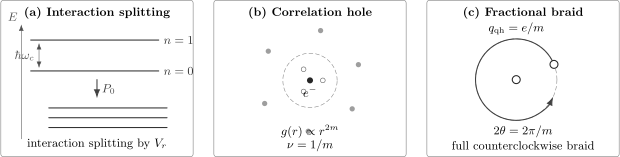
Three layers of the account. Projection removes ordinary kinetic dispersion and lets interactions split the guiding-center manifold; the factor creates a correlation hole; and a quasihole of charge magnitude acquires a full-braid phase around another quasihole, up to orientation convention.
What the trial state proves and does not prove
Section titled “What the trial state proves and does not prove”The Laughlin state gives a controlled representative of the phase and is the exact densest zero-energy ground state of suitable short-range parent Hamiltonians. For a realistic Coulomb interaction, evidence comes from adiabatic continuity, numerical spectra, overlaps, entanglement structure, response, and experiments. A large finite-size overlap is valuable but is not by itself a thermodynamic proof of a phase: two states can have a small overlap yet share a phase, while a large overlap can obscure a gap closing outside the tested sizes.
Fractional Charge
Section titled “Fractional Charge”A quasihole at complex position is generated by one additional zero in every electron coordinate:
This state is still in the lowest Landau level. Inserting one electronic flux quantum adiabatically through the fluid gives the response estimate
The missing electronic charge therefore gives the quasihole physical charge relative to the background. A quasielectron has the opposite charge, but its lowest-Landau-level wavefunction is not obtained by merely replacing the holomorphic quasihole factor with an antiholomorphic one.
Fractional charge is charge carried by a collective excitation of the electron fluid. It does not mean that a microscopic electron has been divided into independently existing vacuum particles. Local operators create topologically neutral combinations, move charge to a boundary, or couple to quasiparticles already present.
How charge is measured
Section titled “How charge is measured”In a weak-backscattering regime where rare tunneling events are approximately independent, low-frequency excess noise approaches the Poisson form
where is the backscattered current. Experiments at found . Away from the dilute-event regime, bunching, energy-dependent transmission, edge reconstruction, and thermal noise can change the inferred effective charge. A fit parameter called must therefore be accompanied by its transport model and bias window.
Anyonic Statistics
Section titled “Anyonic Statistics”In two spatial dimensions, exchanging identical particles is described by braids rather than only by permutations. For an Abelian Laughlin quasihole, a counterclockwise exchange contributes
while taking one quasihole all the way around another gives the full-braid phase
Clockwise paths or opposite phase conventions complex-conjugate these expressions. The exchange angle , full-braid angle , and Aharonov–Bohm phase from fractional electric charge are distinct contributions. Quoting a “statistical phase” without naming the path is ambiguous.
For several localized quasiholes, the Berry phase accumulated around a closed path contains both an area-dependent electromagnetic term and a path-topological term. A schematic interferometer phase is
where counts enclosed quasiparticles and is the full-braid angle. Device charging, edge motion, neutral modes, and bulk–edge coupling can alter the apparent periods and phase slips, so an interference pattern is interpreted through a calibrated device model.
For the state, microscopic Berry-phase arguments, interferometry, and collider-noise experiments form a mutually supporting case for Abelian anyonic statistics. This does not settle the statistics of every observed fractional plateau. In particular, identifying non-Abelian order requires evidence beyond a fractional Hall coefficient or a fractional tunneling charge.
Composite Fermions
Section titled “Composite Fermions”The Laughlin states explain , but many observed odd-denominator fractions organize into the Jain sequences
The composite-fermion construction binds correlation vortices to each electron. At mean-field level the resulting fermions experience
Defining their effective filling by gives, for the same effective-field orientation,
An integer quantum Hall state of composite fermions at then maps to . Reversing the effective-field orientation produces the minus sequence.
For example,
This converts a difficult interacting-electron fraction into two filled effective Landau levels of emergent fermions, while the underlying electron wavefunction remains strongly correlated. At with , the mean effective field vanishes:
The resulting compressible composite Fermi liquid is not a gapped fractional Hall plateau. Pairing or other instabilities of composite fermions provide routes to even-denominator phases, but the resulting order depends on Landau level, interaction, symmetry, and particle–hole structure.
Flux attachment is field-theory and wavefunction language. The attached flux is not an additional microscopic magnetic field concentrated at each electron, and the mean-field cancellation does not remove gauge fluctuations. Composite fermions and hierarchy constructions are complementary organizations of fractional Hall states; universal equivalence must be checked through response, quasiparticle, edge, and ground-sector data.
Edge Modes
Section titled “Edge Modes”A gapped Hall bulk next to vacuum requires low-energy boundary structure. The minimal edge is one downstream chiral boson. In units with , its fixed-point action can be written
The charge density is
The vertex operator carries charge ; creates the elementary Laughlin quasiparticle at the edge, while has electron charge. The simple fixed point predicts power-law tunneling rather than Fermi-liquid behavior.
Real edges can reconstruct into additional counterpropagating charged or neutral branches. Disorder and interactions can drive equilibration between branches, and a finite device may not reach the asymptotic edge fixed point over the available length or temperature range. Electrical conductance sees net charge transport; heat transport also sees neutral modes. The thermal Hall coefficient is
where is the net chiral central charge. For the ideal Laughlin edge, . For candidate even-denominator orders, electrical Hall response can agree while and neutral-mode content differ, making thermal and noise measurements especially valuable and especially sensitive to equilibration.
Topological Order
Section titled “Topological Order”The fractional Hall effect is not only fractional conductivity. The Laughlin phase has a coherent package:
- a bulk many-body gap and local indistinguishability;
- topological ground sectors on a torus, up to exponentially small finite-size splitting;
- Abelian quasiparticle sectors;
- elementary charge magnitude ;
- exchange angle for the elementary quasihole;
- a chiral boundary anomaly matching the bulk response;
- long-range entanglement.
The compact Abelian response ledger uses
For an integer quasiparticle label modulo ,
and
These formulas summarize the topological data; they do not derive the microscopic phase or prove that a material realizes it.
Because every Laughlin sector has quantum dimension one,
for the vacuum-sector topological entanglement entropy. Topological Entanglement Entropy Preview owns subtraction geometries and finite-size limitations.
Many-body Chern response
Section titled “Many-body Chern response”Thread boundary twists through a torus. If a locally indistinguishable ground space has dimension , its non-Abelian Berry curvature has an integer first Chern number
Under the gap and thermodynamic assumptions of the many-body quantization argument,
For the Laughlin state, and give up to orientation sign. The fractional coefficient therefore does not mean that a single noninteracting Bloch band has a fractional first Chern number. The integer belongs to the entire ground-state bundle; the denominator reflects its topological ground-space structure.
Evidence Ledger
Section titled “Evidence Ledger”Different measurements establish different parts of the phase:
| Observation | Strongest direct inference | What it does not establish alone |
|---|---|---|
| Hall plateau with small | robust fractional transverse response | quasiparticle statistics or complete order |
| activated transport or compressibility jump | an incompressible regime and energy scale | universal gap or anyon content |
| shot-noise charge | tunneling-event charge in a stated model | exchange statistics |
| interferometric phase slips | braiding-compatible phase information | interpretation without electrostatic calibration |
| collider correlations | exchange-statistics-sensitive correlations | arbitrary non-Abelian braid matrices |
| thermal Hall response | net chiral energy transport | microscopic wavefunction by itself |
| torus spectrum and flux flow in numerics | candidate topological sectors and response | thermodynamic phase without scaling |
| entanglement spectrum or entropy | universal-structure evidence under assumptions | complete anyon theory from one number |
Agreement across transport, thermodynamics, quasiparticle charge, braiding-sensitive observables, edge structure, and finite-size scaling is more authoritative than any single diagnostic.
Open Problems and Extensions
Section titled “Open Problems and Extensions”Use explicit status labels because the field spans settled physics and rapidly moving claims.
Established. The Laughlin phase is supported by quantized transport, an interaction gap, fractional charge, extensive numerics, and braiding-sensitive experiments. Odd-denominator Jain states and composite-fermion phenomenology are also established organizing structures, although each material realization still has nonuniversal corrections.
Active. Edge reconstruction, neutral-mode equilibration, disorder, finite thickness, and Landau-level mixing determine how universal bulk data appear in finite devices. Quantitative tunneling exponents and activation gaps are therefore active material and device questions even when the bulk phase assignment is secure.
Active and controversial. The topological order at is not fixed by its Hall coefficient. Pfaffian, anti-Pfaffian, particle–hole-symmetric Pfaffian, disorder-dominated, and reconstructed-edge scenarios can share charge response while differing in neutral modes, thermal Hall conductance, and quasiparticle data. Thermal-transport measurements provide powerful evidence, but equilibration and sample dependence must be included before presenting one candidate as universally settled.
Established platform, active identification. Fractionally quantized anomalous Hall plateaus and thermodynamic incompressibility have been observed in moiré Chern bands without a large external magnetic field. These fractional Chern phases extend the Landau-level paradigm, but their microscopic mechanisms, competing symmetry breaking, quantum geometry, and detailed anyon orders remain active topics. A fractional plateau is an entry point to that identification, not its conclusion.
Conjectural engineering goal. Non-Abelian fractional Hall phases could encode operations in protected fusion spaces. Demonstrating the phase, controlling individual quasiparticles, performing a noncommuting braid protocol, and reading out the fusion channel are separate milestones. Fault-tolerant topological quantum computation should not be inferred from a plateau or one interference period.
Other extensions include multicomponent spin, valley, layer, and bilayer states; hierarchy and parton constructions; stripe, nematic, bubble, and Wigner-crystal competitors; fractional quantum spin Hall phases; and nonequilibrium anyon dynamics. Each changes the appropriate diagnostic ledger.
Interpretation Workflow
Section titled “Interpretation Workflow”When assessing a proposed fractional Hall phase:
- Declare the active Hilbert space. State the orbital Landau level or Chern band, spin and valley polarization, layer structure, and filling convention.
- Check the tensor. Compare a Hall plateau with longitudinal dissipation and invert the full conductivity or resistivity tensor when needed.
- Identify the gap evidence. Separate activation, compressibility, spectroscopy, and finite-size numerical gaps.
- Control nonuniversal scales. Record temperature, disorder, sample width, Landau-level mixing, finite thickness, and breakdown current.
- Name the candidate order. Filling factor alone is not a topological-order label.
- Match quasiparticle data. Compare predicted charge, fusion, exchange, full braid, and neutral content with the actual probe.
- Audit the edge. Include reconstruction, contacts, propagation length, and equilibration.
- Demand convergent evidence. Response, ground sectors, quasiparticles, edge data, and entanglement should tell one consistent story.
Common mistakes
Section titled “Common mistakes”- Treating a partially filled noninteracting Landau level as a gapped fractional Hall state.
- Saying that any rational Hall value proves fractionalization.
- Confusing filling factor , quasiparticle charge , and statistical angle .
- Calling the exchange phase and the full-braid phase by the same symbol without defining the path.
- Interpreting attached composite-fermion flux as a microscopic solenoid.
- Assuming every fraction belongs to a Laughlin state.
- Using a large finite-size overlap as the sole phase diagnostic.
- Inferring non-Abelian order from even denominator, fractional charge, or half a conductance quantum alone.
- Ignoring edge reconstruction and equilibration when comparing tunneling or thermal data with a fixed-point theory.
- Calling topological ground-state degeneracy exact in every finite sample.
Exercises
Section titled “Exercises”1. Filling and flux counting
Section titled “1. Filling and flux counting”A spin-resolved two-dimensional electron gas has density
At what magnetic field is ? Estimate there.
Solution
From ,
Then
The calculation assumes one resolved spin and flavor component. An unresolved degeneracy would change the interpretation of the same density and field.
2. The Laughlin correlation hole
Section titled “2. The Laughlin correlation hole”Show that the pair probability of the Laughlin state vanishes as when two electrons approach with separation . Why is odd for spin-polarized electrons?
Solution
Hold all other coordinates fixed and write
The pair-dependent amplitude is
so its squared magnitude behaves as
Under exchange, , giving the factor . Spin-polarized electrons require an antisymmetric spatial wavefunction, so must be odd.
3. Charge pumped by one flux quantum
Section titled “3. Charge pumped by one flux quantum”Use Hall response to find the magnitude of charge transported when one flux quantum is inserted through a fluid. Is this necessarily the charge of one elementary quasiparticle?
Solution
The transported magnitude is
The elementary quasiparticle charge of the simplest Jain state has magnitude . Flux insertion therefore transports the charge of two such elementary units, or an equivalent topological combination. The pumped charge and the smallest quasiparticle charge need not coincide away from .
4. Exchange versus full braid
Section titled “4. Exchange versus full braid”For Laughlin quasiholes, compute the phase for one counterclockwise exchange and for one quasihole winding counterclockwise around another.
Solution
The exchange angle is
so one exchange contributes
A full winding is topologically two exchanges:
Reversing the orientation complex-conjugates both phases. An interferometer must also include the electromagnetic Aharonov–Bohm contribution.
5. Composite-fermion mapping
Section titled “5. Composite-fermion mapping”Map into an integer composite-fermion filling using two attached vortices per electron. What happens at in the same mean-field mapping?
Solution
With ,
Setting gives
At ,
so and at mean-field level. The expected state is a compressible composite Fermi liquid unless an additional instability opens a gap.
6. Tensor inversion off a plateau
Section titled “6. Tensor inversion off a plateau”Suppose
Find and . Compare with .
Solution
In units of , the denominator is
Therefore
and
This is not because is appreciable. The reciprocal plateau formula is valid only as .
7. Laughlin topological data
Section titled “7. Laughlin topological data”For a Laughlin phase, state the torus ground-space dimension, total quantum dimension, topological entanglement entropy, elementary charge magnitude, and elementary quasihole exchange angle.
Solution
Here . The ideal torus ground-space dimension is
All five sectors are Abelian, so
The elementary quasihole has
for the declared counterclockwise convention.
8. Audit an experimental claim
Section titled “8. Audit an experimental claim”A device shows a plateau near and a small but nonzero near half filling. The authors call it a non-Abelian fractional Hall state. List the additional checks needed before that conclusion is justified.
Solution
First invert the full tensor and establish a robust fractional rather than relying on an approximate resistance. Verify the feature across contact pairs, field and density sweeps, temperature, current, and devices; then establish an incompressible bulk through activation, compressibility, or spectroscopy.
Next identify the active Landau level or Chern band, spin and valley order, and realistic disorder and mixing. Fractional charge would support fractionalization but not non-Abelian statistics. The non-Abelian claim requires phase-specific evidence such as compatible neutral-mode and thermal Hall data, controlled interferometry or fusion-sensitive protocols, and numerical results that scale toward the same topological order. Edge reconstruction and incomplete equilibration must be tested because they can mimic candidate thermal or tunneling signatures.
Connections
Section titled “Connections”- Integer Quantum Hall Effect develops plateau transport, disorder localization, tensor conventions, and Laughlin flux insertion before interactions fractionalize the response.
- Moiré Topology compares Landau-level fractionalization with lattice Chern bands and gives the experimental ledger for zero-field fractional QAH claims.
- Quantum Hall Geometry Preview introduces twisted-boundary Berry curvature and explains why a noninteracting occupied-band sum is insufficient for fractional order.
- Topological Order Preview owns local indistinguishability, loop operators, fusion, braiding, long-range entanglement, and finite-size evidence standards.
- Topological Order owns the universal classification ledger: modular data, genus ground spaces, Abelian matrices, chiral response, and multi-probe phase identification.
- Edge and Surface States compares charged and neutral chiral boundaries with helical edges and surface cones while leaving the fractional chiral-boson theory canonical here.
- Quasiparticles Overview distinguishes collective topological excitations from microscopic particles and ordinary spectral poles.
- Luttinger Liquid Preview provides the broader one-dimensional interacting framework behind edge power laws.
- Entanglement Spectrum explains how low-lying entanglement counting can reflect edge and topological structure.
- Conductance Quantization owns reservoirs, transmission, contact resistance, and the distinction between channel conductance and fractional bulk order.
- Mesoscopic Transport supplies the device, lead, noise, and coherence language used by point contacts and interferometers.
- Topological Quantum Computation Bridge compares fractional-Hall and Majorana computation platforms and states what fusion, braiding, readout, and scaling evidence would establish.
Further Reading
Section titled “Further Reading”- J. K. Jain, Composite Fermions, Cambridge University Press, 2007, develops the wavefunctions, effective-field mapping, excitations, and phenomenology of the Jain sequence.
- B. I. Halperin and J. K. Jain, eds., Fractional Quantum Hall Effects: New Developments, World Scientific, 2020, surveys modern experiments, composite fermions, edges, and candidate non-Abelian phases.
- T. H. Hansson, M. Hermanns, S. H. Simon, and S. F. Viefers, “Quantum Hall Physics: Hierarchies and Conformal Field Theory Techniques,” Reviews of Modern Physics 89, 025005 (2017), doi:10.1103/RevModPhys.89.025005.
- C. Nayak, S. H. Simon, A. Stern, M. Freedman, and S. Das Sarma, “Non-Abelian Anyons and Topological Quantum Computation,” Reviews of Modern Physics 80, 1083–1159 (2008), doi:10.1103/RevModPhys.80.1083.
References
Section titled “References”- D. C. Tsui, H. L. Stormer, and A. C. Gossard, “Two-Dimensional Magnetotransport in the Extreme Quantum Limit,” Physical Review Letters 48, 1559–1562 (1982), doi:10.1103/PhysRevLett.48.1559.
- R. B. Laughlin, “Anomalous Quantum Hall Effect: An Incompressible Quantum Fluid with Fractionally Charged Excitations,” Physical Review Letters 50, 1395–1398 (1983), doi:10.1103/PhysRevLett.50.1395.
- F. D. M. Haldane, “Fractional Quantization of the Hall Effect: A Hierarchy of Incompressible Quantum Fluid States,” Physical Review Letters 51, 605–608 (1983), doi:10.1103/PhysRevLett.51.605.
- B. I. Halperin, “Statistics of Quasiparticles and the Hierarchy of Fractional Quantized Hall States,” Physical Review Letters 52, 1583–1586 (1984), doi:10.1103/PhysRevLett.52.1583.
- D. Arovas, J. R. Schrieffer, and F. Wilczek, “Fractional Statistics and the Quantum Hall Effect,” Physical Review Letters 53, 722–723 (1984), doi:10.1103/PhysRevLett.53.722.
- Q. Niu, D. J. Thouless, and Y.-S. Wu, “Quantized Hall Conductance as a Topological Invariant,” Physical Review B 31, 3372–3377 (1985), doi:10.1103/PhysRevB.31.3372.
- S. M. Girvin, A. H. MacDonald, and P. M. Platzman, “Magneto-Roton Theory of Collective Excitations in the Fractional Quantum Hall Effect,” Physical Review B 33, 2481–2494 (1986), doi:10.1103/PhysRevB.33.2481.
- J. K. Jain, “Composite-Fermion Approach for the Fractional Quantum Hall Effect,” Physical Review Letters 63, 199–202 (1989), doi:10.1103/PhysRevLett.63.199.
- X.-G. Wen and Q. Niu, “Ground-State Degeneracy of the Fractional Quantum Hall States in the Presence of a Random Potential and on High-Genus Riemann Surfaces,” Physical Review B 41, 9377–9396 (1990), doi:10.1103/PhysRevB.41.9377.
- X.-G. Wen, “Chiral Luttinger Liquid and the Edge Excitations in the Fractional Quantum Hall States,” Physical Review B 41, 12838–12844 (1990), doi:10.1103/PhysRevB.41.12838.
- G. Moore and N. Read, “Nonabelions in the Fractional Quantum Hall Effect,” Nuclear Physics B 360, 362–396 (1991), doi:10.1016/0550-3213(91)90407-O.
- X.-G. Wen, “Non-Abelian Statistics in the Fractional Quantum Hall States,” Physical Review Letters 66, 802–805 (1991), doi:10.1103/PhysRevLett.66.802.
- R. de-Picciotto et al., “Direct Observation of a Fractional Charge,” Nature 389, 162–164 (1997), doi:10.1038/38241.
- L. Saminadayar, D. C. Glattli, Y. Jin, and B. Etienne, “Observation of the Fractionally Charged Laughlin Quasiparticle,” Physical Review Letters 79, 2526–2529 (1997), doi:10.1103/PhysRevLett.79.2526.
- A. M. Chang, “Chiral Luttinger Liquids at the Fractional Quantum Hall Edge,” Reviews of Modern Physics 75, 1449–1505 (2003), doi:10.1103/RevModPhys.75.1449.
- J. Nakamura, S. Liang, G. C. Gardner, and M. J. Manfra, “Direct Observation of Anyonic Braiding Statistics,” Nature Physics 16, 931–936 (2020), doi:10.1038/s41567-020-1019-1.
- H. Bartolomei et al., “Fractional Statistics in Anyon Collisions,” Science 368, 173–177 (2020), doi:10.1126/science.aaz5601.
- R. L. Willett et al., “Observation of an Even-Denominator Quantum Number in the Fractional Quantum Hall Effect,” Physical Review Letters 59, 1776–1779 (1987), doi:10.1103/PhysRevLett.59.1776.
- M. Banerjee et al., “Observation of Half-Integer Thermal Hall Conductance,” Nature 559, 205–210 (2018), doi:10.1038/s41586-018-0184-1.
- A. K. Paul, P. Tiwari, R. Melcer, V. Umansky, and M. Heiblum, “Topological Thermal Hall Conductance of Even-Denominator Fractional States,” Physical Review Letters 133, 076601 (2024), doi:10.1103/PhysRevLett.133.076601.
- H. Park et al., “Observation of Fractionally Quantized Anomalous Hall Effect,” Nature 622, 74–79 (2023), doi:10.1038/s41586-023-06536-0.
- Y. Zeng et al., “Thermodynamic Evidence of Fractional Chern Insulator in Moiré MoTe,” Nature 622, 69–73 (2023), doi:10.1038/s41586-023-06452-3.
- Z. Lu et al., “Fractional Quantum Anomalous Hall Effect in Multilayer Graphene,” Nature 626, 759–764 (2024), doi:10.1038/s41586-023-07010-7.