Topological Entanglement Entropy Preview
Topological entanglement entropy is a universal, subleading contribution to the spatial entanglement of a suitable gapped two-dimensional ground state. In the standard vacuum-sector setting, it isolates the total quantum dimension of the phase:
Here labels anyon types, is the quantum dimension of type , and natural logarithms are used. The formula is compact; its hypotheses are not. A trustworthy extraction must control the region geometry, correlation length, system size, topological sector, entropy convention, and numerical convergence. It must also distinguish the universal anyonic contribution from corners, physical boundaries, symmetry-breaking constraints, gauge-theory edge conventions, and other nonlocal structures.
The central practical lesson is therefore not “fit a constant.” It is:
Canonical Scope
Section titled “Canonical Scope”This page is the canonical home for the topological-entanglement inference problem in many-body quantum mechanics. It owns:
- the subleading constant in a two-dimensional gapped area law;
- the relation between that constant and total quantum dimension;
- the Kitaev–Preskill disk combination;
- the Levin–Wen annular or conditional-mutual-information combination;
- exact boundary counting in the toric-code fixed-point state;
- anyon-sector, boundary-component, and ground-state-basis dependence;
- direct cylinder extrapolation and minimally entangled states;
- finite-size, Rényi-index, gauge-factorization, and false-positive cautions;
- an evidence workflow for numerical claims.
Neighboring pages retain distinct canonical roles:
- Entanglement Entropy in Many-Body Systems defines spatial von Neumann and Rényi entropies and surveys their broad scaling taxonomy.
- Area Laws owns leading boundary scaling, theorem status, and tensor-network implications.
- Mutual Information in Many-Body Systems owns mutual information as a general correlation measure.
- Topological Order Preview owns intrinsic topological order as a phase: local indistinguishability, topology-dependent ground sectors, loop operators, anyons, fusion, and braiding.
- Entanglement Spectrum owns level-resolved reduced-state structure and the limits of entanglement-spectrum diagnostics.
- Topological Invariants owns the mathematical meaning and failure modes of invariant data.
The Condensed Matter Roadmap is the live bridge to the planned Quantum Matter volume. That volume will own detailed fractional quantum Hall phases, spin liquids, topological field theories, modular data, and material or platform-specific realizations. This page explains the entropic diagnostic without attempting that classification.
Assumptions and Convention Ledger
Section titled “Assumptions and Convention Ledger”Unless stated otherwise, assume:
- a local or sufficiently short-range Hamiltonian in two spatial dimensions;
- a pure zero-temperature ground state;
- a nonzero bulk gap and finite bulk correlation length ;
- regions whose linear dimensions and separations are much larger than ;
- an entangling boundary far from physical edges, defects, and quasiparticles;
- ordinary intrinsic topological order with a finite set of anyon sectors;
- natural logarithms, so entropy is measured in nats;
- a specified tensor-factor or operator-algebra convention for the spatial cut.
For a region and complement ,
The Rényi entropy of index , , is
with .
The symbol will denote a microscopic cutoff when it appears in a ratio such as . The same letter is also conventional for an anyon label. Context distinguishes the two; when both occur in one equation, the cutoff is written .
The Universal Constant Behind the Area Law
Section titled “The Universal Constant Behind the Area Law”Local entanglement gives the leading term
Section titled “Local entanglement gives the leading term”For a smooth simply connected region with boundary length , a gapped ground state typically has an expansion
The coefficient is nonuniversal. It depends on the regulator, microscopic couplings, and precise placement of the cut. The correction contains finite-size, curvature, corner, and other geometry-dependent terms. In the intended scaling limit,
while the shape is scaled without introducing new sharp features, approaches zero or a controlled known form.
The leading term is local because short-range entangled degrees of freedom within of the cut contribute independently along most of the boundary. A schematic local expansion is
where is boundary curvature. The permitted terms depend on symmetries and regulator details. The important point is that they are built from local data on the entangling surface.
The constant is not an ordinary intercept
Section titled “The constant is not an ordinary intercept”If one computes for a handful of small disks and fits
then identifying is generally unjustified. The same fitted intercept can absorb:
- lattice-scale shape changes;
- corners and triple junctions;
- finite correlation length;
- proximity to a physical boundary;
- quasiparticles or topological flux;
- symmetry-breaking cat-state entropy;
- numerical truncation and fit-window bias.
Topological-entanglement constructions use several regions with matched local boundaries so these terms cancel before the large-region limit is taken.
Why a finite-depth circuit does not generate the anyonic term
Section titled “Why a finite-depth circuit does not generate the anyonic term”A constant-depth local circuit can create entanglement only within a bounded distance of the cut. Its contribution can therefore be represented by local boundary functionals, up to corrections controlled by the gate range and region size. Properly designed subtraction geometries cancel those local changes.
This motivates the association between a residual constant and long-range entanglement. It does not prove that every nonzero subtraction result is topological. Certain subsystem-symmetry and replica structures evade the naive argument and produce spurious constants. The limitations below are part of the definition of a credible claim.
Total Quantum Dimension
Section titled “Total Quantum Dimension”Individual quantum dimensions
Section titled “Individual quantum dimensions”An anyon type has quantum dimension . Operationally, controls the asymptotic growth of fusion spaces containing many anyons of type . Abelian anyons have
while non-Abelian anyons have .
The total quantum dimension is
For the vacuum sector, . The sum runs over all superselection sectors of the anyon theory, not over microscopic particles or lattice sites.
Standard disk formula
Section titled “Standard disk formula”For an ordinary two-dimensional intrinsic topological phase in the vacuum sector, the standard asymptotic result is
Thus
The minus sign in the entropy is physical: global topological-charge consistency removes boundary configurations that a purely local count would treat as independent.
Formula status and the modern qualification
Section titled “Formula status and the modern qualification”It is useful to separate three statements that are often compressed into one:
| Statement | Status under stated assumptions |
|---|---|
| Fixed-point string-net, quantum-double, and topological-field-theory calculations give | standard result |
| A controlled Kitaev–Preskill or Levin–Wen extraction in a generic representative of the same ordinary phase approaches the same anyonic value | standard physical expectation with finite-size qualifications |
| Every constant returned by every entropy subtraction equals | false |
Modern results sharpen the last point. For broad classes of two-dimensional gapped ground states, the raw conditional-information definition can contain a nonnegative spurious contribution:
The anyon-theory value is then a universal lower bound rather than an automatic equality. Equality requires the absence, removal, or independent control of the extra contribution. This is not a reason to abandon topological entanglement entropy; it is a reason to report the protocol and evidence rather than only the number.
Benchmark Values
Section titled “Benchmark Values”The total quantum dimension gives a useful compact benchmark.
| Theory or phase | Quantum dimensions | Standard | |
|---|---|---|---|
| trivial short-range-entangled phase | |||
| toric-code order | |||
| Ising anyon theory | , | ||
| bosonic Laughlin-type order at parameter | Abelian sectors | ||
| Fibonacci anyon theory | , |
Here
The toric-code and Ising rows expose an essential limitation:
even though one theory is Abelian and the other contains a non-Abelian sector. Topological entanglement entropy determines one aggregate number, not the fusion rules, braiding matrices, topological spins, or chiral central charge.
A Geometry and Inference Ledger
Section titled “A Geometry and Inference Ledger”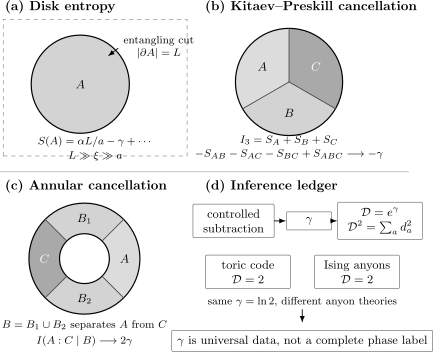
The extraction logic. A disk entropy contains a nonuniversal boundary term and a subleading constant. The Kitaev–Preskill tripartite information tends to when its local boundary contributions cancel. In the annular construction, separates from and tends to . The resulting fixes under the standard assumptions, but equal does not imply equal anyon theories.
Kitaev–Preskill Disk Subtraction
Section titled “Kitaev–Preskill Disk Subtraction”The entropy combination
Section titled “The entropy combination”Choose three adjacent regions , , and whose union is a topological disk. Every region and relevant union should have linear dimensions much larger than . Define the tripartite information
where
and similarly for the other unions.
In the standard asymptotic geometry,
Some authors define the positive quantity
Always state the sign convention. “Topological entropy” is used for both and its negative in the literature.
Why the boundary law cancels
Section titled “Why the boundary law cancels”Suppose the local contribution can be decomposed into pieces associated with interfaces and junction neighborhoods. Inclusion–exclusion assigns each local piece a net coefficient zero. For example, a segment separating from the exterior appears with the same total weight in positive and negative terms. The same is true for the corresponding smooth curvature corrections when the geometries are matched.
The topological constant behaves differently. Every nonempty simply connected region in the idealized configuration contributes . There are three positive single-region terms, three negative double-region terms, and one positive triple-region term, so
The result survives because topology does not decompose into independent local contributions along each boundary segment.
Geometric requirements
Section titled “Geometric requirements”A reliable Kitaev–Preskill calculation checks:
- Every arm and interface is thick compared with .
- The union is contractible and lies in the bulk.
- Corresponding boundary segments use the same lattice convention.
- Triple-junction and corner neighborhoods are scaled or smoothed consistently.
- No quasiparticle, defect, or physical boundary enters one entropy but not its cancellation partner.
- Region sizes are varied while preserving shape.
The cancellation is geometric, not magical. If two nominally matched boundaries cut different microscopic bonds or encounter different edge physics, their nonuniversal terms need not cancel numerically.
Levin–Wen Annular Subtraction
Section titled “Levin–Wen Annular Subtraction”Conditional mutual information
Section titled “Conditional mutual information”Let , , , and form consecutive sectors of a thick annulus, and define
Then separates from along both paths around the annulus. The conditional mutual information is
Strong subadditivity guarantees
For the standard topological annulus in the asymptotic vacuum-sector setting,
The factor of two reflects the two connected entangling boundaries of the annular geometry. An equivalent signed entropy combination tends to .
Why conditioning matters
Section titled “Why conditioning matters”In a generic short-range state, sufficiently thick and screen correlations between and . One therefore expects
as all buffer widths exceed the correlation length. A topologically ordered state retains a global charge-consistency relation around the annulus. Local data in do not erase that nonlocal constraint, leaving the topological remnant.
This is a useful interpretation, but not a universal theorem for every gapped state and every partition. The annulus must be scaled, the buffers must be thick, and spurious long-range structures must be excluded.
Relation to the original annular prescription
Section titled “Relation to the original annular prescription”The original Levin–Wen construction is often written using four region entropies chosen so that all local boundary pieces cancel. Region labels vary among sources. The conditional-information notation makes the sign and positivity transparent:
The equation is meaningful only with the annular topology shown above. An arbitrary conditional mutual information elsewhere in the sample is not automatically a topological entropy.
Exact Toric-Code Boundary Counting
Section titled “Exact Toric-Code Boundary Counting”Fixed-point structure
Section titled “Fixed-point structure”The toric-code ground state is a clean benchmark because its correlation length vanishes at the exactly solvable point and the entanglement spectrum across a simple cut is flat. The Hamiltonian, loop operators, ground sectors, and anyons are developed on Topological Order Preview. Here only the reduced-state count is needed.
Consider a simply connected bulk region . In a common lattice convention, let count independent binary boundary variables before the global topological-charge constraint is imposed. Local boundary entanglement would suggest
allowed boundary configurations. Closed-loop consistency removes one independent binary choice, leaving
At the fixed point the nonzero eigenvalues are equal:
Therefore
The first term is the boundary law. The missing one bit gives
Why one constraint is global
Section titled “Why one constraint is global”No bounded patch of the boundary owns the missing bit. It arises because the total topological charge crossing a contractible entangling loop must fuse to the vacuum when the disk contains no quasiparticle. The constraint couples boundary labels around the entire loop.
This is the microscopic version of the long-range-entanglement statement:
Changing the microscopic cut changes and the leading coefficient. It does not change the missing in the controlled large-region limit.
Rényi check at the fixed point
Section titled “Rényi check at the fixed point”Because the reduced state is flat on its support,
Hence
for every . The topological term is Rényi-index independent at this fixed point. Generic finite-size corrections need not share that independence.
Anyon Content Inside the Region
Section titled “Anyon Content Inside the Region”Charge-sector shift
Section titled “Charge-sector shift”If the disk contains a definite anyon of type , the universal constant changes. In the standard anyonic convention,
Equivalently, define the positive sector-dependent deficit
Then
For an Abelian anyon, , so the disk constant is unchanged. For a non-Abelian anyon, , and the entropy is larger than in the vacuum sector by .
The total enclosed charge is what matters
Section titled “The total enclosed charge is what matters”If several quasiparticles lie inside , the relevant label is their total fusion channel, not merely the list of particle types. If the state is a coherent superposition or classical mixture of total-charge sectors, additional Shannon and fusion-space terms can appear. One should then retain the full sector probability distribution rather than assigning a single by inspection.
This is one reason phase identification belongs to a package of observables. A measured shift can constrain quantum dimensions, but extracting fusion multiplicities and braiding requires richer data.
Connected Boundary Components
Section titled “Connected Boundary Components”The number of connected components of the entangling surface matters. A disk in the plane has one circular component. An annulus has two. A cylindrical region cut from a torus also has two.
At a simple fixed point with vacuum constraints independently associated with boundary components, one may encounter a contribution resembling
That mnemonic is useful but not a universal formula for arbitrary topology. Global charge constraints can correlate different components, and punctures, physical boundaries, defects, or nontrivial ground-state superpositions modify the answer. A reliable calculation derives the sector structure for the actual geometry.
The factor of two in
is a controlled example: the annular construction isolates two topological boundary contributions.
Direct Cylinder Extrapolation
Section titled “Direct Cylinder Extrapolation”One entangling circle
Section titled “One entangling circle”On a long or infinite cylinder of circumference , cut the system into left and right half-cylinders. There is one circular entangling boundary. For a minimally entangled state with definite anyon flux through the cylinder, the expected asymptotic form is
For a gapped phase,
as , although the approach need not be a single exponential over accessible sizes.
For Abelian order, every , so a minimally entangled sector gives
Two entangling circles
Section titled “Two entangling circles”If a torus is divided into two cylinders, the boundary has two connected circles. For a definite minimally entangled flux sector and under the simplest assumptions,
where includes both local cuts. Confusing the one-cut and two-cut geometries creates an immediate factor-of-two error.
Minimally entangled states
Section titled “Minimally entangled states”On a cylinder or torus, the ground space can contain several topological sectors. A minimally entangled state for a chosen cut is a ground-state basis vector with definite topological flux through the cycle dual to that cut. Such states make the universal constant directly interpretable in terms of .
A generic superposition
need not have the same constant. Its reduced state contains sector probabilities
and the entropy can acquire a classical contribution
together with sector-dependent quantum-dimension terms. The precise expression depends on the geometry and entropy index.
Why DMRG often helps
Section titled “Why DMRG often helps”On long cylinders, density-matrix renormalization group calculations tend to favor low-entanglement representatives of a quasi-degenerate ground space. This can select a minimally entangled sector and make the intercept method practical. It is a tendency, not an identity. Near-degenerate optimization, initialization, bond dimension, cylinder length, and boundary pinning can select or mix sectors.
One should therefore diagnose the sector using loop observables, flux insertion, boundary conditions, or repeated initializations whenever possible.
Fit model and scaling window
Section titled “Fit model and scaling window”A useful candidate fit is
The terms displayed are not mandatory or exhaustive. Their purpose is to show why a straight-line intercept from two or three small circumferences can be biased. A robust analysis:
- varies the minimum circumference included;
- compares linear and controlled correction models;
- reports covariance between slope and intercept;
- checks rather than only ;
- repeats the calculation at larger bond dimension;
- and tests more than one cylinder length or boundary termination.
For known benchmarks, the von Neumann entropy can converge accurately once the circumference is many correlation lengths, while higher Rényi entropies may retain much larger finite-size corrections. That empirical scale is a benchmark, not a universal guarantee.
Rényi Topological Terms
Section titled “Rényi Topological Terms”Definition
Section titled “Definition”For a disk or subtraction geometry, define the Rényi analogue by replacing every von Neumann entropy with . At many nonchiral topological fixed points,
is independent of .
This does not mean the full Rényi entropy is index independent. The boundary coefficient generally satisfies
for .
Fixed-point universality versus finite-size convergence
Section titled “Fixed-point universality versus finite-size convergence”Separate the asymptotic statement
from the finite-size estimate . Different Rényi indices weight the eigenvalues of differently. For , the largest eigenvalues dominate, and short-distance distortions of the entanglement spectrum can produce large intercept errors even when ordinary correlation functions appear converged.
Agreement among several values is useful evidence. Disagreement is a diagnostic of finite size, sector mixing, numerical bias, or physics beyond the assumed fixed-point class. It should not be hidden by averaging the indices.
Replica correlation length
Section titled “Replica correlation length”Rényi constructions probe replicated density matrices. The length scale governing their finite-size corrections can be much larger than the ordinary two-point correlation length. A state can therefore look short ranged to local correlators while an topological-Rényi extrapolation remains contaminated.
This motivates a conservative hierarchy:
A Numerical Evidence Workflow
Section titled “A Numerical Evidence Workflow”Step 1: establish the state class
Section titled “Step 1: establish the state class”Record:
- the Hamiltonian and boundary conditions;
- whether the state is exact, variational, DMRG, Monte Carlo, or experimentally reconstructed;
- the energy density and purity assumption;
- the estimated bulk gap and correlation length;
- the symmetry and topological sector;
- the tensor-factor or gauge-algebra convention.
Topological ground-state formulas should not be applied silently to a thermal mixed state, a critical state, or a generic excited eigenstate.
Step 2: choose a protocol before seeing the intercept
Section titled “Step 2: choose a protocol before seeing the intercept”Select one or more of:
- Kitaev–Preskill disk subtraction;
- Levin–Wen annular conditional information;
- one-cut cylinder scaling in a diagnosed minimally entangled sector;
- exact fixed-point boundary counting;
- a phase-specific information-convex or algebraic invariant.
Preselecting the geometry reduces the temptation to search many partitions and report only the one that matches an expected constant.
Step 3: build a geometric scale hierarchy
Section titled “Step 3: build a geometric scale hierarchy”For every relevant width , separation , circumference , and physical-edge distance , require a tested regime such as
The weakest inequality controls the contamination. A large outer disk does not help if one arm of the subtraction geometry is only one correlation length thick.
Step 4: retain all raw entropies
Section titled “Step 4: retain all raw entropies”Do not store only the final cancellation. For Kitaev–Preskill, retain
For the annular construction, retain
The raw terms expose broken geometric symmetries, unconverged regions, and cancellation of large nearly equal numbers.
Step 5: test exact information inequalities
Section titled “Step 5: test exact information inequalities”Numerical entropies must satisfy basic constraints within error bars. Examples include
and
For a pure global state,
A significant violation indicates numerical or bookkeeping error before any topological interpretation is attempted.
Step 6: converge the state and the entropy separately
Section titled “Step 6: converge the state and the entropy separately”Energy convergence is not enough. Increase bond dimension, sampling effort, replica number, tomography depth, or subsystem cutoff until the entropy combination itself stabilizes. Report both absolute and cancellation-amplified errors.
If
then a conservative uncorrelated error estimate is
When the entropy estimates share samples or tensors, their covariance matters:
Step 7: scale the geometry
Section titled “Step 7: scale the geometry”Repeat the extraction for a family indexed by a scale factor :
Then fit or bound the approach to a plateau. A credible result reports the drift
or an equivalent window-stability measure.
Step 8: corroborate the phase
Section titled “Step 8: corroborate the phase”Topological entanglement entropy should agree with an independent evidence packet, such as:
- a nonzero bulk gap stable with size;
- absence of conventional local order under controlled tests;
- topology-dependent low-energy sectors;
- local indistinguishability within the ground band;
- loop-operator or flux-sector data;
- entanglement-spectrum counting appropriate to the candidate phase;
- modular or response data when available.
The Topological Order Preview page owns the interpretation of that full package.
Evidence Strength
Section titled “Evidence Strength”| Observation | What it supports | What it does not establish alone |
|---|---|---|
| linear entropy versus circumference with a stable negative intercept | an area law plus a candidate constant | topological origin of the constant |
| Kitaev–Preskill plateau under geometric scaling | cancellation of local disk-boundary terms | complete anyon theory |
| annular stable for thick buffers | persistent nonlocal annular information | absence of spurious subsystem structure |
| candidate | toric code rather than Ising order | |
| sector-dependent shift | information about an anyon quantum dimension | fusion and braiding data |
| agreement of disk and cylinder protocols | strong control of geometry and fit systematics | material realization or thermal robustness |
| nonzero gap plus TEE plus loop-sector evidence | coherent intrinsic-topological-order case | every detailed field-theory parameter |
Finite-Size and Geometry Contaminants
Section titled “Finite-Size and Geometry Contaminants”Correlation-length crossover
Section titled “Correlation-length crossover”If a region width is comparable to , opposite boundary segments communicate through ordinary short-range correlations. Then the entropy is not a sum of independent local boundary terms plus a topological constant. A schematic contamination is
Near a phase transition, grows and a geometry that was adequate deep in the phase may cease to be adequate.
Corners and junctions
Section titled “Corners and junctions”Corners can contribute constants or logarithms. A subtraction cancels them only when corresponding angles and microscopic placements match. Triple junctions deserve the same care. On a lattice, rotating or translating a region can change the number and type of cut bonds even when the continuum shapes look identical.
Physical edges
Section titled “Physical edges”A physical edge can carry gapless modes, symmetry-protected modes, or a gapped boundary condition with its own topological data. If an entangling region touches that edge, the constant is a boundary topological entropy, not automatically the bulk disk value .
Aspect ratio and thin handles
Section titled “Aspect ratio and thin handles”Topological formulas assume every neck and annular thickness remains macroscopic. Sending the outer radius to infinity while keeping a fixed thin neck does not realize the intended scaling limit. Report all independent aspect ratios.
False Positives and Incomplete Invariants
Section titled “False Positives and Incomplete Invariants”Spurious cylinder intercepts
Section titled “Spurious cylinder intercepts”Short-range-entangled two-dimensional states can yield
with an apparently nonzero for over cylinder extrapolations. The effect can be controlled by a replica correlation length much larger than the ordinary correlation length. A cylinder intercept alone is therefore not a theorem of topological order.
Subsystem-symmetry contributions
Section titled “Subsystem-symmetry contributions”Special subsystem symmetries or long string-order patterns can survive Kitaev–Preskill or Levin–Wen cancellation even in short-range-entangled states. Such contributions may persist at zero ordinary correlation length. Varying the partition orientation, breaking accidental subsystem symmetries, and comparing with a circuit-invariant diagnostic can expose the problem.
Symmetry-breaking cat states
Section titled “Symmetry-breaking cat states”In a finite system, a symmetry-preserving superposition of macroscopically distinct branches can contribute an entropy to many regions. That constant reflects a shared branch label, not intrinsic topological order. Add a weak symmetry-breaking field, compare branch-selected states, and inspect a local order parameter before assigning a topological meaning.
Invertible topological phases
Section titled “Invertible topological phases”A vanishing anyonic topological entropy means
within the assumed anyon framework. It does not imply that the phase is completely trivial. Invertible phases can possess chiral response or protected boundary structure while having no nontrivial anyon sectors and hence .
Thus
Equal constants, inequivalent phases
Section titled “Equal constants, inequivalent phases”Because only determines , distinct anyon theories can share it. The toric-code and Ising examples both have . More generally, does not determine:
- the number of anyon types;
- which anyons are Abelian;
- fusion multiplicities;
- braiding phases;
- topological spins;
- modular matrices;
- chiral central charge.
A nonzero result is evidence, not a verdict
Section titled “A nonzero result is evidence, not a verdict”The logically careful statement is:
Gauge-Theory Factorization
Section titled “Gauge-Theory Factorization”Why the ordinary tensor product can fail
Section titled “Why the ordinary tensor product can fail”In a lattice gauge theory, Gauss-law constraints couple degrees of freedom across a spatial boundary. The physical Hilbert space need not factorize as
One can instead use an extended Hilbert space with edge modes, or assign an operator algebra to the region and specify its center. Different choices redistribute entropy into boundary Shannon, representation-dimension, and distillable-correlation pieces.
What remains universal
Section titled “What remains universal”Many factorization ambiguities are local to the entangling boundary. Carefully matched mutual-information or subtraction constructions can cancel them in an appropriate continuum or lattice limit. That cancellation must be shown for the chosen algebra; it should not be assumed from notation alone.
A gauge-theory result should state:
- which links or operators belong to ;
- whether an extended Hilbert space is used;
- the boundary center or edge-mode convention;
- whether superselection-sector Shannon terms are included;
- which part of the result is invariant under changing that convention.
The planned field-theory treatment will own the full algebraic and continuum analysis. The lesson here is simpler: a spatial partial trace is part of the physical definition, not a harmless implementation detail.
Temperature and Mixed States
Section titled “Temperature and Mixed States”The ground-state formula does not transfer unchanged to
A thermal state contains both quantum and classical correlations, mobile quasiparticles, and extensive entropy. Mutual-information combinations can cancel leading volume terms, but the remainder is a mixed-state diagnostic with its own order of limits.
For two-dimensional toric-code-like systems at any fixed nonzero temperature, thermally excited anyons proliferate in the thermodynamic limit and destroy the zero-temperature topological memory. Finite samples can nevertheless show crossover plateaus on length scales shorter than the thermal defect spacing. One must state whether the limit is
or the reverse. The two need not agree.
Mixed-state topological order, topological negativity, recoverability, and finite-temperature memory are separate research topics. A ground-state TEE value should not be advertised as a finite-temperature lifetime.
Critical and Gapless Systems
Section titled “Critical and Gapless Systems”At a quantum critical point, a Fermi surface, or a phase with Goldstone modes, the entropy can contain universal logarithms and geometry-dependent constants unrelated to intrinsic gapped topological order. The assumed expansion
may be incomplete.
Examples of competing terms include
corner functions, and shape-dependent universal constants. Before applying a topological subtraction, verify the bulk gap and test whether the candidate plateau survives moving away from the critical regime.
The Entanglement and Criticality page owns critical scaling, while Area Laws compares the principal violations and subleading structures.
What the Diagnostic Actually Says
Section titled “What the Diagnostic Actually Says”Positive result
Section titled “Positive result”Under the standard two-dimensional gapped-ground-state assumptions, a reproducible value
supports intrinsic long-range entanglement and constrains the total quantum dimension. Confidence rises sharply when disk subtraction, annular conditional information, sector diagnostics, and independent bulk evidence agree.
Null result
Section titled “Null result”A result consistent with zero can mean:
- a trivial short-range-entangled phase;
- an invertible topological phase with ;
- a region too small to resolve the asymptotic constant;
- cancellation failure or large statistical uncertainty;
- a sector superposition that obscures the expected intercept;
- a state outside the ordinary intrinsic-topological-order setting.
The null result narrows hypotheses; it does not settle all of them.
Quantitative mismatch
Section titled “Quantitative mismatch”If a candidate phase gives far from , do not immediately reinterpret the anyon theory. First test:
- region scale versus ;
- fit-window and correction-model drift;
- bond-dimension or sampling convergence;
- one-cut versus two-cut normalization;
- topological-sector mixing;
- boundary and corner contamination;
- Rényi-index dependence;
- spurious subsystem or replica structure.
Only after those checks should the discrepancy be treated as phase information.
Worked Example: Inclusion–Exclusion on a Disk
Section titled “Worked Example: Inclusion–Exclusion on a Disk”Assume every nonempty simply connected union in a Kitaev–Preskill geometry has
where denotes the complete local boundary functional, not merely Euclidean perimeter. Then
Geometric matching gives
Therefore
The derivation explains both the power and the limitation of the protocol. If the local functionals fail to match, the first line does not vanish. If one of the unions has different topology or charge content, its constant is not the same .
Worked Example: Toric Code Versus Ising Anyons
Section titled “Worked Example: Toric Code Versus Ising Anyons”For toric-code order,
For Ising anyons,
Thus both give
Yet the spectra of quantum dimensions differ. The Ising theory contains a non-Abelian anyon with , while all toric-code anyons are Abelian. The equal TEE is a demonstration of information loss, not an accidental numerical coincidence.
Worked Example: Anyon-Sector Shift
Section titled “Worked Example: Anyon-Sector Shift”Suppose a disk in an Ising topological phase encloses a definite charge. The vacuum-sector deficit is
For the sector,
The universal constant in is therefore less negative by
This shift diagnoses a quantum dimension only if the enclosed topological charge is known and the physical boundary convention is unchanged.
Worked Example: Fit-Window Drift
Section titled “Worked Example: Fit-Window Drift”Consider synthetic one-cut cylinder data generated by
A two-point straight-line fit using and gives approximately
The inferred topological entropy would be only , far below
Using and instead gives approximately
The later window is closer but still not exact. The example shows why a plausible straight line is not evidence of asymptotia; the intercept can drift strongly while the slope looks nearly converged.
Common Mistakes
Section titled “Common Mistakes”Calling every constant topological
Section titled “Calling every constant topological”Constants can arise from corners, boundaries, symmetry breaking, defects, gauge conventions, and finite-size corrections. “Subleading” is not synonymous with “topological.”
Losing the sign
Section titled “Losing the sign”For the disk entropy,
with . The Kitaev–Preskill tripartite information tends to , while the annular conditional mutual information tends to . Report the definition alongside the value.
Missing a factor of two
Section titled “Missing a factor of two”A half-infinite cylinder has one circular cut. A cylindrical region on a torus has two. The corresponding topological constants generally differ by a factor of two in a definite minimally entangled sector.
Ignoring the ground-state basis
Section titled “Ignoring the ground-state basis”Topological-sector superpositions can change the entropy. “A ground state” is not enough information on a nontrivial manifold; state which sector or minimally entangled basis is used.
Using only the ordinary correlation length
Section titled “Using only the ordinary correlation length”Rényi and replica constructions can converge on a longer scale. Local correlators may look asymptotic while the extracted constant is not.
Treating γ = ln 2 as a toric-code fingerprint
Section titled “Treating γ = ln 2 as a toric-code fingerprint”It fixes under the standard assumptions. It does not distinguish toric-code order from Ising anyons or every other theory with the same total quantum dimension.
Treating γ = 0 as proof of triviality
Section titled “Treating γ = 0 as proof of triviality”Invertible topological phases can have . Numerical under-resolution can also drive a nonzero value toward zero.
Mixing entropy bases
Section titled “Mixing entropy bases”If entropy is reported in bits,
If it is reported in nats,
Comparing bit with nats without conversion creates a false discrepancy.
Omitting the factorization convention
Section titled “Omitting the factorization convention”For constrained gauge systems, different regional algebras can produce different boundary entropies. State the convention before comparing constants.
Reporting only the final cancellation
Section titled “Reporting only the final cancellation”Large raw entropies can cancel to a small number. Without the raw terms, covariance, and geometry, readers cannot assess whether the result is stable or accidental.
Exercises
Section titled “Exercises”1. Kitaev–Preskill sign
Section titled “1. Kitaev–Preskill sign”Assume all seven nonempty regions in the Kitaev–Preskill construction are simply connected and each has a topological constant . Compute the topological contribution to
Solution
The three single-region terms contribute
The three double-region entropies enter with a minus sign, so their constants contribute
The triple union contributes . Therefore
The positive convention is .
2. Quantum-dimension benchmarks
Section titled “2. Quantum-dimension benchmarks”Compute and for:
- four Abelian sectors;
- Abelian sectors;
- sectors with dimensions .
Solution
For four Abelian sectors,
For Abelian sectors,
For dimensions ,
so again . The first and third answers have equal TEE but different anyon content.
3. Fibonacci charge in a disk
Section titled “3. Fibonacci charge in a disk”For Fibonacci anyons, and , where . Find the vacuum deficit , the -sector deficit , and their difference.
Solution
The total quantum dimension is
Therefore
For a definite charge,
Their difference is
Thus the entropy of the sector is larger than the vacuum-sector entropy by for the same local boundary geometry.
4. Annular positivity and normalization
Section titled “4. Annular positivity and normalization”Suppose an annular calculation gives
in nats. Under the standard Levin–Wen normalization, estimate and . Is the sign consistent with strong subadditivity?
Solution
The normalization is
Hence
and
The conditional mutual information is positive, as required by strong subadditivity. This value supports under the protocol assumptions; it does not identify the complete anyon theory.
5. One cut or two?
Section titled “5. One cut or two?”A minimally entangled Abelian sector has . Write the expected universal constant for:
- a half-infinite-cylinder bipartition with one circular cut;
- a torus partitioned into two cylinders with two circular cuts.
Solution
For one cut,
For two cuts,
where the second convention includes both local boundaries. The intercept magnitudes differ by a factor of two.
6. Fit-window bias
Section titled “6. Fit-window bias”For
perform two-point linear fits on and on . Compare the inferred values with .
Solution
The first pair gives approximately
The fitted slope is about and the intercept about , so
The later pair gives
The fitted slope is about and the intercept about , so
Both estimates are below
but the later window is much closer. A sequence of fit windows is needed to see the drift.
7. Diagnose the claim
Section titled “7. Diagnose the claim”A short-range-entangled state has zero ordinary two-point correlation length. A Rényi- cylinder fit nevertheless returns a stable-looking positive intercept over the available circumferences. Does this establish intrinsic topological order? Name three further checks.
Solution
No. A Rényi cylinder intercept can be contaminated by a replica correlation length or subsystem-symmetry structure even when ordinary two-point correlations vanish.
Useful checks include:
- repeat the calculation with the von Neumann entropy;
- enlarge the circumference and test moving fit windows;
- use Kitaev–Preskill and annular geometries;
- rotate or deform the partition;
- break accidental subsystem symmetries;
- test loop sectors, local indistinguishability, and topology-dependent ground states;
- compare with a circuit-invariant entropic diagnostic.
Agreement among independent protocols is substantially stronger than the original intercept.
8. Build an evidence packet
Section titled “8. Build an evidence packet”Design a minimal numerical evidence packet for a proposed spin liquid on a cylinder. Include at least one entanglement test, one bulk test, one sector test, and one convergence test. State what remains for a full Quantum Matter treatment.
Solution
One defensible packet is:
- Entanglement: demonstrate a stable one-cut intercept near and, if feasible, an independent disk or annular subtraction near the corresponding value.
- Bulk: extrapolate a nonzero singlet and spin gap and show that local spin and valence-bond correlations are short ranged without a hidden ordering plateau.
- Sector: prepare or diagnose distinct flux sectors using boundary conditions or loop operators, and verify that local bulk observables agree between them up to finite-size corrections.
- Convergence: increase cylinder length, circumference, bond dimension, and fit-window minimum; report entropy and correlation-length drift rather than energy convergence alone.
A full Quantum Matter treatment would still need the microscopic phase diagram, competing orders, response properties, excitation content, anyon statistics, and relation to a material or simulator platform. The TEE packet constrains intrinsic order but does not supply all of that physics.
Summary
Section titled “Summary”Topological entanglement entropy extracts universal long-distance information from spatial entropies whose leading terms are nonuniversal. In the standard vacuum-sector setting of an ordinary gapped two-dimensional intrinsic topological phase,
The Kitaev–Preskill combination gives . The annular conditional mutual information gives . A one-cut cylinder in a minimally entangled sector has an intercept , while a comparable two-cut geometry doubles the simplest contribution.
The universal number is informative but incomplete. It does not identify fusion, braiding, chirality, or even a unique anyon theory. Raw subtraction values can contain spurious nonnegative contributions, and gauge constraints, symmetry breaking, criticality, physical boundaries, thermal defects, or finite-size effects can change the interpretation.
The trustworthy use of TEE is therefore comparative and redundant: scale the geometry, converge the entropy, diagnose the sector, preserve the raw terms, test alternative protocols, and combine the result with independent bulk and topological evidence.
Further Reading and Cross-Links
Section titled “Further Reading and Cross-Links”- Topological Order Preview for the phase-level package of local indistinguishability, ground sectors, loops, and anyons.
- Topological Order for the classification package that combines with modular, fusion, ground-space, charge, and thermal data.
- Anyons and Braiding for the fusion and braid data that one entropy constant cannot reconstruct.
- Area Laws for leading boundary scaling and its exceptions.
- Entanglement Spectrum for level-resolved information beyond the single entropy constant.
- Mutual Information in Many-Body Systems for general correlation and cancellation properties.
- Matrix Product States Preview and Tensor Networks Preview for numerical state representations and truncation diagnostics.
- Quantum Phase Transitions for gap closing and finite-size drift near phase boundaries.
- Topological Invariants for the mathematical distinction between invariant data and complete classification.
- Surface Code for a compact code-family reference related to topological order.
- Condensed Matter Roadmap for the staged route into band topology and interacting topological phases.
References
Section titled “References”- A. Hamma, R. Ionicioiu, and P. Zanardi, “Bipartite Entanglement and Entropic Boundary Law in Lattice Spin Systems”, Physical Review A 71, 022315 (2005).
- A. Kitaev and J. Preskill, “Topological Entanglement Entropy”, Physical Review Letters 96, 110404 (2006).
- M. Levin and X.-G. Wen, “Detecting Topological Order in a Ground State Wave Function”, Physical Review Letters 96, 110405 (2006).
- M. A. Levin and X.-G. Wen, “String-Net Condensation: A Physical Mechanism for Topological Phases”, Physical Review B 71, 045110 (2005).
- A. Y. Kitaev, “Fault-Tolerant Quantum Computation by Anyons”, Annals of Physics 303, 2–30 (2003).
- S. Dong, E. Fradkin, R. G. Leigh, and S. Nowling, “Topological Entanglement Entropy in Chern–Simons Theories and Quantum Hall Fluids”, Journal of High Energy Physics 2008, 016 (2008).
- S. T. Flammia, A. Hamma, T. L. Hughes, and X.-G. Wen, “Topological Entanglement Rényi Entropy and Reduced Density Matrix Structure”, Physical Review Letters 103, 261601 (2009).
- S. V. Isakov, M. B. Hastings, and R. G. Melko, “Topological Entanglement Entropy of a Bose–Hubbard Spin Liquid”, Nature Physics 7, 772–775 (2011).
- Y. Zhang, T. Grover, and A. Vishwanath, “Topological Entanglement Entropy of Spin Liquids and Lattice Laughlin States”, Physical Review B 84, 075128 (2011).
- Y. Zhang, T. Grover, A. Turner, M. Oshikawa, and A. Vishwanath, “Quasiparticle Statistics and Braiding from Ground-State Entanglement”, Physical Review B 85, 235151 (2012).
- H.-C. Jiang, Z. Wang, and L. Balents, “Identifying Topological Order by Entanglement Entropy”, Nature Physics 8, 902–905 (2012).
- H.-C. Jiang, R. R. P. Singh, and L. Balents, “Accuracy of Topological Entanglement Entropy on Finite Cylinders”, Physical Review Letters 111, 107205 (2013).
- W. Donnelly, “Decomposition of Entanglement Entropy in Lattice Gauge Theory”, Physical Review D 85, 085004 (2012).
- H. Casini, M. Huerta, and J. A. Rosabal, “Remarks on Entanglement Entropy for Gauge Fields”, Physical Review D 89, 085012 (2014).
- X. Chen, Z.-C. Gu, and X.-G. Wen, “Local Unitary Transformation, Long-Range Quantum Entanglement, Wave Function Renormalization, and Topological Order”, Physical Review B 82, 155138 (2010).
- C. Castelnovo and C. Chamon, “Entanglement and Topological Entropy of the Toric Code at Finite Temperature”, Physical Review B 76, 184442 (2007).
- L. Zou and J. Haah, “Spurious Long-Range Entanglement and Replica Correlation Length”, Physical Review B 94, 075151 (2016).
- D. J. Williamson, A. Dua, and M. Cheng, “Spurious Topological Entanglement Entropy from Subsystem Symmetries”, Physical Review Letters 122, 140506 (2019).
- K. Kato and P. Naaijkens, “An Entropic Invariant for 2D Gapped Quantum Phases”, Journal of Physics A: Mathematical and Theoretical 53, 085302 (2020).
- P. Bonderson, C. Knapp, and K. Patel, “Anyonic Entanglement and Topological Entanglement Entropy”, Annals of Physics 385, 399–468 (2017).
- I. H. Kim, M. Levin, T.-C. Lin, D. Ranard, and B. Shi, “Universal Lower Bound on Topological Entanglement Entropy”, Physical Review Letters 131, 166601 (2023).
- M. Levin, “Physical Proof of the Topological Entanglement Entropy Inequality”, Physical Review B 110, 165154 (2024).
- C. Nayak, S. H. Simon, A. Stern, M. Freedman, and S. Das Sarma, “Non-Abelian Anyons and Topological Quantum Computation”, Reviews of Modern Physics 80, 1083–1159 (2008).