Mutual Information in Many-Body Systems
Quantum mutual information measures the total correlation between two declared parts of a many-body state. Let the full system be divided into disjoint regions
where may be empty. Starting from a state , form
The mutual information is
This combination answers a sharper question than either regional entropy alone:
How much of the uncertainty in and is shared rather than independent?
In a mixed thermal state, and can both be extensive even when the state has no correlations at all. Their independent bulk contributions cancel in . In a pure state split into complementary regions, by contrast, the mutual information is twice the entanglement entropy. Between separated regions it probes all correlation channels at once, including classical, quantum, symmetry-sector, constraint-induced, and long-range contributions.
That breadth is both the strength and the main caution. Nonzero mutual information does not by itself prove entanglement, identify a phase, locate a critical point, or reveal which observables carry the correlation.
Scope and Canonical Ownership
Section titled “Scope and Canonical Ownership”The general finite-system theory lives on Mutual Information. That page owns:
- the information-theoretic definition;
- the relative-entropy identity;
- nonnegativity and the product-state equality condition;
- elementary product, classically correlated, and Bell-state examples;
- conditional-entropy identities and general finite-dimensional bounds.
This page owns the many-body use of the same quantity:
- complementary, adjacent, and separated spatial geometries;
- cancellation of independent thermal and ultraviolet contributions;
- bounds relating mutual information to connected correlators;
- finite-temperature area laws and their assumptions;
- ground-state, ordered-state, critical, and constrained-sector examples;
- numerical and experimental extraction;
- finite-size, ensemble, regulator, and Rényi-index cautions.
Entanglement Entropy in Many-Body Systems remains the canonical home for entropy scaling itself. Thermal Entropy vs Entanglement Entropy owns the global-purity and thermal-mixing comparison. Connected Correlation Functions owns operator-resolved correlators. Here those objects are combined into a regional total-correlation diagnostic.
Topological Entanglement Entropy Preview owns the special annular conditional-mutual-information geometry that isolates a topological constant; an arbitrary many-body mutual information is not that invariant. The Many-Body Entanglement Glossary collects the core entropy inequalities, mixed-state cautions, and correlator bound.
Convention Ledger
Section titled “Convention Ledger”State and regions
Section titled “State and regions”Unless stated otherwise:
- is a normalized state on a finite lattice Hilbert space;
- and are disjoint sets of sites, orbitals, modes, or local degrees of freedom;
- is the environment traced out before evaluating ;
- uses natural logarithms, so information is measured in nats;
- continuum and gauge-theory statements require additional regulator and algebra choices.
The subsystem choice is physical data. A spatial region, a momentum-space block, an orbital set, and a particle partition generally produce different reduced states and different mutual informations.
Three geometries
Section titled “Three geometries”The same formula appears in three geometrically distinct settings.
| Geometry | Environment | Typical question |
|---|---|---|
| complementary cut | empty | how much total correlation crosses one cut? |
| adjacent and inside | nonempty or empty | how much correlation is localized near their shared interface? |
| separated and | nonempty buffer | how does total correlation decay with separation? |
These geometries should not be compared without matching sizes, boundaries, separation, total volume, and state preparation.
Logarithm base
Section titled “Logarithm base”Changing the logarithm base rescales every entropy and mutual information by the same constant. With base ,
is measured in bits. The descriptive subscript distinguishes this base change from a second Rényi mutual information; a superscript such as is reserved for Rényi constructions.
Core Identities for Many-Body Use
Section titled “Core Identities for Many-Body Use”Relative entropy to the product state
Section titled “Relative entropy to the product state”The central identity is
where is quantum relative entropy. Therefore
with equality exactly when
The comparison product uses the actual marginals of the state. Mutual information removes local mixedness while retaining every deviation of the joint state from independence.
Upper bounds
Section titled “Upper bounds”The Araki–Lieb inequality gives
For finite local Hilbert spaces,
These are dimension bounds, not expected scaling laws. A much smaller value can follow from locality, temperature, separation, symmetry, or the state class.
Data processing
Section titled “Data processing”Local quantum channels cannot increase mutual information. If and act independently,
In particular, discarding degrees of freedom cannot reveal more total correlation:
This monotonicity is useful when comparing single sites, small blocks, and enlarged blocks. It also explains why coarse local measurements provide lower bounds rather than exact reconstructions of the quantum mutual information.
Local-unitary invariance
Section titled “Local-unitary invariance”Independent unitary changes of basis inside the regions preserve the value:
An orbital or mode transformation that mixes with changes the partition and need not preserve it.
Pure-State Geometry
Section titled “Pure-State Geometry”Complementary regions
Section titled “Complementary regions”If the global state on is pure,
and hence
For a complementary pure-state cut, mutual information contains no independent information beyond the entanglement entropy. The factor of two matters: a single Bell pair crossing the cut contributes to and to .
Embedded regions of a pure state
Section titled “Embedded regions of a pure state”Now let be pure and trace out a nonempty . Then
so
This is generally smaller than . Correlations that either region shares with do not automatically become correlations between and .
The distinction is crucial for spatial studies. Two disjoint intervals in a pure chain have a mixed joint state because the sites between and outside them were traced out.
A Bell-pair boundary count
Section titled “A Bell-pair boundary count”Suppose the global state is a product of local states and Bell pairs, each crossing a complementary spatial cut. Then
and
The mutual information therefore obeys the same boundary count, with twice the pure-state entropy coefficient. This fixed-point example motivates an area law but does not prove one for generic interacting states.
Reading Spatial Mutual Information
Section titled “Reading Spatial Mutual Information”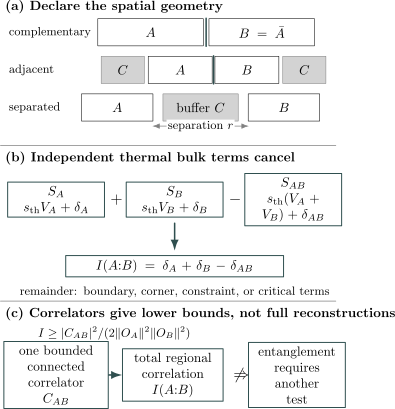
A spatial mutual-information ledger. Panel (a) distinguishes a complementary cut, adjacent embedded regions, and separated regions with a traced buffer . Panel (b) shows why extensive thermal terms cancel when the same entropy density appears in , , and . Panel (c) records the inference direction: any bounded connected correlator supplies a lower bound on , while a small set of small correlators does not by itself upper-bound the full regional mutual information.
Adjacent regions
Section titled “Adjacent regions”When and share a boundary, short-distance degrees of freedom can correlate strongly across that interface. In a short-range thermal state, the leading volume entropy cancels, leaving an interface-controlled contribution under suitable assumptions.
On a lattice the result is finite. In a continuum theory with a sharp shared boundary, the individual entropies and their combination can retain ultraviolet sensitivity. Adjacency should not be confused with the regulator-independent separated-region construction.
Separated regions
Section titled “Separated regions”Let denote the minimum distance between and . For separated regions, the buffer removes a shared ultraviolet boundary. In many gapped ground states and noncritical thermal states, decreases rapidly when
where is an appropriate correlation length. The precise upper bound and decay law require assumptions about locality, the state family, region sizes, and sometimes the phase.
At criticality, scale invariance can replace exponential decay by a power-law or cross-ratio dependence. The functional form is theory and geometry dependent; a generic power law should not be assigned a universal exponent without specifying the operator content and limiting regime.
Region size matters
Section titled “Region size matters”Two single-site regions may have weak mutual information while two larger blocks at the same separation have a substantial value because many weak channels accumulate. Report at least
along with boundary conditions and shape.
Mutual Information and Connected Correlators
Section titled “Mutual Information and Connected Correlators”A rigorous lower bound
Section titled “A rigorous lower bound”Let and be bounded operators supported in and . Define the connected correlator
Because
trace-norm duality gives
Quantum Pinsker inequality in nats states
Combining the two yields
Thus any nonzero bounded connected correlator proves nonzero mutual information. Conversely, sufficiently small mutual information forces every bounded connected correlator between the two regions to be small.
The converse does not follow from a short operator list
Section titled “The converse does not follow from a short operator list”Suppose numerical data show
for several selected pairs. This does not prove . The reduced state may contain:
- higher-order correlations;
- correlations in an unmeasured symmetry channel;
- string or loop correlations;
- a shared conserved-sector label;
- correlations distributed over many individually weak operators.
Full mutual information summarizes the entire , whereas a correlator probes one direction in operator space.
Long-range order
Section titled “Long-range order”If normalized bounded order-parameter operators retain
the lower bound prevents from vanishing at large separation. The reverse statement needs care: nonvanishing mutual information may come from a global constraint, a finite-volume cat state, or another channel rather than the proposed order parameter.
Thermal States
Section titled “Thermal States”Infinite temperature
Section titled “Infinite temperature”For an unconstrained lattice with local Hilbert-space dimensions and , the infinite-temperature state factorizes:
Although
the joint entropy is their sum, and
This is the cleanest demonstration that extensive local entropy is not correlation and not entanglement.
Cancellation of the bulk thermal term
Section titled “Cancellation of the bulk thermal term”In a regular homogeneous thermal phase, suppose
Then
The volume term cancels exactly. The remainder may contain interface, corner, finite-size, conservation-law, critical, or long-range-interaction contributions.
The cancellation is algebraic, but extracting the small remainder numerically can be difficult because it subtracts three much larger quantities.
Gibbs-state area bound
Section titled “Gibbs-state area bound”Let
with a local decomposition
where contains interactions crossing the cut. The product has the same expectations of and as .
The Gibbs variational principle therefore implies
Using the operator norm,
For bounded finite-range interactions with
one obtains
This is a thermal area-law upper bound. It is rigorous under the stated finite-dimensional, bounded-interaction setup, but it can be loose, especially at low temperature where the explicit factor grows.
Area Laws develops the broader theorem ledger and boundary conventions.
Exact Ising-dimer example
Section titled “Exact Ising-dimer example”Consider two spins with
The Gibbs state is diagonal and separable. Both one-spin marginals are maximally mixed, while the joint probabilities favor aligned outcomes. Its mutual information is
At high temperature,
At zero temperature approached through the Gibbs state,
The limiting state is the classical mixture of the two aligned configurations. The nonzero result is one shared classical bit, not entanglement.
Thermal entanglement is a separate question
Section titled “Thermal entanglement is a separate question”An interacting Gibbs state can be entangled at nonzero temperature. Mutual information then combines the quantum contribution with all classical and thermal correlations. To isolate entanglement, use a measure or witness appropriate to the bipartition, such as negativity and the PPT criterion where applicable.
The implication is one-way:
but
does not distinguish separable from entangled states.
Constraints and Ensembles
Section titled “Constraints and Ensembles”Fixed charges create correlations
Section titled “Fixed charges create correlations”The phrase “infinite temperature” is incomplete without the ensemble. The maximally mixed state on the full tensor-product Hilbert space factorizes. The maximally mixed state inside a fixed total-charge sector generally does not.
Consider one particle uniformly mixed over sites:
Partition the lattice into and sites. Region is either empty or contains the particle. Its entropy is
where
Similarly,
while
The mutual information is therefore
At , the fixed-number constraint contributes . This is not an interaction-generated correlation; it is the shared information that if the particle is in one region it is absent from the other.
Canonical versus grand-canonical comparisons
Section titled “Canonical versus grand-canonical comparisons”At finite size, global conservation can produce or slowly decaying contributions absent from an unconstrained ensemble. A reliable comparison records:
- whether total charge, magnetization, momentum, or parity is fixed;
- whether the reduced state retains block labels;
- whether the same ensemble is used at every size;
- which limit is taken before the subsystem fraction is fixed.
Ensemble Equivalence explains when local thermodynamic predictions converge and why information measures can remain sensitive to global constraints at finite size.
Ordered, Critical, and Topological Regimes
Section titled “Ordered, Critical, and Topological Regimes”Finite-volume cat states
Section titled “Finite-volume cat states”For the -spin GHZ state
every nonempty proper region has entropy . If nonempty disjoint and do not cover the whole system,
and
After tracing , the coherence between the two global branches is lost, but the shared branch label remains. For a complementary cut,
This difference is a geometry effect, not a contradiction.
In a symmetry-broken phase, a finite-volume symmetric cat state and a phase-selected thermodynamic state can therefore have different long-distance mutual information. State preparation and order of limits must be declared.
Critical scaling
Section titled “Critical scaling”At a continuous transition, long-distance correlations can make block mutual information scale nonanalytically with region size, separation, temperature, or a conformal cross-ratio. This makes mutual information useful for finite-size scaling.
It does not make the location of a maximum universal. Classical and quantum studies show that peaks, crossings, cusps, and subleading singularities depend on:
- the chosen regions;
- whether von Neumann or Rényi quantities are used;
- boundary and corner geometry;
- subsystem fraction;
- analytic background terms;
- finite-size corrections.
A trustworthy critical analysis uses a scaling ansatz and several sizes. It does not identify a transition from one peak alone. Detailed critical entanglement scaling belongs to the later chapter page on entanglement and criticality and to Quantum Phase Transitions.
Topological phases
Section titled “Topological phases”Mutual information can enter subtraction schemes that cancel local boundary terms, and separated-region patterns can help reveal nonlocal organization. A single value of is nevertheless not a topological invariant. Classical constraints, symmetry breaking, gauge constraints, and ordinary long-range correlations can all produce nonlocal mutual information.
Topological Order Preview owns the phase-specific package of local indistinguishability, global sectors, loop algebra, anyons, and topological entropy.
Continuum and Gauge-Theory Cautions
Section titled “Continuum and Gauge-Theory Cautions”Positive separation
Section titled “Positive separation”For sharply separated continuum regions,
the local ultraviolet divergences in , , and cancel under standard assumptions. Mutual information can then define a finite, regulator-independent correlation quantity.
This statement is not automatic when the regions touch. As the separation tends to zero, short-distance correlations can make the mutual information diverge.
Algebra choice
Section titled “Algebra choice”Gauge constraints can obstruct a naive tensor factorization of the physical Hilbert space. Different choices of regional operator algebra, centers, edge modes, or extended Hilbert space can alter entropy assignments. State the algebraic prescription before comparing values.
The dedicated Entanglement in QFT Preview develops these issues without importing continuum formulas into a lattice calculation by analogy alone.
Dynamics and Locality
Section titled “Dynamics and Locality”Suppose and are initially weakly correlated and evolve under a local Hamiltonian. Lieb–Robinson locality limits how quickly operators and correlations can propagate. Before the effective light cones from the two regions overlap, mutual information growth is correspondingly constrained, with details depending on the initial correlations and interaction range.
The schematic causal condition is
where is the separation and is a Lieb–Robinson velocity. This is not generally an exact zero-correlation cone: exponentially small tails, pre-existing correlations, long-range interactions, and conservation-law effects matter.
Use the Lieb–Robinson Bound for the theorem and hypothesis ledger. Operator Entanglement and Scrambling Preview owns operator Schmidt measures, OTOC distinctions, and channel-level information delocalization.
Numerical and Experimental Extraction
Section titled “Numerical and Experimental Extraction”Exact diagonalization
Section titled “Exact diagonalization”For a state represented explicitly:
- trace out to obtain ;
- trace and to obtain and ;
- diagonalize all three reduced operators;
- compute their entropies with one logarithm convention;
- form only after checking normalization and positivity.
The Hilbert-space cost grows exponentially with . Exploit exact symmetries without dropping sector probabilities from the entropy.
Matrix-product states and operators
Section titled “Matrix-product states and operators”For a pure MPS and one contiguous complementary cut, follows from the bond Schmidt values. For disjoint regions or a mixed matrix-product operator, one needs the reduced operator on as well as its marginals.
Convergence should be tested against:
- bond dimension;
- discarded weight;
- system size and boundary conditions;
- region size and separation;
- purification or operator-space truncation at finite temperature.
An entropy that appears converged does not guarantee that the smaller difference is converged.
Quantum Monte Carlo and replicas
Section titled “Quantum Monte Carlo and replicas”Replica or swap-operator methods naturally estimate integer-order Rényi entropies. One may form a quantity such as
This is experimentally and numerically useful, but it is not the von Neumann mutual information. For Rényi index , several inequivalent generalizations exist, and the simple entropy combination need not inherit every property of , including the same data-processing and positivity guarantees in full generality.
Report the definition, replica geometry, estimator, and normalization rather than writing an unqualified .
Two-copy and randomized measurements
Section titled “Two-copy and randomized measurements”Interference between two copies can measure purities and second Rényi entropies. Randomized measurements provide another route to moments of reduced density operators. Both can construct Rényi correlation diagnostics for selected regions.
Experimental claims should report:
- which Rényi index was measured;
- state-preparation and detection errors;
- symmetry or postselection constraints;
- statistical covariance among the three entropy estimates;
- whether the inferred quantity is total correlation or an entanglement witness.
Subtraction error
Section titled “Subtraction error”Suppose estimates obey
Then
If the errors are independent with standard deviations ,
If they are correlated, covariance terms must be retained. Because may be an area-sized remainder of volume-sized entropies, absolute rather than relative entropy errors control reliability.
A Reliable Many-Body Workflow
Section titled “A Reliable Many-Body Workflow”Step 1: declare the state
Section titled “Step 1: declare the state”Record:
- pure, mixed, thermal, eigenstate, quench, or open-system state;
- Hamiltonian parameters and temperature;
- fixed symmetry sector or ensemble;
- normalization and numerical representation.
Step 2: draw the regions
Section titled “Step 2: draw the regions”Specify:
Record region sizes, shapes, separation, shared interfaces, total size, and boundary conditions.
Step 3: name the information quantity
Section titled “Step 3: name the information quantity”Distinguish:
- von Neumann mutual information;
- a declared Rényi entropy combination;
- classical mutual information after measurement;
- conditional or multipartite information;
- an entanglement measure such as negativity.
Step 4: compute a ledger, not one number
Section titled “Step 4: compute a ledger, not one number”Retain
The three inputs reveal cancellations, symmetry inconsistencies, and numerical pathologies hidden by the final difference.
Step 5: test exact constraints
Section titled “Step 5: test exact constraints”At minimum check:
and, for a pure complementary cut,
Small negative numerical values are error diagnostics, not negative physical mutual information.
Step 6: vary geometry and scale
Section titled “Step 6: vary geometry and scale”Change region size, separation, total size, fit window, and boundary conditions. For thermal states, vary . For tensor networks, vary bond dimension. For Monte Carlo, vary estimator and sampling effort.
Step 7: compare independent observables
Section titled “Step 7: compare independent observables”Use connected correlators to identify channels carrying some of the correlation. Use an entanglement witness or negativity before claiming quantum entanglement. Use order parameters, response, gaps, or topological diagnostics before assigning a phase.
Common Mistakes
Section titled “Common Mistakes”- Calling mutual information an entanglement measure for an arbitrary mixed state.
- Forgetting that assumes a pure global state and complementary regions.
- Omitting the environment for two embedded or separated regions.
- Comparing single-site and block mutual information as though region size were irrelevant.
- Treating one vanishing connected correlator as proof that .
- Treating one nonzero correlator or nonzero mutual information as proof of entanglement.
- Assuming the maximum of mutual information must occur at a critical point.
- Ignoring fixed-charge or postselection correlations at high temperature.
- Calling a second Rényi entropy combination the von Neumann mutual information.
- Subtracting three extensive noisy entropies without propagating covariance.
- Claiming regulator independence for adjacent continuum regions.
- Inferring topological order from one long-range mutual-information value.
- Mixing natural-log and base- conventions.
- Reporting a scaling law without region geometry, ensemble, and limit order.
Exercises
Section titled “Exercises”1. Pure complementary cut
Section titled “1. Pure complementary cut”Let be pure. Derive and evaluate the mutual information for one Bell pair using natural logarithms.
Solution
Purity gives
and equality of the reduced spectra gives
Therefore
For one Bell pair,
so
Hence
2. Classical Ising dimer
Section titled “2. Classical Ising dimer”For
derive
Explain why the result does not certify entanglement.
Solution
The partition function is
Each one-spin marginal is , so
The thermal entropy satisfies
Since
we obtain
Therefore
The Gibbs state is diagonal in a product basis and is a classical mixture of product states. Its mutual information measures classical alignment correlation, not entanglement.
3. Correlator lower bound
Section titled “3. Correlator lower bound”Two normalized observables satisfy
and have connected correlator magnitude . What lower bound on follows in nats?
Solution
The Pinsker-based bound gives
Thus
This is only a lower bound. Other operator channels may carry additional correlation.
4. GHZ region geometry
Section titled “4. GHZ region geometry”For , compare:
- two nonempty disjoint regions and with a nonempty environment ;
- a complementary cut .
Solution
Every nonempty proper region has reduced state
so .
With nonempty , the union is also a proper region. Hence
For a complementary cut, the global state on is pure, so and
Tracing the environment removes the global coherence from while retaining one shared classical branch label.
5. Thermal boundary bound
Section titled “5. Thermal boundary bound”Suppose is a sum of terms, each with norm at most . Derive a thermal mutual-information bound.
Solution
The triangle inequality gives
Insert this into the Gibbs-state bound:
For finite-range lattice interactions, scales with the number of interaction edges crossing the boundary. The result is an area-law upper bound, not an equality or a prediction of the coefficient.
6. One-particle sector
Section titled “6. One-particle sector”For the uniformly mixed one-particle state on sites, show directly that a spatial partition with fraction has
What does the result become at ?
Solution
The reduced state on has vacuum probability and one-particle eigenvalues equal to . Therefore
Using ,
Similarly,
The full state has equal eigenvalues, so . Substitution and , give
At half partition,
The value records perfect anticorrelation of the regional particle-number indicators.
7. Subtraction uncertainty
Section titled “7. Subtraction uncertainty”Three independently estimated entropies have standard deviations
Find the standard deviation of the mutual-information estimator. Why would the answer change for correlated estimates?
Solution
For independent errors,
If the estimates share samples, replicas, or calibration parameters, their errors have nonzero covariance. Then
contains cross terms whose signs depend on the subtraction. Ignoring them can either overestimate or underestimate the uncertainty.
8. Audit an entanglement claim
Section titled “8. Audit an entanglement claim”A finite-temperature simulation reports between adjacent regions and concludes that the Gibbs state is entangled across the cut. Is the conclusion justified? State a stronger analysis.
Solution
No. Positive mutual information proves that the joint state is not a product, but the correlation may be entirely classical. The Ising-dimer Gibbs state is an explicit counterexample.
A stronger analysis should:
- retain the mutual information as a total-correlation diagnostic;
- evaluate a mixed-state entanglement witness or measure appropriate to the dimensions and bipartition, such as negativity;
- test temperature, size, geometry, and numerical convergence;
- separate symmetry-sector and global-constraint contributions;
- avoid inferring a phase from one finite geometry.
Summary
Section titled “Summary”Quantum mutual information is the relative-entropy distance from a regional joint state to the product of its marginals. It is nonnegative, vanishes exactly for an uncorrelated product state, decreases under local information loss, and bounds every bounded connected correlator between the regions.
Its many-body meaning depends on geometry. For a pure complementary cut, . For embedded or separated regions, the environment makes mixed and the mutual information measures only the correlations shared by those declared regions. At finite temperature it cancels independent bulk entropy and, for bounded finite-range interactions, obeys a boundary-controlled upper bound.
The quantity measures total correlation, not entanglement alone. Classical order, quantum entanglement, conserved charges, finite-volume cat states, topological structure, and ordinary thermal correlations can all contribute. Critical peaks and long-range values therefore require finite-size scaling and independent physical diagnostics.
Reliable calculations retain the three-entropy ledger, declare the ensemble and region geometry, distinguish von Neumann from Rényi constructions, propagate subtraction errors, and compare with operator-resolved correlators and genuine entanglement tests.
References
Section titled “References”- B. Groisman, S. Popescu, and A. Winter, “Quantum, Classical, and Total Amount of Correlations in a Quantum State”, Physical Review A 72, 032317 (2005).
- H. Casini, “Mutual Information Challenges Entropy Bounds”, Classical and Quantum Gravity 24, 1293–1302 (2007).
- M. M. Wolf, F. Verstraete, M. B. Hastings, and J. I. Cirac, “Area Laws in Quantum Systems: Mutual Information and Correlations”, Physical Review Letters 100, 070502 (2008).
- H. Casini and M. Huerta, “Remarks on the Entanglement Entropy for Disconnected Regions”, Journal of High Energy Physics 2009, 048 (2009).
- M. B. Hastings, I. González, A. B. Kallin, and R. G. Melko, “Measuring Rényi Entanglement Entropy in Quantum Monte Carlo Simulations”, Physical Review Letters 104, 157201 (2010).
- R. G. Melko, A. B. Kallin, and M. B. Hastings, “Finite-Size Scaling of Mutual Information in Monte Carlo Simulations: Application to the Spin-1/2 XXZ Model”, Physical Review B 82, 100409(R) (2010).
- R. R. P. Singh, M. B. Hastings, A. B. Kallin, and R. G. Melko, “Finite-Temperature Critical Behavior of Mutual Information”, Physical Review Letters 106, 135701 (2011).
- J. Wilms, M. Troyer, and F. Verstraete, “Mutual Information in Classical Spin Models”, Journal of Statistical Mechanics P10011 (2011).
- S. Humeniuk and T. Roscilde, “Quantum Monte Carlo Calculation of Entanglement Rényi Entropies for Generic Quantum Systems”, Physical Review B 86, 235116 (2012).
- J. Iaconis, S. Inglis, A. B. Kallin, and R. G. Melko, “Detecting Classical Phase Transitions with Rényi Mutual Information”, Physical Review B 87, 195134 (2013).
- L. Bonnes, H. Pichler, and A. M. Läuchli, “Entropy Perspective on the Thermal Crossover in a Fermionic Hubbard Chain”, Physical Review B 88, 155103 (2013).
- H. Bernigau, M. J. Kastoryano, and J. Eisert, “Mutual Information Area Laws for Thermal Free Fermions”, Journal of Statistical Mechanics P02008 (2015).
- R. Islam et al., “Measuring Entanglement Entropy in a Quantum Many-Body System”, Nature 528, 77–83 (2015).
- N. Laflorencie, “Quantum Entanglement in Condensed Matter Systems”, Physics Reports 646, 1–59 (2016).
- A. Elben, B. Vermersch, M. Dalmonte, J. I. Cirac, and P. Zoller, “Rényi Entropies from Random Quenches in Atomic Hubbard and Spin Models”, Physical Review Letters 120, 050406 (2018).
- L. Lepori, S. Paganelli, F. Franchini, and A. Trombettoni, “Mutual Information for Fermionic Systems”, Physical Review Research 4, 033212 (2022).
Cross-Links
Section titled “Cross-Links”- Mutual Information — canonical finite-system definition, relative-entropy identity, and elementary examples.
- Many-Body Entanglement Overview — subsystem, state-class, information-object, and scaling workflow.
- Entanglement Entropy in Many-Body Systems — spatial entropy scaling and continuum cautions.
- Entanglement and Criticality — conformal interval laws, central-charge extraction, and finite-size correction controls.
- Thermal Entropy vs Entanglement Entropy — purity, thermal mixing, and subsystem-ETH distinctions.
- Area Laws — boundary conventions and thermal mutual-information bounds.
- Volume Laws — extensive entropy mechanisms and constraint cautions.
- Entanglement Spectrum — reduced-state eigenvalue structure beyond scalar entropies.
- Connected Correlation Functions — operator-resolved correlation channels and clustering.
- Correlation Functions Overview — static, dynamic, connected, and response-function map.
- Entropy in Quantum Statistical Mechanics — thermodynamic, von Neumann, and ensemble entropy.
- Thermal Density Operators — Gibbs-state construction and limits.
- Ensemble Equivalence — local equivalence and finite-size global constraints.
- Quantum Phase Transitions — scaling hypotheses and finite-size diagnostics.
- Topological Order Preview — nonlocal phase evidence beyond one correlation measure.
- Negativity and the PPT Criterion — mixed-state entanglement diagnostic.
- Entanglement in QFT Preview — separated regions, local algebras, and ultraviolet structure.
- Lieb–Robinson Bound — locality and effective light-cone control.