Anyons and Braiding
An anyon is a pointlike topological excitation in two spatial dimensions whose adiabatic exchanges realize a unitary representation of the braid group rather than only the bosonic or fermionic representations of the permutation group. For Abelian anyons, a braid multiplies the state by a phase. For non-Abelian anyons, braids act as matrices on a protected fusion space, and different braid sequences can fail to commute.
The word anyon describes exchange topology and superselection data, not a new elementary-particle species in vacuum. In quantum matter, anyons are emergent quasiparticles of a two-dimensional topologically ordered phase, defects carrying analogous protected zero modes, or controlled excitations in an engineered code Hamiltonian. The platform and status must always be stated.
This page owns the operational anyon language: configuration-space topology, braid-group representations, fusion spaces, - and -moves, adiabatic transport, and Abelian and non-Abelian examples. Topological Quantum Computation Bridge owns the protection stack, material-versus-programmed platform comparison, and dated computation-status ledger. Topological Qubits owns complete hardware modules, parity and fusion readout, controller resources, metrics, and scaling evidence. Topological Order Preview owns the general phase-diagnostic package and toric-code derivation. Fractional Quantum Hall Effect owns phase-specific charge, interferometry, collider, edge, and materials evidence.
Required background. Symmetrization Postulate supplies the boson–fermion exchange baseline, and Topological Order Preview supplies the phase, excitation, and superselection framework.
Helpful background. Symmetric Group supplies the permutation comparison, Fractional Quantum Hall Effect supplies a material anyon realization, and the Adiabatic Theorem supplies the controlled-transport conditions used in braiding arguments.
Statistics in Two Dimensions
Section titled “Statistics in Two Dimensions”Ordered and unordered configuration spaces
Section titled “Ordered and unordered configuration spaces”For point particles moving on a spatial manifold , remove collisions from the ordered configuration space:
For identical particles, configurations related by relabeling represent the same physical arrangement. The unordered configuration space is
A closed path in can exchange particles even though it returns to the same unordered configuration. Paths that can be continuously deformed into one another without collisions belong to the same homotopy class. Quantum transport around such loops may act on the state by a unitary representation of
For the plane,
the braid group. The ordered space instead gives the pure braid group, in which every labeled worldline returns to its original endpoint.
Why the plane is special
Section titled “Why the plane is special”In three spatial dimensions, one worldline can pass around another using the extra direction, and an exchange followed by the same exchange can be contracted. For ordinary point particles this reduces the topology to the permutation group. In two dimensions, clockwise and counterclockwise exchanges are distinct, and a double exchange winds one particle around another.
The braid group is generated by , the counterclockwise exchange of adjacent particles and , with
and
The first relation says that well-separated exchanges commute. The second says that two ways of moving three adjacent strands produce the same braid. Crucially, does not impose
Adding that relation turns the braid group into the symmetric group . Anyonic statistics live in precisely the information discarded by that quotient.
One spatial dimension is different again: point particles cannot pass without collision unless an interaction, boundary condition, internal path, or lattice process supplies additional structure. Calling every one-dimensional exchange phase “anyon statistics” without specifying that structure is too loose.
Statistics as holonomy
Section titled “Statistics as holonomy”Suppose a gapped family of Hamiltonians depends smoothly on quasiparticle positions and has a low-energy subspace spanned by . Adiabatic transport along a loop gives the Wilczek–Zee holonomy
with matrix-valued connection
In a topological limit, the physically relevant part depends only on the braid class , up to a common phase and corrections that vanish as quasiparticles separate and the protocol becomes adiabatic. This is a non-Abelian geometric phase when the transported subspace has dimension greater than one. Holonomy owns the general geometric construction.
Topological Charge and Fusion
Section titled “Topological Charge and Fusion”An anyon type labels a topological superselection sector. A local operator cannot change the total topological charge in a region unless compensating charge crosses the boundary or another excitation is created. The vacuum sector is , and every has an antiparticle with
When anyons and are brought together, their total charge can lie in several channels:
The nonnegative integer is the dimension of the elementary fusion space
For more anyons, a fusion tree chooses an order in which charges are combined. Different trees are bases of the same physical space, related by unitary -moves. For three incoming charges fusing to ,
The intermediate labels and are not generally local observables. They encode nonlocal fusion information shared by separated anyons.
The quantum dimensions satisfy
For identical anyons of type , the fusion-space dimension grows asymptotically like , subject to the fixed total charge. Abelian anyons have . A non-Abelian anyon in a unitary topological phase has
A merely accidental degeneracy does not make an anyon non-Abelian. The fusion space must be topologically organized and braid operations must act on it noncommutatively.
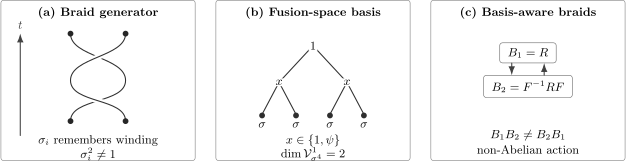
The operational ledger. A planar exchange is a braid generator with ; four Ising anyons with total vacuum have a two-dimensional basis labeled by ; and adjacent braid generators act as and in that chosen fusion-tree convention.
Abelian Anyons
Section titled “Abelian Anyons”A one-dimensional unitary representation of maps every generator to the same phase:
The braid relation forces the phases for neighboring generators to agree. Bosons and fermions are the special cases
Other values describe Abelian anyons. “Abelian” means every braid acts by a scalar on the relevant state space; it does not mean the phase is small or physically trivial.
Exchange, full braid, and spin
Section titled “Exchange, full braid, and spin”Keep three operations separate:
- exchanges and in fusion channel .
- takes one anyon fully around the other.
- rotates one anyon by and is its topological spin phase.
They obey the ribbon identity
For identical Abelian anyons in a unique fusion channel, a full braid is the square of the exchange amplitude. For distinguishable anyon types, a single exchange swaps the ordered labels and need not be a scalar operation on the original basis; the closed full braid is usually the cleaner observable.
Topological spin is related to exchange statistics but is not ordinary microscopic spin angular momentum. A fractional Hall quasiparticle can have a fractional topological spin even though the underlying electrons are spin- fermions.
Toric-code mutual statistics
Section titled “Toric-code mutual statistics”The toric-code sectors obey
The and anyons each have bosonic self-statistics in the conventional model, yet a full braid of around contributes
Their mutual statistics are nontrivial even though every sector is Abelian. The composite is a fermion. Topological Order Preview derives these statements from crossing string operators.
Non-Abelian Anyons
Section titled “Non-Abelian Anyons”For non-Abelian anyons, braiding gives a matrix representation
where is a multi-anyon fusion space. Two braid words can obey
This is the meaning of non-Abelian statistics. It has nothing to do with a non-Abelian microscopic spin-rotation or gauge symmetry.
Ising anyons
Section titled “Ising anyons”The Ising theory has charges
with fusion
Because two anyons have two possible fusion outcomes,
Four anyons constrained to total charge span a two-dimensional space. In the basis where the first pair fuses to , a common gauge choice is
and
The first adjacent braid is diagonal:
To braid a pair that is not diagonal in this fusion basis, change basis, apply , and change back:
Then . Individual matrix entries depend on fusion-tree and gauge conventions; probabilities for a complete preparation, braid, and fusion-measurement protocol do not.
Fibonacci anyons
Section titled “Fibonacci anyons”The Fibonacci theory contains and with
Its nontrivial quantum dimension is the golden ratio,
Ising versus Fibonacci braid universality
Section titled “Ising versus Fibonacci braid universality”Fibonacci braid representations can approximate arbitrary unitaries on suitable encoded spaces. By contrast, braiding ordinary Ising anyons generates protected Clifford operations but not a universal gate set by itself. Non-Abelian does not automatically mean computationally universal.
Braiding Operations
Section titled “Braiding Operations”A physical braid protocol
Section titled “A physical braid protocol”An ideal adiabatic protocol has four stages:
- prepare a definite total topological charge and a separated set of anyons;
- move them along worldlines without collisions or uncontrolled pair creation;
- return to the original spatial arrangement after a chosen braid word;
- fuse or interferometrically measure a basis-sensitive outcome.
Let be the bulk excitation gap, the residual splitting within the nominal fusion space, a quasiparticle-poisoning time, and a coherence time. A useful operating window is
The left inequality suppresses transitions out of the low-energy subspace. The right inequalities prevent the system from resolving unwanted fusion-space splittings or suffering an uncontrolled topological-charge event during the operation. A viable platform needs a parametrically nonempty window, not merely a formal braid diagram.
The realized operation has the schematic form
where is a separation scale, a correlation length, and contains common dynamical or geometric phases. Topological protection controls the projective braid action; it does not guarantee that every global phase, timing error, measurement, or leakage process is irrelevant.
Path independence and its limits
Section titled “Path independence and its limits”Two trajectories implement the same topological operation when their worldlines can be smoothly deformed into one another while:
- preserving endpoints and braid orientation;
- avoiding quasiparticle collisions;
- avoiding boundaries or defects that change the topology;
- keeping the bulk gap open;
- preserving the set of topological charges.
Path independence does not mean spatial control can be crude. Moving too quickly causes nonadiabatic leakage; moving too close creates exponentially larger splittings; moving around an unintended quasiparticle changes the braid class; and long-range electromagnetic phases can retain geometric dependence.
Creating and measuring anyons
Section titled “Creating and measuring anyons”Local operations create total-vacuum combinations such as pairs. Fusion measurement brings charges together or couples their total channel to an interferometer, resonator, charge sensor, parity detector, or boundary. A measured fusion probability depends on preparation, braid, readout model, and detector fidelity.
A braid matrix is basis dependent. An experimental claim should therefore specify:
- the encoded fusion basis;
- the braid word and orientation;
- the preparation channel;
- the final fusion or interference observable;
- the expected outcome distribution;
- controls excluding ordinary dynamical and Aharonov–Bohm phases.
Quantum Hall Examples
Section titled “Quantum Hall Examples”Laughlin anyons
Section titled “Laughlin anyons”For the Laughlin phase, topological charges can be labeled by
Fusion is addition modulo :
The charge, exchange phase, and full mutual braid are
and
up to orientation and charge-sign conventions. Every sector has quantum dimension one, so these anyons are Abelian. The fractional Hall page owns the flux-insertion derivation and experimental evidence ladder.
Candidate non-Abelian Hall states
Section titled “Candidate non-Abelian Hall states”The Moore–Read construction supports Ising-type anyons and motivates candidate orders at even-denominator filling. Read–Rezayi constructions support richer parafermionic and Fibonacci-like sectors. These are mathematically established model phases.
Their realization in a particular material is a separate empirical question. At , Pfaffian, anti-Pfaffian, particle–hole-symmetric, disorder-dominated, and reconstructed-edge scenarios can share the same electrical Hall coefficient. Thermal transport, neutral modes, interferometry, quasiparticle charge, and controlled fusion-sensitive operations must be interpreted together. As of this review, evidence for non-Abelian order is active and platform dependent rather than a license to treat one braid model as universally settled.
Abelian statistics experiments
Section titled “Abelian statistics experiments”At Laughlin and Jain fillings, interferometers, quasiparticle partitioning, and collider correlations probe phases or correlations sensitive to Abelian statistics. Recent devices have improved control of charging and enclosed quasiparticle number. The strongest inference comes from agreement among fractional charge, phase evolution, topology-aware device modeling, and control fillings.
An observed phase slip is not automatically a braid phase. Edge displacement, Coulomb charging, changing interferometer area, neutral modes, and slow bulk quasiparticle motion can contribute. Fractional Quantum Hall Effect gives the canonical experiment-by-experiment inference limits.
Topological Quantum Computation
Section titled “Topological Quantum Computation”Non-Abelian anyons provide a hardware-level encoding idea:
Information is nonlocal because no sufficiently small local measurement can determine the total fusion channel of well-separated anyons. Smooth local perturbations therefore have exponentially weak matrix elements within the ideal code space. This protection is partial: thermal quasiparticles can alter the braid word, finite separation splits the fusion space, nonadiabatic motion causes leakage, and initialization and readout require additional engineering.
Four Ising anyons with fixed total vacuum can encode one qubit, but Ising braiding alone supplies only Clifford gates. Fibonacci anyons are braid-universal in principle. Neither algebraic fact establishes a scalable hardware platform.
Topological Quantum Computation consumes the declared fusion rules and / data to own the total-charge encoding, executable braid/fusion/measurement program, induced projective logical channel, native alphabet and non-braid completion, leakage, verification, and resource record. Topological Quantum Computation Bridge retains the protection hierarchy, material and programmed-platform comparison, and dated evidence ledger. Topological Codes owns the common defect, string, homology, and syndrome dictionary for active codes, while Surface Code retains the concrete stabilizer-patch realization, repeated extraction, decoding, and threshold language.
Evidence and Status
Section titled “Evidence and Status”| Claim | Required evidence | Insufficient by itself |
|---|---|---|
| fractionalization | quantized response plus charge- or sector-sensitive probe | a rational-looking feature |
| Abelian anyonic statistics | braid-sensitive phase or correlation with electromagnetic and charging controls | fractional charge alone |
| non-Abelian fusion | multiple protected fusion channels and reproducible channel probabilities | ordinary level degeneracy |
| non-Abelian braiding | noncommuting, fusion-basis-sensitive operations with braid-word controls | one path-independent scalar phase |
| intrinsic material anyons | excitations of a gapped many-body phase with convergent bulk, edge, and operation evidence | a programmed simulator |
Established: braid-group kinematics, unitary anyon models, Abelian Laughlin quasiparticles, and engineered toric-code braid demonstrations.
Active: increasingly controlled Abelian Hall interferometry and collider experiments, including device-dependent interpretation of higher Jain fractions.
Active and controversial: identifying a specific non-Abelian order in even-denominator Hall platforms and separating intrinsic braid data from edge equilibration, disorder, and electrostatics.
Conjectural engineering program: scalable creation, motion, fusion readout, and universal logical computation with intrinsic non-Abelian anyons.
Common Mistakes
Section titled “Common Mistakes”- Saying that anyons are particles with arbitrary ordinary spin.
- Treating a braid as merely a permutation of endpoint labels.
- Imposing and then claiming to retain anyonic winding.
- Calling a full braid and one exchange the same operation.
- Assigning an exchange phase to distinguishable anyons without tracking the swapped basis.
- Assuming fractional charge implies fractional statistics.
- Assuming non-Abelian means a microscopic non-Abelian symmetry.
- Treating every degenerate subspace as a protected fusion space.
- Quoting and matrices without a fusion-tree and gauge convention.
- Assuming all non-Abelian anyons are universal for quantum computation.
- Calling a quantum simulation of a code Hamiltonian evidence for intrinsic material anyons.
- Ignoring finite temperature, quasiparticle poisoning, boundaries, and readout.
Exercises
Section titled “Exercises”1. From braids to permutations
Section titled “1. From braids to permutations”Show that imposing on the braid-group presentation produces the adjacent-transposition presentation of . What topological information is lost?
Solution
The adjacent transpositions obey
and
These are the braid relations plus . The quotient map sends to and remembers only the endpoint permutation. It discards winding, exchange orientation, and the distinction between two braids with the same final permutation.
2. One-dimensional braid representations
Section titled “2. One-dimensional braid representations”Let with . Use the braid relation to show that all are equal.
Solution
For scalar phases, the neighboring braid relation gives
Every is nonzero, so division by yields
Induction gives one common phase
for every generator. This is the Abelian statistical angle.
3. Exchange and monodromy
Section titled “3. Exchange and monodromy”At , find the counterclockwise exchange amplitude of two elementary Laughlin quasiholes and the phase for one winding fully around the other.
Solution
For and ,
The full braid is two exchanges in the unique Abelian fusion channel:
Clockwise paths give the complex conjugates. An interferometer also accumulates electromagnetic and dynamical phases.
4. Mutual statistics in the toric code
Section titled “4. Mutual statistics in the toric code”Use the crossing-string algebra
to explain why winding around gives a minus sign even though each has bosonic self-statistics.
Solution
A closed string implementing the winding intersects an string ending on the enclosed anyon once. Their operators anticommute, so reversing their order contributes
The closed process therefore multiplies the state by . Self-statistics concerns exchanging two anyons or two anyons; mutual statistics concerns winding one species around the other. The two statements are independent.
5. Count Ising fusion states
Section titled “5. Count Ising fusion states”Show that Ising anyons with total charge have fusion-space dimension .
Solution
Fuse the anyons in pairs. Each pair can have charge or . There are initially binary assignments. The final total charge is only when the number of pairs in the channel is even, because
Exactly half of the binary assignments have even parity, giving
For four anyons, and the space is two-dimensional.
6. Noncommuting Ising braids
Section titled “6. Noncommuting Ising braids”Using
with , show that and do not commute.
Solution
Because ,
Its off-diagonal entries are nonzero when . A diagonal matrix with distinct entries does not commute with a matrix having nonzero off-diagonal entries. Therefore
This algebraic noncommutativity is the fusion-basis manifestation of non-Abelian braiding.
7. Adiabatic operating window
Section titled “7. Adiabatic operating window”A candidate platform has , residual splitting , and poisoning time . Estimate the braid-time window before including other control limits.
Solution
The adiabatic lower scale is
Because ,
This is more restrictive than the poisoning time. The idealized window is therefore
Actual pulse bandwidth, motion distance, heating, readout, and coherence can narrow it further.
8. Audit a braiding claim
Section titled “8. Audit a braiding claim”A seven-qubit processor prepares a toric-code state, applies two topologically equivalent programmed loops, and measures the same phase for both. The result is announced as “non-Abelian anyons discovered in a superconductor.” Evaluate the claim.
Solution
The equal phases support path independence for the implemented code operations. A phase is also consistent with the Abelian mutual statistics of toric-code and excitations. Nothing in this protocol demonstrates noncommuting braid matrices or multiple fusion channels, so it is not evidence for non-Abelian statistics.
The processor is simulating or engineering a toric-code Hamiltonian with controlled gates. That is a valuable demonstration of an anyon model, but it does not show that the underlying superconducting hardware material has intrinsic deconfined anyonic quasiparticles. The accurate claim names the encoded model, state-preparation fidelity, braid paths, phase observable, and distinction between simulation and intrinsic order.
Connections
Section titled “Connections”- Symmetrization Postulate and Exchange Operators own ordinary bosonic and fermionic exchange in tensor-product quantum mechanics.
- Symmetric Group owns permutations and adjacent transpositions; the braid group retains winding data discarded by .
- Spin–Statistics Preview states the assumptions behind the relativistic three-dimensional boson–fermion connection and its two-dimensional boundary.
- Aharonov–Bohm Effect develops electromagnetic holonomy in punctured real space, a contribution that must be separated from statistical phase in charged-anyon interferometry.
- Quasiparticles Overview explains why an emergent anyon is not defined by one microscopic-particle spectral pole.
- Entanglement Spectrum and Topological Entanglement Entropy Preview connect fusion data to nonlocal numerical diagnostics without claiming that one spectrum or entropy determines the full theory.
- Topological Order organizes fusion, modular matrices, chiral central charge, -matrix descriptions, ground spaces, and evidence into a phase-classification ledger.
- Fractionalization owns the broader physical criterion for deconfined sectors, including one-dimensional and gapless cases where a braid theory is not the defining structure.
- Fractional Quantum Hall Effect owns Laughlin quasiholes, candidate even-denominator phases, edge complications, and the experimental evidence ledger.
- Topological Superconductors owns the BdG topology, Majorana zero-mode algebra, vortices, parity constraints, and platform evidence that precede any braiding claim.
- Topological Quantum Computation Bridge compares material and programmed platforms, audits the protection hierarchy and dated evidence, and separates passive protection from fault tolerance.
- Topological Qubits develops the complete anyon or Majorana device module, measurement stack, error ledger, scaling tests, and current hardware status.
- Surface Code owns the stabilizer-code realization of string operators, defects, logical measurements, and threshold language.
Further Reading
Section titled “Further Reading”- A. Stern, “Anyons and the Quantum Hall Effect: A Pedagogical Review,” Annals of Physics 323, 204–249 (2008), doi:10.1016/j.aop.2007.10.008.
- C. Nayak, S. H. Simon, A. Stern, M. Freedman, and S. Das Sarma, “Non-Abelian Anyons and Topological Quantum Computation,” Reviews of Modern Physics 80, 1083–1159 (2008), doi:10.1103/RevModPhys.80.1083.
- J. K. Pachos, Introduction to Topological Quantum Computation, Cambridge University Press, 2012.
References
Section titled “References”- J. M. Leinaas and J. Myrheim, “On the Theory of Identical Particles,” Il Nuovo Cimento B 37, 1–23 (1977), doi:10.1007/BF02727953.
- F. Wilczek, “Quantum Mechanics of Fractional-Spin Particles,” Physical Review Letters 49, 957–959 (1982), doi:10.1103/PhysRevLett.49.957.
- Y.-S. Wu, “General Theory for Quantum Statistics in Two Dimensions,” Physical Review Letters 52, 2103–2106 (1984), doi:10.1103/PhysRevLett.52.2103.
- D. Arovas, J. R. Schrieffer, and F. Wilczek, “Fractional Statistics and the Quantum Hall Effect,” Physical Review Letters 53, 722–723 (1984), doi:10.1103/PhysRevLett.53.722.
- G. Moore and N. Read, “Nonabelions in the Fractional Quantum Hall Effect,” Nuclear Physics B 360, 362–396 (1991), doi:10.1016/0550-3213(91)90407-O.
- X.-G. Wen, “Non-Abelian Statistics in the Fractional Quantum Hall States,” Physical Review Letters 66, 802–805 (1991), doi:10.1103/PhysRevLett.66.802.
- A. Y. Kitaev, “Fault-Tolerant Quantum Computation by Anyons,” Annals of Physics 303, 2–30 (2003), doi:10.1016/S0003-4916(02)00018-0.
- N. E. Bonesteel, L. Hormozi, G. Zikos, and S. H. Simon, “Braid Topologies for Quantum Computation,” Physical Review Letters 95, 140503 (2005), doi:10.1103/PhysRevLett.95.140503.
- A. Kitaev, “Anyons in an Exactly Solved Model and Beyond,” Annals of Physics 321, 2–111 (2006), doi:10.1016/j.aop.2005.10.005.
- P. Bonderson, M. Freedman, and C. Nayak, “Measurement-Only Topological Quantum Computation,” Physical Review Letters 101, 010501 (2008), doi:10.1103/PhysRevLett.101.010501.
- J. Nakamura, S. Liang, G. C. Gardner, and M. J. Manfra, “Direct Observation of Anyonic Braiding Statistics,” Nature Physics 16, 931–936 (2020), doi:10.1038/s41567-020-1019-1.
- H. Bartolomei et al., “Fractional Statistics in Anyon Collisions,” Science 368, 173–177 (2020), doi:10.1126/science.aaz5601.
- M. Ruelle et al., “Comparing Fractional Quantum Hall Laughlin and Jain Topological Orders with the Anyon Collider,” Physical Review X 13, 011031 (2023), doi:10.1103/PhysRevX.13.011031.
- B. Ghosh et al., “Anyonic Braiding in a Chiral Mach–Zehnder Interferometer,” Nature Physics 21, 1392–1397 (2025), doi:10.1038/s41567-025-02960-3.
- C. Song et al., “Demonstration of Topological Robustness of Anyonic Braiding Statistics with a Superconducting Quantum Circuit,” Physical Review Letters 121, 030502 (2018), doi:10.1103/PhysRevLett.121.030502.
- Y. Xu et al., “Demonstrating Path-Independent Anyonic Braiding on a Modular Superconducting Quantum Processor,” Physical Review Letters 132, 020601 (2024), doi:10.1103/PhysRevLett.132.020601.