Weyl and Dirac Semimetals
A Weyl semimetal is a three-dimensional crystal whose bulk bands contain isolated, generically twofold crossings with nonzero Berry-flux charge. A Dirac semimetal contains fourfold crossings that can be viewed locally as opposite-chirality Weyl nodes superposed and stabilized by additional symmetry. Weyl nodes are momentum-space sources or sinks of Berry curvature; surface Fermi arcs and chiral magnetic-field Landau levels are consequences of that charge.
These are gapless phases. Their topology is not an invariant of a completely filled set of bands over the entire Brillouin zone, as in an insulator. Instead, it is attached to a band crossing or to a gapped two-dimensional momentum slice that avoids the crossing. The node is stable because a small perturbation can move it but cannot remove its quantized charge except by bringing it together with nodes whose total charge cancels.
The words Weyl and Dirac describe low-energy quasiparticle Hamiltonians. They do not claim that the crystal is Lorentz invariant or that its Bloch states are elementary relativistic particles. The effective spinor can combine orbitals, sublattices, Kramers partners, or physical spin; velocities are anisotropic; the spectrum has a finite bandwidth; and lattice regularization requires additional nodes.
This page owns crystalline Weyl charge, symmetry-stabilized three-dimensional Dirac nodes, Fermi arcs, chiral Landau levels, anomaly transport, and the experimental evidence ledger. Berry Curvature owns the general geometric definition; Chern Numbers in Band Theory owns occupied-projector Chern invariants and numerical methods; From SU(2) Spinors to Lorentz Spinors owns the relativistic representation-theory bridge; and Hall Effect owns the wider transport taxonomy.
Required background. Band Theory Overview supplies the crystal-band setting, Berry Curvature supplies the enclosing-surface flux, and Chern Numbers in Band Theory supplies the gapped-slice invariant.
Helpful background. Fermi Surface supplies the node, pocket, and chemical-potential geometry, while Symmetry Classification Preview supplies the constraints that distinguish Weyl from Dirac crossings.
Band Crossings as Quasiparticles
Section titled “Band Crossings as Quasiparticles”Near an isolated crossing of two nondegenerate bands at crystal momentum , any smooth Hermitian Hamiltonian can be expanded as
The identity term tilts the spectrum, while the Pauli-vector term opens a splitting away from the crossing. If the real velocity matrix is nonsingular, the eigenvalues are
Three independent Pauli coefficients must vanish to produce a degeneracy. In three momentum dimensions, the three components of can satisfy those three conditions at isolated points without fine tuning. This codimension argument is why a two-band Weyl point is stable in three dimensions.
The same crossing in two dimensions would normally require tuning an extra parameter or imposing a symmetry. A fourfold three-dimensional Dirac point is also not generic: more matrices can gap or split it, so a crystalline or antiunitary symmetry must forbid the dangerous terms.
Type-I and type-II cones
Section titled “Type-I and type-II cones”For every direction , compare the tilt speed with the cone speed:
A type-I node satisfies
for every direction. At the node energy, its ideal Fermi surface shrinks to a point. A type-II node has at least one direction for which
so the crossing occurs where electron and hole pockets touch. The tilt changes the Fermi-surface geometry and magnetic response but not the node’s quantized Berry charge as long as the two-band crossing remains isolated.
Density of states
Section titled “Density of states”For one untilted anisotropic node with principal velocities , the positive-energy density of states per volume is
The law follows from three-dimensional phase space and linear dispersion. It implies vanishing carrier density at an ideal type-I node when the chemical potential is tuned exactly to . Real materials usually have:
- a chemical potential displaced from the nodes;
- several symmetry-related nodes at different energies;
- additional trivial electron or hole pockets;
- disorder broadening and interactions;
- nonlinear dispersion outside a limited momentum window.
Consequently, observing an approximately quadratic low-energy density of states is compatible with a Weyl cone but does not determine its topological charge.
Weyl Nodes and Chirality
Section titled “Weyl Nodes and Chirality”For a nondegenerate band , define Berry curvature using the convention
Take a small closed surface enclosing one Weyl point and no other degeneracy. The Chern number of the lower band on that surface is
For a simple linear node, . Multiple-Weyl nodes with can occur when crystal rotation symmetry forces higher-order dispersion in transverse directions.
For the untilted linear model above, an orientation convention gives
Some literature calls the chirality, while other literature calls the occupied-band Chern charge itself the chirality. Here the node charge is ; when a right- or left-handed label is used, its sign convention will be stated. Observable statements depend on relative signs and total flux, not on the naming convention.
In isotropic coordinates the lower-band curvature has the monopole form
Its flux is
The singularity belongs to momentum-space band geometry. It is not a magnetic monopole in real space and does not violate for the electromagnetic field.
Stability of the node
Section titled “Stability of the node”Let remain gapped between the two bands while the Hamiltonian changes smoothly. Its integer cannot vary continuously. A weak perturbation can:
- shift the node in momentum and energy;
- tilt or anisotropically reshape the cone;
- change the surrounding Fermi pocket;
- mix the eigenvectors smoothly.
It cannot gap an isolated unit-charge node by itself. Removal requires one of the following:
- collision and annihilation with nodes whose total charge is ;
- loss of translation structure so severe that the momentum-space description must be replaced;
- transfer of charge through another degeneracy crossing the enclosing surface;
- interaction-driven physics outside the quasiparticle-band description.
Lattice charge neutrality
Section titled “Lattice charge neutrality”The Brillouin zone is a compact three-torus with no boundary. Applying the divergence theorem away from all degeneracies gives
This is the band-geometric form of fermion doubling. A strictly three-dimensional lattice cannot contain one unpaired Weyl node. Surface states do not evade the rule; they encode how bulk nodes of opposite net charge are connected.
Symmetry further constrains the multiplicity:
- With inversion symmetry but broken time reversal, a node at is paired with one at of opposite charge. The minimal number is two.
- With time reversal but broken inversion, a node at is paired with one at of the same charge. Another same-charge pair of opposite total charge is required, so the minimal number is four.
- With both inversion and spinful time reversal, bands are Kramers degenerate at every momentum under their product. An isolated nondegenerate Weyl node is forbidden unless another symmetry is broken.
These statements assume ordinary symmorphic momentum mapping and isolated simple nodes. Nonsymmorphic symmetries and nodes pinned to special momenta can enlarge the minimal multiplets.
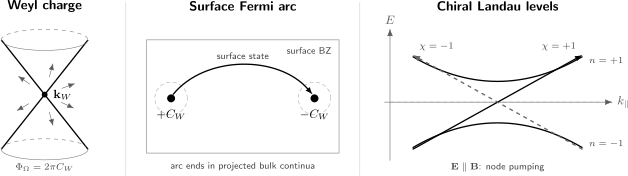
A Weyl point is an isolated linear crossing with quantized Berry flux . On a surface, the projections of nodes with opposite net charge are joined by a Fermi arc, understood as the family of edge modes of two-dimensional Chern slices. A magnetic field produces oppositely propagating zeroth Landau levels; parallel electric and magnetic fields pump carriers between the two chiral sectors while conserving total charge.
Chern Slices and Fermi Arcs
Section titled “Chern Slices and Fermi Arcs”Suppose two simple Weyl nodes lie at different values of . For each fixed that avoids a node, the remaining subsystem is a gapped two-dimensional band structure with Chern number
As passes through a Weyl node, the slice Chern number jumps by that node’s charge:
Between a pair of opposite-charge nodes, the slices can therefore be Chern insulators. At a physical surface, each nontrivial slice contributes a chiral boundary state. At a fixed surface energy, the collection of these states over the interval of forms an open contour: a Fermi arc.
This construction is the cleanest explanation of bulk–boundary correspondence in a Weyl semimetal. The arc must terminate where the surface state merges into the projected bulk continuum. Its endpoints are the surface projections of bulk nodes, counted with projected net charge.
What is protected
Section titled “What is protected”The exact shape of a Fermi arc is not universal. Surface potentials can bend it, reconnect arcs among several projected nodes, or mix it with trivial surface bands. Topology constrains:
- the net number of chiral surface crossings along a closed momentum-space loop;
- the change of that count when the loop encloses projected Weyl charge;
- termination in the projected bulk continuum;
- the impossibility of realizing an isolated open Fermi contour in a strictly two-dimensional band structure.
If opposite-charge nodes project to the same surface momentum, their net projected charge is zero and an arc need not be visible on that face. If the chemical potential is far from the node energy, surface arcs can join bulk electron and hole pockets and appear as parts of closed contours. Calling every surface feature that looks open a Fermi arc is therefore unsafe.
Spectroscopic identification
Section titled “Spectroscopic identification”Angle-Resolved Photoemission Spectroscopy can distinguish surface-localized states from bulk states by varying photon energy and thus the sampled out-of-plane momentum, subject to final-state and escape-depth limits. A strong arc diagnosis combines:
- bulk crossings at the predicted three-dimensional momenta;
- a validated crystal structure and chemical potential;
- surface contours with negligible bulk dispersion;
- endpoint consistency with projected bulk nodes;
- an odd net chiral crossing count on a loop enclosing projected charge;
- slab calculations that include the actual surface termination.
The closed-loop crossing count is more robust than tracing one visually appealing contour through regions where surface and bulk intensity overlap.
Dirac Semimetals and Symmetry
Section titled “Dirac Semimetals and Symmetry”A three-dimensional Dirac point contains two Weyl sectors of opposite charge at the same momentum and energy. A schematic low-energy Hamiltonian is
where
The total Berry charge through a surface enclosing the fourfold point is zero. Unlike a single Weyl node, topology alone therefore does not prevent the two sectors from mixing and gapping. A stable Dirac semimetal requires symmetry that forbids the mixing mass.
Rotation-protected crossings
Section titled “Rotation-protected crossings”In and -type models, band inversion occurs along a crystal rotation axis. Conduction and valence Kramers doublets with different rotation eigenvalues cannot hybridize on that axis. Their crossing produces a pair of symmetry-protected bulk Dirac points.
The protection ledger includes:
- spinful time reversal;
- inversion, giving double degeneracy at each momentum;
- a crystal rotation or nonsymmorphic symmetry distinguishing the crossing bands;
- translation symmetry and a momentum location where those labels apply.
Breaking the protecting rotation while preserving inversion and time reversal generally allows a mass and gaps the node. Depending on the mass sign and band inversion, the resulting phase can be a topological or trivial insulator. Breaking inversion or time reversal can split a Dirac point into separated Weyl nodes if the remaining terms do not simply gap it.
This makes a Dirac semimetal a useful parent phase at the boundary among several gapped and Weyl phases. It also makes it less generic than a Weyl semimetal: the fourfold node has no nonzero total Chern charge once its crystalline protection is removed. Topological Phase Transitions uses codimension to explain when a direct critical point expands into an intervening Weyl interval.
Stable phase versus critical point
Section titled “Stable phase versus critical point”Not every three-dimensional Dirac crossing defines an extended semimetal phase. At a topological-insulator transition, tuning a mass through zero can produce a Dirac point only at one critical parameter value:
The spectrum
is gapless only at . A symmetry-protected Dirac semimetal instead forbids the relevant mass over a finite parameter region and pins crossings along a symmetry line. Experimental language should distinguish a stable phase from a tuned critical point.
Magnetic Field and the Chiral Anomaly
Section titled “Magnetic Field and the Chiral Anomaly”Apply a magnetic field along to an ideal isotropic Weyl cone. The transverse motion forms Landau levels. For , the levels are paired:
The zeroth level is different:
where labels the two node chiralities and the sign depends on the charge and magnetic-field conventions. The invariant statement is that opposite-chirality nodes have oppositely directed zeroth Landau levels.
An electric field parallel to accelerates crystal momentum along these one-dimensional branches. States are pumped from one node to the other. For one simple pair, a standard continuum convention gives
where
is the chiral population imbalance and is an intervalley relaxation time. Total electric charge remains conserved:
The anomaly is the failure of separate right- and left-node number conservation in parallel fields, not creation of net electric charge.
In the steady state,
The resulting nonequilibrium chemical-potential imbalance can add a conductivity along the field. In an ideal weak-field semiclassical regime,
with coefficients that depend on chemical potential, velocities, temperature, disorder, and the number of nodes.
Why negative magnetoresistance is not enough
Section titled “Why negative magnetoresistance is not enough”A decrease of longitudinal resistance for nominally parallel current and magnetic field is compatible with anomaly transport, but several effects can imitate it:
- current jetting: large transverse magnetoresistance focuses current through an inhomogeneous path, making a four-probe voltage geometry appear less resistive;
- weak localization, magnetic scattering, or field-dependent mobility;
- conductivity from trivial pockets;
- contact placement and sample-shape errors;
- small angular misalignment mixed with a large transverse response;
- field-induced changes of magnetic order or band structure;
- entry into the quantum limit with mechanisms unrelated to a clean semiclassical anomaly.
The TaP case is especially instructive: negative longitudinal magnetoresistance was observed even when the Fermi surface enclosed opposite-chirality nodes together, so chirality was not separately well defined, and modeled current redistribution strongly affected the signal. A credible anomaly experiment needs multiple voltage-contact configurations, homogeneous current injection, angular maps, sample-shape scaling, independent Fermi-surface characterization, and evidence that intervalley pumping is meaningful.
There is also no generic persistent bulk equilibrium current proportional to a static magnetic field in a lattice ground state. The transport anomaly described here is a nonequilibrium response involving electric-field pumping and relaxation.
Transport and Optical Signatures
Section titled “Transport and Optical Signatures”Anomalous Hall response
Section titled “Anomalous Hall response”For an ideal time-reversal-breaking Weyl semimetal with a single pair separated by in momentum space, the intrinsic Hall response contains
up to sign convention, filled-band contributions, and reciprocal-lattice ambiguities associated with adding three-dimensional quantum Hall layers. The slice picture explains the result: every momentum slice between the nodes contributes a two-dimensional Chern response.
In a real magnetic metal, conventional Berry curvature from all occupied bands also contributes to the anomalous Hall effect. A large Hall conductivity is therefore not a node counter. A validated band structure and chemical-potential dependence are needed.
Optical conductivity
Section titled “Optical conductivity”For a clean, neutral, type-I three-dimensional Weyl cone, interband phase space gives a low-frequency optical conductivity linear in frequency:
Finite chemical potential Pauli-blocks low-frequency interband absorption and adds a Drude response. Anisotropy, tilt, several nodes, phonons, disorder, interactions, and trivial bands modify the slope and threshold. Linear optical conductivity supports a linearly dispersing three-dimensional spectrum but does not by itself measure .
Quantum oscillations and Weyl orbits
Section titled “Quantum oscillations and Weyl orbits”Bulk quantum oscillations determine extremal Fermi-surface areas through
A phase offset influenced by Berry phase can be suggestive, but extracting a topological phase from a Landau fan requires care with:
- whether conductivity or resistivity extrema are indexed;
- three-dimensional curvature corrections;
- Zeeman splitting;
- multiple frequencies;
- chemical-potential motion in field;
- the quantum-limit regime.
In a thin slab, a proposed Weyl orbit combines a surface arc on one face, a chiral bulk Landau level, the opposite surface arc, and a return bulk channel. Thickness-dependent oscillation phase can test this picture, but surface and bulk paths, magnetic breakdown, and ordinary closed orbits must be modeled together.
Evidence ledger
Section titled “Evidence ledger”| Probe | Topological-semimetal information | Main limitation |
|---|---|---|
| Bulk ARPES | Node position, dispersion, tilt, and chemical potential | Finite resolution, matrix elements, and incomplete out-of-plane momentum mapping |
| Surface ARPES | Arc connectivity and chiral crossing count | Surface termination, trivial bands, overlapping bulk projection |
| First-principles and tight-binding calculations | Candidate nodes, charges, symmetry labels, surface spectrum | Depend on structure, correlation treatment, and chemical potential; prediction is not measurement |
| Quantum oscillations | Fermi-pocket geometry, mobility, effective mass, possible Weyl orbits | Berry-phase intercepts and surface assignments are not unique |
| Longitudinal magnetotransport | Possible intervalley anomaly pumping | Current jetting and several ordinary mechanisms can mimic negative resistance |
| Anomalous Hall effect | Integrated Berry curvature and node-separation contribution | Other occupied bands and magnetic textures also contribute |
| Optical and terahertz response | Linear dispersion, Drude weight, interband threshold, Landau transitions | Usually sums over topological and trivial carriers |
| STM and quasiparticle interference | Surface-state dispersion and scattering constraints | Arc termination can be hidden by matrix elements and bulk continuum |
The strongest identification closes a loop:
- determine crystal and magnetic symmetry;
- locate bulk crossings and their energy;
- compute the Berry charge in a validated Hamiltonian;
- observe the corresponding surface connectivity;
- test response while controlling trivial carriers and geometry;
- track a symmetry-breaking or annihilation transition when possible.
Representative Materials
Section titled “Representative Materials”Inversion-breaking Weyl semimetals
Section titled “Inversion-breaking Weyl semimetals”The noncentrosymmetric TaAs family , , , and supplied the first widely accepted material Weyl-semimetal realizations. Time reversal is preserved, so nodes occur in same-charge pairs at opposite momenta and the full set contains additional opposite-charge pairs. In TaAs, spectroscopy and first-principles calculations jointly resolved bulk cones and surface arcs.
These materials also illustrate why the ideal two-node cartoon is only a local model. Several inequivalent nodes and trivial pockets can coexist near the Fermi level, and projected nodes can overlap on a chosen surface.
Magnetic Weyl semimetals
Section titled “Magnetic Weyl semimetals”Breaking time reversal permits a minimal pair and an intrinsic anomalous Hall response related to node separation. Candidate and realized magnetic Weyl systems include kagome magnets, noncollinear antiferromagnets, and correlated semimetals. In them, determining the magnetic space group is part of determining whether a Weyl node is allowed. Domains, field-driven spin reorientation, and many-body renormalization can change the measured response without a simple rigid-band interpretation.
Dirac semimetals
Section titled “Dirac semimetals”and are canonical three-dimensional Dirac-semimetal platforms. Their inverted bands cross along a rotation axis, and photoemission has observed three-dimensional Dirac-like dispersions. High mobility and small effective masses make them useful for magnetotransport, but those properties alone do not establish crystalline protection.
Surface states of a Dirac semimetal are subtler than those of an isolated Weyl pair because the coincident opposite charges can mix at a surface that breaks the protecting crystal symmetry. Arc-like states may reconnect or become ordinary closed contours depending on termination and symmetry.
Type-II systems
Section titled “Type-II systems”Strongly tilted crossings have been proposed and observed in materials including transition-metal dichalcogenides. Because the node sits at the contact of electron and hole pockets, the chemical potential, lattice constants, structural phase, and computational details can control whether the crossing exists. The correct claim is material- and phase-specific, not “large nonsaturating magnetoresistance proves a type-II Weyl node.”
Common Mistakes
Section titled “Common Mistakes”Calling any linear band crossing a Weyl node. A Weyl node is isolated in three dimensions and carries nonzero Berry-flux charge. A nodal line, an avoided crossing, and a trivial accidental cone are different objects.
Treating the Pauli matrices as literal electron spin. They act in the two-band subspace and may represent orbitals, sublattices, Kramers sectors, or mixed spin–orbital states.
Forgetting lattice doubling. A single Weyl Hamiltonian is a valid local continuum theory, not a complete periodic band structure. The total node charge in the Brillouin zone vanishes.
Calling a Dirac point two independently protected Weyl nodes. Their net charge is zero at the same momentum. A crystalline symmetry must prevent mixing; once it is relaxed, a mass is generally allowed.
Drawing a Fermi arc without projected bulk states. The arc terminates by merging into the bulk continuum. Surface potential changes its shape, and opposite charges can project onto one point.
Using negative longitudinal magnetoresistance as a stand-alone anomaly proof. Current jetting, magnetic scattering, geometry, and trivial carriers require explicit controls.
Identifying a Landau-fan intercept with a universal Berry phase. Three-dimensional curvature, Zeeman energy, indexing convention, and chemical-potential motion alter the intercept.
Equating condensed-matter chirality with exact Lorentz chirality. The low-energy algebra is analogous, while the lattice, preferred frame, finite bandwidth, and node multiplicity remain essential.
Exercises
Section titled “Exercises”1. Diagonalize an anisotropic Weyl cone
Section titled “1. Diagonalize an anisotropic Weyl cone”Consider
Find the spectrum and the occupied-band node charge in the convention of this page.
Solution
The Pauli matrices anticommute, so
Therefore
The velocity matrix is diagonal, with
Using the occupied-band convention
the charge is
Changing the sign of one principal velocity reverses the node charge. Changing two preserves it.
2. Derive the quadratic density of states
Section titled “2. Derive the quadratic density of states”For an isotropic untilted node with , derive the number of positive-energy states per volume below and hence for one nondegenerate cone.
Solution
The occupied momentum volume inside radius
is . One state per real-space volume occupies momentum volume , so
Differentiating gives
Node, spin, and valley multiplicities must be inserted explicitly rather than hidden in this one-cone result.
3. Integrate the Berry monopole
Section titled “3. Integrate the Berry monopole”Given
evaluate the flux through a sphere of radius and recover the Chern number.
Solution
On the sphere,
Hence
Integrating over solid angle gives
Therefore
The radius cancels, so any enclosing surface that remains gapped gives the same integer.
4. Count symmetry-related nodes
Section titled “4. Count symmetry-related nodes”Explain why a time-reversal-invariant, inversion-breaking Weyl semimetal needs at least four simple nodes, whereas an inversion-symmetric, time-reversal-breaking one can have two.
Solution
Under time reversal,
The orientation of a small sphere also reverses when is mapped to . The two sign reversals cancel, so time reversal maps a node to one of the same charge. Charge neutrality then requires another time-reversal-related pair with the opposite charge. The minimum is four.
Under inversion,
because Berry curvature is an axial vector. The enclosing-surface orientation still reverses, so the node at has the opposite charge. One inversion-related pair can satisfy
giving a minimum of two when time reversal is broken.
5. Build a Fermi arc from Chern slices
Section titled “5. Build a Fermi arc from Chern slices”Two Weyl nodes lie at and with charges and . Assume for . Find in all three intervals and explain the surface consequence.
Solution
Crossing the first node changes the slice Chern number by :
The second node returns the value to zero because its charge is . Every intermediate slice is a Chern insulator and carries one chiral edge mode at a surface. At fixed energy, the family of edge states over
forms a surface contour ending at the projected nodes: the Fermi arc.
6. Gap a Dirac critical point
Section titled “6. Gap a Dirac critical point”For anticommuting matrices , consider
Show that gaps the Dirac point. Why must a stable Dirac semimetal forbid this term?
Solution
Anticommutation eliminates cross terms:
Thus
At , the conduction and valence energies are separated by
Because the coincident Weyl sectors have zero total charge, topology does not forbid this mixing mass. A stable Dirac semimetal needs a crystal or other symmetry under which is not allowed; otherwise the gapless point occurs only at the tuned value .
7. Solve the anomaly rate equation
Section titled “7. Solve the anomaly rate equation”For uniform parallel fields and no spatial gradient, let
Find for and its steady value.
Solution
The first-order linear equation has solution
At long times,
The buildup time is the intervalley relaxation time. Fast intervalley scattering suppresses the imbalance even though the microscopic Landau-level pumping remains. The equation transfers population between nodes and leaves total charge unchanged.
8. Audit a chiral-anomaly claim
Section titled “8. Audit a chiral-anomaly claim”A high-mobility crystal shows a large decrease in resistance for one nominally parallel field–current geometry. The voltage changes strongly when contacts are moved, no ARPES or quantum-oscillation Fermi surface is available, and the transverse magnetoresistance is enormous. The result is announced as “unambiguous chiral anomaly.” Evaluate the claim and design four controls.
Solution
The strong contact dependence and large transverse magnetoresistance make current jetting a leading alternative. Without a known Fermi surface, it is also unclear whether separate chiral pockets exist or whether trivial carriers dominate. The observation is a candidate negative longitudinal magnetoresistance, not an unambiguous anomaly.
Useful controls include:
- map the internal voltage distribution with several longitudinal and transverse contact pairs;
- repeat with homogeneous full-width current contacts and several aspect ratios;
- rotate through fine angular steps while modeling tensor conductivity and misalignment;
- determine the Fermi pockets, chemical potential, and node separations by quantum oscillations or spectroscopy;
- compare samples with different residual resistivity and intervalley disorder;
- test whether the inferred , temperature, and chemical-potential trends are consistent across the semiclassical regime;
- measure complementary node or surface evidence rather than relying on transport alone.
A robust conclusion must survive the same geometry analysis that explains current focusing in an ordinary anisotropic conductor.
Connections
Section titled “Connections”- Graphene and Dirac Materials provides the two-dimensional honeycomb benchmark and shows why sublattice pseudospin, valley doubling, and a zero Landau level do not by themselves imply a three-dimensional Weyl charge.
- Band Theory Overview supplies the effective one-electron framework and the limits of a quasiparticle-band interpretation.
- Fermi Surface owns pocket topology, carrier counting, velocity orientation, and quantum-oscillation geometry.
- Chern Numbers in Band Theory develops gauge-covariant projectors, Wilson loops, discretized computation, and Hall response for gapped slices.
- Topological Insulators gives the gapped class-AII comparison and explains how symmetry breaking can pass through a Weyl phase.
- Edge and Surface States places Fermi arcs within a broader boundary-state taxonomy and distinguishes their open-contour evidence from gapped-bulk edge and surface modes.
- Bulk–Boundary Correspondence states the gapped theorem and explains why a Weyl semimetal must instead apply it slice by slice between bulk nodes.
- Spin–Orbit Coupling in Solids owns the microscopic and crystal-symmetry mechanisms that split or invert spin–orbital bands.
- Angular Momentum to Helicity distinguishes helicity from Lorentz chirality before those terms are borrowed for crystal quasiparticles.
- Dirac Equation Formula Card records the relativistic equation and conventions; the crystal Hamiltonians here are low-energy analogues, not exact Lorentz theories.
Further Reading
Section titled “Further Reading”- N. P. Armitage, E. J. Mele, and A. Vishwanath, “Weyl and Dirac Semimetals in Three-Dimensional Solids,” Reviews of Modern Physics 90, 015001 (2018), doi:10.1103/RevModPhys.90.015001.
- B. Q. Lv, T. Qian, and H. Ding, “Experimental Perspective on Three-Dimensional Topological Semimetals,” Reviews of Modern Physics 93, 025002 (2021), doi:10.1103/RevModPhys.93.025002.
- A. A. Burkov, “Weyl Metals,” Annual Review of Condensed Matter Physics 9, 359–378 (2018), doi:10.1146/annurev-conmatphys-033117-054129.
References
Section titled “References”- C. Herring, “Accidental Degeneracy in the Energy Bands of Crystals,” Physical Review 52, 365–373 (1937), doi:10.1103/PhysRev.52.365.
- H. B. Nielsen and M. Ninomiya, “Absence of Neutrinos on a Lattice: (I). Proof by Homotopy Theory,” Nuclear Physics B 185, 20–40 (1981), doi:10.1016/0550-3213(81)90361-8.
- X. Wan, A. M. Turner, A. Vishwanath, and S. Y. Savrasov, “Topological Semimetal and Fermi-Arc Surface States in the Electronic Structure of Pyrochlore Iridates,” Physical Review B 83, 205101 (2011), doi:10.1103/PhysRevB.83.205101.
- A. A. Burkov and L. Balents, “Weyl Semimetal in a Topological Insulator Multilayer,” Physical Review Letters 107, 127205 (2011), doi:10.1103/PhysRevLett.107.127205.
- S. M. Young et al., “Dirac Semimetal in Three Dimensions,” Physical Review Letters 108, 140405 (2012), doi:10.1103/PhysRevLett.108.140405.
- Z. Wang et al., “Dirac Semimetal and Topological Phase Transitions in (),” Physical Review B 85, 195320 (2012), doi:10.1103/PhysRevB.85.195320.
- Z. Wang, H. Weng, Q. Wu, X. Dai, and Z. Fang, “Three-Dimensional Dirac Semimetal and Quantum Transport in ,” Physical Review B 88, 125427 (2013), doi:10.1103/PhysRevB.88.125427.
- H. Weng et al., “Weyl Semimetal Phase in Noncentrosymmetric Transition-Metal Monophosphides,” Physical Review X 5, 011029 (2015), doi:10.1103/PhysRevX.5.011029.
- S.-M. Huang et al., “A Weyl Fermion Semimetal with Surface Fermi Arcs in the Transition Metal Monopnictide TaAs Class,” Nature Communications 6, 7373 (2015), doi:10.1038/ncomms8373.
- S.-Y. Xu et al., “Discovery of a Weyl Fermion Semimetal and Topological Fermi Arcs,” Science 349, 613–617 (2015), doi:10.1126/science.aaa9297.
- B. Q. Lv et al., “Experimental Discovery of Weyl Semimetal TaAs,” Physical Review X 5, 031013 (2015), doi:10.1103/PhysRevX.5.031013.
- Z. K. Liu et al., “Discovery of a Three-Dimensional Topological Dirac Semimetal, ,” Science 343, 864–867 (2014), doi:10.1126/science.1245085.
- S. Borisenko et al., “Experimental Realization of a Three-Dimensional Dirac Semimetal,” Physical Review Letters 113, 027603 (2014), doi:10.1103/PhysRevLett.113.027603.
- M. Neupane et al., “Observation of a Three-Dimensional Topological Dirac Semimetal Phase in High-Mobility ,” Nature Communications 5, 3786 (2014), doi:10.1038/ncomms4786.
- H. B. Nielsen and M. Ninomiya, “The Adler–Bell–Jackiw Anomaly and Weyl Fermions in a Crystal,” Physics Letters B 130, 389–396 (1983), doi:10.1016/0370-2693(83)91529-0.
- D. T. Son and B. Z. Spivak, “Chiral Anomaly and Classical Negative Magnetoresistance of Weyl Metals,” Physical Review B 88, 104412 (2013), doi:10.1103/PhysRevB.88.104412.
- J. Xiong et al., “Evidence for the Chiral Anomaly in the Dirac Semimetal ,” Science 350, 413–416 (2015), doi:10.1126/science.aac6089.
- F. Arnold et al., “Negative Magnetoresistance without Well-Defined Chirality in the Weyl Semimetal TaP,” Nature Communications 7, 11615 (2016), doi:10.1038/ncomms11615.
- A. A. Soluyanov et al., “Type-II Weyl Semimetals,” Nature 527, 495–498 (2015), doi:10.1038/nature15768.