Spin–Orbit Coupling in Solids
Spin–orbit coupling in a solid is the relativistic coupling that entangles an electron’s spin with its orbital motion through the crystal potential. It begins with the same local physics that produces atomic fine structure, but a crystal adds orbital hybridization, crystal fields, Bloch momentum, surfaces, interfaces, and space-group symmetry. Those ingredients decide whether spin–orbit coupling merely shifts local levels, splits a band, changes magnetic anisotropy, generates a transverse spin response, or reorganizes the topology of the occupied states.
The phrase “strong spin–orbit coupling” is incomplete without a comparison scale. A matrix element can be large relative to a magnetic exchange energy and small relative to a crystal-field gap; it can strongly alter a nearly degenerate band crossing while barely changing remote bands. The useful question is therefore not whether spin–orbit coupling is present—it is—but which projected Hilbert space it acts in, which symmetries constrain it, and which competing energy scales it exceeds.
Spin–Orbit Coupling is the canonical home for the angular-momentum-addition algebra of . Fine Structure develops its atomic spectroscopic role, and the Pauli Equation gives its nonrelativistic origin. This article starts from those results and develops their consequences in crystalline materials.
Required background. Spin–Orbit Coupling supplies angular-momentum algebra, while Symmetry of Bloch States supplies little-group, double-group, and degeneracy labels.
Helpful background. Tight-Binding Models supplies basis projections, Time Reversal for Spin-1/2 supplies Kramers constraints, and Berry Curvature supplies the geometric response object.
Convention and scale ledger
Section titled “Convention and scale ledger”We use the following conventions throughout:
- is the free-electron mass, while is a signed band effective mass when a one-band approximation is valid.
- is the electron’s potential energy, not the electrostatic potential.
- denotes Pauli matrices in an explicitly stated two-state subspace. It represents physical spin only when that projection is justified.
- is crystal momentum. A continuum expansion is local to a specified high-symmetry point and is not automatically periodic over the Brillouin zone.
- Time reversal for a physical spin- doublet is , up to an overall phase, and .
- Inversion sends but leaves spin unchanged because spin is an axial vector.
- The signs of Rashba and Dresselhaus coefficients depend on axis, basis, interface-normal, and Pauli-matrix conventions. Spectra determine magnitudes more directly than signs.
Several energy scales must be kept separate:
Here is an atomic or local spin–orbit scale, a crystal-field splitting, a hopping or bandwidth scale, an exchange splitting, a band splitting or avoided-crossing gap, and a disorder broadening. There is no universal ordering among them.
Relativistic origin
Section titled “Relativistic origin”For a static scalar potential, the Foldy–Wouthuysen expansion of the Dirac Hamiltonian contains the Pauli spin–orbit term
The coefficient includes the Thomas-precession factor. If one instead writes an electrostatic potential for an electron of charge , then ; silently replacing by reverses a sign.
For a central potential ,
so that
The large gradient near a heavy nucleus is why atomic spin–orbit scales generally increase strongly with atomic number. In a solid, however, a band state is a coherent mixture of atomic orbitals. The relevant matrix element depends on which atomic regions it samples, the orbital characters and covalency, and the projection used to construct a low-energy model. “Made from a heavy element” is useful chemical guidance, not a quantitative answer.
For a local shell one often writes
where is the crystal field, represents hybridization with ligands, and contains local interactions. The fitted in this Hamiltonian is an effective matrix element; it need not equal a free-ion constant.
Crystal fields, orbital quenching, and pseudospin
Section titled “Crystal fields, orbital quenching, and pseudospin”A crystal field removes some or all of an atomic multiplet’s orbital degeneracy. If an orbital eigenstate is nondegenerate and can be chosen real, its first-order expectation value of vanishes. This is the usual sense in which the orbital moment is quenched. It does not mean that has disappeared as an operator. Virtual admixture of excited crystal-field levels produces corrections of order
as well as anisotropic factors and magnetocrystalline anisotropy. Near an orbital degeneracy, spin–orbit coupling can instead act in first order.
Cubic d orbitals
Section titled “Cubic d orbitals”In an ideal octahedral environment, the five orbitals split into a lower triplet and an upper doublet for the usual ligand-field sign. Within the manifold, projected orbital matrices can be represented by an effective angular momentum with the opposite sign:
Consequently,
The statement is about matrices in a specified orbital basis, not a claim that the electron’s microscopic orbital angular momentum has literally changed sign. Electron versus hole descriptions, distortions, covalency, and the sign convention for must all be declared before assigning level order.
In the ideal subspace, the direct projection vanishes. Spin–orbit effects nevertheless survive through mixing with states, ligand orbitals, and lower-symmetry fields. Thus “orbital quenching” and “negligible spin–orbit coupling” are not synonyms.
Three useful coupling regimes
Section titled “Three useful coupling regimes”The order in which one diagonalizes local terms should follow the scale hierarchy:
- If , first diagonalize the crystal field and project into its low-energy manifold.
- If , first form atomic multiplets and then apply the crystal field within them.
- If the scales are comparable, neither limiting label is exact; diagonalize the full local Hamiltonian and report wave-function composition rather than forcing a pure - or -coupling name.
The low-energy two-state object is often a Kramers pseudospin rather than a bare spin. Its magnetic moment has the general form
where is a tensor. Neutron scattering, magnetic resonance, and Zeeman coupling probe matrix elements of the physical moment, not the abstract Pauli labels alone.
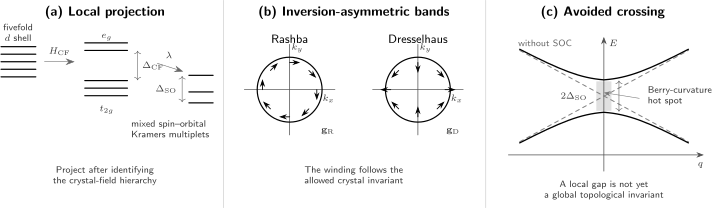
Three distinct uses of spin–orbit coupling. Left: a crystal field first organizes local orbitals, after which acts within and between the surviving manifolds. Center: inversion asymmetry permits momentum-dependent Rashba or Dresselhaus fields. Right: spin–orbit coupling can gap a symmetry-allowed crossing and concentrate Berry curvature, but the existence of a gap alone does not determine a topological invariant.
Bloch Hamiltonians and symmetry
Section titled “Bloch Hamiltonians and symmetry”Near a chosen point, an isolated two-state band subspace can be written
Its eigenvalues are
For representing physical spin, the two eigenstates have
For a spin–orbital pseudospin, this equation describes the pseudospin texture; the physical spin texture follows only after projecting the spin operator into the same subspace.
Time reversal and inversion
Section titled “Time reversal and inversion”Time-reversal invariance requires
which gives
At a time-reversal-invariant momentum satisfying
with reciprocal vector , the odd field vanishes and the pair is Kramers degenerate.
If inversion is also present, then
Within a same-parity spin doublet this makes even. Time reversal makes it odd, so . More generally, the antiunitary operation leaves every fixed and satisfies
for spinful electrons when inversion and time reversal commute. Every Bloch level is then at least twofold degenerate at every , not only at the time-reversal-invariant momenta. Kramers Degeneracy develops the theorem and its hypotheses.
Breaking inversion while preserving time reversal allows spin-split bands away from the invariant momenta. Breaking time reversal allows a Zeeman or exchange term even at those momenta. A measured band splitting therefore does not identify Rashba coupling until the relevant crystal, surface, magnetic, and little-group symmetries have been established.
Rashba coupling
Section titled “Rashba coupling”For an approximately isotropic two-dimensional band with a polar axis , the leading structural-inversion-asymmetry term is
This convention gives
The sign changes if the surface normal, coordinate orientation, or Pauli basis is reversed. For a parabolic band,
and
For , useful scales are
The lower branch has a ring minimum at lying below the unsplit crossing energy in this ideal model. The two pseudospins wind tangentially in opposite directions around the crossing.
It is tempting to identify with a bare electric field in the vacuum Pauli term. In actual solids, is a band parameter produced by inversion-asymmetric orbital hybridization together with atomic spin–orbit matrix elements. Wave-function weight near heavy atoms, avoided crossings, confinement, electrostatic gating, and structural relaxation can all matter. A large potential gradient without suitable orbital mixing need not produce a large band splitting.
Crystal symmetry also permits higher harmonics. Hexagonal warping, for example, can generate an out-of-plane spin component and a noncircular contour. The linear isotropic Hamiltonian is a controlled low- model, not a universal definition of every surface splitting.
Dresselhaus coupling
Section titled “Dresselhaus coupling”Bulk inversion asymmetry in a zinc-blende crystal permits the cubic Dresselhaus invariant
The angular dependence follows the crystal axes and is qualitatively different from the rotationally symmetric Rashba field. Along selected high-symmetry directions, the leading splitting vanishes.
Confinement in a [001] quantum well replaces by a subband expectation value and produces a linear in-plane term. Absorbing projection signs into , we write
while residual cubic terms become important as the in-plane Fermi momentum grows. The fitted depends on well width, strain, composition, subband occupation, and convention; it is not simply a universal bulk multiplied by one geometric number.
Rashba and Dresselhaus together
Section titled “Rashba and Dresselhaus together”For a [001] two-dimensional system with both linear terms,
so
The splitting is anisotropic:
At , the field points along the fixed spin axis :
where
The component is conserved in the ideal parabolic, linear-coupling model. The associated exact SU(2) structure supports a persistent spin helix with wavevector magnitude
Cubic Dresselhaus terms, unequal coefficients, spatial disorder, additional subbands, and other spin-relaxation channels limit the lifetime in real samples. The symmetry point is robust physics, not a promise of infinite experimental lifetime.
Magnetic consequences
Section titled “Magnetic consequences”Spin–orbit coupling lets the lattice distinguish spin directions. After high-energy orbital states are eliminated, it can generate:
- anisotropic tensors and single-ion anisotropy;
- symmetric anisotropic exchange and antisymmetric Dzyaloshinskii–Moriya exchange;
- magnetocrystalline anisotropy and easy axes or easy planes;
- spin–momentum locking and current-induced nonequilibrium spin polarization;
- gaps at magnon or electronic band crossings;
- orbital moments and mixed spin–orbital collective modes.
Exchange Interactions gives the canonical exchange-tensor decomposition. Magnetic Anisotropy develops the resulting easy directions, shape and interface competition, texture length scales, and material inference. The important power counting is that a local spin–orbit term can enter an effective spin Hamiltonian only after it is combined with hopping, hybridization, exchange, or crystal-field processes. A Dzyaloshinskii–Moriya vector is therefore constrained by bond symmetry and microscopic virtual paths; it is not obtained by attaching an arbitrary vector to every bond.
In an itinerant ferromagnet, exchange already breaks time reversal and separates spin-mixed bands. Spin–orbit coupling then changes their avoided crossings, orbital moments, Berry curvature, and orientation-dependent total energy. Describing such states as pure “spin up” and “spin down” is generally an approximation.
Spin Hall response
Section titled “Spin Hall response”The spin Hall effect is a transverse spin response to a longitudinal electric field. A commonly used conventional spin-current operator is
where is the flow direction and is the spin-polarization axis. Because spin–orbit coupling produces a torque,
this current is generally not associated with a strictly conserved bulk density. Alternative conserved-current definitions shift torque-dipole terms between “current” and “source.” A quoted spin Hall conductivity is meaningful only with the operator, axes, units, frequency, and boundary protocol stated.
Intrinsic contribution
Section titled “Intrinsic contribution”For a clean multiband crystal, an intrinsic dc contribution can be written in Kubo form as
with the spin Berry curvature
All states and energies here are evaluated at the same . Near spin–orbit-induced avoided crossings, the small denominator can produce large hot spots. The total response still requires the occupation, all relevant bands, and symmetry-related cancellations.
Time reversal forbids an ordinary intrinsic charge Hall conductivity in a nonmagnetic equilibrium crystal because charge Berry curvature is odd in . It does not generally forbid spin Hall response: both velocity and spin reverse under time reversal, so their symmetrized product is even.
Extrinsic contribution
Section titled “Extrinsic contribution”Disorder can generate two distinct leading mechanisms:
- skew scattering, an asymmetric scattering probability whose conductivity often scales with the transport lifetime in a dilute-disorder regime;
- side jump, a coordinate displacement during scattering whose leading conductivity is often independent of the lifetime, even though scattering events are essential.
The decomposition into intrinsic, side-jump, and skew terms can depend on model and representation, especially in multiband systems. Scaling with longitudinal conductivity, impurity control, thickness dependence, and comparison with microscopic calculations are more informative than assigning a mechanism from one transverse voltage.
A widely used conversion is
but some authors absorb into the definition of or reverse an axis. A spin Hall angle without its convention cannot be compared safely across papers.
The ideal linear Rashba two-dimensional electron gas is a useful warning. Its clean-band calculation suggests a simple intrinsic dc value, but vertex corrections cancel that result for a common model of spin-independent short-range disorder in the uniform, zero-frequency limit. The cancellation is not a theorem for real multiorbital crystals, finite frequency, finite size, nonlinear coupling, or arbitrary disorder.
Hall Effect owns the general conductivity-tensor, sign, multiband, and experimental-inference framework. Spintronics owns spin injection, inverse conversion, torques, and device architectures rather than the definition of spin–orbit coupling itself.
Bridge to topological materials
Section titled “Bridge to topological materials”Spin–orbit coupling can gap a band crossing, invert orbital characters, or change the symmetry representations of occupied states. None of those observations alone proves topology. A topological phase is diagnosed by the global occupied-state bundle and the protecting symmetries.
In a two-band avoided crossing,
the gap is , and the Berry curvature is concentrated near . Whether the integrated contribution is topologically nontrivial depends on how this valley is completed elsewhere in the Brillouin zone and on the signs of all symmetry-related masses.
For a time-reversal-invariant two-dimensional insulator, Kramers structure permits a classification even when no spin component is conserved. In the spin-conserving limit of the Kane–Mele model, one can picture two opposite-Chern sectors related by time reversal. Rashba coupling mixes those sectors, yet the quantum spin Hall phase can survive as long as time reversal and the bulk gap remain intact. The spin Chern-number picture is then no longer the fundamental definition.
Berry Curvature develops the local geometric response, Chern Numbers develops the integer invariant, and Topological Quantum Numbers compares invariant families. Topological Insulators owns the full class-AII construction and material evidence ledger. A material claim additionally needs a bulk invariant, a gap or mobility-gap statement, symmetry control, and boundary evidence consistent with the same phase.
How to infer spin–orbit physics in a material
Section titled “How to infer spin–orbit physics in a material”No single measurement returns “the spin–orbit coupling.” A defensible analysis separates model identification, parameter extraction, and mechanism attribution.
Symmetry first
Section titled “Symmetry first”- Determine the bulk space group and whether the relevant surface, interface, distortion, magnetic order, or applied field breaks inversion or time reversal.
- Identify the little group along the measured momentum path and the degeneracies it protects.
- Decide whether a two-band Pauli model is legitimate or whether orbital and sublattice degrees of freedom must remain explicit.
- Enumerate the lowest-order invariants before fitting their coefficients.
Symmetry of Bloch States owns the little-group, double-group, and nonsymmorphic labels and the degeneracy or crossing taxonomy used in the first two steps. This page owns the microscopic spin–orbit mechanisms and the resulting Rashba, Dresselhaus, spin-Hall, and material-facing consequences.
Bulk inversion asymmetry, structural inversion asymmetry, and exchange splitting can produce superficially similar band separations but obey different angular and symmetry constraints.
Spectroscopy and transport
Section titled “Spectroscopy and transport”Angle-resolved photoemission can measure dispersions and, with spin resolution, spin expectation values. Matrix elements, overlapping bands, final-state effects, surface band bending, and finite resolution can mimic or obscure a splitting. Quantum oscillations resolve extremal orbit areas but require care: two frequencies can arise from warping, multiple pockets, domains, or magnetic breakdown rather than spin splitting.
Weak antilocalization, spin resonance, optical orientation, and spin-relaxation anisotropy constrain spin precession and decoherence. Their extracted “spin–orbit field” is model dependent. Fits should state the diffusive or ballistic regime, dimensionality, intervalley and magnetic scattering assumptions, and the hierarchy among , the spin-precession time, and the phase-coherence time.
Spin Hall measurements often infer a bulk conversion through edge spin accumulation, inverse spin Hall voltages, spin-torque ferromagnetic resonance, nonlocal transport, or terahertz emission. Interface transparency, current shunting, spin diffusion, thermoelectric backgrounds, and spin-memory loss must be calibrated before assigning a bulk angle.
Computation
Section titled “Computation”A useful first-principles workflow is:
- compare scalar-relativistic and fully relativistic bands using the same converged structure;
- project wave functions onto atomic and symmetry-adapted orbitals;
- verify symmetry-enforced degeneracies and transformation properties;
- construct a spinor Wannier or other low-energy model only after checking the disentanglement window;
- converge avoided-crossing gaps and spin Berry-curvature hot spots on dense momentum meshes;
- test the stability of fitted Rashba or Dresselhaus coefficients over the claimed momentum range.
Turning spin–orbit coupling on and off in a code is a diagnostic counterfactual, not an experimentally tunable operation. It can reveal which feature is SOC-enabled, but it does not by itself identify the atomic path or establish a topological invariant.
Common mistakes
Section titled “Common mistakes”| Mistake | Why it fails | Better check |
|---|---|---|
| Calling every nonmagnetic band splitting “Rashba” | Bulk inversion asymmetry, nonsymmorphic symmetry, hidden sector polarization, or unresolved bands may be responsible | Establish bulk and local symmetry, momentum dependence, and spin texture |
| Treating Pauli matrices as physical spin | A low-energy doublet may be strongly spin–orbital entangled | Project the physical spin and magnetic-moment operators |
| Equating a heavy atom with a large target-band splitting | Orbital weight, hybridization, and energy denominators control the projection | Inspect orbital-resolved wave functions and avoided crossings |
| Inferring topology from an SOC-opened gap | A local mass does not determine a global invariant | Compute the appropriate bulk invariant and check its protecting symmetry |
| Comparing spin Hall angles without conventions | Current normalization and axis signs differ | Report , geometry, units, and the conversion |
| Assuming inversion plus time reversal forbids SOC | It forbids spin splitting of each Bloch level, not spin–orbital entanglement | Distinguish degeneracy from absence of SOC matrix elements |
| Dropping cubic Dresselhaus terms at all densities | Their relative importance grows with in-plane momentum | Fit angular dependence over the experimental momentum range |
| Reading a fitted as a microscopic electric field | The coefficient is a multiband material parameter | Track structural, orbital, and gate dependence in a microscopic model |
Exercises
Section titled “Exercises”1. Recover the central-potential form
Section titled “1. Recover the central-potential form”Starting from
derive the form for . State where the factor of relative to a naive rest-frame argument appears.
Solution
For a central potential,
Using gives
The Pauli coefficient already contains the Thomas-precession correction. A naive transformation to the electron’s instantaneous rest frame misses this kinematic factor and gives twice the correct spin–orbit coupling.
2. Degeneracy with inversion and time reversal
Section titled “2. Degeneracy with inversion and time reversal”For a spinful, nonmagnetic centrosymmetric crystal, show that every Bloch energy is at least doubly degenerate at each . Why does this not imply that the eigenstates are pure spin states?
Solution
Inversion maps to , and time reversal does the same. Their product therefore leaves fixed. For ordinary inversion, and , while . Hence
If is an eigenstate, is an orthogonal eigenstate at the same energy and momentum. Spin–orbit coupling may still entangle spin with orbital and sublattice amplitudes within this doublet. Degeneracy constrains the energy; it does not provide a globally unique spin quantization axis.
3. Rashba momentum and energy scales
Section titled “3. Rashba momentum and energy scales”For and
find the ring minimum and its energy relative to . Give the spin direction for on the axis.
Solution
Differentiation gives
so
Substitution yields
At ,
The helicity has spin along and the helicity along . Which energy branch is called “inner” or “outer” depends on the chosen Fermi energy.
4. Persistent-spin-helix symmetry
Section titled “4. Persistent-spin-helix symmetry”Set in the linear Rashba–Dresselhaus Hamiltonian. Show that one spin component is conserved and derive the helix wavevector for a parabolic band.
Solution
At equal couplings,
Therefore for
The kinetic and SOC terms along complete the square:
The two conserved-spin branches are shifted by
which is the spatial helix wavevector. Terms that fail to commute with make the lifetime finite.
5. Dresselhaus nodes
Section titled “5. Dresselhaus nodes”Use the cubic bulk Dresselhaus Hamiltonian to show that the spin splitting vanishes for momenta along and . Is this enough to conclude that the entire line remains degenerate in a real material?
Solution
For , take . Every component contains either a vanishing prefactor or a vanishing difference, so .
For , take . Each difference such as vanishes, again giving .
This conclusion applies to the displayed lowest-order invariant in the chosen band and symmetry setting. Higher-order invariants, coupling to other bands, strain, surfaces, magnetic order, or lower actual symmetry can lift the degeneracy. The little-group representations of the full crystal decide what is exact.
6. Why time reversal permits a spin Hall response
Section titled “6. Why time reversal permits a spin Hall response”Determine the time-reversal parity of the charge current and of the conventional spin current . Use it to explain why a nonmagnetic crystal can have zero charge Hall conductivity and nonzero spin Hall conductivity.
Solution
Time reversal changes both velocity and spin:
Thus charge current is odd, whereas
is even. In a time-reversal-invariant equilibrium crystal, symmetry-related momenta cancel the transverse charge response. The extra time-reversal-odd spin insertion reverses that cancellation pattern, so a transverse spin current is symmetry allowed. Its actual value can still vanish because of additional crystal symmetries or dynamical cancellations.
7. A gap is not yet a topological invariant
Section titled “7. A gap is not yet a topological invariant”Two time-reversal-related massive Dirac valleys contribute Berry-curvature hot spots. Explain why observing the same gap magnitude at both valleys does not determine whether their topological contributions add or cancel.
Solution
For a local Dirac Hamiltonian, the sign of the Berry-curvature contribution depends not only on but on the sign of the mass and the orientation encoded by the velocity Jacobian. Schematically,
Spectroscopy of the gap gives , not this signed product. Symmetry can relate the masses and valley orientations so that contributions cancel, add within one spin sector, or reorganize into a invariant. One must determine the global occupied wave functions or an equivalent symmetry indicator; equal local gap magnitudes are insufficient.
Connections
Section titled “Connections”- Unconventional Superconductivity takes a spin–orbit-projected pseudospin or orbital basis as input for pairing classification; this page retains the material Hamiltonian, band spin texture, and physical-moment projection.
- Magnetic Moments in Matter takes the crystal-field and spin–orbit-projected manifold as input, interprets its physical tensor, and tests whether a fixed pseudospin moment is controlled.
- Spin–Orbit Coupling owns the coupled-basis spectrum of .
- Pauli Equation derives the nonrelativistic relativistic corrections and fixes electromagnetic conventions.
- Tight-Binding Models develops orbital Bloch Hamiltonians into which local and bond spin–orbit matrices are projected.
- Time Reversal for Spin One-Half develops and .
- Fermi Surface explains how band splitting changes contours, extremal orbits, and momentum-resolved observables.
- Exchange Interactions develops symmetric anisotropy and Dzyaloshinskii–Moriya exchange.
- Hall Effect supplies the charge-transport baseline needed to interpret spin Hall conversion.
- Berry Curvature connects interband matrix elements and avoided crossings to geometric response.
- Topological Quantum Numbers distinguishes local curvature from global invariants.
- Weyl and Dirac Semimetals shows how spin–orbit coupling, inversion breaking, magnetism, and crystalline symmetry organize topological point crossings in solids.
- Quantum Wells supplies the confinement, heterointerface, subband, and electric-field ledger for Rashba- and Dresselhaus-coupled two-dimensional carriers.
- Two-Dimensional Electron Gases connects those couplings to gate-dependent occupation, weak-antilocalization and oscillation diagnostics, disorder lifetimes, and oxide interfaces.
- Transition-Metal Dichalcogenides applies atomic spin–orbit coupling and broken inversion to a material-specific spin–valley and exciton hierarchy.
- 2D Magnets and Ferroelectrics connects spin–orbit-induced anisotropy and valley locking to finite-temperature monolayer order, polarization, and magnetoelectric coupling.
- van der Waals Heterostructures develops the interface self-energy and evidence ledger for proximity-induced spin–orbit terms.
References
Section titled “References”- L. L. Foldy and S. A. Wouthuysen, “On the Dirac Theory of Spin 1/2 Particles and Its Non-Relativistic Limit,” Physical Review 78, 29–36 (1950), doi:10.1103/PhysRev.78.29.
- J. H. Van Vleck, The Theory of Electric and Magnetic Susceptibilities, Oxford University Press (1932).
- A. Abragam and B. Bleaney, Electron Paramagnetic Resonance of Transition Ions, Oxford University Press (1970).
- G. Khaliullin, “Orbital Order and Fluctuations in Mott Insulators,” Progress of Theoretical Physics Supplement 160, 155–202 (2005), doi:10.1143/PTPS.160.155.
- E. I. Rashba, “Properties of Semiconductors with an Extremum Loop. 1. Cyclotron and Combinational Resonance in a Magnetic Field Perpendicular to the Plane of the Loop,” Soviet Physics, Solid State 2, 1109–1122 (1960).
- Y. A. Bychkov and E. I. Rashba, “Properties of a 2D Electron Gas with Lifted Spectral Degeneracy,” JETP Letters 39, 78–81 (1984).
- G. Dresselhaus, “Spin-Orbit Coupling Effects in Zinc Blende Structures,” Physical Review 100, 580–586 (1955), doi:10.1103/PhysRev.100.580.
- R. Winkler, Spin–Orbit Coupling Effects in Two-Dimensional Electron and Hole Systems, Springer (2003), doi:10.1007/b13586.
- A. Manchon, H. C. Koo, J. Nitta, S. M. Frolov, and R. A. Duine, “New Perspectives for Rashba Spin–Orbit Coupling,” Nature Materials 14, 871–882 (2015), doi:10.1038/nmat4360.
- B. A. Bernevig, J. Orenstein, and S.-C. Zhang, “Exact SU(2) Symmetry and Persistent Spin Helix in a Spin-Orbit Coupled System,” Physical Review Letters 97, 236601 (2006), doi:10.1103/PhysRevLett.97.236601.
- J. D. Koralek, C. P. Weber, J. Orenstein, B. A. Bernevig, S.-C. Zhang, S. Mack, and D. D. Awschalom, “Emergence of the Persistent Spin Helix in Semiconductor Quantum Wells,” Nature 458, 610–613 (2009), doi:10.1038/nature07871.
- M. I. Dyakonov and V. I. Perel, “Possibility of Orienting Electron Spins with Current,” JETP Letters 13, 467–469 (1971).
- J. E. Hirsch, “Spin Hall Effect,” Physical Review Letters 83, 1834–1837 (1999), doi:10.1103/PhysRevLett.83.1834.
- S. Murakami, N. Nagaosa, and S.-C. Zhang, “Dissipationless Quantum Spin Current at Room Temperature,” Science 301, 1348–1351 (2003), doi:10.1126/science.1087128.
- J. Sinova, D. Culcer, Q. Niu, N. A. Sinitsyn, T. Jungwirth, and A. H. MacDonald, “Universal Intrinsic Spin Hall Effect,” Physical Review Letters 92, 126603 (2004), doi:10.1103/PhysRevLett.92.126603.
- J. Sinova, S. O. Valenzuela, J. Wunderlich, C. H. Back, and T. Jungwirth, “Spin Hall Effects,” Reviews of Modern Physics 87, 1213–1260 (2015), doi:10.1103/RevModPhys.87.1213.
- Y. K. Kato, R. C. Myers, A. C. Gossard, and D. D. Awschalom, “Observation of the Spin Hall Effect in Semiconductors,” Science 306, 1910–1913 (2004), doi:10.1126/science.1105514.
- J. Wunderlich, B. Kaestner, J. Sinova, and T. Jungwirth, “Experimental Observation of the Spin-Hall Effect in a Two-Dimensional Spin-Orbit Coupled Semiconductor System,” Physical Review Letters 94, 047204 (2005), doi:10.1103/PhysRevLett.94.047204.
- E. G. Mishchenko, A. V. Shytov, and B. I. Halperin, “Spin Current and Polarization in Impure Two-Dimensional Electron Systems with Spin-Orbit Coupling,” Physical Review Letters 93, 226602 (2004), doi:10.1103/PhysRevLett.93.226602.
- C. L. Kane and E. J. Mele, “Quantum Spin Hall Effect in Graphene,” Physical Review Letters 95, 226801 (2005), doi:10.1103/PhysRevLett.95.226801.
- C. L. Kane and E. J. Mele, “ Topological Order and the Quantum Spin Hall Effect,” Physical Review Letters 95, 146802 (2005), doi:10.1103/PhysRevLett.95.146802.
- L. Fu and C. L. Kane, “Topological Insulators with Inversion Symmetry,” Physical Review B 76, 045302 (2007), doi:10.1103/PhysRevB.76.045302.
- M. Z. Hasan and C. L. Kane, “Colloquium: Topological Insulators,” Reviews of Modern Physics 82, 3045–3067 (2010), doi:10.1103/RevModPhys.82.3045.
- X.-L. Qi and S.-C. Zhang, “Topological Insulators and Superconductors,” Reviews of Modern Physics 83, 1057–1110 (2011), doi:10.1103/RevModPhys.83.1057.
- I. Žutić, J. Fabian, and S. Das Sarma, “Spintronics: Fundamentals and Applications,” Reviews of Modern Physics 76, 323–410 (2004), doi:10.1103/RevModPhys.76.323.