Skyrmions and Magnetic Textures
A magnetic texture is a spatially varying magnetic order parameter. Domains, domain walls, vortices, spirals, bubbles, merons, skyrmions, and three-dimensional singular structures are different ways for that order parameter to vary in space. Their form is set jointly by topology, exchange, anisotropy, dipolar fields, Dzyaloshinskii–Moriya coupling, applied fields, boundaries, disorder, and temperature.
Topology answers whether one smooth texture can be continuously deformed into another while respecting a declared order-parameter space and boundary condition. It does not by itself answer whether the texture is the equilibrium state, how large it is, how long it lives, or how much current moves it. Those are energetic and dynamical questions.
Magnetic Anisotropy owns the exchange, anisotropy, dipolar, and Dzyaloshinskii–Moriya energy ledger, including the canonical one-dimensional wall profile and wall energy. Spintronics owns injected spin torques. Hall Effect owns the broader transverse-response inference framework. This page owns texture classification, vortex and skyrmion charge, stability and topology change, rigid-texture dynamics, emergent electrodynamics, and experimental identification.
Required background. Magnetic Anisotropy supplies the micromagnetic energy ledger, while Homotopy and Winding supplies the winding and topological-charge language.
Helpful background. Ferromagnetism provides the familiar order-parameter branch, while Spintronics supplies current-induced torques and electrical detection.
Convention and topology ledger
Section titled “Convention and topology ledger”Unless stated otherwise, consider a thin magnetic layer in the oriented plane with normal . A ferromagnetic texture is represented by
The oriented skyrmion-density convention used here is
and the total charge is
Reversing the spatial orientation, exchanging and , or reversing every spin changes the sign of . A paper that quotes only “” without its orientation and core/background convention has not fully specified the texture.
Integer quantization requires more than smooth local magnetization. If
the plane plus its point at infinity is topologically a sphere:
The texture is then a map
whose degree belongs to
An open edge, a nonuniform far field, a vanishing magnetization amplitude, or an unresolved singularity invalidates this compactification and can make the integral noninteger.
The common defect ledger is:
| Texture | Surrounding object in real space | Typical classification | Essential boundary statement |
|---|---|---|---|
| Domain wall | two points on opposite sides | the two domains lie in disconnected minima | |
| Vortex | closed loop around a core | the order parameter remains in the allowed manifold on the loop | |
| Skyrmion | compactified two-dimensional plane | the far field approaches one constant value |
Here is the actual order-parameter manifold. It need not be . An easy-plane magnet, a collinear antiferromagnet with director identification, a noncollinear magnet, and a multiferroic can have different manifolds and different defect classifications. Homotopy and Winding supplies the general mathematical language.
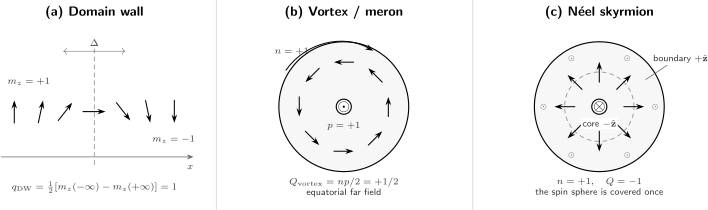
Three texture classes under the conventions of this page. A domain wall interpolates between disconnected easy-axis minima. A thin-film vortex winds once around an out-of-plane core and covers half the spin sphere, giving the meron charge . A unit Néel skyrmion with a down core, up background, and vorticity covers the sphere once and has .
Energy is not topology
Section titled “Energy is not topology”A representative two-dimensional micromagnetic energy is
The Dzyaloshinskii–Moriya density depends on crystal and interface symmetry, while is nonlocal magnetostatic energy. Their canonical forms and sign conventions are developed in Magnetic Anisotropy.
Under a dilation
local two-dimensional terms scale schematically as
Dipolar energy and finite boundaries have additional geometry dependence. A finite texture radius can be selected when terms with different scaling balance. Topological charge alone supplies no length scale.
For the ideal two-dimensional sigma model, define
Completing a square gives the Belavin–Polyakov bound
Configurations saturating the bound have a continuous size modulus: exchange alone neither selects a preferred radius nor makes the skyrmion the thermodynamic ground state. Lattice discreteness can remove scale invariance and permit collapse, while Dzyaloshinskii–Moriya coupling, frustrated exchange, anisotropy, field, dipolar energy, confinement, or higher-order interactions can stabilize a finite size.
Three stability statements must be kept separate:
- topological distinction means a smooth deformation is obstructed under declared boundary and fixed-length assumptions;
- metastability means the texture is a local free-energy minimum separated by a finite barrier;
- thermodynamic stability means it minimizes the relevant free energy against every competing phase.
A skyrmion can be topologically nontrivial and metastable, while a skyrmion lattice is stable only within a material- and geometry-dependent phase region.
Domain walls
Section titled “Domain walls”An easy-axis ferromagnet has two uniform minima,
A wall interpolates between them. With an oriented coordinate , define a one-dimensional wall charge
An up-to-down wall has in this convention; reversing the domains reverses the sign. This charge records the boundary interpolation and is not the two-dimensional skyrmion number .
For exchange stiffness and positive effective easy-axis anisotropy , the ideal wall scale and energy are
Those results, including the full minimizing profile and width-convention warning, are derived at From anisotropy to magnetic textures.
A Bloch wall rotates through an in-plane direction parallel to the wall, whereas a Néel wall rotates through the wall normal. Magnetostatics, thickness, crystal symmetry, and interfaces decide which costs less. Dzyaloshinskii–Moriya coupling can select both wall type and handedness, but observing a chiral wall does not determine without the rest of the energy ledger.
Two collective coordinates often describe a nearly rigid wall:
where is wall position and its internal rotation angle. Field or current can couple translation to internal precession. Above a material- and geometry-dependent Walker scale, no longer remains stationary and the simple steady-velocity picture fails. Pinning, wall tilting, deformation, and nucleation frequently matter before that ideal threshold.
Walls can terminate at a sample boundary, meet other walls, or change character through a three-dimensional singularity such as a Bloch point. Their dynamics therefore depends on both local texture and global domain geometry.
Magnetic vortices and merons
Section titled “Magnetic vortices and merons”In a thin disk, magnetostatic energy often favors in-plane flux closure. Far from a small core, write
with
The integer
is the vorticity. The phase sets circulation or helicity. Near the center, the magnetization turns out of plane to avoid an exchange singularity. Its polarity is
For the axisymmetric profile
the skyrmion charge inside a circular region is
A magnetic vortex with in-plane far field has
so
It covers half the spin sphere and is therefore called a meron. The half-integer is compatible with topology because the far-field magnetization is not one constant point on ; it winds around the equator.
Vorticity, polarity, and circulation are distinct labels. Reversing the core changes and without changing the in-plane winding. Reversing circulation can change without changing or . A vortex can annihilate with an antivortex, leave through an edge, or reverse polarity through a short-lived singular core.
The same gyroforce that appears for skyrmions produces gyrotropic vortex-core motion. Confinement supplies a restoring force, yielding a low-frequency orbit whose sense depends on core polarity under standard conventions.
Skyrmions, antiskyrmions, and helicity
Section titled “Skyrmions, antiskyrmions, and helicity”For the axisymmetric ansatz above, choose a down core and up background:
Then
With , this page therefore calls the texture . Other sign conventions are common.
For , the helicity distinguishes:
Topological charge does not determine helicity. Two textures can have the same and different in-plane winding patterns, energies, and responses.
An antiskyrmion has the opposite winding structure and typically anisotropic helicity around its perimeter. It is favored by selected anisotropic Dzyaloshinskii–Moriya tensors rather than by the isotropic bulk or ideal interfacial forms. A skyrmionium can contain nested walls with total . Magnetic bubbles can have or nonzero depending on their complete vector texture. A circular image alone does not determine the topological class.
An isolated skyrmion is a localized excitation or metastable state. A skyrmion crystal is a periodic magnetic phase with one or more topological objects per magnetic unit cell. Reciprocal-space Bragg peaks establish periodic order, while real-space or polarization-sensitive information is needed to determine the vector texture and charge.
How magnetic interactions select texture
Section titled “How magnetic interactions select texture”Different mechanisms stabilize superficially similar objects:
- bulk Dzyaloshinskii–Moriya coupling in chiral crystals commonly favors Bloch-type twists;
- interfacial Dzyaloshinskii–Moriya coupling in polar multilayers commonly favors Néel-type twists;
- anisotropic Dzyaloshinskii–Moriya coupling can favor antiskyrmions;
- dipolar energy can stabilize magnetic bubbles and flux-closure textures even without Dzyaloshinskii–Moriya coupling;
- frustrated exchange can select finite-wavevector and multi- textures in centrosymmetric magnets;
- itinerant multi-spin or Fermi-surface-mediated interactions can stabilize short-period noncoplanar order;
- confinement and patterned boundaries can stabilize states absent in the bulk phase diagram.
Broken inversion permits particular Dzyaloshinskii–Moriya invariants; it does not guarantee a skyrmion phase. Likewise, centrosymmetry forbids conventional pairwise Dzyaloshinskii–Moriya coupling on inversion-symmetric bonds but does not forbid all skyrmions.
Useful material families include chiral B20 magnets, polar magnets, ultrathin heavy-metal/ferromagnet multilayers, frustrated centrosymmetric magnets, ferrimagnetic films, antiferromagnets, and magnetic insulators. Their characteristic sizes span atomic to micrometre scales, and their stability windows vary greatly. “Skyrmion material” is therefore a phase-diagram statement, not merely a chemical label.
Creation, annihilation, and conditional protection
Section titled “Creation, annihilation, and conditional protection”In a smooth fixed-length continuum on a closed surface, cannot change continuously. Real magnets evade one of those assumptions through:
- escape across a physical boundary;
- a Bloch point or other three-dimensional singularity;
- local suppression of near a high-temperature or itinerant core;
- atomic-scale lattice evolution for which the continuum map ceases to be smooth;
- nucleation from a defect, notch, contact, or strongly driven region.
Topology can therefore raise an activation barrier and prolong lifetime, but it does not make a texture indestructible. The barrier depends on the actual annihilation path and can be much smaller at an edge or defect than in a perfect bulk calculation.
Emergent electrodynamics
Section titled “Emergent electrodynamics”When a conduction electron’s spin follows adiabatically, the spin eigenstate accumulates a real-space Berry phase. For the two locally aligned spin bands, a common convention gives
The emergent flux through one smooth texture is
The sign depends on the local spin band, electron-charge convention, and spatial orientation. The magnitude is one ordinary flux quantum per unit in this adiabatic continuum limit.
For a time-dependent texture, the corresponding emergent electric field can be written
A moving skyrmion lattice can therefore generate a spin-dependent electromotive response.
On a lattice, the local precursor is scalar spin chirality,
For slowly varying spins, oriented sums of approximate the continuum solid angle. At atomic scales, however, band structure, nonadiabaticity, multiple orbitals, and momentum-space Berry curvature can invalidate a simple emergent-field estimate.
An often used one-band estimate is
with carrier polarization and ordinary Hall coefficient . It is not a universal extraction formula. Multiband transport, anomalous Hall evolution, nonadiabatic scattering, inhomogeneity, and changing magnetic phases can all produce or reshape a Hall residual. A “topological Hall” hump is supporting evidence only when combined with independent texture information and a controlled background model.
Rigid-texture dynamics
Section titled “Rigid-texture dynamics”Projecting the Landau–Lifshitz–Gilbert equation onto a slowly translating texture gives a Thiele-type force balance. One common current-driven convention is
Here:
- is texture velocity;
- is an electron-drift or adiabatic spin-transfer velocity;
- is the gyrovector with ;
- is a dissipative tensor built from texture gradients;
- is Gilbert damping and a nonadiabatic coefficient;
- includes confinement, defects, and interactions;
- can represent spin–orbit torque, field gradients, temperature gradients, or other drives.
The gyroscopic term is transverse to motion and produces a skyrmion Hall angle in a ferromagnet. Damping produces a longitudinal drag. Pinning can impose a threshold, while deformation makes , , and the drive coupling state dependent.
In an ideal bipartite antiferromagnet, opposite sublattice gyrovectors can cancel, suppressing transverse drift. In a ferrimagnet, the gyroscopic coefficient can pass through zero near angular-momentum compensation. Neither cancellation is automatic in a real multilayer, canted state, uncompensated interface, or nonrigid texture.
The Thiele equation omits internal modes. Skyrmions can breathe, gyrate, deform, split, couple to magnons, and acquire effective inertia through additional coordinates. Near annihilation, collision, or strong drive, a rigid-particle interpretation can fail completely.
Computing charge from discrete data
Section titled “Computing charge from discrete data”Directly replacing derivatives by finite differences is fragile when a wall spans only a few pixels. A geometric method triangulates the image or simulation mesh. For an oriented triangle of unit vectors, define its signed solid angle by
Then
All triangles must use one orientation. Nearly antipodal neighboring spins make the solid-angle branch ambiguous and signal inadequate resolution, a singular configuration, or both.
A reproducible charge calculation should report:
- the reconstructed vector field, not only one magnetic projection;
- pixel or mesh spacing relative to wall width;
- normalization and masking rules;
- boundary treatment and assumed far field;
- triangle orientation and branch convention;
- uncertainty under smoothing, registration, and spatial resampling;
- whether the result is near an integer for physical reasons or by imposed boundary processing.
Experimental signatures
Section titled “Experimental signatures”No single probe universally measures .
| Probe | Primary sensitivity | What remains model dependent |
|---|---|---|
| Lorentz transmission electron microscopy | projected in-plane induction and deflection contrast | three-dimensional magnetization, core polarity, thickness and defocus transfer |
| Spin-polarized scanning tunneling microscopy | surface magnetic contrast with atomic resolution | tip polarization, vector reconstruction, subsurface texture |
| XMCD photoemission or transmission microscopy | element-specific magnetization projection | missing vector components, depth averaging, domain overlap |
| MFM or scanning NV magnetometry | stray field above the sample | inverse reconstruction, material parameters, buried layers |
| Small-angle neutron or resonant x-ray scattering | periodic wavevectors, orientation, selected chirality information | individual-object topology and defects |
| Hall transport | transverse electrical response | ordinary/anomalous backgrounds, adiabaticity, multiband coefficients |
| Microwave and terahertz spectroscopy | collective gyration and breathing modes | mode assignment and coexistence with non-skyrmion phases |
Evidence ladder
Section titled “Evidence ladder”A strong identification proceeds from morphology to vector topology:
- establish magnetic origin and calibrate spatial resolution;
- map field, temperature, thickness, and history dependence;
- reconstruct enough vector components to distinguish Bloch, Néel, antiskyrmion, bubble, and trivial-ring candidates;
- calculate with declared orientation and boundary assumptions;
- compare dimensions and phase boundaries with a complete energy model;
- use scattering, transport, resonance, or dynamics as orthogonal evidence;
- test creation and annihilation paths, including edges and defects;
- report coexistence and selection bias rather than presenting only the clearest objects.
Imaging circles plus a Hall hump is not yet a topology measurement. Conversely, imperfectly quantized from finite-resolution open-boundary data does not automatically refute a skyrmion interpretation. The inference must propagate measurement resolution and boundary uncertainty.
Common mistakes
Section titled “Common mistakes”| Mistake | Why it fails | Better practice |
|---|---|---|
| Treating topology as an energy-minimization theorem | Homotopy does not select radius or phase stability | Compute the full free energy and competing phases |
| Calling every circular domain a skyrmion | Bubbles and skyrmionia can have different | Reconstruct the vector field and integrate charge |
| Quoting without orientation | Its sign changes under axis or core/background conventions | State , film normal, core, and far field |
| Assuming Dzyaloshinskii–Moriya coupling is required | Dipolar, frustrated, and itinerant mechanisms can stabilize skyrmions | Identify the material’s actual interaction ledger |
| Assuming broken inversion guarantees skyrmions | Symmetry only permits selected chiral terms | Determine coefficients and the full phase diagram |
| Calling a vortex an integer skyrmion | Its far field winds on the equator | Track , , and the meron charge |
| Treating topological protection as indestructibility | Boundaries, singularities, amplitude collapse, and the lattice permit topology change | Calculate the minimum annihilation path |
| Extracting topology from a Hall residual | Background subtraction is model dependent | Combine transport with imaging or scattering |
| Applying a rigid Thiele equation during deformation | Internal modes and annihilation violate the ansatz | Check shape, drive, and frequency dependence |
| Computing from one image projection | A scalar projection does not specify | Reconstruct or constrain all vector components |
Exercises
Section titled “Exercises”1. Match defects to homotopy groups
Section titled “1. Match defects to homotopy groups”For an easy-axis magnet with two disconnected minima, an easy-plane magnet with order parameter , and an isotropic unit-vector magnet in two dimensions, identify the natural homotopy groups for a domain wall, vortex, and skyrmion.
Solution
The easy-axis vacuum manifold consists of two disconnected points. Domain walls are classified by disconnected components,
For an easy-plane order parameter,
and a loop surrounding a vortex maps into that circle:
For a fixed-length three-component field with constant far boundary, the compactified plane is and
These answers change if the actual magnetic order parameter has additional identifications or the boundary condition is relaxed.
2. Charge of an axisymmetric texture
Section titled “2. Charge of an axisymmetric texture”For
derive
Does depend on helicity ?
Solution
In polar coordinates,
and
For the ansatz,
Therefore
The constant drops out. Helicity changes the in-plane pattern but not the degree.
3. Why a vortex is a meron
Section titled “3. Why a vortex is a meron”Take a vortex with vorticity , core polarity , and in-plane far field. Find . Why need it not be an integer?
Solution
An in-plane far field has
Using the axisymmetric result,
The far field does not approach one constant point on the spin sphere. Instead it winds around the equator, so the compactified-plane assumption behind integer degree is absent. The texture covers half the sphere, hence “meron.”
4. Belavin–Polyakov bound
Section titled “4. Belavin–Polyakov bound”Starting from
use to prove
Solution
Because ,
Positivity gives
Expanding the square and using the scalar triple product yields
Choose the sign appropriate to the sign of :
Saturating the bound constrains the texture to a first-order self-duality equation. The bound fixes energy within a charge sector but does not select a radius.
5. Emergent flux
Section titled “5. Emergent flux”Using
show that a texture of charge carries emergent flux .
Solution
By the definition of ,
Therefore
This result assumes adiabatic following of a smooth fixed-length texture. It does not make the measured Hall resistance universal.
6. Hall angle from a simple Thiele balance
Section titled “6. Hall angle from a simple Thiele balance”Suppose
with scalar . Find , , and the Hall angle.
Solution
Since
the component equations are
and
Solving,
and
Thus
The sign follows the stated gyrovector and force conventions. Pinning, drive-dependent deformation, and edges can change the observed angle.
7. Evaluate an experimental claim
Section titled “7. Evaluate an experimental claim”An experiment reports circular MFM features and a hump remaining after ordinary-plus-anomalous Hall subtraction. List the additional evidence needed before claiming skyrmions with measured .
Solution
MFM measures stray field, not the complete magnetization vector, and Hall subtraction is model dependent. A stronger case would require:
- calibrated spatial resolution and a forward model connecting stray field to candidate textures;
- enough vector information to distinguish a trivial bubble, skyrmion, antiskyrmion, and skyrmionium;
- declared core, background, coordinate, and boundary conventions;
- a charge calculation with uncertainty under reconstruction and smoothing;
- field, temperature, thickness, and history phase maps;
- controls for multiband, anomalous Hall, inhomogeneous, and thermoelectric backgrounds;
- comparison with an interaction model using independently constrained , , , , and geometry;
- orthogonal evidence such as Lorentz microscopy, x-ray microscopy, scattering, or characteristic dynamics.
The two reported observations are compatible with skyrmions, but they do not uniquely establish vector topology or a numerical .
Connections
Section titled “Connections”- Magnetic Anisotropy owns the micromagnetic energy, wall profile, Dzyaloshinskii–Moriya invariants, and exchange lengths used here.
- Exchange Interactions develops the microscopic isotropic, symmetric-anisotropic, and antisymmetric pair couplings.
- Ferromagnetism develops domains, demagnetizing fields, hysteresis, and magnetic thermodynamics.
- Antiferromagnetism supplies Néel-order conventions and the compensated two-sublattice setting.
- Ferrimagnetism distinguishes magnetization and angular-momentum compensation in texture dynamics.
- Spintronics owns spin-transfer and spin–orbit torque normalization, injection, and device-level detection.
- Hall Measurements explains why a background-subtracted Hall hump is not a direct topology measurement and builds the required branch, geometry, and orthogonal-evidence checks.
- Hall Effect develops ordinary, anomalous, multiband, and quantized Hall backgrounds.
- Homotopy and Winding gives the general deformation and winding-number language.
- Berry Phase supplies the geometric phase underlying emergent gauge fields.
- Order Parameters explains how the correct magnetic manifold follows from symmetry and observable content.
References
Section titled “References”- A. A. Belavin and A. M. Polyakov, “Metastable states of two-dimensional isotropic ferromagnets,” JETP Letters 22, 245–248 (1975).
- A. N. Bogdanov and D. A. Yablonskii, “Thermodynamically stable ‘vortices’ in magnetically ordered crystals. The mixed state of magnets,” Soviet Physics JETP 68, 101–103 (1989).
- A. N. Bogdanov and A. Hubert, “Thermodynamically stable magnetic vortex states in magnetic crystals,” Journal of Magnetism and Magnetic Materials 138, 255–269 (1994), doi:10.1016/0304-8853(94)90046-9.
- U. K. Rößler, A. N. Bogdanov, and C. Pfleiderer, “Spontaneous skyrmion ground states in magnetic metals,” Nature 442, 797–801 (2006), doi:10.1038/nature05056.
- S. Mühlbauer, B. Binz, F. Jonietz, C. Pfleiderer, A. Rosch, A. Neubauer, R. Georgii, and P. Böni, “Skyrmion lattice in a chiral magnet,” Science 323, 915–919 (2009), doi:10.1126/science.1166767.
- X. Z. Yu, Y. Onose, N. Kanazawa, J. H. Park, J. H. Han, Y. Matsui, N. Nagaosa, and Y. Tokura, “Real-space observation of a two-dimensional skyrmion crystal,” Nature 465, 901–904 (2010), doi:10.1038/nature09124.
- N. Nagaosa and Y. Tokura, “Topological properties and dynamics of magnetic skyrmions,” Nature Nanotechnology 8, 899–911 (2013), doi:10.1038/nnano.2013.243.
- A. Fert, N. Reyren, and V. Cros, “Magnetic skyrmions: advances in physics and potential applications,” Nature Reviews Materials 2, 17031 (2017), doi:10.1038/natrevmats.2017.31.
- K. Everschor-Sitte, J. Masell, R. M. Reeve, and M. Kläui, “Perspective: Magnetic skyrmions—overview of recent progress in an active research field,” Journal of Applied Physics 124, 240901 (2018), doi:10.1063/1.5048972.
- C. H. Back, V. Cros, H. Ebert, K. Everschor-Sitte, A. Fert, M. Garst, T. Ma, S. Mankovsky, T. L. Monchesky, M. Mostovoy, N. Nagaosa, S. S. P. Parkin, C. Pfleiderer, N. Reyren, A. Rosch, Y. Taguchi, Y. Tokura, K. von Bergmann, and J. Zang, “The 2020 skyrmionics roadmap,” Journal of Physics D: Applied Physics 53, 363001 (2020), doi:10.1088/1361-6463/ab8418.
- A. A. Thiele, “Steady-state motion of magnetic domains,” Physical Review Letters 30, 230–233 (1973), doi:10.1103/PhysRevLett.30.230.
- B. Berg and M. Lüscher, “Definition and statistical distributions of a topological number in the lattice sigma-model,” Nuclear Physics B 190, 412–424 (1981), doi:10.1016/0550-3213(81)90568-X.
- A. Hubert and R. Schäfer, Magnetic Domains: The Analysis of Magnetic Microstructures, Springer (1998), doi:10.1007/978-3-540-85054-0.
- A. P. Malozemoff and J. C. Slonczewski, Magnetic Domain Walls in Bubble Materials, Academic Press (1979).
- T. Shinjo, T. Okuno, R. Hassdorf, K. Shigeto, and T. Ono, “Magnetic vortex core observation in circular dots of permalloy,” Science 289, 930–932 (2000), doi:10.1126/science.289.5481.930.
- B. Van Waeyenberge, A. Puzic, H. Stoll, K. W. Chou, T. Tyliszczak, R. Hertel, M. Fähnle, H. Brückl, K. Rott, G. Reiss, I. Neudecker, D. Weiss, C. H. Back, and G. Schütz, “Magnetic vortex core reversal by excitation with short bursts of an alternating field,” Nature 444, 461–464 (2006), doi:10.1038/nature05240.
- A. Neubauer, C. Pfleiderer, B. Binz, A. Rosch, R. Ritz, P. G. Niklowitz, and P. Böni, “Topological Hall effect in the A phase of MnSi,” Physical Review Letters 102, 186602 (2009), doi:10.1103/PhysRevLett.102.186602.
- T. Schulz, R. Ritz, A. Bauer, M. Halder, M. Wagner, C. Franz, C. Pfleiderer, K. Everschor, M. Garst, and A. Rosch, “Emergent electrodynamics of skyrmions in a chiral magnet,” Nature Physics 8, 301–304 (2012), doi:10.1038/nphys2231.
- S. Rohart and A. Thiaville, “Skyrmion confinement in ultrathin film nanostructures in the presence of Dzyaloshinskii–Moriya interaction,” Physical Review B 88, 184422 (2013), doi:10.1103/PhysRevB.88.184422.
- N. Romming, C. Hanneken, M. Menzel, J. E. Bickel, B. Wolter, K. von Bergmann, A. Kubetzka, and R. Wiesendanger, “Writing and deleting single magnetic skyrmions,” Science 341, 636–639 (2013), doi:10.1126/science.1240573.
- C. Moreau-Luchaire, C. Moutafis, N. Reyren, J. Sampaio, C. A. F. Vaz, N. Van Horne, K. Bouzehouane, K. Garcia, C. Deranlot, P. Warnicke, P. Wohlhüter, J.-M. George, M. Weigand, J. Raabe, V. Cros, and A. Fert, “Additive interfacial chiral interaction in multilayers for stabilization of small individual skyrmions at room temperature,” Nature Nanotechnology 11, 444–448 (2016), doi:10.1038/nnano.2015.313.
- S. Woo, K. Litzius, B. Krüger, M.-Y. Im, L. Caretta, K. Richter, M. Mann, A. Krone, R. M. Reeve, M. Weigand, P. Agrawal, I. Lemesh, M.-A. Mawass, P. Fischer, M. Kläui, and G. S. D. Beach, “Observation of room-temperature magnetic skyrmions and their current-driven dynamics in ultrathin metallic ferromagnets,” Nature Materials 15, 501–506 (2016), doi:10.1038/nmat4593.
- K. Litzius, I. Lemesh, B. Krüger, P. Bassirian, L. Caretta, K. Richter, F. Büttner, K. Sato, O. A. Tretiakov, J. Förster, R. M. Reeve, M. Weigand, I. Bykova, H. Stoll, G. Schütz, G. S. D. Beach, and M. Kläui, “Skyrmion Hall effect revealed by direct time-resolved x-ray microscopy,” Nature Physics 13, 170–175 (2017), doi:10.1038/nphys4000.
- F. Jonietz, S. Mühlbauer, C. Pfleiderer, A. Neubauer, W. Münzer, A. Bauer, T. Adams, R. Georgii, P. Böni, R. A. Duine, K. Everschor, M. Garst, and A. Rosch, “Spin transfer torques in MnSi at ultralow current densities,” Science 330, 1648–1651 (2010), doi:10.1126/science.1195709.
- S. Milde, D. Köhler, J. Seidel, L. M. Eng, A. Bauer, A. Chacon, J. Kindervater, S. Mühlbauer, C. Pfleiderer, S. Buhrandt, C. Schütte, and A. Rosch, “Unwinding of a skyrmion lattice by magnetic monopoles,” Science 340, 1076–1080 (2013), doi:10.1126/science.1234657.