Hall Effect
The Hall effect is a transverse electrical response: a current driven along one direction produces an electric field perpendicular to both the current and an axial quantity such as magnetic field or magnetization. In its simplest form, the Lorentz force deflects mobile charge until a transverse electrostatic field balances that deflection. In real quantum matter, the same measurement can also contain multiple carrier types, anisotropic scattering, Berry-curvature velocity, magnetic order, real-space spin texture, or a quantized two-dimensional response.
That variety makes the Hall effect unusually informative and unusually easy to overinterpret. A Hall slope can determine carrier density only within a validated one-carrier model. A positive slope need not prove that every Fermi-surface pocket is hole-like. A zero-field transverse signal need not scale with net magnetization. A plateau is not merely an ordinary Hall line with an especially precise slope.
This page owns Hall tensor and sign conventions, ordinary and multiband Hall transport, anomalous Hall mechanisms, and the bridge to quantized Hall response. Hall Measurements owns terminal geometry, signed-state acquisition, parity reduction, hysteresis protocols, carrier extraction, and experimental uncertainty. Drude Theory owns the relaxation-time benchmark, Boltzmann Transport owns the collision equation, and Quantum Hall Geometry Preview owns the geometric preview of Hall quantization.
Helpful background. Conventions fixes charge and tensor signs, Drude Theory supplies the one-carrier benchmark, and Boltzmann Transport with Fermi Surface supports the multiband semiclassical branch. Berry Curvature supports the intrinsic anomalous-Hall branch.
Convention Ledger
Section titled “Convention Ledger”Hall signs are meaningful only after the axes, tensor order, charge convention, and voltage polarity are fixed. Throughout this page:
- is a right-handed coordinate system;
- the imposed longitudinal current has ;
- the magnetic induction is ;
- is signed, with for electrons and for holes;
- the Hall resistivity is
- the weak-field Hall coefficient is
The in-plane conductivity tensor for an isotropic or fourfold-symmetric system is written
Its inverse is
Therefore
Some literature instead names as , or writes the antisymmetric conductivity entries in the opposite order. Those are legitimate conventions, but formulas cannot be transferred between them by inspection. The tensor definition above is the authority for every sign on this page.
Hall-Bar Geometry and Measured Voltage
Section titled “Hall-Bar Geometry and Measured Voltage”Consider a rectangular bar of width along , thickness along , and current along . In a uniform three-dimensional sample,
If the signed Hall voltage is defined operationally by , then
An actual voltmeter measures a scalar-potential difference. Because , the lead polarity must be mapped explicitly onto the stated definition of . Swapping the leads reverses the reported sign without changing the sample.
For a two-dimensional conducting sheet, thickness is not part of the response:
The three-dimensional has units of , whereas the sheet Hall resistance has units of . Likewise, has units of for a bulk density and for a sheet density.
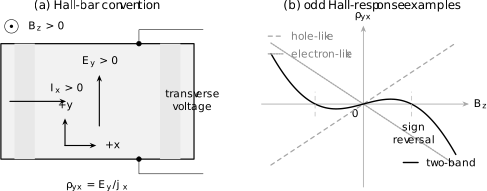
The sign convention fixes , , and . A one-carrier hole response has positive slope and an electron response negative slope. The solid curve is a schematic two-band response whose low- and high-field signs differ; Hall sign is therefore not a literal count of pocket types.
Classical One-Carrier Hall Effect
Section titled “Classical One-Carrier Hall Effect”Take carriers of density , signed charge , isotropic mass , and transport time . Their steady drift velocity obeys
With , the component equations are
Define the positive mobility and signed cyclotron parameter
Using gives
Tensor inversion, not a small-field approximation, gives
Thus the one-carrier Hall coefficient is
For , electrons give and holes give . The result can also be read directly from transverse force balance. Under open-circuit conditions , hence , and the equation requires
Because , dividing gives .
What the minimal result does and does not say
Section titled “What the minimal result does and does not say”The same model predicts no longitudinal magnetoresistance:
This cancellation is special to one isotropic parabolic band with one constant . A measured field dependence of is not a failure of tensor algebra; it is evidence that at least one simplifying assumption is inadequate.
The Hall angle in this convention is
Only when may one use
Replacing resistivity by conductivity without checking this condition can corrupt both magnitudes and scaling exponents.
Hall Coefficient, Density, and Mobility
Section titled “Hall Coefficient, Density, and Mobility”In the one-carrier model,
These equations are model-dependent inference rules, not definitions of density or mobility. They require:
- one relevant carrier species;
- a known charge magnitude;
- a uniform conducting volume or sheet;
- an approximately parabolic, isotropic transport response;
- a Hall factor near one;
- negligible parallel conduction;
- a field range appropriate to the inferred limit.
In a doped semiconductor, is often called the Hall density. The name should preserve the qualification: it need not equal a chemical dopant density, a total band filling, or a quantum-oscillation carrier count.
Energy-dependent scattering and the Hall factor
Section titled “Energy-dependent scattering and the Hall factor”Even one isotropic nondegenerate parabolic band can depart from when depends on energy. In the standard weak-field treatment,
For this result, the average is weighted by the current-carrying states:
If in the nondegenerate limit,
Cauchy–Schwarz implies for this positive weighting. In a strongly degenerate metal with a smooth , the thermal window narrows around the Fermi energy and . Band anisotropy and anisotropic scattering require more general tensor factors; they cannot always be compressed into one universal scalar .
Multiband Hall Transport
Section titled “Multiband Hall Transport”Suppose independent carrier groups have density , signed charge , and positive mobility . For isotropic bands their Drude conductivities add:
The measured resistivities follow only after the summed tensor is inverted. At weak field,
The numerator weights mobility quadratically. A small population of highly mobile carriers can therefore set the Hall sign even when another population dominates the number of states.
Electron–hole model
Section titled “Electron–hole model”For electron density , hole density , and mobilities ,
The exact two-carrier Hall resistivity is
Away from exact compensation, and once both and are large,
The weak-field sign is mobility weighted; the high-field sign approaches the net charge imbalance. A sign reversal between these limits is therefore possible without any field-induced change of band topology.
At compensation, , the nominal high-field expression is singular and the full formula must be retained. More generally, the limit assumes closed semiclassical orbits, field-independent densities and mobilities, and no magnetic breakdown. Open Fermi surfaces, density-wave reconstruction, quantum oscillations, or field-driven phase changes can invalidate it.
Identifiability of a multiband fit
Section titled “Identifiability of a multiband fit”A nonlinear is compatible with multiband transport, but it does not uniquely determine a microscopic band structure. Several parameter sets can fit the same field window, especially when is omitted. A defensible analysis should:
- fit and simultaneously;
- transform the measured tensor to and consistently;
- report parameter covariances and sensitivity to the chosen field range;
- compare densities with stoichiometry, capacitance, ARPES, or quantum oscillations;
- test whether fitted mobilities predict the observed onset of nonlinearity.
An excellent fit is evidence for compatibility, not uniqueness.
Fermi-Surface and Boltzmann View
Section titled “Fermi-Surface and Boltzmann View”The scalar formula conceals the geometry of a crystal band. In weak magnetic field, the Lorentz term moves a wave packet along a constant-energy surface:
Within a relaxation-time treatment, the first magnetic correction to the conductivity can be written
For an isotropic parabolic band and constant , this reduces to the Drude result. For an anisotropic Fermi surface, the curvature of the velocity field and the variation of the mean free path matter. Consequently:
- a single connected band can have a nontrivial Hall coefficient;
- electron-like and hole-like regions can coexist on a complicated Fermi surface;
- scattering anisotropy can change the Hall response without changing the enclosed volume;
- an interacting metal need not admit a simple carrier-density interpretation.
At stronger field, carriers retain memory around longer portions of their semiclassical orbit. The Chambers formula on Boltzmann Transport provides the corresponding velocity-history construction.
Extracting the Odd Transverse Signal
Section titled “Extracting the Odd Transverse Signal”Real Hall contacts are never perfectly aligned. A fraction of the usually much larger longitudinal voltage leaks into the transverse leads. If ordinary longitudinal resistivity is even in magnetic field while Hall resistivity is odd, field reversal separates them:
This procedure removes an even longitudinal pickup but is not a universal background subtraction. It can fail or need modification when:
- the magnetization is hysteretic, so and lie on different magnetic branches;
- the longitudinal response itself has an odd component from broken reciprocity or inhomogeneous current flow;
- contacts heat differently under current reversal;
- the sample has planar Hall response tied to an in-plane magnetic direction;
- current jetting produces a field-dependent nonuniform current path;
- parallel surface, substrate, or contact layers conduct.
For a magnetic sample, record both sweep directions and treat as state variables. Current reversal,
rejects current-even thermoelectric offsets, but it does not replace field symmetrization.
Resistivity first, conductivity second
Section titled “Resistivity first, conductivity second”Geometry converts measured voltages and currents into . The conductivity is then obtained from the full tensor. With the convention above,
Using is justified only at small Hall angle. This distinction becomes essential near a quantum Hall plateau, in a clean anomalous Hall metal, or whenever is not small compared with .
Ordinary and Anomalous Hall Effects
Section titled “Ordinary and Anomalous Hall Effects”The ordinary Hall effect is the field-odd orbital response associated with the Lorentz force and the carrier dynamics described above. In a magnetic material, an additional transverse response can track magnetic order even as the external field tends to zero. A useful phenomenological decomposition is
Here denotes the ordinary contribution and the anomalous Hall contribution. Writing the decomposition this way avoids silently mixing magnetic induction with magnetic field or absorbing convention-dependent factors of into an anomalous coefficient.
The formula is a fitting organization, not a microscopic derivation. It is most credible when magnetization independently saturates, the high-field ordinary slope is reproducible, and the decomposition works across temperature, orientation, and sweep history. In a multiband magnet, itself can be nonlinear in field. In a metamagnet, the band structure and scattering can change with . A straight-line subtraction is then not guaranteed to isolate a unique anomalous signal.
Intrinsic Berry-Curvature Contribution
Section titled “Intrinsic Berry-Curvature Contribution”For a nondegenerate Bloch band, adopt the Berry connection and curvature
The wave-packet velocity contains an anomalous term:
At zero external magnetic field, , so the anomalous velocity is transverse to . The resulting intrinsic Hall conductivity in the convention of this page is
This is an occupied-state property of the band wavefunctions. It does not require a Lorentz-force deflection or an asymmetric impurity collision. Near avoided crossings opened by spin–orbit coupling, Berry curvature can become strongly concentrated and make the intrinsic anomalous Hall response sensitive to chemical potential.
Symmetry constraints
Section titled “Symmetry constraints”Time reversal relates Berry curvature at opposite crystal momenta:
In thermal equilibrium with unbroken time reversal, paired states have equal occupations and the linear charge Hall conductivity vanishes. Inversion instead makes Berry curvature even in momentum. When both symmetries hold, the Abelian curvature of an isolated nondegenerate band vanishes pointwise wherever that description is valid.
Broken time reversal is necessary for an equilibrium linear anomalous charge Hall effect, but a large uniform magnetization is not. Noncollinear antiferromagnets can have nearly zero net moment and still possess a symmetry-allowed Berry-curvature integral. The magnetic space group, not merely the scalar , decides whether is allowed.
Filled two-dimensional bands
Section titled “Filled two-dimensional bands”For a completely filled isolated two-dimensional band,
The intrinsic formula becomes
This is the geometric bridge between anomalous Hall response in bands and quantized Hall conductance. The sign follows the Berry-curvature and tensor conventions stated above; changing either convention changes the displayed sign but not the measured physics.
Extrinsic Anomalous Hall Mechanisms
Section titled “Extrinsic Anomalous Hall Mechanisms”Disorder and scattering also generate anomalous Hall response. The traditional mechanism labels are useful, but in a multiband spin–orbit-coupled material their separation can depend on the theoretical representation.
Skew scattering
Section titled “Skew scattering”Spin–orbit-coupled disorder can make the transition probability asymmetric:
when the magnetic state breaks time reversal. The asymmetric part produces a transverse component of the nonequilibrium distribution. In the conventional clean-limit regime,
At small Hall angle this implies
Side jump
Section titled “Side jump”During a spin–orbit-coupled scattering event, a wave packet can acquire a coordinate shift transverse to its incoming direction. The event rate scales as while the nonequilibrium occupation scales as , leaving the conventional side-jump conductivity of order . Its resistivity contribution therefore often scales as
at small Hall angle.
The intrinsic Berry-curvature conductivity is also of order in the clean metallic regime. This motivates the empirical scaling form
The linear term is often associated with skew scattering and the quadratic term with intrinsic plus side-jump response. That association is a diagnostic, not a proof. Temperature can change phonon and impurity scattering differently, longitudinal channels can mix, and the intrinsic Berry-curvature integral can itself change with magnetization or chemical potential. A mechanism claim should combine scaling with microscopic calculation, controlled disorder variation, and symmetry information.
Distinguishing Other Transverse Responses
Section titled “Distinguishing Other Transverse Responses”Several effects can resemble an anomalous Hall trace:
| Effect | Essential ingredient | Key distinction |
|---|---|---|
| Planar Hall effect | Anisotropic magnetoresistance with in-plane field or order | Commonly even under reversal of the axial field and depends on in-plane angle |
| Topological Hall contribution | Real-space spin chirality and adiabatic coupling | Extracted residual is model dependent; subtraction alone does not establish a skyrmion phase |
| Spin Hall effect | Transverse spin current from spin–orbit coupling | Charge Hall voltage may vanish under time reversal |
| Thermal Hall effect | Transverse heat transport | Requires thermal-gradient and heat-current definitions, including magnetization-current corrections |
| Nonlinear Hall effect | Second- or higher-order electric response | Can occur in a time-reversal-invariant but inversion-broken metal; scales nonlinearly with drive |
The phrase “topological Hall effect” is especially vulnerable to overclaiming. A hump left after subtracting fitted ordinary and anomalous backgrounds is not by itself a real-space topology measurement. Imaging, scattering, field-angle dependence, and a controlled model of the magnetic texture are needed.
Quantum Hall Bridge
Section titled “Quantum Hall Bridge”In a sufficiently clean two-dimensional electron system at strong perpendicular field, the Hall response ceases to be a smooth semiclassical line. Landau quantization reorganizes the spectrum, and experiment finds plateaus
When ,
The filling factor has magnitude
for a simple spin-resolved two-dimensional gas. Integer plateaus arise when the chemical potential lies in a mobility gap: bulk states at the Fermi level are localized while chiral edge transport remains. The robustness is tied to an integer Chern number, not to an exceptionally accurate estimate of a Drude relaxation time.
The ordinary and quantum Hall effects are connected but not interchangeable:
- the ordinary result follows from semiclassical force balance and depends continuously on density;
- the integer quantum Hall value is a two-dimensional conductance fixed by and a topological integer;
- disorder is detrimental to mobility yet helps broaden plateaus by localizing bulk states;
- edge channels and bulk topology supply a description absent from the one-carrier Drude model.
Landau Levels owns the orbital spectrum, Chern Numbers owns the topological invariant, and Quantum Hall Discovery records the experimental milestone. Integer Quantum Hall Effect develops plateau formation, edge states, localization, flux insertion, and resistance metrology.
Interpretation Workflow
Section titled “Interpretation Workflow”A reliable Hall analysis proceeds in layers:
- Declare conventions. Record axes, field direction, lead polarity, tensor order, thickness, and whether or is plotted.
- Establish reciprocity checks. Reverse current, reverse field, repeat both sweep directions, and inspect raw even and odd components.
- Construct resistivity. Apply the sample geometry and uncertainty in thickness before tensor inversion.
- Test the minimal model. Ask whether is linear, is field independent, and independent evidence supports one carrier.
- Escalate only as needed. Compare multiband, anisotropic Boltzmann, magnetic, and Berry-curvature descriptions against both longitudinal and transverse data.
- Constrain the fit externally. Use magnetization, gate capacitance, stoichiometry, spectroscopy, oscillations, or imaging.
- Report the regime. State temperature, field interval, Hall angle, hysteresis branch, and whether parameters are weak-field, high-field, or global-fit quantities.
Common mistakes
Section titled “Common mistakes”- Reporting a carrier sign without stating voltage polarity or tensor convention.
- Using in an evidently nonlinear multiband trace.
- Calling every positive Hall slope “hole doping.”
- Fitting with a conductivity formula, or vice versa.
- Treating as exact.
- Removing a hysteretic anomalous signal by naive antisymmetrization.
- Assigning terms uniquely to microscopic mechanisms.
- Calling a residual hump a topological Hall effect without independent evidence.
- Comparing a bulk Hall coefficient with a sheet Hall resistance without converting dimensions.
Exercises
Section titled “Exercises”1. Hall sign from force balance
Section titled “1. Hall sign from force balance”For and , derive the sign of for electrons and holes without inverting a tensor.
Solution
Open-circuit transverse conditions imply . The component of
is , so . Since , electron drift has and hole drift has . Therefore for electrons and for holes. Equivalently, .
2. Invert the Hall tensor
Section titled “2. Invert the Hall tensor”Starting from
derive and show that the signs of and agree in this convention.
Solution
The determinant is , and
Hence
Because is positive, the two components have the same sign. The component has the opposite sign.
3. A two-band sign reversal
Section titled “3. A two-band sign reversal”Use dimensionless parameters , , , and . Determine the weak-field sign, the high-field sign, and the nonzero field at which the exact two-band changes sign.
Solution
The weak-field numerator is
so the initial Hall slope is hole-like. At high field, , so is electron-like.
The nonzero crossing satisfies
Thus
in the reciprocal-mobility field units used for the parameters. No carrier density changes at the crossing.
4. Bound on the Hall factor
Section titled “4. Bound on the Hall factor”Prove for the positive transport weighting used in the one-band Hall factor. When does equality hold?
Solution
Normalize the positive weight so that . Cauchy–Schwarz applied to and gives
Therefore
Equality holds when is constant over all states carrying nonzero weight.
5. Contact misalignment
Section titled “5. Contact misalignment”Suppose a raw transverse resistance is
where . Show what field antisymmetrization returns. What changes if the magnetic state is hysteretic?
Solution
The odd component is
so the even longitudinal contamination cancels. In a hysteretic sample, the states reached at and need not be time-reversed partners on one sweep. An anomalous contribution tied to can then be mixed or erased incorrectly. Both sweep branches and independent magnetization information are required.
6. Filled Chern band
Section titled “6. Filled Chern band”Starting from the intrinsic Berry-curvature formula, derive the Hall conductivity of one completely filled two-dimensional band with Chern number .
Solution
For a filled band,
Therefore
The displayed sign belongs to the connection, curvature, and tensor conventions used on this page.
7. Scaling is not mechanism identification
Section titled “7. Scaling is not mechanism identification”In the small-Hall-angle regime, show why gives , whereas a Hall conductivity gives . Explain why observing these powers is not a unique microscopic diagnosis.
Solution
For small Hall angle,
Since , a skew term gives . A intrinsic or side-jump term gives .
The inference is not unique because several scattering channels can have different temperature dependence, intrinsic Berry curvature can change with magnetic order or chemical potential, side-jump and intrinsic terms share the same leading power, and the approximation fails at large Hall angle.
Connections
Section titled “Connections”- Hall Measurements turns the tensor and mechanism dictionary into Hall-bar and van der Pauw acquisition, four-state reduction, multiband fitting, magnetic-history, and uncertainty workflows.
- Transport Measurements develops terminal notation, current and field reversal, reciprocity, contact, geometry, and tensor-reduction checks shared by longitudinal and transverse measurements.
- Conventions for Quantum Matter fixes charge, field, response, and dimensional conventions used throughout the volume.
- Drude Theory derives the relaxation-time conductivity and optical benchmark.
- Boltzmann Transport develops collision operators, transport lifetimes, and finite-field velocity histories.
- Fermi Surface explains electron and hole pockets, orbit geometry, and quantum oscillations.
- Berry Curvature owns the geometric field and its gauge structure.
- Kubo Formula gives the exact equilibrium linear-response framework.
- Spintronics develops spin Hall injection, inverse conversion, spin pumping, and torque measurements at the device level.
- Integer Quantum Hall Effect is the canonical home for quantized plateaus, mobility gaps, chiral edges, and Hall-resistance metrology.
- Weyl and Dirac Semimetals develops Berry-curvature Hall response, chiral-anomaly transport, and the experimental controls needed to separate them from ordinary multiband effects.
- Conductance Quantization separates ordinary ballistic channel steps from topological Hall plateaus and tracks degeneracy, contacts, and transmission.
- Two-Dimensional Electron Gases applies low- and high-field Hall response to sheet-density counting, multiband mobility weighting, quantum lifetimes, and dimensionality tests.
- Mesoscopic Transport introduces coherent devices, conductance channels, and multiterminal measurements.
- Condensed-Matter Roadmap places transport among band theory, many-body physics, and topology.
References
Section titled “References”- E. H. Hall, “On a New Action of the Magnet on Electric Currents,” American Journal of Mathematics 2, 287–292 (1879), doi:10.2307/2369245.
- N. W. Ashcroft and N. D. Mermin, Solid State Physics (Holt, Rinehart and Winston, 1976), Chapters 12 and 13.
- J. M. Ziman, Principles of the Theory of Solids, 2nd ed. (Cambridge University Press, 1972), Chapters 7 and 9.
- R. G. Chambers, “The kinetic formulation of conduction problems,” Proceedings of the Physical Society. Section A 65, 458–459 (1952), doi:10.1088/0370-1298/65/6/114.
- R. Karplus and J. M. Luttinger, “Hall Effect in Ferromagnetics,” Physical Review 95, 1154–1160 (1954), doi:10.1103/PhysRev.95.1154.
- L. Berger, “Side-Jump Mechanism for the Hall Effect of Ferromagnets,” Physical Review B 2, 4559–4566 (1970), doi:10.1103/PhysRevB.2.4559.
- J. Sinitsyn, “Semiclassical theories of the anomalous Hall effect,” Journal of Physics: Condensed Matter 20, 023201 (2008), doi:10.1088/0953-8984/20/02/023201.
- N. Nagaosa, J. Sinova, S. Onoda, A. H. MacDonald, and N. P. Ong, “Anomalous Hall effect,” Reviews of Modern Physics 82, 1539–1592 (2010), doi:10.1103/RevModPhys.82.1539.
- D. Xiao, M.-C. Chang, and Q. Niu, “Berry phase effects on electronic properties,” Reviews of Modern Physics 82, 1959–2007 (2010), doi:10.1103/RevModPhys.82.1959.
- F. D. M. Haldane, “Berry Curvature on the Fermi Surface: Anomalous Hall Effect as a Topological Fermi-Liquid Property,” Physical Review Letters 93, 206602 (2004), doi:10.1103/PhysRevLett.93.206602.
- K. von Klitzing, G. Dorda, and M. Pepper, “New Method for High-Accuracy Determination of the Fine-Structure Constant Based on Quantized Hall Resistance,” Physical Review Letters 45, 494–497 (1980), doi:10.1103/PhysRevLett.45.494.
- D. J. Thouless, M. Kohmoto, M. P. Nightingale, and M. den Nijs, “Quantized Hall Conductance in a Two-Dimensional Periodic Potential,” Physical Review Letters 49, 405–408 (1982), doi:10.1103/PhysRevLett.49.405.