Two-Dimensional Electron Gases
A two-dimensional electron gas is a populated many-electron system whose accessible low-energy motion is extended in two directions and frozen into one or a few confinement subbands in the third. The name describes kinematics and occupation, not an assumption that interactions, disorder, spin, valleys, or finite thickness are absent.
The most controlled examples are semiconductor inversion layers, heterojunctions, and quantum wells. Related electronic systems occur at surfaces, in atomically thin materials, and at complex-oxide interfaces, but their orbital content and confinement mechanisms can differ substantially. Calling all of them “the 2DEG” hides the very parameters that decide their behavior.
This page owns the populated-interface ledger: density and Fermi scales, finite-thickness effects, transport and quantum lifetimes, disorder diagnostics, readiness for quantum Hall physics, two-dimensional spin–orbit response, and standards for oxide-interface claims. Quantum Wells owns the underlying one-direction confinement, heterointerface matching, subband DOS, and optical selection rules. Graphene and Dirac Materials owns the contrasting linear-dispersion density scales, sublattice pseudospin, and Dirac Landau sequence. Hall Effect owns ordinary and multiband Hall inversion. Integer Quantum Hall Effect and Fractional Quantum Hall Effect own the plateau mechanisms and topological phases.
Operational Definition
Section titled “Operational Definition”Let and be the first two confinement thresholds. A clean single-subband hierarchy is
where is the single-particle broadening and is the in-plane Fermi energy. The inequalities need not be extremely strong for useful quasi-two-dimensional behavior, but every occupied subband, valley, and spin branch must be counted.
Several distinct tests support a two-dimensional assignment:
- subband spectroscopy resolves confinement normal to the layer;
- magnetotransport depends primarily on the perpendicular field ;
- quantum-oscillation frequencies count sheet rather than volume density;
- electrostatic gating changes a sheet conductance and a confined charge profile;
- thickness-sensitive probes bound the carrier distribution along ;
- a self-consistent band and electrostatic model reproduces both confinement and occupation.
An anisotropic three-dimensional conductor can imitate one or two of these signatures. Dimensionality is strongest when geometry, spectrum, field-angle dependence, and charge counting agree.
Density and Fermi-Scale Ledger
Section titled “Density and Fermi-Scale Ledger”For one circular parabolic subband with total unresolved degeneracy , state counting gives
and therefore
The in-plane Fermi energy and velocity are
These formulas require an explicit degeneracy convention. Spin, valley, layer, orbital, and subband degeneracies can be lifted by strain, interfaces, magnetic field, or spin–orbit coupling. For a noncircular Fermi contour, Luttinger state counting uses its area:
A density inferred from a circular contour can therefore be wrong even when the measured area is correct.
Interaction scale
Section titled “Interaction scale”For a conventional parabolic 2DEG, define the effective Bohr radius
and the mean-spacing parameter
Roughly, compares Coulomb energy at the mean spacing with kinetic energy. Small favors a weak-coupling starting point; increasing strengthens exchange and correlation effects. It is not a phase label. Finite thickness, valleys, dielectric environment, disorder, and Landau-level projection can all change the relevant many-body problem.
The static two-dimensional polarizability is constant for in the ideal zero-temperature parabolic model. With the Coulomb convention
the Thomas–Fermi wavevector is
This compact result does not make screening density independent in every observable: , finite thickness, local-field corrections, multiple bands, and dynamic response still depend on the physical regime. Plasmons Preview owns the collective plasmon and its damping.
Interface Confinement
Section titled “Interface Confinement”At a semiconductor interface, band offsets and electrostatic band bending confine carriers normal to the plane. A useful idealization is a hard barrier at and a triangular potential for :
The envelope equation has Airy-function solutions, with energies
where obeys and . The key scalings are
A stronger interface field raises confinement energies and narrows the charge profile.
The Fang–Howard variational envelope,
provides a convenient analytic profile. It has
The variational parameter is fixed by kinetic energy, interface field, depletion charge, and electron–electron electrostatics; it is not a free “thickness” detached from density.
Self-consistency and modulation doping
Section titled “Self-consistency and modulation doping”The populated layer contributes to the electric field that confines it. A realistic calculation iterates the subband occupations with Poisson’s equation, fixed dopants, gates, interface charge, and material-dependent dielectric response. A square or triangular potential with independently prescribed density is only an estimate.
Modulation doping spatially separates mobile electrons from their ionized parent donors. An undoped spacer suppresses large-angle impurity scattering and enabled exceptionally high mobilities in GaAs/AlGaAs. The separation is a tradeoff: remote charges still produce long-wavelength disorder, and increasing the setback changes density, screening, and confinement as well as scattering.
Undoped field-effect structures can reduce ionized-donor disorder, but gate dielectrics, background impurities, surface charge, and contacts remain. “Undoped” does not mean disorder free.
Finite-thickness form factors
Section titled “Finite-thickness form factors”A 2DEG has two-dimensional kinematics but a nonzero charge-profile width. Projecting an interaction into the occupied envelope produces a form factor such as
Because at sufficiently large , finite thickness softens short-distance interactions. The same profile affects interface-roughness scattering, subband-dependent spin–orbit coupling, and parallel-field orbital response. Treating a real layer as a mathematical plane is controlled only when the relevant in-plane length scales greatly exceed its width.
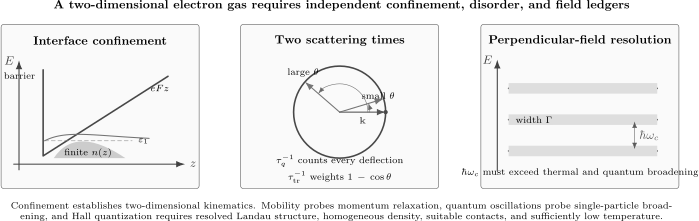
Three ledgers that should not be collapsed into one quality number. Confinement and self-consistent charge establish two-dimensional kinematics; and weight the disorder angular spectrum differently; and resolved Landau structure requires to exceed thermal and quantum broadening.
Mobility and Disorder
Section titled “Mobility and Disorder”For a single parabolic electron band in the low-field Drude regime,
where is sheet conductance and is the momentum-relaxation time. The associated mean free path is
Mobility is useful, but it is not a universal sample-quality scalar. It weights scattering by momentum loss and can be very large when disorder produces mostly small-angle deflections.
Transport and quantum lifetimes
Section titled “Transport and quantum lifetimes”For elastic scattering on the Fermi contour with angular kernel ,
The quantum lifetime counts every event that broadens a single-particle orbit. The transport lifetime suppresses forward scattering because a small deflection barely relaxes current. Consequently,
is a signature of predominantly small-angle disorder, not an inconsistency.
The ratio is diagnostic only within a model. Spatial density variations, multiple subbands, nonuniform current, interaction corrections, and an incorrectly assumed effective mass can contaminate the extracted times.
Quantum oscillations and the Dingle factor
Section titled “Quantum oscillations and the Dingle factor”For weak Shubnikov–de Haas oscillations, a common first-harmonic form is
with
The temperature factor can determine a cyclotron mass; the Dingle factor estimates a quantum lifetime under assumptions of uniform density, appropriate line broadening, and a controlled field window. A nonlinear “Dingle plot” can signal unresolved beating, field-dependent scattering, density inhomogeneity, or the breakdown of the weak-oscillation approximation.
The Onsager frequency satisfies
For total degeneracy ,
If spin or valley branches are resolved, must be changed accordingly rather than inserted by habit.
Disorder sources
Section titled “Disorder sources”| Source | Typical spatial character | Strongly affects | Diagnostic control |
|---|---|---|---|
| remote ionized dopants | long range, often small angle | more than | spacer thickness and density dependence |
| background charged impurities | long range throughout layers | both lifetimes and low-density inhomogeneity | growth purity and depth dependence |
| interface roughness | short-range height fluctuations | high-density mobility and subband broadening | well width, electric field, and growth orientation |
| alloy disorder | atomic scale in alloy-occupied regions | quantum and transport scattering | wavefunction overlap with alloy |
| phonons | temperature dependent | mobility and energy relaxation | temperature and lattice comparison |
| surface or dielectric charge | long range and often time dependent | drift, hysteresis, low-frequency noise | gate history, illumination, and sweep rate |
| macroscopic density gradients | spatially smooth | oscillation damping and plateau transitions | multi-contact and local-probe comparison |
Matthiessen’s rule,
is an approximation. Screening, correlated disorder, occupation changes, and energy-dependent scattering can prevent independent rates from adding.
Hall density and multiband traps
Section titled “Hall density and multiband traps”For one electron band at low magnetic field,
With several same-sign bands, the low-field Hall coefficient becomes
It is mobility weighted and generally does not equal . A nonlinear Hall trace may support multiband conduction, but fitting too many densities and mobilities can be non-identifiable. Oscillation frequencies, capacitance, gating, and spectroscopic subband information are needed to stabilize the inference.
Quantum Hall Platform
Section titled “Quantum Hall Platform”A perpendicular magnetic field reorganizes each 2D parabolic band into Landau levels. The central scales are
and the total filling factor is
Here counts all occupied spin, valley, layer, and orbital branches. Whether individual branches are resolved depends on Zeeman energy, spin–orbit coupling, interactions, and disorder.
A practical hierarchy for observing resolved orbital quantization is
The condition describes strong classical orbital bending, but quantum oscillation visibility is tied more directly to . High mobility helps, yet it does not guarantee narrow Landau levels, homogeneous density, good contacts, or low electron temperature.
The integer quantum Hall effect additionally requires localization between extended-state energies so that plateaus acquire finite width. The fractional effect requires interactions to dominate the residual disorder and temperature after projection into a partially filled Landau level. Mobility alone does not rank samples universally for fragile fractional states; density, well width, Landau-level mixing, alloy content, and the disorder spectrum matter.
Integer Quantum Hall Effect owns plateau quantization, localization, chiral edges, Chern response, and metrology. Fractional Quantum Hall Effect owns incompressible correlated fluids, fractional charge and statistics, composite fermions, and evidence standards.
Spin–Orbit Effects
Section titled “Spin–Orbit Effects”Structural inversion asymmetry in a confined layer permits a Rashba term,
while bulk inversion asymmetry in a [001] zinc-blende well permits a leading Dresselhaus term,
up to basis and axis conventions. With pure linear Rashba coupling,
so the same total sheet density can occupy two spin-split contours.
Gating often changes , but it also changes density, screening, wavefunction position, subband occupation, and disorder. A gate-dependent weak-antilocalization curve therefore does not isolate one parameter without a coupled electrostatic and transport model.
Common probes include:
- beating or multiple frequencies in quantum oscillations;
- weak antilocalization and its field-angle dependence;
- spin precession in patterned channels;
- optical or photoemission spin-resolved spectroscopy;
- anisotropic spin relaxation;
- the persistent-spin-helix regime near balanced linear Rashba and Dresselhaus couplings.
Each has ambiguities. Density inhomogeneity or two occupied subbands can imitate beating. Weak-antilocalization fits depend on dimensionality, elastic regime, cubic terms, intervalley scattering, and dephasing. Spin–Orbit Coupling in Solids owns the symmetry derivation, spin textures, weak-(anti)localization framework, and spin Hall caveats.
Oxide Interfaces
Section titled “Oxide Interfaces”The conducting interface between LaAlO and SrTiO established that two insulating oxides can host a gate-tunable, quasi-two-dimensional electronic system. It also illustrates why semiconductor 2DEG intuition must be used carefully.
Several mechanisms can contribute to interface charge:
- polar discontinuity and electronic reconstruction;
- oxygen vacancies or other defects;
- cation intermixing;
- surface adsorbates and redox chemistry;
- strain, ferroelectric-like polarization, and structural relaxation;
- electrostatic gating and trapped charge.
These mechanisms are not mutually exclusive. Growth oxygen pressure, annealing, thickness, termination, electrostatic history, and illumination can change their relative importance. A nominal polar-layer thickness threshold supports an electrostatic mechanism but does not prove that every mobile carrier comes from one idealized half-electron transfer.
Orbital and dielectric complexity
Section titled “Orbital and dielectric complexity”At SrTiO-based interfaces, Ti orbitals can produce several subbands with distinct in-plane masses, confinement lengths, and mobilities. The dielectric response of SrTiO is large, temperature dependent, and nonlinear in electric field. Consequently:
- the charge profile need not be a simple Fang–Howard envelope;
- Hall density can differ strongly from total transferred charge;
- a Lifshitz-like change in occupied orbitals can alter transport;
- spin–orbit and superconducting scales can vary nonmonotonically with gate voltage;
- multiband fits can be underdetermined.
The word “2D” should be supported by perpendicular-field scaling, confinement or depth profiling, anisotropic critical fields where relevant, and sheet-density consistency. Oxygen-vacancy conduction extending deep into the substrate can look interfacial in a two-terminal measurement but fail these tests.
Superconductivity has been observed and electrostatically tuned in LaAlO/SrTiO interfaces. Magnetic signals have also been reported in related samples. Establishing microscopic coexistence requires more than observing both signatures somewhere on one device: spatial homogeneity, probe volume, sample history, and alternative defect phases must be addressed.
Semiconductor and oxide ledgers
Section titled “Semiconductor and oxide ledgers”| Question | Conventional semiconductor 2DEG | Complex-oxide interface |
|---|---|---|
| low-energy orbitals | often one conduction band plus spin and valleys | often several transition-metal orbitals |
| dielectric response | usually modest and approximately linear | can be large, nonlinear, and temperature dependent |
| charge source | dopants, gate, or known band bending | reconstruction, defects, chemistry, gate, and polarization may coexist |
| disorder control | spacer, purity, roughness, dielectric charge | vacancies, intermixing, domains, dislocations, surface chemistry |
| Hall interpretation | single-band regime often attainable | multiband mobility weighting is common |
| model starting point | effective-mass Schrödinger–Poisson | multiorbital, structural, electrostatic, and correlation effects may all be needed |
Experimental Inference Workflow
Section titled “Experimental Inference Workflow”- Establish geometry. Measure layer thickness, interface termination, gate dimensions, and contact configuration.
- Count charge independently. Compare low- and high-field Hall response, capacitance, oscillation frequencies, and known gate charge.
- Resolve occupation. Test for multiple subbands, valleys, layers, or orbitals using spectroscopy and field dependence.
- Separate lifetimes. Extract from mobility and from controlled quantum-oscillation damping.
- Test dimensionality. Rotate the magnetic field, constrain the depth profile, and compare sheet and volume descriptions.
- Track temperature and current. Verify electron temperature, linear response, phonon crossover, and possible heating.
- Vary disorder deliberately. Use spacer thickness, growth conditions, density, illumination, or gate history rather than one nominally clean sample.
- Audit model identifiability. Report parameter correlations and alternative fits for multiband Hall, weak antilocalization, and self-consistent confinement.
- Match claims to probes. Mobility supports long momentum relaxation; it does not alone establish phase coherence, narrow levels, topology, or microscopic homogeneity.
Common Mistakes
Section titled “Common Mistakes”Calling an interface conductor two-dimensional from geometry alone
Section titled “Calling an interface conductor two-dimensional from geometry alone”A thin nominal layer or buried interface is not enough. Use spectral, angular-field, and charge-profile evidence.
Treating mobility as the quantum lifetime
Section titled “Treating mobility as the quantum lifetime”suppresses forward scattering; does not. Remote disorder can produce a large ratio.
Equating Hall density with total charge in a multiband layer
Section titled “Equating Hall density with total charge in a multiband layer”Low-field Hall response is mobility weighted. Compare it with oscillations, capacitance, and gate charge.
Using a square well for an occupied heterojunction without self-consistency
Section titled “Using a square well for an occupied heterojunction without self-consistency”The electron density helps create its own confining field. Dopants, gates, and dielectric response must enter Poisson’s equation.
Forgetting finite thickness
Section titled “Forgetting finite thickness”Two-dimensional kinematics does not imply a delta-function charge profile. Interaction, roughness, parallel-field, and spin–orbit matrix elements retain -dependence.
Inferring spin splitting from beating alone
Section titled “Inferring spin splitting from beating alone”Two subbands, density inhomogeneity, or Zeeman evolution can produce similar oscillations. Use complementary probes and gate dependence.
Assuming high mobility guarantees quantum Hall quality
Section titled “Assuming high mobility guarantees quantum Hall quality”Quantum lifetime, density uniformity, electron temperature, contacts, and the relevant many-body gap are independent constraints.
Assigning oxide-interface charge to one mechanism by default
Section titled “Assigning oxide-interface charge to one mechanism by default”Polar reconstruction, vacancies, intermixing, surface chemistry, and gating can coexist and depend on preparation.
Exercises
Section titled “Exercises”1. Fermi scales in GaAs
Section titled “1. Fermi scales in GaAs”A spin-degenerate GaAs 2DEG has and . Find , , , and .
Solution
Convert the density:
With ,
The Fermi energy and velocity are
These are in-plane scales. The system is single-subband only if remains below the next confinement threshold after self-consistency.
2. Mobility, transport time, and mean free path
Section titled “2. Mobility, transport time, and mean free path”For the 2DEG in Exercise 1, take . Find and .
Solution
The mobility is . Thus
Using the velocity from Exercise 1,
This long mean free path supports ballistic device behavior over shorter lengths, but it does not determine phase-coherence length or quantum lifetime.
3. Diagnose two lifetimes
Section titled “3. Diagnose two lifetimes”A sample has and . What does the ratio suggest? What does it not prove?
Solution
The ratio
suggests that small-angle scattering is important. Such events broaden quantum orbits but relax momentum inefficiently, as expected for remote charged disorder.
The ratio does not uniquely identify remote dopants. Background charge at a distance, smooth interface potential, density inhomogeneity, or extraction errors can produce similar behavior. One should test density and spacer dependence, verify Dingle linearity, rule out unresolved subbands, and compare with a screened-disorder model.
4. Density from an oscillation frequency
Section titled “4. Density from an oscillation frequency”A circular spin-degenerate 2DEG has one Shubnikov–de Haas frequency . Find the sheet density. How would the result change if the spin branches were separately resolved and referred to one branch?
Solution
For unresolved spin degeneracy ,
If belonged to one resolved, nondegenerate spin contour, that branch would contain
The total density would require summing all resolved branch frequencies.
5. Magnetic scales and filling
Section titled “5. Magnetic scales and filling”For , , and , calculate , , and . Compare the cyclotron energy with at .
Solution
The total filling is
The magnetic length and cyclotron energy are
At , , so thermal broadening is much smaller than the orbital spacing. Disorder broadening and unresolved spin splitting must still be checked. Since is not an integer, the field does not place the ideal homogeneous system at an integer filling.
6. Triangular-well scaling
Section titled “6. Triangular-well scaling”The interface field doubles while material parameters remain fixed. By what factors do the triangular-well energies and characteristic width change?
Solution
Since
doubling gives
In a real device, changing gate voltage also changes density, screening, depletion charge, and possibly occupied subbands, so the pure scaling is a controlled benchmark rather than a complete gate-response model.
7. Audit a gate-tuned spin-splitting claim
Section titled “7. Audit a gate-tuned spin-splitting claim”Quantum-oscillation beating changes with gate voltage and is fitted to a gate-dependent Rashba coefficient. List independent checks needed before accepting that interpretation.
Solution
Check whether one or several confinement subbands are occupied; compare the sum of oscillation-frequency densities with Hall and capacitance density; test whether the nodes follow the expected field evolution including Zeeman splitting; map density homogeneity across contacts; repeat at several temperatures; fit weak antilocalization with the correct elastic regime and cubic terms; model how gating moves the envelope and changes both Rashba and Dresselhaus couplings; and seek a spin-precession or spectroscopic cross-check.
Beating alone does not distinguish spin-split contours from two orbital subbands or a spatial density distribution.
8. Audit an oxide-interface 2DEG claim
Section titled “8. Audit an oxide-interface 2DEG claim”A LaAlO/SrTiO sample conducts after low-oxygen-pressure growth and has a nonlinear Hall trace. What evidence would distinguish a confined multiband interface system from oxygen-vacancy conduction extending into the substrate?
Solution
Useful tests include oxygen annealing and controlled growth-pressure dependence; depth-sensitive conductivity or spectroscopy; magnetic-field rotation to test scaling; gate response from both sides of the interface; comparison of capacitance, Hall, and oscillation densities; thickness and termination dependence; local mapping of conduction; and a multiband fit constrained by independent orbital or spectroscopic information.
Nonlinear Hall response alone establishes neither confinement nor a particular charge source. A strong case combines a bounded depth profile, two-dimensional field scaling, reproducible electrostatic control, and preparation-dependent tests of vacancy alternatives.
Connections
Section titled “Connections”- Low-Dimensional Quantum Matter separates geometric, kinematic, critical, and environmental dimension and gives the general crossover evidence behind a 2DEG assignment.
- Two-Dimensional Materials distinguishes atomically thin crystals from populated interfaces and develops their nonlocal screening, valleys, excitons, stacking, and gate controls.
- Engineered Heterostructures compares semiconductor and oxide 2DEGs with other interface platforms and separates formal compensation charge from mobile carriers.
- Quantum Wells develops the confinement Hamiltonian, heterointerface matching, subband density of states, and optical transitions beneath the occupied-layer description.
- Fermi Momentum and Fermi Energy supplies dimension-dependent state counting and thermodynamic Fermi scales.
- Boltzmann Transport develops the distribution function, collision operator, and limits of relaxation-time models.
- Hall Effect owns one- and multiband Hall tensors, sign conventions, and inversion pitfalls.
- Quantum Coherence in Conductors separates elastic scattering, dephasing, thermal averaging, and escape.
- Universal Conductance Fluctuations develops magnetofingerprint variance, scaling, gate-energy calibration, and symmetry-mode counting.
- Quantum Point Contacts treats split-gate electrostatics, electronic width, local adiabatic modes, and charge-detector operation in a patterned 2DEG.
- Conductance Quantization owns the Landauer channel ledger, plateaus, imperfect transmission, contact resistance, and noise diagnosis.
- Integer Quantum Hall Effect develops plateaus, localization, edges, Chern response, and resistance metrology.
- Fractional Quantum Hall Effect develops interaction-driven incompressibility, fractional quasiparticles, composite fermions, and edge evidence.
- Spin–Orbit Coupling in Solids owns Rashba and Dresselhaus symmetry, spin textures, weak antilocalization, and spin Hall response.
- Plasmons Preview develops two-dimensional screening and collective charge modes.
- Condensed Matter Roadmap places 2DEGs between band engineering, mesoscopic transport, topological phases, and correlated matter.
Further Reading
Section titled “Further Reading”- T. Ando, A. B. Fowler, and F. Stern, “Electronic Properties of Two-Dimensional Systems,” Reviews of Modern Physics 54, 437–672 (1982), doi:10.1103/RevModPhys.54.437.
- J. H. Davies, The Physics of Low-Dimensional Semiconductors, Cambridge University Press (1998), doi:10.1017/CBO9780511819070.
- T. Ihn, Semiconductor Nanostructures: Quantum States and Electronic Transport, Oxford University Press (2010), doi:10.1093/acprof:oso/9780199534425.001.0001.
- S. Das Sarma and A. Pinczuk, eds., Perspectives in Quantum Hall Effects, Wiley (1997), doi:10.1002/9783527617258.
References
Section titled “References”- F. F. Fang and W. E. Howard, “Negative Field-Effect Mobility on (100) Si Surfaces,” Physical Review Letters 16, 797–799 (1966), doi:10.1103/PhysRevLett.16.797.
- F. Stern, “Polarizability of a Two-Dimensional Electron Gas,” Physical Review Letters 18, 546–548 (1967), doi:10.1103/PhysRevLett.18.546.
- R. Dingle, H. L. Störmer, A. C. Gossard, and W. Wiegmann, “Electron Mobilities in Modulation-Doped Semiconductor Heterojunction Superlattices,” Applied Physics Letters 33, 665–667 (1978), doi:10.1063/1.90457.
- T. Ando, A. B. Fowler, and F. Stern, “Electronic Properties of Two-Dimensional Systems,” Reviews of Modern Physics 54, 437–672 (1982), doi:10.1103/RevModPhys.54.437.
- P. T. Coleridge, “Small-Angle Scattering in Two-Dimensional Electron Gases,” Physical Review B 44, 3793–3801 (1991), doi:10.1103/PhysRevB.44.3793.
- M. J. Manfra, “Molecular Beam Epitaxy of Ultra-High-Quality AlGaAs/GaAs Heterostructures: Enabling Physics in Low-Dimensional Electronic Systems,” Annual Review of Condensed Matter Physics 5, 347–373 (2014), doi:10.1146/annurev-conmatphys-031113-133905.
- K. von Klitzing, G. Dorda, and M. Pepper, “New Method for High-Accuracy Determination of the Fine-Structure Constant Based on Quantized Hall Resistance,” Physical Review Letters 45, 494–497 (1980), doi:10.1103/PhysRevLett.45.494.
- D. C. Tsui, H. L. Störmer, and A. C. Gossard, “Two-Dimensional Magnetotransport in the Extreme Quantum Limit,” Physical Review Letters 48, 1559–1562 (1982), doi:10.1103/PhysRevLett.48.1559.
- Y. A. Bychkov and E. I. Rashba, “Properties of a 2D Electron Gas with Lifted Spectral Degeneracy,” JETP Letters 39, 78–81 (1984).
- J. Nitta, T. Akazaki, H. Takayanagi, and T. Enoki, “Gate Control of Spin-Orbit Interaction in an Inverted InGaAs/InAlAs Heterostructure,” Physical Review Letters 78, 1335–1338 (1997), doi:10.1103/PhysRevLett.78.1335.
- J. D. Koralek, C. P. Weber, J. Orenstein, B. A. Bernevig, S.-C. Zhang, S. Mack, and D. D. Awschalom, “Emergence of the Persistent Spin Helix in Semiconductor Quantum Wells,” Nature 458, 610–613 (2009), doi:10.1038/nature07871.
- A. Ohtomo and H. Y. Hwang, “A High-Mobility Electron Gas at the LaAlO/SrTiO Heterointerface,” Nature 427, 423–426 (2004), doi:10.1038/nature02308.
- S. Thiel, G. Hammerl, A. Schmehl, C. W. Schneider, and J. Mannhart, “Tunable Quasi-Two-Dimensional Electron Gases in Oxide Heterostructures,” Science 313, 1942–1945 (2006), doi:10.1126/science.1131091.
- N. Nakagawa, H. Y. Hwang, and D. A. Muller, “Why Some Interfaces Cannot Be Sharp,” Nature Materials 5, 204–209 (2006), doi:10.1038/nmat1569.
- N. Reyren et al., “Superconducting Interfaces between Insulating Oxides,” Science 317, 1196–1199 (2007), doi:10.1126/science.1146006.
- A. D. Caviglia et al., “Electric Field Control of the LaAlO/SrTiO Interface Ground State,” Nature 456, 624–627 (2008), doi:10.1038/nature07576.
- P. Zubko, S. Gariglio, M. Gabay, P. Ghosez, and J.-M. Triscone, “Interface Physics in Complex Oxide Heterostructures,” Annual Review of Condensed Matter Physics 2, 141–165 (2011), doi:10.1146/annurev-conmatphys-062910-140445.