Ferromagnetism
Ferromagnetism is an equilibrium phase with spontaneous uniform magnetization. In a selected thermodynamic state, the magnetic-moment density remains nonzero as the externally applied selecting field is removed:
The word uniform distinguishes conventional ferromagnetic order from antiferromagnetic, spiral, and other finite-wavevector magnetic structures. The word spontaneous distinguishes the phase from an ordinary paramagnet whose magnetization disappears with the applied field.
Neither word means that every macroscopic specimen behaves as one bar magnet. A low-field sample often divides into domains whose local magnetizations have magnitude but cancel in the spatial average. Hysteresis, remanence, and coercivity then depend on domain-wall motion, defects, shape, and measurement history. They are important material properties, but none is the thermodynamic definition of ferromagnetism.
This page owns ferromagnetism as a material phase: its order parameter, spin-symmetry breaking, domains, low-energy spin waves, Curie behavior, experiments, and local-moment versus itinerant descriptions. Spontaneous Symmetry Breaking owns the general thermodynamic-limit construction, Magnons owns spin-wave quantization, and Exchange Interactions owns microscopic coupling pathways.
Required background. Exchange Interactions supplies coupling signs and microscopic mechanisms, while Order Parameters supplies the source-selected definition of a phase.
Helpful background. Spontaneous Symmetry Breaking develops the thermodynamic-limit logic, and Finite-Temperature Phase Transitions supplies transition and scaling caveats.
Magnetization as the Order Parameter
Section titled “Magnetization as the Order Parameter”The SI magnetization is magnetic dipole moment per volume:
It has units of . Spin, orbital angular momentum, and itinerant current can all contribute to ; a site-local sum is only one representation of the total magnetic moment.
In matter,
in SI units. The magnetic induction , magnetic field , and magnetization are distinct quantities. Their separation inside a finite magnet depends on the sample’s demagnetizing field and shape anisotropy.
Spontaneous and saturation magnetization
Section titled “Spontaneous and saturation magnetization”The spontaneous magnetization is the equilibrium order-parameter magnitude inside a pure, selected domain at zero internal field. The saturation magnetization is the high-field moment after domains align and any remaining canting or moment-amplitude response is suppressed.
They can be close at low temperature in a simple local-moment ferromagnet, but they are not definitions of the same limiting procedure. A high field can continue to polarize itinerant bands, crystal-field levels, paramagnetic impurities, or noncollinear components after domains are already aligned.
The order of limits
Section titled “The order of limits”Let be an energy-density source conjugate to magnetization. A selected spontaneous magnetization is
The thermodynamic limit comes first. In a finite system with exact time-reversal or spin-flip symmetry, an unbiased thermal state can have
even when it has strong ferromagnetic correlations. Reversing the limits keeps that symmetric answer and misses phase selection.
Long-range order can instead be diagnosed through correlations:
in an ideal uniform phase. A symmetric mixture of oppositely magnetized states can have zero one-point function but a nonzero long-distance two-point limit.
Broken Symmetry
Section titled “Broken Symmetry”For an isotropic exchange Hamiltonian without spin–orbit coupling or field, global spin rotations form an symmetry. A ferromagnetic state chooses a direction :
Rotations about leave the state invariant, so the symmetry-breaking pattern is
The order-parameter manifold is
Time reversal changes , so a magnetized state also breaks time reversal. The states and are symmetry-related members of the same ordered phase when the Hamiltonian has that symmetry.
Crystal anisotropy changes the exact symmetry
Section titled “Crystal anisotropy changes the exact symmetry”Spin–orbit coupling ties the magnetization to the lattice. An easy-axis ferromagnet may have only two low-energy orientations, and , related by time reversal. An easy-plane magnet retains an approximate angular degree of freedom within a plane. Cubic anisotropy supplies several crystallographically equivalent easy directions.
The order parameter is still magnetization, but the exact broken group, domain variants, critical universality class, and magnon gap all change. Describing every ferromagnet as exact breaking silently discards the material’s spin–orbit and dipolar energies.
A ferromagnetic finite-size exception
Section titled “A ferromagnetic finite-size exception”Many symmetry-breaking systems have a unique symmetric finite-size ground state and only develop oriented states through near-degenerate superpositions as volume grows. The isotropic Heisenberg ferromagnet is special: its maximal-total-spin ground multiplet can be exactly degenerate even at finite size, and a fully polarized member already has nonzero magnetization.
This exception does not make phase language unnecessary. Robustness to local perturbations, thermodynamic correlations, finite-temperature order, domains, and response still distinguish a ferromagnetic phase from an accidentally degenerate few-spin system.
Exchange and the Uniform State
Section titled “Exchange and the Uniform State”Using the convention of Exchange Interactions,
ferromagnetic couplings have . Parallel spin correlations lower their bond energy.
A negative nearest-neighbor is neither necessary nor sufficient for a real material to show simple ferromagnetism:
- longer-range couplings can select a spiral or another wavevector;
- anisotropic exchange can favor noncollinear order;
- frustration can suppress long-range order;
- dimensional fluctuations can destroy finite-temperature continuous order;
- itinerant magnetism may not admit fixed local spins;
- dipolar and anisotropy energies determine the mesoscale texture.
For a translation-invariant isotropic spin model, the favored ordering wavevector is controlled by the minimum of the Fourier-transformed exchange energy. A conventional ferromagnet orders at
This reciprocal-space statement is more general than the sign of one bond.
Landau Description Near the Curie Point
Section titled “Landau Description Near the Curie Point”For an easy-axis magnet in zero stress and a uniform approximation, let denote the signed magnetization along the easy axis. A minimal Landau free-energy density is
with , , and source .
At , stationarity gives
The mean-field branches are
Above , the source susceptibility is
This gives the mean-field exponents
Those powers describe the quartic saddle point, not every material. Critical fluctuations, dipolar interactions, anisotropy, disorder, coupling to strain, and gapless electrons can alter the asymptotic regime or drive a first-order transition. Landau Theory owns the general expansion and Universality owns critical classification.
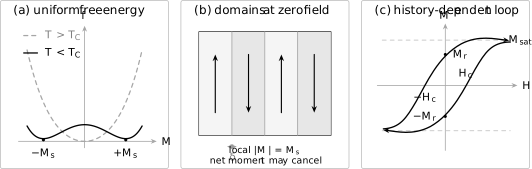
Below , the uniform free energy has symmetry-related magnetized minima. A finite body can reduce magnetostatic energy by forming domains whose local moment is nonzero while the net zero-field moment cancels. A hysteresis loop records metastable switching, remanence , and coercive field ; it is not the equilibrium free-energy curve.
Curie–Weiss Regime and Molecular Field
Section titled “Curie–Weiss Regime and Molecular Field”For localized moments of spin and number density , the high-temperature Curie constant is
A molecular-field treatment gives
The Weiss temperature is obtained by extrapolating the high-temperature inverse susceptibility. It is not automatically the measured transition temperature.
For the exchange convention
uniform local-moment mean field predicts
A net ferromagnetic exchange sum makes the right-hand side positive. The same approximation gives .
Real fluctuations lower or reshape the transition, and competing interactions can make a poor estimate of . Curie–Weiss susceptibility is evidence for correlated magnetic degrees of freedom, not by itself proof that rigid local moments exist or that the eventual ordered state is ferromagnetic.
Domains
Section titled “Domains”A uniformly magnetized finite body produces stray magnetic field outside itself. The field energy can be extensive:
The sample can reduce this magnetostatic energy by forming regions with different magnetization directions. Creating more domains costs wall energy, so the equilibrium pattern balances:
- exchange stiffness, which penalizes rapid spatial rotation;
- magnetic anisotropy, which penalizes departure from easy directions;
- magnetostatic energy, which favors flux closure;
- Zeeman energy in an applied field;
- magnetoelastic energy, surfaces, and defects.
A simple micromagnetic functional for a unit direction field is
Here is exchange stiffness and an easy-axis anisotropy density.
A 180-degree domain wall
Section titled “A 180-degree domain wall”For a one-dimensional wall with
the exchange-plus-anisotropy energy per area is
Minimization gives the ideal profile
Its wall energy is
A commonly quoted conventional wall width is
The numerical width depends on definition and on whether the wall is Bloch-like, Néel-like, chiral, confined, or magnetostatically distorted.
Demagnetizing field and sample shape
Section titled “Demagnetizing field and sample shape”For a uniformly magnetized ellipsoid along a principal axis,
where is the demagnetizing factor for that axis. The factors along three principal axes sum to one in this SI convention.
Raw susceptibility, apparent saturation field, and hysteresis shape can depend strongly on geometry. A claimed intrinsic curve should state whether and how the demagnetizing correction was made.
Hysteresis Is a Nonequilibrium Record
Section titled “Hysteresis Is a Nonequilibrium Record”The familiar loop occurs because the system does not instantaneously find the global equilibrium minimum as field changes. Domain walls pin at defects, new domains nucleate across barriers, and coherent or incoherent rotation can remain metastable.
Key loop quantities are:
- remanent magnetization : the moment remaining after a saturating field is removed along a specified history;
- coercive field : the reverse field at which the measured net magnetization crosses zero;
- saturation field: an operational field range in which domain and canting changes become negligible;
- loop area: energy dissipated per cycle under the stated protocol.
These are rate-, temperature-, geometry-, and microstructure-dependent. A soft ferromagnet can have tiny and nearly zero remanence. A blocked assembly of noninteracting nanoparticles can show hysteresis on laboratory timescales without constituting a bulk equilibrium ferromagnetic phase.
Equilibrium thermodynamics uses global free-energy minima and is reversible. A hysteresis loop maps metastability and dynamics. Confusing the two turns coercive behavior into a false phase definition.
Spin Waves and Low-Temperature Magnetization
Section titled “Spin Waves and Low-Temperature Magnetization”Long-wavelength rotations of an ordered ferromagnet form spin waves. In an isotropic ferromagnet at zero field,
For an isotropic solid,
The quadratic dispersion is a type-B Goldstone mode. Although two spin-rotation generators are broken, their commutator has a nonzero expectation value proportional to the magnetization, so the two transverse coordinates form one canonical pair and one magnon branch.
Magnetic anisotropy, field, dipolar coupling, finite size, or nonconservation of spin can gap or reshape the long-wavelength mode. Goldstone Modes in Many-Body Systems owns the counting, while Magnons owns the Holstein–Primakoff derivation.
Each simple ferromagnetic magnon lowers the conserved axial spin by one unit. For a three-dimensional gapless quadratic band, the thermal magnon density scales as
This produces Bloch’s low-temperature law,
within its regime of validity. A gap gives activated behavior at sufficiently low temperature; itinerant particle–hole excitations and magnon interactions add corrections.
Dimensionality and the Curie Temperature
Section titled “Dimensionality and the Curie Temperature”The Mermin–Wagner theorem excludes nonzero-temperature ferromagnetic long-range order in one- or two-dimensional isotropic Heisenberg models with sufficiently short-range exchange. The low-energy quadratic magnons make the thermal spin-deviation integral infrared divergent in .
The theorem does not say that every atomically thin magnet must be paramagnetic. Real two-dimensional ferromagnets can order because one or more assumptions are changed:
- spin–orbit coupling creates easy-axis or discrete anisotropy;
- dipolar interactions are long ranged;
- weak interlayer exchange makes the system quasi-two-dimensional;
- finite lateral size cuts off the longest wavelengths;
- substrate coupling or strain modifies the symmetry.
These ingredients can be small compared with microscopic exchange yet decisive for . Reporting only the largest misses the scale that regularizes the infrared physics.
Localized-Moment Ferromagnetism
Section titled “Localized-Moment Ferromagnetism”In a localized-moment description, atomic or molecular moments exist over times long compared with the collective spin dynamics. Their magnitudes remain approximately fixed while exchange organizes their orientations:
Typical signatures include:
- Curie–Weiss susceptibility over a substantial paramagnetic range;
- an effective moment near an identifiable atomic multiplet;
- local magnetic spectral weight persisting above ;
- magnetic entropy comparable with a local-spin manifold;
- well-defined exchange-driven magnons below ;
- ferromagnetism that can occur in an electrical insulator.
None of these is individually conclusive. Crystal fields, covalency, Kondo screening, and orbital-selective correlations can renormalize the apparent moment.
The phrase “localized” concerns the magnetic degree of freedom, not necessarily the entire material. A local-moment ferromagnet can coexist with conduction electrons that mediate RKKY exchange or carry spin-polarized current.
Itinerant Ferromagnetism
Section titled “Itinerant Ferromagnetism”In an itinerant ferromagnet, the same delocalized electrons form bands and develop a spin-polarized occupation. The canonical Stoner Criterion derivation compares the band-energy cost of transferring particles between spin-resolved Fermi seas with the exchange-energy gain.
For a paramagnetic density of states per spin and a matching scalar interaction , the uniform unpolarized state loses quadratic mean-field stability when
The threshold explains why a large density of states can promote ferromagnetism, but it does not determine the ordered moment or Curie temperature. The scalar Stoner model neglects finite-wavevector competitors, strong dynamical spin fluctuations, nonlocal correlations, detailed orbital structure, and the possibility that sizable local moments survive above . It is a starting point for the material discussion, not a complete theory of metallic magnets.
A continuum, not a binary classification
Section titled “A continuum, not a binary classification”Local-moment and itinerant language describe limiting organizations:
| Question | Local-moment limit | Itinerant limit |
|---|---|---|
| What orders? | Pre-existing moment orientations | Spin polarization of bands |
| Above | Moment amplitude can persist | Polarization may collapse |
| Natural model | Spin Hamiltonian | Interacting band model |
| Low-energy charge | Can be gapped | Usually metallic |
| Primary scale | Exchange among moments | Bandwidth, density of states, interaction |
Real iron, cobalt, nickel, rare-earth metals, and correlated ferromagnets need not sit at either endpoint. Hund coupling can create robust local moments in a metal, while itinerant carriers determine their coherence and exchange. A trustworthy analysis asks which moment amplitudes, time scales, orbitals, and wavevectors are actually resolved.
Experimental Identification
Section titled “Experimental Identification”Ferromagnetism is established most reliably by converging evidence.
Bulk magnetometry
Section titled “Bulk magnetometry”Measure with known sample volume or mass and correct for substrate, holder, and demagnetizing contributions. Extrapolating a high-field branch to zero internal field can estimate , but linear backgrounds and unsaturated components must be modeled.
Near , look for consistent behavior in:
- spontaneous magnetization;
- low-field susceptibility;
- heat capacity;
- critical scattering or correlation length;
- hysteresis and domain contrast;
- frequency and size dependence.
An Arrott-style plot based on a mean-field equation of state can be useful, but straight lines and exponents are model assumptions. Modified critical plots should be checked against independent scaling and demagnetizing corrections.
Magnetic structure
Section titled “Magnetic structure”Elastic neutron diffraction, polarized neutron scattering, resonant x-ray scattering, and magnetic circular dichroism can establish the direction, wavevector, and element-resolved moment. Conventional ferromagnetic order has , so magnetic intensity can overlap nuclear Bragg peaks; polarization analysis or temperature dependence is then important.
Local and spatial probes
Section titled “Local and spatial probes”Muon spin rotation, nuclear magnetic resonance, Mössbauer spectroscopy, scanning magnetometry, magnetic force microscopy, Kerr microscopy, Lorentz microscopy, and x-ray magnetic imaging probe different combinations of local field, dynamics, surface sensitivity, and domain structure.
Seeing domains is strong evidence for a ferroic order parameter, but the imaged contrast must be tied to magnetization rather than strain, topography, or another correlated order.
Excitations and electronic structure
Section titled “Excitations and electronic structure”Inelastic neutron scattering and spin-polarized electron spectroscopy measure magnon dispersion and damping. Spin-resolved photoemission, tunneling, and optical probes can test exchange-split bands. A local-moment model should reproduce both static order and dynamic spectral weight; an itinerant model should account for the observed band polarization and collective modes.
Distinguishing Nearby Magnetic States
Section titled “Distinguishing Nearby Magnetic States”| State | Uniform moment | Internal pattern | Defining distinction |
|---|---|---|---|
| Ferromagnet | Nonzero in a selected domain | Equivalent moments align uniformly | Primary order is magnetization |
| Ferrimagnet | Usually nonzero | Opposing unequal sublattices | Net moment is a difference of sublattice orders |
| Canted antiferromagnet | Small nonzero component possible | Primary staggered order | Uniform moment is secondary to Néel order |
| Spin glass | Sample-dependent frozen moment | Random, nonperiodic freezing | No conventional uniform long-range order |
| Superparamagnet | Time-window dependent | Finite ferromagnetic particles fluctuate | Blocking is not a bulk equilibrium transition |
| Paramagnet | Zero at zero field | No spontaneous uniform order | Magnetization is induced and vanishes with field |
A nonzero net moment does not alone identify ferromagnetism. The ordering wavevector, sublattice structure, thermodynamic limit, and time dependence decide the classification.
Reliable Analysis Workflow
Section titled “Reliable Analysis Workflow”- Define the magnetic variables. State SI or cgs units and distinguish , , and .
- Correct geometry. Report shape, demagnetizing factor, volume, and field orientation.
- Separate equilibrium and history. Measure both field directions, sweep rates, waiting times, and zero-field protocols.
- Identify the ordering wavevector. Uniform magnetization alone can hide ferrimagnetic or canted structure.
- Establish a bulk transition. Combine magnetization with thermodynamic or scattering evidence.
- Resolve domains. Test whether a small net signal reflects cancellation rather than absent local order.
- Choose a microscopic limit. Compare local moments, band splitting, charge transport, and dynamic susceptibility.
- Test excitations. Fit the full magnon or spin-fluctuation spectrum, not only .
- State finite-size and anisotropy scales. They are decisive in films and two-dimensional materials.
Common mistakes
Section titled “Common mistakes”- Defining ferromagnetism by hysteresis rather than spontaneous equilibrium order.
- Calling a multidomain sample paramagnetic because its zero-field net moment is small.
- Equating , , and .
- Ignoring demagnetizing fields when comparing shapes or orientations.
- Treating the Weiss temperature as an exact Curie temperature.
- Using mean-field critical exponents as universal material laws.
- Saying two-dimensional ferromagnetism violates Mermin–Wagner without checking anisotropy and interaction range.
- Calling every nonzero magnetic moment ferromagnetic.
- Treating local-moment and itinerant descriptions as mutually exclusive labels.
- Inferring a microscopic mechanism from one loop.
Exercises
Section titled “Exercises”1. Why the thermodynamic limit comes first
Section titled “1. Why the thermodynamic limit comes first”Suppose a finite easy-axis magnet has an exact symmetry that sends . Explain why its zero-field Gibbs state has , and why this does not exclude ferromagnetism.
Solution
Let implement the symmetry. Since and , the finite-volume Gibbs operator commutes with . Then
so . Ferromagnetism concerns the infinite-volume family. Taking in a small selecting field can produce one extremal state, after which the field may be removed while a nonzero magnetization remains.
2. Landau minima and susceptibility
Section titled “2. Landau minima and susceptibility”For
derive the zero-field minima and the susceptibility above and below .
Solution
At ,
For , the stable solution is . For ,
Differentiate the equation of state
Above ,
Below , evaluate the derivative at :
3. Mean-field Curie temperature
Section titled “3. Mean-field Curie temperature”A nearest-neighbor spin- model has coordination and in the convention . Estimate .
Solution
The exchange sum is
For , , so
Using gives
This is a convention-specific mean-field estimate, not a prediction that includes critical fluctuations.
4. Domain-wall width and energy
Section titled “4. Domain-wall width and energy”For
show that a minimum-energy wall obeys and obtain its energy.
Solution
The Euler–Lagrange equation is
Multiplying by and integrating with and far from the wall gives
Thus
which integrates to . The two energy terms are equal on the solution:
5. Bloch-law scaling
Section titled “5. Bloch-law scaling”Use to show by rescaling momentum that the thermal magnon density in three dimensions is proportional to .
Solution
The density is
Set
Then , while the Bose factor becomes . The remaining dimensionless integral is temperature independent, so
Each magnon reduces the axial magnetization, yielding the leading law.
6. Stoner convention check
Section titled “6. Stoner convention check”A nonmagnetic band calculation reports a spin-summed density of states
and a matching interaction . Test the uniform scalar instability and find the susceptibility enhancement predicted on the stable side.
Solution
The criterion uses the density of states per spin:
The Stoner product is
so the uniform paramagnet remains locally stable in this scalar mean field. Its predicted enhancement is
Using the spin-summed density directly would give and incorrectly reverse the stability conclusion.
7. Zero net moment with visible domains
Section titled “7. Zero net moment with visible domains”A thin sample shows equal-area up and down magnetic domains at zero field, no net magnetometer signal, domain contrast that disappears at a sharp temperature, and a uniform moment after a small field is applied. Is zero-field ferromagnetism excluded?
Solution
No. Equal domain areas can cancel the spatially averaged magnetization while each domain has nonzero spontaneous . The disappearing domain contrast and field-selectable uniform state support a ferroic transition.
One should still verify that the contrast is magnetic, correct for demagnetizing fields, establish a bulk thermodynamic or scattering anomaly, and exclude blocked independent particles. The net zero-field moment alone is not the order parameter of a multidomain specimen.
Connections
Section titled “Connections”- Exchange Interactions derives direct, superexchange, double-exchange, RKKY, and anisotropic pathways.
- RKKY Interaction explains how a carrier spin susceptibility can favor uniform order, finite-wavevector order, or frustrated oscillatory bonds.
- Antiferromagnetism contrasts uniform order with compensated finite-wavevector order, sublattices, linear spin waves, and spin-flop response.
- Ferrimagnetism contrasts uniform primary order with uncompensated antiparallel sublattices, compensation points, and paired acoustic and optical modes.
- Order Parameters owns uniform versus finite-wavevector magnetic diagnostics.
- Spontaneous Symmetry Breaking develops phase selection, finite-volume cautions, and thermodynamic-limit states.
- Finite-Temperature Phase Transitions distinguishes critical boundaries, crossovers, dimensional constraints, and finite-size rounding.
- 2D Magnets and Ferroelectrics applies ferromagnetic order and spin-wave theory to anisotropy-stabilized monolayers, layer stacks, gates, and coupled polar phases.
- Landau Theory owns symmetry-allowed free-energy expansions and their limitations.
- Heisenberg Model supplies exact local-spin benchmarks and exchange conventions.
- Magnons derives ferromagnetic spin waves, Bloch scaling, spectral weight, and interaction corrections.
- Spin Waves and Magnons in Materials connects magnetic structures and Hamiltonians to probe-weighted branches, stiffness fits, linewidths, and falsification tests.
- Skyrmions and Magnetic Textures develops domain-wall topology, vortices, skyrmion charge, stability, dynamics, and texture imaging.
- Itinerant Magnetism develops exchange-split bands, Stoner enhancement, collective transverse response, and the evidence separating limiting magnetic descriptions.
- Stoner Criterion owns the convention-aware scalar energy-curvature and susceptibility derivations, finite-temperature extension, and failure tests.
- Magnetic Susceptibility owns SQUID, VSM, ac, ZFC/FC, demagnetizing-field, background, and dilute-impurity controls for bulk magnetic claims.
- Fermi-Liquid Theory Preview describes the interacting susceptibility route to an itinerant ferromagnetic instability.
- Spintronics uses ferromagnets as spin injectors, analyzers, nonvolatile states, and recipients of current-induced torque.
- Hall Effect explains anomalous Hall response in time-reversal-broken materials without equating it universally with net magnetization.
- Condensed-Matter Roadmap places magnetism among electronic structure, collective modes, topology, and correlations.
References
Section titled “References”- P. Weiss, “L’hypothèse du champ moléculaire et la propriété ferromagnétique,” Journal de Physique Théorique et Appliquée 6, 661–690 (1907), doi:10.1051/jphystap:019070060066100.
- W. Heisenberg, “Zur Theorie des Ferromagnetismus,” Zeitschrift für Physik 49, 619–636 (1928), doi:10.1007/BF01328601.
- F. Bloch, “Zur Theorie des Ferromagnetismus,” Zeitschrift für Physik 61, 206–219 (1930), doi:10.1007/BF01339661.
- E. C. Stoner, “Collective Electron Ferromagnetism. II. Energy and Specific Heat,” Proceedings of the Royal Society A 169, 339–371 (1939), doi:10.1098/rspa.1939.0003.
- C. Kittel, “Theory of the Structure of Ferromagnetic Domains in Films and Small Particles,” Physical Review 70, 965–971 (1946), doi:10.1103/PhysRev.70.965.
- F. J. Dyson, “General Theory of Spin-Wave Interactions,” Physical Review 102, 1217–1230 (1956), doi:10.1103/PhysRev.102.1217.
- N. D. Mermin and H. Wagner, “Absence of Ferromagnetism or Antiferromagnetism in One- or Two-Dimensional Isotropic Heisenberg Models,” Physical Review Letters 17, 1133–1136 (1966), doi:10.1103/PhysRevLett.17.1133.
- A. Aharoni, Introduction to the Theory of Ferromagnetism, 2nd ed. (Oxford University Press, 2001), doi:10.1093/oso/9780198508083.001.0001.
- A. Hubert and R. Schäfer, Magnetic Domains: The Analysis of Magnetic Microstructures (Springer, 1998), ISBN 978-3-540-64108-7.
- T. Moriya, Spin Fluctuations in Itinerant Electron Magnetism (Springer, 1985), doi:10.1007/978-3-642-82499-9.
- J. Kübler, Theory of Itinerant Electron Magnetism (Oxford University Press, 2000), doi:10.1093/acprof:oso/9780198500285.001.0001.
- J. M. D. Coey, Magnetism and Magnetic Materials (Cambridge University Press, 2010), doi:10.1017/CBO9780511845000.
- J. Stöhr and H. C. Siegmann, Magnetism: From Fundamentals to Nanoscale Dynamics (Springer, 2006), doi:10.1007/978-3-540-30283-4.