Topology in Quantum Matter
A topological phase is a phase of quantum matter that cannot be deformed into a chosen trivial reference while preserving the relevant locality, gap, symmetries, and other constraints. Its distinguishing information is global: it may reside in the occupied-state bundle over momentum space, in a quantized many-body response, in symmetry action on an entangled ground state, or in the fusion and braiding structure of fractionalized excitations.
This definition is deliberately conditional. “Topological” is incomplete unless one states:
- the spatial dimension and degrees of freedom;
- whether the system is gapped, mobility-gapped, or gapless;
- which symmetries and conservation laws must be preserved;
- whether interactions and disorder are allowed;
- which bulk invariant or many-body diagnostic is used;
- what boundary, defect, or response consequence is expected.
Topology does not mean that every microscopic quantity is unchanged. Energies, velocities, wavefunctions, and boundary dispersions can vary continuously within one phase. The stable object is an equivalence class under allowed deformations.
This page owns that organizing logic. Berry Phase and Chern Numbers own the geometric constructions; Chern Numbers in Band Theory owns occupied projectors, the TKNN relation, and numerical band evaluation; Integer Quantum Hall Effect owns integer Hall transport; Fractional Quantum Hall Effect owns the interacting Hall fluid and its fractionalized quasiparticles; Topological Order Preview owns the general many-body diagnostic package. Here the task is to connect phase equivalence, bulk data, boundaries, response, and evidence without treating any one of them as a universal shortcut.
Required background. Phases of Matter in Many-Body Quantum Mechanics supplies the gapped-phase, locality, deformation, and thermodynamic-limit framework used throughout.
Helpful background. Bloch’s Theorem and Berry Phase prepare the band-geometric branch, while Topological Invariants supplies the abstract deformation-invariant language.
The Claim Ledger
Section titled “The Claim Ledger”For a finite-range or sufficiently rapidly decaying Hamiltonian on a system of linear size , write
where each acts near a bounded region . A topological claim should specify the following entries.
| Entry | Question that must be answered |
|---|---|
| Setting | What are the dimension, statistics, filling, and boundary conditions? |
| Low-energy sector | Is there a unique ground state or a separated ground-state multiplet? |
| Gap | Is the relevant protection a spectral gap, a mobility gap, or a nodal gap away from isolated points? |
| Constraints | Which internal, crystalline, antiunitary, or particle–hole structures are preserved? |
| Deformations | Are disorder, interactions, extra trivial bands, and changes of unit cell allowed? |
| Diagnostic | What invariant, response coefficient, entanglement datum, or excitation algebra distinguishes the phase? |
| Consequence | Which boundary state, defect mode, pump, or quantized response should follow? |
For a ground-state multiplet of dimension , a useful finite-size separation is
The phase statement requires an appropriate thermodynamic limit, usually
while splittings within a topological ground-state multiplet may vanish with . A small nonzero level spacing in one finite sample is therefore not by itself a bulk gap.
The word gap also needs care. A clean band insulator has a spectral gap at the chemical potential. A disordered integer quantum Hall plateau may instead rely on a mobility gap: localized bulk states can occur at the Fermi energy while extended states remain separated. Gapless topological matter, such as a Weyl semimetal, uses a different claim in which isolated nodes carry stable charges. It should not be silently folded into the gapped-phase definition.
Why Local Order Parameters Are Not Enough
Section titled “Why Local Order Parameters Are Not Enough”Landau’s symmetry-breaking framework classifies many phases by a local observable and its transformation under a symmetry. Distinct thermodynamic branches may satisfy
or exhibit different long-distance correlations. Ferromagnets, crystals, and conventional superfluids fit this logic extraordinarily well.
But two gapped states can have the same unbroken ordinary symmetries and the same short-range local correlations while remaining separated by a phase transition under the allowed deformations. Three important mechanisms are:
- Band topology. The occupied Bloch subspace can possess a global obstruction even when every local patch in momentum space admits smooth eigenvectors.
- Symmetry-protected topology. A short-range-entangled state can be nontrivial only while a specified symmetry is enforced.
- Intrinsic topological order. A long-range-entangled state can support locally indistinguishable ground sectors and fractionalized excitations, without relying on an ordinary protecting symmetry.
These mechanisms do not invalidate symmetry breaking. A material can simultaneously break symmetry and carry topological structure. A Chern magnet, for example, may have magnetic order as well as a nonzero band Chern number. The local order parameter diagnoses the broken symmetry; it does not replace the global invariant.
Nor does “topological” refer simply to the number of holes in the physical sample. Real-space topology becomes useful in flux insertion, ground-state degeneracy on closed manifolds, and boundary-defect arguments, but the primary object may instead be a map, vector bundle, projector, Green function, or many-body ground-state family.
Gapped Phases and Adiabatic Continuity
Section titled “Gapped Phases and Adiabatic Continuity”Consider a continuous path of local Hamiltonians
Two ground states are in the same gapped phase, relative to a declared constraint set, when one can choose such a path so that:
- locality is maintained;
- the relevant symmetries and conservation laws are maintained;
- the bulk gap remains nonzero in the thermodynamic limit;
- the structure of the separated ground-state sector is not singularly changed.
Symbolically,
For local gapped systems, quasi-adiabatic continuation implements the path by a quasi-local unitary,
where projects onto the low-energy sector. The generator can be chosen quasi-local:
This is the physical reason that a phase is insensitive to weak local perturbations. Nearby Hamiltonians do not have identical ground states; rather, their low-energy sectors are related by a locality-preserving transformation.
The contrapositive is the practical topological statement. If a discrete invariant differs at the two endpoints, no allowed uniformly gapped path connects them. At least one assumption must fail:
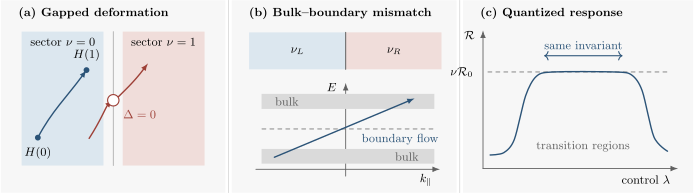
Three linked diagnostics. A gapped path cannot change a discrete invariant ; changing requires leaving the allowed gapped space. At an interface, the mismatch can force boundary spectral flow. A response plateau is robust over a finite parameter interval even though microscopic quantities vary.
Symmetry changes the equivalence relation
Section titled “Symmetry changes the equivalence relation”Suppose and can be connected only after time-reversal symmetry is broken. Then they are distinct as time-reversal-protected phases but may be equivalent when that symmetry is forgotten. The phrase “same phase” therefore always means “same phase under a specified class of paths.”
This point prevents a common mistake about symmetry-protected phases. Their boundary modes are not robust against every perturbation. They are robust against local perturbations that respect the protecting symmetry and do not close the bulk gap or introduce a compensating boundary phase.
Adding trivial degrees of freedom
Section titled “Adding trivial degrees of freedom”Band classifications usually permit adding completely filled or empty atomic bands. This stable equivalence prevents an arbitrary choice of basis size from changing the answer:
Fragile and obstructed atomic limits require a more refined ledger because the permitted added bands and crystalline representations matter. A label such as “nontrivial band topology” should say which equivalence relation is being used.
Global Structure of Occupied States
Section titled “Global Structure of Occupied States”For a translation-invariant noninteracting insulator, let
At a chemical potential in a band gap, the gauge-invariant occupied projector is
Individual occupied eigenvectors may mix by a momentum-dependent unitary transformation,
without changing . The topology belongs to the occupied subspace as a whole, not to a preferred phase convention for one eigenvector.
Spectral flattening makes the classification idea explicit:
has eigenvalues and , so flattening removes nonuniversal band dispersion while preserving the occupied subspace and the gap. The remaining question is whether the map can be continuously deformed to an atomic projector while satisfying the declared symmetries.
Two-band map
Section titled “Two-band map”For a two-band Hamiltonian,
the direct gap is
When everywhere, the normalized vector
maps the Brillouin torus to a sphere. In two dimensions its wrapping is measured by
This compact formula is a worked model of the global principle, not a substitute for the gauge-patch derivation on Chern Numbers. A nonzero Berry curvature at one momentum is not enough. The integral, occupied subspace, gap, and symmetry class all matter.
How Topology Can Change
Section titled “How Topology Can Change”Near a clean two-dimensional direct transition, the soft bands often reduce to
A mass sign reversal therefore passes through , where the local gap closes. This is a useful normal form, not a universal transition law and not an integer invariant by itself. A lattice regulator and every symmetry-related cone determine the global change; disorder may instead close a mobility gap, interactions may close a neutral many-body gap or produce a Green-function zero, and a first-order transition may proceed through a ground-state level crossing.
Topological Phase Transitions owns the gap taxonomy, invariant-transfer proof, Dirac-curvature calculation, codimension analysis, disorder and interaction mechanisms, and experimental evidence criteria.
Robust Boundary States
Section titled “Robust Boundary States”Place two gapped bulks with invariants and on opposite sides of an interface. If the interface preserved every relevant constraint and were itself fully gapped and nondegenerate, one could try to interpolate locally from one bulk to the other. A topological mismatch obstructs that interpolation.
For a Chern interface, the net chirality obeys
The individual number of boundary bands can depend on termination, but the net protected spectral flow cannot change without modifying a bulk invariant or adding compensating boundary degrees of freedom.
A sign-changing Dirac mass makes the local mechanism visible: the gap closes within the interpolation region and a normalizable directed branch appears. Bulk–Boundary Correspondence owns that domain-wall solution, the lattice-regulator warning, oriented crossing counts, interacting alternatives, and numerical strip checks. The continuum preview alone is not an integer band-topology proof.
What robustness does and does not mean
Section titled “What robustness does and does not mean”A protected boundary state may:
- change velocity and spatial penetration depth;
- move in energy or momentum;
- mix with trivial surface bands;
- survive disorder without retaining a sharp crystal momentum.
It may cease to be gapless if:
- the protecting symmetry is broken at the boundary;
- opposite protected modes are coupled in an allowed way;
- the boundary develops symmetry breaking or intrinsic topological order;
- the bulk gap closes or the adjoining bulk phase changes.
Conversely, a boundary-localized state is not automatically topological. Tamm, Shockley, electrostatic accumulation, dangling-bond, and reconstruction states can occur without a nontrivial bulk invariant. Evidence for topology requires a bulk-boundary package, not a surface spectrum alone.
Topological Response
Section titled “Topological Response”Topology becomes experimentally consequential when a bulk invariant fixes a response coefficient or an integrated transport process. For a clean, noninteracting, two-dimensional Chern insulator with conserved charge and completely filled occupied bands,
The integer quantum Hall effect shows how this bulk statement survives realistic boundaries, contacts, and disorder through a combination of mobility gaps, chiral channels, and localization.
An adiabatic one-dimensional pump supplies a second viewpoint. Let a periodic Hamiltonian depend on a cyclic parameter,
For a filled isolated band, the transported charge in one cycle is
where is the first Chern number over the torus. A static invariant in one higher parameter dimension appears as quantized transport. Berry-Phase Polarization and Charge Pumping owns the full crystalline polarization-branch, ionic-charge, and closed-cycle pumping construction.
Quantized response is powerful but not universal. Some symmetry-protected phases have no simple electromagnetic coefficient. Intrinsic topological order may have fractional response, thermal response, or no charge response at all. Crystalline topology can require a symmetry-compatible surface or defect. The diagnostic must match the phase.
Approximate quantization in a real experiment
Section titled “Approximate quantization in a real experiment”Exact quantization is normally a zero-temperature, infinite-system, adiabatic, or linear-response statement. Corrections can scale schematically as
where is the measured response, a correlation or localization length, a drive frequency, and a broadening scale. The precise correction law is platform dependent; the equation is a checklist, not a universal error formula.
Interactions Change the Language
Section titled “Interactions Change the Language”Band eigenvectors are not fundamental once interactions are strong. Some band invariants survive in many-body form, some free-fermion classifications collapse, and intrinsically interacting phases appear.
Twisted-boundary response
Section titled “Twisted-boundary response”For a charge-conserving many-body system on a torus, impose boundary twists
with . If a unique ground state remains separated over the twist torus, define
and
Under the appropriate gap and charge-conservation assumptions, this invariant controls the Hall conductance. A degenerate topological ground sector requires a non-Abelian treatment and can support fractional Hall response. The formula illustrates a broader lesson: topology can be attached to a family of many-body ground states even when crystal momentum and quasiparticle bands are unavailable.
Short-range and long-range entanglement
Section titled “Short-range and long-range entanglement”A useful high-level classification is:
| Phase type | Role of symmetry | Entanglement and boundary character |
|---|---|---|
| Trivial gapped phase | Symmetry optional | Deformable to a product or atomic state |
| Symmetry-protected topological phase | Essential | Short-range entangled; boundary obstruction disappears if protection is relaxed |
| Invertible topological phase | May be absent | No fractional bulk excitations, but nontrivial response or boundary anomaly |
| Intrinsic topological order | Not required | Long-range entangled; anyons, nonlocal operators, and topology-dependent ground sectors |
The labels overlap in specialized conventions, so the ledger still matters. In particular, topological order should not be used as a synonym for every topological band phase. Its canonical many-body signatures are developed in Topological Order Preview.
From Theory to Evidence
Section titled “From Theory to Evidence”A credible material claim triangulates bulk, boundary, and response information.
| Proposed claim | Strong evidence package | Important lookalikes |
|---|---|---|
| Chern insulator | Bulk gap, integer invariant from a validated model, quantized Hall response, chiral edge consistency | Inhomogeneous anomalous Hall response, parallel conduction |
| Time-reversal-protected insulator | Bulk gap, symmetry-resolved invariant, odd protected surface structure, symmetry tests | Trivial surface accumulation or reconstruction |
| Topological superconductor | Bulk pairing gap, particle–hole-compatible invariant, boundary or vortex signatures, nonlocal consistency | Disorder-induced zero-bias peaks, ordinary Andreev bound states |
| Intrinsic topological order | Bulk gap, fractionalized sectors, nonlocal or entanglement diagnostics, geometry or braiding consistency | Symmetry-breaking degeneracy, finite-size crossover |
No single row is a universal checklist. Transport can be obscured by contacts and parallel channels. Spectroscopy can reveal dispersion without proving transport protection. A first-principles band inversion can motivate an invariant calculation but does not establish the actual chemical potential, surface condition, or correlation regime.
A practical audit
Section titled “A practical audit”- State the Hilbert space and filling. Identify which bands or many-body sector are occupied.
- Demonstrate the relevant gap. Distinguish direct, indirect, mobility, quasiparticle, and finite-size gaps.
- Declare the protection. List the exact symmetries and conservation laws used by the invariant.
- Compute a gauge-invariant diagnostic. Use a projector, Wilson loop, many-body twist, response, or excitation algebra appropriate to the setting.
- Predict a consequence. Give the boundary, defect, or response signature with its assumptions.
- Stress-test it. Add symmetry-preserving disorder, interactions, finite temperature, and realistic boundaries.
- Compare with alternatives. Ask whether a trivial surface state, inhomogeneity, conventional order, or finite-size effect explains the same observation.
Common Mistakes
Section titled “Common Mistakes”“Nonzero Berry curvature means a topological phase”
Section titled ““Nonzero Berry curvature means a topological phase””Berry curvature is local in parameter space and need not integrate to a nonzero quantized invariant. Metals can also possess Berry curvature. Specify the occupied subspace, integration domain, gap, and quantized quantity.
“Band inversion proves topology”
Section titled ““Band inversion proves topology””Band inversion is basis and symmetry dependent. It is often a useful mechanism, not a standalone invariant. The complete Hamiltonian and protecting symmetries must be analyzed.
“Robust means immune to all perturbations”
Section titled ““Robust means immune to all perturbations””Robustness is conditional on locality, the bulk gap, and any protecting symmetry. Strong enough allowed perturbations can drive a phase transition; forbidden perturbations can remove symmetry-protected boundary modes immediately.
“Any edge state proves a topological bulk”
Section titled ““Any edge state proves a topological bulk””Trivial boundaries also bind states. Seek protected spectral flow, a bulk invariant, and a matched response or perturbation test.
“The invariant is defined even when the occupied subspace is ambiguous”
Section titled ““The invariant is defined even when the occupied subspace is ambiguous””A band crossing at the Fermi level can destroy the vector bundle whose invariant was being computed. Nodal systems require invariants on loops or surfaces that avoid the nodes.
“All topological phases have topological order”
Section titled ““All topological phases have topological order””Free-fermion Chern insulators and symmetry-protected phases need not have intrinsic topological order. Long-range entanglement, fractionalized sectors, and topology-dependent ground-state structure are stronger claims.
“A finite avoided crossing settles the thermodynamic phase”
Section titled ““A finite avoided crossing settles the thermodynamic phase””Finite systems generally round transitions. Study the scaling of the minimum gap, correlation length, entanglement, and diagnostic with system size and boundary conditions.
Exercises
Section titled “Exercises”1. Why a discrete invariant cannot drift
Section titled “1. Why a discrete invariant cannot drift”Let be an integer-valued invariant that is continuous along every allowed gapped path. Prove that is constant on such a path.
Solution
The interval is connected. A continuous image of a connected set is connected, but the only connected subsets of are single points. Therefore
for every . If , continuity of the invariant must fail somewhere because the gap closes, the invariant becomes undefined, or another declared constraint is violated.
2. What a Dirac mass does and does not prove
Section titled “2. What a Dirac mass does and does not prove”For the local model
identify where the gap closes. Why does a sign change of not, by itself, prove that a lattice Chern number changed?
Solution
The minimum direct gap is at . A continuous change from to passes through , where the two bands touch at . Whether the two signs differ by an integer invariant is decided only after the continuum theory is embedded in a complete regulated model.
A lattice calculation must include all critical cones, their orientations, the occupied-band rank, and the ultraviolet completion over the compact Brillouin zone. Symmetry-related cone contributions can add or cancel. The canonical calculation and its non-band generalizations are developed in Topological Phase Transitions.
3. Boundary state versus boundary index
Section titled “3. Boundary state versus boundary index”A boundary-localized band enters a projected bulk gap, crosses a reference energy once with positive slope and once with negative slope, then returns to the same bulk continuum. What is its net spectral flow, and does its presence alone establish a nontrivial bulk phase?
Solution
The upward crossing contributes and the downward crossing contributes , so
Such a branch can be created or removed by boundary reconstruction and is compatible with a trivial bulk. Boundary localization and an in-gap energy are not enough; one must compare the stable boundary index with an independently computed bulk invariant. The canonical counting rules are developed in Bulk–Boundary Correspondence.
4. Winding in a dimerized chain
Section titled “4. Winding in a dimerized chain”The SSH model has off-diagonal Bloch function
Determine when the curve winds around the origin and identify the bulk transition.
Solution
As traverses the Brillouin zone, traces a circle of radius centered at in the complex plane. The origin lies inside the circle when
so the winding has magnitude one. It lies outside when
giving zero winding. At
reaches zero and the bulk gap closes. The winding is protected by the off-diagonal, or chiral, structure; an allowed diagonal term changes the classification.
5. Stacking and boundary chirality
Section titled “5. Stacking and boundary chirality”Two decoupled two-dimensional Chern insulators have Chern numbers and . Find the invariant of the stack and the net number of right-moving minus left-moving edge channels at a boundary with vacuum.
Solution
For a direct sum of occupied projectors, first Chern numbers add:
Taking the vacuum to have , bulk–boundary correspondence gives
Additional counterpropagating pairs may occur for a particular termination, but local edge mixing can remove such pairs. The net chirality remains one while the bulk gap stays open.
6. Gauge change on the twist torus
Section titled “6. Gauge change on the twist torus”Under
show how and transform.
Solution
Direct substitution gives
Therefore
The curvature and its integral are gauge invariant, although the connection is not.
7. Audit a boundary-state claim
Section titled “7. Audit a boundary-state claim”A calculation for a finite slab shows a surface-localized band crossing the chemical potential. List four additional checks needed before calling the material a topological insulator.
Solution
A defensible audit should include at least:
- verify a bulk gap at the actual filling;
- identify the protecting symmetry and show that the calculation respects it;
- compute a bulk invariant or equivalent gauge-invariant diagnostic;
- test whether the surface crossing has the required connectivity and response to symmetry-preserving perturbations.
Useful further checks include changing the surface termination, increasing slab thickness, adding realistic disorder, testing interaction sensitivity, and excluding trivial accumulation or dangling-bond states. Surface localization alone is not sufficient.
8. Classify the protection mechanism
Section titled “8. Classify the protection mechanism”Classify each statement as primarily describing symmetry breaking, symmetry-protected topology, an invertible topological phase, or intrinsic topological order:
- two ground states have opposite local magnetization;
- an edge mode can be gapped only after time-reversal symmetry is broken;
- a charge-conserving two-dimensional bulk has and one net chiral edge channel;
- a torus supports locally indistinguishable ground sectors and anyonic excitations.
Solution
- Opposite local magnetization is ordinary symmetry breaking.
- Dependence on time-reversal symmetry identifies symmetry-protected topology.
- The integer Chern phase is an invertible topological phase; it has chiral response without fractional bulk excitations.
- Local indistinguishability together with anyons identifies intrinsic topological order.
The categories state the primary mechanism. A concrete system may carry additional broken symmetries or coexist with other forms of order.
Connections
Section titled “Connections”- Phases of Matter in Many-Body QM develops the general gapped-path definition and its thermodynamic qualifications.
- Topological Invariants separates deformation invariance from coordinate and gauge invariance.
- Berry Connection, Berry Curvature, and Chern Numbers provide the geometric machinery.
- Chern Numbers in Band Theory develops occupied-subspace formulas, symmetry constraints, the Kubo bridge, and gauge-invariant numerical computation.
- Moiré Topology shows how long-period minibands make Chern topology and fractional Hall order electrically tunable while preserving a strict evidence hierarchy.
- Quantum Materials by Design places symmetry indicators and topological screening inside a synthesis, disorder, measurement, and reproduction ladder.
- Data Interpretation and Pitfalls provides a cross-platform claim ladder for separating topological ingredients and compatible signatures from invariant-linked responses and protected operations.
- Symmetry-Protected Structure Preview explains how the allowed symmetry-preserving deformation class changes the phase distinction.
- Quantum Phase Transitions owns critical scaling and thermodynamic singularities beyond the Dirac mass example.
- Integer Quantum Hall Effect is the canonical material realization of quantized Chern response, chiral boundaries, and a disorder-stabilized mobility gap.
- Fractional Quantum Hall Effect is the canonical interacting realization joining fractional response, anyonic quasiparticles, topological ground sectors, and chiral edges.
- Anyons and Braiding develops configuration-space topology, fusion bases, braid matrices, operational timescales, and evidence boundaries.
- Topological Insulators develops spinful time reversal, invariants, helical edges, strong and weak indices, surface Dirac cones, and material evidence.
- Edge and Surface States compares chiral and helical edges, surface Dirac cones, finite-size hybridization, symmetry protection, and experimental probes.
- Bulk–Boundary Correspondence develops relative bulk indices, oriented spectral flow, mass-domain-wall modes, interacting caveats, and numerical strip checks.
- Topological Superconductors develops gapped BdG invariants, particle–hole redundancy, Majorana boundary and vortex modes, and a platform evidence ladder.
- Weyl and Dirac Semimetals treats gapless band topology: charged point nodes, Chern-number slices, Fermi arcs, symmetry protection, and transport evidence.
- Symmetry-Protected Topological Phases develops the symmetry-restricted many-body equivalence relation, projective edges, anomalous boundaries, interactions, and cohomology limits.
- Topological Order develops fusion and modular data, genus-dependent ground spaces, Abelian matrices, entanglement and thermal response, and evidence standards for intrinsic order.
- Topological Order Preview develops local indistinguishability, topology-dependent ground sectors, loop operators, long-range entanglement, and anyons.
- Condensed Matter Roadmap places band topology and interacting topology in a broader preparation sequence.
References
Section titled “References”Phase equivalence and many-body structure
Section titled “Phase equivalence and many-body structure”- P. W. Anderson, “More Is Different,” Science 177, 393–396 (1972), doi:10.1126/science.177.4047.393.
- X.-G. Wen, “Topological Orders in Rigid States,” International Journal of Modern Physics B 4, 239–271 (1990), doi:10.1142/S0217979290000139.
- X.-G. Wen and Q. Niu, “Ground-State Degeneracy of the Fractional Quantum Hall States in the Presence of a Random Potential and on High-Genus Riemann Surfaces,” Physical Review B 41, 9377–9396 (1990), doi:10.1103/PhysRevB.41.9377.
- M. B. Hastings and X.-G. Wen, “Quasi-Adiabatic Continuation of Quantum States: The Stability of Topological Ground-State Degeneracy and Emergent Gauge Invariance,” Physical Review B 72, 045141 (2005), doi:10.1103/PhysRevB.72.045141.
- X. Chen, Z.-C. Gu, and X.-G. Wen, “Local Unitary Transformation, Long-Range Quantum Entanglement, Wave Function Renormalization, and Topological Order,” Physical Review B 82, 155138 (2010), doi:10.1103/PhysRevB.82.155138.
- F. Pollmann, E. Berg, A. M. Turner, and M. Oshikawa, “Symmetry Protection of Topological Phases in One-Dimensional Quantum Spin Systems,” Physical Review B 85, 075125 (2012), doi:10.1103/PhysRevB.85.075125.
Band topology, response, and boundaries
Section titled “Band topology, response, and boundaries”- D. J. Thouless, M. Kohmoto, M. P. Nightingale, and M. den Nijs, “Quantized Hall Conductance in a Two-Dimensional Periodic Potential,” Physical Review Letters 49, 405–408 (1982), doi:10.1103/PhysRevLett.49.405.
- D. J. Thouless, “Quantization of Particle Transport,” Physical Review B 27, 6083–6087 (1983), doi:10.1103/PhysRevB.27.6083.
- Q. Niu, D. J. Thouless, and Y.-S. Wu, “Quantized Hall Conductance as a Topological Invariant,” Physical Review B 31, 3372–3377 (1985), doi:10.1103/PhysRevB.31.3372.
- F. D. M. Haldane, “Model for a Quantum Hall Effect without Landau Levels: Condensed-Matter Realization of the ‘Parity Anomaly’,” Physical Review Letters 61, 2015–2018 (1988), doi:10.1103/PhysRevLett.61.2015.
- Y. Hatsugai, “Chern Number and Edge States in the Integer Quantum Hall Effect,” Physical Review Letters 71, 3697–3700 (1993), doi:10.1103/PhysRevLett.71.3697.
- C. L. Kane and E. J. Mele, “ Topological Order and the Quantum Spin Hall Effect,” Physical Review Letters 95, 146802 (2005), doi:10.1103/PhysRevLett.95.146802.
- L. Fu and C. L. Kane, “Topological Insulators with Inversion Symmetry,” Physical Review B 76, 045302 (2007), doi:10.1103/PhysRevB.76.045302.
- A. P. Schnyder, S. Ryu, A. Furusaki, and A. W. W. Ludwig, “Classification of Topological Insulators and Superconductors in Three Spatial Dimensions,” Physical Review B 78, 195125 (2008), doi:10.1103/PhysRevB.78.195125.
- A. Kitaev, “Periodic Table for Topological Insulators and Superconductors,” AIP Conference Proceedings 1134, 22–30 (2009), doi:10.1063/1.3149495.
Broad reviews
Section titled “Broad reviews”- M. Z. Hasan and C. L. Kane, “Colloquium: Topological Insulators,” Reviews of Modern Physics 82, 3045–3067 (2010), doi:10.1103/RevModPhys.82.3045.
- X.-L. Qi and S.-C. Zhang, “Topological Insulators and Superconductors,” Reviews of Modern Physics 83, 1057–1110 (2011), doi:10.1103/RevModPhys.83.1057.
- C.-K. Chiu, J. C. Y. Teo, A. P. Schnyder, and S. Ryu, “Classification of Topological Quantum Matter with Symmetries,” Reviews of Modern Physics 88, 035005 (2016), doi:10.1103/RevModPhys.88.035005.