Bloch’s Theorem
Bloch’s theorem classifies one-particle states by the characters of a crystal’s discrete translation group. For a Hamiltonian with exact Bravais-lattice symmetry, its stationary states can be chosen so that translation by any lattice vector changes the state only by a phase. In position space,
or, equivalently,
The theorem is exact whenever its symmetry assumptions hold. It does not assume a weak potential, nearly free electrons, inversion symmetry, time-reversal symmetry, or one atom per primitive cell. It supplies the kinematic organization into crystal-momentum sectors; it does not by itself determine the dispersion, filling, lifetime, or experimental spectral weight.
Crystals and Lattices defines the translation group, Reciprocal Lattice defines its dual characters, and Brillouin Zones chooses representatives of those characters. This page is the canonical home for the theorem, its proof, its finite-size normalization, and its limitations.
Required background. Crystals and Lattices supplies the discrete translation group and finite crystal; Reciprocal Lattice supplies its translation characters; Brillouin Zones supplies one representative set for the resulting crystal-momentum classes.
Theorem
Section titled “Theorem”Let be a Bravais lattice,
and use the active translation convention
Suppose a self-adjoint one-particle Hamiltonian and its operator domain are invariant under every :
Then the Hilbert space decomposes into translation-character sectors labeled by a wavevector , and stationary states may be chosen to satisfy
The label is defined only modulo a reciprocal-lattice vector:
On a finite Born–von Karman crystal, these are ordinary normalizable eigenvectors at a discrete set of values. On an infinite crystal, the precise statement is a Bloch–Floquet direct-integral decomposition; the individual Bloch waves are generally generalized eigenfunctions rather than square-integrable vectors on all of .
Assumptions and Scope
Section titled “Assumptions and Scope”The theorem needs three structural ingredients.
- A full-rank translation lattice. The Hamiltonian repeats under the same primitive translations throughout the bulk.
- A symmetry-compatible operator problem. The differential expression, internal matrix structure, nonlocal kernels, operator domain, and boundary conditions must all respect the lattice translations being used.
- A stationary linear one-particle problem. This includes exact one-particle Hamiltonians and effective linear problems such as mean-field, Kohn–Sham, photonic, phononic, and Bogoliubov–de Gennes eigenproblems, with the qualifications appropriate to each.
For the familiar scalar Schrödinger operator,
the kinetic term is invariant under all continuous translations and the potential reduces that symmetry to . The same argument works for periodic matrix potentials, spinors with spin–orbit coupling, periodic effective masses, and suitable periodic nonlocal operators because the proof uses commutation with translations rather than the detailed form of .
External surfaces and arbitrary finite boundaries do not obey the premise. Born–von Karman boundary conditions are a controlled finite-volume construction that preserves translation symmetry; an actual open crystal must instead be treated with its reduced bulk, surface, or slab symmetries.
Finite-Crystal Proof
Section titled “Finite-Crystal Proof”The cleanest proof starts with a finite periodic crystal. Take primitive cells along and identify
The primitive translation operators
are unitary, commute with one another, and satisfy
They therefore represent the finite abelian group
Every unitary is normal, and commuting normal operators admit a simultaneous spectral decomposition. The Hilbert space can consequently be split into common eigenspaces of all . Because , the Hamiltonian preserves each such eigenspace and can be diagonalized within it.
Let a common translation eigenvector obey
Unitarity gives , while gives
Write the phases as
For a general lattice vector ,
This proves the translation-eigenvalue form. Since preserves each character sector, its eigenstates can be chosen with definite and an additional label that distinguishes eigenstates within that sector.
What degeneracy changes
Section titled “What degeneracy changes”The statement “an energy eigenstate is a translation eigenstate” needs care. If an energy is degenerate across different crystal momenta, an arbitrary linear combination of those energy eigenvectors need not have definite . The correct statement is:
A complete energy eigenbasis can be chosen to diagonalize the commuting lattice translations simultaneously.
Within a degenerate energy eigenspace, diagonalize the restricted translation operators. Degeneracy does not invalidate the theorem; it makes the choice of basis nonunique.
Position-Space Form
Section titled “Position-Space Form”Project the translation equation onto position:
Replacing by gives the quasiperiodic boundary condition
Now define
Then
Thus is lattice periodic and the wavefunction has Bloch form,
This equivalence also works for multicomponent wavefunctions. The periodic object may be a spinor, an orbital vector, a Nambu spinor, or a field profile; translation symmetry does not require it to be a scalar.
Crystal Momentum and Reciprocal Equivalence
Section titled “Crystal Momentum and Reciprocal Equivalence”Two wavevectors label the same translation character when
for every . By definition this holds exactly when
Crystal momentum therefore lives on the quotient
which is a -dimensional torus. A Brillouin zone is a choice of one representative from each equivalence class, not an additional physical boundary in momentum space.
Reciprocal sewing
Section titled “Reciprocal sewing”The same physical Bloch wave can be relabeled by :
One compatible choice is
The factor is itself lattice periodic. Consequently, the spectrum is reciprocal-periodic as a set:
At crossings, a fixed numerical band index can be permuted by continuation, so setwise periodicity is more fundamental than a globally fixed ordering of individual branches.
What crystal momentum is not
Section titled “What crystal momentum is not”is the generator label for discrete lattice translations. It is not generally the mechanical momentum , nor is it necessarily the expectation value of the canonical momentum operator. A Bloch wave contains ordinary momentum components , and a periodic potential exchanges reciprocal-lattice momentum among those components.
The Cell Hamiltonian
Section titled “The Cell Hamiltonian”Substituting into
gives a family of cell problems,
where
For a scalar periodic potential,
The operator acts on cell-periodic functions. Instead of solving one differential equation over the entire crystal, one solves a parameterized eigenproblem on one primitive cell for each in a Brillouin zone.
Reciprocal shifts are implemented by unitary conjugation:
This relation explains both spectral periodicity and the change of the cell-periodic eigenvector across an identified zone boundary.
Infinite Crystals and Bloch–Floquet Theory
Section titled “Infinite Crystals and Bloch–Floquet Theory”In an infinite crystal, a function with nonzero periodic density cannot be normalized over all space. The literal finite-dimensional simultaneous-diagonalization proof must therefore be replaced by a spectral decomposition.
Under standard hypotheses for a periodic self-adjoint operator, the Bloch–Floquet transform gives
and
where is any Brillouin-zone fundamental domain and is a cell Hilbert space with -quasiperiodic boundary conditions. Each fiber problem has discrete eigenvalues under the usual elliptic conditions, while their union over continuous forms energy bands.
The symbols in an infinite perfect crystal should therefore be read like plane waves: they are generalized eigenfunctions used to resolve normalizable wavepackets,
A physical bulk state has an integrable amplitude , or is first defined in a finite periodic volume and then taken to the thermodynamic limit.
Finite-Size Quantization and State Counting
Section titled “Finite-Size Quantization and State Counting”Born–von Karman periodicity imposes
Combining this with Bloch quasiperiodicity gives
If reciprocal primitive vectors obey
the allowed momenta can be represented as
There are exactly
distinct values in one reciprocal primitive cell. Thus every isolated band contributes one-particle states before spin or other internal multiplicities. This counting is the momentum-space version of the fact that a lattice with cells has independent translates of each localized orbital.
Normalization
Section titled “Normalization”Use the cell-average inner product
If
then the finite-volume normalized state is
The frequently written form suppresses this overall normalization. For two allowed momenta, the sum over cells produces
so states with different translation characters are orthogonal.
Plane-Wave Content
Section titled “Plane-Wave Content”Because is lattice periodic, it has a reciprocal-lattice Fourier series:
Therefore
A Bloch state has one crystal momentum but generally many canonical plane-wave momenta . The periodic Hamiltonian couples precisely those plane-wave components whose wavevectors differ by a reciprocal-lattice vector.
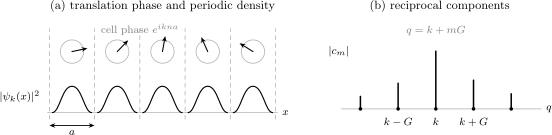
Translation changes a Bloch amplitude by a cell-dependent phase while leaving its probability density periodic. The same state is a superposition of reciprocal components ; crystal momentum labels the common equivalence class rather than a single canonical momentum.
The density of a single Bloch state is periodic:
This does not imply that the state carries no current. A phase gradient and the internal structure of can support a nonzero expectation value of the velocity.
Worked Examples
Section titled “Worked Examples”Free particle in a chosen lattice
Section titled “Free particle in a chosen lattice”The free-particle Hamiltonian is invariant under every translation, so it is also invariant under any chosen lattice. Restrict to one Brillouin zone and label plane waves by reciprocal vectors:
Its periodic factor and energy are
Folding the free parabola into one zone produces many crossing branches. A periodic potential can couple branches with the same reduced , which is the starting point of Nearly Free Electrons. Bloch’s theorem itself is already exact before that approximation is made.
One-dimensional periodic potential
Section titled “One-dimensional periodic potential”For ,
acts on periodic functions over . For a regular scalar problem, one may solve with
Equivalently, solve the original Hamiltonian on one cell with quasiperiodic conditions
Scanning through yields the complete bulk spectrum.
Nearest-neighbor tight-binding chain
Section titled “Nearest-neighbor tight-binding chain”Let be one localized orbital in each cell and
The normalized Bloch sum is
Since ,
and direct application of gives
The form of the Bloch sum follows from translation symmetry; the cosine dispersion follows from the additional nearest-neighbor hopping model.
Two-site motif
Section titled “Two-site motif”A honeycomb lattice has a triangular Bravais lattice with two sites, conventionally labeled and , in each primitive cell. Bloch’s theorem uses the triangular translations, not a fictitious one-site honeycomb Bravais lattice. At each , the cell-periodic object is a two-component orbital vector,
and the band index comes from diagonalizing a Bloch Hamiltonian. More orbitals, spin, layers, and Nambu doubling enlarge this internal vector without changing the translation character.
Physical Interpretation
Section titled “Physical Interpretation”Bloch’s theorem separates two kinds of spatial structure:
- records how the state transforms between equivalent cells;
- records the detailed amplitude, phase, orbital, and spin structure within a cell.
The separation is basis dependent, but the translation character is physical. A local probe can resolve the intracell structure; a bulk momentum-resolved probe organizes spectral weight by crystal momentum modulo reciprocal vectors.
The band label is not supplied by the translation group. It enumerates the eigenstates left after fixing . Different microscopic Hamiltonians with the same lattice have the same allowed translation characters but different , eigenvectors, gaps, and matrix elements.
Extensions and Limitations
Section titled “Extensions and Limitations”Internal degrees of freedom and nonlocal operators
Section titled “Internal degrees of freedom and nonlocal operators”If a spinor or orbital Hamiltonian commutes with the lattice translations, each component carries the same overall translation character. Spin–orbit coupling may remove spin degeneracy and entangle spin with orbital motion, but it does not invalidate Bloch form. A periodic nonlocal kernel is compatible when
Interacting many-body systems
Section titled “Interacting many-body systems”For an interacting Hamiltonian invariant under simultaneous translation of all particles, many-body eigenstates can be labeled by a total crystal momentum modulo . This is a representation statement about the many-body translation group. It does not imply that the exact state is a Slater determinant of one-particle Bloch orbitals or that its excitations are sharp independent-electron bands.
Translation-invariant one-particle Green functions remain block diagonal in , but poles can broaden, split, lose weight, or be replaced by continua. The one-particle Bloch theorem and many-body crystal momentum must not be conflated.
Magnetic fields
Section titled “Magnetic fields”In a uniform magnetic field, a vector potential is not generally invariant under ordinary translations. The Hamiltonian may commute instead with gauge-covariant magnetic translations, whose operators can fail to commute with one another. For rational magnetic flux through a cell, an enlarged magnetic unit cell and magnetic Brillouin zone may restore a Bloch-like classification. See Magnetic Translations.
Disorder, boundaries, and incommensurability
Section titled “Disorder, boundaries, and incommensurability”Static disorder breaks exact lattice translations in a given sample, even if an ensemble average restores them statistically. An open surface breaks translations normal to the boundary but can preserve those parallel to it, giving a surface crystal momentum. Quasicrystals and incommensurate structures lack a finite ordinary primitive cell; higher-dimensional embeddings or approximants may be useful, but the elementary theorem above does not apply unchanged.
Other periodic eigenproblems
Section titled “Other periodic eigenproblems”The same representation logic organizes phonon polarization vectors, photonic modes, magnons, and other linear periodic problems. Their inner products, constraints, and generalized eigenvalue structures can differ from the electronic Schrödinger problem. Spatial Bloch theory should also be distinguished from time-domain Floquet theory: both exploit periodicity, but their spectra and physical interpretations are different.
Common Mistakes
Section titled “Common Mistakes”Reversing the translation phase
Section titled “Reversing the translation phase”With
the translation eigenvalue is , while the shifted-coordinate relation is
Both signs are correct in their respective equations. Changing the definition of the active translation operator changes the bookkeeping.
Calling the Bloch wave periodic
Section titled “Calling the Bloch wave periodic”and are periodic. The wavefunction is generally quasiperiodic and becomes cell periodic only when its translation character is trivial.
Assuming every energy eigenvector already has definite crystal momentum
Section titled “Assuming every energy eigenvector already has definite crystal momentum”An arbitrary vector in a degenerate energy subspace may mix translation sectors. Choose a simultaneous eigenbasis of and the translations.
Treating the theorem as a weak-potential approximation
Section titled “Treating the theorem as a weak-potential approximation”Weak-potential and tight-binding methods approximate particular band dispersions. Bloch’s theorem precedes both and remains exact for a strongly varying periodic one-particle Hamiltonian.
Equating crystal and mechanical momentum
Section titled “Equating crystal and mechanical momentum”Crystal momentum is conserved modulo reciprocal vectors under lattice-symmetric dynamics. Mechanical momentum and velocity depend on the Hamiltonian and on the state’s full periodic structure.
Forgetting normalization volume
Section titled “Forgetting normalization volume”If the periodic factor has unit cell-average norm, has norm squared in a finite crystal. Include when an actual unit-normalized wavefunction is required.
Ignoring basis sewing at a zone boundary
Section titled “Ignoring basis sewing at a zone boundary”and label the same translation character, but their cell-periodic representatives differ by a periodic unitary. Raw eigenvector components and Berry connections need not be numerically identical across that boundary.
Problem-Solving Checklist
Section titled “Problem-Solving Checklist”Before invoking Bloch’s theorem, check:
- What translations leave the full operator problem invariant?
- Is the translation convention active or passive?
- What primitive direct and reciprocal vectors are being used?
- Is discrete in a finite periodic sample or continuous in an infinite-crystal limit?
- Which normalization is used for and ?
- Which internal basis and orbital embedding define the cell Hamiltonian?
- Are degeneracies, reciprocal-boundary sewing, magnetic phases, disorder, or surfaces relevant?
Exercises
Section titled “Exercises”Exercise 1: derive Bloch form
Section titled “Exercise 1: derive Bloch form”Starting from
derive the quasiperiodic position-space condition and prove that is lattice periodic.
Solution
The active convention gives
Replace by :
Then
Thus with periodic .
Exercise 2: reciprocal equivalence
Section titled “Exercise 2: reciprocal equivalence”Prove that two wavevectors define the same character of every lattice translation if and only if their difference is a reciprocal-lattice vector.
Solution
The characters agree when
for all , or
The reciprocal lattice is precisely
Therefore . The converse follows immediately from the same definition.
Exercise 3: finite momentum mesh
Section titled “Exercise 3: finite momentum mesh”A rectangular two-dimensional crystal contains primitive cells with
Find the allowed crystal momenta under Born–von Karman boundary conditions and count them in the first Brillouin zone.
Solution
Global periodicity requires
Thus
with and chosen from any and consecutive integers. There are inequivalent pairs in one Brillouin zone, hence states per band before internal multiplicities.
Exercise 4: tight-binding translation
Section titled “Exercise 4: tight-binding translation”For the nearest-neighbor chain in the worked example, verify both the translation eigenvalue and the energy dispersion of .
Solution
Translate the Bloch sum and relabel :
For the Hamiltonian,
The sign of the translation eigenvalue follows from the active convention, while the energy is even in for this real, inversion-symmetric model.
Exercise 5: reciprocal plane-wave support
Section titled “Exercise 5: reciprocal plane-wave support”Show that a Bloch function’s Fourier transform can have support only at wavevectors . Then explain why this does not mean that every coefficient is nonzero.
Solution
Expand the periodic factor in its reciprocal Fourier series:
Multiplication by gives
Thus no other wavevectors occur. Symmetry, the form of the periodic potential, orbital selection rules, or a special eigenstate can force particular coefficients to vanish.
Exercise 6: degeneracy audit
Section titled “Exercise 6: degeneracy audit”Suppose and have the same energy but distinct translation characters. Is
an energy eigenstate? Is it a translation eigenstate?
Solution
It is an energy eigenstate because both terms have the same energy:
Under a lattice translation,
This is not proportional to unless the two characters coincide. The example shows why the theorem promises a simultaneous eigenbasis, not that every vector chosen inside a degenerate energy subspace has definite crystal momentum.
Exercise 7: diagnose a failed premise
Section titled “Exercise 7: diagnose a failed premise”For each system, state whether the elementary Bloch theorem applies without modification: (a) a perfect periodic scalar potential, (b) one impurity in an otherwise periodic crystal, (c) a slab periodic only in two directions, and (d) a charged particle in a periodic potential plus a uniform magnetic field.
Solution
(a) Yes, provided the operator domain or finite boundary conditions are translation compatible.
(b) No for the exact impurity Hamiltonian. Bulk Bloch states can still be used as a basis for scattering theory, but they are not exact eigenstates of the disordered system.
(c) Partly. Two-dimensional Bloch classification survives for translations parallel to the slab, while momentum normal to the surface is not a conserved crystal label.
(d) Not generally with ordinary translations because the vector potential changes under translation. Magnetic translations supply the appropriate gauge-covariant symmetry; their algebra depends on the flux through a cell.
Connections
Section titled “Connections”- The chapter gateway places this exact symmetry theorem in the local dependency graph and separates it from later model approximations and outputs.
- Band Theory Overview carries the translation-sector result into fermionic filling, material classification, and the hierarchy of electronic-structure approximations.
- Brillouin Zones constructs a fundamental domain for the crystal-momentum labels proved here.
- Nearly Free Electrons applies degenerate perturbation theory to weakly coupled free branches in each Bloch sector.
- Tight-Binding Models constructs the same Bloch sectors from localized crystalline orbitals.
- Wannier Functions chooses and Fourier-transforms a Bloch frame into localized orbitals and owns the resulting gauge, localization, and obstruction questions; the theorem here supplies the translation fibers but does not choose that frame.
- Symmetry of Bloch States begins after the translation-sector theorem and owns the little-group representations, nontranslation band labels, compatibility relations, and crystalline degeneracy taxonomy within those fibers.
- Chern Numbers in Band Theory turns the cell-periodic Bloch fibers into an occupied bundle and a gauge-invariant Hall invariant.
- Translations and Momentum develops continuous and discrete translation operators abstractly.
- Translation-Invariant Hamiltonians explains symmetry sectors and conserved quantum numbers beyond the crystalline application.
- Periodic Boundary Conditions develops finite-volume momentum quantization.
- Tight-Binding Model applies Bloch sums to localized lattice orbitals.
- Bloch Theorem formula card is the compact lookup version of the result.
- Conventions for Quantum Matter fixes the translation sign, cell inner product, reciprocal sewing, and basis conventions used here.
References
Section titled “References”- N. W. Ashcroft and N. D. Mermin, Solid State Physics (Holt, Rinehart and Winston, 1976), Chapters 8–9.
- F. Bloch, “Über die Quantenmechanik der Elektronen in Kristallgittern,” Zeitschrift für Physik 52, 555–600 (1929), doi:10.1007/BF01339455.
- M. S. P. Eastham, The Spectral Theory of Periodic Differential Equations (Scottish Academic Press, 1973).
- C. Kittel, Introduction to Solid State Physics, 8th ed. (Wiley, 2004), Chapter 7.
- P. Kuchment, “An overview of periodic elliptic operators,” Bulletin of the American Mathematical Society 53, 343–414 (2016), doi:10.1090/bull/1528.
- P. Kuchment, “Floquet theory for partial differential equations,” Russian Mathematical Surveys 37(4), 1–60 (1982), doi:10.1070/RM1982v037n04ABEH003965.
- M. P. Marder, Condensed Matter Physics, 2nd ed. (Wiley, 2010), Chapters 2–4.
- M. Reed and B. Simon, Methods of Modern Mathematical Physics, Vol. IV: Analysis of Operators (Academic Press, 1978), Section XIII.16.
- S. H. Simon, The Oxford Solid State Basics (Oxford University Press, 2013), Chapters 5–7.
- M. Tinkham, Group Theory and Quantum Mechanics (Dover, 2003), Chapters 4–5.
- J. Zak, “Magnetic Translation Group,” Physical Review 134, A1602–A1606 (1964), doi:10.1103/PhysRev.134.A1602.