Nearly Free Electrons
The nearly-free-electron model is controlled perturbation theory around free plane waves in a weak periodic potential. Away from free-electron degeneracies, the potential produces small energy shifts and weak reciprocal-lattice satellites. At a Bragg plane, however, two or more plane waves are degenerate, ordinary perturbation theory fails, and even an arbitrarily weak Fourier component can split the degeneracy at first order.
For an isolated two-wave crossing, the leading direct gap is
where is the Fourier coefficient of the periodic potential at the reciprocal vector connecting the two waves. This compact result explains why zone boundaries are special, but it must be read with its assumptions: the crossing must be isolated from other free branches, omitted couplings must be perturbative, and a local avoided crossing is not automatically a global insulating gap.
Bloch’s Theorem is exact and supplies the crystal-momentum sectors. This page owns the weak-potential approximation inside those sectors: the central equation, Bragg degeneracy, gap opening, reduced-zone interpretation, standing waves, and validity tests.
Required background. Bloch’s Theorem supplies the exact crystal-momentum sectors, Brillouin Zones supplies zone-boundary geometry and folding conventions, and Degenerate Perturbation Theory supplies the avoided-crossing calculation at a Bragg plane.
Model and Approximation
Section titled “Model and Approximation”Consider
with a real lattice-periodic potential,
Expand it in reciprocal vectors:
where
Reality implies
The average shifts every energy equally and can be absorbed into the energy origin. The nonzero coefficients scatter a plane wave with wavevector into waves at
“Nearly free” means that the relevant are small compared with the energy separations to plane-wave branches excluded from a chosen perturbative subspace. It does not mean that every microscopic ionic potential is weak at every point. In practical electronic-structure reasoning, screening and pseudopotentials can make the effective potential seen by valence electrons much smoother than the bare core potential.
Free Electrons in a Periodic Box
Section titled “Free Electrons in a Periodic Box”For primitive cells with Born–von Karman boundary conditions, free eigenstates are normalized plane waves,
with energies
Choose in one Brillouin zone. Every allowed plane wave can be written uniquely as
At fixed , the free basis is therefore
with folded branches
Folding these parabolas into one zone is only a relabeling of the free spectrum. It creates branch crossings on a plot but does not open a gap. Gaps appear only after the periodic potential couples crossing branches.
The Central Equation
Section titled “The Central Equation”A Bloch state at fixed has the plane-wave expansion
The matrix element of the potential is
Substitution into the Schrödinger equation gives the central equation
Equivalently,
This is an infinite matrix eigenproblem within one Bloch sector. A plane-wave calculation truncates the reciprocal basis at a kinetic-energy cutoff; the nearly-free approximation instead keeps only the resonant branches analytically and treats the rest perturbatively.
Away from Degeneracy
Section titled “Away from Degeneracy”Suppose the free plane wave is separated in energy from every coupled appreciably by the potential. Nondegenerate perturbation theory gives
The first-order correction is only the spatial average . The nonuniform potential changes a nondegenerate free energy first at second order, although it changes the eigenvector at first order.
The expansion fails when a denominator becomes small:
This is not a technical nuisance to be ignored. It identifies the Bragg planes where a qualitatively new two-wave or multiwave problem must be solved.
Bragg Planes
Section titled “Bragg Planes”Free waves and are degenerate when
Canceling common terms yields
This is the perpendicular-bisector equation for a reciprocal-lattice vector. The nearest such planes are exactly the faces used to construct the first Brillouin zone.
The same condition is the elastic Bragg-scattering condition. The periodic potential can transfer reciprocal momentum without changing the free kinetic energy, so the incident and Bragg-reflected waves mix coherently.
Two-Wave Degenerate Perturbation Theory
Section titled “Two-Wave Degenerate Perturbation Theory”Near an isolated Bragg plane, retain
To first order in the weak potential, the effective Hamiltonian is
Its eigenvalues are
At exact degeneracy,
so the leading avoided-crossing gap is
Corrections from omitted plane waves begin at higher order when those waves remain well separated. If several free branches are degenerate, the two-state formula is insufficient and the full degenerate block must be diagonalized.
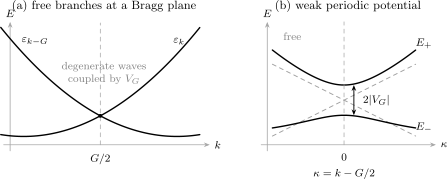
Folding alone produces a crossing between and . The Fourier coefficient couples the degenerate waves and replaces the crossing by two smooth branches separated by at the Bragg plane. Here measures displacement normal to the plane.
One-Dimensional Zone Boundary
Section titled “One-Dimensional Zone Boundary”For a lattice spacing , take
The coupled wavevectors are
Their average free energy and half-difference are
The two-wave dispersion is therefore
Far enough from the boundary that
the branches approach the folded free parabolas. Inside the mixing region, the eigenstates contain comparable right- and left-moving components and the free crossing is rounded.
Standing waves at the boundary
Section titled “Standing waves at the boundary”Write
At , normalized eigenvectors may be chosen as
Their densities are
The resonant part of the potential is
The upper state concentrates density near maxima of this harmonic, while the lower state concentrates near its minima. Translating the coordinate origin changes and shifts both patterns, but it cannot change the energies or the gap .
The Factor-of-Two Convention
Section titled “The Factor-of-Two Convention”The safest rule is to compute the Fourier coefficient before quoting a gap. If
then
and
If another author writes
then and the gap is . Both statements are the same physics with different definitions of the cosine amplitude. Writing “the gap equals twice the potential” without defining the Fourier convention is ambiguous.
Reduced, Extended, and Repeated Zones
Section titled “Reduced, Extended, and Repeated Zones”The three common band schemes contain the same states.
Extended-zone scheme
Section titled “Extended-zone scheme”Follow a branch through successive zones using the physical wavevector that resembles the dominant free component. The periodic potential opens gaps where the free parabola meets a Bragg plane.
Reduced-zone scheme
Section titled “Reduced-zone scheme”Map every wavevector into one Brillouin zone and assign a band index. Free branches cross before coupling; after coupling, the ordered eigenvalues form separated bands near each avoided crossing.
Repeated-zone scheme
Section titled “Repeated-zone scheme”Repeat the reduced-zone bands in every reciprocal cell:
as a spectral statement, with the usual qualification that labels can exchange at degeneracies.
Folding changes labels, not physics. Coupling by changes eigenvalues and eigenvectors. Keeping those two operations separate prevents a common false inference that a smaller chosen unit cell or a plotted fold automatically opens a physical gap.
Higher Dimensions
Section titled “Higher Dimensions”On a generic face of a Brillouin zone, the two-wave derivation applies to motion normal to that face. Momentum parallel to the face remains continuous, so the avoided crossing forms a gapped sheet rather than an isolated point.
At an edge or corner, several reciprocal vectors can generate simultaneous degeneracies. If the resonant plane waves are
one must diagonalize the matrix
Point-group symmetry constrains this matrix and can protect residual degeneracies. A geometrical free-electron crossing does not guarantee a first-order gap: the required may vanish by symmetry or motif interference.
Local gap versus global gap
Section titled “Local gap versus global gap”is a local direct splitting between two branches at a particular Bragg plane. A crystal is insulating only if, after considering all , band overlaps, internal degeneracies, and electron filling, the highest occupied states are separated from the lowest unoccupied states by a global gap. In two and three dimensions, different folded free branches often overlap in energy even though each individual avoided crossing is nonzero.
Worked Examples
Section titled “Worked Examples”Single cosine
Section titled “Single cosine”Let
Only
are nonzero apart from the average. At the first-zone boundaries , the leading gap is . The same harmonic also couples other pairs of plane waves separated by , but only resonant pairs acquire a first-order splitting.
Shifted cosine
Section titled “Shifted cosine”For
the coefficient is
The shift changes the phase of the coupling and the position of the standing-wave nodes. Since
the band energies and gap are independent of the arbitrary origin.
Rectangular lattice
Section titled “Rectangular lattice”Take
At the Bragg plane away from a zone corner, the relevant pair differs by and the leading splitting is . Similarly, the face has splitting .
At their intersection, four free plane waves can be degenerate. Treating the two faces independently can miss level multiplicities and symmetry combinations; the correct calculation diagonalizes the four-state block.
What the Model Explains
Section titled “What the Model Explains”The nearly-free picture gives a controlled account of:
- why weak periodicity matters most near Bragg planes;
- why energy gaps are tied to reciprocal Fourier components;
- why zone-boundary states become standing-wave combinations;
- how folded free parabolas turn into smooth Bloch bands;
- why different crystal planes can have different gap sizes;
- how a free-electron-like Fermi surface is reconstructed near a zone boundary.
It also motivates the language of electron-like and hole-like curvature near band extrema. Quantitative effective-mass theory and material classification require the full dispersion and filling, not only the local two-wave model.
Validity and Limitations
Section titled “Validity and Limitations”Controlled truncation
Section titled “Controlled truncation”Let project onto the retained resonant plane waves and . The approximation is controlled when matrix elements coupling to are small compared with the corresponding free-energy separations:
for the omitted states that matter. Near a multiwave degeneracy, enlarge rather than forcing a two-state treatment.
Strong potentials and localized orbitals
Section titled “Strong potentials and localized orbitals”When many Fourier components mix strongly, a low-order nearly-free expansion loses quantitative accuracy. A larger plane-wave diagonalization remains valid as a numerical representation, while a tight-binding or Wannier description may be more economical for localized bands. These are different approximations to the same Bloch problem, not competing versions of Bloch’s theorem.
Core electrons and pseudopotentials
Section titled “Core electrons and pseudopotentials”Bare ionic potentials are singular and core wavefunctions oscillate strongly. Nearly-free reasoning is most natural for delocalized valence states after core physics has been incorporated into an effective potential. Orthogonality to core states and nonlocal pseudopotentials can be essential even when the resulting valence dispersion looks free-electron-like.
Interactions, disorder, and lifetimes
Section titled “Interactions, disorder, and lifetimes”The elementary model is a one-particle Hamiltonian. Electron–electron interactions can renormalize dispersions, transfer spectral weight, and produce finite lifetimes or entirely new phases. Disorder broadens crystal momentum and can obscure small gaps. A fitted nearly-free band should therefore be identified as a one-particle or quasiparticle description, not as the exact many-body spectrum.
Common Mistakes
Section titled “Common Mistakes”Using nondegenerate perturbation theory at a Bragg plane
Section titled “Using nondegenerate perturbation theory at a Bragg plane”The vanishing denominator is the signal to diagonalize the degenerate subspace. Dropping the divergent term or inserting an ad hoc cutoff misses the first-order gap.
Confusing a potential amplitude with its Fourier coefficient
Section titled “Confusing a potential amplitude with its Fourier coefficient”For , the coefficient at is . The two-wave gap is always in the convention used here.
Saying folding opens a gap
Section titled “Saying folding opens a gap”Folding creates a representation with crossing free branches. A nonzero symmetry-allowed coupling opens the avoided crossing.
Calling every zone-boundary splitting a global band gap
Section titled “Calling every zone-boundary splitting a global band gap”Other momenta or other bands may occupy the same energy interval. Insulating behavior requires a global gap at the relevant filling.
Assuming every boundary is a two-state problem
Section titled “Assuming every boundary is a two-state problem”Zone corners, nonsymmorphic degeneracies, internal orbitals, and accidental coincidences can require a larger degenerate block.
Ignoring the phase of the eigenvectors
Section titled “Ignoring the phase of the eigenvectors”The gap depends only on , but the phase of determines which standing-wave pattern is upper or lower relative to the spatial potential. Origin changes move that phase without changing observables.
Treating “weak” as a universal material label
Section titled “Treating “weak” as a universal material label”Weakness is a ratio between couplings and energy denominators for a specified subspace and energy range. The same material can be nearly free for one set of valence bands and strongly non-free for another.
Exercises
Section titled “Exercises”Exercise 1: derive the central equation
Section titled “Exercise 1: derive the central equation”Starting from the Bloch expansion
derive the reciprocal-space eigenvalue equation for a periodic scalar potential.
Solution
The kinetic term acts diagonally:
For the potential,
The coefficient of has . Equating coefficients gives
Exercise 2: derive the Bragg plane
Section titled “Exercise 2: derive the Bragg plane”Show that free waves and are degenerate on the perpendicular bisector of and in reciprocal space.
Solution
Set the free energies equal:
Expanding the right-hand side,
Therefore
The points satisfying this equation have equal distance from and , so they form the perpendicular-bisector hyperplane.
Exercise 3: audit the cosine amplitude
Section titled “Exercise 3: audit the cosine amplitude”Find the first-zone gap for each potential:
Solution
With ,
Thus
The leading gaps are
The apparent discrepancy disappears once the cosine and Fourier amplitudes are distinguished.
Exercise 4: standing-wave energy ordering
Section titled “Exercise 4: standing-wave energy ordering”For real at , show that the symmetric standing wave is the upper state and the antisymmetric standing wave is the lower state. How does the answer change when ?
Solution
The two-state matrix at the boundary is
For , the vector has energy and produces
The vector has energy and produces
up to an overall phase. When , the eigenvectors are the same but their energy ordering reverses. The lower state always places more density near minima of the resonant potential harmonic.
Exercise 5: recover the free branches
Section titled “Exercise 5: recover the free branches”Use the one-dimensional formula for to show that far from the mixing region the two eigenvalues approach and .
Solution
Define
When ,
The two eigenvalues become the average free energy plus or minus . Those are the larger and smaller of and , with only second-order corrections. Their ordering swaps as crosses zero, which is why the coupled branches avoid rather than pass through one another.
Exercise 6: origin dependence
Section titled “Exercise 6: origin dependence”Translate the coordinate origin by . Show how transforms and prove that the two-wave energies are unchanged.
Solution
With the new coordinate ,
Thus
The phase changes but
Since the eigenvalues depend on the coupling through , the dispersion and gap are origin independent. The eigenvector phases transform so that the real-space state is described consistently.
Exercise 7: why a local gap need not insulate
Section titled “Exercise 7: why a local gap need not insulate”Construct a qualitative two-dimensional scenario in which a nonzero avoided crossing opens on one Brillouin-zone face but the system remains metallic.
Solution
Suppose the avoided crossing on one face creates a local interval with no states from the two participating branches at that momentum. A different branch can still have a minimum below the upper split level at another momentum, or the lower branch can have a maximum above that interval elsewhere in the zone.
Equivalently, the indirect gap
can be negative even though the local direct splitting
is positive. If the Fermi level intersects any band, the system remains metallic.
Connections
Section titled “Connections”- The chapter gateway helps choose this weak-potential branch instead of a localized-orbital construction and records its stop conditions.
- Band Theory Overview places weak-potential bands within the broader filling, gap, quasiparticle, and validity ledger.
- Bloch’s Theorem supplies the exact symmetry decomposition used before the weak-potential approximation.
- Reciprocal Lattice defines the vectors that connect plane-wave components and label potential harmonics.
- Brillouin Zones constructs the Bragg planes on which free branches become degenerate.
- Degenerate Perturbation Theory gives the general finite-subspace method behind the avoided crossing.
- Quasi-Degenerate Perturbation Theory systematizes corrections from nearby but nonresonant states.
- Tight-Binding Models develops the complementary localized-orbital construction and its material-model validation.
- Tight-Binding Model provides the complementary localized-orbital limit.
- Fourier Series owns the mathematical expansion used for the periodic potential.
References
Section titled “References”- N. W. Ashcroft and N. D. Mermin, Solid State Physics (Holt, Rinehart and Winston, 1976), Chapter 9.
- C. Kittel, Introduction to Solid State Physics, 8th ed. (Wiley, 2005), Chapter 7.
- S. H. Simon, The Oxford Solid State Basics (Oxford University Press, 2013), Chapters 5–7.
- M. P. Marder, Condensed Matter Physics, 2nd ed. (Wiley, 2010), Chapters 2–4.
- J. M. Ziman, Principles of the Theory of Solids, 2nd ed. (Cambridge University Press, 1972), Chapters 2–3.
- W. A. Harrison, Electronic Structure and the Properties of Solids (Dover, 1989), Chapters 1–3.
- P. A. Lee, “Band Structure,” lecture notes for Theory of Solids I, MIT OpenCourseWare (2004), course materials.
- E. Fitzgerald and L. Gibson, “Bloch Model and Band Gaps,” lecture notes for Electronic and Mechanical Properties of Materials, MIT OpenCourseWare (2007), course materials.
- F. Bloch, “Über die Quantenmechanik der Elektronen in Kristallgittern,” Zeitschrift für Physik 52, 555–600 (1929), doi:10.1007/BF01339455.
- L. Brillouin, Wave Propagation in Periodic Structures, 2nd ed. (Dover, 1953).