Band Theory Overview
Band theory describes a periodic quantum system through energy eigenvalues and eigenstates labeled by crystal momentum and a band index. In its simplest form it solves an effective one-electron problem,
then fills the resulting Bloch states according to Fermi–Dirac statistics. The functions are the energy bands.
This compact construction explains why some crystals have a Fermi surface while others have a gap, why velocities and effective masses depend on band derivatives, and why atomic orbitals can become broad dispersive spectra in a solid. It does not mean that electrons in real materials cease to interact. The words band structure can refer to model eigenvalues, Hartree–Fock orbitals, Kohn–Sham eigenvalues, or interacting quasiparticle peaks. Those objects can resemble one another while answering different questions.
This overview owns the conceptual chain from periodic Hamiltonian to bands, fermionic filling, valence and conduction bands, Fermi energy, material classification, interaction corrections, and failure tests. Band Gaps owns the detailed cross-gap comparison. The band constructions remain canonical in Bloch’s Theorem, Nearly Free Electrons, and Tight-Binding Models.
Use the Band Theory and Electronic Structure gateway to audit readiness, choose a subject branch, and find substantive fallbacks for unwritten topics.
Required background. Bloch’s Theorem supplies the translation-sector eigenstates, reciprocal equivalence, and cell-periodic eigenproblem used to define bands.
Helpful background. The page assumes introductory reciprocal-space and fermion-filling language.
Start from the Many-Particle Crystal
Section titled “Start from the Many-Particle Crystal”A nonrelativistic crystal contains nuclei and electrons. Before approximation, its Hamiltonian includes nuclear kinetic energy, electron kinetic energy, electron–nuclear attraction, nuclear repulsion, and electron–electron repulsion:
The exact electronic state is therefore a many-fermion wavefunction, not a list of independently occupied orbitals.
Band theory begins with a controlled or declared reduction:
- Separate slow nuclear and fast electronic motion, usually within a Born–Oppenheimer or clamped-ion description.
- Use the periodic nuclear arrangement, possibly including a self-consistent electronic field, to define lattice translations.
- Replace or reorganize the interacting electronic problem by an effective one-particle or quasiparticle problem.
- Solve that periodic problem in crystal-momentum sectors.
- Fill or interpret the resulting states according to the approximation being used.
The first step is not exact at arbitrary nuclear velocity or near every degeneracy. The third step is where Hartree, Hartree–Fock, density-functional, model-Hamiltonian, and Green-function approaches diverge.
From Translation Symmetry to Bands
Section titled “From Translation Symmetry to Bands”Suppose the effective Hamiltonian commutes with every lattice translation:
Bloch’s theorem allows eigenstates of the form
Define the cell-periodic Hamiltonian
For each in a primitive Brillouin zone, solve
As varies continuously, each eigenvalue traces a band. Reciprocal periodicity implies
up to possible relabeling among degenerate or connected bands.
The band index is not a universal observable name. Near avoided crossings, orbital character can pass continuously from one energy branch to another. At exact degeneracies, any unitary basis inside the degenerate subspace is valid. Robust statements concern the whole subspace, its symmetry representation, its projector, or gauge-invariant observables rather than an arbitrary eigenvector label. This overview owns the consequences for filling and material classification; the representation-level labels, compatibility relations, and protected-versus-avoided crossing taxonomy belong to Symmetry of Bloch States.
One Band Contains One State per Cell
Section titled “One Band Contains One State per Cell”Consider a crystal with primitive cells and periodic boundary conditions. There are allowed points in one Brillouin zone. A single nondegenerate band therefore contains
one-particle states, or one state per primitive cell.
If every displayed band is spin degenerate and spin is not included in , the capacity is
If spin–orbit coupling, magnetism, or an explicitly spinful basis is already included in the band index, no automatic factor of two may be added.
This counting is independent of whether the band is broad or flat. Bandwidth changes the energy distribution of states, not their total number.
Filling Bands with Fermions
Section titled “Filling Bands with Fermions”For noninteracting or independent-quasiparticle bands,
where
At zero temperature,
The electron count per primitive cell is
when includes all internal states. A full nondegenerate band contributes one to ; a partial band contributes its occupied fraction of the Brillouin zone.
The elementary filling criterion
Section titled “The elementary filling criterion”In a simple spin-degenerate independent-electron model:
- an even number of electrons per cell can fill an integer number of spin-degenerate bands;
- an odd number per cell leaves at least one band incompletely filled, so an ordinary full band gap is impossible. The result is generically metallic, although symmetry or fine tuning can place the chemical potential at a semimetallic point or line node with vanishing density of states.
This is a useful first check, not a theorem about every material. Magnetism can lift spin degeneracy. Translation-symmetry breaking can enlarge the cell and change the filling per new cell. Nonsymmorphic symmetries can force groups of bands to remain connected. Strong correlations can produce a Mott insulator at a filling where ordinary band theory predicts a metal.
Filled Bands and Charge Transport
Section titled “Filled Bands and Charge Transport”For a nondegenerate band without Berry-curvature corrections, the group velocity is
Semiclassical Dynamics of Bloch Electrons owns the isolated-band packet derivation, force equation, field-driven trajectory, and validity window. Here the velocity is retained only as the input needed to interpret band filling and ordinary current.
The equilibrium current contribution of a completely filled band is proportional to
Because the band energy is periodic on the Brillouin torus, the boundary terms cancel:
Thus a full ordinary band has no net longitudinal group-velocity current. A partially filled band can respond because an electric field distorts its occupation near the Fermi surface.
When only a few states are missing from an otherwise full band, Holes owns the exact reorganization into positive-charge carriers and the required momentum–velocity–current sign convention.
This argument does not say that every filled band is physically inert. Filled bands determine polarization, orbital magnetization, and interband optical response, and topological filled bands can carry quantized transverse transport. Energies alone are insufficient for those effects; Bloch eigenvectors and their geometry matter.
Valence and Conduction Bands
Section titled “Valence and Conduction Bands”For a band insulator at zero temperature:
- valence bands are occupied bands below the gap;
- conduction bands are empty bands above the gap;
- the valence-band maximum is the highest occupied band energy;
- the conduction-band minimum is the lowest empty band energy.
Write
and
The independent-particle fundamental gap is
The labels valence and conduction refer primarily to occupation and energy position, not to immutable atomic orbitals. A band with mostly anion character in one part of the zone can hybridize and acquire other character elsewhere.
In a metal, a band that crosses the chemical potential is partly occupied, so the clean valence/conduction division is not generally available. In a semimetal, nominal valence and conduction bands touch or overlap.
Fermi Energy and Chemical Potential
Section titled “Fermi Energy and Chemical Potential”The chemical potential is the thermodynamic cost of changing particle number:
In a zero-temperature metal, the terms Fermi energy and chemical potential are commonly identified:
The Fermi surface is then the set . This page uses only that definition; the material-facing geometry belongs to Fermi Surface.
For an ideal band insulator at zero temperature, every value of inside the gap gives the same occupations. A plotted midgap “Fermi level” is often a convention, not a uniquely occupied one-particle state. At nonzero temperature, charge neutrality, dopants, defects, and contact reservoirs determine .
Do not confuse:
- the chemical potential measured relative to an internal energy zero;
- the vacuum-referenced work function;
- the highest occupied eigenvalue of a finite calculation;
- the Fermi energy of a free-electron gas;
- a spectrometer’s binding-energy zero.
These quantities can be related only after their energy references and approximations are stated.
Band-Gap Orientation
Section titled “Band-Gap Orientation”A direct separation compares occupied and empty bands at the same crystal momentum. A global band gap allows the valence maximum and conduction minimum to occur at different momenta. The global gap can therefore be negative even when every same- separation is positive: the bands are locally separated but overlap in energy.
Use Band Gaps for the exact direct and full-zone definitions and for the distinction among band, charge, quasiparticle, Kohn–Sham, optical, transport, and mobility gaps. This overview needs only the material-level consequence: a local avoided crossing does not establish an insulating interval, and a conventional path plot cannot exclude an off-path extremum or another relevant band.
Material Classification at the Band Level
Section titled “Material Classification at the Band Level”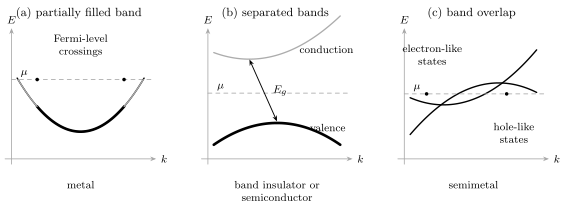
Independent-particle classification by filling and global energy separation. A metal has a Fermi-level crossing; a band insulator or intrinsic semiconductor has separated occupied and empty bands; a semimetal has touching or overlapping bands with reduced carrier phase space.
| Band-level state | Zero-temperature structure | Low-energy charged excitations |
|---|---|---|
| Metal | one or more bands cross | gapless states on a Fermi surface |
| Band insulator | occupied and empty bands separated by | gapped electron and hole excitations |
| Intrinsic semiconductor | a band insulator with a gap small enough for useful thermal, optical, or dopant control | thermally or optically activated carriers |
| Semimetal | bands touch or overlap weakly | point, line, or small-pocket carriers |
This is a band-theory classification, not an exhaustive taxonomy of insulating phases. Anderson localization can suppress dc transport without a clean band gap. Mott localization can produce an interaction-driven gap where a one-electron filling argument predicts a metal. Topological Insulators are bulk band insulators whose occupied eigenvectors carry nontrivial global structure and whose boundary claims require additional symmetry and evidence.
Two Complementary Pictures
Section titled “Two Complementary Pictures”Nearly free electrons
Section titled “Nearly free electrons”Begin with plane waves and turn on a weak periodic potential. Reciprocal Fourier components mix states whose momenta differ by a reciprocal vector. At a Bragg degeneracy, this mixing splits levels and opens a local gap. This picture is strongest when the ionic pseudopotential is weak for the states of interest.
Tight binding
Section titled “Tight binding”Begin with localized orbitals on separated atoms and turn on hopping. Each atomic level produces as many crystal states as there are cells, and hopping spreads them into a band. Multiple orbitals and basis sites produce multiple bands and hybridization gaps.
The two constructions are not rival ontologies. They are basis choices and approximation regimes for the same Bloch organization. A converged calculation can be expanded in plane waves or a localized basis without changing gauge-invariant observables. Wannier Functions owns the precise Bloch-frame Fourier construction, localization criteria, and the qualifications introduced by topology and disentanglement.
Worked Example: Two Hybridizing Bands
Section titled “Worked Example: Two Hybridizing Bands”Consider
The eigenvalues are
At a crossing of the uncoupled bands,
the direct splitting is
If symmetry forces , the crossing can remain exact. If , it is avoided. Whether the system becomes insulating still depends on filling and on every other band throughout the Brillouin zone.
What Kind of Band Structure?
Section titled “What Kind of Band Structure?”The source of must be stated.
Model bands
Section titled “Model bands”Nearly-free-electron, tight-binding, and models retain selected degrees of freedom and parameters. They are valuable because assumptions are visible and mechanisms can be isolated. Their accuracy is limited to the fitted orbitals, energies, momenta, and observables.
Hartree–Fock bands
Section titled “Hartree–Fock bands”Hartree–Fock minimizes the energy over single Slater determinants and produces a self-consistent nonlocal Fock operator. Its orbitals include direct and exchange fields but omit dynamical correlation. Orbital energies are not automatically exact electron-addition and removal energies.
The Hartree–Fock Approximation owns the variational derivation and limitations.
Kohn–Sham bands
Section titled “Kohn–Sham bands”Kohn–Sham density-functional theory introduces a noninteracting auxiliary system constructed to reproduce the interacting ground-state density in exact DFT. In practical DFT, an approximate exchange-correlation functional determines the effective potential.
Kohn–Sham bands are extremely useful for total energies, forces, trends, Fermi surfaces in many weakly correlated materials, and as a starting point for further calculations. But the formal target is the ground-state density, not the complete charged-excitation spectrum. Treating every Kohn–Sham eigenvalue difference as a measured excitation energy is an additional approximation.
The exact multiplicative Kohn–Sham gap and the interacting charge gap differ by an exchange-correlation derivative discontinuity. Band Gaps owns that decomposition and its generalized-Kohn–Sham and approximate-functional caveats.
Quasiparticle bands
Section titled “Quasiparticle bands”The interacting one-particle Green function satisfies a Dyson equation. In matrix notation,
Peaks of the spectral function
define quasiparticle dispersions only when the peaks are sufficiently sharp. The self-energy shifts energies, changes velocities and masses, gives finite lifetimes, transfers weight into satellites, and can destroy a simple band picture.
The Spectral Functions page is the canonical home for this distinction.
Gap Objects Beyond a Band Plot
Section titled “Gap Objects Beyond a Band Plot”An interacting charge gap compares ground-state energies in different particle-number sectors, whereas a neutral optical excitation remains at fixed particle number and is filtered by a response operator. A quasiparticle gap requires coherent addition and removal features; transport activation and mobility gaps require kinetic and localization models. These objects may be close in a weakly interacting semiconductor, but notation does not make them identical. Their definitions, matched-threshold subtractions, methods, and probe caveats are centralized in Band Gaps.
Reading a Band Plot Correctly
Section titled “Reading a Band Plot Correctly”A standard band plot samples selected high-symmetry lines. It can display:
- crossings and avoided crossings along those lines;
- bandwidths and approximate effective masses;
- symmetry-enforced degeneracies;
- orbital or spin character when projected weights are supplied;
- direct gaps along the sampled path.
It cannot by itself establish:
- the global minimum gap;
- a complete Fermi surface;
- a converged density of states;
- the absence of an off-path crossing;
- transport coefficients or carrier lifetimes;
- topological invariants;
- whether a broad experimental feature is a coherent quasiparticle.
Those questions require full-zone meshes, eigenvectors, matrix elements, spectral functions, and convergence tests appropriate to the observable.
Where Interactions Enter
Section titled “Where Interactions Enter”Interactions enter band-based reasoning at several levels:
- Static mean fields: Hartree, exchange, magnetism, density waves, and self-consistent crystal potentials reshape bands.
- Screening: the effective electron–electron interaction is reduced and made frequency dependent by polarization.
- Quasiparticle renormalization: the self-energy shifts dispersions and changes velocities, masses, residues, and lifetimes.
- Bound states: electron–hole attraction produces excitons not present in an independent transition picture.
- Collective order: superconductivity and density waves mix states and reconstruct spectra.
- Strong correlation: local interactions can suppress charge motion, transfer spectral weight, and produce Hubbard bands or fractionalized excitations.
- Electron–phonon coupling: ionic motion renormalizes electron energies, broadens states, and can form polarons or paired phases.
It is therefore better to ask which interaction effects have been incorporated, at what level, and for which observable? than to label a calculation simply “band theory” or “many-body.”
When Band Theory Works
Section titled “When Band Theory Works”A band or quasiparticle description is most useful when:
- translation symmetry is exact or approximately restored after disorder averaging;
- low-energy spectral peaks are sharp compared with their separation and dispersion;
- a small set of orbitals or bands captures the energy window of interest;
- interaction corrections can be absorbed into renormalized parameters or calculated self-energies;
- symmetry breaking, if present, is represented with the correct enlarged cell and order parameter;
- predictions are stable under basis, mesh, cell, and approximation checks.
Success is observable dependent. The same calculation can predict an equilibrium structure well and a band gap poorly, or reproduce a Fermi surface while missing satellite spectra.
When the Simple Picture Fails
Section titled “When the Simple Picture Fails”Mott localization
Section titled “Mott localization”A partially filled band can be insulating when repulsion prevents charge motion. The gap is then interaction driven and cannot be obtained by merely filling a fixed noninteracting band.
Strongly incoherent metals
Section titled “Strongly incoherent metals”If spectral peaks are as broad as their energy, a long-lived is not a faithful low-energy degree of freedom. Spectral weight may still disperse, but calling it a conventional band can conceal the missing quasiparticle.
Fractionalization and topological order
Section titled “Fractionalization and topological order”The electron can cease to be the elementary low-energy excitation. Emergent gauge fields and fractional quasiparticles require a many-body description beyond occupied electron bands. Fractional Quantum Hall Effect gives the canonical case: interactions within a partially filled Landau level produce an incompressible fluid whose charge, statistics, edge, and ground sectors cannot be reconstructed from electron band energies alone.
Disorder and localization
Section titled “Disorder and localization”Strong disorder removes exact crystal momentum and can localize eigenstates. A large supercell always produces folded eigenvalues, but that does not restore a physically meaningful clean-crystal band picture.
Pairing
Section titled “Pairing”Superconductors are often described by Bogoliubov–de Gennes bands in an enlarged particle–hole space. These are coherent superpositions of electron addition and removal, not ordinary electron bands filled up to .
Hidden symmetry changes
Section titled “Hidden symmetry changes”Magnetic, structural, or charge order can enlarge the primitive cell and reconstruct the Brillouin zone. Using the high-symmetry phase’s bands below such a transition can give the wrong filling and wrong Fermi surface.
A Reliability Checklist
Section titled “A Reliability Checklist”Before interpreting a band calculation, record:
- the physical Hamiltonian or electronic-structure functional;
- the clamped-ion structure, magnetic order, and primitive cell;
- whether spin, spin–orbit coupling, and relativistic effects are included;
- the basis, pseudopotential or core treatment, and convergence controls;
- the electron count, chemical-potential convention, and degeneracy bookkeeping;
- whether eigenvalues are model, Hartree–Fock, Kohn–Sham, or quasiparticle quantities;
- whether the claim needs only energies or also eigenvectors and matrix elements;
- whether the full Brillouin zone, not just a path, has been searched;
- which experimental observable is being compared and what resolution or final-state effects enter;
- which interaction, disorder, and temperature scales could invalidate the approximation.
This checklist is the operative ledger for this page. The reusable Conventions for Quantum Matter ledger and Band Structure Workflows provide the wider convention and computational context. This page interprets band-like objects and gaps; it does not itself implement a computational workflow.
Common Mistakes
Section titled “Common Mistakes”Saying periodicity creates noninteracting electrons
Section titled “Saying periodicity creates noninteracting electrons”Periodicity gives crystal-momentum organization. Independence is a separate approximation.
Calling every plotted eigenvalue an observable excitation
Section titled “Calling every plotted eigenvalue an observable excitation”Model, Hartree–Fock, Kohn–Sham, and quasiparticle eigenvalues have different formal meanings.
Inferring a global gap from one avoided crossing
Section titled “Inferring a global gap from one avoided crossing”The valence maximum or conduction minimum may lie elsewhere in the zone or in another band.
Counting spin twice
Section titled “Counting spin twice”Check whether spin is explicit in before multiplying the capacity of a band.
Treating the Fermi level in an insulator as a unique state
Section titled “Treating the Fermi level in an insulator as a unique state”At zero temperature, any chemical potential inside an ideal gap gives the same band occupations.
Assuming full bands do nothing
Section titled “Assuming full bands do nothing”They carry no ordinary equilibrium group-velocity current, but they contribute to polarization, optical response, magnetization, and topological transport.
Equating a Kohn–Sham gap with the optical gap
Section titled “Equating a Kohn–Sham gap with the optical gap”The fundamental charge gap, Kohn–Sham gap, and neutral optical gap answer different questions.
Declaring band theory useless whenever interactions matter
Section titled “Declaring band theory useless whenever interactions matter”Interactions can produce well-defined renormalized quasiparticle bands. The relevant test is spectral coherence and predictive accuracy, not the mere presence of Coulomb forces.
Exercises
Section titled “Exercises”Exercise 1: capacity of a band
Section titled “Exercise 1: capacity of a band”A three-dimensional crystal has primitive cells and a nonmagnetic calculation displays one spin-degenerate band. How many one-particle states does it contain? How many electrons are required to fill it?
Solution
Periodic boundary conditions produce allowed crystal momenta in one Brillouin zone. At each momentum the displayed band represents two spin states. It therefore contains
one-particle states and requires electrons for complete filling. Per primitive cell, its capacity is two electrons.
If spin were already explicit in the band index, each spin-resolved band would instead contain states.
Exercise 2: current of a filled one-dimensional band
Section titled “Exercise 2: current of a filled one-dimensional band”Show that the sum of group velocities in a completely filled one-dimensional band vanishes.
Solution
In the thermodynamic limit,
Choose the zone from to . Then
by reciprocal periodicity. Hence the equilibrium group-velocity current vanishes. The proof does not exclude Berry-curvature or interband responses of filled bands.
Exercise 3: audit a path-plot gap
Section titled “Exercise 3: audit a path-plot gap”A high-symmetry band path shows a positive separation between the plotted occupied and empty bands. Explain why this does not yet establish a global bulk band gap, and identify the next canonical page.
Solution
The path can miss an off-path valence maximum, conduction minimum, node, or an additional band in the same energy window. The claim needs a converged full-Brillouin-zone and all-relevant-band search with the structure, filling, spin sectors, interpolation, and uncertainty declared. Band Gaps owns that global-gap audit and the distinction from direct, charge, optical, transport, and mobility gaps.
Exercise 4: hybridization gap
Section titled “Exercise 4: hybridization gap”At , two uncoupled bands have equal energy and are coupled by a real matrix element . Diagonalize the local Hamiltonian and find the splitting.
Solution
The matrix is
The symmetric and antisymmetric combinations have energies
Hence
If symmetry forbids , no avoided-crossing gap opens at this order.
Exercise 5: chemical potential inside a gap
Section titled “Exercise 5: chemical potential inside a gap”Why does moving the zero-temperature chemical potential within an ideal band gap not change the particle number?
Solution
At zero temperature,
Suppose no eigenvalue lies between and . For every
all valence states remain below and all conduction states remain above it. Every step function is unchanged, so is constant throughout the gap.
At nonzero temperature, exponentially small electron and hole populations and charge-neutrality constraints generally select a temperature-dependent value.
Exercise 6: diagnose the approximation
Section titled “Exercise 6: diagnose the approximation”For each case, state whether ordinary independent-electron bands are sufficient, useful but incomplete, or qualitatively unreliable: (a) a weakly interacting alkali metal with sharp ARPES peaks; (b) a half-filled narrow band with a large interaction-driven insulating gap; (c) a conventional semiconductor optical absorption edge dominated by a bound exciton; (d) a disordered sample whose states at the chemical potential are Anderson localized.
Solution
(a) Bands are highly useful, with interactions entering mainly through quasiparticle renormalization and lifetime. A nearly-free-electron or quasiparticle description can be quantitatively successful.
(b) A fixed independent-electron band is qualitatively unreliable for the insulating mechanism. A correlated many-body treatment is required, although orbital and lattice information from band theory remains useful input.
(c) Bands are useful but incomplete. They supply electron and hole dispersions, while electron–hole attraction and optical matrix elements are required for the absorption edge.
(d) Clean-crystal bands are useful as a reference, but they do not decide dc conduction. Localization and disorder statistics are essential because exact crystal momentum is absent and extended-state assumptions fail.
Foundational Connections
Section titled “Foundational Connections”- The Lattices, Reciprocal Space, and Bloch Electrons gateway selects the direct-space, reciprocal-space, theorem, and band-construction route that precedes this filling and material-interpretation overview.
- Bloch’s Theorem derives translation eigenstates and the cell-periodic eigenproblem.
- Effective Mass derives the curvature tensor and separates density-of-states, conductivity, cyclotron, optical, and quasiparticle masses.
- Landau Levels in Solids specializes controlled material band Hamiltonians to anisotropic orbital ladders, Zeeman and orbital shifts, valley multiplicity, and the boundary between parabolic, nonparabolic, and Dirac regimes.
Specialist Connections
Section titled “Specialist Connections”Continue to these pages for the specialist questions:
- Two-Dimensional Materials for monolayer gaps, valleys, excitons, and heterostructure alignment.
- Metals, Insulators, and Semiconductors for a mechanism-aware material taxonomy.
- Band Gaps for charge, quasiparticle, Kohn–Sham, optical, transport, and mobility gaps.
- Nearly Free Electrons and Tight-Binding Models for complementary band constructions.
- Density of States and Fermi Surface for state counting and metallic geometry.
- Hartree–Fock Approximation and Spectral Functions for interaction effects.
- The Effective Mass formula card for compact lookup.
- Weyl and Dirac Semimetals develops stable three-dimensional band crossings, their symmetry constraints, surface arcs, and material-evidence tests.
References
Section titled “References”- N. W. Ashcroft and N. D. Mermin, Solid State Physics (Holt, Rinehart and Winston, 1976), Chapters 7–12.
- F. Bloch, “Über die Quantenmechanik der Elektronen in Kristallgittern,” Zeitschrift für Physik 52, 555–600 (1929), doi:10.1007/BF01339455.
- L. Hedin, “New Method for Calculating the One-Particle Green’s Function with Application to the Electron-Gas Problem,” Physical Review 139, A796–A823 (1965), doi:10.1103/PhysRev.139.A796.
- P. Hohenberg and W. Kohn, “Inhomogeneous Electron Gas,” Physical Review 136, B864–B871 (1964), doi:10.1103/PhysRev.136.B864.
- C. Kittel, Introduction to Solid State Physics, 8th ed. (Wiley, 2005), Chapters 7–9.
- W. Kohn, “Theory of the Insulating State,” Physical Review 133, A171–A181 (1964), doi:10.1103/PhysRev.133.A171.
- W. Kohn and L. J. Sham, “Self-Consistent Equations Including Exchange and Correlation Effects,” Physical Review 140, A1133–A1138 (1965), doi:10.1103/PhysRev.140.A1133.
- R. M. Martin, Electronic Structure: Basic Theory and Practical Methods (Cambridge University Press, 2004), Chapters 1–5 and 12–13.
- N. F. Mott, Metal-Insulator Transitions, 2nd ed. (Taylor & Francis, 1990).
- J. P. Perdew, R. G. Parr, M. Levy, and J. L. Balduz, Jr., “Density-Functional Theory for Fractional Particle Number: Derivative Discontinuities of the Energy,” Physical Review Letters 49, 1691–1694 (1982), doi:10.1103/PhysRevLett.49.1691.
- S. H. Simon, The Oxford Solid State Basics (Oxford University Press, 2013), Chapters 4–7.