Holes
A hole is the absence of an electron relative to a specified nearly full band, reorganized as a positive-energy excitation with charge . It is not an additional microscopic particle. Hole language is useful because a few missing occupations are easier to track than almost all the electrons in the band, and because the resulting excitation has a consistent positive-charge current description.
For the physical-momentum convention used throughout this page,
so that, modulo a reciprocal-lattice vector,
The reference band, energy zero, internal-state convention, and regime of validity must accompany these formulas. The generic particle–hole treatment owns pair continua and response kinematics. This page owns the crystalline nearly-full-band specialization: exact state counting per cell, the two common momentum labels, the group-current sign, and the point at which a scalar hole band must be replaced by a multiband or spectral description.
Required background. Band Theory Overview supplies band labels, Brillouin-zone periodicity, filling, and the distinction among model, Kohn–Sham, and quasiparticle bands.
Helpful background. Effective Mass supplies the curvature tensor; Fermi Surface supplies pocket geometry; and Metals, Insulators, and Semiconductors supplies equilibrium carrier statistics and material classification.
A Missing Electron in a Nearly Full Band
Section titled “A Missing Electron in a Nearly Full Band”Consider one finite crystal with primitive cells and periodic boundary conditions. A nondegenerate band contains allowed Bloch states. If an unresolved multiplicity remains outside the band label—for example, a genuine twofold spin degeneracy—the capacity is
If of those states are occupied, the number of holes is the exact complement
No approximation enters this count. The approximation enters when the missing occupations are treated as independent or weakly interacting quasiparticles with a well-defined dispersion.
The hole representation is economical when . Near an otherwise full valence band, a many-electron occupation pattern can then be specified by listing only the empty modes. Near an otherwise empty conduction band, the electron representation is more economical. Near half filling neither description has a privileged small carrier number, even though algebraic particle–hole transformations may still be useful in a model.
Three declarations are needed before the word hole is quantitative:
- Reference. State which band or retained subspace is regarded as full.
- Band object. State whether its energies are model eigenvalues, Kohn–Sham eigenvalues, coherent quasiparticle poles, or another controlled object.
- Labels. State whether the hole carries the label of the removed electron or a relabeled physical crystal momentum.
The first declaration fixes what is missing. The second fixes what, if anything, may be called a hole dispersion. The third fixes the signs of momentum and velocity.
The Filled-Band Reference and Hole Operators
Section titled “The Filled-Band Reference and Hole Operators”Let run over every one-electron state in the retained valence band, including momentum and any internal label. Choose a fixed ordering and define the filled reference
The ordering changes an overall fermionic phase convention but not physical matrix elements. Define a hole creation operator by removing the corresponding electron,
The electron anticommutation relations immediately give
Thus the filled electronic band is the hole vacuum. The occupation identity is
For a diagonal one-body band Hamiltonian,
normal ordering about the filled reference gives
The minus sign does not describe a negative-energy particle. Absolute one-electron energies can be shifted by a constant, and removing an electron changes particle number. A positive hole energy appears only after the relevant reference generator and energy zero are declared.
The transformation is exact for the chosen finite set of fermionic modes. It does not by itself make interactions disappear. A two-body electron Hamiltonian becomes a hole Hamiltonian with a reference constant, one-body terms produced by contractions with the filled band, and residual hole–hole interactions. Calling holes “noninteracting” is an additional physical approximation.
Hole Energy, Charge, and State Count
Section titled “Hole Energy, Charge, and State Count”Three useful energy conventions
Section titled “Three useful energy conventions”Different questions attach different constants to the same missing occupation. They must not be mixed.
| Quantity | Definition for removing an electron from | Use |
|---|---|---|
| band-edge hole energy | dispersion and effective-mass expansion near a valence maximum | |
| grand-canonical removal cost | exchange with a reservoir governed by | |
| electron–hole pair energy | number-conserving promotion across bands |
For a full valence band below the chemical potential,
The first term is the cost of bringing a hole to the valence edge; the second is its kinetic energy measured downward from that edge. In a number-conserving electron–hole promotion, the chemical potential cancels. In an interacting system, the exact removal energies are differences between - and -electron eigenenergies; a sharp hole band exists only when the removal spectrum contains a sufficiently coherent pole.
Positive charge relative to the filled reference
Section titled “Positive charge relative to the filled reference”With , the electronic charge operator in the retained band is
Relative to the filled-band charge ,
An electronic hole therefore carries charge relative to the reference. This is an additive-charge statement, not a claim that the vacuum contains a new elementary positively charged particle.
State density
Section titled “State density”When the band and internal multiplicities are explicit, the hole density is
Here includes every retained internal state. An external degeneracy factor should be inserted only for labels omitted from . The formula counts missing states per real-space -volume; multiplying by the primitive-cell volume gives holes per cell. The equilibrium form of , intrinsic and doped carrier densities, and charge-neutrality equations remain with Metals, Insulators, and Semiconductors.
As a finite check, a spin-degenerate band in a crystal of eight cells has sixteen states. Fourteen electrons leave exactly two holes, not two holes per spin and not eighteen total carriers. If spin is already part of the displayed band index, multiplying by two again is an error.
Momentum Labels, Velocity, and Current
Section titled “Momentum Labels, Velocity, and Current”Two legitimate hole labels
Section titled “Two legitimate hole labels”Let an electron be removed from . The many-body crystal momentum changes by
Two conventions are common.
| Convention | Creation operator | Meaning of label | Physical crystal momentum change |
|---|---|---|---|
| removed-state label | names the missing electron state | modulo | |
| physical-momentum label | label equals the hole wave vector | , with |
The bar on denotes the conjugate hole label associated with electron state ; it does not by itself assume time-reversal symmetry. In spinful bands, authors often choose a time-reversed basis. Any phase or unitary sewing matrix used to convert to that basis must then accompany the operator definition rather than being inferred from the word hole.
This page uses the physical-momentum label below and drops the tilde. Its band-edge energy is
The hole group velocity is therefore
With the removed-state label instead, differentiating gives . That derivative is not a contradiction; the label is then the negative of the hole’s physical momentum coordinate.
The current sign
Section titled “The current sign”For ordinary group-velocity current in one band and sample volume ,
A completely filled ordinary band has zero net group-velocity current because the Brillouin-zone sum of the gradient of a periodic energy vanishes. Using
and subtracting the filled reference gives
The missing electron current is exactly the current of a carrier with charge and velocity . This is the clean reason the signs must be fixed together.
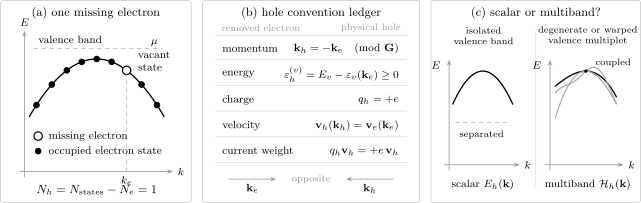
The hole description is a change of reference and labels. Removing the electron at creates one hole at ; the physical-momentum convention makes , , and the current weight mutually consistent. Dividing that weight by the sample volume gives one carrier’s contribution to the current density. An isolated band supports a scalar or tensor dispersion, whereas a degenerate or strongly mixed valence subspace requires a matrix Hamiltonian.
In a uniform electric field and in the simplest isolated-band approximation, the same relabeling turns into . Semiclassical Dynamics of Bloch Electrons owns the complete signed field equations and their validity tests; this page retains the electron-to-hole charge, momentum, velocity, and current transformation. Collision terms, Berry-curvature corrections, and observable conductivities require the dedicated transport and geometric owners. The group-current derivation above also does not erase polarization, orbital magnetization, interband response, or quantized transverse response from filled bands.
Curvature and the Effective-Mass Handoff
Section titled “Curvature and the Effective-Mass Handoff”Let a smooth nondegenerate valence band have a maximum at . Write the removed electron wave vector as
and the physical hole wave vector relative to its corresponding extremum as
If the valence band has the local expansion
then the hole excitation has
The positive hole-mass tensor is the negative of the valence electron curvature tensor at the maximum. This conversion does not give the electron a negative rest mass, nor does it make every response mass equal. Effective Mass owns the curvature derivation and the distinctions among curvature, density-of-states, conductivity, cyclotron, optical, and quasiparticle masses.
The expansion is local. Farther from the extremum, nonparabolicity, warping, nearby avoided crossings, and band mixing can make one constant tensor inadequate. At an exact degeneracy, assigning a Hessian to one arbitrarily chosen eigenvector is generally not gauge invariant; the retained degenerate subspace must be treated together.
Worked Reorganization of a Cosine Band
Section titled “Worked Reorganization of a Cosine Band”Consider a one-dimensional valence band with lattice spacing ,
The maximum is at . Remove an electron at . The band-edge hole energy is
The velocities are
and
Near the band edge,
Suppose the band has momentum states and only the electron state at is missing. The electron current of that occupied state would have been . Removing it changes the current by
Energy, velocity, momentum, charge, and current therefore agree under one convention. If one instead labels the hole by , the physical momentum remains ; changing only the symbol without changing the energy argument is the usual source of a sign error.
Hole Pockets Versus Hole Quasiparticles
Section titled “Hole Pockets Versus Hole Quasiparticles”A hole excitation is a missing occupation relative to a filled reference. A hole pocket is a Fermi-surface geometry: a compact sheet enclosing a small unoccupied region near a band maximum. They often occur together, but they are not synonyms.
Fermi Surface owns the orientation of electron and hole pockets, compensation, Fermi-volume counting, extremal orbits, and topology changes. In particular, a measured Hall sign is not a model-independent pocket label. In a multiband material it depends on carrier densities, mobilities, anisotropic scattering, field regime, and sometimes Berry or interband effects. Hall Effect owns that inference.
The word quasiparticle adds another requirement. In an interacting crystal, annihilating an electron produces an exact state in the sector, but it need not overlap mainly with one long-lived eigenstate. The electron-removal spectral function can contain
- a narrow quasihole pole with residue ;
- incoherent satellites or continua;
- several mixed orbital branches;
- broad features whose lifetime is comparable to their excitation energy.
A sharp hole dispersion is justified only for those branches and energy–momentum windows containing a sufficiently narrow pole with ; incoherent weight may coexist with that pole. Spectral Functions owns poles, residues, self-energies, and incoherent weight. Angle-Resolved Photoemission Spectroscopy owns the occupation-, matrix-element-, surface-, and resolution-weighted intensity; a bright ARPES ridge is evidence for a removal feature, not automatically a complete bulk hole Hamiltonian.
An optical electron–hole pair is neutral as a whole, and an exciton is a correlated bound neutral excitation. Neither is an isolated charge- hole. Band Gaps owns the distinction among charge, quasiparticle, neutral, and optical thresholds.
Degenerate Valence Bands and Multiband Limits
Section titled “Degenerate Valence Bands and Multiband Limits”The scalar picture is controlled only when one smooth band is isolated from the others over the wave packet’s support. Many technologically important valence edges fail this test.
In common cubic semiconductors, atomic spin–orbit coupling and crystal symmetry organize the valence states near the zone center into coupled angular-momentum subspaces. The top manifold supports heavy-hole and light-hole branches, while a split-off manifold lies at a material-dependent separation. In an ideal bulk crystal the heavy- and light-hole branches meet at the zone center; strain, confinement, fields, and lower symmetry can lift or reorganize them.
The correct low-energy object is then a matrix Hamiltonian acting on the retained valence subspace,
whose off-diagonal terms encode symmetry-allowed mixing. The Luttinger parameters summarize the leading quadratic invariants for a cubic manifold. “Heavy” and “light” refer to curvatures along specified directions and in specified regimes; they are not immutable particle species throughout the Brillouin zone.
Use the following escalation test.
| Situation | Minimum adequate description |
|---|---|
| smooth isolated nondegenerate valence band | scalar hole dispersion, generally with a mass tensor |
| two or more nearly degenerate valence bands | coupled multiband Hamiltonian and subspace projectors |
| strong spin–orbit coupling or warping | momentum-dependent spinor states and anisotropic response |
| wave packet sampling an avoided crossing | multiband dynamics; check interband transitions |
| coherent pole with strong interaction renormalization | quasihole dispersion, residue, and lifetime |
| broad or fractionalized removal spectrum | spectral description; no single-hole band claim |
| important Berry curvature or orbital moment | geometric wave-packet treatment in the retained subspace |
The internal quantum numbers of a hole also transform contragrediently to those of the removed electron. For spin-1/2, a time-reversed labeling can make the hole basis look familiar. For orbital multiplets, simply copying the electron’s magnetic quantum number can give the wrong sign for an additive generator. State the basis and determine observables from the many-body change, not from a mnemonic.
Semiconductor and Probe Handoffs
Section titled “Semiconductor and Probe Handoffs”Hole bookkeeping is an input to several larger calculations. It does not replace them.
| Question | Canonical owner | What the hole ledger alone does not determine |
|---|---|---|
| How many carriers are present at temperature ? | Metals, Insulators, and Semiconductors | chemical potential, dopant ionization, charge neutrality, degeneracy regime |
| Which mass enters a measured response? | Effective Mass | density-of-states, conductivity, cyclotron, optical, or quasiparticle definition |
| Is a Fermi-surface sheet electron-like or hole-like? | Fermi Surface | pocket geometry, compensation, orbit orientation |
| What is the conductivity or mobility? | Boltzmann Transport | collision operator, relaxation times, distribution, vertex corrections |
| What fixes the Hall sign? | Hall Effect | multicarrier weighting, field regime, anomalous terms |
| Is a removal feature a coherent quasihole? | Spectral Functions and ARPES | residue, lifetime, matrix elements, surface sensitivity, resolution |
| What is the optical threshold? | Band Gaps | directness, selection rules, exciton binding, phonon assistance |
| What is a generic neutral particle–hole continuum? | Particle–Hole Excitations | joint phase space, response vertices, collective poles |
Likewise, acceptor chemistry, junction electrostatics, confinement, and devices require their own material and boundary-condition models. The statement “acceptors create holes” is a carrier-count summary, not a microscopic account of the impurity wave function, ionization energy, screening, or compensation.
Validity and Reporting Checklist
Section titled “Validity and Reporting Checklist”Before using a hole Hamiltonian, record:
- Reference occupancy. Which band or subspace is nearly full, and how small is ?
- Energy object. Are the inputs model, Kohn–Sham, quasiparticle, or measured removal energies?
- Energy zero. Is the quoted value referenced to , to , or to a number-conserving electron–hole transition?
- Momentum convention. Does the label name the removed electron state or the physical hole momentum?
- Internal labels. Are spin, valley, orbital, Kramers, and degeneracy indices explicit, and is any multiplicity counted exactly once?
- Isolation test. Is one band separated from nearby bands across the wave-packet and field-induced momentum range?
- Coherence test. Does the removal spectrum contain a pole narrow enough for the intended time and energy scale?
- Response handoff. Which scattering, vertex, geometric, electrostatic, or probe model converts the hole inputs into the requested observable?
- Failure test. Would degeneracy, nonparabolicity, strong fields, disorder, interactions, or topology invalidate the scalar description?
A defensible result has the form: “relative to this filled reference, using this energy and momentum convention, these missing states behave as charge- holes over this specified window.” It is not a universal claim about every valence-band feature or every experimental sign.
Common Mistakes
Section titled “Common Mistakes”Calling a hole a microscopic positive particle. A hole is a missing electronic occupation relative to a reference. Its positive charge is the change in electronic charge when an electron is removed.
Giving a hole the removed electron’s momentum without qualification. If the hole is labeled by , its physical crystal momentum change is . If its label is to equal physical momentum, relabel .
Mixing the energy references. , , and answer different questions. A constant is harmless only while the hole number is fixed.
Using charge with the wrong velocity. Current consistency requires the momentum relabeling and the energy argument to be transformed together. Copying one sign from each convention produces a spurious minus sign.
Multiplying degeneracy twice. A band index that already includes spin or Kramers partners needs no extra factor of two. Count the actual one-particle labels in the retained subspace.
Treating every valence edge as one parabolic band. Degenerate, warped, or strongly spin–orbit-coupled valence manifolds require a matrix Hamiltonian. Heavy-hole and light-hole labels are regime- and direction-dependent.
Inferring carrier type from one probe sign. Hall, thermopower, optical, and ARPES signals contain different weights and assumptions. Route each inference through its response owner.
Confusing a hole with a positron, an exciton, or a Bogoliubov quasiparticle. A positron is an antiparticle, an exciton is a neutral correlated electron–hole excitation, and a Bogoliubov quasiparticle coherently mixes particle creation and annihilation. Ordinary band-hole bookkeeping does none of those things.
Exercises
Section titled “Exercises”1. Finite-band transformation
Section titled “1. Finite-band transformation”A nondegenerate band has four Bloch modes labeled , with
Define the filled reference and hole operators. Show that the two-hole state has electron occupations and . Rewrite in hole-normal-ordered form.
Solution
Choose a fixed product order,
and set , . Since
one hole in modes 2 and 4 gives ; the other modes retain . Fermionic reordering may change the state’s overall sign but not these occupations. With ,
2. Do not mix energy zeros
Section titled “2. Do not mix energy zeros”A valence state has , the valence maximum is , the chemical potential is , and a conduction state has . Find the band-edge hole energy, grand-canonical removal cost, and number-conserving electron–hole pair energy.
Solution
The three quantities are
and
They differ because the first measures kinetic energy down from the valence edge, the second changes particle number relative to , and the third preserves particle number.
3. Momentum conventions on a Brillouin torus
Section titled “3. Momentum conventions on a Brillouin torus”In a one-dimensional lattice with Brillouin zone , remove an electron at . Give (a) the removed-state hole label and its physical momentum, and (b) a physical-momentum hole label in the same zone. Explain why adding does not create a different crystal-momentum sector.
Solution
In the removed-state convention the hole is labeled , but the many-body momentum change is
In the physical-momentum convention choose
The alternative representative differs by the reciprocal vector and therefore labels the same crystal momentum on the Brillouin torus.
4. Current consistency in the cosine band
Section titled “4. Current consistency in the cosine band”For the worked cosine band, take a hole at . Compute , , the removed electron wave vector, and the current carried by one hole in volume .
Solution
The removed electron was at . Therefore
and
The electron velocity at has the same value. Removing its charge- current changes the total current by
5. Degeneracy-aware state counting
Section titled “5. Degeneracy-aware state counting”A crystal has primitive cells. A valence manifold contains two explicitly listed spin–orbit-split bands, each with one state per , and has electrons. How many holes are present? What error results from adding an extra spin factor of two?
Solution
The two explicit bands contain
states, so
The spin–orbit-split bands already carry their internal labels. Multiplying their capacity by two again would predict states and the nonsensical count holes.
6. Decide whether one hole mass is enough
Section titled “6. Decide whether one hole mass is enough”At a zone-center valence edge, two branches are exactly degenerate, split linearly under strain, and mix strongly away from a high-symmetry axis. A fit along that axis reports one “heavy-hole mass.” List the minimum additional information needed before using that number in a three-dimensional conductivity model.
Solution
At minimum one needs:
- the retained degenerate subspace and basis;
- the matrix Hamiltonian or symmetry-allowed parameters away from the fitted axis;
- the strain tensor and its splitting of the branches;
- the carrier-density and momentum window sampled;
- direction-dependent velocities or curvature tensors after mixing;
- scattering and interband-coherence assumptions for conductivity.
One axial curvature is not a global species label or a complete transport mass. The problem requires a multiband hole Hamiltonian before the transport calculation.
7. Route four experimental statements
Section titled “7. Route four experimental statements”Assign each statement to the owner needed beyond hole bookkeeping:
- “The ARPES ridge has a linewidth of .”
- “The Hall coefficient is positive.”
- “The optical onset is .”
- “The hole density at is .”
State one reason each number cannot be interpreted from charge alone.
Solution
- Route the linewidth through Spectral Functions and ARPES; it depends on self-energy, matrix elements, surface sensitivity, and resolution.
- Route the sign through Hall Effect; multiple carriers, mobilities, anisotropy, and field regime enter.
- Route the onset through Band Gaps and the optical-probe model; directness, selection rules, excitons, and phonons can shift or hide thresholds.
- Route the density through Metals, Insulators, and Semiconductors; the chemical potential, density of states, dopant ionization, and charge neutrality determine it.
The hole ledger fixes the relative charge and state complement, not these response-specific forward models.
References
Section titled “References”- N. W. Ashcroft and N. D. Mermin, Solid State Physics, Holt, Rinehart and Winston (1976), Chapters 12–13 and 28.
- E. O. Kane, “Band Structure of Indium Antimonide,” Journal of Physics and Chemistry of Solids 1, 249–261 (1957), doi:10.1016/0022-3697(57)90013-6.
- C. Kittel, Introduction to Solid State Physics, 8th ed., Wiley (2004), Chapters 6 and 8.
- J. M. Luttinger, “Quantum Theory of Cyclotron Resonance in Semiconductors: General Theory,” Physical Review 102, 1030–1041 (1956), doi:10.1103/PhysRev.102.1030.
- J. M. Luttinger and W. Kohn, “Motion of Electrons and Holes in Perturbed Periodic Fields,” Physical Review 97, 869–883 (1955), doi:10.1103/PhysRev.97.869.
- M. P. Marder, Condensed Matter Physics, 2nd ed., Cambridge University Press (2010), Chapters 7–9.
- R. M. Martin, Electronic Structure: Basic Theory and Practical Methods, Cambridge University Press (2004), doi:10.1017/CBO9780511805769.
- S. H. Simon, The Oxford Solid State Basics, Oxford University Press (2013), Chapters 6–8.
- G. Sundaram and Q. Niu, “Wave-Packet Dynamics in Slowly Perturbed Crystals: Gradient Corrections and Berry-Phase Effects,” Physical Review B 59, 14915–14925 (1999), doi:10.1103/PhysRevB.59.14915.
- R. Winkler, Spin–Orbit Coupling Effects in Two-Dimensional Electron and Hole Systems, Springer Tracts in Modern Physics 191, Springer (2003), doi:10.1007/b13586.
- P. Y. Yu and M. Cardona, Fundamentals of Semiconductors: Physics and Materials Properties, 4th ed., Springer (2010), doi:10.1007/978-3-642-00710-1.