Correlated Insulators in Moiré Systems
A correlated insulator in a moiré system is a charge-incompressible or charge-localized phase at a commensurate moiré filling whose insulating behavior requires electron interactions beyond a calibrated independent-particle miniband description. This definition deliberately separates an observation from its interpretation. A resistance peak at an integer or fractional filling is evidence for inhibited transport; it is not yet proof of a thermodynamic gap, a Mott state, a Wigner crystal, or any particular order.
The phrase covers several mechanisms that can coexist:
| candidate limit | organizing physics | characteristic evidence |
|---|---|---|
| one-body band insulator | a complete set of reconstructed subbands is filled | gap reproduced by a validated single-particle Hamiltonian |
| Mott-like insulator | local interaction blocks charge fluctuations at an integer occupation of effective sites or orbitals | thermodynamic charge gap, local moments, and interaction-controlled tuning without required charge-cell enlargement |
| generalized Wigner crystal | longer-range repulsion selects a commensurate spatial charge pattern | fractional-filling incompressibility plus enlarged-period charge order |
| flavor-ordered or Slater-like insulator | spin, valley, layer, or intervalley-coherent order reconstructs the spectrum | an order parameter tracks the gap and its symmetry-breaking field response |
| correlated Chern insulator | interactions select an incompressible state with nonzero many-body Hall topology | bulk gap together with quantized Hall response and appropriate magnetic-field slope |
| localized or percolative regime | disorder, twist inhomogeneity, contacts, or Coulomb blockade interrupt conduction | strong spatial dependence and transport insulation without a reproducible bulk thermodynamic gap |
“Correlated” is strongest when several probes exclude the simpler rows, not when it merely labels a large resistance.
Canonical Scope
Section titled “Canonical Scope”This page is the canonical home for filling-controlled insulating phases in moiré materials: filling conventions, the distinction between Mott-like and generalized Wigner pictures, spin and valley order, experimental claim standards, and the relation to extended multi-flavor Hubbard models.
Moiré Superlattices owns the emergent geometry, cell area, mini Brillouin zone, minibands, and generic interaction-to-bandwidth hierarchy. Flat Bands owns flatness, projectors, form factors, and quantum geometry. Mott Insulators owns the general definition and thermodynamics of a Mott phase, while Hubbard Physics in Materials owns the full material-to-model workflow.
Twisted Bilayer Graphene and Transition-Metal Dichalcogenides retain platform-specific band structures and experimental records. This page compares their insulating mechanisms without duplicating those material accounts.
Filling-Controlled Phases
Section titled “Filling-Controlled Phases”Filling is a calibrated, signed quantity
Section titled “Filling is a calibrated, signed quantity”For a device with local carrier density , reference density , and moiré-cell area , define
The sign, reference, and active-manifold capacity must accompany the number. In one convention is charge neutrality; in another it is an empty conduction miniband or a filled valence miniband. A four-flavor manifold may be called full at , whereas a normalized convention calls the same point filling one. “Half filling” is therefore ambiguous unless the number of active one-particle states per cell is stated.
For a triangular moiré lattice of period , the cell area is .
The inferred density of one carrier per cell is only as accurate as the local twist, strain, reconstruction, and electrostatic calibration. A small spatial variation of produces a doubled relative variation in and hence shifts the density assigned to a fixed .
Integer filling does not identify a mechanism
Section titled “Integer filling does not identify a mechanism”At integer , at least three conceptually different gaps are possible.
- A band gap appears because an integer number of one-particle subbands is filled.
- A Mott-like gap appears because changing the local integer occupation costs interaction energy even though the noninteracting active band would be partially filled.
- A flavor-ordering gap appears when interactions polarize or coherently mix internal states and thereby reconstruct the bands.
These are limiting descriptions, not always sharply separated phases. A flavor-polarized state can also have strong local charge correlations; a lattice relaxation can produce a one-body gap that interactions enhance; and a Chern insulator can arise after flavor polarization of a topological band.
Fractional filling gives a stronger hint of translation-breaking or topological order, but it is still not decisive. A larger structural supercell, single-particle miniband splitting, disorder-induced puddles, or a fractional Chern phase can all produce nontrivial fractions. The correct denominator is the capacity of the experimentally established primitive cell, not an assumed ideal cell.
The tuning space is multidimensional
Section titled “The tuning space is multidimensional”Gate voltages can vary density, displacement field, dielectric screening, and layer polarization at once. Twist angle changes the bandwidth, wave functions, topology, and relaxation. Pressure changes tunneling and structure. Magnetic field couples to spin, orbital magnetization, and Chern number. A useful phase diagram therefore reports the experimentally controlled coordinates rather than compressing them into a single nominal ratio such as .
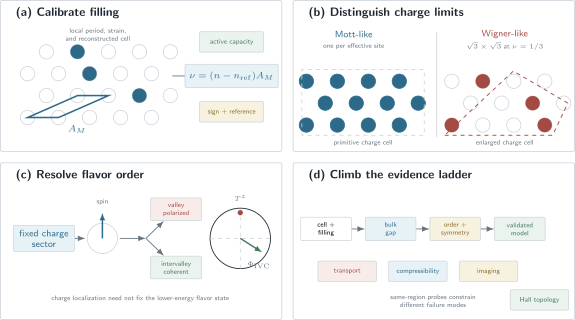
A correlated-insulator claim has four linked ledgers: calibrate carriers per moiré cell; distinguish site-centered Mott-like localization from enlarged-cell charge order; identify spin, valley, or intervalley-coherent structure; and combine thermodynamic, symmetry, transport, and topological evidence. No single panel determines the mechanism.
Mott-Like and Wigner-Like Pictures
Section titled “Mott-Like and Wigner-Like Pictures”A minimal extended lattice model
Section titled “A minimal extended lattice model”When isolated moiré bands admit sufficiently localized orbitals, a useful starting point is
Here label moiré orbitals or sites, label spin, valley, layer, or orbital flavors, and . The local term can include intra-orbital repulsion, interorbital repulsion, Hund-like exchange, and flavor anisotropy. Nonlocal exchange, density-assisted hopping, pair hopping, and coupling to remote bands may be important. The Coulomb matrix depends on Wannier extent, gates, dielectric interfaces, and dynamical screening.
This Hamiltonian is a hypothesis whose basis and truncation must be validated. Topological or fragile-topological active bands may obstruct a symmetry-preserving, exponentially localized, few-orbital representation. Even without an obstruction, broad moiré Wannier functions make neighboring interaction matrix elements comparable enough that an onsite-only model can fail.
Mott-like localization
Section titled “Mott-like localization”In the simplest site-centered picture, each effective site carries a commensurate integer occupation. Charge motion creates an energetically costly empty–double-occupation pair, while spin or valley degrees of freedom remain at lower energy. The charge density need not enlarge the moiré translation cell.
The word Mott-like is appropriate when evidence supports this local-constraint mechanism but the full microscopic requirements of a clean one-band Hubbard model are not established. A trustworthy assignment asks:
- Would the calibrated noninteracting bands be metallic at this filling?
- Is there a bulk charge gap or incompressible density interval?
- Do local spin, valley, or orbital moments survive above any ordering temperature?
- Does tuning the kinetic-to-interaction hierarchy close the gap consistently?
- Can structural, flavor-ordering, and disorder alternatives be bounded?
The canonical many-body charge-gap definition and its distinction from spectral, optical, and transport gaps are developed in Mott Insulators.
Generalized Wigner crystallization
Section titled “Generalized Wigner crystallization”A continuum Wigner crystal minimizes long-range Coulomb energy at low density by spontaneously forming a lattice. A generalized Wigner crystal in a moiré system instead uses the pre-existing moiré lattice as a registry and forms a larger commensurate charge pattern. On a triangular lattice at , for example, occupying one of three sublattices produces a pattern with one carrier per enlarged cell.
In a classical occupancy limit,
Longer-range terms select among stripes, bubbles, triangular crystals, and other commensurate arrangements. Quantum hopping melts or dresses these patterns. Because the moiré potential already breaks continuous translation symmetry, “Wigner crystal” does not mean the same symmetry breaking as in a translationally invariant electron gas; the experimentally testable statement is enlarged-period charge order driven substantially by nonlocal repulsion.
A charge structure factor can diagnose that enlargement:
Bragg scaling of at a wavevector not equivalent to a primitive moiré reciprocal vector supports long-range charge order. A gap at fractional filling without such evidence should be called a fractional correlated insulator until its order or topology is established.
The boundary can be a crossover
Section titled “The boundary can be a crossover”“Mott” and “Wigner” emphasize different pieces of the same extended-interaction problem. At one carrier per moiré site, onsite avoidance may dominate while nonlocal repulsion reshapes the charge distribution inside each cell. At fractional filling, a charge crystal can still have strong local suppression of double occupancy. Broad orbitals may shift charge continuously between site-centered and interstitial regions.
Accordingly, labels such as Mott–Wigner state can be useful if the measured regime genuinely combines local constraints and nonlocal charge order. They should not conceal missing evidence. The practical discriminator is whether an enlarged charge unit cell is required and observed, together with how the gap evolves when screening, bandwidth, and filling are tuned independently.
Spin and Valley Order
Section titled “Spin and Valley Order”Charge localization leaves internal degrees of freedom that can order at scales far below the charge gap. For a spin–valley spinor , convenient local operators are
acts on spin and on valley. Valley polarization has . Intervalley coherence instead uses an off-diagonal order parameter, for example
which breaks an approximate valley symmetry when intervalley scattering is weak. Layer polarization and combined spin–valley order require analogous operators. The symmetry actually available is material dependent: graphene often has approximate spin and valley flavor symmetries, while spin–orbit coupling in TMD valence bands can lock spin to valley and make the effective exchange strongly anisotropic.
For a single orbital with real nearest-neighbor hopping, one particle per site, and , the simplest virtual-hopping estimate is
This is not a generic moiré exchange formula. Triangular geometry frustrates antiferromagnetism; complex hopping phases, multiple orbitals, direct exchange, Hund coupling, and longer-range virtual processes generate anisotropic, ring-exchange, and chiral terms. If is not the dominant excitation energy, even the denominator changes.
The hierarchy of transition scales is informative. A charge gap can open at a temperature much higher than spin or valley ordering, leaving an intermediate local-moment regime. Conversely, an insulating gap that appears only with a flavor-order parameter may be primarily Slater-like. Magnetic-field dependence alone is insufficient because Zeeman coupling, orbital moments, Chern magnetization, and field-dependent screening can all shift a gap.
Experimental Signatures
Section titled “Experimental Signatures”Establish the moiré cell and filling first
Section titled “Establish the moiré cell and filling first”The first evidence layer is metrology:
- twist angle, lattice mismatch, and reconstruction from microscopy or diffraction;
- local moiré period and strain rather than only a fabrication target;
- gate capacitances and the density reference;
- active-band capacity from Landau fans, quantum oscillations, or spectroscopic closure;
- spatial uniformity over the region sampled by later probes.
A feature repeating every nominal is useful evidence of commensurability. It does not determine whether the primitive electronic cell equals the geometric cell, especially when relaxation or spontaneous order enlarges it.
Thermodynamic incompressibility is the central charge test
Section titled “Thermodynamic incompressibility is the central charge test”An incompressible state produces a chemical-potential jump and suppressed differential charge response. Local single-electron transistors, penetration-field capacitance, gate capacitance, and calibrated optical sensors can access related quantities. A convenient inverse-compressibility measure is
with a singular or strongly enhanced response at a zero-temperature charge gap. Real devices add geometric capacitance, electrostatic image charges, finite temperature, inhomogeneous broadening, and negative electronic compressibility in nearby metallic regions. These contributions must be modeled before converting a measured capacitance dip or peak into an energy gap.
In TMD moiré heterostructures, excitons in the active or a nearby sensing layer can respond sharply to electronic screening. Such optical signatures have revealed integer and fractional incompressible states even where direct electrical contacts are difficult. The exciton is a transducer: its energy or oscillator strength must be calibrated against charge response, and it does not by itself identify the electron ordering pattern.
Transport locates phases but rarely names them
Section titled “Transport locates phases but rarely names them”A thermally activated channel is often fitted as
The factor of two assumes symmetric activation of mobile particles and holes; variable-range hopping, percolation, edge conduction, contact resistance, and a temperature-dependent prefactor change the interpretation. is a transport scale, not automatically the many-body charge gap.
The most reliable transport claims reproduce filling locations across contacts and thermal cycles, map the response over displacement field and magnetic field, and compare it with a thermodynamic probe in the same density range. A resistance maximum that follows a high-resistance device region or disappears after changing contacts is weak bulk evidence.
Determine the broken symmetry
Section titled “Determine the broken symmetry”Charge order can be tested by scanning tunneling microscopy, local compressibility, microwave impedance microscopy, diffraction-sensitive methods, or spatially resolved optical response. The required observation is a reproducible modulation with a wavevector and phase relation not already imposed by the primitive structure.
Spin and valley order require probes coupled to those degrees of freedom: magnetization, susceptibility, circular dichroism, Kerr rotation, spin-resolved spectroscopy, field-angle dependence, or collective excitations. Hysteresis can support ferromagnetism but can also arise from domains and slow electrostatics. An order assignment should identify its conjugate field, symmetry, domain structure, and transition or crossover scale.
For a gapped two-dimensional phase, the Středa slope gives
Together with a robust Hall plateau and vanishing longitudinal response, an integer slope supports Chern number . A sloped line in a density–field map by itself is not quantization; contact mixing, parallel channels, and incomplete bulk insulation must be excluded. Fractional Hall topology requires correspondingly stronger evidence, including fractional quantization and many-body gap systematics.
Use an evidence ladder
Section titled “Use an evidence ladder”A defensible mechanism assignment proceeds through increasingly specific claims:
- Commensurate transport feature: an anomaly occurs at a calibrated .
- Bulk incompressibility: a chemical-potential step or equivalent charge response establishes a gap.
- Interaction necessity: a validated one-body model cannot account for the gap, and controlled tuning implicates interactions.
- Order identification: charge, spin, valley, layer, or topological structure is measured.
- Model validation: one microscopic parameter set explains the gap, order, excitations, and tuning within uncertainties.
Later rungs do not erase the earlier error bars. Ideally, local structure, thermodynamics, and order are measured on the same region because twist-angle disorder can make nominally simultaneous global probes sample different electronic phases.
Relation to Hubbard Models
Section titled “Relation to Hubbard Models”Moiré tunability makes Hubbard language tempting
Section titled “Moiré tunability makes Hubbard language tempting”Moiré periods enlarge electronic orbitals and reduce kinetic scales. Gates can alter dielectric screening, displacement fields can change orbital character, and twist can tune hopping. This makes the ratio of interaction to bandwidth unusually controllable. It does not make every moiré material a one-band Hubbard model.
A model requires:
| ingredient | material question |
|---|---|
| active orbitals | which bands and flavors remain below the cutoff? |
| hopping matrix | does it reproduce dispersion, Berry structure, and orbital embedding? |
| interactions | which onsite, nonlocal, exchange, and assisted terms survive screening? |
| filling map | how do gate density and reconstructed cell map to model occupancy? |
| solver | which temperatures, sizes, signs, and symmetry sectors are controlled? |
| observable map | how are compressibility, optical shifts, transport, and order reconstructed? |
The hierarchy is often better described as an extended multi-flavor Hubbard family. A triangular TMD miniband may motivate a one-orbital triangular model in a restricted regime. Twisted graphene generally requires valley, sublattice, topology, remote-band, and interaction-form-factor care. At fractional filling with sizable , a lattice-gas or charge-order description may be more transparent than an onsite Hubbard reduction.
Parameters are linked to the device
Section titled “Parameters are linked to the device”Wannier matrix elements schematically obey
Here is the screened interaction appropriate to the chosen low-energy partition, and only in the simplest density–density estimate. Metallic gates change the long-distance tail; layer-polarized wave functions change both hopping and interactions; and screening by remote bands can be frequency dependent. Quoting from is a scale estimate, not a complete downfolding.
Model success is observable-specific
Section titled “Model success is observable-specific”“Simulation of Hubbard physics” can mean several levels:
- a Hubbard-inspired model reproduces a qualitative sequence of commensurate states;
- parameters derived from measured structure reproduce selected energies;
- a controlled many-body calculation predicts several observables without retuning;
- tuning screening, bandwidth, or filling verifies the proposed causal mechanism.
The strongest work closes the loop from local structure to Hamiltonian to several probes. Failure at one level should narrow the claim rather than be hidden by changing the model after each observable.
Representative Experimental Lessons
Section titled “Representative Experimental Lessons”Twisted graphene
Section titled “Twisted graphene”The 2018 observation of a half-filled insulating state near the first magic angle established that narrow graphene moiré bands can host interaction-driven phases. Subsequent compressibility, transport, and local-probe studies revealed cascades of flavor transitions, substantial device dependence, and close competition among correlated insulators, Chern states, superconductivity, and compressible metals. The early “Mott-like” analogy was productive, but a literal single-orbital Mott assignment is not universal: topology, flavor polarization, remote bands, strain, and screening all matter.
Semiconductor moiré systems
Section titled “Semiconductor moiré systems”Aligned WSe/WS and related heterostructures revealed incompressible states at integer and many fractional fillings through optical sensing, capacitance, and transport. Integer states can realize Mott-like local constraints; fractions such as and motivate generalized Wigner or charge-order pictures because long-range repulsion can favor enlarged cells. Later observations of stripe-like patterns, tunable charge gaps, and continuous metal–insulator transitions demonstrate both the power and the nonuniversality of a single minimal model.
TMD homobilayers add twist-tunable bandwidth, displacement-field control, and strong spin–orbit-coupled valley structure. They are especially useful for testing triangular-lattice Hubbard ideas, but the relevant orbital center, valley content, and topology can change across twist and field. “TMD moiré” is a platform family, not one Hamiltonian.
Common Mistakes
Section titled “Common Mistakes”- Calling every resistance peak a correlated insulator. Transport can be dominated by contacts, disorder, percolation, or a one-body gap.
- Omitting the filling convention. The sign, reference density, active degeneracy, and cell area belong to every quoted .
- Equating integer filling with a Mott state. Band completion and flavor reconstruction are competing explanations.
- Equating fractional filling with a Wigner crystal. Enlarged-cell charge order must be measured or strongly constrained; topological and structural alternatives remain.
- Treating the transport activation scale as the charge gap. Mobility edges and in-gap conduction usually lower the transport scale.
- Inferring order from field dependence alone. Spin, valley, orbital, and topological couplings can produce similar shifts.
- Using onsite-only Hubbard parameters by default. Moiré orbitals are extended, and gates modify nonlocal interactions.
- Ignoring spatial inhomogeneity. A global trace can average metallic and insulating regions with different local twist angles.
- Assuming one tuning knob changes one model parameter. Density gates, displacement field, pressure, and twist generally move several coordinates.
- Calling a fitted model a quantum simulation. Predictive validation requires structure-linked parameters and multiple observables.
Exercises
Section titled “Exercises”Exercise 1: converting density to filling
Section titled “Exercise 1: converting density to filling”A triangular moiré lattice has . Find its unit-cell area and the carrier density corresponding to one carrier per cell. Express the density in .
Solution
The area is
Therefore
If the local period were larger, the cell area would be about larger and the inferred one-per-cell density about smaller.
Exercise 2: commensurability versus mechanism
Section titled “Exercise 2: commensurability versus mechanism”At a device shows a sharp resistance peak. A continuum calculation predicts a single-particle gap at the same density, and the measured gap changes only weakly when a nearby screening gate is moved. What is the strongest justified claim?
Solution
The data establish a commensurate insulating transport feature consistent with a band gap. They do not require a correlated insulator because the calibrated one-body model already provides a candidate explanation and screening produces little response. A bulk thermodynamic gap measurement would strengthen the insulating assignment, but interaction necessity would still require a discrepancy with the one-body prediction or another interaction-specific signature.
Exercise 3: a fractional charge pattern
Section titled “Exercise 3: a fractional charge pattern”On a triangular moiré lattice, construct the simplest charge pattern that avoids occupied nearest neighbors. How many primitive sites lie in its charge unit cell, and what new ordering wavevector should a structure-factor measurement find?
Solution
Color the triangular lattice with three sublattices and occupy one color. The occupied sites form a triangular lattice with spacing times the original spacing. The charge cell contains three primitive moiré sites and one carrier.
The order is conventionally called . Its Bragg peaks occur at the inequivalent points of the primitive triangular-lattice Brillouin zone, modulo reciprocal lattice vectors. A gap at without such enlarged-period evidence remains a fractional correlated-insulator observation rather than a demonstrated crystal.
Exercise 4: exchange scale
Section titled “Exercise 4: exchange scale”Use the simplest one-band estimate for and . Find in millielectronvolts and kelvin. Take .
Solution
The leading estimate gives
Thus . This estimate is meaningful only if the assumed local charge excitation dominates and other orbitals, direct exchange, complex hopping, and higher-order processes are small.
Exercise 5: three gaps
Section titled “Exercise 5: three gaps”A capacitance measurement gives addition and removal edges separated by . Transport fitted over a restricted range gives , while an optical sensor shifts at the same filling. Are the three observations inconsistent?
Solution
No. The separation estimates a thermodynamic charge gap after electrostatic corrections. The smaller transport scale can reflect mobility edges, disorder-assisted hopping, or in-gap conduction. The optical shift supports a change in screening or compressibility but requires its own calibration and need not equal either energy. Agreement in filling and systematic temperature dependence is valuable even when the extracted scales differ.
Exercise 6: evidence audit
Section titled “Exercise 6: evidence audit”A fractional-filling state has a chemical-potential jump, no detected charge modulation, a Hall resistance near , nonzero longitudinal resistance, and a density–field slope close to . Classify what is established and what remains open.
Solution
The chemical-potential jump establishes bulk incompressibility at the measured resolution. The field slope is consistent with an integer Chern response, and the Hall value is suggestive. Because the longitudinal resistance is nonzero and exact Hall quantization is not established, the data do not yet prove a Chern insulator. The absence of detected charge modulation bounds order only at the probe’s resolution and wavevector coverage. Improved longitudinal insulation, metrological Hall accuracy, nonlocal or edge tests, and more complete imaging would discriminate a Chern phase from an inhomogeneous charge-ordered or parallel-conduction state.
Research Status
Section titled “Research Status”The existence of interaction-driven integer and fractional incompressible states in several graphene and semiconductor moiré platforms is established. Thermodynamic probes, optical sensing, local imaging, and transport have moved the field beyond the original resistance-anomaly evidence. Extended interactions, flavor degrees of freedom, and device-controlled screening are demonstrably important.
Material-specific microscopic assignments remain active research. The relation between a given integer state and Mott, Slater, flavor-polarized, or topological limits can change with twist, strain, displacement field, and screening. Fractional charge patterns are increasingly accessible, but distinguishing crystals, liquids, and disorder-pinned mixtures requires local order and excitation measurements. Quantitative downfolding is challenged by reconstruction, nonlocal screening, topology, and spatial inhomogeneity. These uncertainties should be stated at the level of each device and phase rather than generalized to all moiré systems.
Summary
Section titled “Summary”- Filling is carriers per calibrated moiré cell relative to a stated reference; its sign and active-manifold capacity are indispensable.
- Integer and fractional commensurability locate candidate phases but do not identify their mechanisms.
- Mott-like localization emphasizes an integer local constraint without required charge-cell enlargement.
- Generalized Wigner crystallization emphasizes nonlocal repulsion and an enlarged commensurate charge pattern, often at fractional filling.
- Spin, valley, layer, and intervalley-coherent orders can coexist with charge localization or generate an insulating gap themselves.
- Thermodynamic incompressibility is the central charge criterion; transport, optics, imaging, and Hall response answer complementary questions.
- Moiré models are usually extended, multi-flavor, and device dependent. A one-band onsite Hubbard model is a controlled conclusion only after basis, interactions, and observables are validated.
Connections
Section titled “Connections”- Moiré Superlattices develops the geometric cell, filling conversion, minibands, and interaction-scale hierarchy.
- Flat Bands distinguishes energy flatness from projector geometry and projected interaction structure.
- Twisted Bilayer Graphene gives the graphene-specific continuum model and correlated-state evidence ledger.
- Transition-Metal Dichalcogenides develops spin–valley locking, excitons, and semiconductor moiré platforms.
- Moiré Superconductivity tests whether neighboring superconductivity shares a causal mechanism with an insulating phase or merely occupies adjacent control space.
- Moiré Topology separates topological minibands, symmetry-broken Chern insulators, charge order, and fractional Chern order using Hall and Středa evidence.
- Mott Insulators owns charge-gap thermodynamics and the general Mott claim standard.
- Hubbard Physics in Materials explains active subspaces, screened interactions, model solvers, and validation.
- Charge and Spin Density Waves owns finite-wavevector order and its experimental diagnosis.
- Chern Numbers in Band Theory develops band Chern invariants and quantized Hall response.
- Topological Order covers long-range entanglement, ground-state structure, and fractionalized excitations beyond independent bands.
Further Reading
Section titled “Further Reading”- E. Wigner, “On the Interaction of Electrons in Metals,” Physical Review 46, 1002–1011 (1934), doi:10.1103/PhysRev.46.1002.
- J. Hubbard, “Generalized Wigner Lattices in One Dimension and Some Applications to Tetracyanoquinodimethane Salts,” Physical Review B 17, 494–505 (1978), doi:10.1103/PhysRevB.17.494.
- F. D. M. Haldane, “Model for a Quantum Hall Effect without Landau Levels,” Physical Review Letters 61, 2015–2018 (1988), doi:10.1103/PhysRevLett.61.2015.
- B. Padhi, R. Chitra, and P. W. Phillips, “Generalized Wigner Crystallization in Moiré Materials,” Physical Review B 103, 125146 (2021), doi:10.1103/PhysRevB.103.125146.
- Y. Cao et al., “Correlated Insulator Behaviour at Half-Filling in Magic-Angle Graphene Superlattices,” Nature 556, 80–84 (2018), doi:10.1038/nature26154.
- Y. Cao et al., “Unconventional Superconductivity in Magic-Angle Graphene Superlattices,” Nature 556, 43–50 (2018), doi:10.1038/nature26160.
- F. Wu, T. Lovorn, E. Tutuc, and A. H. MacDonald, “Hubbard Model Physics in Transition Metal Dichalcogenide Moiré Bands,” Physical Review Letters 121, 026402 (2018), doi:10.1103/PhysRevLett.121.026402.
- X. Lu et al., “Superconductors, Orbital Magnets and Correlated States in Magic-Angle Bilayer Graphene,” Nature 574, 653–657 (2019), doi:10.1038/s41586-019-1695-0.
- Y. Tang et al., “Simulation of Hubbard Model Physics in WSe/WS Moiré Superlattices,” Nature 579, 353–358 (2020), doi:10.1038/s41586-020-2085-3.
- E. C. Regan et al., “Mott and Generalized Wigner Crystal States in WSe/WS Moiré Superlattices,” Nature 579, 359–363 (2020), doi:10.1038/s41586-020-2092-4.
- Y. Shimazaki et al., “Strongly Correlated Electrons and Hybrid Excitons in a Moiré Heterostructure,” Nature 580, 472–477 (2020), doi:10.1038/s41586-020-2191-2.
- L. Wang et al., “Correlated Electronic Phases in Twisted Bilayer Transition Metal Dichalcogenides,” Nature Materials 19, 861–866 (2020), doi:10.1038/s41563-020-0708-6.
- Y. Xu et al., “Correlated Insulating States at Fractional Fillings of Moiré Superlattices,” Nature 587, 214–218 (2020), doi:10.1038/s41586-020-2868-6.
- U. Zondiner et al., “Cascade of Phase Transitions and Dirac Revivals in Magic-Angle Graphene,” Nature 582, 203–208 (2020), doi:10.1038/s41586-020-2373-y.
- D. Wong et al., “Cascade of Electronic Transitions in Magic-Angle Twisted Bilayer Graphene,” Nature 582, 198–202 (2020), doi:10.1038/s41586-020-2339-0.
- S. Liu et al., “Tunable Hubbard Model Physics and Generalized Wigner Crystal in Transition Metal Dichalcogenide Moiré Superlattices,” Physical Review X 11, 011076 (2021), doi:10.1103/PhysRevX.11.011076.
- C. Jin et al., “Stripe Phases in WSe/WS Moiré Superlattices,” Nature Materials 20, 940–944 (2021), doi:10.1038/s41563-021-00959-8.
- X. Huang et al., “Correlated Insulating States at Fractional Fillings of the WS/WSe Moiré Lattice,” Nature Physics 17, 715–719 (2021), doi:10.1038/s41567-021-01171-w.
- T. Li et al., “Continuous Mott Transition in Semiconductor Moiré Superlattices,” Nature 597, 350–354 (2021), doi:10.1038/s41586-021-03853-0.
- A. Ghiotto et al., “Quantum Criticality in Twisted Transition Metal Dichalcogenides,” Nature 597, 345–349 (2021), doi:10.1038/s41586-021-03815-6.
- T. Li et al., “Charge-Order-Enhanced Capacitance in Semiconductor Moiré Superlattices,” Nature Nanotechnology 16, 1068–1072 (2021), doi:10.1038/s41565-021-00955-8.
- H. Li et al., “Imaging Two-Dimensional Generalized Wigner Crystals,” Nature 597, 650–654 (2021), doi:10.1038/s41586-021-03874-9.
- K. Zhang, Y. Zhang, L. Fu, and E.-A. Kim, “Moiré Quantum Chemistry: Charge Transfer in Transition Metal Dichalcogenide Superlattices,” Physical Review B 102, 201115(R) (2020), doi:10.1103/PhysRevB.102.201115.
- H. Pan, F. Wu, and S. Das Sarma, “Quantum Phase Diagram of a Moiré-Hubbard Model,” Physical Review B 102, 201104(R) (2020), doi:10.1103/PhysRevB.102.201104.
- N. Morales-Durán, P. Potasz, and A. H. MacDonald, “Magnetism and Quantum Melting in Moiré-Material Wigner Crystals,” Physical Review B 103, L241110 (2021), doi:10.1103/PhysRevB.103.L241110.
- D. M. Kennes et al., “Moiré Heterostructures as a Condensed-Matter Quantum Simulator,” Nature Physics 17, 155–163 (2021), doi:10.1038/s41567-020-01154-3.
- K. F. Mak and J. Shan, “Semiconductor Moiré Materials,” Nature Nanotechnology 17, 686–695 (2022), doi:10.1038/s41565-022-01165-6.
- C. N. Lau, M. W. Bockrath, K. F. Mak, and F. Zhang, “Reproducibility in the Fabrication and Physics of Moiré Materials,” Nature 602, 41–50 (2022), doi:10.1038/s41586-021-04173-z.
- E. Y. Andrei and A. H. MacDonald, “Graphene Bilayers with a Twist,” Nature Materials 19, 1265–1275 (2020), doi:10.1038/s41563-020-00840-0.
- D. P. Arovas, E. Berg, S. A. Kivelson, and S. Raghu, “The Hubbard Model,” Annual Review of Condensed Matter Physics 13, 239–274 (2022), doi:10.1146/annurev-conmatphys-031620-102024.