Charge and Spin Density Waves
A density wave is a state in which a charge, spin, orbital, or bond observable develops a periodic component at a nonzero ordering wavevector . A charge-density wave (CDW) modulates a time-reversal-even electronic observable; a spin-density wave (SDW) modulates magnetization and is odd under time reversal. Both break translations when is not a reciprocal-lattice vector, reconstruct electronic states by mixing momenta separated by , and support collective fluctuations of their amplitude and phase.
Density waves are identified by their operator, wavevector, symmetry, correlation length, and dynamics. A nested Fermi-surface sketch, a partial gap, or a resistivity anomaly is not by itself a density-wave diagnosis.
Canonical Scope
Section titled “Canonical Scope”Order Parameters owns the general construction of symmetry-breaking fields. Long-Range Order, Structure Factors, and Equal-Time Correlations own thermodynamic-limit and finite-size tests. Itinerant Magnetism owns the detailed Stoner and matrix-susceptibility route to material SDWs, including chromium. BCS Theory owns uniform weak-coupling superconductivity.
This page is the canonical home for comparing charge and spin density waves in quantum materials: their symmetry and harmonics, nesting and Peierls limits, band reconstruction, collective modes, experimental evidence, and competition or coexistence with superconductivity.
Periodic Charge and Spin Modulation
Section titled “Periodic Charge and Spin Modulation”Write the microscopic density as a lattice-periodic background plus slowly varying Fourier components:
Reality requires and . The order parameters may carry orbital, sublattice, or bond indices that are suppressed here. Those internal form factors can be decisive: a bond-density wave may strongly modulate hopping or kinetic energy while producing only a small onsite charge modulation.
Under a lattice translation by ,
Time reversal leaves the physical charge profile unchanged and reverses the spin profile. For the fixed- coefficients in the real-space expansion above,
At the operator level, antiunitarity instead gives and . Taking the transformed expectation value supplies a second complex conjugation, producing the fixed- rule above. Spin rotations act on but not on a scalar CDW. Thus a collinear SDW generally breaks spin rotation, time reversal, and translation, whereas a nonmagnetic scalar CDW need only break translation and perhaps point-group symmetries.
Longitudinal, spiral, and stripe order
Section titled “Longitudinal, spiral, and stripe order”A real vector amplitude gives a collinear SDW,
If the real and imaginary parts of are orthogonal, the spin direction rotates in space and the state is spiral or helical. A stripe usually denotes unidirectional charge or spin order, often with an accompanying breaking of rotational symmetry. In a doped antiferromagnet, charge-rich domain walls can separate antiphase spin regions; this is a strong-coupling organization and need not originate from weak-coupling Fermi-surface nesting.
Harmonics and coupled order
Section titled “Harmonics and coupled order”Nonlinear couplings generate harmonics. For a collinear SDW,
so a charge or lattice modulation at is symmetry-allowed. A Landau coupling that encodes this relation is
For a circular spiral, , so the induced scalar harmonic can vanish even though magnetic order is present. Harmonic content therefore helps distinguish structures.
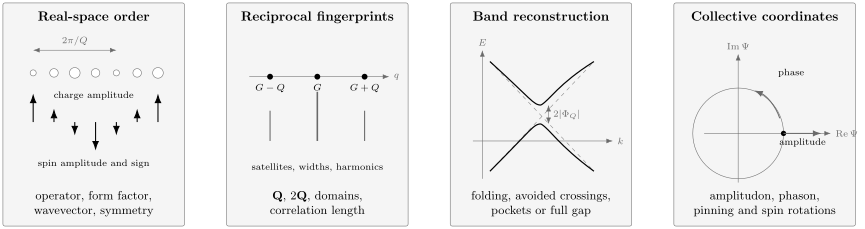
A density-wave claim links four levels. Real-space charge or spin modulation defines the operator channel; diffraction satellites identify and its harmonics; folding mixes and and can open a gap ; fluctuations split into amplitude and phase coordinates, with pinning or commensurability giving the phase mode a finite restoring scale.
Commensurate and Incommensurate Order
Section titled “Commensurate and Incommensurate Order”The wave is commensurate when an integer exists such that
for a reciprocal-lattice vector . Then the phase can be locked by an invariant such as
The continuous sliding phase is reduced to translation-related choices. An incommensurate wave has no finite and, in an ideal clean continuum description, admits an approximate sliding phase. Real disorder, boundaries, lattice discreteness, and long-range forces pin it. Temperature, pressure, or doping can produce lock-in transitions and discommensurations rather than a smooth change of period.
Nesting
Section titled “Nesting”Two Fermi-surface patches are nested by when translating one by makes it approximately parallel and coincident with another over an extended region. This enhances the phase space for low-energy particle–hole excitations.
For Bloch bands , a bare susceptibility has the form
The matrix element contains orbital and probe information. The low-frequency imaginary part measures near-Fermi-surface joint phase space; the static real part includes virtual transitions over a broader energy range. A geometric nesting picture can therefore disagree with the actual charge, spin, orbital, or phonon-weighted susceptibility.
Enhancement is not an instability
Section titled “Enhancement is not an instability”In a selected particle–hole channel , an approximate instability occurs when the largest eigenvalue of the interaction-dressed kernel reaches unity:
The vertex may contain screened Coulomb, exchange, electron–phonon, orbital, and local-field effects. The matrix character matters in a multiorbital crystal. A peak in is only one factor; the interaction can favor another wavevector or channel.
For a phonon-coupled CDW, the same statement appears as a softening of a dressed phonon propagator,
A Kohn anomaly is a nonanalyticity or pronounced softening produced by electronic response. A phonon that reaches zero frequency signals an instability of the assumed high-symmetry structure within the approximation. A broad anomaly that remains finite is evidence for coupling, not proof of static CDW order.
Why nesting is often overclaimed
Section titled “Why nesting is often overclaimed”Real material surfaces are rarely perfectly nested. Curvature, warping, finite lifetime, temperature, spin–orbit coupling, and orbital mismatch cut off the enhancement. In layered dichalcogenides, wavevector-dependent electron–phonon matrix elements and lattice dynamics can be as important as Fermi-surface geometry. In cuprates, charge order emerges from a correlated normal state with pseudogaps and strong momentum-dependent spectral weight, so a bare-band nesting construction is especially incomplete.
A trustworthy mechanism claim should predict the ordering wavevector, transition scale, soft mode or susceptibility evolution, orbital form factor, and response to controlled tuning. Retrofitting one observed to two visually parallel contours is not enough.
Peierls Instability
Section titled “Peierls Instability”The Peierls problem is the controlled ideal in which nesting is strongest. Consider a one-dimensional metal with Fermi points . The static susceptibility has a logarithmic singularity near :
A lattice displacement at creates a periodic electronic potential . In the reduced zone, states near and mix:
The reconstructed eigenvalues are
For perfect nesting, and a full gap opens at the Fermi points. The electronic energy gain contains a logarithm that can overcome the elastic cost for arbitrarily weak coupling in the ideal zero-temperature mean-field limit.
Three qualifications are essential:
- a strictly one-dimensional fluctuating system is not identical to its static mean-field solution;
- finite-temperature order in real quasi-one-dimensional compounds relies on interchain coupling, lattice discreteness, long-range interactions, or three-dimensional phonons;
- imperfect nesting cuts off the logarithm and restores a finite threshold.
The Peierls instability is also different from the Peierls Phase Preview, which concerns the electromagnetic gauge phase attached to a hopping amplitude.
Fermi-Surface Reconstruction
Section titled “Fermi-Surface Reconstruction”The same matrix describes the simplest CDW reconstruction in any dimension, with replaced by a charge-order matrix element . Translation breaking folds the original Brillouin zone, hybridizes states at and , and opens avoided crossings where their energies are close.
Imperfect nesting usually leaves pockets or arcs of reconstructed quasiparticle contours rather than a full gap. Transport coefficients can change sign, quantum-oscillation frequencies can appear, and optical spectral weight can move from a Drude component into finite-frequency interband transitions. None of these signatures is unique to a density wave; the ordering peak and symmetry information must close the case.
For an SDW, the reconstruction matrix also acts in spin space. A collinear state can mix opposite or equal spin labels depending on the quantization convention, while a spiral mixes spin and momentum simultaneously. Spin–orbit coupling can pin the polarization and gap otherwise soft spin rotations. Itinerant Magnetism develops that matrix susceptibility and magnetic continuum in detail.
Mechanisms Beyond One Cartoon
Section titled “Mechanisms Beyond One Cartoon”Several mechanisms can produce the same broken translation symmetry.
| Route | Driving physics | Diagnostic emphasis |
|---|---|---|
| Peierls or electron–phonon CDW | electronic susceptibility plus a soft lattice mode | phonon dispersion, isotope or pressure response, momentum-dependent coupling |
| excitonic or electronic CDW | particle–hole attraction or Coulomb-driven coherence | orbital character, collective spectrum, lattice response as secondary or cooperative |
| local-interaction charge order | intersite repulsion, valence constraints, commensurability | real-space charge disproportionation, strong harmonics, insulating gaps |
| itinerant SDW | exchange-enhanced finite- spin susceptibility | magnetic diffraction, spin polarization, reconstructed bands |
| strong-coupling stripes | kinetic energy competing with local correlations and antiferromagnetism | linked spin and charge wavevectors, domain structure, non-rigid spectral weight |
The categories can cooperate. A primarily electronic instability distorts the lattice, and a soft phonon modifies the electronic interaction. “Electronic” and “lattice” are not mutually exclusive once the ordered state is self-consistent.
Collective Modes
Section titled “Collective Modes”Write a single complex density-wave field as
The radial fluctuation is an amplitude mode or amplitudon. The angular fluctuation is a phase mode or phason. In an ideal incommensurate neutral theory, a uniform phase shift translates the wave and costs no energy, so the phason is gapless. Commensurability and disorder add a restoring force and pin it.
Charge order couples the phason to electric fields, normal carriers, and long-range Coulomb forces. Screening, dimensionality, and pinning determine whether the mode remains low, becomes plasmon-like, or appears as a broad relaxational response. Above the transition, a soft phonon, central peak, or overdamped order-parameter fluctuation may replace a sharp collective pole.
An SDW has additional orientation modes. If spin rotation is broken continuously, transverse spin waves appear; spin–orbit anisotropy gaps or splits them. Longitudinal amplitude fluctuations usually overlap a particle–hole continuum and can be strongly damped. A sharp Raman line or pump–probe oscillation should therefore be assigned only after symmetry, polarization, temperature, and continuum coupling are checked.
Sliding transport
Section titled “Sliding transport”An incommensurate CDW can depin above a threshold electric field and contribute nonlinear collective current. Narrow-band noise, mode locking under combined dc and ac drive, and hysteretic threshold behavior are classic evidence. This is not ordinary zero-resistance superconductivity: pinning, dissipation through normal carriers, contacts, and phase slips remain central.
Competition and Coexistence with Superconductivity
Section titled “Competition and Coexistence with Superconductivity”Let denote a density-wave amplitude and a uniform superconducting order parameter. The lowest local coupling consistent with both symmetries is
A positive expresses local competition; a negative favors mutual enhancement. With , a locally stable interior coexistence solution requires
and the resulting squared amplitudes must both be positive. This determinant condition is stronger than boundedness when is large and positive: because the physical variables and are nonnegative, a large positive cross-coupling can leave the free energy bounded while favoring an axis minimum with only one order. Thus competition does not imply mutual exclusion. Spatial inhomogeneity, disorder, gradients, multiple wavevectors, and magnetic field can produce coexistence in different regions even when the local coupling is repulsive.
Microscopically, the two orders often compete for the same low-energy states. A density-wave gap reduces the density of states available for pairing; superconductivity can in turn weaken the diffraction peak below . Conversely, a soft density-wave mode can enhance an effective pairing interaction, and partial reconstruction can leave pockets that still pair.
In underdoped YBaCuO, x-ray measurements show charge order that is weakened below and strengthened when magnetic field suppresses superconductivity. This is direct evidence for competition in that material and regime, not a universal sign of for every density wave. Stripe-ordered La-based cuprates demonstrate that spin order, charge order, lattice symmetry, and superconducting coherence can be intertwined in still more structured ways.
A pair-density wave is a spatial modulation of the pair field, not merely a CDW coexisting with uniform superconductivity. Couplings can induce secondary charge harmonics, but the pair order requires a pair-sensitive diagnostic.
Experimental Evidence
Section titled “Experimental Evidence”| Probe | Primary sensitivity | Strong evidence | Main caveat |
|---|---|---|---|
| nonresonant X-ray diffraction | atomic displacements and total charge | satellites at , correlation length, harmonics | intensity may be dominated by the lattice distortion |
| resonant X-ray scattering | element- and orbital-selective electronic response | energy and polarization dependence tied to a form factor | absorption, self-absorption, and tensor modeling |
| neutron diffraction | magnetic moment and nuclear structure | magnetic satellites, polarization, spin orientation | small moments and finite time window |
| ARPES | occupied single-particle spectrum | folded bands, avoided crossings, coherence factors | matrix elements, surfaces, domains, pseudogaps |
| STM and spectroscopy | surface local density and tunneling conductance | real-space phase, defects, form-factor-resolved Fourier peaks | surface selection and setpoint effects |
| optical and transport probes | current response and reconstructed carriers | spectral-weight transfer, collective pinning, nonlinear sliding | gaps and anomalies are not symmetry-specific |
| NMR, NQR, and muon probes | local charge or magnetic environment | line splitting, internal fields, fluctuation timescales | local disorder can mimic broad distributions |
The minimum static claim should report , peak width, temperature dependence, background subtraction, instrumental resolution, and whether the signal scales as a bulk correlation volume. Mechanism claims require more: the soft mode or susceptibility that leads to the transition, orbital and phonon content, and response to at least one controlled tuning variable.
Evidence ladder
Section titled “Evidence ladder”- Tendency: a susceptibility peak, softened phonon, or enhanced finite- correlations.
- Quasi-static correlations: a finite-width peak within the probe’s time window.
- Long-range order: resolution-limited or scaling-supported correlations with a symmetry-consistent order parameter.
- Reconstruction: folded bands or transport changes quantitatively tied to the same .
- Mechanism: one microscopic model explains the transition, collective modes, form factors, and tuning response.
Skipping from level 1 to level 5 is the most common overclaim.
Material Examples
Section titled “Material Examples”Quasi-one-dimensional conductors
Section titled “Quasi-one-dimensional conductors”Compounds such as blue bronze and NbSe display multiple classic CDW signatures: superlattice peaks, partial electronic gaps, pinned collective response, threshold conduction, and narrow-band noise. Their anisotropy makes the Peierls language useful, while interchain coupling and disorder explain why the real transition is not a strictly one-dimensional mean-field theorem.
Layered transition-metal dichalcogenides
Section titled “Layered transition-metal dichalcogenides”Materials such as 2H-NbSe combine charge order, soft phonons, multiband electronic structure, and superconductivity. The ordering wavevector is not explained reliably by Fermi-surface geometry alone; momentum-dependent electron–phonon coupling and anharmonic lattice dynamics are part of the mechanism.
Chromium
Section titled “Chromium”Chromium is the canonical itinerant SDW metal. Incommensurate magnetic order, a concomitant charge and strain modulation, reconstructed electronic structure, and pressure or alloy dependence can be related to electron and hole Fermi-surface sheets. Even here, quantitative theory requires more than a nesting cartoon.
Cuprates
Section titled “Cuprates”Cuprate charge order and spin stripes live in a strongly correlated, often pseudogapped background. Their wavevectors, orbital form factors, short correlation lengths, field response, and relation to superconductivity vary across families. The t–J Model supplies one projected strong-coupling language, but the observed density wave is not thereby reduced to weak-coupling nesting or to one universal stripe mechanism.
Common Mistakes
Section titled “Common Mistakes”Calling any Fourier peak an order parameter
Section titled “Calling any Fourier peak an order parameter”Bragg peaks from the original lattice, quasiparticle-interference peaks, impurity Friedel oscillations, and finite-range correlations can all appear in Fourier space. Temperature, field, energy, phase coherence, and size scaling distinguish them.
Equating a partial gap with a CDW
Section titled “Equating a partial gap with a CDW”Superconductivity, hybridization, magnetism, Mott physics, disorder, and matrix-element suppression can all reduce spectral weight. A density-wave gap must be tied to translation breaking and the same that folds the states.
Treating nesting as sufficient
Section titled “Treating nesting as sufficient”The relevant susceptibility includes orbital matrix elements and a channel-dependent vertex. The strongest geometric nesting vector can differ from the observed order, and many observed CDWs are cooperative electronic–lattice instabilities.
Calling every phonon anomaly Peierls
Section titled “Calling every phonon anomaly Peierls”A Kohn anomaly records electronic screening of a phonon. The Peierls limit additionally requires a one-dimensional singularity and a self-consistent symmetry-breaking distortion.
Confusing the Peierls instability and Peierls phase
Section titled “Confusing the Peierls instability and Peierls phase”The instability creates a density wave through electron–lattice coupling. The Peierls phase is a gauge-covariant phase factor on hopping in an electromagnetic vector potential.
Treating finite probe time as truly static
Section titled “Treating finite probe time as truly static”A peak can look elastic when fluctuations are slower than instrumental resolution. Comparing neutron, x-ray, NMR, muon, and pump–probe windows can reveal glassy or slowly fluctuating order.
Assuming competition forbids coexistence
Section titled “Assuming competition forbids coexistence”A positive local coupling can still permit coexistence when both bare tendencies are strong and the quartic form is stable. Domains, vortices, and disorder create further spatial coexistence.
Exercises
Section titled “Exercises”1. Translation and time-reversal audit
Section titled “1. Translation and time-reversal audit”For a scalar CDW amplitude and a collinear SDW amplitude , determine their transformation under translation by and time reversal. Which symmetries are necessarily broken by a generic incommensurate state?
Solution
Translation gives the phase factors
Time reversal acts on the physical profiles without reflecting space:
The operator identities and contain a conjugated wavevector because is antiunitary. The transformed expectation value is conjugated once more. The reality relation should therefore not be mistaken for a time-reversal shift of the physical charge pattern.
A generic incommensurate CDW breaks lattice translation but need not break time reversal. A collinear SDW breaks translation and time reversal; without spin–orbit pinning it also breaks continuous spin rotation down to rotations about the ordered axis. Point-group symmetry may also break if one member of a symmetry-related star of wavevectors is selected.
2. Density-wave reconstruction
Section titled “2. Density-wave reconstruction”Diagonalize
and show that perfect nesting produces a gap .
Solution
The characteristic equation gives
Under perfect nesting, , so
At the original Fermi crossing , the upper and lower branches lie at . Their separation is therefore .
3. Cutoff of the Peierls singularity
Section titled “3. Cutoff of the Peierls singularity”The ideal one-dimensional susceptibility contains
Give three physical effects that replace the vanishing denominator by a finite scale, and state their consequence for the instability.
Solution
Finite temperature smears the Fermi edge and supplies a scale of order . A finite quasiparticle scattering rate supplies . Transverse hopping or Fermi-surface curvature produces an imperfect-nesting mismatch . Schematically,
The logarithm then remains finite. An arbitrarily weak coupling no longer guarantees order; the interaction and lattice gain must exceed a finite threshold set by the cutoff and elastic cost.
4. Charge harmonic induced by a collinear SDW
Section titled “4. Charge harmonic induced by a collinear SDW”Let . Show that the scalar contains a component at , and explain why the same conclusion can fail for a circular spiral.
Solution
Using ,
A scalar charge or lattice field can therefore couple linearly to the harmonic.
For a circular spiral, write
Then . The spin magnitude is spatially constant, so the simplest quadratic mechanism does not induce a charge modulation.
5. Homogeneous coexistence with superconductivity
Section titled “5. Homogeneous coexistence with superconductivity”For the Landau free energy above, set and . Solve for a stationary coexistence state and state the stability and positivity conditions.
Solution
The stationarity equations are
Inverting gives
The Hessian in the interior variables is positive definite when , , and . Homogeneous coexistence additionally requires and . A positive suppresses both amplitudes relative to uncoupled values but does not automatically make either vanish. If , the quartic energy is still bounded on the physical quadrant , but the interior stationary point is not a coexistence minimum.
6. Peak growth versus long-range order
Section titled “6. Peak growth versus long-range order”For sites, define
How does scale for true long-range order, finite-correlation-length order, and algebraic correlations ?
Solution
If the modulated correlation approaches at long distance, the double sum contains coherent terms and the prefactor leaves
Thus .
For finite correlation length , each site correlates coherently with only a volume of order , so approaches a size-independent value proportional to once .
For algebraic correlations, integrate over a volume of radius :
for . The peak diverges but remains subextensive, so . A growing raw peak is therefore not sufficient evidence for long-range order.
Research Status
Section titled “Research Status”The symmetry classification, Peierls limit, response-function framework, band folding, commensurability, and amplitude/phase collective coordinates are standard. CDWs in quasi-one-dimensional conductors and SDW order in chromium are mature benchmark subjects.
Material mechanisms remain system-dependent. In many layered compounds, nesting, electron–phonon coupling, excitonic effects, anharmonicity, orbital texture, and correlations cooperate. In cuprates and other strongly correlated systems, the origin, dimensionality, fluctuation spectrum, and relationship of charge order to pseudogap and superconductivity remain active. Claims should distinguish an observed order parameter from a proposed microscopic driver.
Connections
Section titled “Connections”- Order Parameters — symmetry transformation, source fields, and density-wave operator construction.
- Long-Range Order — correlation limits and finite-size scaling.
- Structure Factors — elastic and dynamical momentum-resolved response.
- Particle–Hole Excitations — continua and low-energy phase space.
- Fermi Surface — nesting geometry and reconstruction.
- Random Phase Approximation — matrix susceptibility and pole criteria.
- Itinerant Magnetism — finite- magnetic instability and chromium.
- Antiferromagnetism — local and itinerant finite-wavevector magnetic order.
- Phonons — normal modes, softening, linewidths, and lattice dynamics.
- BCS Theory — the uniform weak-coupling superconducting baseline.
- Competing Orders — coupled-order phase topology and evidence standards for density waves near superconducting, magnetic, or nematic phases.
- Pair-Density Waves and Exotic Orders — the distinct finite-momentum pair operator, induced charge harmonics, phase defects, and pair-sensitive diagnostics.
- t–J Model — projected strong-coupling routes to stripes and competing correlations.
- Transition-Metal Dichalcogenides — the semiconducting monolayer and moiré branch of the TMD family, distinct from the metallic-TMD density waves treated here.
References
Section titled “References”- W. Kohn, “Image of the Fermi surface in the vibration spectrum of a metal,” Physical Review Letters 2, 393–394 (1959).
- A. W. Overhauser, “Spin density waves in an electron gas,” Physical Review 128, 1437–1452 (1962).
- G. Grüner, “The dynamics of charge-density waves,” Reviews of Modern Physics 60, 1129–1181 (1988).
- E. Fawcett, “Spin-density-wave antiferromagnetism in chromium,” Reviews of Modern Physics 60, 209–283 (1988).
- P. A. Lee, T. M. Rice, and P. W. Anderson, “Fluctuation effects at a Peierls transition,” Solid State Communications 14, 703–709 (1974).
- M. D. Johannes and I. I. Mazin, “Fermi surface nesting and the origin of charge density waves in metals,” Physical Review B 77, 165135 (2008).
- F. Weber, S. Rosenkranz, J.-P. Castellan, et al., “Extended phonon collapse and the origin of the charge-density wave in 2H-NbSe,” Physical Review Letters 107, 107403 (2011).
- P. B. Littlewood and C. M. Varma, “Amplitude collective modes in superconductors and their coupling to charge-density waves,” Physical Review B 26, 4883–4893 (1982).
- J. A. Wilson, F. J. Di Salvo, and S. Mahajan, “Charge-density waves and superlattices in the metallic layered transition metal dichalcogenides,” Advances in Physics 24, 117–201 (1975).
- P. Monceau, “Electronic crystals: An experimental overview,” Advances in Physics 61, 325–581 (2012).
- J. M. Tranquada, B. J. Sternlieb, J. D. Axe, Y. Nakamura, and S. Uchida, “Evidence for stripe correlations of spins and holes in copper oxide superconductors,” Nature 375, 561–563 (1995).
- J. Chang, E. Blackburn, A. T. Holmes, et al., “Direct observation of competition between superconductivity and charge density wave order in YBaCuO,” Nature Physics 8, 871–876 (2012).
- E. Fradkin, S. A. Kivelson, and J. M. Tranquada, “Colloquium: Theory of intertwined orders in high temperature superconductors,” Reviews of Modern Physics 87, 457–482 (2015).
- R. Comin and A. Damascelli, “Resonant x-ray scattering studies of charge order in cuprates,” Annual Review of Condensed Matter Physics 7, 369–405 (2016).
- M. D. Johannes, I. I. Mazin, and C. A. Howells, “Fermi-surface nesting and the origin of the charge-density wave in NbSe,” Physical Review B 73, 205102 (2006).
Summary
Section titled “Summary”Charge and spin density waves are finite-wavevector ordered states defined by an operator, symmetry, wavevector, and thermodynamic correlation criterion. Nesting enhances particle–hole phase space but becomes an instability only after channel-dependent interactions and matrix elements are included. The Peierls model supplies an ideal one-dimensional limit; real materials add imperfect nesting, phonons, orbitals, disorder, dimensional crossover, or strong coupling. Ordered waves reconstruct bands and support amplitude, phase, and spin-orientation modes. Their relationship with superconductivity can be competitive, cooperative, homogeneous, or spatially intertwined, and must be established with cross-probe evidence rather than inferred from one gap or one Fourier peak.