Phonons
A phonon is one quantum of a stable vibrational normal mode of a material. In a crystal, the modes are collective displacement patterns labeled by wave vector , branch , and polarization. Their frequencies form a phonon dispersion, and their eigenvectors determine which atoms move, in which directions, and with what relative phases.
The word phonon does three jobs in materials physics:
- it names the harmonic quanta used to count vibrational energy;
- it labels sharp, renormalized vibrational peaks when interactions remain weak enough;
- it provides the kinematic language for heat capacity, thermal transport, structural instabilities, and scattering experiments.
Those uses are related but not identical. A calculated harmonic mode can be invisible in a chosen probe. A measured broad feature need not define a long-lived phonon. An imaginary harmonic frequency is not a negative-energy particle.
Phonons as Many-Body Excitations is the canonical home for the universal derivation from coupled coordinates to bosonic operators, one-phonon states, coherent lattice waves, and phonon propagators. This page owns the material-facing lattice-dynamics problem: force constants, real-crystal dispersions and polarizations, phonon density of states, thermodynamics, probe-dependent spectra, computational workflows, and stability interpretation.
Required background. Crystals and Lattices supplies primitive cells, basis atoms, and equilibrium positions. Reciprocal Lattice supplies reciprocal vectors and the Fourier-phase language used in the dynamical matrix. Brillouin Zones supplies reduced-wave-vector zones and reciprocal-space paths used to read a phonon dispersion.
Helpful background. Phonons as Many-Body Excitations supplies normal-mode quantization and the bosonic creation and annihilation operators used here without rederivation.
From a Crystal Structure to a Spectrum
Section titled “From a Crystal Structure to a Spectrum”Let label primitive cells and the equilibrium position of basis atom within a cell. Its position is
where is a displacement from the chosen reference structure.
Within a clamped-electron or Born–Oppenheimer description, expand the potential-energy surface:
The linear term vanishes at a stationary reference structure. The harmonic interatomic force constants are
They are a real-space Hessian, not merely pairwise spring constants. Electronic screening, chemical bonding, long-range electrostatics, and the chosen electronic-structure approximation are all encoded in them.
Dynamical matrix
Section titled “Dynamical matrix”This page uses a Fourier phase containing the full equilibrium atomic position. Translation symmetry lets one fix the first cell at and define
Some codes omit the basis positions from the Fourier phase and move the corresponding phases into the eigenvectors and structure factors. Frequencies are unchanged, but raw polarization vectors from the two conventions cannot be compared component by component without conversion.
The mass-weighted eigenproblem is
For a Hermitian dynamical matrix, the eigenvectors can be normalized as
The eigenvalue is , not . A negative eigenvalue therefore gives exponential growth in the harmonic equations of motion. Plotting such a mode at a negative ordinate is a visualization convention for an imaginary frequency.
Translation invariance
Section titled “Translation invariance”A rigid translation cannot change the energy of a free bulk crystal. The force constants must obey the acoustic sum rule
Consequently, an ordinary stable three-dimensional crystal has three zero-frequency translation modes at . Small nonzero values in a calculation can come from finite convergence, interpolation, or imperfect enforcement of invariance. Large violations are evidence of a defective force-constant model, not a harmless plotting issue.
Rotational invariance imposes additional constraints. They are especially important for low-dimensional materials, where a freestanding membrane has a flexural acoustic branch that is quadratic at sufficiently long wavelength in the ideal harmonic continuum.
Quantization Without Repeating the Derivation
Section titled “Quantization Without Repeating the Derivation”For every stable nonzero normal mode, canonical quantization gives
The displacement operator is
up to the paired phase convention for the polarization vectors.
A one-phonon state is obtained by applying . It is not one atom oscillating, and it need not have nonzero mean displacement. A classical-looking lattice wave is generally a coherent state involving many occupation numbers.
Phonons carry energy and crystal momentum modulo a reciprocal vector. Their number is not generally conserved: cubic and higher anharmonic interactions can create and annihilate phonons, and equilibrium phonons ordinarily have zero chemical potential.
Reading a Phonon Dispersion
Section titled “Reading a Phonon Dispersion”A dispersion plot samples along a chosen path through the Brillouin zone. It is analogous to an electronic band plot, but the eigenvalues are squared frequencies and the eigenvectors are mass-weighted displacement patterns.
Branch counting
Section titled “Branch counting”With basis atoms in a three-dimensional bulk crystal, there are
branches at each . Near the zone center, a stable free crystal ordinarily has:
The names refer to long-wavelength displacement character, not directly to audibility or optical brightness. A monatomic primitive cell has no optical branches in the harmonic branch-counting sense. A two-dimensional monolayer embedded in three-dimensional space still has three displacement directions per atom, even though is two-dimensional.
Acoustic branches and sound
Section titled “Acoustic branches and sound”For a regular acoustic branch at small wave vector,
The slope is a direction- and polarization-dependent sound velocity. In continuum elasticity, the Christoffel matrix
has eigenvalues . Here is the elastic tensor, is mass density, and is the propagation direction.
Longitudinal and transverse labels are exact in isotropic media and along suitable symmetry directions. At a generic wave vector in a low-symmetry crystal, a mode can have mixed polarization. The eigenvector, not the branch color chosen by plotting software, decides.
Optical branches
Section titled “Optical branches”At a zone-center optical mode, basis atoms move against one another while the cell’s center-of-mass translation cancels. The frequency can remain finite as .
An optical branch is:
- infrared active if its mode effective charge is nonzero;
- Raman active if the mode changes the polarizability tensor in an allowed symmetry channel;
- silent in a given first-order optical probe if neither selection rule is met.
These are symmetry and matrix-element statements. “Optical phonon” does not mean “visible in every optical spectrum.”
Polar crystals and directional limits
Section titled “Polar crystals and directional limits”In a polar insulator, a longitudinal optical displacement creates a macroscopic electric field. The long-range Coulomb interaction adds a nonanalytic term as . If the Born effective charges are expressed in units of , a representative SI form is
The limit depends on the direction of approach. This produces longitudinal–transverse optical splitting and means that “the frequency at ” can require a boundary condition and direction, not just one number.
Crossings, avoided crossings, and branch identity
Section titled “Crossings, avoided crossings, and branch identity”Eigenvalues can cross when symmetry forbids mixing. Modes with compatible symmetry generally repel and exchange character through an avoided crossing. Sorting branches only by frequency can then create discontinuous colors or labels.
Robust mode tracking uses some combination of:
- eigenvector overlap between neighboring points;
- irreducible representations at high-symmetry points and lines;
- projections onto atoms, directions, or molecular units;
- continuity of experimentally relevant structure factors.
At a degeneracy, individual eigenvectors may rotate arbitrarily inside the degenerate subspace. The subspace is meaningful even when a particular polarization vector is not.
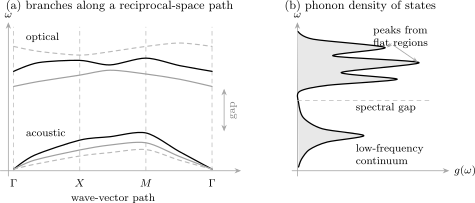
A phonon dispersion resolves wave vector and branch, whereas the density of states integrates over momentum. Flat portions of several branches can produce sharp DOS features. A measured neutron, x-ray, Raman, or infrared spectrum adds probe-dependent polarization and basis weights, so it is not generally equal to the unweighted DOS shown here.
Phonon Density of States
Section titled “Phonon Density of States”For wave vectors sampling a primitive Brillouin zone, define the density of states per primitive cell by
For a three-dimensional crystal with basis atoms,
This normalization counts modes per cell per angular-frequency interval. A density per physical volume is . If energy is used instead, the Jacobian must be included:
Constant-frequency surfaces
Section titled “Constant-frequency surfaces”In the continuum limit,
At a regular frequency,
Large DOS appears where constant-frequency surfaces have large area or where group velocity is small. Critical points of produce van Hove features. A sharp DOS peak does not by itself imply a localized vibration or a long lifetime.
Projected and weighted densities
Section titled “Projected and weighted densities”For mass-weighted eigenvectors, an atom-projected density can be defined as
With the stated normalization,
Other projections can resolve Cartesian direction, chemical species, layer, or molecular unit. Their meaning depends on the eigenvector convention and projector.
An experimentally extracted “phonon DOS” is often a generalized or probe-weighted density. In incoherent neutron measurements, species weights can scale roughly as scattering cross section divided by mass. Multiphonon contributions, Debye–Waller factors, detector response, and instrumental resolution must be removed or modeled before comparing with the unweighted theoretical .
Low-frequency laws
Section titled “Low-frequency laws”For three linearly dispersing acoustic branches in a three-dimensional continuum,
In an isotropic solid this becomes
The law is not universal across dimension or dispersion. A two-dimensional linear branch gives , while an ideal quadratic flexural branch gives a constant low-frequency contribution.
Vibrational Thermodynamics
Section titled “Vibrational Thermodynamics”For harmonic phonons,
The phonon internal energy is
The free energy is
The mode heat capacity is
Summing over all modes gives in the fixed-frequency harmonic approximation.
Low and high temperature
Section titled “Low and high temperature”For a three-dimensional crystal with linear acoustic modes,
This is the Debye law. Optical modes and high-frequency acoustic states are exponentially suppressed at sufficiently low temperature.
At temperatures large compared with all relevant ,
per primitive cell in a three-dimensional harmonic crystal. This is the Dulong–Petit limit. Electronic, magnetic, defect, and anharmonic contributions can prevent measured heat capacity from being purely phononic.
Zero-point energy affects total energies, isotope shifts, equilibrium structures, and phase competition, but it does not contribute to harmonic heat capacity when the frequencies are temperature independent.
Volume dependence and thermal expansion
Section titled “Volume dependence and thermal expansion”The quasiharmonic approximation lets frequencies depend on volume while retaining harmonic occupation at each volume. Define the mode Grüneisen parameter
The vibrational contribution to volumetric expansion is schematically
where is the isothermal bulk modulus. Negative-Grüneisen modes can drive negative thermal expansion over a temperature range.
Quasiharmonicity includes thermal expansion from volume-dependent harmonic spectra. It does not include every explicit phonon–phonon frequency shift or linewidth at fixed volume.
Thermal transport is not fixed by the DOS
Section titled “Thermal transport is not fixed by the DOS”In a relaxation-time description,
The DOS supplies heat-capacity weighting, but conductivity also requires group velocities and lifetimes. Two materials can have similar phonon DOS and very different thermal conductivity.
How Scattering Sees Phonons
Section titled “How Scattering Sees Phonons”In a one-phonon event, the probe transfers momentum and angular frequency . Crystal momentum conservation gives
while energy conservation gives
Here positive means energy lost by the probe and gained by the sample. The plus sign creates a phonon; the minus sign annihilates a thermally occupied phonon.
Neutron and nonresonant x-ray scattering
Section titled “Neutron and nonresonant x-ray scattering”For coherent one-phonon neutron scattering, a representative mode structure factor is
is the nuclear scattering length and the Debye–Waller exponent. Omitting overall kinematic prefactors, the harmonic one-phonon contribution has the form
This equation explains several experimental facts:
- the creation side remains at zero temperature through ;
- the annihilation side vanishes as ;
- modes polarized perpendicular to can be dark through ;
- basis atoms can interfere constructively or destructively;
- heavier atoms have smaller displacement amplitudes for the same mass-weighted eigenvector;
- intensity changes between reciprocal zones even though is periodic.
Nonresonant inelastic x-ray scattering has closely related displacement and interference factors, with electronic form factors replacing neutron scattering lengths and different instrumental kinematics. Neutrons are often favorable for light atoms and isotope contrast; hard x-rays can access very small samples and extreme sample environments. Neither probe displays “the dispersion” without matrix-element and resolution effects.
Neutron Scattering owns the neutron beam, nuclear and magnetic channel separation, instrument coverage, resolution, background, absolute normalization, and reciprocal-zone measurement strategy.
X-Ray Scattering owns hard-X-ray momentum and energy kinematics, form factors, attenuation, analyzer resolution, and the nonresonant IXS forward model.
Detailed balance requires
When symmetry makes the and responses equivalent, the ratio of annihilation to creation intensity is .
Raman, infrared, and Brillouin probes
Section titled “Raman, infrared, and Brillouin probes”Visible and infrared photons carry little crystal momentum compared with a Brillouin-zone dimension. First-order Raman and infrared spectra therefore probe modes near .
- Infrared absorption couples to a changing dipole and requires a nonzero mode effective charge.
- Raman scattering couples to a changing polarizability tensor and obeys polarization-dependent symmetry selection rules.
- Brillouin light scattering resolves long-wavelength acoustic modes and elastic properties.
- Ultrafast pump–probe measurements can launch coherent zone-center or finite-wave-vector lattice motion, depending on the excitation mechanism and geometry.
A Raman peak is not automatically an infrared peak, and a zone-boundary phonon is not ordinarily visible in first-order optical spectroscopy unless disorder, a superstructure, resonance, or a multiphonon process relaxes momentum selection.
Frequencies, linewidths, and spectral weight
Section titled “Frequencies, linewidths, and spectral weight”An ideal harmonic mode gives a delta-function line. Real spectra are broadened by:
- anharmonic phonon–phonon decay;
- isotope and defect disorder;
- boundaries and finite domains;
- electron–phonon or spin–phonon coupling;
- hybridization with other collective modes;
- instrumental energy and momentum resolution.
The observed peak position can differ from the harmonic frequency, and its width can depend on temperature and wave vector. A lifetime inferred from a width must state whether the width is a half width or full width and whether the lifetime refers to amplitude or population decay. When the width is comparable to the mode frequency or neighboring separation, a sharp-phonon description can fail.
Structure Factors owns exact correlation-function and detailed-balance conventions. Spectral Functions owns pole, continuum, linewidth, residue, and sum-rule interpretation.
Computing Phonons in Materials
Section titled “Computing Phonons in Materials”Two common first-principles routes are:
- finite displacement: displace atoms in a supercell, calculate forces, infer real-space force constants, and Fourier interpolate;
- density-functional perturbation theory: calculate the linear response to periodic displacements directly at selected points.
Both routes approximate the electronic ground-state energy surface and require convergence tests. Agreement between software packages is not meaningful unless structure, pseudopotentials, exchange-correlation approximation, magnetic order, spin–orbit treatment, supercell or mesh, and nonanalytic corrections are aligned.
A reproducible workflow
Section titled “A reproducible workflow”- Relax the intended structure and state pressure, strain, magnetic order, charge state, and symmetry constraints.
- Converge electronic basis, Brillouin-zone sampling, smearing, and self-consistency more tightly than needed for a rough total energy.
- Calculate force constants by finite displacement or linear response.
- Check permutation symmetry, acoustic sum rules, and, where important, rotational invariance.
- Include long-range dipole corrections for polar materials using Born charges and .
- Interpolate to a dense mesh for the DOS and to a declared path for visualization.
- Test supercell size, displacement amplitude, mesh, and integration broadening.
- Compare frequencies and intensities with the geometry and resolution of the relevant experiment.
- Add quasiharmonic, anharmonic, electronic, magnetic, or disorder effects only when the observable requires them.
Finite differences need a window
Section titled “Finite differences need a window”Displacements that are too small amplify force noise. Displacements that are too large mix in anharmonicity. A reliable finite-displacement calculation repeats the extraction over a reasonable amplitude range and checks that the force constants and frequencies are stable.
A path is not the Brillouin zone
Section titled “A path is not the Brillouin zone”A standard high-symmetry path can miss:
- an instability at a generic wave vector;
- a narrow avoided crossing;
- anisotropic sound velocity away from displayed directions;
- a DOS feature generated by a broad off-path surface.
Stability and thermodynamics require a converged full-zone mesh, not only an attractive line plot.
Harmonic stability is conditional
Section titled “Harmonic stability is conditional”If every harmonic is nonnegative, the reference structure is a local minimum within the modeled degrees of freedom. This is dynamical stability, not proof of global thermodynamic stability. Another structure may have lower free energy.
Conversely, an imaginary zero-temperature harmonic mode can be stabilized at finite temperature by anharmonic fluctuations, disorder, or entropy. The correct response is to examine the eigenvector, convergence, reference symmetry, and temperature-dependent effective potential rather than deleting the point or replacing by .
Interpreting Characteristic Features
Section titled “Interpreting Characteristic Features”Soft mode
Section titled “Soft mode”A branch whose renormalized frequency decreases toward zero can signal proximity to a structural instability. The eigenvector identifies the distortion pattern and the soft wave vector identifies the translation symmetry of the emerging structure. Not every structural transition is a simple displacive soft-mode transition.
Kohn anomaly
Section titled “Kohn anomaly”Electron screening can produce a cusp or rapid softening at wave vectors connecting important electronic states. Such a Kohn anomaly is evidence of momentum-dependent electron–phonon response, but nesting alone does not determine a transition. Electronic matrix elements, dimensionality, interactions, and phonon self-energy all matter.
Avoided crossing
Section titled “Avoided crossing”When two compatible modes hybridize, their frequencies repel and their atomic or polarization character exchanges. Fitting each side as an unrelated branch can create false discontinuities in group velocity or coupling.
Acoustic–optical gap
Section titled “Acoustic–optical gap”A frequency gap between acoustic and optical sectors can restrict three-phonon decay phase space and alter thermal transport. It does not by itself guarantee high thermal conductivity; velocities, anharmonic vertices, disorder, and boundaries remain decisive.
Flat branch
Section titled “Flat branch”A flat branch has small group velocity and often contributes a DOS peak. It can arise from weakly coupled local units, heavy atoms, geometric constraints, or hybridization. Flatness alone does not establish localization.
A Monatomic-Chain Reading Example
Section titled “A Monatomic-Chain Reading Example”The Harmonic Chain Model Dossier derives the periodic nearest-neighbor chain. Its dispersion is
This one formula illustrates how to read a material dispersion:
- there is one branch because the primitive cell has one scalar displacement;
- follows from translation invariance;
- the sound speed is
- the group velocity vanishes at the zone boundary;
- the one-dimensional DOS per cell is
where
- the square-root divergence at is a one-dimensional van Hove singularity caused by the flat zone-boundary dispersion.
The model is a benchmark, not a generic material fit. Real crystals have vector displacements, basis atoms, longer-range force constants, anharmonicity, and probe-dependent intensities.
Common Mistakes
Section titled “Common Mistakes”- Treating a phonon as one atom moving independently.
- Calling every normal mode a phonon without checking harmonic or quasiparticle stability.
- Confusing , ordinary frequency , energy , and spectroscopic wavenumber.
- Comparing polarization vectors from different Fourier or mass-normalization conventions directly.
- Assuming every optical branch is infrared or Raman active.
- Reading longitudinal or transverse labels from a plot without checking the eigenvector.
- Treating a high-symmetry path as a full stability test.
- Replacing imaginary frequencies by absolute values and continuing as if the structure were stable.
- Comparing an unweighted theoretical DOS with a neutron- or x-ray-weighted spectrum.
- Inferring the absence of a branch from zero intensity in one scattering geometry.
- Calling numerical broadening a physical linewidth.
- Using the Dulong–Petit limit or Debye law outside its temperature regime.
- Inferring thermal conductivity from the phonon DOS alone.
Exercises
Section titled “Exercises”1. Branch and state-counting audit
Section titled “1. Branch and state-counting audit”A three-dimensional crystal has five atoms in its primitive cell. How many phonon branches occur at each ? How many are acoustic near , how many are optical, and what is the integral of the DOS per primitive cell?
Solution
There are three displacement coordinates per atom, so
branches. An ordinary stable bulk crystal has three acoustic branches associated with rigid translations. The remaining
are optical branches near . With the DOS normalization used here,
2. Normalize the chain density of states
Section titled “2. Normalize the chain density of states”Show that
contains one mode per cell over .
Solution
Integrate using :
The divergence at the upper edge is integrable. It produces a sharp feature without creating extra states.
3. Which sound branch dominates low-temperature heat capacity?
Section titled “3. Which sound branch dominates low-temperature heat capacity?”An isotropic solid has . Compare the longitudinal contribution to the combined contribution of the two transverse branches in the Debye coefficient.
Solution
Each branch contributes in proportion to . The longitudinal weight is
The two transverse branches contribute
Their ratio is
The slower transverse branches dominate because low-frequency state counting scales as .
4. A dark optical mode
Section titled “4. A dark optical mode”Two identical atoms in a primitive cell have an optical eigenvector with equal magnitudes and opposite directions. At a scattering vector where their basis phases are equal, assume equal . What happens to the one-phonon structure factor?
Solution
The two terms are equal in magnitude. Their opposite polarizations give opposite signs in , while the basis phases and species weights are equal. Therefore they cancel:
The mode is dark in that geometry even though it exists. Moving to a reciprocal zone with a different basis phase, changing polarization geometry, or using another probe can restore intensity.
5. Creation and annihilation intensity
Section titled “5. Creation and annihilation intensity”For a sharp mode of frequency , find the ratio of the creation-side intensity to the annihilation-side intensity at temperature , assuming all other structure factors are equal.
Solution
The creation side is proportional to , while the annihilation side is proportional to . Since
the ratio is
At low temperature, annihilation is strongly suppressed because few thermal phonons are available.
6. Negative thermal expansion from one mode
Section titled “6. Negative thermal expansion from one mode”A mode frequency increases as the crystal volume increases. What is the sign of its Grüneisen parameter, and what sign does its weighted contribution make to ?
Solution
Because
the definition gives
Since the mode heat capacity is positive, its term contributes negatively to the quasiharmonic thermal-expansion sum. Whether the total expansion is negative depends on all modes and the elastic response.
7. Audit an imaginary branch
Section titled “7. Audit an imaginary branch”A first-principles calculation shows a small imaginary acoustic frequency near and a large imaginary optical branch at a generic wave vector. Give a defensible interpretation workflow.
Solution
First separate likely numerical drift from a physical instability:
- check relaxation forces, stress, electronic convergence, and the intended magnetic or charge state;
- enforce or diagnose the acoustic sum rule and rotational invariance;
- converge supercell size or mesh, displacement amplitude, basis, and Brillouin-zone sampling;
- inspect whether the small near- acoustic error shrinks under those tests;
- inspect the eigenvector of the large generic- mode and build a commensurate supercell if possible;
- displace along that eigenvector and map the energy surface rather than replacing by ;
- compare lower-symmetry relaxed structures and, when relevant, finite-temperature anharmonic stabilization.
A tiny sum-rule-sensitive acoustic artifact and a robust large optical instability should not be assigned the same physical meaning.
Connections
Section titled “Connections”- Phonons as Many-Body Excitations derives quantization, one-phonon states, coherent waves, propagators, and anharmonic number-changing processes.
- Harmonic Chain Model Dossier supplies the exact periodic-chain benchmark and finite-size audits.
- Crystals and Lattices defines cells and basis atoms; Reciprocal Lattice and Brillouin Zones define the geometry.
- Quantum Matter Conventions fixes angular-frequency, energy, Fourier-phase, cell, and reciprocal-space conventions.
- Quasiparticles Overview explains lifetime, residue, and breakdown of a particle-like mode.
- Polarons Preview treats a mobile carrier dressed by lattice motion.
- BCS Theory explains how retarded electron–phonon attraction can produce Cooper pairing and where the reduced interaction gives way to Eliashberg theory.
- Boltzmann Transport uses phonon absorption, emission, detailed balance, and momentum transfer in electronic collision integrals.
- Heat Capacity and Thermodynamics owns calorimeter models, addenda subtraction, experimental Debye-coefficient extraction, and entropy accounting.
- Math Needed for Quantum Matter collects the Fourier, eigenvalue, and numerical tools used here.
- Condensed Matter Roadmap places phonons between band theory and material response.
References
Section titled “References”- M. Born and K. Huang, Dynamical Theory of Crystal Lattices, Oxford University Press, 1954.
- N. W. Ashcroft and N. D. Mermin, Solid State Physics, Holt, Rinehart and Winston, 1976.
- M. T. Dove, Introduction to Lattice Dynamics, Cambridge University Press, 1993, doi:10.1017/CBO9780511619885.
- G. L. Squires, Introduction to the Theory of Thermal Neutron Scattering, 3rd ed., Cambridge University Press, 2012.
- S. Baroni, S. de Gironcoli, A. Dal Corso, and P. Giannozzi, “Phonons and Related Crystal Properties from Density-Functional Perturbation Theory,” Reviews of Modern Physics 73, 515–562 (2001), doi:10.1103/RevModPhys.73.515.
- X. Gonze and C. Lee, “Dynamical Matrices, Born Effective Charges, Dielectric Permittivity Tensors, and Interatomic Force Constants from Density-Functional Perturbation Theory,” Physical Review B 55, 10355–10368 (1997), doi:10.1103/PhysRevB.55.10355.
- A. Togo and I. Tanaka, “First Principles Phonon Calculations in Materials Science,” Scripta Materialia 108, 1–5 (2015), doi:10.1016/j.scriptamat.2015.07.021.
- B. Fultz, “Vibrational Thermodynamics of Materials,” Progress in Materials Science 55, 247–352 (2010), doi:10.1016/j.pmatsci.2009.05.002.
- A. Q. R. Baron, “Introduction to High-Resolution Inelastic X-Ray Scattering,” in Synchrotron Light Sources and Free-Electron Lasers, Springer, 2016, doi:10.1007/978-3-319-14394-1_52.
- W. Cochran, “Crystal Stability and the Theory of Ferroelectricity,” Advances in Physics 9, 387–423 (1960), doi:10.1080/00018736000101229.
- F. Giustino, “Electron–Phonon Interactions from First Principles,” Reviews of Modern Physics 89, 015003 (2017), doi:10.1103/RevModPhys.89.015003.
- National Institute of Standards and Technology, “Neutron Spectroscopy”, overview of energy- and momentum-resolved neutron probes for phonons and other material excitations.