Phonons as Many-Body Excitations
A phonon is one quantum of a normal mode of a many-body vibrational system. In a crystal, the microscopic coordinates are atomic displacements, but the harmonic eigencoordinates are extended patterns labeled by crystal momentum, branch, and polarization. Quantization promotes each pattern to an oscillator with creation and annihilation operators.
The conceptual chain is
This definition separates three ideas that are often blurred:
- a normal mode is an available harmonic degree of freedom;
- a phonon is a quantum occupying that mode;
- a classical lattice wave is usually represented by a coherent state containing an indefinite, often large, number of phonons.
Phonons are bosonic quasiparticles even when the atoms or ions are not bosons. Their Bose algebra follows from quantizing harmonic normal coordinates, not from exchanging the microscopic constituents. In the ideal harmonic Hamiltonian they are exact, infinitely long-lived excitations. Anharmonicity, disorder, boundaries, electrons, spins, and other modes can shift, scatter, or destroy that idealization.
Scope and Canonical Ownership
Section titled “Scope and Canonical Ownership”This page owns the universal many-body construction:
- the harmonic expansion around a stable equilibrium;
- mass weighting and the dynamical-matrix eigenproblem;
- branch counting, polarization, and acoustic versus optical motion;
- canonical quantization of lattice normal modes;
- phonon creation, annihilation, number states, and coherent waves;
- zero-point and thermal displacement correlations;
- crystal momentum and the distinction from mechanical momentum;
- the one-phonon content of scattering spectra;
- the first controlled effects of anharmonicity;
- the relation between lattice phonons and oscillator modes in quantum field theory.
Neighboring pages retain narrower ownership:
- Harmonic Chain Model Dossier owns the convention-complete periodic monatomic baseline, center-of-mass audit, finite-chain examples, and matrix benchmark.
- Coupled Oscillators: First Encounter owns the elementary two-oscillator change of coordinates.
- Bosonic Operators in Many-Body Models owns abstract bosonic Fock-space algebra.
- Collective Modes owns the cross-system language of collective coordinates, response eigenchannels, and hybridization.
- Quasiparticles Overview owns residue, lifetime, propagation, and quasiparticle breakdown.
- Goldstone Modes in Many-Body Systems owns symmetry-enforced acoustic modes and spacetime-symmetry counting.
- Structure Factors owns scattering normalization, detailed balance, and exact spectral representations.
- Spectral Functions owns interacting peak, continuum, linewidth, and sum-rule conventions.
- Bogoliubov Theory owns paraunitary diagonalization and neutral-superfluid phonons.
- Polarons Preview owns the distinct problem of a mobile carrier or impurity dressed by phonons or other host excitations.
- Harmonic Oscillator to Fields owns the broader free-field mode expansion.
Detailed crystallography, empirical and first-principles force constants, polar-crystal nonanalyticities, material dispersions, vibrational thermodynamics, and probe-specific spectra belong in Phonons in Quantum Matter. Here the crystal is a clean setting in which the oscillator quantization and many-body excitation picture can be derived once.
Geometric and Fourier Conventions
Section titled “Geometric and Fourier Conventions”Cells, basis atoms, and displacements
Section titled “Cells, basis atoms, and displacements”Let denote the Bravais-lattice vector of cell , and let locate basis atom inside the cell. Its equilibrium position is
Write the instantaneous position as
where is the displacement operator and is the mass. Cartesian components are labeled by .
The system contains:
Periodic boundary conditions give allowed crystal momenta in the first Brillouin zone.
A cell-phase convention
Section titled “A cell-phase convention”This page uses the Fourier transform
The basis position is not included in the phase. Including it is an equally valid convention, but it moves phase factors between polarization vectors and scattering form factors.
Because a classical displacement is real,
The quantum operator will be Hermitian for the analogous reason: its positive- and negative-frequency pieces occur together.
Why mass weighting is useful
Section titled “Why mass weighting is useful”The factor makes the kinetic energy Euclidean in the Fourier amplitudes. It also turns the normal-mode equation into an ordinary Hermitian eigenproblem. Without mass weighting one instead solves a generalized eigenproblem with the mass matrix on the right-hand side.
Both approaches give the same frequencies and physical displacements. Mixing their normalization formulas does not.
Harmonic Expansion About Equilibrium
Section titled “Harmonic Expansion About Equilibrium”Force constants
Section titled “Force constants”Expand the Born–Oppenheimer potential energy in displacements:
At a stationary equilibrium,
The harmonic force-constant matrix is the Hessian
Translation symmetry implies dependence only on the cell separation:
Harmonic and anharmonic pieces
Section titled “Harmonic and anharmonic pieces”The vibrational Hamiltonian is organized as
where
The cubic and quartic terms contain third- and fourth-order force constants. They are interactions among harmonic phonons, not corrections to the canonical commutator.
Stability
Section titled “Stability”At a stable equilibrium, the quadratic potential must be nonnegative:
Exact translations of an isolated crystal cost no energy and generate zero eigenvalues. All other harmonic eigenvalues should be positive for a strict local minimum.
An imaginary reported frequency means
It signals that the chosen reference structure is unstable within the harmonic expansion. It is not a phonon with negative energy and not an oscillator to quantize with the usual Fock construction.
The Acoustic Sum Rule
Section titled “The Acoustic Sum Rule”Uniform translation
Section titled “Uniform translation”If every atom is shifted by the same constant vector, the potential energy of an isolated translation-invariant crystal is unchanged. Therefore
for every .
This is the acoustic sum rule.
Consequence at zero momentum
Section titled “Consequence at zero momentum”For a uniform displacement in direction , the mass-weighted polarization is proportional to
The acoustic sum rule makes it a zero-frequency eigenvector:
Numerical force constants often violate the sum rule slightly because of finite convergence tolerances. Enforcing it can remove an unphysical small gap, but it must not be used to hide a genuine pinning potential or an unstable structure.
The Dynamical Matrix
Section titled “The Dynamical Matrix”Definition
Section titled “Definition”In the cell-phase convention, define
For real conservative force constants,
Thus has real eigenvalues and an orthonormal eigenbasis whenever ordinary diagonalization applies.
Eigenproblem
Section titled “Eigenproblem”The normal-mode equation is
The branch label enumerates eigenvectors at fixed . We choose
Completeness gives
For a time-reversal-invariant nonmagnetic lattice one may choose, away from gauge obstructions and degeneracies,
Polarization gauge
Section titled “Polarization gauge”Each nondegenerate eigenvector can be rephased:
Inside a degenerate subspace, any unitary rotation is allowed. Individual components and phases are therefore not observables by themselves. Frequencies, projectors onto isolated mode subspaces, and consistently transformed matrix elements are gauge invariant.
This becomes important near crossings. A branch should be tracked by symmetry, continuity, and polarization character, not merely by sorting frequencies at each momentum.
From Normal Coordinates to Independent Oscillators
Section titled “From Normal Coordinates to Independent Oscillators”Mode amplitudes
Section titled “Mode amplitudes”Expand the mass-weighted displacement in polarization vectors:
Define conjugate normal momenta with the corresponding unitary transformation. The reality constraints are
Diagonal harmonic Hamiltonian
Section titled “Diagonal harmonic Hamiltonian”The quadratic Hamiltonian becomes
This form is a collection of independent real oscillators even though traveling-wave coordinates are complex. One can instead use real standing-wave coordinates built from each pair .
No extra particles have been inserted
Section titled “No extra particles have been inserted”Diagonalization changes coordinates; it does not add degrees of freedom. The count remains
At each allowed there are branches. Quantization then gives arbitrarily many occupation states for each oscillator, but it does not create extra oscillator species.
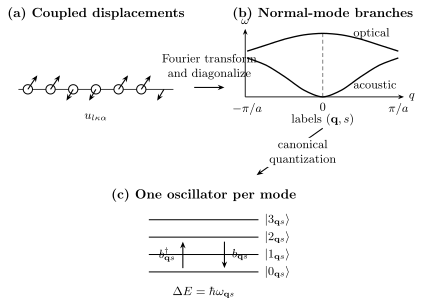
Coupled microscopic displacements are reorganized into momentum- and branch-labeled normal modes. Each mode is then quantized as an oscillator; the raising operator adds one phonon without adding an atom.
Canonical Quantization
Section titled “Canonical Quantization”Microscopic canonical algebra
Section titled “Microscopic canonical algebra”Promote displacements and momenta to operators satisfying
Normal-mode quantization is a canonical change of basis preserving these relations.
Phonon operators
Section titled “Phonon operators”Introduce
with all annihilator–annihilator and creator–creator commutators zero.
The displacement operator is
The conjugate momentum is
The two terms in each bracket make the microscopic operators Hermitian.
The zero-mode caveat
Section titled “The zero-mode caveat”The formulas contain and therefore do not apply directly to an exact translation mode with . A finite isolated crystal’s center of mass is a free coordinate, not a harmonic oscillator.
Common controlled choices are:
- fix the center of mass;
- add an infinitesimal pinning potential and remove it after computing relative observables;
- work at nonzero momentum before taking the thermodynamic limit.
Simply dividing by at the exact zero mode is not a valid quantization.
Diagonal Hamiltonian
Section titled “Diagonal Hamiltonian”For every positive-frequency mode,
The harmonic vacuum obeys
A normalized occupation state is
Its vibrational energy is
What One Phonon Means
Section titled “What One Phonon Means”One quantum in one mode
Section titled “One quantum in one mode”The one-phonon state is
Relative to the harmonic vacuum, it carries energy
and crystal momentum
where is a reciprocal-lattice vector.
It does not identify one atom as excited. The mode polarization distributes the displacement matrix element over every cell:
This extended matrix element is the precise sense in which a harmonic phonon is collective.
Mean displacement is not the diagnostic
Section titled “Mean displacement is not the diagnostic”In a number state,
The absence of a mean displacement does not mean the lattice is motionless. Quadratic fluctuations and transition matrix elements are nonzero.
For one oscillator coordinate
the variance is
A phonon is not a tiny classical wave
Section titled “A phonon is not a tiny classical wave”A number state has definite occupation and undefined oscillator phase. A classical-looking wave requires phase coherence between number sectors. That is supplied by a coherent state, not by a single phonon.
Coherent Lattice Waves
Section titled “Coherent Lattice Waves”Coherent state
Section titled “Coherent state”For a chosen mode,
Its mean occupation and number variance are
The expected displacement contains
This is the corresponding classical normal-mode wave.
Standing versus traveling waves
Section titled “Standing versus traveling waves”A real standing wave can be formed from coherent amplitudes at and . A traveling wave can be represented by a phase-correlated choice whose mean displacement moves with phase velocity.
The distinction is state preparation, not a difference in the underlying normal-mode spectrum.
Coherent phonons in experiments
Section titled “Coherent phonons in experiments”Ultrafast optical excitation can prepare a macroscopic phase-coherent lattice oscillation. Calling it a “coherent phonon” refers to the state of a vibrational mode. It does not mean that each constituent phonon is a different quasiparticle species.
A Monatomic Chain Benchmark
Section titled “A Monatomic Chain Benchmark”Hamiltonian
Section titled “Hamiltonian”Consider equal masses on a periodic one-dimensional chain with spacing :
The allowed momenta are
chosen modulo .
Classical mode equation
Section titled “Classical mode equation”For
the equation of motion gives
Therefore
The frequency is periodic in reciprocal space:
Long-wavelength limit
Section titled “Long-wavelength limit”For ,
with sound speed
The mode is uniform translation. The zone-boundary mode has neighboring atoms moving in opposite phase and frequency
Quantized chain
Section titled “Quantized chain”For nonzero-frequency modes,
One application of adds of vibrational energy and crystal momentum modulo .
This simple chain is a benchmark, not a complete theory of a material. Real crystals require multiple polarizations, basis atoms, longer-range and tensor force constants, electronic screening, and three-dimensional symmetry.
Acoustic and Optical Branches
Section titled “Acoustic and Optical Branches”Branch counting
Section titled “Branch counting”With atoms per primitive cell in dimensions, there are
branches at each .
For an ordinary unpinned crystal near , these are commonly organized as:
The labels describe long-wavelength motion, not the measurement method.
Acoustic motion
Section titled “Acoustic motion”At small momentum, basis atoms in an acoustic mode move approximately together. In a stable three-dimensional bulk crystal,
The sound speed depends on propagation direction and polarization. In an isotropic medium there is one longitudinal and two transverse acoustic branches.
Optical motion
Section titled “Optical motion”In an optical mode, basis atoms move relative to one another inside the unit cell. Such a branch generally has
The word “optical” arose because some zone-center relative motions couple to electromagnetic radiation. An optical phonon need not be optically active; symmetry and effective charges decide that.
A diatomic-chain illustration
Section titled “A diatomic-chain illustration”For alternating masses and connected by equal nearest-neighbor springs , with primitive-cell length , the two branches satisfy
At ,
The lower branch is acoustic and the upper branch is optical. This model illustrates branch splitting; detailed lattice dynamics and material interpretation require the full crystal symmetry and interaction range.
Longitudinal and transverse are conditional labels
Section titled “Longitudinal and transverse are conditional labels”A polarization is longitudinal when
and transverse when
In anisotropic crystals and along generic directions, modes can be mixed rather than purely longitudinal or transverse. At degeneracies, the basis within the degenerate polarization subspace is not unique.
Goldstone Interpretation and Its Limits
Section titled “Goldstone Interpretation and Its Limits”Crystal acoustic phonons
Section titled “Crystal acoustic phonons”In an ideal self-organized continuum crystal, continuous translations are spontaneously broken. The displacement field is the corresponding long-wavelength coordinate, and acoustic phonons are spacetime Goldstone modes.
Broken rotations do not normally add independent acoustic branches because a slowly varying local rotation is encoded in spatial derivatives of the displacement field.
A lattice model is not the same symmetry problem
Section titled “A lattice model is not the same symmetry problem”If particles live on an externally imposed lattice, continuous translations are already absent from the Hamiltonian. A gapless mode must then be justified by the actual symmetry, conservation laws, or tuning of that model.
Likewise, a substrate or pinning potential can give a translational mode a nonzero gap.
Optical modes are not required Goldstone modes
Section titled “Optical modes are not required Goldstone modes”Relative motion inside a unit cell is not a uniform translation of the entire solid. Optical branches can soften at structural transitions, but their generic finite zone-center frequency does not contradict Goldstone reasoning.
The symmetry theorem and its spacetime caveats belong to Goldstone Modes in Many-Body Systems.
Crystal Momentum Is Not Mechanical Momentum
Section titled “Crystal Momentum Is Not Mechanical Momentum”Translation eigenvalue
Section titled “Translation eigenvalue”Under translation by a Bravais vector ,
Thus labels the representation of discrete translation symmetry. It is defined modulo a reciprocal vector:
Why crystal momentum is not generally center-of-mass momentum
Section titled “Why crystal momentum is not generally center-of-mass momentum”The crystal background can exchange reciprocal-lattice momentum with an excitation. A phonon’s quasimomentum is conserved modulo , while the mechanical momentum of atoms, supports, and external fields must be tracked for a full momentum balance.
It is therefore unsafe to assign each phonon a literal atom-like momentum in every mechanical calculation.
Normal and umklapp kinematics
Section titled “Normal and umklapp kinematics”A three-phonon process can obey
If , it is called a normal process. If , it is called an umklapp process after all momenta are represented in the first Brillouin zone.
Energy conservation separately requires, for a coalescence process,
Both constraints and the interaction matrix element determine whether a process actually occurs.
Zero-Point Motion
Section titled “Zero-Point Motion”Harmonic vacuum fluctuations
Section titled “Harmonic vacuum fluctuations”Even in the phonon vacuum,
For a diagonal Cartesian component,
with exact zero modes treated separately.
Low-frequency modes contribute strongly because of the factor . Whether the thermodynamic-limit integral converges depends on dimension, observable, branch dispersion, and pinning.
Ground-state energy
Section titled “Ground-state energy”The harmonic zero-point contribution is
Absolute values depend on the effective model and reference energy, but differences in zero-point energy can affect isotope trends, phase competition, and equilibrium structure.
The harmonic approximation alone does not produce thermal expansion because its frequencies are fixed at the reference geometry. Geometry-dependent frequencies in the quasiharmonic approximation and explicit anharmonicity generate such effects.
Thermal Occupation and Displacement Correlations
Section titled “Thermal Occupation and Displacement Correlations”Bose occupation
Section titled “Bose occupation”For independent harmonic phonons in equilibrium,
The phonon chemical potential is ordinarily
because anharmonic and environmental processes can create and destroy phonons while conserving the microscopic quantities of the full system.
An approximately conserved driven phonon population can sometimes be described by a transient effective chemical potential. That is a nonequilibrium statement, not the equilibrium default.
Thermal covariance
Section titled “Thermal covariance”The equal-time displacement covariance is
The identity
unifies zero-point and thermal fluctuations.
Debye–Waller suppression
Section titled “Debye–Waller suppression”Scattering from a fluctuating atom contains a factor schematically of the form
where, in a Gaussian harmonic state,
The same displacement covariance that defines phonon fluctuations therefore suppresses elastic Bragg intensity and weights inelastic channels.
Density of States and Heat Capacity
Section titled “Density of States and Heat Capacity”Vibrational density of states
Section titled “Vibrational density of states”Define
Its integrated mode count is
up to separately treated exact zero coordinates.
Thermal energy
Section titled “Thermal energy”The harmonic vibrational energy is
The constant-volume heat capacity is
Debye scaling
Section titled “Debye scaling”For linearly dispersing acoustic modes in dimensions,
at low frequency. Consequently,
In three dimensions this gives the Debye law
The Debye cutoff is a mode-counting approximation, not a physical abrupt end shared by every real branch. Full material thermodynamics requires the actual spectrum and anharmonic corrections.
How Phonons Appear in Scattering
Section titled “How Phonons Appear in Scattering”Momentum transfer
Section titled “Momentum transfer”Let a probe transfer momentum . In a crystal, one-phonon scattering is organized by
where lies in the first Brillouin zone.
The reciprocal vector identifies the Brillouin zone in which the measurement is made, while identifies the reduced phonon momentum.
One-phonon form factor
Section titled “One-phonon form factor”For a density-like probe, a typical one-phonon amplitude has the structure
Here represents the probe-dependent atomic scattering amplitude. The dot product supplies a polarization selection rule, and interference among basis atoms can make a real phonon dark at a particular .
Creation and annihilation sides
Section titled “Creation and annihilation sides”Suppressing instrument and normalization factors, the harmonic one-phonon contribution is
For the convention in which positive means energy deposited into the sample:
- creates a phonon and carries ;
- annihilates a thermally occupied phonon and carries .
Their ratio is
subject to the precise momentum and operator convention stated by the experiment.
Visibility is not existence
Section titled “Visibility is not existence”A missing peak at one momentum transfer does not prove that the mode is absent. The polarization factor, basis interference, probe coupling, resolution, and multiphonon background all matter.
Neutron scattering, inelastic x-ray scattering, Raman spectroscopy, infrared absorption, Brillouin scattering, and ultrafast probes sample different momentum, symmetry, and frequency windows.
Propagators and Spectral Peaks
Section titled “Propagators and Spectral Peaks”Harmonic retarded propagator
Section titled “Harmonic retarded propagator”For a dimensionless normal coordinate proportional to
one common retarded convention gives
It has poles at positive and negative frequency. A different normalization of changes the numerator but not the pole locations.
Interacting propagator
Section titled “Interacting propagator”Anharmonicity and coupling to other sectors generate a self-energy:
Near an isolated positive-frequency pole, write
Then:
- is the renormalized mode frequency;
- is the amplitude decay rate in this convention;
- the narrow Lorentzian has half width at half maximum approximately ;
- the amplitude decays as .
Population and energy decay rates can differ by a factor of two in a simple damped oscillator. Any quoted “lifetime” must state which convention is being used.
Quasiparticle criterion
Section titled “Quasiparticle criterion”A sharp phonon quasiparticle requires at least
Propagation also depends on group velocity
and on whether the corresponding mean free path is long compared with the wavelength and microscopic scales.
Lifetime and Spectral Weight owns the systematic width, decay-rate, residue, and propagation criteria used to decide when the phonon remains well defined.
Anharmonic Phonon Interactions
Section titled “Anharmonic Phonon Interactions”Cubic and quartic vertices
Section titled “Cubic and quartic vertices”After substituting the mode expansion, the leading corrections have the schematic form
and
Compact labels such as include momentum and branch. Translation symmetry restricts each vertex by crystal-momentum conservation modulo a reciprocal vector.
Phonon number is emergent
Section titled “Phonon number is emergent”The harmonic number operator is
Generally,
Terms can describe:
- one phonon decaying into two;
- two phonons combining into one;
- three-phonon virtual processes;
- source-like terms if the reference structure was not truly stationary.
Nonconservation of phonon number does not violate energy conservation or microscopic atom-number conservation. Phonon number is an occupation count in an approximate normal-mode basis.
Observable consequences
Section titled “Observable consequences”Anharmonicity can produce:
- temperature-dependent frequency shifts;
- finite linewidths and lifetimes;
- thermal expansion;
- mode mixing and avoided crossings;
- multiphonon continua;
- finite thermal resistance through normal, umklapp, defect, and boundary processes;
- stabilization or destabilization of structures beyond the bare harmonic Hessian.
The harmonic approximation is controlled when typical displacements remain small enough that higher-order terms are perturbative over the observables and timescales of interest.
Soft Modes and Structural Instability
Section titled “Soft Modes and Structural Instability”Softening
Section titled “Softening”A mode softens when its renormalized frequency decreases as a parameter is varied:
The associated polarization identifies the displacement pattern becoming inexpensive. Condensation of that pattern can lead to a new equilibrium structure.
Harmonic instability versus renormalized stability
Section titled “Harmonic instability versus renormalized stability”A negative eigenvalue of the zero-temperature harmonic Hessian means the chosen reference point is a saddle at that level of approximation. At finite temperature, anharmonic fluctuations can renormalize the free-energy curvature, so the physically stable phase need not be inferred from the bare Hessian alone.
Conversely, a small positive harmonic frequency is not proof of a continuous phase transition. Coupling to strain, other modes, disorder, or higher-order terms can alter the transition.
Do not quantize an imaginary branch as usual
Section titled “Do not quantize an imaginary branch as usual”For
the quadratic Hamiltonian is an inverted oscillator. Ladder operators built with do not define a stable Fock vacuum.
The correct next step is to locate a stable configuration or treat the unstable coordinate with an appropriate nonlinear or time-dependent theory.
Phonons Coupled to Other Degrees of Freedom
Section titled “Phonons Coupled to Other Degrees of Freedom”Generic linear coupling
Section titled “Generic linear coupling”An electronic density can couple to displacement through
The same pattern applies to spins, defects, excitons, cavity fields, and order parameters with different operators and selection rules.
Integrating out a harmonic phonon
Section titled “Integrating out a harmonic phonon”Formally eliminating a Gaussian phonon coordinate generates a retarded interaction
up to sign and normalization conventions fixed by the action and coupling.
This interaction is frequency dependent. Calling it simply “an attraction” without stating the frequency window, electronic repulsion, screening, and retardation is incomplete.
BCS Mean-Field Theory owns the reduced pairing model. A full electron–phonon theory belongs in Quantum Matter.
Hybrid modes
Section titled “Hybrid modes”When a phonon couples strongly to another excitation of the same symmetry, the eigenmodes are mixtures. Near resonance they can exchange polarization character and show avoided crossings.
It can still be useful to say “phonon-like” when the displacement spectral weight dominates, but the exact normal mode belongs to the coupled system rather than to either uncoupled sector alone.
Relation to Quantum Field Theory
Section titled “Relation to Quantum Field Theory”The shared oscillator architecture
Section titled “The shared oscillator architecture”A free bosonic field is decomposed into independent momentum modes:
The harmonic phonon Hamiltonian has the same algebra:
This is why phonons are a natural bridge from many-body quantum mechanics to quantum field theory.
Continuum elastic field
Section titled “Continuum elastic field”At wavelengths much longer than the lattice spacing, acoustic displacements can be represented by a field . A harmonic elastic Lagrangian has the form
with strain
Fourier decomposition again produces oscillator modes. Quantizing them gives long-wavelength phonons.
Important differences from fundamental fields
Section titled “Important differences from fundamental fields”The shared algebra does not erase physical distinctions:
- a phonon is emergent and medium dependent;
- the Brillouin zone supplies a microscopic momentum cutoff;
- several branches and polarizations can occur;
- Lorentz invariance is generally absent;
- the dispersion need not remain linear;
- phonon number is not a fundamental conserved charge;
- anharmonic interactions arise from the medium’s nonlinear energy landscape;
- the description can fail near melting, strong disorder, or wavelengths comparable with microscopic structure.
The lesson is structural: quantizing normal modes produces particles. It is not that every phonon is a fundamental particle.
When the Phonon Picture Works
Section titled “When the Phonon Picture Works”Harmonic normal modes
Section titled “Harmonic normal modes”The strongest idealization assumes:
- a well-defined reference configuration;
- small displacements;
- a positive semidefinite harmonic Hessian;
- sufficiently weak coupling among normal modes;
- observation over times short compared with strong decay or rearrangement.
Then is a useful mode label and phonon Fock states organize the spectrum.
Renormalized quasiparticles
Section titled “Renormalized quasiparticles”The bare harmonic approximation may be inaccurate while a renormalized phonon remains sharp. In that case the measured pole frequency and polarization differ from the bare Hessian prediction, but the excitation is still adiabatically connected to a lattice vibrational mode.
Breakdown
Section titled “Breakdown”The particle-like phonon description becomes unreliable when:
- a peak broadens until no isolated pole remains;
- the mean free path approaches a wavelength or microscopic spacing;
- strong anharmonicity mixes many number sectors nonperturbatively;
- structural rearrangements invalidate the reference lattice;
- disorder produces strongly localized or diffusive vibrational states;
- the mode lies inside a dense continuum and loses identifiable spectral weight.
A vibrational density of states can remain meaningful after a sharp phonon quasiparticle has failed.
A Practical Calculation Workflow
Section titled “A Practical Calculation Workflow”Step 1: Specify the reference structure
Section titled “Step 1: Specify the reference structure”State:
- Bravais lattice and basis;
- masses and equilibrium positions;
- boundary conditions;
- whether translations are exact, pinned, or externally imposed;
- the approximation defining the potential-energy surface.
Step 2: Construct and audit force constants
Section titled “Step 2: Construct and audit force constants”Check:
for conservative real coordinates, translation constraints, point-group constraints, and numerical convergence.
Step 3: Build the dynamical matrix
Section titled “Step 3: Build the dynamical matrix”State the Fourier phase convention and mass weighting. Verify
at representative momenta.
Step 4: Diagonalize and track modes
Section titled “Step 4: Diagonalize and track modes”Record:
- rather than only signed plotting conventions;
- normalized polarization vectors;
- degeneracies and symmetry labels;
- acoustic sum-rule residuals;
- continuity of mode projectors across momentum.
Step 5: Quantize only stable modes
Section titled “Step 5: Quantize only stable modes”Use the same eigenvector and Fourier convention in , , scattering amplitudes, and interaction vertices. Treat exact zero coordinates separately.
Step 6: Connect to an observable
Section titled “Step 6: Connect to an observable”Specify the probe operator. A dispersion curve alone does not determine intensity, selection rules, linewidth, or whether a mode is visible.
Step 7: Test the approximation
Section titled “Step 7: Test the approximation”Compare characteristic linewidths, displacement amplitudes, anharmonic shifts, and experimental resolution with the scales relevant to the claim.
Common Mistakes
Section titled “Common Mistakes”Calling a mode a phonon
Section titled “Calling a mode a phonon”A mode is an oscillator degree of freedom; a phonon is a quantum of it. The mode exists even in its vacuum state.
Treating one phonon as one displaced atom
Section titled “Treating one phonon as one displaced atom”One phonon changes an extended normal coordinate. Its local displacement expectation still vanishes in a number state.
Equating a one-phonon state with a classical wave
Section titled “Equating a one-phonon state with a classical wave”A classical mean displacement requires phase coherence, usually represented by a coherent state or another superposition of number states.
Double-counting opposite momenta
Section titled “Double-counting opposite momenta”The displacement field contains both positive- and negative-frequency pieces. One may sum over the full Brillouin zone with independent operators or use real standing-wave coordinates. Combining half-zone and full-zone conventions creates factor-of-two errors.
Forgetting mass factors
Section titled “Forgetting mass factors”The polarization normalization and displacement prefactor depend on whether coordinates are mass weighted. A formula copied from a different convention can violate the microscopic canonical commutator.
Reading crystal momentum as literal mechanical momentum
Section titled “Reading crystal momentum as literal mechanical momentum”Crystal momentum is defined modulo reciprocal vectors. Mechanical momentum balance includes the lattice, supports, and fields.
Assuming every optical branch couples to light
Section titled “Assuming every optical branch couples to light”Optical means relative basis motion near the zone center. Infrared and Raman activity require separate symmetry and coupling conditions.
Treating every acoustic branch as audible
Section titled “Treating every acoustic branch as audible”“Acoustic” describes the long-wavelength branch approaching zero frequency. Most of its Brillouin-zone frequencies can be far above the audible range.
Calling an imaginary frequency a negative-energy phonon
Section titled “Calling an imaginary frequency a negative-energy phonon”An imaginary harmonic frequency signals an unstable reference structure. The usual stable-oscillator Fock basis does not exist there.
Inferring absence from a dark spectrum
Section titled “Inferring absence from a dark spectrum”A mode can have zero matrix element for one probe geometry. Check polarization, basis interference, symmetry, and resolution.
Assigning a conserved chemical potential
Section titled “Assigning a conserved chemical potential”Equilibrium phonon number is ordinarily not conserved. A nonzero effective chemical potential needs a stated nonequilibrium preparation and lifetime hierarchy.
Confusing a bare and a dressed phonon
Section titled “Confusing a bare and a dressed phonon”The harmonic Hessian defines bare modes within an approximation. Experiments observe excitations dressed by anharmonicity and coupling to other sectors.
Exercises
Section titled “Exercises”Exercise 1: Chain dispersion and sound speed
Section titled “Exercise 1: Chain dispersion and sound speed”For the monatomic chain
derive the dispersion and its long-wavelength sound speed. Identify the physical meaning of .
Solution
The equation of motion is
Insert
Then
Hence
For ,
so
At , every mass moves by the same amount. Neighbor separations do not change, so the spring energy vanishes. It is the uniform translation coordinate.
Exercise 2: Recover the canonical commutator
Section titled “Exercise 2: Recover the canonical commutator”For a single atom per cell and one polarization, use
to show .
Solution
Only annihilator–creator cross terms survive. For each their sum gives
The discrete Fourier completeness relation is
Therefore
The square roots of and cancel. Changing one prefactor without changing the other would fail this test.
Exercise 3: One phonon without a mean wave
Section titled “Exercise 3: One phonon without a mean wave”For one oscillator mode, compute and when
Explain why the result does not contradict the physical reality of a one-phonon excitation.
Solution
Because and change occupation by one,
For the square,
The first two terms have zero diagonal matrix element, while
Thus
A number state has no definite oscillator phase, so its mean coordinate vanishes. It is detected through energy, variance, transition matrix elements, and correlations rather than a classical mean wave.
Exercise 4: Acoustic sum rule
Section titled “Exercise 4: Acoustic sum rule”Suppose the harmonic potential is unchanged by
Show that a uniform displacement is a zero eigenvector of the harmonic Hessian and identify the corresponding mass-weighted polarization.
Solution
Differentiate translation invariance once with respect to and once with respect to a displacement. At equilibrium this gives
Acting on a uniform physical displacement therefore gives zero restoring force.
In mass-weighted coordinates,
Hence the zero-mode polarization in direction is proportional to
The denominator normalizes the polarization vector.
Exercise 5: Coherent state as a classical lattice wave
Section titled “Exercise 5: Coherent state as a classical lattice wave”Let only one mode be in a coherent state with
Show that its expected normal coordinate follows the classical oscillator equation.
Solution
In the Heisenberg picture,
Therefore
It obeys
The mean occupation is . The classical-looking wave is therefore a coherent superposition of number states, not a one-phonon number state.
Exercise 6: Creation and annihilation intensity
Section titled “Exercise 6: Creation and annihilation intensity”Using
show that the ratio of phonon-annihilation to phonon-creation thermal factors is .
Solution
The creation factor is and the annihilation factor is . Their ratio is
Since
we obtain
This is the mode-level origin of the detailed-balance asymmetry between energy-gain and energy-loss sides of a thermal spectrum.
Exercise 7: Limits of the diatomic chain
Section titled “Exercise 7: Limits of the diatomic chain”For
evaluate both branches at and at . Assume .
Solution
At , the square root equals . Hence
At the zone boundary,
The square root becomes
Therefore
The heavier sublattice sets the lower zone-boundary frequency and the lighter sublattice the upper one.
Exercise 8: Audit an anharmonic decay claim
Section titled “Exercise 8: Audit an anharmonic decay claim”A calculation reports a cubic process
List the minimum checks needed before interpreting it as a physical phonon lifetime.
Solution
At minimum, verify:
- Stable external modes: the initial and final excitations have well-defined positive renormalized frequencies.
- Crystal momentum: for some reciprocal vector .
- Energy: within the linewidth and approximation used.
- Vertex: the cubic matrix element is nonzero after symmetry and polarization selection rules.
- Occupation factors: spontaneous and stimulated terms are included consistently at the stated temperature.
- Normalization: eigenvectors, masses, cell count, and Brillouin-zone weights use one convention.
- Other channels: isotope, boundary, electron, defect, and higher-order processes are not silently attributed to the same rate.
- Lifetime convention: amplitude decay, population decay, half width, and full width are distinguished.
- Quasiparticle validity: the resulting width remains small enough that an isolated phonon pole is meaningful.
Passing momentum and energy conservation alone is necessary but not sufficient.
Summary
Section titled “Summary”- Coupled atomic displacements become independent harmonic normal coordinates after diagonalizing the mass-weighted dynamical matrix.
- Quantizing each stable normal coordinate gives bosonic operators and .
- A normal mode is an available oscillator; a phonon is one quantum occupying it; a classical lattice wave is generally a coherent many-phonon state.
- A one-phonon state has zero mean displacement but nonzero energy, variance, and displacement transition matrix elements.
- There are branches per momentum for basis atoms in dimensions; ordinary crystals have acoustic branches and optical branches near the zone center.
- Acoustic sum rules express translation invariance. Exact zero coordinates must be treated separately from positive-frequency oscillators.
- Phonons carry crystal momentum modulo reciprocal vectors, not automatically literal mechanical momentum.
- Zero-point and thermal motion follow from the same displacement covariance, with the factor .
- One-phonon scattering intensities depend on polarization, masses, basis interference, Debye–Waller factors, and Bose occupation.
- Anharmonicity makes phonons interacting, shifts frequencies, permits number-changing processes, and generates finite lifetimes.
- A phonon is an emergent oscillator quantum, providing a concrete bridge from many-body quantum mechanics to field quantization.
References and Further Reading
Section titled “References and Further Reading”- M. Born and K. Huang, Dynamical Theory of Crystal Lattices (Oxford University Press, 1954). The classic systematic treatment of harmonic lattice dynamics, force constants, long-wavelength limits, and crystal stability.
- P. Debye, “Zur Theorie der spezifischen Wärmen,” Annalen der Physik 344, 789–839 (1912), doi:10.1002/andp.19123441404. Continuum mode counting and the low-temperature heat-capacity law.
- I. E. Tamm, “Über die Quantentheorie der molekularen Lichtzerstreuung in festen Körpern,” Zeitschrift für Physik 60, 345–363 (1930). An early quantum treatment of light scattering by crystal vibrations.
- A. A. Maradudin, E. W. Montroll, G. H. Weiss, and I. P. Ipatova, Theory of Lattice Dynamics in the Harmonic Approximation, 2nd ed. (Academic Press, 1971). A detailed reference for dynamical matrices, Green functions, and lattice models.
- N. W. Ashcroft and N. D. Mermin, Solid State Physics (Holt, Rinehart and Winston, 1976), Chapters 22–25. A standard treatment of phonons, thermodynamics, scattering, and anharmonic processes.
- W. Cochran, “Crystal stability and the theory of ferroelectricity,” Advances in Physics 9, 387–423 (1960), doi:10.1080/00018736000101229. Soft-mode lattice instability and structural transitions.
- R. A. Cowley, “Anharmonic crystals,” Reports on Progress in Physics 31, 123–166 (1968), doi:10.1088/0034-4885/31/1/303. A broad review of anharmonic thermodynamics, scattering, and transport.
- A. A. Maradudin and A. E. Fein, “Scattering of neutrons by an anharmonic crystal,” Physical Review 128, 2589–2608 (1962), doi:10.1103/PhysRev.128.2589. Frequency shifts and linewidths from anharmonic interactions.
- P. G. Klemens, “Anharmonic decay of optical phonons,” Physical Review 148, 845–848 (1966), doi:10.1103/PhysRev.148.845. A canonical analysis of optical-phonon decay into acoustic modes.
- G. L. Squires, Introduction to the Theory of Thermal Neutron Scattering, 3rd ed. (Cambridge University Press, 2012). Probe conventions, one-phonon structure factors, and multiphonon scattering.
- G. D. Mahan, Many-Particle Physics, 3rd ed. (Springer, 2000), doi:10.1007/978-1-4757-5714-9. Phonon Green functions, self-energies, and electron–phonon coupling.
- S. Baroni, S. de Gironcoli, A. Dal Corso, and P. Giannozzi, “Phonons and related crystal properties from density-functional perturbation theory,” Reviews of Modern Physics 73, 515–562 (2001), doi:10.1103/RevModPhys.73.515. First-principles force constants, dynamical matrices, polar materials, and strain response.
- B. Fultz, “Vibrational thermodynamics of materials,” Progress in Materials Science 55, 247–352 (2010), doi:10.1016/j.pmatsci.2009.05.002. Vibrational entropy, quasiharmonicity, and anharmonic effects in materials.
- F. Giustino, “Electron–phonon interactions from first principles,” Reviews of Modern Physics 89, 015003 (2017), doi:10.1103/RevModPhys.89.015003. Modern conventions and methods for electron–phonon matrix elements, renormalization, and lifetimes.