Heavy Fermions
A heavy-fermion metal is an intermetallic conductor in which partly localized -electron degrees of freedom become incorporated into exceptionally narrow, strongly renormalized low-energy electronic states. The resulting quasiparticles can have large thermodynamic and orbit-dependent effective masses, often tens to hundreds of free-electron masses and sometimes more. “Heavy” describes the low-energy electronic response, not a large bare atomic mass and not one universal scalar attached to every carrier.
The defining claim is an evidence chain. Local-moment or mixed-valence states must be established at elevated temperature; a coherent low-temperature metal must then be identified; and several probes should show that the large density of states, slow dispersions, enhanced cyclotron masses, and strong scattering belong to the same correlated electronic state. A large heat-capacity coefficient alone is suggestive, not conclusive.
Canonical Scope
Section titled “Canonical Scope”Kondo Effect owns the single-impurity screening crossover and the operational definitions of . RKKY Interaction owns the conduction-electron-mediated interaction between localized moments. Fermi-Liquid Theory Preview owns Landau quasiparticles, response ratios, and the general low-temperature formalism. Quantum Phase Transitions owns general zero-temperature scaling.
This page is the canonical home for the materials-facing heavy-fermion diagnosis: the coexistence of local character and conduction states, the emergence of narrow hybridized bands, the meanings of large effective mass and coherence temperature, Fermi-volume evidence, representative compounds, and the experimental status of quantum criticality and unconventional superconductivity. Kondo Lattices develops dense-lattice competition and Kondo-breakdown models, while Quantum Criticality owns the cross-material endpoint and scaling methodology.
Local f-Electrons and Conduction Electrons
Section titled “Local f-Electrons and Conduction Electrons”Heavy-fermion compounds commonly contain Ce, Yb, or an actinide. A useful ionic starting point is Ce or Yb , although real solids need not have an exactly integral valence. The orbitals are spatially compact, so Coulomb repulsion and atomic spin–orbit coupling are large while direct - hopping is weak. The more extended orbitals of U and related actinides can lie closer to the boundary between localized and itinerant behavior.
Atomic spin–orbit coupling first organizes the shell into total-angular-momentum multiplets. The crystalline electric field then splits the relevant multiplet into site-symmetry representations. For ions with an odd number of electrons and time-reversal symmetry, Kramers degeneracy leaves at least a doublet. If the first excited crystal-field level lies well above the temperatures of interest, that doublet can be represented by an effective pseudospin. If several levels are thermally occupied, the degeneracy changes the Kondo scale and the magnetic anisotropy; forcing a two-level model too early can be quantitatively misleading.
A minimal periodic Anderson Hamiltonian is
Here labels a broad conduction manifold, labels correlated local orbitals, is symmetry-dependent hybridization, and records crystal-field structure not already absorbed into . This one-orbital interaction term is schematic; real materials can require several orbitals, Hund coupling, and spin–orbit-entangled matrix elements.
Two regimes should not be conflated:
| Regime | Charge state | Useful low-energy language | Typical warning |
|---|---|---|---|
| Local moment | lies near an integer and charge excitations are costly | Kondo exchange between a moment and conduction electrons | A moment may order through intersite exchange before becoming coherently screened |
| Mixed valence | Different charge configurations have appreciable low-energy weight | Correlated hybridized orbitals with substantial charge fluctuations | A sharp separation between charge, Kondo, and coherence scales may not exist |
In the local-moment limit, virtual charge fluctuations can be eliminated to obtain a Kondo-lattice description. That reduction is controlled only when the removed charge-excitation energies remain large compared with the retained scales. It does not make the electron physically disappear; it changes the variables used to describe its low-energy spin degree of freedom.
From a Kondo Lattice to Heavy Bands
Section titled “From a Kondo Lattice to Heavy Bands”At high temperature, conduction electrons scatter incoherently from many nearly local moments. At sufficiently low temperature, some materials form a translation-coherent metallic state in which the degrees of freedom participate in Bloch-like quasiparticles. The crossover is a collective lattice phenomenon, not a copy of one isolated Kondo singlet placed independently at every site.
A two-band quasiparticle model captures the avoided crossing without pretending to derive its renormalized parameters:
Its eigenvalues are
and are low-energy parameters, generally much smaller than bare atomic scales. They may be estimated by a slave-particle mean field, dynamical mean-field calculation, or a phenomenological fit, but the displayed matrix by itself is not a microscopic proof of a heavy Fermi liquid.
For momentum-independent and a flat level, the conduction-electron weight of either branch is
Therefore
An -dominated segment has small and a small group velocity even though it remains an electronic Bloch state. Hybridization can thus produce narrow dispersions and large curvature or cyclotron masses near the chemical potential.
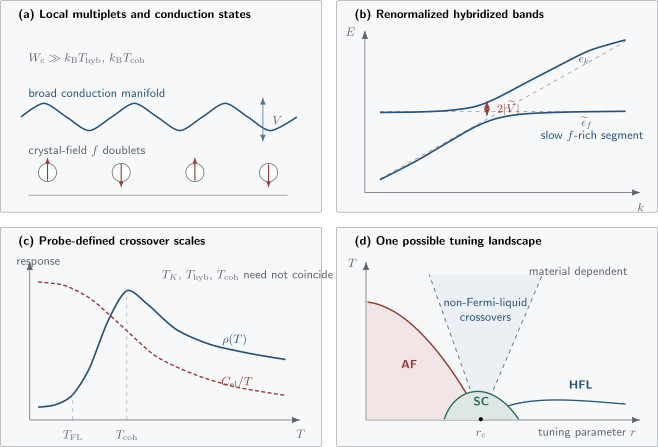
A materials ledger rather than a universal phase diagram. Local multiplets hybridize with broad conduction states; the low-energy avoided crossing can create slow, -rich quasiparticles. Transport and identify probe-dependent coherence scales. Pressure, field, or composition may tune magnetic order, a heavy Fermi liquid (HFL), non-Fermi-liquid crossovers, and superconductivity (SC), but the topology and interpretation vary between compounds.
Residue is not the only mass renormalization
Section titled “Residue is not the only mass renormalization”For a single electronic component, the quasiparticle residue is
If the self-energy is nearly momentum independent and the Fermi surface is simple, one often writes . Heavy-fermion crystals are usually multiband, anisotropic, and strongly hybridized. Momentum derivatives of , orbital mixing, and band curvature then matter, so no exact material-wide identity exists. Spectral weight, thermodynamic density of states, optical mass, penetration-depth mass, and cyclotron mass answer related but distinct questions.
Large and small Fermi surfaces
Section titled “Large and small Fermi surfaces”In a conventional, translation-invariant, spin-degenerate heavy Fermi liquid, the local moments contribute to the Luttinger count even when the microscopic starting point describes them as localized spins. For primitive-cell volume ,
for an electron-like sheet and for a hole-like sheet under this signed-volume convention. counts the relevant local moments per primitive cell. This is called a large Fermi surface; a phase in which only enters is called small.
Several cautions are essential. A Hall coefficient is not generally in a compensated multiband metal. Antiferromagnetism enlarges the unit cell and folds the Brillouin zone, which can make large and small counts indistinguishable by volume alone. Lifshitz transitions can change observed frequencies without destroying Kondo entanglement. A defensible localization claim therefore combines symmetry, quantum oscillations, Hall or thermoelectric response, spectroscopy, and material-specific band calculations.
What “Large Effective Mass” Means
Section titled “What “Large Effective Mass” Means”There is no instrument that returns one universal heavy-fermion mass. The strongest diagnosis compares complementary observables.
Electronic heat capacity
Section titled “Electronic heat capacity”After phonon, nuclear, Schottky, and magnetic-order contributions have been separated, a Fermi liquid has
with
Here is the renormalized quasiparticle density of states per formula unit and per energy, including both spin projections. Values of in heavy-fermion compounds can exceed ordinary-metal values by two orders of magnitude. The comparison to a reliable band-structure value is more informative than comparison to the free-electron mass.
A large measured that continues to vary strongly as may instead signal quantum-critical fluctuations, unresolved nuclear terms, disorder, or a nearby transition. Calling its finite-temperature value a Fermi-liquid would then be premature.
Quantum oscillations
Section titled “Quantum oscillations”For a closed extremal orbit perpendicular to magnetic field,
and the cyclotron mass is
The Lifshitz–Kosevich thermal damping factor is
Fitting the temperature dependence of an oscillation amplitude yields an orbit-specific . This is among the most direct heavy-mass measurements, but the heaviest sheets can be invisible because thermal, impurity, and field damping suppress their oscillations. A spectrum containing only lighter detected orbits need not account for the full heat capacity.
Spectroscopy and electrodynamics
Section titled “Spectroscopy and electrodynamics”Spectral Functions connect photoemission and tunnelling to the energy- and momentum-resolved electronic states. ARPES can reveal an avoided crossing and a narrow -derived dispersion, but surface termination, matrix elements, energy resolution, and the low coherence temperature complicate extraction. Scanning tunnelling spectra can display interference between light and heavy channels rather than a direct density of states.
Optical conductivity may show a very narrow Drude response and finite-frequency spectral weight associated with hybridization. The inferred optical mass depends on the plasma frequency, the integration window, and which bands are included. Penetration depth and upper-critical-field scales provide further information in superconductors, but likewise weight the Fermi surface nonuniformly.
Low-temperature transport
Section titled “Low-temperature transport”When a clean heavy Fermi liquid is reached,
The empirical Kadowaki–Woods ratio
often groups related heavy-fermion materials more closely than ordinary metals. It is not a universal constant. Carrier density, dimensionality, Fermi-surface geometry, orbital degeneracy, current direction, and multiband short-circuiting all alter it. The ratio should be compared within a stated material class and only over a genuine common interval.
Coherence Temperature
Section titled “Coherence Temperature”“The coherence temperature” is an operational label for a crossover, and different probes need not assign the same number. A useful scale ledger is:
| Symbol | Operational meaning | Typical evidence | What it is not |
|---|---|---|---|
| Single-ion screening scale under a specified convention | Dilute analogue, impurity fit, local susceptibility, entropy release | Automatically the lattice coherence temperature | |
| or | Onset of detectable intersite or hybridization-related response | Knight-shift anomaly, ARPES, optics, tunnelling, two-fluid fit | A universal phase transition |
| Formation of a coherent conducting state | Broad resistivity maximum followed by a rapid decrease, optical narrowing | Necessarily the point where all weight becomes itinerant | |
| Upper edge of asymptotic Fermi-liquid behavior | Stable resistivity, constant , saturated susceptibility | Equal to or |
In many Ce-based Kondo lattices, magnetic resistivity first increases on cooling because incoherent Kondo scattering strengthens, reaches a broad maximum, and then falls as coherent quasiparticles develop. Phonons, crystal-field depopulation, disorder, multiple conduction channels, or magnetic order can shift or obscure that maximum. Yb systems can show reversed pressure trends because pressure changes their valence and hybridization differently.
The onset can also be broad: spectroscopy may see hybridization before transport becomes coherent, while a true regime appears only much lower. Quoting a scale without its extraction rule hides this hierarchy. A good report states, for example, “resistivity maximum at ” or “Knight-shift anomaly onset near ,” rather than silently calling both .
Representative Material Families
Section titled “Representative Material Families”The label covers several distinct electronic settings:
| Material or family | Why it is instructive | Evidential caution |
|---|---|---|
| CeAl and CeCu | Early paramagnetic heavy-fermion benchmarks with large low-temperature heat capacity | Historical single-number masses came before modern multiband resolution |
| CeRuSi | Clean tetragonal system with strong anisotropy and field-tuned metamagnetic crossover | A metamagnetic crossover is not automatically a quantum critical point |
| CeRhIn | Antiferromagnetism, pressure-induced superconductivity, and strong changes in de Haas–van Alphen spectra | Pressure cells restrict angular and field windows; reconstruction and breakdown scenarios must be distinguished |
| YbRhSi | Very low-field antiferromagnetic suppression, Hall crossovers, and non-Fermi-liquid response | Extrapolating finite-temperature crossover widths to is model dependent |
| CeCuSi and CeCoIn | Bulk heavy-fermion superconductivity with strong evidence for unconventional pairing | Gap topology is material specific; CeCuSi is not a simple universal nodal template |
| UPt and related U compounds | Multiple superconducting phases and partially itinerant behavior | The localized-versus-itinerant split is less clean than in many Ce compounds |
This table is a map, not a taxonomy by one threshold value of . Stoichiometry, disorder, strain, field orientation, and sample growth can change low-temperature behavior qualitatively.
Quantum Criticality
Section titled “Quantum Criticality”Pressure, magnetic field, or composition can suppress magnetic order toward zero temperature. Heavy-fermion systems are especially informative because the tuning may reorganize both the order parameter and the degree to which moments participate in the Fermi surface.
A credible material case normally combines:
- a continuously suppressed ordering scale with a well-characterized tuning variable;
- thermodynamic evidence for accumulating low-energy entropy or a divergent Grüneisen response;
- a non-Fermi-liquid regime whose temperature window narrows toward the proposed critical point;
- recovery of distinct low-temperature phases on both sides;
- Fermi-surface, Hall, or spectroscopic evidence interpreted with the broken symmetry and multiband structure included.
At least three frameworks may need comparison:
- Spin-density-wave criticality: Kondo coherence survives, and an itinerant heavy Fermi surface is reconstructed by the magnetic ordering wavevector. Critical scattering can be strongest near hot regions of the Fermi surface.
- Kondo destruction or local quantum criticality: an additional scale associated with Kondo entanglement collapses at the transition, and the zero-temperature Fermi volume changes between large and small. This is an influential active framework, not an established universal mechanism for every heavy-fermion critical point.
- Other reconstructions: valence fluctuations, multipolar order, frustration, disorder, or a Lifshitz transition can produce overlapping anomalies and must be tested material by material.
The Hall crossover in YbRhSi and pressure-dependent quantum oscillations in CeRhIn are prominent evidence for sharp Fermi-surface reorganization. Neither observation alone proves a universal Kondo-breakdown scenario. Hall response includes mobilities and vertex corrections; quantum-oscillation frequencies can change through symmetry breaking or band topology. Quantum Criticality continues the detailed material phenomenology, while general scaling belongs to Quantum Phase Transitions.
Unconventional Superconductivity
Section titled “Unconventional Superconductivity”The 1979 discovery of superconductivity in CeCuSi established that a metal with an enormous normal-state electronic heat capacity could form a superconducting condensate. A zero-resistance transition is not enough to prove this. Bulk superconductivity requires a thermodynamic anomaly and magnetic screening or another volume-sensitive measurement, with filamentary paths and secondary phases excluded.
To show that the heavy carriers participate, one seeks consistency among the normal-state , the superconducting heat-capacity anomaly, low-temperature entropy balance, penetration depth, thermal transport, upper critical fields, and spectroscopic gaps on heavy bands. No one ratio is universal in a multiband, strongly coupled material.
“Unconventional” must be split into two claims. A pairing-structure claim concerns crystal representation, parity or pseudospin structure, nodes, relative signs, and multicomponent symmetry breaking. A pairing-mechanism claim concerns which interaction generated that state. Neither claim establishes the other.
Evidence for nontrivial pairing structure may include:
- power-law low-temperature heat capacity, penetration depth, or thermal conductivity consistent with nodes;
- phase-sensitive or impurity response consistent with a sign-changing order parameter;
- multiple superconducting phases or broken rotational or time-reversal symmetry.
A spin resonance, proximity to magnetic fluctuations, or a pressure or field phase diagram can constrain candidate interactions, but none identifies the pairing glue or representation by itself.
Each structural or mechanism-sensitive observation has alternatives. Multiband gaps can mimic power laws over a limited range; disorder can lift or fill nodes; a neutron resonance supports but does not uniquely prove sign change. CeCoIn has strong evidence for predominantly -wave pairing. CeCuSi illustrates why the field remains active: modern measurements support a fully opened gap while several sign-changing multiband states remain viable. Heavy-fermion superconductivity is therefore a family of material-specific problems, not one pairing symmetry.
BCS Theory supplies the weak-coupling benchmark. Deviations from that benchmark should be stated as measured facts before a pairing glue or representation is assigned.
Experimental Inference Workflow
Section titled “Experimental Inference Workflow”- Establish the ionic and crystal-field ledger. Use valence-sensitive spectroscopy, magnetic susceptibility, inelastic neutron scattering, and local probes to identify charge state, low multiplets, anisotropy, and moment formation.
- Subtract backgrounds transparently. Separate phonon, nuclear, crystal-field, impurity, and magnetic-order contributions before assigning or entropy.
- Map all crossover scales. Report how each temperature was extracted from transport, optics, ARPES, NMR, or thermodynamics; do not force them to coincide.
- Test low-temperature coherence. Look for a common regime of long-lived quasiparticles, transport, stable , narrow optical response, and reproducible sample dependence.
- Resolve the Fermi surface. Combine quantum oscillations, ARPES, Hall response, and realistic calculations. Include missing heavy sheets and magnetic folding in the uncertainty budget.
- Tune without changing too many variables. Hydrostatic pressure and field are often cleaner than substitution, which also introduces disorder and changes carrier chemistry.
- For superconductors, prove bulk condensation and heavy-band participation. Then distinguish gap magnitude, nodes, sign structure, spin state, and pairing mechanism as separate questions.
Common Mistakes
Section titled “Common Mistakes”- Treating “heavy fermion” as a chemical label rather than a low-energy electronic diagnosis.
- Equating a large with one isotropic for every Fermi-surface sheet.
- Calling the broad resistivity maximum without an operational definition.
- Inferring carrier density directly from in a compensated multiband metal.
- Reading a changed quantum-oscillation frequency as automatic proof of -electron localization.
- Applying the Kadowaki–Woods ratio outside a verified regime or comparing unlike dimensionalities without corrections.
- Calling any linear resistivity “quantum critical” without thermodynamic scaling and a controlled tuning axis.
- Inferring a universal pairing symmetry from the phrase “heavy-fermion superconductor.”
Exercises
Section titled “Exercises”1. Heavy velocity from an avoided crossing
Section titled “1. Heavy velocity from an avoided crossing”Let and assume . Show that the lower hybridized branch is -dominated and estimate its velocity relative to the bare conduction velocity.
Solution
For the lower branch,
Expanding the square root,
so
Therefore
The branch remains a coherent mixture, but its small conduction weight makes it nearly flat in this simplified model. At the exact avoided crossing, ; the extreme slowing occurs on the -rich side, not exactly at the crossing.
2. What can be inferred from heat capacity?
Section titled “2. What can be inferred from heat capacity?”A compound has , while a noninteracting band calculation gives . What is the robust inference, and what stronger statement is unjustified?
Solution
The ratio is
If both values refer to the same formula unit and the low-temperature state is a Fermi liquid, the total quasiparticle density of states is enhanced by roughly a factor of relative to the calculation. It is unjustified to conclude that every carrier has or even . Different sheets contribute different densities of states, the calculated band masses are not all , and momentum-dependent self-energy and hybridization break a one-mass description. Quantum oscillations or momentum-resolved spectroscopy are needed to distribute the enhancement among sheets.
3. Thermal damping of a heavy orbit
Section titled “3. Thermal damping of a heavy orbit”Using
estimate for and at (a) and (b) .
Solution
At ,
so
At ,
Cooling by a factor of five changes the thermal damping dramatically. This is why very low temperatures and high fields are needed to observe heavy orbits, and why undetected sheets cannot automatically be declared absent.
4. Build a scale ledger
Section titled “4. Build a scale ledger”A material shows impurity-like susceptibility scaling near , an optical hybridization feature below , a broad resistivity maximum at , and stable only below . Assign the four scales and explain whether their separation is contradictory.
Solution
A defensible assignment is
The numbers are operational and need not coincide. Local screening correlations can become appreciable before a momentum-coherent lattice response is visible; spectroscopy can detect hybridization before transport loses incoherent scattering; and asymptotic Fermi-liquid behavior can require a much lower temperature. The separation is physical information, not an inconsistency.
5. Large versus small Fermi volume
Section titled “5. Large versus small Fermi volume”Consider a translation-invariant, spin-degenerate metal with conduction density per primitive cell and one spin- local moment per cell. Ignoring filled bands, what fractions of the Brillouin-zone volume are enclosed per spin in small- and large-Fermi-surface descriptions?
Solution
For an electron-like Fermi sea, the per-spin occupied fraction is half the counted density. A small Fermi surface counts only conduction electrons:
A conventional heavy Fermi liquid counts the local moment as one additional electron per cell:
The difference is one half of a Brillouin zone per spin. If antiferromagnetism doubles the real-space unit cell, Brillouin-zone folding can make these counts equivalent modulo filled bands, so volume alone may no longer distinguish the phases.
6. Classify quantum-critical evidence
Section titled “6. Classify quantum-critical evidence”Under pressure, an antiferromagnetic extrapolates continuously to zero. Near the critical pressure, , grows approximately as over a decade, a Hall crossover sharpens on cooling, and de Haas–van Alphen frequencies differ on the two sides. Which conclusions are supported, and which are not yet established?
Solution
The observations support a pressure-tuned magnetic quantum-critical region with non-Fermi-liquid thermodynamics and transport, provided the transition remains continuous and disorder or first-order behavior has been excluded. They also support a Fermi-surface reconstruction or a strong mobility reorganization.
They do not by themselves establish Kondo destruction. Magnetic Brillouin-zone folding, a Lifshitz transition, pressure-dependent scattering, or selective visibility of oscillation branches can change Hall and oscillation signals. A stronger case would track the zero-temperature width of the Hall crossover, establish the magnetic unit cell, compare large- and small-Fermi-surface calculations, look for an additional vanishing energy scale, and verify the same reconstruction with spectroscopy or thermodynamics.
Research Status
Section titled “Research Status”The existence of heavy quasiparticles, their thermodynamic and cyclotron-mass signatures, coherent low-temperature Fermi-liquid regimes, and bulk heavy-fermion superconductivity are established. The periodic Anderson and Kondo-lattice models are standard organizing descriptions, and Luttinger counting provides a precise benchmark for a conventional heavy Fermi liquid.
The microscopic formation of lattice coherence, the degree of universality among coherence scales, and the interpretation of many quantum-critical materials remain active. Kondo destruction is well developed theoretically and has significant experimental support in selected compounds, but it is not a settled account of every heavy-fermion quantum critical point. Pairing mechanisms and gap structures are likewise material dependent; even canonical compounds continue to motivate competing multiband descriptions.
Connections
Section titled “Connections”- Unconventional Superconductivity owns the stable cross-material pairing-structure taxonomy and evidence audit; this page retains the heavy-fermion platform, Kondo coherence, Fermi-volume, and compound-specific mechanism record.
- Kondo Effect — impurity screening, , resistivity minima, and the screening cloud.
- RKKY Interaction — intersite exchange mediated by conduction electrons.
- Kondo Lattices — dense local moments, the Doniach heuristic, heavy-Fermi-liquid formation, Fermi-volume counting, and Kondo breakdown.
- Fermi Surface — Luttinger volume, extremal orbits, and reconstruction geometry.
- Effective Mass — curvature, tensors, cyclotron mass, and limits of the one-band concept.
- Fermi-Liquid Theory Preview — quasiparticle residue, thermodynamics, response ratios, and scattering.
- Heat Capacity and Thermodynamics — calorimeter response, Sommerfeld-coefficient extraction, entropy ledgers, and low-temperature backgrounds.
- Magnetic Susceptibility — local-moment fits, Pauli-like low-temperature response, Wilson-ratio bookkeeping, anisotropy, and impurity controls.
- Spectral Functions — coherent poles, linewidths, ARPES, and tunnelling observables.
- Antiferromagnetism — ordering wavevectors, zone folding, and local-versus-itinerant diagnostics.
- Quantum Phase Transitions — scaling, crossover fans, and dangerously irrelevant variables.
- Quantum Criticality — endpoint inference, Grüneisen and crossover tests, transport anomalies, and competing magnetic scenarios.
- Competing Orders — bicritical and tetracritical topology, microscopic-coexistence tests, and antiferromagnetism–superconductivity case studies.
- Non-Fermi Liquids — pole-failure criteria, momentum selectivity, transport caveats, and alternative infrared mechanisms.
- Strange Metals — comparative linear-, Planckian, optical, and thermodynamic evidence across correlated material families.
- BCS Theory — the conventional superconducting benchmark.
References
Section titled “References”- K. Andres, J. E. Graebner, and H. R. Ott, “4f-virtual-bound-state formation in CeAl at low temperatures,” Physical Review Letters 35, 1779–1782 (1975).
- S. Doniach, “The Kondo lattice and weak antiferromagnetism,” Physica B+C 91, 231–234 (1977).
- F. Steglich, J. Aarts, C. D. Bredl, et al., “Superconductivity in the presence of strong Pauli paramagnetism: CeCuSi,” Physical Review Letters 43, 1892–1896 (1979).
- G. R. Stewart, “Heavy-fermion systems,” Reviews of Modern Physics 56, 755–787 (1984).
- K. Kadowaki and S. B. Woods, “Universal relationship of the resistivity and specific heat in heavy-fermion compounds,” Solid State Communications 58, 507–509 (1986).
- A. C. Hewson, The Kondo Problem to Heavy Fermions (Cambridge University Press, 1993).
- M. Oshikawa, “Topological approach to Luttinger’s theorem and the Fermi surface of a Kondo lattice,” Physical Review Letters 84, 3370–3373 (2000).
- S. Paschen, T. Lühmann, S. Wirth, et al., “Hall-effect evolution across a heavy-fermion quantum critical point,” Nature 432, 881–885 (2004).
- H. Shishido, R. Settai, H. Harima, and Y. Ōnuki, “A drastic change of the Fermi surface at a critical pressure in CeRhIn: dHvA study under pressure,” Journal of the Physical Society of Japan 74, 1103–1106 (2005).
- H. v. Löhneysen, A. Rosch, M. Vojta, and P. Wölfle, “Fermi-liquid instabilities at magnetic quantum phase transitions,” Reviews of Modern Physics 79, 1015–1075 (2007).
- P. Gegenwart, Q. Si, and F. Steglich, “Quantum criticality in heavy-fermion metals,” Nature Physics 4, 186–197 (2008).
- Y.-f. Yang, Z. Fisk, H.-O. Lee, J. D. Thompson, and D. Pines, “Scaling the Kondo lattice,” Nature 454, 611–613 (2008).
- C. Pfleiderer, “Superconducting phases of -electron compounds,” Reviews of Modern Physics 81, 1551–1624 (2009).
- O. Stockert, J. Arndt, E. Faulhaber, et al., “Magnetically driven superconductivity in CeCuSi,” Nature Physics 7, 119–124 (2011).
- S. Wirth and F. Steglich, “Exploring heavy fermions from macroscopic to microscopic length scales,” Nature Reviews Materials 1, 16051 (2016).
- M. Smidman, O. Stockert, E. M. Nica, et al., “Colloquium: Unconventional fully gapped superconductivity in the heavy-fermion metal CeCuSi,” Reviews of Modern Physics 95, 031002 (2023).
- H. Hu, L. Chen, and Q. Si, “Quantum critical metals and loss of quasiparticles,” Nature Physics 20, 1863–1873 (2024).
Summary
Section titled “Summary”Heavy-fermion metals turn partly localized degrees of freedom into narrow, coherent low-energy electronic states. Their diagnosis rests on a cross-probe ledger: ionic and crystal-field evidence at high temperature; probe-defined Kondo, hybridization, coherence, and Fermi-liquid scales; large heat-capacity and orbit-dependent masses; and a Fermi surface consistent with the material’s symmetry and carrier count. Quantum criticality can involve order-parameter fluctuations, Kondo destruction, or other reconstructions, and superconducting gap structure is compound specific. The trustworthy conclusion is therefore not “the electrons have one huge mass,” but that a correlated lattice has generated a multiband electronic fluid whose slow excitations, entropy, scattering, and ordered phases are mutually constrained by experiment.