Strange Metals
A strange metal is an experimentally identified metallic regime whose low-energy response cannot be reconciled with ordinary quasiparticle transport using one consistent set of carriers, scattering processes, and crossover scales. The most familiar signature is an electrical resistivity proportional to temperature over an unusually broad interval, sometimes continuing to the lowest accessible normal-state temperature. The stronger cases also show anomalous optical, thermodynamic, spectroscopic, or magnetotransport behavior.
The name is operational, not a microscopic classification. Strange metals in cuprates, iron-based superconductors, organic conductors, heavy-fermion compounds, and moiré systems need not belong to one phase or universality class. Nor does every linear- resistivity imply strong electronic correlations: conventional electron–phonon scattering is approximately linear at temperatures above the Bloch–Grüneisen scale.
A trustworthy analysis therefore separates three claims:
- Phenomenology: a stated observable has a reproducible anomalous dependence over a stated window.
- Rate extraction: a transport or optical model converts that observable into a relaxation scale of order .
- Mechanism: a theory explains the same coefficients, tuning trends, and independent probes.
Evidence for the first claim does not establish the second or third.
Canonical Scope
Section titled “Canonical Scope”This page is the canonical home for:
- linear-in-temperature resistivity as a materials diagnostic;
- the meaning and limitations of Planckian scattering language;
- comparisons across cuprates, pnictides, organics, heavy fermions, and moiré materials;
- optical, thermodynamic, spectral, and magnetotransport cross-checks;
- a status-aware comparison of proposed strange-metal mechanisms;
- an inference protocol that distinguishes robust observations from unresolved interpretations.
Neighboring pages own the underlying general theories. Drude Theory defines carrier parameters, optical memory functions, and extended-Drude conventions. Boltzmann Transport develops collision operators, transport lifetimes, and phonon crossovers. Kubo Formula owns exact linear response and the order of transport limits. Non-Fermi Liquids classifies pole failure, singular self-energies, and replacement theories. Quantum Criticality owns endpoint evidence, crossover fans, and scaling inference.
What Counts as Strong Evidence?
Section titled “What Counts as Strong Evidence?”The evidential strength of linear- transport depends on where and how it appears.
| Observation | What it establishes | What it does not establish |
|---|---|---|
| nearly linear at high temperature | a broad transport crossover | an electronic quantum-critical mechanism |
| linear below the phonon scale | an anomalous low-energy momentum-relaxation law | a unique scattering time or universality class |
| linearity persists after superconductivity is suppressed | access to a low-temperature normal-state trajectory | that the suppressing field leaves the state unchanged |
| slope tracks independently measured carrier weight | consistency with a rate proportional to in a declared model | a universal quantum bound |
| dc, optical, thermodynamic, and spectral data scale together | a constrained many-body account | uniqueness of the proposed microscopic mechanism |
The term bad metal usually emphasizes that resistivity exceeds a conventional saturation or mean-free-path estimate. The term strange metal emphasizes anomalous low-energy laws. A material may be both, either, or neither. The metals, insulators, and semiconductors guide develops the broader classification.
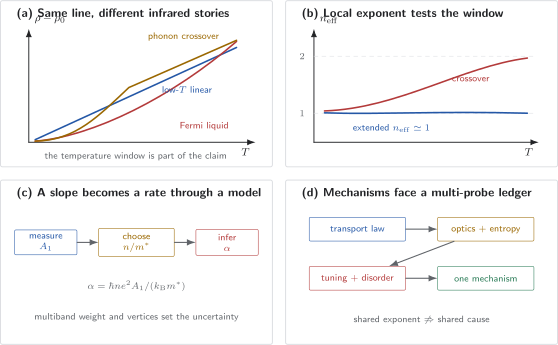
An evidence ladder for strange-metal claims. A straight is only the first panel of the analysis: the fit must survive a local-exponent test, any inferred must declare its carrier model, and a mechanism should account for several probes and tuning trends.
Linear-in-Temperature Resistivity
Section titled “Linear-in-Temperature Resistivity”The empirical law
Section titled “The empirical law”The minimal low-temperature fit is
where is the residual resistivity and is the linear coefficient. Real data often require additional terms,
The terms need not represent independent scattering probabilities. Matthiessen’s rule can fail when anisotropic channels, multiple bands, hydrodynamic flow, or temperature-dependent carrier densities are present. A good polynomial fit is consequently a description of a window, not a decomposition into microscopic processes.
A useful window-independent diagnostic is the local logarithmic exponent
An extended plateau near is stronger evidence for linearity than the visual straightness of one plot. It also exposes sensitivity to the chosen : an incorrect residual subtraction can manufacture an apparent exponent drift.
Why the low-temperature limit matters
Section titled “Why the low-temperature limit matters”At temperatures well above an acoustic-phonon Bloch–Grüneisen scale, the thermally occupied phonon phase space gives an approximately linear resistivity. At low temperature in a clean three-dimensional metal, the corresponding Bloch–Grüneisen contribution instead falls rapidly, commonly as under standard assumptions. This is why linearity extending below all identified phonon and coherence scales is the more discriminating observation.
Superconductivity or another ordered phase often hides that limit. Magnetic field, pressure, disorder, or composition can expose a normal state, but each tuning method is an intervention. A field can reconstruct or polarize the electronic state; chemical substitution can change disorder and carrier density. A responsible claim states the tuning path and tests whether the inferred slope is continuous across it.
Mean-free-path heuristics
Section titled “Mean-free-path heuristics”In a simple isotropic metal one may estimate
at the Mott–Ioffe–Regel crossover. This is a useful warning that a semiclassical wave packet is losing spatial coherence. It is not a sharp universal boundary. Multiband currents, incoherent spectral weight, anisotropic Fermi surfaces, and uncertain carrier densities make model dependent. Exceeding a heuristic saturation resistivity does not by itself identify the strange-metal mechanism.
Planckian Scattering Language
Section titled “Planckian Scattering Language”A dimensionless rate
Section titled “A dimensionless rate”The Planckian parametrization writes a chosen relaxation rate as
where the subscript must identify the channel: dc transport, optical current relaxation, single-particle decay, energy relaxation, phase decoherence, or another process. Saying only “the lifetime” hides an essential physical choice.
The thermal time is the only time scale that can be constructed from , , and . A fitted of order unity can therefore signal scale-free dynamics. It is not presently an established universal upper bound on all quantum relaxation rates. The energy–time uncertainty relation does not derive such a bound, and different correlation functions can relax at parametrically different rates in the same system.
From a resistivity slope to a rate
Section titled “From a resistivity slope to a rate”Under a one-band Drude interpretation,
Combining this relation with gives
This conversion is informative only after and have been defined and measured consistently. In a correlated multiband material, the relevant quantity is a current-carrying spectral weight rather than a unique thermodynamic mass. Fermi-surface anisotropy, vertex corrections, parallel bands, and temperature-dependent coherent weight can all change the inferred without changing the measured .
For several independent conducting channels,
so resistivities cannot generally be assigned band by band and added. The longest-lived or highest-weight channel may short-circuit strongly scattered regions of the Fermi surface.
A reporting standard
Section titled “A reporting standard”A useful Planckian claim reports all of the following:
- the observable and the fitted interval;
- the definition of and the response model used to obtain it;
- carrier density, effective mass, plasma frequency, or Drude weight with uncertainties;
- treatment of interband backgrounds, residual scattering, and parallel channels;
- whether is sample dependent or invariant under tuning;
- independent evidence that the same degrees of freedom control other probes.
The phrase Planckian metal is best reserved for a material regime in which this extraction is robust. It should not replace the measured statement ” is linear in .”
Materials Ledger
Section titled “Materials Ledger”No single material family supplies every diagnostic, and the same label hides different experimental constraints.
| Family | Tuning and strongest evidence | Principal caveat |
|---|---|---|
| hole-doped cuprates | low- linear resistivity near characteristic dopings after superconductivity is suppressed; angle-dependent magnetoresistance can separate isotropic linear and anisotropic quadratic channels | pseudogap, charge order, field effects, and doping-dependent carrier weight complicate a one-rate account |
| iron pnictides | linear transport and enhanced effective mass near antiferromagnetic or nematic endpoints in several compounds | multiband compensation, intertwined order, and impurity mixing alter transport exponents |
| quasi-one-dimensional organics | a linear resistivity component grows with spin-fluctuation signatures and superconducting pairing under pressure | dimensional crossover and narrow pressure windows limit universal extrapolation |
| heavy-fermion metals | linear resistivity, divergent thermodynamic coefficients, and field-tuned reconstruction can coincide near magnetic or Kondo-destruction criticality | very small coherence scales, neutral modes, disorder, and field tuning separate transport from electron decay |
| moiré systems | large, gate-tunable linear resistivity near correlated fillings in a low-bandwidth platform | acoustic phonons can also produce a large linear slope, and twist-angle inhomogeneity changes the inferred band parameters |
Cuprates
Section titled “Cuprates”Cuprates provide the most extensively mapped strange-metal phenomenology. In several overdoped compounds, a linear term survives beside a quadratic contribution; near the pseudogap endpoint, it can dominate to the lowest measured normal-state temperatures. Comparisons of with quantum-oscillation or specific-heat masses yield rates of order under a quasiparticle transport conversion. Angle-dependent magnetoresistance in overdoped TlBaCuO further indicates that an approximately isotropic linear-in- contribution can coexist with a strongly anisotropic conventional component.
Those results constrain models, but they do not prove that every cuprate has one isotropic microscopic lifetime. Carrier density changes across the pseudogap regime, superconductivity truncates the zero-field normal state, and charge-order or field scales can overlap the putative critical fan. The Mott Insulators page develops the doped-Mott starting point without assigning it a unique transport outcome.
Other correlated families
Section titled “Other correlated families”Iron pnictides and organic superconductors make the association with antiferromagnetic tuning especially suggestive: linear transport strengthens near the loss of magnetic order and weakens into a regime away from it. Heavy-fermion compounds add direct evidence for collapsing coherence and, in some cases, abrupt Fermi-surface reconstruction. Heavy Fermions and Kondo Lattices distinguish a heavy Fermi-liquid crossover from Kondo destruction.
Moiré bands provide electrostatic control over density and bandwidth, but they also sharpen the phonon caution. In twisted bilayer graphene, a large linear slope can be modeled by acoustic-phonon scattering over relevant windows. The presence of correlations elsewhere in the phase diagram does not make every linear transport coefficient electronic in origin.
Beyond DC Transport
Section titled “Beyond DC Transport”Optical response
Section titled “Optical response”Frequency-dependent conductivity asks whether the dc anomaly belongs to a coherent peak, a broad continuum, or spectral-weight transfer between them. A commonly tested scaling form is
A successful collapse requires a common exponent , a justified subtraction of temperature-independent backgrounds, and compatibility with optical sum rules. A power law over a partial frequency decade is not enough. Cuprate data have shown approximate frequency–temperature scaling, nearly constant phase angles over selected windows, a low-frequency Drude-like component whose width is of order , and higher-energy continua. Whether these pieces share one scaling function remains material- and window-dependent.
The optical scattering function extracted from depends on the chosen intraband plasma frequency and interband subtraction. It should not be equated automatically with an angle-resolved photoemission linewidth. The exact conventions and caveats are given in Drude Theory.
Thermodynamics and spectra
Section titled “Thermodynamics and spectra”Near the pseudogap endpoint in several cuprates, the electronic specific-heat coefficient has been reported to peak and to grow approximately logarithmically on cooling,
over a finite field-exposed normal-state window. Heavy-fermion strange metals can show related divergences or noninteger power laws. Such entropy accumulation supports critical low-energy degrees of freedom, but it is not a universal definition: dimensionality, dangerously irrelevant variables, neutral excitations, and disorder can change the thermodynamic form.
Photoemission, tunneling, and quantum oscillations test whether charged quasiparticles remain well defined. Their lifetimes need not equal because small-angle collisions broaden a spectral line while relaxing little current, whereas current-vertex processes can dominate conductivity. Spectral Functions gives the exact relation between measured spectra and the many-body Green function.
Magnetic field and thermal transport
Section titled “Magnetic field and thermal transport”Some strange metals show magnetoresistance approximately linear in field, or a quadrature dependence combining temperature and field scales. These observations are valuable because they challenge a simple weak-field orbital expansion, but they are not universal. Zeeman coupling, cyclotron motion, disorder, current geometry, and field-induced reconstruction must be separated before replacing by a single combined energy.
Thermal conductivity and thermopower provide another independent ledger. A mismatch between charge and heat relaxation can reveal neutral modes or strong inelastic scattering; agreement with the Wiedemann–Franz law in an appropriate zero-temperature limit can instead indicate surviving charged fermions. The order of , , and field limits must be stated.
Proposed Explanations
Section titled “Proposed Explanations”Several mechanisms can generate a linear resistivity or a rate of order . Their discriminating predictions matter more than the shared exponent.
| Mechanism | Route to anomalous transport | Discriminating question | Present status |
|---|---|---|---|
| marginal Fermi liquid | a nearly momentum-independent fluctuation spectrum gives electron damping linear in | do causal optical and spectral functions share the predicted marginal form? | influential phenomenology; microscopic origin remains debated |
| order-parameter quantum criticality | critical spin, charge, or nematic fluctuations scatter a Fermi surface | where are the hot regions, and why do cold carriers not short-circuit them? | controlled in selected limits; material transport remains model dependent |
| Kondo destruction or local criticality | collapse of Kondo entanglement changes both critical modes and Fermi volume | does the Hall or quantum-oscillation scale sharpen with the coherence collapse? | strong evidence in selected heavy-fermion systems; not a generic cuprate theory |
| SYK-like local dynamics | strongly interacting large- degrees of freedom lack quasiparticles and can yield -linear transport after spatial coupling | which predictions survive finite , locality, translation symmetry, and lattice momentum? | solvable model families; material realization is unresolved |
| spatially random interactions | randomness relaxes momentum while preserving universal local critical dynamics after averaging | are the predicted disorder and sample dependencies observed? | controlled constructions exist; microscopic relevance varies |
| incoherent or hydrodynamic transport | conductivity is governed by susceptibilities, diffusion, and weak momentum relaxation rather than a carrier lifetime | do viscosity, diffusivity, thermoelectric response, and momentum relaxation close quantitatively? | general framework, not a unique mechanism |
| holographic quantum matter | strongly coupled field theories provide scale-invariant transport without quasiparticles | which operator content and conservation laws map to the material? | controlled in model dualities; mapping to specific solids is conjectural |
| electron–phonon scattering | thermal phonons produce a linear transport rate above an appropriate crossover | does linearity persist below the phonon scale with the expected isotope and density trends absent? | established conventional alternative, decisive in some regimes |
The hot–cold problem
Section titled “The hot–cold problem”Critical scattering is often strongest only near points connected by an ordering wavevector. Long-lived cold regions then dominate the conductivity because conductivities add in parallel. Disorder or additional small-angle processes can mix hot and cold sectors and restore a broad linear regime, but the coefficient will generally depend on that mixing. A theory that computes a hot-spot self-energy without the current vertex has not yet computed the resistivity.
Marginal and local dynamics
Section titled “Marginal and local dynamics”Marginal-Fermi-liquid phenomenology organizes several cuprate observations through an electron damping scale that is linear in energy or temperature, accompanied by a causal logarithm in the real self-energy. SYK-like and spatially random models provide controlled many-body examples of local criticality and rapid relaxation. Their conceptual value is substantial, but translation-invariant charge transport requires extra spatial structure. Momentum relaxation cannot be inferred from local spectral decay alone.
Quantum criticality is a hypothesis to test
Section titled “Quantum criticality is a hypothesis to test”Scale invariance near a quantum critical point naturally motivates scaling and a rate proportional to . Yet a fan-shaped region and linear resistivity do not locate the endpoint. One must track crossover scales on both sides, identify the tuning field, and test the scaling dimensions of several observables. The full protocol lives in Quantum Criticality.
What Is Established and What Is Debated?
Section titled “What Is Established and What Is Debated?”Established at the level of observation
Section titled “Established at the level of observation”- Several high-quality correlated materials exhibit reproducible resistivity dominated by a linear- term over broad windows.
- In selected cuprates and heavy-fermion compounds, linearity reaches unusually low normal-state temperatures after superconductivity or order is suppressed.
- Optical, thermodynamic, and spectroscopic anomalies coexist with linear transport in important cases.
- Converting measured slopes with independently estimated carrier weights often gives dimensionless coefficients of order unity.
- Conventional phonons can also generate linear resistivity and an apparently Planckian rate in appropriate temperature regimes.
Active or unresolved
Section titled “Active or unresolved”- No universal theorem establishes or fixes one material-independent coefficient for all relaxation channels.
- It is unsettled whether the major strange-metal families share one infrared universality class.
- The microscopic origin of low-temperature linear resistivity in the cuprates remains debated.
- The relation between strange-metal scattering and unconventional pairing is suggestive in several phase diagrams but is not a proof of a common glue.
- It remains difficult to distinguish a stable strange-metal phase from a quantum-critical trajectory or a finite-temperature incoherent regime when order intervenes.
An Inference Workflow
Section titled “An Inference Workflow”- Define the window. Report temperature, field, pressure, composition, current direction, and whether the state is truly normal.
- Audit the raw transport. Establish geometry, contact linearity, residual resistivity, sample dependence, and uncertainty before fitting exponents.
- Use local diagnostics. Plot and ; vary and the fitting interval.
- Exclude ordinary crossovers. Compare with phonon, coherence, dimensional, magnetic, and structural scales.
- Declare the rate model. State the carrier density, mass or optical weight, multiband assumptions, and vertex corrections behind any .
- Demand orthogonal probes. Confront optics, thermodynamics, spectroscopy, Hall response, heat transport, and tuning with the same degrees of freedom.
- Test discriminating predictions. A mechanism should explain momentum selectivity, disorder response, coefficient trends, and crossover boundaries, not merely reproduce .
- State the knowledge level. Separate measured facts, model-dependent extractions, controlled theoretical limits, and material conjectures.
Common Mistakes
Section titled “Common Mistakes”- Calling every high-temperature linear resistivity strange. Above a phonon scale, linearity can be conventional.
- Treating as a scattering rate. It becomes a rate only through a carrier and current-response model.
- Invoking energy–time uncertainty as a proof. It supplies dimensional motivation, not a transport bound.
- Using one effective mass everywhere. Thermodynamic, cyclotron, band, and optical masses answer different weighted questions.
- Adding band resistivities. Parallel conducting channels add in conductivity.
- Equating optical, transport, and spectral lifetimes. Their angular factors and vertex corrections differ.
- Ignoring the field used to reveal the normal state. The field may change the phase or its carriers.
- Reading a fit exponent as a phase label. Crossovers can mimic a power law over a limited interval.
- Assuming a link to superconductivity proves causation. Nearby domes and correlated slopes are constraints, not a microscopic derivation.
Exercises
Section titled “Exercises”1. Local exponent of a mixed resistivity
Section titled “1. Local exponent of a mixed resistivity”Let
Find . At what temperature is it halfway between the linear and quadratic limits?
Solution
Using the logarithmic derivative,
It approaches for and for . Setting gives
Thus a finite interval can look nearly linear even when a quadratic channel is present; the crossover is set by a ratio of coefficients, not by a new universal scale.
2. A one-band Planckian estimate
Section titled “2. A one-band Planckian estimate”A metal has , carrier density , and . Estimate in the one-band Drude model. Use .
Solution
First convert the slope:
Then
The numerical result is Planckian in this declared model. It is not model independent: halving the conducting density halves , while doubling the assigned mass halves it. Uncertainties in correlated multiband weights can therefore dominate the apparent precision.
3. Residual-resistivity bias
Section titled “3. Residual-resistivity bias”Suppose the true law is , but an analysis subtracts . Derive the apparent local exponent and describe its behavior as approaches .
Solution
The analyzed temperature-dependent part is , so
It exceeds one and diverges as from above. A small error in can therefore create dramatic low-temperature curvature in a logarithmic exponent even when the intrinsic law is exactly linear.
4. Why high-temperature linearity is insufficient
Section titled “4. Why high-temperature linearity is insufficient”A material has only for , where is independently identified as its acoustic-phonon scale. Below that range it crosses to . Is it a strange metal on the evidence given?
Solution
No strong strange-metal inference follows. Linear resistivity above a sizable fraction of a phonon scale is compatible with ordinary electron–phonon transport, while the low-temperature law is consistent with a Fermi-liquid regime. One may still investigate unusual coefficients, saturation, or optics, but the stated data alone describe a conventional crossover rather than an anomalous infrared metal.
5. Scaling collapse with a background
Section titled “5. Scaling collapse with a background”Measured optical data have the form
where is temperature independent. Why can plotting against fail even when the critical term scales perfectly? Name two checks on a proposed subtraction.
Solution
After rescaling, the background becomes and therefore differs among temperatures. It spoils the collapse despite perfect scaling of the first term. A subtraction should be checked against optical sum rules and Kramers–Kronig consistency. One should also vary the subtraction window and compare the inferred intraband weight with independent band, Hall, or quantum-oscillation information.
6. Ranking a mechanism claim
Section titled “6. Ranking a mechanism claim”Near a tuning value , a compound shows low- linear resistivity, , and a broad electron spectrum. The linear coefficient is largest where superconducting is largest. Which conclusions are justified, and what would distinguish quantum-critical scattering from phonons or disorder?
Solution
The data establish a correlated anomalous regime and make a critical mechanism plausible. They do not identify a unique critical field, prove a Planckian bound, or show that the same fluctuations cause pairing. Stronger evidence would track crossover scales on both sides of , test scaling, map momentum selectivity, compare disorder and isotope dependence, and verify that the transport coefficient follows independently measured current-carrying spectral weight. A phonon account predicts characteristic phonon-scale and often isotope trends; a disorder-assisted critical account predicts systematic sample dependence and hot–cold mixing.
Research Status and Open Problems
Section titled “Research Status and Open Problems”The experimental existence of broad anomalous metallic regimes is settled; their common theoretical organization is not. Major open questions include:
- Is low-temperature linear resistivity controlled by a small number of universality classes or by several material-specific mechanisms?
- Which definition of a Planckian rate remains meaningful when quasiparticles, a single carrier density, or a Drude peak are absent?
- Can a translation-invariant microscopic lattice model produce robust linear dc resistivity without inserted disorder or an external momentum sink?
- How do hot and cold regions, current vertices, and Fermi-surface reconstruction cooperate in real materials?
- Are strange-metal fluctuations causally responsible for unconventional pairing, or do both emerge from a third organizing principle?
- Which multi-probe scaling collapses survive larger dynamic range, sample variation, and complete optical sum-rule audits?
- Can one distinguish a zero-temperature strange-metal phase from a finite-temperature fan when superconductivity or order repeatedly intervenes?
These questions are active. Controlled model results should be labeled by their limits, and material interpretations should remain distinguishable from direct observations.
For a new Planckian-rate, universality, or mechanism claim, Quantum Matter Frontiers and Open Problems freezes the carrier and Drude assumptions, covariance, alternatives, falsifier, and review trigger before routing its changing status.
Connections
Section titled “Connections”- Non-Fermi Liquids asks whether Landau quasiparticles fail and what replaces them; the present page asks how anomalous metals are identified across materials.
- Quantum Criticality gives the endpoint, fan, and scaling tests needed for a critical interpretation.
- Drude Theory and Boltzmann Transport provide the conventional baselines and define the assumptions behind extracted rates.
- Kubo Formula derives exact response from equilibrium correlation functions and distinguishes current decay from single-particle decay.
- What Are Strong Correlations? explains why a large interaction scale or anomalous exponent alone is not a complete diagnosis.
- Mott Insulators develops spectral-weight transfer and the doped-Mott constraints relevant to cuprates.
- Heavy Fermions and Kondo Lattices supply the coherence and Fermi-volume diagnostics specific to -electron systems.
References
Section titled “References”- C. M. Varma, P. B. Littlewood, S. Schmitt-Rink, E. Abrahams, and A. E. Ruckenstein, “Phenomenology of the normal state of Cu-O high-temperature superconductors”, Physical Review Letters 63, 1996–1999 (1989); erratum 64, 497 (1990). Marginal-Fermi-liquid phenomenology.
- R. Hlubina and T. M. Rice, “Resistivity as a function of temperature for models with hot spots on the Fermi surface”, Physical Review B 51, 9253–9260 (1995). Cold-region short-circuit problem.
- A. Rosch, “Interplay of disorder and spin fluctuations in the resistivity near a quantum critical point”, Physical Review Letters 82, 4280–4283 (1999). Disorder mixing in a hot–cold metal.
- D. van der Marel et al., “Quantum critical behaviour in a high- superconductor”, Nature 425, 271–274 (2003). Optical power laws and phase-angle evidence.
- N. Doiron-Leyraud et al., “Linear- scattering and pairing from antiferromagnetic fluctuations in the organic superconductors”, European Physical Journal B 78, 23–36 (2010). Pressure-tuned transport and pairing correlation.
- J. A. N. Bruin, H. Sakai, R. S. Perry, and A. P. Mackenzie, “Similarity of scattering rates in metals showing -linear resistivity”, Science 339, 804–807 (2013). Comparative Planckian-rate analysis.
- S. A. Hartnoll, “Theory of universal incoherent metallic transport”, Nature Physics 11, 54–61 (2015). Diffusivity-based incoherent transport proposal.
- A. Legros et al., “Universal -linear resistivity and Planckian dissipation in overdoped cuprates”, Nature Physics 15, 142–147 (2019). Low-temperature slopes and mass-based rate estimates.
- B. Michon et al., “Thermodynamic signatures of quantum criticality in cuprate superconductors”, Nature 567, 218–222 (2019). Specific-heat enhancement near the pseudogap endpoint.
- A. A. Patel and S. Sachdev, “Theory of a Planckian metal”, Physical Review Letters 123, 066601 (2019). Solvable large- random-interaction metal.
- H. Polshyn et al., “Large linear-in-temperature resistivity in twisted bilayer graphene”, Nature Physics 15, 1011–1016 (2019). Gate-tunable moiré transport and phonon interpretation.
- P. Cha, N. Wentzell, O. Parcollet, A. Georges, and E.-A. Kim, “Linear resistivity and Sachdev–Ye–Kitaev (SYK) spin liquid behavior in a quantum critical metal with spin-1/2 fermions”, Proceedings of the National Academy of Sciences 117, 18341–18346 (2020). SYK-related local critical transport construction.
- J. Ayres et al., “Incoherent transport across the strange-metal regime of overdoped cuprates”, Nature 595, 661–666 (2021). Field and temperature transport across overdoped cuprates.
- G. Grissonnanche et al., “Linear-in temperature resistivity from an isotropic Planckian scattering rate”, Nature 595, 667–672 (2021). Angle-dependent magnetoresistance in overdoped TlBaCuO.
- D. V. Else and T. Senthil, “Strange metals as ersatz Fermi liquids”, Physical Review Letters 127, 086601 (2021). Symmetry and anomaly constraints on compressible metals.
- C. H. Mousatov and S. A. Hartnoll, “Phonons, electrons and thermal transport in Planckian high materials”, npj Quantum Materials 6, 81 (2021). Phonon-based Planckian-scale comparison.
- D. H. Nguyen et al., “Superconductivity in an extreme strange metal”, Nature Communications 12, 4341 (2021). Ultralow-temperature normal-state and superconducting behavior of YbRhSi.
- E. E. Aldape, T. Cookmeyer, A. A. Patel, and E. Altman, “Solvable theory of a strange metal at the breakdown of a heavy Fermi liquid”, Physical Review B 105, 235111 (2022). Controlled Kondo-breakdown construction.
- J. van Heumen et al., “Strange metal electrodynamics across the phase diagram of BiSrCaCuO”, Physical Review B 106, 054515 (2022). Low-energy peak and higher-energy optical continuum.
- A. A. Patel, H. Guo, I. Esterlis, and S. Sachdev, “Universal theory of strange metals from spatially random interactions”, Science 381, 790–793 (2023). Spatially extended random-interaction theory.
- B. Michon et al., “Reconciling scaling of the optical conductivity of cuprate superconductors with Planckian resistivity and specific heat”, Nature Communications 14, 3033 (2023). Joint optical, transport, and thermodynamic scaling analysis.
- A. Gleis, S.-S. B. Lee, G. Kotliar, and J. von Delft, “Dynamical scaling and Planckian dissipation due to heavy-fermion quantum criticality”, Physical Review Letters 134, 106501 (2025). Cluster calculation emphasizing current-vertex contributions.
Summary
Section titled “Summary”Strange-metal phenomenology begins with reproducible anomalous transport, most prominently low-temperature linear resistivity, but it cannot end there. A Planckian coefficient is a dimensionless result of a declared response model, not a directly observed universal clock. The most persuasive cases combine dc transport with optical spectral weight, thermodynamics, spectra, heat flow, and controlled tuning. Quantum criticality, marginal dynamics, Kondo destruction, SYK-like models, incoherent transport, holography, disorder, and phonons can reproduce overlapping pieces of the evidence. The field’s central task is therefore discriminating rather than naming: determine which degrees of freedom carry current, which process relaxes it, and which theory predicts the full materials ledger with one consistent set of assumptions.