What Are Strong Correlations?
A quantum material is strongly correlated when interactions and collective constraints reorganize the states relevant to an observable so thoroughly that an independent-particle description is not a controlled starting point at that scale. Typical consequences include suppressed charge fluctuations, local moments, narrow coherence scales, strongly renormalized or absent quasiparticles, large transfers of spectral weight, and low-energy degrees of freedom that are not bare electrons.
This is an operational definition, not a universal inequality. A material may be strongly correlated for low-energy transport yet admit a useful high-energy band description. A heavy Fermi liquid can have sharp quasiparticles and still be strongly correlated because their mass and coherence scale arise collectively. Conversely, a broad spectral line can come from disorder, phonons, instrumental resolution, or an unresolved band manifold rather than strong electronic correlation.
This page owns the materials-facing definition, diagnostic hierarchy, and evidence standard. Interacting Many-Body Systems Overview owns generic interaction language. Hubbard Model owns the canonical lattice Hamiltonian and its controlled limits. Lifetime and Spectral Weight and Spectral Functions own the general pole and Lehmann machinery. Mott Insulators owns interaction-driven charge incompressibility, while Hubbard Physics in Materials owns the crystal-to-model parameter and validation pipeline.
Computational Quantum Matter owns the material-facing route from that model and diagnostic target to a solver, convergence design, benchmark, probe comparison, and bounded claim; this page retains the definition and evidence hierarchy.
Magnetism and Spin Systems routes moment, exchange, conventional magnetic order, magnon, itinerant, Kondo, and texture claims. Quantum spin liquids, fractionalization, and emergent gauge fields remain owned by Strong Correlations and Emergence.
Three Meanings of Strong
Section titled “Three Meanings of Strong”The phrase “strongly correlated” is used in three related but non-equivalent senses.
| Sense | Operational question | Typical indicator |
|---|---|---|
| scale competition | Are interaction energies comparable to or larger than kinetic, crystal-field, or coherence scales? | , , , , or a small |
| failure of a baseline | Does a controlled independent-particle or weak-coupling expansion reproduce the relevant state and response? | large self-energy, nonrigid doping evolution, missing spectral weight, or incorrect entropy |
| emergent organization | Are the useful low-energy variables constrained or collective objects rather than bare electrons? | local moments, heavy quasiparticles, collective order, spinons, holons, or gauge fields |
None is sufficient by itself. A large bare Coulomb energy can be screened into a conventional metal. A weak microscopic interaction can become decisive near a nested Fermi surface, in one dimension, or at a critical point. A local-density approximation can miss a gap for reasons that do not prove a particular Mott mechanism. Strong correlation is therefore a statement about scales, observables, and the failure of specified approximations.
The distinction between strong interaction and strong correlation is especially important. Interaction strength is a Hamiltonian parameter. Correlation is structure in a state or response that cannot be reduced to independent occupations in the chosen description. A symmetry-broken mean-field state may capture a large interaction with one determinant, while a modest interaction in a frustrated or low-dimensional system can generate highly nonclassical correlations.
Competing Energy Scales
Section titled “Competing Energy Scales”A downfolded electronic Hamiltonian often has the schematic form
The hopping matrix sets bandwidths and Fermi velocities. The local repulsion , intersite interaction , Hund coupling, spin–orbit coupling, crystal-field splittings, and electron–phonon terms compete with those kinetic scales. Temperature, disorder, pressure, dimensionality, filling, and frustration decide which competition is visible.
For a one-band lattice model,
is a useful first coordinate. It is not a phase criterion. Both and depend on the chosen orbital basis and downfolding window. The critical ratio for a metal–insulator transition depends on lattice geometry, density of states, magnetic order, temperature, degeneracy, and whether longer-range interactions are retained.
Other systems require different coordinates:
organizes dilute continuum electrons, while a Hund metal may be controlled by , orbital filling, and a suppressed coherence scale even before reaches a single-band Mott threshold. A Kondo material can be strongly correlated because an exponentially small screening scale emerges from moderate microscopic exchange. Flat bands amplify interactions by reducing . One-dimensional fermions can lose the Landau quasiparticle pole through infrared collective behavior without a universal large bare coupling.
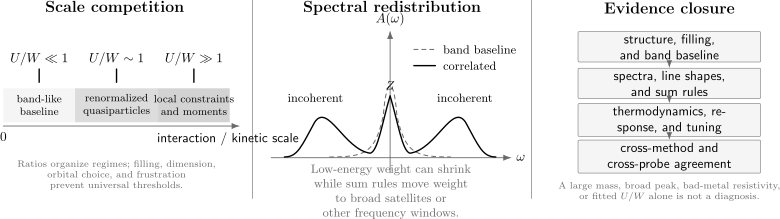
Three complementary ledgers are needed. Interaction-to-kinetic ratios organize regimes but do not define universal thresholds. Correlations can transfer spectral weight between a low-energy coherent feature of weight and broad incoherent sectors. A material claim becomes persuasive only when structure and filling, spectroscopy and sum rules, thermodynamics and response, tuning, and cross-method agreement close consistently.
When Independent Particles Fail
Section titled “When Independent Particles Fail”Independent-particle band theory assumes that the many-electron problem can be organized by occupied one-electron states, perhaps after replacing bare electrons by weakly dressed quasiparticles. It fails in several distinct ways:
- charge configurations become locally constrained rather than approximately independent;
- several atomic multiplets or orbital sectors remain dynamically active;
- the self-energy varies strongly with frequency or momentum;
- quasiparticle weight becomes small or the pole broadens into a continuum;
- spectral weight moves across energies comparable to , not merely near the Fermi level;
- doping changes the available low-energy Hilbert space rather than rigidly shifting a chemical potential;
- competing orders, frustration, or critical fluctuations prevent a single stable reference state.
Failure is observable dependent. A density-functional calculation may predict the lattice and broad orbital character well while failing for a charge gap or magnetic entropy. A renormalized band may fit a narrow low-temperature window while missing the incoherent response above the coherence scale.
Quasiparticle residue and coherence
Section titled “Quasiparticle residue and coherence”For one band, write
Near a sufficiently sharp pole, the residue is
The pole half-width in energy units is approximately
A useful quasiparticle requires more than : its width must be small compared with the energy scale on which it is used. Small means that a bare-electron insertion overlaps only weakly with the coherent excitation; the missing weight resides in incoherent many-body states. It does not mean that the state is unphysical. Heavy-fermion metals provide a central example of small-, large-mass quasiparticles that become sharply coherent only below a low temperature.
The converse warning is equally important. A broad peak or mass enhancement does not uniquely identify electron–electron correlations. Electron–phonon coupling, disorder, multiband hybridization, surface reconstruction, and finite experimental resolution must be tested.
Local Constraints and Moments
Section titled “Local Constraints and Moments”The half-filled repulsive Hubbard model gives the cleanest local diagnostic. Define the double occupancy
and the local spin-polarization fluctuation
Repulsion suppresses . Near one electron per site, this increases the local-moment amplitude even before the moments develop long-range order. At large , charge-changing states cost energy of order , while the low-energy sector is approximately restricted to one electron per site.
Virtual hopping still acts inside that constrained sector. In the simplest half-filled one-band limit it produces an antiferromagnetic exchange scale
This scale separation is a model example of emergence: high-energy charge fluctuations generate low-energy spin dynamics. The controlled projection and its corrections belong to Effective Hamiltonians in Many-Body Systems, while Exchange Interactions places the result among direct, superexchange, carrier-mediated, and itinerant mechanisms.
Local moments do not by themselves prove a Mott insulator. Hund metals, dilute magnetic alloys, charge-transfer materials, and bad metals can support substantial fluctuating moments. Conversely, a nonmagnetic singlet can be strongly correlated. The evidence must connect filling, charge response, spectra, and spin dynamics.
Spectral-Weight Transfer
Section titled “Spectral-Weight Transfer”For a normalized single-particle orbital, the exact spectral sum rule is
Interactions do not remove this weight; they redistribute it. A weakly dressed band concentrates most of the weight near a quasiparticle pole. A correlated metal may show a narrow coherent feature plus broad removal and addition continua. Approaching a Mott regime can suppress low-energy weight and build lower and upper Hubbard sectors. Doping can transfer weight between these sectors over an energy range far larger than the chemical-potential shift.
Optical data provide a complementary partial sum,
The cutoff must be stated. A lost Drude weight may reappear in a mid-infrared feature or in higher interband structure. Matrix elements, multiple orbitals, and temperature-dependent lattice effects complicate the bookkeeping. “Spectral weight transfer” is persuasive when the integration window, background subtraction, polarization, sum-rule closure, and uncertainty are reported.
This redistribution distinguishes a correlated evolution from a simple rigid-band picture, but it is not unique to a single microscopic model. Coupling to phonons produces satellites; disorder broadens and localizes; density-wave order reconstructs bands. The strongest diagnosis combines one-particle spectra with charge, spin, optical, and thermodynamic information.
Emergent Degrees of Freedom
Section titled “Emergent Degrees of Freedom”An emergent degree of freedom is a variable that efficiently describes the low-energy sector but is not a freely propagating constituent of the microscopic Hamiltonian. Strong correlations often create such variables by freezing some fluctuations and retaining others.
| Microscopic setting | Useful low-energy variable | Evidence needed | Qualification |
|---|---|---|---|
| charge localized near one electron per site | local spin or orbital moment | charge gap or suppressed compressibility plus spin response | moment formation and magnetic order are distinct |
| Kondo lattice below coherence | heavy quasiparticle | thermodynamics, quantum oscillations, spectroscopy, and Fermi-volume tests | coherent quasiparticles can still be strongly correlated |
| paired electrons | collective phase and Bogoliubov excitation | gap symmetry, phase stiffness, response, and coherence | pairing alone does not specify mechanism |
| frustrated quantum magnet | collective spin sector | continuum, thermodynamics, absence of order, and model closure | a continuum alone does not prove fractionalization |
| deconfined phase | spinon, holon, vison, or gauge flux | multiple topological and dynamical signatures | partons may be calculational redundancies unless deconfined |
Fractionalization is a stronger claim than “the electron is dressed.” A quasiparticle carries the electron’s conserved quantum numbers with renormalized weight. Fractionalized excitations separate those quantum numbers or introduce new topological sectors, and they require evidence for deconfinement rather than a suggestive continuum alone.
Emergence also occurs without exotic fractionalization. Screening converts a bare Coulomb interaction into collective dielectric response. Local moments interact through exchange. A Fermi surface organizes low-temperature thermodynamics even though it is a many-electron object. Anderson’s maxim that “more is different” is useful precisely when it is read as a demand for a correct effective description, not as permission to detach phenomenology from microscopic constraints.
Material Evidence
Section titled “Material Evidence”No single anomaly certifies strong correlation. A reliable case closes several ledgers.
Establish the noninteracting baseline
Section titled “Establish the noninteracting baseline”Determine composition, valence, crystal structure, dimensionality, carrier density, and orbital content. Compare several electronic-structure approximations where possible. State whether the baseline predicts a metal, band insulator, semimetal, or ordered state and which observable it fails to reproduce.
Kohn–Sham eigenvalues are not exact excitation energies, and a failed semilocal functional is not itself proof of Mott physics. Structural errors, magnetic order, spin–orbit coupling, nonlocal exchange, and an incomplete orbital window can change the baseline.
Reconstruct dynamics over a wide window
Section titled “Reconstruct dynamics over a wide window”Photoemission and tunneling constrain occupied or local spectral weight; inverse probes access addition spectra; optical spectroscopy follows current-carrying weight; resonant x-ray and neutron methods probe orbital, charge, and spin sectors. A narrow energy window can mistake a pseudogap, hybridization gap, density-wave gap, or surface feature for a universal correlation gap.
Useful signatures include:
- bandwidth renormalization that is consistent across momentum and probes;
- coherent weight that collapses above a material coherence scale;
- lower- and upper-energy satellites with controlled orbital assignment;
- nonrigid spectral evolution under doping, pressure, or temperature;
- reduced Drude weight and recovered finite-frequency optical weight;
- local-moment spectral weight and entropy consistent with the retained degrees of freedom.
Close thermodynamics and response
Section titled “Close thermodynamics and response”Specific heat, compressibility, magnetic susceptibility, entropy, charge stiffness, and transport test different parts of the effective theory. Large linear specific heat can indicate a heavy mass, but phonons and nuclear terms must be removed. Bad-metal resistivity can signal loss of coherent transport, but saturation, inhomogeneity, and multiband conduction matter. Linear-in-temperature resistivity is not a standalone definition of strong correlation or “Planckian” dynamics.
A useful claim table is:
| Observation | Correlated interpretation | Important alternatives |
|---|---|---|
| large effective mass | small coherence scale and strong self-energy slope | flat bare band, electron–phonon dressing, unresolved pockets |
| broad or missing band | incoherent electronic weight | disorder, matrix elements, surface state, resolution |
| insulating state at partial band filling | interaction-driven localization | symmetry breaking, disorder localization, structural reconstruction |
| mid-infrared optical weight | transfer from coherent charge motion | interband transition, polaron absorption, inhomogeneity |
| fluctuating local moment | suppressed charge fluctuation or Hund physics | dilute impurities, mixed valence, slow disorder |
| continuum in scattering | fractionalized or overdamped excitations | multiparticle continuum, disorder, decay, instrument background |
The material diagnosis should survive tuning. Pressure often increases hopping and bandwidth; doping changes filling and screening; magnetic field changes spin and orbital scales; strain changes geometry and crystal fields. A model gains authority when the same parameters explain several trends without being independently refitted for every observable.
A Minimal Worked Example
Section titled “A Minimal Worked Example”Consider one narrow, half-filled band with nearest-neighbor hopping and onsite repulsion .
- Band baseline. With , a partially filled band is metallic.
- Local competition. Increasing suppresses double occupancy and builds local moments.
- Spectral reorganization. Coherent low-energy weight decreases while incoherent addition and removal weight develops.
- Large- sector. Charge motion costs energy of order , but virtual hopping produces spin dynamics of order .
- Ground-state selection. Lattice geometry and frustration decide whether moments order, remain fluctuating, or form a more entangled state.
- Doping. Removing or adding carriers restores mobile charge inside a constrained background; it does not simply reproduce the original band with a shifted chemical potential.
This sequence explains why a Mott material can have a charge gap far above its magnetic exchange scale. It does not imply that every half-filled narrow band is a one-band Mott system. Real transition-metal compounds may be multiorbital, ligand-dominated, charge-transfer-like, structurally active, or magnetically ordered. The material page must establish the appropriate orbital basis and gap mechanism.
Why Strong-Correlation Problems Are Hard
Section titled “Why Strong-Correlation Problems Are Hard”For spinful orbitals, the full Fock space has dimension
The kinetic term is simplest in momentum space, local interactions in real space, and neither basis diagonalizes the full problem. Fermionic signs, frustration, long-range entanglement, low coherence scales, and competing nearly degenerate phases make both analysis and numerics difficult. Real-frequency experiments add an inverse problem because many finite-temperature methods work in imaginary time.
Every practical method controls a different approximation:
| Method | Main strength | Central limitation to audit |
|---|---|---|
| band theory or semilocal DFT | structure, orbital baseline, weakly correlated bands | Kohn–Sham spectrum and static functional may miss dynamical correlations |
| Hartree–Fock, DFT+, or static mean field | ordered states and local polarization | bias toward static symmetry breaking; parameter and double-counting dependence |
| and related diagrammatics | screened quasiparticles in weak-to-intermediate regimes | vertex truncation and difficulty near local constraints |
| dynamical mean-field theory | nonperturbative local temporal fluctuations and Mott crossover | local self-energy approximation; impurity solver, downfolding, and double counting |
| exact diagonalization | exact finite-cluster spectrum and dynamics | exponential size growth and severe finite-size structure |
| quantum Monte Carlo | statistically controlled results in favorable regimes | fermion sign problem and real-frequency continuation |
| DMRG and tensor networks | controlled low-entanglement states, especially in one dimension | bond-dimension growth, cylinders, dynamics, and two-dimensional scaling |
Agreement between methods with different biases is evidence, not redundancy. The two-dimensional Hubbard-model benchmark literature shows that even a compact Hamiltonian can require coordinated cross-method comparisons before numerical error bars are credible.
Practical Diagnostic Workflow
Section titled “Practical Diagnostic Workflow”- Name the observable and scale. A claim about a 10 meV transport regime need not describe a 2 eV spectrum.
- Declare the orbital window. State which bands were retained and how , , , and were obtained.
- Build a band and structure baseline. Include spin–orbit, crystal-field, and ordered-state alternatives where relevant.
- Measure redistribution, not one peak. Use line shapes, sum rules, addition and removal sectors, and broad energy windows.
- Track local and collective variables. Compare double occupancy, compressibility, moment, entropy, and correlation length.
- Tune a control parameter. Pressure, filling, field, strain, or temperature should evolve several observables consistently.
- Compare methods and probes. Require agreement across approximations with different failure modes.
- Separate established from proposed emergence. Local moments may be established while fractionalization remains a hypothesis.
- Report alternatives and uncertainty. Disorder, phonons, surfaces, structural transitions, and matrix elements deserve explicit tests.
Common Mistakes
Section titled “Common Mistakes”- Defining strong correlation by a universal numerical threshold in .
- Calling every material with a large Coulomb matrix element strongly correlated.
- Treating a failed density-functional band gap as proof of a Mott mechanism.
- Equating broad spectra with electron–electron incoherence without disorder or phonon controls.
- Treating large effective mass as the absence of quasiparticles.
- Using magnetic order as a synonym for local-moment formation or Mott insulation.
- Calling a nonrigid spectrum “spectral-weight transfer” without checking an integration sum rule.
- Inferring fractionalization from a continuum without excluding multiparticle decay and disorder.
- Quoting a model parameter without its orbital basis, screening convention, or uncertainty.
- Presenting one numerical method as exact outside its controlled geometry, sign, or truncation regime.
Exercises
Section titled “Exercises”1. Double occupancy and local moments
Section titled “1. Double occupancy and local moments”At half filling, evaluate for an uncorrelated paramagnet with and for an ideal singly occupied limit with . Interpret the change.
Solution
At half filling, . For independent up and down occupations,
In the singly occupied limit,
Repulsion suppresses empty–double fluctuations and makes a spinful singly occupied state more probable. This establishes local-moment amplitude, not long-range magnetic order.
2. Residue and width
Section titled “2. Residue and width”Suppose near the Fermi level
with real , , and . Find the quasiparticle residue and the renormalized width.
Solution
The derivative of the real self-energy is
so
The pole denominator can be multiplied by , showing that the renormalized half-width is
A small residue does not automatically make the pole broad. Coherence requires to be small compared with the energy and temperature scales used to resolve the excitation.
3. Pressure and a correlation ratio
Section titled “3. Pressure and a correlation ratio”A one-band fit gives and at ambient pressure. Under pressure, assume and . Compute and explain what can and cannot be concluded.
Solution
The ratios are
Pressure moves this model toward greater itinerancy. The numbers do not by themselves locate a phase boundary. One still needs filling, orbital degeneracy, magnetic and structural order, temperature, longer-range interactions, and the downfolding convention. Spectral, transport, and thermodynamic evolution must test the proposed trend.
4. Conserved spectral weight
Section titled “4. Conserved spectral weight”Model a momentum-resolved spectrum as
where each Lorentzian integrates to one. Verify the sum rule and identify the coherent and incoherent weights.
Solution
Integrating term by term gives
The central coherent feature carries weight . The two incoherent satellites together carry . Correlations redistribute weight without violating the single-orbital sum rule. In a real multiorbital experiment, matrix elements and a finite energy window complicate this direct partition.
5. Mott or Slater?
Section titled “5. Mott or Slater?”A half-filled material becomes antiferromagnetic and insulating at the same temperature. List measurements that would help distinguish a correlation-driven local-moment insulator from a weak-coupling Slater insulator.
Solution
Useful tests include whether a charge gap or pseudogap persists above the ordering temperature, whether local moments and substantial magnetic entropy exist above it, whether optical weight moves over an interaction-scale window, whether the gap follows the magnetic order parameter, and whether realistic ordered band theory reproduces both charge and spin scales. Pressure or frustration that suppresses order is particularly informative. The two mechanisms can interpolate or coexist, so the goal is a quantitative hierarchy of scales rather than a forced binary label.
6. Method selection
Section titled “6. Method selection”Choose a method combination for each task: a half-filled two-dimensional Hubbard benchmark without a sign problem, a frustrated doped cylinder, and a realistic three-dimensional transition-metal oxide near a Mott crossover.
Solution
For a sign-favorable half-filled benchmark, quantum Monte Carlo can provide controlled finite-temperature data, supplemented by exact diagonalization on small clusters and finite-size scaling. For a frustrated doped cylinder, DMRG or another tensor-network method is natural, with bond-dimension, width, boundary, and competing-state checks. For a realistic three-dimensional oxide, an electronic-structure baseline combined with dynamical mean-field theory can treat local multiplets and temporal fluctuations; the orbital window, interaction parameters, double counting, impurity solver, and comparison with nonlocal or ordered alternatives must be reported. Cross-method agreement remains preferable in every case.
Research Status
Section titled “Research Status”The existence of interaction-driven localization, local moments, heavy quasiparticles, spectral-weight transfer, and scale-dependent effective degrees of freedom is established. The Hubbard, Kondo, and related model frameworks are standard. Dynamical mean-field theory, quantum Monte Carlo, exact diagonalization, and tensor networks have controlled domains and mature benchmark practices.
Active questions concern quantitative material assignment and emergent phases: which orbital model is sufficient, how nonlocal correlations alter local approximations, when a bad metal loses quasiparticle organization, how pseudogaps and strange metals arise, and which spin-liquid or fractionalization signatures are decisive. These uncertainties do not weaken the standard framework; they limit how specifically it can be attached to a given material.
Connections
Section titled “Connections”- Hubbard Model — canonical lattice formalism, symmetries, limits, diagnostics, and strong-coupling structure.
- Hubbard Physics in Materials — active subspaces, screened interactions, double counting, and material closure.
- t–J Model — projected doped-Mott dynamics, cuprate reduction, and evidence boundaries.
- Fermi-Liquid Theory Preview — the renormalized-quasiparticle baseline and its breakdown.
- Lifetime and Spectral Weight — pole residue, linewidth, and incoherent continua.
- Spectral Functions — Lehmann representation, sum rules, and probe interpretation.
- Metals, Insulators, and Semiconductors — band, mobility, interaction, and pairing gap mechanisms.
- Fermi Surface — quasiparticle sheets, interacting qualifications, and measurement.
- Exchange Interactions — local-moment, itinerant, superexchange, and carrier-mediated mechanisms.
- Quantum Spin Liquids — material evidence for deconfined magnetic phases, with explicit disorder, freezing, and weak-order controls.
- Kondo Effect — screening and the emergence of low coherence scales.
- Effective Hamiltonians in Quantum Matter — orbital-window and downfolding audits.
- Analytic Continuation — real-frequency inference from imaginary-time data.
References
Section titled “References”- P. W. Anderson, “More is different,” Science 177, 393–396 (1972).
- N. F. Mott, Metal-Insulator Transitions, 2nd ed., Taylor & Francis (1990).
- M. Imada, A. Fujimori, and Y. Tokura, “Metal-insulator transitions,” Reviews of Modern Physics 70, 1039–1263 (1998).
- A. Georges, G. Kotliar, W. Krauth, and M. J. Rozenberg, “Dynamical mean-field theory of strongly correlated fermion systems and the limit of infinite dimensions,” Reviews of Modern Physics 68, 13–125 (1996).
- G. Kotliar, S. Y. Savrasov, K. Haule, et al., “Electronic structure calculations with dynamical mean-field theory,” Reviews of Modern Physics 78, 865–951 (2006).
- E. Dagotto, “Correlated electrons in high-temperature superconductors,” Reviews of Modern Physics 66, 763–840 (1994).
- P. A. Lee, N. Nagaosa, and X.-G. Wen, “Doping a Mott insulator: Physics of high-temperature superconductivity,” Reviews of Modern Physics 78, 17–85 (2006).
- P. Phillips, “Colloquium: Identifying the propagating charge modes in doped Mott insulators,” Reviews of Modern Physics 82, 1719–1742 (2010).
- D. N. Basov, R. D. Averitt, D. van der Marel, M. Dressel, and K. Haule, “Electrodynamics of correlated electron materials,” Reviews of Modern Physics 83, 471–541 (2011).
- A. Damascelli, Z. Hussain, and Z.-X. Shen, “Angle-resolved photoemission studies of the cuprate superconductors,” Reviews of Modern Physics 75, 473–541 (2003).
- A. Georges, L. de’ Medici, and J. Mravlje, “Strong correlations from Hund’s coupling,” Annual Review of Condensed Matter Physics 4, 137–178 (2013).
- J. Zaanen, G. A. Sawatzky, and J. W. Allen, “Band gaps and electronic structure of transition-metal compounds,” Physical Review Letters 55, 418–421 (1985).
- B. Keimer, S. A. Kivelson, M. R. Norman, S. Uchida, and J. Zaanen, “From quantum matter to high-temperature superconductivity in copper oxides,” Nature 518, 179–186 (2015).
- J. P. F. LeBlanc et al., “Solutions of the two-dimensional Hubbard model: Benchmarks and results from a wide range of numerical algorithms,” Physical Review X 5, 041041 (2015).
- M. Troyer and U.-J. Wiese, “Computational complexity and fundamental limitations to fermionic quantum Monte Carlo simulations,” Physical Review Letters 94, 170201 (2005).
- P. Coleman, Introduction to Many-Body Physics, Cambridge University Press (2015).
- A. Auerbach, Interacting Electrons and Quantum Magnetism, Springer (1994).
Summary
Section titled “Summary”Strong correlation is a scale- and observable-dependent diagnosis, not a universal value of . Its most persuasive signatures are the controlled failure of an independent-particle baseline, suppressed local charge fluctuations, renormalized or absent quasiparticles, spectral-weight transfer over wide energy windows, and low-energy variables organized by collective constraints. No one mass, gap, broad peak, resistivity law, or model fit is decisive. Trust comes from closing structure, filling, spectroscopy, sum rules, thermodynamics, response, tuning, and cross-method calculations with explicit alternatives and uncertainties.