Hubbard Model
The single-band Hubbard model describes spin- fermions that hop between lattice sites and interact when opposite-spin particles occupy the same site. In its standard nearest-neighbor form,
where . The hopping amplitude favors delocalization. Repulsive penalizes double occupancy, while attractive favors onsite pairs.
The formula is short, but it poses a genuinely many-body problem. The kinetic term is simple in momentum space, the interaction is simple in real space, and the two terms generally cannot be diagonalized in the same one-particle basis. Their competition produces correlated metals, local moments, interaction-driven charge localization, magnetic exchange, pairing tendencies, and difficult numerical benchmarks.
Canonical Scope
Section titled “Canonical Scope”This page is the canonical home for the fermionic Hubbard model: its Hilbert space, Hamiltonian conventions, parameters, symmetries, exact limits, elementary spectrum, and basic observables. The Hubbard Dimer dossier owns the convention-complete two-site record and MB-B003 handoff, while the Hubbard Chain dossier owns the periodic Lieb–Wu record and MB-B004 handoff. Lattice Models Overview supplies the shared site, graph, locality, hopping, interaction, and model-validity language.
The operator algebra itself is developed in Fermionic Anticommutation Relations, finite-basis construction lives in Occupation-Number Representation, and the onsite term is placed in the general pair-interaction framework in Two-Body Operators. The controlled lattice projection from the repulsive model to Heisenberg or t–J structure is derived in Effective Hamiltonians in Many-Body Systems. What Are Strong Correlations? owns the materials-facing diagnostic hierarchy; Mott Insulators owns the phase definition and experimental diagnosis; and Hubbard Physics in Materials owns active-orbital choices, screened parameters, double counting, and material-model validation.
Physical Setup
Section titled “Physical Setup”Choose a lattice or, more generally, a graph with sites. Each site has two fermionic modes labeled by
The canonical anticommutation relations are
A single site has four occupation states,
The first three have no interaction energy in the fixed-particle-number convention above. The doubly occupied state has interaction energy .
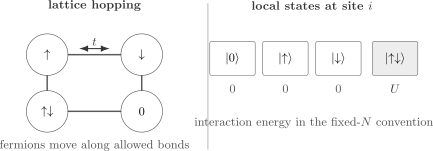
The Hubbard model combines intersite hopping with a local four-state Hilbert space. In the fixed- convention, the onsite interaction changes only the energy of ; a chemical potential shifts states according to their particle number.
The site label is a mode label, not a distinguishable-particle label. Fermionic signs therefore depend on a declared global ordering of the modes even when the Hamiltonian is local.
Hilbert Space and Symmetry Sectors
Section titled “Hilbert Space and Symmetry Sectors”After fixing a mode ordering, the Fock space is isomorphic as a vector space to a product of local four-dimensional spaces:
This ordinary tensor-product notation is useful for counting. The locality of fermionic operators still carries the parity and ordering structure explained on the occupation-number pages.
For spin-conserving hopping, the particle numbers
are separately conserved. The corresponding sector has dimension
At fixed total particle number but unrestricted spin projection,
These formulas explain why small clusters already become difficult. At half filling with , the sector dimension grows approximately exponentially with even after both particle numbers are fixed.
General Single-Band Hamiltonian
Section titled “General Single-Band Hamiltonian”On an arbitrary lattice, a useful number-conserving form is
with
The matrix specifies hopping amplitudes, Peierls phases, and possibly longer-range motion. The scalar may represent a trap, disorder, or a site-dependent orbital energy. A chemical potential belongs to the grand Hamiltonian
rather than to the isolated fixed- Hamiltonian unless a convention explicitly folds it into .
For real uniform nearest-neighbor hopping, one commonly writes
where denotes each unordered bond once. If oriented bonds are summed instead, the Hermitian-conjugate term and numerical normalization must be adjusted.
Parameters and Conventions
Section titled “Parameters and Conventions”| Quantity | Meaning | Important qualification |
|---|---|---|
| nearest-neighbor hopping energy | its sign may or may not be gauge-removable | |
| onsite interaction energy | repulsive; attractive | |
| chemical potential | convention-dependent zero at half filling | |
| number of lattice sites | distinct from the number of fermionic modes | |
| total particle number | ranges from to | |
| filling per site | half filling is , not | |
| noninteracting bandwidth | depends on lattice and hopping network | |
| temperature | compare with , , and emergent scales |
The ratio is common for a fixed lattice convention, while is often more portable across lattices. Neither ratio alone specifies the model: dimension, geometry, filling, boundary conditions, flux, and hopping range also matter.
For hole doping away from half filling, a common convention is
Then denotes hole doping and electron doping. Other communities use different signs, so the definition should always accompany the symbol.
The Sign of the Hopping
Section titled “The Sign of the Hopping”On a bipartite lattice with only real hopping between opposite sublattices, the transformation
changes . The sign is therefore gauge-equivalent in that restricted setting.
On a non-bipartite lattice, with longer-range hopping, or in a nontrivial flux sector, products of hopping phases around closed loops are invariant. The sign and phase pattern can then affect the spectrum and cannot be dismissed as a convention.
Noninteracting Limit
Section titled “Noninteracting Limit”When , the model reduces to the spinful Tight-Binding Model. For a translationally invariant -dimensional hypercubic lattice with spacing and nearest-neighbor hopping,
and
with dispersion
The band runs from to , so
where is the coordination number. This identity is specific to the nearest-neighbor hypercubic lattice.
At zero temperature, each spin species fills the lowest one-particle energies up to the Fermi level. Turning on couples momenta and destroys the reduction to independent occupation numbers, even though translation symmetry may remain exact.
Atomic Limit
Section titled “Atomic Limit”When , sites decouple. For one site in the grand-canonical convention,
the local energies are
and the one-site partition function is
The mean occupation and double occupancy are
For repulsive at the particle-hole-symmetric value , one finds at every temperature. As , empty and doubly occupied states are suppressed relative to the two singly occupied states. Charge is frozen locally while a spin- degree of freedom remains.
The atomic limit is not by itself a proof of a thermodynamic Mott phase. It is an exact reference point that reveals the local charge scale and the emergent spin degeneracy.
Particle-Hole-Symmetric Convention
Section titled “Particle-Hole-Symmetric Convention”On a bipartite lattice, the grand Hamiltonian at half filling is often written
Expanding the interaction gives
Thus is the standard grand Hamiltonian at
plus the additive constant . In the centered convention, half filling is described by zero shifted chemical potential. Statements such as “ at half filling” and “ at half filling” can therefore both be correct under different conventions. Chemical Potential explains the underlying energy-zero and particle-number conventions.
Let on sublattice and on sublattice . The particle-hole transformation
sends to its negative and leaves the nearest-neighbor centered Hamiltonian invariant. This symmetry pins the half-filled density in the grand-canonical ensemble under the stated assumptions.
Continuous and Lattice Symmetries
Section titled “Continuous and Lattice Symmetries”For spin-independent hopping and no spin-dependent fields, total particle number is conserved:
The Hamiltonian is also invariant under global spin rotations. Define dimensionless local spin operators by
Then
The separate conservation of and is compatible with this spin symmetry: is one generator, while the raising and lowering generators connect sectors with different and at fixed .
Additional symmetries depend on the lattice and parameters:
- translations for uniform periodic lattices;
- point-group operations preserved by the hopping graph;
- time reversal for real spin-independent hopping without magnetic flux;
- particle-hole symmetry for the centered model on an appropriate bipartite lattice;
- an additional pseudospin structure in special bipartite forms of the model.
Symmetry labels reduce finite-cluster calculations and constrain correlation functions. They do not, by themselves, solve the interacting spectrum.
Exact Hubbard Dimer Spectrum
Section titled “Exact Hubbard Dimer Spectrum”The two-site, two-fermion problem is the smallest cluster that contains hopping, double occupancy, spin symmetry, and interaction-generated exchange. Let
Choose the mode order . In the spin-singlet sector, define
With this phase convention,
Changing the phase of changes both off-diagonal signs but no observable. The three triplet states have energy zero because Pauli exclusion prevents an onsite same-orbital triplet.
The two coupled singlet energies are
while the decoupled odd doublon has energy . For , the ground state is the lower singlet with energy .
The Hellmann-Feynman theorem gives its total double occupancy:
At , . At large positive ,
The exact singlet-triplet gap is
Its large- limit is . The controlled effective-Hamiltonian derivation explains why this scale is an antiferromagnetic exchange rather than an ordinary first-order hopping energy.
Strong-Coupling Spin Physics
Section titled “Strong-Coupling Spin Physics”For repulsive at half filling and
the low-energy states have approximately one fermion per site. A single hop creates a virtual doublon-hole pair with energy cost of order ; a second hop can remove it. To second order, the resulting low-energy Hamiltonian is
within the no-double-occupancy subspace. At exactly one fermion per site, and the density term is an additive constant, leaving the antiferromagnetic Heisenberg model.
The hierarchy
separates spin dynamics from charge excitations. A system can have well-formed local moments while its spins remain thermally disordered when
Away from half filling, real hopping survives inside the projected low-energy space, leading to the t–J model rather than a pure spin Hamiltonian. Longer-range hopping, multi-orbital structure, and higher orders in generate additional terms. The coefficient is therefore a controlled result for a specific limit, not a universal formula for every antiferromagnet.
Mott Physics Preview
Section titled “Mott Physics Preview”A band can be partially filled and therefore metallic in the noninteracting description, yet become charge insulating when repulsion suppresses charge fluctuations. This interaction-driven mechanism is the central Mott-physics lesson of the Hubbard model.
For a finite cluster, a useful charge-gap diagnostic is
The thermodynamic interpretation requires a controlled limit. A positive limiting charge gap and vanishing zero-temperature charge compressibility support an incompressible state. On a finite lattice, avoided crossings and nonzero level spacings are not by themselves phase transitions.
Several distinctions matter:
- suppressed double occupancy is evidence of local correlation, not a complete definition of a Mott insulator;
- a charge gap does not require a spin gap;
- antiferromagnetic order can coexist with interaction-driven charge localization;
- at half filling in one dimension, the repulsive nearest-neighbor model has a charge gap for every , while spin excitations remain gapless;
- higher-dimensional behavior depends on lattice, frustration, temperature, and the distinction between symmetry breaking and paramagnetic localization;
- the doped two-dimensional model contains important open questions, so no single universal phase diagram should be presented as settled.
This page introduces those diagnostics without replacing the dedicated treatment of Mott phases and correlated materials.
Local Moments and Magnetism
Section titled “Local Moments and Magnetism”Define the local double occupancy
Because ,
Repulsive interaction at fixed filling tends to reduce and increase this local-moment diagnostic. Long-range magnetic order is a separate question requiring intersite correlations and a thermodynamic limit.
The spin structure factor is commonly defined by
On a bipartite square lattice, enhanced weight near signals antiferromagnetic correlations. Demonstrating spontaneous order requires finite-size scaling rather than inspection of one small cluster.
Structure Factors owns the connected-versus-full convention, peak scaling, dynamic spectra, and scattering normalization shared by Hubbard spin, charge, and pair channels.
Attractive Interaction
Section titled “Attractive Interaction”For , onsite double occupation lowers the energy. The local low-energy tendency is toward empty or doubly occupied sites rather than isolated spins. This favors onsite spin-singlet pairing and charge correlations.
The onsite pair operator is
with equal-time pair correlation
On a bipartite lattice, a particle-hole transformation applied to one spin species maps the repulsive and attractive models into one another while exchanging aspects of spin and charge order. This exact correspondence is useful, but boundary conditions, chemical-potential terms, spin imbalance, and extra hopping can modify or break it.
Core Observables
Section titled “Core Observables”No single observable characterizes all Hubbard regimes. A reliable analysis usually combines several of the following.
Filling and compressibility
Section titled “Filling and compressibility”The normalization of compressibility varies across subfields; some definitions include factors of or volume.
Susceptibilities separates , isothermal compressibility, local response, and the static-versus-uniform limit conventions.
Double occupancy
Section titled “Double occupancy”in thermal equilibrium at fixed values of the other Hamiltonian parameters. The free-energy derivative makes double occupancy a direct measure of interaction response.
Kinetic energy
Section titled “Kinetic energy”This measures delocalization but is convention-dependent through the hopping network and energy zero.
Momentum distribution
Section titled “Momentum distribution”For an interacting system this is not generally restricted to zero or one even at zero temperature, although the total occupation per fermionic mode remains bounded by one.
Charge and spin correlations
Section titled “Charge and spin correlations”With ,
Their Fourier transforms diagnose characteristic wavevectors and correlation lengths.
One-particle spectrum
Section titled “One-particle spectrum”The retarded Green function and spectral function reveal addition and removal energies, coherent quasiparticle features, incoherent continua, and interaction-induced gaps. Their definitions belong on the correlation and response pages; here the key point is that the interacting spectrum is not determined by the noninteracting dispersion alone.
From Continuum or Orbitals to the Model
Section titled “From Continuum or Orbitals to the Model”The Hubbard Hamiltonian can arise by projecting a continuum or multiorbital problem onto localized orbitals . A schematic hopping matrix element is
For a short-range continuum interaction , the onsite coupling is approximately
For electronic orbitals with an effective interaction ,
Projecting to one band is controlled only when neglected bands and interaction matrix elements are sufficiently separated from the scales of interest. Real materials may require several orbitals, longer-range Coulomb terms, spin-orbit coupling, lattice vibrations, disorder, or frequency-dependent effective interactions.
In Optical Lattices, the periodic potential and short-range atomic collisions can provide a comparatively direct realization of the same structure. The mapping is still an effective one: trap inhomogeneity, finite temperature, higher bands, and calibration of and remain part of the experimental problem.
Exact Solution Status
Section titled “Exact Solution Status”The Hubbard model is not generally exactly solvable. Its status depends sharply on geometry and parameters.
| Regime | What is controlled |
|---|---|
| free-fermion band problem | |
| independent atomic sites | |
| two sites | complete finite-dimensional diagonalization |
| one-dimensional nearest-neighbor chain | Bethe-ansatz solution for the standard uniform model |
| near half filling | controlled strong-coupling expansion for low energies |
| general two-dimensional doped model | no complete exact solution; multiple numerical and analytical methods are required |
| infinite coordination with standard scaling | dynamical mean-field theory becomes exact |
An exact solution in one dimension does not determine the two-dimensional phase diagram. Likewise, a strong-coupling expansion controls a scale-separated regime, not arbitrary intermediate .
Numerical Representation
Section titled “Numerical Representation”For exact diagonalization, choose a fixed ordering such as
or an interleaved site ordering, and use it everywhere. A basis state can be represented by two -bit strings, one for each spin. The interaction is diagonal:
Each hopping term flips one occupied and one empty bit in the same spin string. Its matrix element includes the fermionic parity accumulated between the two modes in the declared ordering. The resulting Hamiltonian is sparse.
Useful method families include exact diagonalization for small clusters, tensor networks in one dimension and selected quasi-one-dimensional geometries, determinant and auxiliary-field Monte Carlo where sign structure permits, dynamical mean-field methods, diagrammatic expansions, and controlled weak- or strong-coupling approximations. Variational Many-Body States uses the Hubbard dimer to show how a Gutzwiller factor variationally suppresses, but need not eliminate, finite- doublons.
The repulsive model with real hopping on a bipartite lattice at particle-hole-symmetric half filling is a standard sign-problem-free setting for determinant quantum Monte Carlo. Generic doping, frustration, or additional hopping can reintroduce a severe sign problem. The Sign Problem Preview explains the determinant pairing and why this is an algorithm-specific structural statement, not a claim that every half-filled Hubbard calculation is easy.
Finite-Size and Boundary Checks
Section titled “Finite-Size and Boundary Checks”Before comparing two calculations, state:
- lattice geometry and dimension;
- number of sites and cluster shape;
- open, periodic, antiperiodic, or twisted boundary conditions;
- hopping amplitudes and flux conventions;
- fixed particle numbers or chemical potential;
- temperature and ensemble;
- symmetry sector;
- observable normalization.
Shell effects can make small noninteracting clusters unusually degenerate or gapped. Twisted-boundary averaging can reduce some one-particle shell effects, but it does not replace a thermodynamic extrapolation.
Relation to Materials and Cold Atoms
Section titled “Relation to Materials and Cold Atoms”The same Hamiltonian supports two different kinds of use.
As a model of electrons in solids, it isolates how narrow-band motion competes with local Coulomb repulsion. It can organize reasoning about local moments, Mott physics, antiferromagnetism, and correlated spectral weight. A quantitative material description may require parameters derived from electronic structure and extensions beyond the single-band model.
As a model for ultracold fermions in optical lattices, it can be engineered from a periodic potential and tunable short-range interactions. This offers access to site occupations, spin correlations, doublons, transport, and nonequilibrium protocols under conditions different from a crystalline solid.
Neither realization makes the Hubbard model universally complete. Its authority comes from being a sharply specified minimal model whose assumptions can be tested, extended, or rejected.
Common Mistakes
Section titled “Common Mistakes”- Calling “full filling.” For two spin modes per site, is half filling and is full filling.
- Omitting the lattice, hopping graph, filling, and boundary conditions when quoting .
- Treating the sign of as removable on every lattice or in every flux sector.
- Forgetting that and shifted are the same half-filled point in different conventions.
- Interpreting reduced double occupancy as sufficient proof of a Mott-insulating phase.
- Equating local-moment formation with long-range antiferromagnetic order.
- Applying outside the repulsive, single-band, strong-coupling assumptions that produce it.
- Dropping fermionic signs when constructing hopping matrix elements.
- Inferring a thermodynamic phase transition from one finite cluster.
- Treating a one-band Hubbard model as automatically quantitative for a specific material.
- Assuming the general doped two-dimensional phase diagram is settled.
Exercises
Section titled “Exercises”1. Sector counting
Section titled “1. Sector counting”For sites, compute the full Fock-space dimension, the dimension at total particle number , and the dimension in the balanced sector .
Solution
There are fermionic modes, so
At fixed total particle number,
In the balanced sector,
Fixing and removes the sectors that are still present in the fixed- space.
2. Atomic half filling
Section titled “2. Atomic half filling”Use the one-site partition function to show that at . Find the double occupancy and its low-temperature limit for .
Solution
At ,
so
The occupation numerator is
which equals . Therefore
The double occupancy is
For and , this tends to zero. Empty and doubly occupied states retain equal probability by particle-hole symmetry, while singly occupied states dominate.
3. Particle-hole transformation
Section titled “3. Particle-hole transformation”On a bipartite nearest-neighbor lattice, show that sends to its negative and leaves invariant.
Solution
The number operator transforms as
Hence
and the product of the two centered spin densities is invariant.
For a nearest-neighbor bond, . Anticommuting the transformed operators back into normal order supplies the second minus sign required to preserve the hopping term. Constants do not appear in the centered interaction, so the full is invariant.
4. Hubbard dimer diagnostics
Section titled “4. Hubbard dimer diagnostics”Starting from
derive the total double occupancy and the leading large- singlet-triplet gap.
Solution
By the Hellmann-Feynman theorem,
For and ,
Therefore
The triplets have zero energy, so
The charge admixture is of order , while the induced spin-energy scale is of order .
5. Hypercubic bandwidth
Section titled “5. Hypercubic bandwidth”For
find the band edges and bandwidth. Why is not a universal identity for arbitrary lattices?
Solution
Each cosine lies between and . Therefore
and
Since a hypercubic lattice has ,
Other lattices have different adjacency spectra, may be non-bipartite, and can include several sites per unit cell or longer-range hopping. Coordination number alone does not determine the exact band edges.
6. Local moment versus magnetic order
Section titled “6. Local moment versus magnetic order”Show that
Explain why a large expectation value of this operator does not establish antiferromagnetic long-range order.
Solution
Using ,
This is a one-site diagnostic. It measures whether a site tends to carry an uncompensated spin, but it contains no information about alignment between distant sites. Antiferromagnetic order requires long-distance spin correlations or scaling of with system size.
Cross-Links
Section titled “Cross-Links”- Many-Body and Quantum Statistical Mechanics
- Hubbard Dimer dossier
- Hubbard Chain dossier
- Core Objects and Notation
- Occupation-Number Representation
- Field Operators in Many-Body Models
- Grand-Canonical Ensemble
- Fermionic Anticommutation Relations
- Many-Particle Hamiltonians
- Tight-Binding Dimer
- Benchmark Problems — analytic Hubbard-dimer and independently reproducible four-site-chain contracts.
- Effective Hamiltonians in Many-Body Systems
- Effective Hamiltonians in Quantum Matter
- Exchange Interactions in Quantum Matter — interprets the Hubbard strong-coupling result among direct, ligand-mediated, mobile-carrier, and itinerant mechanisms in materials.
- Stoner Criterion — derives the uniform weak-coupling Hartree–Fock instability and explains why it is not the strong-coupling magnetic limit.
- Heisenberg Model
- t–J Model Preview
- Correlation Functions Overview
- Structure Factors
- Susceptibilities
- Degenerate Fermi Gases Overview
- Hubbard Model Hamiltonian Card
- Hubbard Model Reference Card
- Hubbard Model Glossary Entry
References
Section titled “References”- J. Hubbard, “Electron correlations in narrow energy bands,” Proceedings of the Royal Society A 276, 238–257 (1963).
- M. C. Gutzwiller, “Effect of correlation on the ferromagnetism of transition metals,” Physical Review Letters 10, 159–162 (1963).
- J. Kanamori, “Electron correlation and ferromagnetism of transition metals,” Progress of Theoretical Physics 30, 275–289 (1963).
- E. H. Lieb and F. Y. Wu, “Absence of Mott transition in an exact solution of the short-range, one-band model in one dimension,” Physical Review Letters 20, 1445–1448 (1968).
- A. H. MacDonald, S. M. Girvin, and D. Yoshioka, “ expansion for the Hubbard model,” Physical Review B 37, 9753–9756 (1988).
- D. P. Arovas, E. Berg, S. A. Kivelson, and S. Raghu, “The Hubbard model,” Annual Review of Condensed Matter Physics 13, 239–274 (2022).
- T. Esslinger, “Fermi-Hubbard physics with atoms in an optical lattice,” Annual Review of Condensed Matter Physics 1, 129–152 (2010).
- F. H. L. Essler, H. Frahm, F. Göhmann, A. Klümper, and V. E. Korepin, The One-Dimensional Hubbard Model, Cambridge University Press (2005).
- A. Auerbach, Interacting Electrons and Quantum Magnetism, Springer (1994).
- J. P. F. LeBlanc et al., “Solutions of the two-dimensional Hubbard model: benchmarks and results from a wide range of numerical algorithms,” Physical Review X 5, 041041 (2015).