Degenerate Fermi Gases Overview
A degenerate atomic Fermi gas is a trapped ensemble in which Fermi statistics, rather than thermal equipartition, controls occupation, pressure, fluctuations, and collision phase space. Its basic reduced temperature is , but that symbol is meaningful only after the density, spin-component, or trap convention used to define has been stated.
Unlike a Bose–Einstein condensate, an unpaired Fermi gas does not put a macroscopic number of atoms into one one-particle orbital. Pauli exclusion fills a Fermi sea with at most one fermion per one-particle mode per internal component. The experimental opportunity comes from combining that statistical rigidity with unusually clean controls:
The final line contains three different inferences. A gas can be degenerate without being paired, paired without having established long-range pair coherence, and spectroscopically gapped without a direct superfluid-response measurement. Reliable analysis keeps those claims separate.
Canonical Scope
Section titled “Canonical Scope”This page owns the AMO-facing account of:
- homogeneous, local, and trap Fermi scales with explicit spin conventions;
- Pauli pressure and blocked collision phase space as experimental effects;
- why spin mixtures are needed for low-temperature -wave thermalization;
- magnetic Feshbach control through the dimensionless coordinate ;
- the molecular-BEC, unitary, and BCS regimes as one crossover;
- experimental distinctions among pairing, pair condensation, and superfluidity;
- continuum and lattice quantum-simulation uses.
Degenerate Fermi Gas owns the ideal low-temperature thermodynamics, active Fermi shell, and Sommerfeld coefficients. Quantum Gases in Traps owns harmonic-trap state counting, local-density formulas, and projected profiles. BCS Mean-Field Theory owns the pairing Hamiltonian, gap and number equations, coherence factors, and number-symmetry caveats. This page uses those results to organize a laboratory platform.
Fermi Scales
Section titled “Fermi Scales”Component-resolved convention
Section titled “Component-resolved convention”Consider a nonrelativistic gas with internal components labeled by . For one homogeneous component of density ,
and
For a balanced two-component gas,
where is the total density. The common Fermi wavevector is then
The factor of two is not cosmetic. Inserting total density into the single-component formula overestimates by and by .
For an imbalanced gas, report both component scales or explicitly define a reference scale from the total density. No single convention removes the physical mismatch between and .
Reduced temperature
Section titled “Reduced temperature”The occupation of a one-particle state with energy is
At , states far below remain nearly full, states far above it remain nearly empty, and only an energy shell of width near the Fermi surface is thermally active. The fraction of particles in that shell scales as
Thus measures more than “coldness.” It controls the available particle–hole phase space, heat capacity, fluctuations, and many collision rates.
Worked homogeneous scale
Section titled “Worked homogeneous scale”Take a balanced two-state gas of lithium-6 with total density
Using gives
At , the reduced temperature is about . The gas is degenerate even though its atoms retain momenta up to ; degeneracy does not mean that every atom is nearly at rest.
Harmonic-trap convention
Section titled “Harmonic-trap convention”For ideal fermions of one component in a three-dimensional harmonic trap,
where
For a balanced mixture with total atom number ,
For and ,
The trap Fermi energy is a global state-counting scale. A local-density analysis instead uses
and defines a position-dependent from the local density or equation of state. Mixing a central with a trap-averaged temperature without saying so makes dimensionless interaction and temperature coordinates ambiguous.
Pauli Pressure
Section titled “Pauli Pressure”Pressure without repulsion
Section titled “Pressure without repulsion”At zero temperature, an ideal balanced three-dimensional gas has
and
Because ,
This degeneracy pressure exists even when the interparticle potential vanishes. Compressing the cloud forces atoms into higher momentum states because lower states are already occupied. It is therefore a kinetic and statistical pressure, not a hidden pairwise repulsion.
The zero-temperature isothermal compressibility of the ideal balanced gas is
Low compressibility, a broad momentum distribution, and finite cloud size at very low temperature are all consequences of the filled Fermi sea.
A trapped zero-temperature profile
Section titled “A trapped zero-temperature profile”In the local-density approximation, a balanced ideal gas in an external potential has
For a harmonic trap, the cloud edge satisfies
along principal axis . The profile is flatter than a classical Gaussian and remains finite in size as . Interactions deform this profile, so extracting a temperature from cloud shape requires the appropriate equation of state.
Density fluctuations
Section titled “Density fluctuations”For an ideal mode with mean occupation ,
Modes deep inside the Fermi sea have and suppressed occupation fluctuations. Spatially resolved number fluctuations likewise fall below the classical Poisson expectation after imaging resolution, finite cell size, and interactions are accounted for. This is a direct statistical signature of degeneracy, but it is not itself evidence of pairing.
Spin Mixtures and Collisions
Section titled “Spin Mixtures and Collisions”Why one component stalls
Section titled “Why one component stalls”Two identical fermions in the same internal state have an antisymmetric total wavefunction. At ultralow collision energy, their symmetric -wave spatial channel is forbidden. The leading allowed odd partial wave is usually wave, whose threshold rate is strongly suppressed away from a -wave resonance.
A single spin-polarized Fermi gas can therefore become collisionally isolated during evaporation: energetic atoms leave, but the remaining cloud cannot rethermalize rapidly enough. This is why experiments commonly use:
- two hyperfine components that can collide in an wave;
- sympathetic cooling with another internal state or species;
- controlled spin-changing preparation before the final evaporation stage.
The statement “fermions do not scatter” is false. Identical fermions lack the low-energy -wave channel in the same internal state; distinguishable components can have large -wave scattering.
Minimal two-component Hamiltonian
Section titled “Minimal two-component Hamiltonian”For two equal-mass components with short-range interactions, a continuum model is
The contact term couples unlike components. Same-component contact terms vanish for fermionic fields at one point. In three dimensions the bare coupling requires ultraviolet matching to the physical scattering length; writing without its regime and regulator is only a low-energy shorthand.
Pauli blocking of final states
Section titled “Pauli blocking of final states”A two-body collision integral contains occupation factors schematically of the form
The initial states must be occupied and the final states must be empty. Deep in a degenerate gas, many energetically allowed final states are already filled. Near equilibrium, only a thin shell around the Fermi surface participates, and ordinary Fermi-liquid relaxation rates commonly acquire a low-temperature factor proportional to .
This is distinct from the absence of same-spin -wave scattering:
- exchange antisymmetry removes a partial wave for identical particles;
- Pauli blocking suppresses final-state phase space for an occupied many-body distribution.
Both can slow evaporation and equilibration.
Population balance
Section titled “Population balance”Define total polarization
For pairing between opposite momenta and spins, imbalance produces mismatched Fermi surfaces. The system may respond through an unpaired majority component, spatial phase separation in a trap, polarized quasiparticles, or more exotic finite-momentum pairing under restricted conditions. A two-component sample is not automatically balanced, and equal preparation pulses do not guarantee equal final atom numbers after state-dependent loss.
Feshbach Tuning
Section titled “Feshbach Tuning”Magnetic-field control
Section titled “Magnetic-field control”Near an isolated magnetic Feshbach resonance, the zero-energy scattering length is commonly parameterized as
Here is the pole, is the signed width in the stated convention, and the zero crossing occurs at . The pole is not the same field as the zero crossing or a maximum in loss.
At finite relative wavevector , the effective-range amplitude is
In the zero-range limit, the distinguishable-particle elastic cross section is
As , the cross section approaches rather than diverging. Collision energy, effective range, inelastic channels, and density remain essential near resonance.
The many-body interaction coordinate
Section titled “The many-body interaction coordinate”For a homogeneous balanced gas, define
The broad-resonance crossover is organized as:
This coordinate is meaningful only with the quoted convention. A complete regime label also includes
and relevant loss or ramp times. The single number does not identify a state by itself.
Broad and narrow resonances
Section titled “Broad and narrow resonances”For a broad, open-channel-dominated resonance with , low-energy equilibrium properties can approach a universal zero-range description. A narrow resonance introduces an additional range or closed-channel scale. Then two gases at the same need not share the same many-body properties.
Field stability also matters. Near a pole,
so magnetic noise can become large interaction noise. A reported field setpoint should be accompanied by resonance calibration, field width, and ramp trajectory.
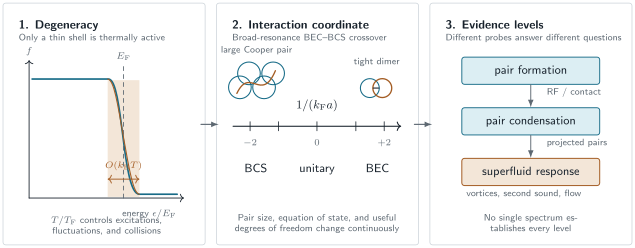
Degeneracy, interaction regime, and claim strength are independent axes. controls the active shell, locates the broad-resonance crossover, and complementary probes are needed to move from pair formation to pair coherence and superfluid response.
BEC–BCS Crossover Overview
Section titled “BEC–BCS Crossover Overview”Continuously connected paired states
Section titled “Continuously connected paired states”For a balanced two-component gas with attractive -wave interactions, the zero-temperature molecular-BEC and BCS superfluids are continuously connected. The crossover changes pair size, chemical potential, excitation spectrum, and equation of state without requiring a separate symmetry-breaking transition between its endpoints.
| Regime | Two-body and pair structure | Many-body description |
|---|---|---|
| BEC side, | weakly bound dimers exist; pair size can be smaller than interparticle spacing | interacting bosonic molecules of mass |
| unitarity, | no scattering-length scale; pair size and spacing are comparable | strongly correlated universal Fermi gas |
| BCS side, | no shallow two-body dimer; overlapping Cooper pairs are many-body objects | paired state organized around a Fermi surface |
“BEC side” does not mean that unpaired fermions have become elementary bosons. It means that opposite-spin fermions bind into composite dimers whose low-energy center-of-mass motion can Bose condense.
Molecular side
Section titled “Molecular side”For a large positive scattering length and negligible effective range, the shallow dimer binding energy is
for two equal-mass atoms. This universal formula requires to be much larger than the interaction range. The dimer density of a fully paired balanced gas is , and its mass is .
The molecules interact with one another and can be lost in inelastic collisions. Treating them as an ideal Bose gas ignores dimer–dimer scattering, residual unpaired atoms, finite binding energy, and conversion dynamics.
Weak BCS side
Section titled “Weak BCS side”For , the mean-field zero-temperature gap has the asymptotic form
Because , the exponent is negative and the pairs are exponentially fragile in weak coupling. Their size is much larger than the interparticle spacing. Medium-induced corrections change the prefactor, and this asymptotic expression should not be extrapolated through unitarity.
The full gap equation, number equation, and quasiparticle transformation belong to BCS Mean-Field Theory.
Unitary gas
Section titled “Unitary gas”At unitarity,
the scattering length drops out of the zero-range equilibrium problem. For a homogeneous balanced gas at zero temperature, dimensional analysis gives
and
where the Bertsch parameter is measured and calculated to be approximately
The number is not determined by dimensional analysis; it is a universal many-body constant. Scale invariance also implies
for the idealized homogeneous zero-range gas. Effective range, trap anharmonicity, imbalance, and finite temperature break or qualify this simple universal form.
A resonance is not a phase transition
Section titled “A resonance is not a phase transition”Sweeping through changes the sign of continuously. In a balanced low-temperature paired gas, it connects molecular and Cooper pairing. The resonance field itself is not the superfluid transition.
At fixed interaction, raising temperature can produce:
- a low-temperature superfluid;
- a normal state with strong pair correlations or a pairing pseudogap over some regime;
- a higher-temperature nondegenerate gas.
The locations and even the usefulness of these crossovers depend on the observable and model. A spectroscopic pairing scale need not equal the superfluid critical temperature.
Pairing, Condensation, and Superfluidity
Section titled “Pairing, Condensation, and Superfluidity”Pair formation
Section titled “Pair formation”Pairing means that opposite-spin atoms develop strong two-body or many-body correlations. Possible signatures include:
- a shifted or broadened radio-frequency spectrum;
- a pair-breaking threshold;
- an enhanced contact or high-momentum tail;
- correlated opposite-momentum atoms;
- molecule production after a projection ramp.
Each probe has a forward model. Radio-frequency spectra can contain Hartree shifts, final-state interactions, trap averaging, and pulse broadening. Molecule conversion depends on ramp speed and overlap. Pairing evidence alone does not prove phase coherence or superfluid flow.
Pair condensation
Section titled “Pair condensation”Fermionic pair condensation is associated with a macroscopic eigenvalue of an appropriate two-body density matrix, not of the fermionic one-body density matrix. Experimentally, rapid magnetic-field sweeps can project fragile pairs onto tightly bound molecules whose center-of-mass momentum distribution is easier to image. A low-momentum molecular component then supports pair condensation under the conversion model.
The ramp must be:
- fast compared with many-body motion that would rearrange pair center-of-mass momentum;
- slow enough to convert pairs efficiently through the two-body avoided crossing;
- characterized for unpaired-atom conversion and loss.
These requirements can compete. A “rapid projection” is not an instantaneous, model-free measurement.
The number-conserving order criterion and distinction from anomalous averages live in Off-Diagonal Long-Range Order.
Superfluid response
Section titled “Superfluid response”Superfluidity concerns response, not merely pair population. Strong evidence includes:
- quantized vortex lattices under rotation;
- second sound and two-fluid hydrodynamics;
- a critical velocity with controlled obstacle and heating analysis;
- persistent flow or phase stiffness;
- equation-of-state and collective-mode behavior across a thermodynamic transition.
Vortex lattices are particularly direct because circulation quantization and macroscopic rotational response are difficult to reproduce with a normal paired gas. Even then, nucleation thresholds, lifetime, imaging selection, and the rotation protocol should be reported.
Observables and Inference
Section titled “Observables and Inference”Evidence ledger
Section titled “Evidence ledger”| Observable | Primary inference | Important caveat |
|---|---|---|
| in situ density | equation of state, pressure, compressibility | trap and imaging calibration |
| momentum distribution | Fermi surface or low-momentum pairs | interactions during expansion |
| density fluctuations | Pauli suppression and correlations | optical resolution and binning |
| radio-frequency spectrum | pairing and excitation energies | final-state interactions and pulse response |
| pair projection | pair center-of-mass distribution | sweep dynamics and conversion efficiency |
| collective mode | hydrodynamics and equation of state | collision regime and anharmonicity |
| first or second sound | compressibility and two-fluid response | inhomogeneity and damping |
| vortex lattice | quantized superfluid circulation | nucleation and survival bias |
| site-resolved lattice image | occupations and correlations | parity projection and detection fidelity |
The strongest analyses predict several observables from one parameter set. For example, a measured equation of state fixes pressure and compressibility; those predict sound speed and hydrodynamic profiles. Treating each data set with an independent effective temperature, interaction, and density hides inconsistency.
Equation of state from a trap
Section titled “Equation of state from a trap”Under local-density conditions,
A single trapped profile samples many local chemical potentials. With a calibrated potential and imaging response, hydrostatic balance can convert the density profile into pressure and compressibility. At unitarity these data can be organized into universal functions of reduced temperature and polarization.
LDA fails near small systems, sharp interfaces, rapidly varying lattice potentials, and length scales comparable with correlation or pair sizes.
Expansion
Section titled “Expansion”For a weakly interacting gas released suddenly, long time of flight can approximately map momentum to position:
Near unitarity, collisions and interaction pressure continue during expansion. Aspect-ratio inversion can indicate hydrodynamic behavior, but it is not unique to superfluidity: a strongly collisional normal gas can also expand hydrodynamically. Turning interactions off rapidly can improve momentum mapping, but that ramp itself must be modeled.
Thermometry
Section titled “Thermometry”Deep degeneracy makes thermometry difficult because most atoms are insensitive to temperature. Common methods include:
- fits to weakly interacting momentum or density wings;
- equation-of-state thermometry against a calibrated universal curve;
- fluctuation thermometry through fluctuation–dissipation relations;
- impurities or minority components used as embedded thermometers;
- adiabatic ramps to a regime with a better calibrated thermometer;
- lattice spin or density correlations compared with controlled theory.
State the measured quantity and calibration range. A Gaussian width is not a universal thermometer for a degenerate or strongly interacting Fermi gas.
Preparation Workflow
Section titled “Preparation Workflow”Cooling chain
Section titled “Cooling chain”A typical sequence is:
- laser cool a fermionic isotope, often with a bosonic isotope or another component available for sympathetic cooling;
- prepare two long-lived hyperfine components and measure their populations;
- transfer into a magnetic or optical conservative trap;
- set an interaction that supplies rapid elastic rethermalization without unacceptable loss;
- evaporatively or sympathetically cool while monitoring and collision rate;
- move to the target with a characterized field ramp;
- hold for redistribution or pair formation;
- probe density, spectroscopy, correlations, or response.
Evaporative Cooling owns the selectivity, efficiency, runaway, and loss equations. In a Fermi gas, Pauli blocking can reduce late-stage rethermalization precisely when the reduced temperature becomes smallest.
Timescale ledger
Section titled “Timescale ledger”Compare:
A ramp can be adiabatic relative to two-body binding while nonadiabatic relative to trap motion, or vice versa. State which degree of freedom is intended to follow the ramp.
Minimal report
Section titled “Minimal report”Report at least:
- isotope, hyperfine components, atom numbers, and polarization;
- trap frequencies, geometry, dimensionality, and anharmonicity;
- whether is central, local, homogeneous, or trap defined;
- and the thermometer;
- magnetic field, , signed width convention, , and uncertainty;
- , , and range model;
- elastic, inelastic, equilibration, ramp, and imaging times;
- density and imaging calibration;
- the exact observable supporting degeneracy, pairing, condensation, or superfluidity.
Quantum Simulation Uses
Section titled “Quantum Simulation Uses”Continuum universal matter
Section titled “Continuum universal matter”The unitary gas is a clean realization of strongly interacting fermions without a material lattice. It supports quantitative studies of:
- universal thermodynamics and transport;
- pairing above and below the superfluid transition;
- spin imbalance and polarons;
- shear and spin transport;
- scale invariance and its anomalies;
- expansion and two-fluid hydrodynamics.
Universality is a hypothesis with corrections, not a label bestowed by setting . Verify small effective range, adequate system size, three-dimensional kinematics, and controlled loss.
Optical lattices
Section titled “Optical lattices”Projecting two-component fermions into a sufficiently isolated lowest band can produce the Fermi–Hubbard model
The lattice depth controls tunneling and Wannier functions; the scattering length contributes to on-site interaction ; confinement produces . At large repulsive near half filling, the low-energy spin-exchange scale is
Reaching is much harder than reaching in the original continuum gas. Lattice loading can redistribute entropy, and off-resonant photon scattering or technical noise can heat the sample.
Hubbard Model owns the canonical Hamiltonian, limits, and many-body phases. Optical Lattices owns band, loading, calibration, and hardware implementation.
Quantum gas microscopy
Section titled “Quantum gas microscopy”Fermionic microscopes can resolve site occupations and correlations, allowing direct measurements of:
- density and spin correlation functions;
- antiferromagnetic domains;
- doublons and holes;
- transport of particles and correlations;
- full counting statistics over finite regions.
Detection can be parity projected, state selective, or lossy depending on the protocol. The reconstructed observable must match the actual detection channel.
Common Mistakes
Section titled “Common Mistakes”Using total density in a one-component formula
Section titled “Using total density in a one-component formula”For a balanced two-state mixture, when is total density. Always state the component convention.
Calling Pauli pressure an interaction
Section titled “Calling Pauli pressure an interaction”Degeneracy pressure exists in the ideal gas. Interactions modify the equation of state but do not create the exclusion principle.
Saying identical fermions cannot collide
Section titled “Saying identical fermions cannot collide”The low-energy same-state wave is forbidden. Higher partial waves and collisions between distinguishable components remain possible.
Assuming large scattering length means infinite cross section
Section titled “Assuming large scattering length means infinite cross section”At finite momentum, unitarity bounds the -wave cross section at a scale proportional to .
Using magnetic field as the interaction coordinate
Section titled “Using magnetic field as the interaction coordinate”The same field detuning can correspond to different at different density, and narrow resonances introduce range dependence.
Calling the Feshbach pole a phase transition
Section titled “Calling the Feshbach pole a phase transition”The pole marks divergent zero-energy scattering length. The temperature-driven superfluid transition is a separate many-body event.
Equating a pairing gap with superfluidity
Section titled “Equating a pairing gap with superfluidity”Pair correlations or a spectroscopic gap need not establish phase coherence or superfluid response.
Treating pair projection as direct photography
Section titled “Treating pair projection as direct photography”The field sweep converts and evolves pairs. Its efficiency, selectivity, and timescale hierarchy are part of the measurement model.
Inferring superfluidity from anisotropic expansion alone
Section titled “Inferring superfluidity from anisotropic expansion alone”A strongly collisional normal gas can also expand hydrodynamically. Vortices, second sound, or another response probe provide independent evidence.
Calling every lattice gas a Hubbard model
Section titled “Calling every lattice gas a Hubbard model”Band isolation, Wannier localization, interaction range, higher-band admixture, density dependence, and heating must all be checked.
Decision Workflow
Section titled “Decision Workflow”For a candidate degenerate Fermi platform:
- Fix conventions. Define total and component densities, atom numbers, , and .
- Establish degeneracy. Use a calibrated distribution, equation of state, or fluctuation measurement to infer .
- Audit collisions. Separate partial-wave selection from many-body final-state blocking.
- Map the interaction. Convert field to , then report and .
- Close timescales. Compare collision, ramp, pairing, trap, loss, and heating times.
- Name the claim. Degeneracy, pair formation, pair condensation, and superfluidity require different evidence.
- Overconstrain the model. Predict density, spectroscopy, and response from a shared parameter set.
- For lattices, rematch scales. Replace continuum with , , , band gaps, entropy, and trap inhomogeneity as appropriate.
Canonical Connections
Section titled “Canonical Connections”- Degenerate Fermi Gas owns the active shell, Pauli blocking, pressure, heat capacity, and ideal low-temperature formulas.
- Fermi Momentum and Fermi Energy owns dimension-by-dimension state-counting conventions.
- Quantum Gases in Traps owns harmonic state counting, LDA, profiles, and projection formulas.
- BCS Mean-Field Theory owns the Cooper instability, pairing saddle, gap and number equations, quasiparticles, and symmetry bookkeeping.
- Off-Diagonal Long-Range Order owns the two-body density-matrix criterion for fermion-pair condensation.
- Hubbard Model owns the canonical lattice Hamiltonian and its controlled limits.
- Ultracold Atoms owns the broader scattering, resonance, confinement, and control-to-Hamiltonian audit.
References
Section titled “References”- B. DeMarco and D. S. Jin, “Onset of Fermi Degeneracy in a Trapped Atomic Gas,” Science 285, 1703–1706 (1999), doi:10.1126/science.285.5434.1703.
- K. M. O’Hara, S. L. Hemmer, M. E. Gehm, S. R. Granade, and J. E. Thomas, “Observation of a Strongly Interacting Degenerate Fermi Gas of Atoms,” Science 298, 2179–2182 (2002), doi:10.1126/science.1079107.
- C. A. Regal, M. Greiner, and D. S. Jin, “Emergence of a Molecular Bose–Einstein Condensate from a Fermi Gas,” Nature 426, 537–540 (2003), doi:10.1038/nature02199.
- M. W. Zwierlein, C. A. Stan, C. H. Schunck, S. M. F. Raupach, S. Gupta, Z. Hadzibabic, and W. Ketterle, “Observation of Bose–Einstein Condensation of Molecules,” Physical Review Letters 91, 250401 (2003), doi:10.1103/PhysRevLett.91.250401.
- C. A. Regal, M. Greiner, and D. S. Jin, “Observation of Resonance Condensation of Fermionic Atom Pairs,” Physical Review Letters 92, 040403 (2004), doi:10.1103/PhysRevLett.92.040403.
- M. Bartenstein, A. Altmeyer, S. Riedl, S. Jochim, C. Chin, J. Hecker Denschlag, and R. Grimm, “Crossover from a Molecular Bose–Einstein Condensate to a Degenerate Fermi Gas,” Physical Review Letters 92, 120401 (2004), doi:10.1103/PhysRevLett.92.120401.
- M. W. Zwierlein, C. A. Stan, C. H. Schunck, S. M. F. Raupach, A. J. Kerman, and W. Ketterle, “Condensation of Pairs of Fermionic Atoms near a Feshbach Resonance,” Physical Review Letters 92, 120403 (2004), doi:10.1103/PhysRevLett.92.120403.
- T. Bourdel, L. Khaykovich, J. Cubizolles, J. Zhang, F. Chevy, M. Teichmann, L. Tarruell, S. J. J. M. F. Kokkelmans, and C. Salomon, “Experimental Study of the BEC–BCS Crossover Region in Lithium 6,” Physical Review Letters 93, 050401 (2004), doi:10.1103/PhysRevLett.93.050401.
- C. Chin, M. Bartenstein, A. Altmeyer, S. Riedl, S. Jochim, J. Hecker Denschlag, and R. Grimm, “Observation of the Pairing Gap in a Strongly Interacting Fermi Gas,” Science 305, 1128–1130 (2004), doi:10.1126/science.1100818.
- M. W. Zwierlein, J. R. Abo-Shaeer, A. Schirotzek, C. H. Schunck, and W. Ketterle, “Vortices and Superfluidity in a Strongly Interacting Fermi Gas,” Nature 435, 1047–1051 (2005), doi:10.1038/nature03858.
- S. Giorgini, L. P. Pitaevskii, and S. Stringari, “Theory of Ultracold Atomic Fermi Gases,” Reviews of Modern Physics 80, 1215–1274 (2008), doi:10.1103/RevModPhys.80.1215.
- I. Bloch, J. Dalibard, and W. Zwerger, “Many-Body Physics with Ultracold Gases,” Reviews of Modern Physics 80, 885–964 (2008), doi:10.1103/RevModPhys.80.885.
- C. Chin, R. Grimm, P. Julienne, and E. Tiesinga, “Feshbach Resonances in Ultracold Gases,” Reviews of Modern Physics 82, 1225–1286 (2010), doi:10.1103/RevModPhys.82.1225.
- N. Navon, S. Nascimbène, F. Chevy, and C. Salomon, “The Equation of State of a Low-Temperature Fermi Gas with Tunable Interactions,” Science 328, 729–732 (2010), doi:10.1126/science.1187582.
- M. J. H. Ku, A. T. Sommer, L. W. Cheuk, and M. W. Zwierlein, “Revealing the Superfluid Lambda Transition in the Universal Thermodynamics of a Unitary Fermi Gas,” Science 335, 563–567 (2012), doi:10.1126/science.1214987.
- L. W. Cheuk, M. A. Nichols, M. Okan, T. Gersdorf, V. V. Ramasesh, W. S. Bakr, T. Lompe, and M. W. Zwierlein, “Quantum-Gas Microscope for Fermionic Atoms,” Physical Review Letters 114, 193001 (2015), doi:10.1103/PhysRevLett.114.193001.
- A. Mazurenko, C. S. Chiu, G. Ji, M. F. Parsons, M. Kanász-Nagy, R. Schmidt, F. Grusdt, E. Demler, D. Greif, and M. Greiner, “A Cold-Atom Fermi–Hubbard Antiferromagnet,” Nature 545, 462–466 (2017), doi:10.1038/nature22362.
Exercises
Section titled “Exercises”1. Balanced-mixture convention
Section titled “1. Balanced-mixture convention”A balanced lithium-6 gas has total density . Calculate the common , , , and . What values would result for and if total density were mistakenly inserted into the one-component formula?
Solution
For a balanced two-state gas,
With ,
The incorrect one-component substitution gives
and
Numerically, these are approximately and , respectively.
2. Trap Fermi temperature
Section titled “2. Trap Fermi temperature”A balanced two-component gas has total atom number in a trap with . Calculate the ideal trap Fermi temperature. If , what is ?
Solution
Each component has , so
Therefore
and
Thus
This is a global ideal-trap convention, not the local reduced temperature at every point in the cloud.
3. Derive degeneracy pressure
Section titled “3. Derive degeneracy pressure”At zero temperature, the total energy of a homogeneous ideal three-dimensional Fermi gas is
Use to derive the pressure.
Solution
At fixed ,
Therefore
Using gives
No interaction energy was used. The pressure comes from filling momentum states subject to Pauli exclusion.
4. Two Pauli suppressions
Section titled “4. Two Pauli suppressions”Explain separately why two identical spin-up fermions have no low-energy -wave collision channel and why an up–down collision can still be suppressed in a deeply degenerate balanced gas.
Solution
For two identical spin-up fermions, the internal spin state is symmetric. The full two-fermion state must be antisymmetric, so the spatial state must be odd under exchange. An wave has even parity and is forbidden; the leading allowed low-energy channel is wave.
An up and a down fermion are distinguishable internal components, so an -wave collision is allowed. In a degenerate many-body state, however, the collision rate contains
If candidate final states 3 and 4 are already occupied, the factors and suppress the event. The first mechanism is a two-particle exchange selection rule; the second is final-state blocking by the many-body occupation distribution.
5. Pole, zero, and crossover coordinate
Section titled “5. Pole, zero, and crossover coordinate”A model resonance has
Find the pole and zero crossing. At , calculate and for . Classify the side of the crossover.
Solution
The pole is at . The zero is at
At ,
Hence
and
The scattering length is positive, so this point lies on the molecular-BEC side. Whether the universal shallow-dimer formula is accurate also requires to exceed the microscopic range.
6. Universal shallow dimer
Section titled “6. Universal shallow dimer”For lithium-6 atoms with and , estimate the universal dimer binding energy in frequency and temperature units.
Solution
The scattering length is
For equal masses,
Therefore
and
These values use the zero-range universal formula. Effective-range and closed-channel corrections matter if is not sufficiently larger than the interaction range.
7. Audit three experimental claims
Section titled “7. Audit three experimental claims”Classify each observation as primary evidence for degeneracy, pairing, pair condensation, or superfluid response. State one caveat for each.
- Suppressed local density fluctuations relative to a Poisson gas.
- A radio-frequency pair-breaking threshold.
- A stable triangular vortex lattice after rotation.
Solution
- Suppressed fluctuations are primary evidence for Fermi degeneracy and correlations. Imaging resolution, binning, and interaction corrections must be included.
- A pair-breaking threshold is primary evidence for pairing or an excitation gap. Final-state interactions, Hartree shifts, trap averaging, and pulse broadening must be modeled. It does not by itself prove superfluidity.
- A stable vortex lattice is primary evidence for quantized superfluid rotational response. The stirring, nucleation threshold, survival during ramps, and imaging selection must still be characterized.
The observations become much stronger together because they constrain different logical levels.
8. Exchange scale in a Fermi–Hubbard simulator
Section titled “8. Exchange scale in a Fermi–Hubbard simulator”A lattice simulator has and . Estimate from . If , calculate . Why is before lattice loading not enough to claim an antiferromagnetic low-temperature state?
Solution
Since ,
Thus
The temperature ratio is
The relevant magnetic scale in the strongly repulsive lattice is , not the pre-lattice continuum Fermi energy alone. Loading changes the spectrum and can redistribute entropy or add heat. A credible antiferromagnetic claim therefore uses spin correlations, structure factors, or staggered magnetization together with calibrated , , entropy, and detection fidelity.