Evaporative Cooling
Evaporative cooling increases the phase-space density of a trapped gas by selectively removing its most energetic particles and allowing elastic collisions to rethermalize those that remain. The basic cycle is
Particle loss is the resource that exports energy and entropy. Cooling is efficient only when an escaping particle carries substantially more than the average energy per trapped particle.
Three statements that sound similar are physically different:
- The temperature fell. This may result from adiabatic decompression and need not increase phase-space density.
- Energetic particles were spilled. A rapid depth ramp can discard particles before collisions establish a colder equilibrium.
- Evaporation increased phase-space density. Selective loss and rethermalization jointly produced a favorable gain relative to atom loss.
The central experimental competition is between good collisions, which redistribute energy elastically, and bad processes, which remove or heat particles without sufficient energetic selectivity.
Canonical Scope
Section titled “Canonical Scope”This page owns:
- truncated thermal distributions and the truncation parameter ;
- elastic collision and rethermalization requirements;
- energy and particle rate equations for evaporation;
- phase-space-density efficiency and its ideal harmonic-trap limit;
- fixed-confinement and optical-trap runaway criteria;
- one-, two-, and three-body loss, anti-evaporation, heating, and opacity;
- sympathetic cooling and the crossover toward Bose or Fermi degeneracy;
- ramp design, diagnostics, and common failure modes.
Optical Dipole Traps owns trap depth, curvature, gravity, photon scattering, and technical heating. Scattering Length and Low-Energy Scattering own the two-body scattering formalism. Bose–Einstein Condensation owns the many-body equilibrium theory at and below the transition. This page uses those ingredients to describe the cooling trajectory. Ultracold Atoms owns the operational degeneracy, interaction, and dimensionality audits applied after that trajectory.
Truncating the Energy Distribution
Section titled “Truncating the Energy Distribution”Measure single-particle energy from the trap minimum. Let the lowest escape threshold be . The truncation parameter is
A large makes loss energetically selective but suppresses the available tail exponentially. A small speeds loss but throws away particles that carry too little excess energy. There is no universal optimum because elastic rate, background lifetime, inelastic loss, trap geometry, and quantum statistics all matter.
Truncated Boltzmann model
Section titled “Truncated Boltzmann model”A standard classical ansatz is
The distribution is thermal below the knife and vanishes above it. This model assumes sufficient ergodicity: collisions and trap dynamics mix phase space well enough that the distribution is approximately a function of total energy.
For a three-dimensional harmonic trap,
Before truncation, the normalized classical energy distribution is
The equilibrium population above the threshold is
This tail fraction is not the evaporative loss rate. Evaporation is a collision-flux problem: collisions must place an outgoing particle above the threshold in a geometry from which it can escape.
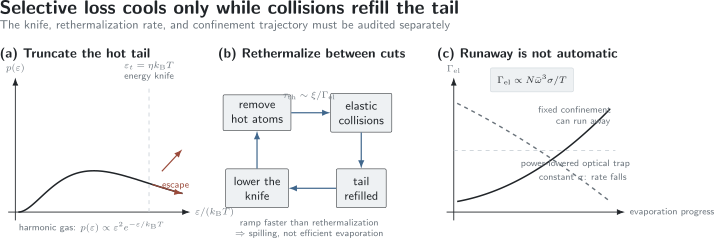
The knife at removes an exponentially small, energy-rich tail. Elastic collisions must repopulate that tail before the threshold is lowered again. With fixed confinement, density can rise relative to thermal speed and produce runaway evaporation; lowering optical power usually weakens confinement and makes the elastic rate fall when the cross section is energy independent.
Physical Implementations of the Knife
Section titled “Physical Implementations of the Knife”The escape threshold can be controlled in several ways.
Radio-frequency evaporation
Section titled “Radio-frequency evaporation”In a magnetic trap, an RF field drives atoms from a trapped Zeeman state to an untrapped or anti-trapped state on a resonant magnetic-field surface. Sweeping the RF frequency lowers the energy at which atoms are removed while leaving the trap’s central curvature approximately independent.
Microwave evaporation
Section titled “Microwave evaporation”Microwave transitions can provide hyperfine-state-selective removal and can distinguish species or internal states more strongly than an RF knife.
Lowering optical power
Section titled “Lowering optical power”In a red-detuned optical trap, reducing laser power lowers the escape depth. It also usually lowers the trap frequencies:
for fixed beam geometry. Depth and confinement therefore change together. This reduces density and may slow the elastic collision rate.
Tilting or opening the trap
Section titled “Tilting or opening the trap”A magnetic-field gradient, gravity, an auxiliary optical field, or a controlled saddle can lower one escape barrier while preserving much of the local curvature. This separates the energy knife from confinement and can accelerate evaporation.
Species-selective removal
Section titled “Species-selective removal”In a mixture, the knife may remove only one component. Other components cool sympathetically through interspecies elastic collisions.
Every implementation must use the lowest actual saddle of the complete potential, including gravity and field gradients, as .
Rethermalization
Section titled “Rethermalization”Immediately after hot particles leave, the remaining distribution is not an equilibrium distribution at a lower temperature. Elastic collisions redistribute energy and refill the high-energy tail.
Define the density-averaged elastic collision rate
For a classical gas of equal masses in a harmonic trap,
and
The Maxwellian mean relative speed is
When the cross section is effectively constant,
This scaling is one of the most useful evaporation diagnostics.
Rethermalization time
Section titled “Rethermalization time”Write
where is the number of collisions required for the measured relaxation mode. It is of order a few for equal-mass, isotropic cross-dimensional relaxation but can be much larger for unequal masses, anisotropic scattering, poor overlap, or weak ergodicity.
A ramp should be slow enough that the gas remains near a truncated equilibrium:
locally. It should also be fast compared with the time over which background loss, three-body loss, and technical heating dominate. These requirements can conflict.
Elastic Collision Requirement
Section titled “Elastic Collision Requirement”At ultralow energy, the -wave cross section for distinguishable particles is approximately
For identical bosons, exchange doubles the threshold result:
Identical spin-polarized fermions cannot scatter in the wave. Their leading allowed partial wave is suppressed at low energy. Evaporative cooling of fermions therefore commonly uses two spin states or sympathetic cooling with another component.
Increasing does not improve evaporation without limit:
- the cross section is bounded by unitarity;
- three-body recombination can grow strongly;
- mean-field effects alter the trap and density;
- hydrodynamic opacity can prevent escaping atoms from leaving cleanly;
- near a resonance, the cross section becomes energy dependent.
The relevant figure of merit is not alone but its ratio to all bad rates:
The denominator is schematic because heating is not always expressible as a particle-loss rate. A useful experiment measures each contribution rather than assigning every deviation to “imperfect evaporation.”
Energy Removed per Evaporated Particle
Section titled “Energy Removed per Evaporated Particle”For a classical gas in a three-dimensional harmonic trap,
The mean energy per particle is therefore . Kinetic theory gives the energy carried away per evaporated particle as
The quantity is the mean excess above the threshold. For an energy-independent cross section in the high- harmonic regime,
Thus approaches for large . Exact finite-depth expressions contain incomplete gamma functions and depend on trap shape and cross-section energy dependence.
Evaporation cools because
In the harmonic classical model, this requires
Increasing phase-space density requires the stronger condition derived below.
Ideal Energy and Number Scaling
Section titled “Ideal Energy and Number Scaling”First consider fixed trap frequencies, constant , negligible bad loss, and no external heating. If particles evaporate, energy conservation gives
Because ,
As decreases, decreases when .
Phase-space density
Section titled “Phase-space density”For one classical component in a harmonic trap, define
This equals the peak phase-space density in the Maxwell–Boltzmann limit. For a spin mixture, use the population of the component whose degeneracy is being assessed.
At fixed ,
The evaporation efficiency is conventionally
Therefore, in the ideal harmonic model,
Phase-space density increases when
A quoted efficiency should specify the interval over which the logarithmic slope was fit. A single endpoint ratio can hide stagnation or a change of regime.
Why large eta is not automatically optimal
Section titled “Why large eta is not automatically optimal”In a common high- harmonic approximation,
up to a factor set by the collision-rate convention. Increasing improves energy removed per lost particle but suppresses evaporation exponentially. If evaporation becomes slower than background loss or heating, the measured efficiency falls.
Lowering an Optical Trap
Section titled “Lowering an Optical Trap”When optical power is reduced, the changing trap does work on the gas. For a harmonic optical trap with ,
At constant with threshold proportional to depth, define
The ideal scaling law is
The phase-space-density gain remains
Thus the same ideal efficiency emerges after the adiabatic work is included. What changes dramatically is the collision-rate trajectory.
Adiabatic decompression is not evaporation
Section titled “Adiabatic decompression is not evaporation”If a harmonic trap is weakened adiabatically with no particle loss,
Then
stays constant. The gas becomes colder in kelvin and larger in space, but it does not become more quantum degenerate.
Runaway Evaporation
Section titled “Runaway Evaporation”Runaway evaporation means that the elastic collision rate increases as evaporation proceeds. This continually accelerates rethermalization and can permit a faster knife sweep.
Fixed confinement
Section titled “Fixed confinement”For constant cross section and fixed ,
Using the ideal scaling,
Because decreases, the collision rate rises when
RF evaporation in a magnetic trap can approach this fixed-confinement regime.
Power-lowered optical confinement
Section titled “Power-lowered optical confinement”For fixed beam geometry,
at constant . With an energy-independent cross section,
The exponent is positive, so decreases as the trap is lowered. Ordinary power lowering is therefore not runaway in this ideal constant-cross-section model.
At unitarity, scales approximately as over the relevant collision energies. The exponent becomes
and runaway behavior can reappear for . This is a special energy-dependent-cross-section regime, not a general property of optical traps.
Preserving curvature
Section titled “Preserving curvature”Tilt evaporation, auxiliary knives, dynamically shaped traps, and dimple geometries can lower the escape threshold without proportionally lowering all trap frequencies. The design objective is to preserve density and elastic rate while avoiding excessive three-body loss and opacity.
Bad Loss and Anti-Evaporation
Section titled “Bad Loss and Anti-Evaporation”Write positive particle-loss fluxes as :
An energy ledger is
One-body loss
Section titled “One-body loss”Background collisions usually sample the cloud approximately uniformly. In a classical harmonic gas, a lost particle then carries the mean energy:
Ideal one-body loss changes but not directly, so it lowers phase-space density.
Density-dependent loss
Section titled “Density-dependent loss”A -body process is weighted toward the dense trap center. In a classical harmonic gas with energy-independent local loss, the mean energy removed per lost particle is
Hence
Both are below the ensemble mean . Rethermalization therefore raises the temperature: density-dependent loss is anti-evaporative. Recombination products can deposit additional energy, making the heating worse.
Technical heating
Section titled “Technical heating”Intensity noise, pointing noise, photon scattering, and field fluctuations add energy without favorable particle removal. An observed plateau in can result from a balance between evaporative cooling and technical or recombination heating; it is not evidence that equilibrium has been reached.
Opacity and the Hydrodynamic Limit
Section titled “Opacity and the Hydrodynamic Limit”Evaporated particles must leave. Let
be a mean free path and a characteristic escape distance. When , an energetic particle can recollide before exiting, return energy to the sample, or leave through a geometry-dependent channel.
Equivalently, compare with trap frequencies. A collision rate much larger than a motional rate signals hydrodynamic behavior along that axis. Runaway scaling must then be replaced by a transport model that includes opacity and anisotropic escape.
The best elastic rate is therefore not infinite. Efficient evaporation requires enough collisions to rethermalize but enough mean free path for the hot products to escape.
Sympathetic Evaporative Cooling
Section titled “Sympathetic Evaporative Cooling”Suppose component is selectively evaporated while component remains trapped. Interspecies elastic collisions transfer energy from to , which exports it through evaporation.
Requirements include:
- a large interspecies elastic-to-inelastic ratio;
- spatial overlap throughout the ramp;
- compatible trap depths and gravitational sag;
- enough coolant heat capacity and particle number;
- manageable differential light shifts and state changes.
For masses and , the fractional energy-transfer efficiency per collision contains the kinematic factor
Large mass imbalance slows thermalization. Differential sag can remove overlap precisely when the gas becomes coldest.
Sympathetic cooling is especially useful for:
- spin-polarized fermions with suppressed -wave self-collisions;
- species that cannot be laser cooled efficiently;
- internal states that should not be exposed to the evaporation knife;
- mixtures used to assemble ultracold molecules.
The coolant can itself become too dilute or too degenerate to thermalize the target efficiently.
Path to Quantum Degeneracy
Section titled “Path to Quantum Degeneracy”The classical model is a guide, not a theory of the final state.
Bosons
Section titled “Bosons”For an ideal harmonically trapped Bose gas, condensation begins near
Equivalently, the global degeneracy parameter reaches
Near and below the transition, Bose statistics, mean-field shifts, condensate growth, collective modes, and three-body loss modify the classical evaporation equations.
Fermions
Section titled “Fermions”For one spin component with particles,
As decreases, Pauli blocking reduces available final states for collisions. A two-spin mixture can still evaporate effectively, but the thermalization law and heat capacity become quantum statistical.
Stopping criterion
Section titled “Stopping criterion”The final trap should be chosen for the science measurement, not merely for the lowest temperature. Continuing evaporation can reduce particle number, increase relative fluctuations, worsen three-body loss, or lower interaction rates without improving the target observable.
Worked Collision and Efficiency Audit
Section titled “Worked Collision and Efficiency Audit”Consider a classical gas with
and geometric-mean frequency
Take and , and use the identical-boson threshold cross section.
The peak density is
and the collision-weighted density is
The threshold cross section and mean relative speed are
Thus
Taking gives
The classical phase-space density is
For ,
so the ideal efficiency is
Using the conventional estimate
gives
The gas rethermalizes in milliseconds, but the selected loss occurs on a seconds scale. Good vacuum and low heating remain essential.
If the ideal efficiency remained valid until , the retained fraction would be
This is an optimistic classical extrapolation. Cross-section energy dependence, inelastic loss, trap weakening, and quantum statistics must be included in a real ramp.
Diagnosing an Evaporation Ramp
Section titled “Diagnosing an Evaporation Ramp”Measure at several points during the ramp:
- , , and all trap frequencies;
- actual escape depth including gravity and tilt;
- peak and collision-weighted density;
- elastic, one-body, two-body, and three-body rates;
- phase-space density or ;
- rethermalization after a controlled perturbation;
- heating with the knife held fixed;
- internal-state populations.
Useful plots include:
and
A temperature curve alone cannot distinguish evaporation from decompression, spilling, or selective loss.
Common Mistakes
Section titled “Common Mistakes”“Removing atoms always cools”
Section titled ““Removing atoms always cools””Random one-body loss removes the mean energy and does not lower temperature ideally. Density-dependent loss preferentially removes low-potential-energy particles and heats the remainder.
“The equilibrium tail fraction is the evaporation rate”
Section titled ““The equilibrium tail fraction is the evaporation rate””The tail population is a static integral. The evaporation rate depends on collision flux, trap geometry, and escape probability.
“Lower trap power means higher phase-space density”
Section titled ““Lower trap power means higher phase-space density””Adiabatic decompression lowers and together, leaving phase-space density unchanged.
“More elastic collisions are always better”
Section titled ““More elastic collisions are always better””Large improves rethermalization only until three-body loss, hydrodynamic opacity, or other density-dependent effects dominate.
“Runaway evaporation happens in every optical trap”
Section titled ““Runaway evaporation happens in every optical trap””With an energy-independent cross section, lowering optical power weakens confinement and makes the elastic collision rate fall in the ideal constant- model.
“A constant eta ramp is universally optimal”
Section titled ““A constant eta ramp is universally optimal””Constant gives useful scaling laws. Real optimum control depends on background lifetime, heating, inelastic loss, cross-section energy dependence, degeneracy, and the target final state.
“A large endpoint efficiency validates the whole ramp”
Section titled ““A large endpoint efficiency validates the whole ramp””Local stagnation, biased thermometry, changing spin populations, or incorrect trap frequencies can make an endpoint slope misleading.
Experimental Audit Checklist
Section titled “Experimental Audit Checklist”- Calibrate the knife. Use the lowest true escape saddle, including gravity and all external fields.
- Measure confinement separately. Record as depth changes; do not infer them from nominal laser power alone.
- Measure rethermalization. Obtain rather than assuming a scattering length guarantees equilibrium.
- Resolve good and bad rates. Measure background, two-body, three-body, and technical-heating contributions.
- Track eta. Calculate from measured depth and temperature.
- Test ramp speed. Look for spilling when the ramp approaches the rethermalization time.
- Check opacity. Compare mean free path and collision rate with cloud dimensions and trap frequencies.
- Fit local efficiency. Plot logarithmic phase-space-density gain against atom loss in segments.
- Change control parameters. Verify predicted scalings with knife, confinement, scattering length, and density.
- Switch models near degeneracy. Stop applying classical rate equations when Bose or Fermi statistics become important.
References
Section titled “References”- H. F. Hess, “Evaporative cooling of magnetically trapped and compressed spin-polarized hydrogen,” Physical Review B 34, R3476–R3479 (1986), doi:10.1103/PhysRevB.34.3476.
- N. Masuhara, J. M. Doyle, J. C. Sandberg, D. Kleppner, T. J. Greytak, H. F. Hess, and G. P. Kochanski, “Evaporative cooling of spin-polarized atomic hydrogen,” Physical Review Letters 61, 935–938 (1988), doi:10.1103/PhysRevLett.61.935.
- W. Ketterle and N. J. van Druten, “Evaporative cooling of trapped atoms,” Advances in Atomic, Molecular, and Optical Physics 37, 181–236 (1996), doi:10.1016/S1049-250X(08)60101-9.
- O. J. Luiten, M. W. Reynolds, and J. T. M. Walraven, “Kinetic theory of the evaporative cooling of a trapped gas,” Physical Review A 53, 381–389 (1996), doi:10.1103/PhysRevA.53.381.
- K. M. O’Hara, M. E. Gehm, S. R. Granade, and J. E. Thomas, “Scaling laws for evaporative cooling in time-dependent optical traps,” Physical Review A 64, 051403(R) (2001), doi:10.1103/PhysRevA.64.051403.
- M. D. Barrett, J. A. Sauer, and M. S. Chapman, “All-optical formation of an atomic Bose–Einstein condensate,” Physical Review Letters 87, 010404 (2001), doi:10.1103/PhysRevLett.87.010404.
- C. S. Adams, H. J. Lee, N. Davidson, M. Kasevich, and S. Chu, “Evaporative cooling in a crossed dipole trap,” Physical Review Letters 74, 3577–3580 (1995), doi:10.1103/PhysRevLett.74.3577.
- C. J. Myatt, E. A. Burt, R. W. Ghrist, E. A. Cornell, and C. E. Wieman, “Production of two overlapping Bose–Einstein condensates by sympathetic cooling,” Physical Review Letters 78, 586–589 (1997), doi:10.1103/PhysRevLett.78.586.
- M. H. Anderson, J. R. Ensher, M. R. Matthews, C. E. Wieman, and E. A. Cornell, “Observation of Bose–Einstein condensation in a dilute atomic vapor,” Science 269, 198–201 (1995), doi:10.1126/science.269.5221.198.
- K. B. Davis, M.-O. Mewes, M. R. Andrews, N. J. van Druten, D. S. Durfee, D. M. Kurn, and W. Ketterle, “Bose–Einstein condensation in a gas of sodium atoms,” Physical Review Letters 75, 3969–3973 (1995), doi:10.1103/PhysRevLett.75.3969.
- B. DeMarco and D. S. Jin, “Onset of Fermi degeneracy in a trapped atomic gas,” Science 285, 1703–1706 (1999), doi:10.1126/science.285.5434.1703.
- K. M. O’Hara, S. L. Hemmer, M. E. Gehm, S. R. Granade, and J. E. Thomas, “Observation of a strongly interacting degenerate Fermi gas of atoms,” Science 298, 2179–2182 (2002), doi:10.1126/science.1079107.
- W. Ketterle, “Nobel lecture: When atoms behave as waves: Bose–Einstein condensation and the atom laser,” Reviews of Modern Physics 74, 1131–1151 (2002), doi:10.1103/RevModPhys.74.1131.
- C. Chin, R. Grimm, P. Julienne, and E. Tiesinga, “Feshbach resonances in ultracold gases,” Reviews of Modern Physics 82, 1225–1286 (2010), doi:10.1103/RevModPhys.82.1225.
Exercises
Section titled “Exercises”1. Population above an energy knife
Section titled “1. Population above an energy knife”For a classical gas in a three-dimensional harmonic trap, calculate the equilibrium fraction above a knife with .
Solution
Use
At ,
About of an untruncated equilibrium distribution lies above the knife. This is not the rate at which collisions produce escaping atoms.
2. Derive the ideal efficiency
Section titled “2. Derive the ideal efficiency”For fixed harmonic confinement, use
and
to derive and .
Solution
Differentiating the energy gives
Equating the two expressions and dividing by yields
Thus
At fixed ,
so
Therefore
3. Selectivity versus speed
Section titled “3. Selectivity versus speed”Compare and using
and the rate factor
Find the ideal efficiency and relative rate factor for each.
Solution
For ,
and
For ,
and
At the same elastic collision rate, the knife is about
times slower but ideally much more particle efficient. Background loss and heating decide which tradeoff is better.
4. Elastic collision audit
Section titled “4. Elastic collision audit”For the worked example, verify
from
Find for .
Solution
Multiplication gives
Therefore
5. Runaway criterion
Section titled “5. Runaway criterion”In fixed harmonic confinement with constant cross section, show that increases during evaporation when .
Solution
At fixed confinement,
The ideal temperature scaling is
Hence
Because decreases, the collision rate increases only if the exponent is negative:
If optical power lowering also reduces the trap frequencies, this fixed- confinement conclusion does not apply.
6. Adiabatic decompression
Section titled “6. Adiabatic decompression”A classical gas in a harmonic trap is decompressed adiabatically so that every trap frequency is halved. No particles are lost. What happens to and ?
Solution
Adiabatic invariance gives
Thus the temperature is halved. However,
contains the ratio , which is unchanged. With constant ,
The gas is colder but no more degenerate.
7. Anti-evaporation from three-body loss
Section titled “7. Anti-evaporation from three-body loss”Show that a local three-body process in a classical harmonic gas removes per lost particle on average. Explain the resulting temperature change.
Solution
Three-body loss is weighted by . Since
the lost particles sample a spatial distribution proportional to
For a three-dimensional harmonic potential, their mean potential energy is
Their local kinetic distribution still contributes . Therefore
This is below the ensemble mean . After rethermalization, the remaining energy is shared among fewer particles and the temperature rises.
8. Sympathetic cooling with unequal masses
Section titled “8. Sympathetic cooling with unequal masses”Compute the mass-transfer factor
for mass ratio . What additional measurements are needed before claiming efficient sympathetic cooling?
Solution
Set . Then
Only about one third of the equal-mass kinematic efficiency is available per collision, so more collisions are needed.
One must also measure the interspecies elastic and inelastic rates, spatial overlap and differential sag, both temperatures, coolant depletion, state-changing collisions, and whether either component becomes degenerate or hydrodynamic during the ramp.