Bose–Einstein Condensation
Bose–Einstein condensation is the appearance of a one-particle mode whose occupation is proportional to the total number of bosons. In a sequence of systems approaching a thermodynamic limit,
or, more sharply,
For a uniform ideal gas, the macroscopically occupied mode is the zero-momentum ground state. That familiar case is important but not the general definition. In an interacting or inhomogeneous system, the condensate mode is identified as an eigenvector of the one-body density matrix. It need not be a plane wave or the bare one-particle ground orbital.
The ideal-gas mechanism is an excited-state capacity limit. As the chemical potential approaches the lowest one-particle energy, the excited modes can hold only a finite density of particles in suitable dimensions. Any particles beyond that capacity accumulate macroscopically in the lowest mode.
This page owns:
- the basis-independent Penrose–Onsager criterion;
- the excited-state saturation mechanism;
- the critical temperature and condensate fraction of the uniform ideal gas;
- the general density-of-states criterion;
- dimensional and harmonic-trap variants;
- finite-size and ensemble qualifications;
- the distinction among condensation, coherence, symmetry breaking, and superfluidity;
- the boundary between the ideal benchmark and interacting condensates.
The Ideal Bose Gas page owns the full box model, partition function, pressure, energy, and entropy. The historical article owns the path from Einstein’s prediction to dilute-gas experiments.
Off-Diagonal Long-Range Order places the one-body criterion inside the reduced-density-matrix hierarchy, relates its spectrum to spatial coherence, and develops the corresponding fermion-pair criterion.
Evaporative Cooling owns the selective-loss and rethermalization route by which many dilute-gas experiments approach the degenerate regime.
Ultracold Atoms owns the broader experimental criteria for degeneracy, interaction tuning, and dimensional freeze-out.
After establishing condensation, use Superfluidity in Condensed Matter for a neutral material’s stiffness, flow, and evidence claim. Use Superfluidity and Superconductivity to route a charged-superconductor claim; this page stops at the condensation criterion and ideal-gas benchmark.
Three Levels of the Concept
Section titled “Three Levels of the Concept”It is useful to separate three statements.
Statistical permission.
Bosonic statistics allows
in one mode. This makes macroscopic occupation possible but does not guarantee it.
Thermodynamic mechanism.
For some spectra and thermodynamic limits, the excited states have finite capacity at fixed temperature. A macroscopic occupation then becomes necessary below a critical scale.
General many-body criterion.
Condensation is diagnosed by an extensive eigenvalue of the one-body density matrix. This definition remains meaningful with interactions and without translation invariance.
Confusing these levels leads to statements such as “all bosons condense because they can share a state” or “BEC always means zero momentum.” Neither is generally correct.
Penrose–Onsager Criterion
Section titled “Penrose–Onsager Criterion”For field operators and , define the equal-time one-body density matrix
As a positive Hermitian kernel, it has orthonormal eigenfunctions:
The eigenfunctions are natural orbitals and the eigenvalues are natural occupations. Their sum is the mean particle number:
A conventional, or simple, condensate has one eigenvalue that is extensive:
while all other are subextensive. The condensate fraction is
If two or more eigenvalues are extensive, the condensate is called fragmented. Fragmentation can arise from symmetry, degeneracy, strong correlations, or constraints. It is not captured by saying that one bare orbital is occupied.
The Occupation Numbers page develops the distinction between integer Fock-state counts, mean mode occupations, and natural occupations.
The Ideal Uniform Benchmark
Section titled “The Ideal Uniform Benchmark”Consider spinless, noninteracting bosons in a cubic box of volume with periodic boundary conditions. Measure energies relative to the unique ground mode:
The mean occupation of mode is
For a finite system,
Separate the ground occupation:
where
and
The ground mode must remain discrete. Replacing every mode by a continuum integral would remove the very degree of freedom that becomes macroscopic.
Thermal Wavelength and Excited-State Density
Section titled “Thermal Wavelength and Excited-State Density”Define the thermal de Broglie wavelength
In the three-dimensional thermodynamic limit, the excited-state sum becomes
Evaluating the integral gives
The polylogarithm increases with , but the bosonic constraint prevents from exceeding one. Therefore
The maximum excited-state density is finite:
This finite capacity is the mathematical core of ideal-gas condensation.
Critical Temperature in a Box
Section titled “Critical Temperature in a Box”At the critical temperature, the total density just equals the maximum excited-state density:
Equivalently,
Solving for temperature gives
This formula assumes:
- a uniform three-dimensional gas;
- a quadratic nonrelativistic dispersion;
- one independent internal component;
- a unique ground mode;
- no interactions;
- the thermodynamic limit at fixed .
Changing any of these ingredients can change the formula or the existence of a sharp transition.
Condensate Fraction
Section titled “Condensate Fraction”Below , the thermodynamic-limit fugacity reaches
The excited-state population is then
Since
comparison with the number equation at yields
The ideal uniform condensate fraction is therefore
Above , the thermodynamic-limit condensate fraction vanishes and is fixed by
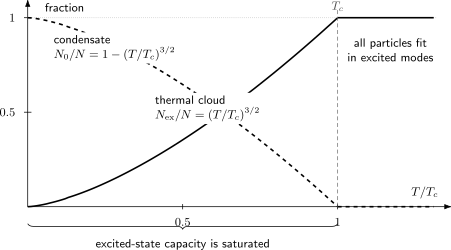
Uniform three-dimensional ideal gas in the thermodynamic limit. Below , the thermal cloud is saturated and its capacity scales as ; the remaining particles occupy the ground mode. A finite system rounds the corner near .
The formula does not mean that particles are divided into two distinguishable species. “Condensate” and “thermal cloud” refer to contributions to the one-body density matrix and mode occupations.
Why Saturation Occurs
Section titled “Why Saturation Occurs”At low momentum and ,
In three dimensions, the momentum-space measure contributes . The low-momentum excited-number integral therefore behaves as
which is finite at the lower limit.
The Bose occupation of each low-energy mode diverges as , but the phase-space volume of those modes shrinks quickly enough that the total excited density remains finite. Condensation depends on this competition between the occupation factor and the density of states.
General Density-of-States Criterion
Section titled “General Density-of-States Criterion”Suppose the low-energy density of excited one-particle states is
At the condensation boundary,
so, measuring from ,
The low-energy integrand behaves as
The integral converges at zero exactly when
When the power law applies over the relevant spectrum,
The ideal critical temperature is
and below it,
This compact criterion unifies boxes, traps, and other spectra. It also makes clear that unrestricted bosonic mode occupation is not enough: the low-energy density of states must permit finite excited-state capacity.
Dimension and Dispersion
Section titled “Dimension and Dispersion”For a uniform -dimensional system with low-momentum dispersion
the density of states scales as
Thus
and the ideal excited-state integral converges when
For ordinary massive particles,
so a uniform ideal gas has a finite-temperature condensation transition only for
In three dimensions, . In two dimensions, the low-momentum integral diverges logarithmically. In one dimension, it diverges more strongly.
This is a thermodynamic-limit statement. A finite one- or two-dimensional box can show a large ground-state population and a pronounced crossover, but no exact finite-temperature nonanalytic transition survives the standard uniform thermodynamic limit.
For interacting homogeneous Bose systems with short-range forces, long-wavelength phase fluctuations also forbid ordinary one-body long-range order at finite temperature in one and two dimensions under the hypotheses of Hohenberg-type results. A two-dimensional interacting fluid can nevertheless undergo a Berezinskii–Kosterlitz–Thouless transition with algebraically decaying order and nonzero superfluid response. That phenomenon is not the ideal-gas condensation derived here.
Low-Dimensional Quantum Gases develops the explicit one- and two-dimensional densities of states, finite-size qualifications, phase-fluctuation argument, dimensional-freezing criteria, and bridges to BKT and Luttinger-liquid physics.
Harmonic Traps
Section titled “Harmonic Traps”Laboratory atomic gases are often confined by an anisotropic harmonic potential:
Define the geometric mean frequency
At excitation energies large compared with the level spacings, the three-dimensional trap density of states is
Here
so the maximum excited population is
The leading ideal-gas critical temperature is
Below this scale,
The exponent is , not , because a harmonic trap has a different density of states from a uniform box.
The approximation requires
for thermally relevant directions. A sharp trapped-gas thermodynamic limit is constructed by taking
while keeping
fixed. At finite , discrete-level corrections shift and round the crossover. Interactions also change the density profile and transition region.
The condensate in a trap occupies a spatial orbital. It is not generally a zero-momentum plane wave.
Example: Box and Trap Scales
Section titled “Example: Box and Trap Scales”Uniform rubidium-87 estimate
Section titled “Uniform rubidium-87 estimate”Take an ideal uniform gas of rubidium-87 atoms with
and density
The box formula gives
This is an order-of-magnitude benchmark. A real trapped, interacting cloud must be analyzed with its actual confinement, component populations, and scattering properties.
Harmonic-trap estimate
Section titled “Harmonic-trap estimate”For
atoms in a trap with
the leading ideal result is
At half this temperature, the ideal trap fraction is
For a uniform box at , the corresponding ideal fraction is
The contrast comes entirely from the different density-of-states exponents.
Real-Space Coherence
Section titled “Real-Space Coherence”For a translation-invariant uniform gas,
where the integral contains the noncondensed modes. At large separation, the thermal contribution decays, leaving
with
This nonzero asymptote is off-diagonal long-range order. It is the real-space form of an extensive eigenvalue of the one-body density matrix.
In an inhomogeneous trap there is no translation-invariant separation limit of this simple form. Diagonalizing provides the more general criterion.
Long-range one-body coherence is not complete state tomography. Density correlations, phase fluctuations, depletion, and higher-order correlations contain additional information.
Condensation and Symmetry Breaking
Section titled “Condensation and Symmetry Breaking”The microscopic Hamiltonian of a number-conserving Bose gas is invariant under the global transformation
In an exact fixed- state,
because changes particle number. Nevertheless, the one-body density matrix can have an extensive eigenvalue. The Penrose–Onsager criterion therefore defines condensation without assuming broken symmetry.
In a symmetry-breaking description, one writes the complex order parameter
with
This representation is powerful in the thermodynamic limit and in mean-field theory. It selects a phase and replaces the condensate operator partly by a classical field. A number-conserving treatment and a broken-symmetry treatment can agree on local observables in their common regime while organizing the calculation differently.
The condensate phase is not an absolute observable. Interference experiments reveal relative phases, and measurement can establish a relative phase even between initially number-defined clouds.
The general logic of fixed-number symmetry, source-selected phase states, and their local thermodynamic equivalence is developed in Spontaneous Symmetry Breaking.
Finite Systems
Section titled “Finite Systems”At finite and finite volume:
- the spectrum is discrete;
- the partition function is analytic;
- remains below the lowest one-particle energy;
- the condensate fraction changes smoothly;
- there is no exact thermodynamic singularity.
For the ideal ground mode,
Solving for fugacity gives
Therefore
for macroscopic . The statement below is a thermodynamic-limit shorthand. A finite ideal system has .
A finite cloud may still have a clearly dominant natural occupation and experimentally useful crossover temperature. “No exact phase transition” does not mean “no observable condensate.” The general distinction among finite- rounding, mode resolution, trap scales, and a bulk comparison belongs to Finite-Size Effects.
Ensemble Dependence of Condensate Fluctuations
Section titled “Ensemble Dependence of Condensate Fluctuations”The leading thermodynamic-limit mean condensate fraction can agree across ensembles, while condensate-number fluctuations do not.
For a single ideal bosonic mode in the grand-canonical ensemble,
If is extensive,
These order-one relative fluctuations are often called the grand-canonical condensate-fluctuation problem. They arise from coupling an exactly zero-energy ideal mode to an unlimited particle reservoir.
In a canonical ensemble, fixed total number couples the condensate and thermal cloud:
Total-number fluctuations vanish, and condensate fluctuations are controlled by fluctuations of the excited population. Interactions modify the result again.
Ensemble equivalence must therefore be stated for a specified observable and limit. Bulk pressure can be ensemble equivalent while a zero-mode fluctuation is not.
Thermodynamic Signatures of the Ideal Transition
Section titled “Thermodynamic Signatures of the Ideal Transition”Below in the uniform ideal gas,
and
The condensate carries no kinetic energy in the convention . Hence
below , and
There is no latent heat in the ideal transition. Thermodynamic derivatives become nonanalytic only in the thermodynamic limit. The general distinction between first-order and continuous thermal transitions, including finite-size rounding, is developed in Finite-Temperature Phase Transitions.
The ideal uniform gas also becomes anomalously compressible as . Its pathological softness below the transition is another sign that interactions are essential for a realistic stable superfluid.
The complete ideal-gas thermodynamics and its assumptions belong to the Ideal Bose Gas.
Interactions Change the State, Not the Definition
Section titled “Interactions Change the State, Not the Definition”For a dilute gas with short-range interactions, a common low-energy Hamiltonian is
with
where is the -wave scattering length.
For a weakly repulsive homogeneous gas, the dilute parameter is
Interactions have several effects:
- they make the condensate orbital self-consistent rather than a bare one-particle eigenstate;
- they produce finite compressibility and sound;
- they create quantum depletion even at zero temperature;
- they change collective modes and condensate fluctuations;
- they connect condensation with superfluid response in a nontrivial way;
- they shift and reshape the critical region;
- they provide collisions needed for equilibration.
At zero temperature, the leading homogeneous Bogoliubov depletion is
Thus an interacting condensate need not have even at .
The Penrose–Onsager criterion still applies: interactions change and its eigenvalues, not the definition of condensation. The Weakly Interacting Bose Gas Preview develops the dilute parameter, mean-field scales, Bogoliubov sound branch, depletion, and superfluidity boundary. Those results require their own approximations and are not consequences of the ideal saturation derivation.
Condensate Fraction Is Not Superfluid Fraction
Section titled “Condensate Fraction Is Not Superfluid Fraction”The condensate fraction is
defined from the largest eigenvalue of the one-body density matrix.
The superfluid fraction is a response coefficient. It can be defined through the free-energy cost of a phase twist, response to slow rotation, or nondissipative transport under stated conditions.
The two quantities are related in many weakly interacting Bose gases but are not identical:
- the uniform ideal Bose gas condenses, yet its quadratic excitation spectrum gives zero Landau critical velocity;
- strongly interacting liquid helium can have a superfluid fraction much larger than its condensate fraction;
- an infinite homogeneous two-dimensional fluid can have BKT superfluidity with algebraic one-body order but no conventional finite-temperature condensate;
- disorder, lattices, and finite geometry can further separate one-body coherence from transport response.
“BEC” is therefore not a synonym for “superfluid,” and neither term should be inferred from the other without assumptions.
Condensation Is Not Ordinary Spatial Condensation
Section titled “Condensation Is Not Ordinary Spatial Condensation”Bose–Einstein condensation occurs in one-particle state space. The condensate orbital can extend across the entire sample or trap.
It is not the same as:
- forming a liquid droplet;
- freezing into a solid;
- increasing the real-space density without bound;
- every atom sitting at one spatial point;
- every particle following a classical trajectory with zero velocity.
Repulsive interactions, trapping, kinetic energy, and quantum pressure determine the spatial profile of an atomic condensate. The word “condensation” refers to macroscopic mode occupation.
Experimental Diagnostics
Section titled “Experimental Diagnostics”No single measurement is universally sufficient in every system. Common diagnostics include:
Momentum-space bimodality.
After release from a trap, a narrow low-momentum component can appear on top of a broad thermal distribution.
One-body coherence.
Interference and correlation measurements probe the spatial coherence encoded in .
Condensate-mode fitting.
In trapped gases, density profiles can be decomposed into a condensate contribution and a thermal cloud using a model appropriate to the interaction and expansion regime.
Macroscopic natural occupation.
When the one-body density matrix can be reconstructed or computed, its leading eigenvalue gives the basis-independent condensate fraction.
Response and collective behavior.
Sound, vortices, collective modes, and superfluid response provide important information about interactions and superfluidity, but they probe more than condensation alone.
The experimental sequence, 1995 dilute-gas observations, and historical interpretation belong to Bose–Einstein Condensation as Historical and Modern Topic and the compact experiment card.
Variants and Boundaries
Section titled “Variants and Boundaries”Internal components
Section titled “Internal components”If internal states are independent, degenerate, and share one chemical potential, the normal-phase excited density acquires a factor . For a uniform ideal gas,
Then
But the factor cannot be inserted blindly. If component numbers are separately conserved, if levels are split, or if the ground manifold is degenerate, several chemical potentials or fragmented condensation may be relevant.
Lattices
Section titled “Lattices”On a lattice, the low-energy band dispersion and density of states replace the continuum quadratic formulas. Interactions can drive a superfluid-to-Mott transition, where a simple ideal-band condensation picture is inadequate.
Quasiparticles
Section titled “Quasiparticles”Photons, magnons, polaritons, and other bosonic quasiparticles may have nonconserved number, driven-dissipative dynamics, effective masses, or finite lifetimes. Their condensation criteria require the actual conservation laws and equilibration mechanism. The atomic fixed- formulas should not be transplanted automatically.
Degenerate minima
Section titled “Degenerate minima”If several one-particle minima are exactly degenerate, the condensate can occupy a superposition, choose one minimum through symmetry breaking, or fragment across modes. The one-body density matrix decides which description applies.
Practical Workflow
Section titled “Practical Workflow”To analyze a possible Bose condensate:
- Identify the bosonic particles or quasiparticles and the conserved quantities.
- Specify the one-particle spectrum, geometry, boundary conditions, and internal components.
- Separate any discrete lowest modes from the continuum approximation.
- Determine the low-energy density-of-states exponent .
- Check whether the excited-state integral converges as .
- Define the thermodynamic limit appropriate to a box, trap, lattice, or other geometry.
- Compute and only within the assumptions of the chosen spectrum.
- For interacting or inhomogeneous systems, use the one-body density matrix rather than assuming the condensate orbital.
- Treat finite-size rounding and ensemble-dependent fluctuations explicitly.
- Keep condensate fraction, coherence, symmetry breaking, and superfluid response conceptually distinct.
Common Mistakes
Section titled “Common Mistakes”Defining BEC only as ground-state occupation.
That is correct for a simple ideal gas with a unique lowest orbital. The general criterion uses the largest eigenvalue of the one-body density matrix.
Assuming every bosonic gas condenses at finite temperature.
The low-energy density of states and thermodynamic limit decide whether the excited-state capacity is finite.
Applying the box formula to a harmonic trap.
The critical-temperature scaling and condensate-fraction exponent differ.
Calling a finite-system crossover an exact phase transition.
Finite partition functions are analytic; sharp nonanalyticity requires a limit.
Setting in a finite ideal system.
For finite , remains strictly below .
Replacing the ground mode by the continuum density of states.
This can erase the condensate contribution.
Equating condensate fraction with the probability that one particle is condensed.
is a natural occupation divided by total number, not a particle-label probability.
Equating BEC with superfluidity.
Condensation is one-body order; superfluidity is a response property.
Assuming all particles occupy the condensate at zero temperature.
Interactions generate quantum depletion.
Treating a narrow momentum peak as a complete many-body diagnosis.
Geometry, expansion dynamics, finite resolution, interactions, and coherence measurements matter.
Ignoring component degeneracy.
Every spin or internal state is a distinct mode unless dynamics imposes a different effective description.
Using broken-symmetry notation as the definition.
An exact fixed-number condensate can have and still satisfy the Penrose–Onsager criterion.
Exercises
Section titled “Exercises”Uniform critical temperature
Section titled “Uniform critical temperature”Starting from
derive for a three-dimensional uniform ideal gas. Check the dimensions.
Solution
Insert
Then
Raise both sides to the power and solve:
The factor has units of energy times length squared, while has units of inverse length squared. Their product is an energy, and division by gives temperature.
General low-energy criterion
Section titled “General low-energy criterion”Suppose
near the lowest energy. Determine when the excited-state capacity is finite and derive its temperature scaling.
Solution
At the saturation boundary,
For small ,
so the integrand behaves as
The lower-limit integral converges when
or
With ,
The remaining integral is
so
Infrared divergence in two dimensions
Section titled “Infrared divergence in two dimensions”Show directly that a uniform two-dimensional ideal Bose gas with quadratic dispersion has no finite excited-state capacity at nonzero temperature.
Solution
At ,
For small ,
The two-dimensional measure is proportional to , so the infrared contribution is
This diverges logarithmically. The excited modes can absorb arbitrarily large density as , so there is no standard finite-temperature ideal-gas BEC in the uniform two-dimensional thermodynamic limit.
Harmonic-trap result
Section titled “Harmonic-trap result”Use
to derive the ideal three-dimensional harmonic-trap critical temperature and condensate fraction.
Solution
At saturation,
Since
this becomes
Setting this equal to gives
Below ,
so
Finite-system chemical potential
Section titled “Finite-system chemical potential”For a finite ideal system with ground energy zero, show that
when .
Solution
The ground occupation is
Solving gives
Because ,
For , use :
Thus approaches zero from below as the condensate becomes macroscopic but is not exactly zero at finite .
Simple and fragmented condensation
Section titled “Simple and fragmented condensation”Consider a two-mode one-body density matrix
with . Find its natural occupations. Classify the limits and .
Solution
The eigenvalues are
When
the occupations are
There is one macroscopically occupied natural orbital: simple condensation.
When
the occupations are
Two orthogonal natural orbitals are macroscopically occupied, so the state is fragmented at the one-body level.
For fixed as , both eigenvalues remain proportional to , which is also fragmented condensation.
Condensate and superfluid diagnostics
Section titled “Condensate and superfluid diagnostics”For each statement, identify whether it concerns condensation, superfluidity, both, or neither:
- the largest eigenvalue of is ;
- the free energy increases quadratically under a small phase twist;
- the Landau critical velocity is zero;
- in a fixed-number state.
Solution
- An eigenvalue is extensive, so it directly diagnoses condensation.
- A phase-twist stiffness diagnoses superfluid response.
- Zero Landau critical velocity means the Landau criterion does not support stable superflow; it does not by itself decide whether there is a condensate. The uniform ideal Bose gas is the standard example with BEC but zero Landau critical velocity.
- This decides neither. Exact particle-number conservation forces , but condensation can still be present in the one-body density matrix.
Quantum depletion estimate
Section titled “Quantum depletion estimate”For a homogeneous weakly interacting gas with
estimate the leading zero-temperature noncondensed fraction.
Solution
The Bogoliubov result is
Here
Therefore
The leading depletion is about . It is small but nonzero, illustrating that an interacting ground state is not a pure occupation of one bare mode.
Cross-Links
Section titled “Cross-Links”- Ideal Bose Gas — box spectrum, partition function, density of states, equation of state, and ideal thermodynamics.
- Weakly Interacting Bose Gas Preview — contact interactions, mean-field stiffness, Bogoliubov phonons, depletion, and the Landau criterion.
- Bose–Einstein Statistics — the one-mode occupation factor and chemical-potential constraint.
- Occupation Numbers — Fock counts, means, fluctuations, one-body density matrices, and natural occupations.
- Thermodynamic Limit — why a finite crossover becomes a sharp phase transition only in a limit.
- Field Operators — field expansions and real-space one-body density matrices.
- Correlation Functions Overview — off-diagonal long-range order and correlation diagnostics.
- Equal-Time Correlations — one-body coherence conventions, positivity checks, and the boundary between static one-body and pair diagnostics.
- Fluctuations and Susceptibilities — ensemble-dependent number fluctuations and response.
- Bose–Einstein Condensation as Historical and Modern Topic — prediction, experimental realization, and historical context.
- Bose–Einstein Condensates Overview — AMO preparation, effective-field scales, collective modes, interference, and experimental evidence.
- Ideal Bose Gas Reference Card — compact formulas for lookup.
- Bose Gas Formula Sheet — ideal occupations, condensation scales, thermodynamics, and dimensional limits.
References
Section titled “References”- R. K. Pathria and P. D. Beale, Statistical Mechanics, 4th ed., Academic Press (2021) — ideal Bose gas, condensation, dimensionality, and thermodynamic limits.
- K. Huang, Statistical Mechanics, 2nd ed., Wiley (1987) — standard ideal-gas derivation and thermodynamic behavior.
- C. J. Pethick and H. Smith, Bose–Einstein Condensation in Dilute Gases, 2nd ed., Cambridge University Press (2008) — dilute trapped gases, interactions, and condensate physics.
- L. Pitaevskii and S. Stringari, Bose–Einstein Condensation and Superfluidity, Oxford University Press (2016) — condensation criteria, weak interactions, superfluidity, and finite-temperature theory.
- O. Penrose and L. Onsager, “Bose–Einstein Condensation and Liquid Helium”, Physical Review 104, 576–584 (1956) — basis-independent definition through an extensive eigenvalue of the one-body density matrix.
- P. C. Hohenberg, “Existence of Long-Range Order in One and Two Dimensions”, Physical Review 158, 383–386 (1967) — rigorous restrictions on long-range order in low-dimensional equilibrium systems.
- F. Dalfovo, S. Giorgini, L. P. Pitaevskii, and S. Stringari, “Theory of Bose–Einstein Condensation in Trapped Gases”, Reviews of Modern Physics 71, 463–512 (1999) — authoritative review of trapped dilute-gas theory.
- W. Ketterle and N. J. van Druten, “Bose–Einstein Condensation of a Finite Number of Particles Trapped in One or Three Dimensions”, Physical Review A 54, 656–660 (1996) — finite-number and trap-dimensionality analysis.