Off-Diagonal Long-Range Order
Off-diagonal long-range order (ODLRO) is macroscopic coherence encoded in a reduced density matrix. Its basis-independent signature is an eigenvalue whose scaling is parametrically larger than the ordinary background:
Here is an eigenvalue of the one-body reduced density matrix, whereas is an eigenvalue of the fermionic two-body density matrix on antisymmetric pair space. The two criteria have the same logic but act on different body ranks because Pauli exclusion prevents a fermionic one-body eigenvalue from becoming macroscopic.
The word “off-diagonal” does not mean that some matrix element happens to be nonzero in a chosen basis. It refers historically to matrix elements between configurations that remain macroscopically separated. The spectral criterion is safer: eigenvalues survive basis changes, while individual diagonal and off-diagonal entries do not.
ODLRO supplies a number-conserving language for condensates. A fixed-particle-number state can have
or
and still possess a macroscopic density-matrix eigenvalue. This distinction connects exact finite systems, symmetry-preserving thermodynamic states, and broken-symmetry approximations without identifying them.
Canonical Scope
Section titled “Canonical Scope”This page is the canonical home for:
- the reduced-density-matrix definition of ODLRO;
- the common reduced-density-matrix logic connecting the Penrose–Onsager bosonic criterion to Yang’s fermion-pair criterion;
- the relation between macroscopic eigenvalues and long-distance one-body or pair-correlation limits;
- simple and fragmented condensation;
- fixed-number and broken-number descriptions of the same long-distance coherence;
- pair internal structure, center-of-mass motion, and finite-momentum condensates;
- gauge covariance of density-matrix kernels and the special caution required for charged pairs;
- finite-size, low-dimensional, numerical, and experimental diagnostics;
- distinctions from pair binding, a spectral gap, superfluid stiffness, Meissner response, and entanglement.
Neighboring pages retain separate ownership:
- One-Body Operators owns one-body lifting, expectation values, and the basic one-body density-matrix convention.
- Two-Body Operators owns two-body operator ordering, trace conventions, contractions, and representability caveats.
- Equal-Time Correlations owns the general static one-body and pair correlators.
- Bose–Einstein Condensation owns the full Penrose–Onsager treatment, ideal-gas saturation mechanism, critical temperature, condensate fraction, traps, and the distinction from superfluid fraction.
- BCS Mean-Field Theory owns the Cooper instability, anomalous decoupling, gap and number equations, coherence factors, and quasiparticles.
- Order Parameters owns the general operator–source–response dictionary.
- Spontaneous Symmetry Breaking owns phase selection, noncommuting limits, finite-size symmetric states, and broken-symmetry sectors.
- Long-Range Order owns diagonal correlation plateaus, volume averages, and structure-factor scaling for local order.
The purpose here is to expose the common density-matrix structure without repeating those derivations.
Use Superfluidity in Condensed Matter when a density-matrix coherence diagnostic must be joined to neutral-material stiffness, critical flow, or two-fluid evidence. Use Superfluidity and Superconductivity for charged, defect, or device routing; this page retains ODLRO ownership.
Thermodynamic and Normalization Conventions
Section titled “Thermodynamic and Normalization Conventions”ODLRO is a statement about a sequence of systems. Unless stated otherwise:
- particles occupy a region of volume ;
- at fixed density ;
- the body rank of the reduced density matrix remains fixed;
- reduced density matrices are unnormalized, so their traces count particles or ordered particle tuples;
- the thermodynamic limit is taken before the large-separation limit;
- a macroscopic eigenvalue means an eigenvalue proportional to , with a nonzero limiting ratio.
At finite size, every density matrix merely has finite eigenvalues. It is therefore more precise to say that a finite system shows scaling consistent with ODLRO than to claim a strict long-range limit from one size.
For variable particle number, in ratios should be replaced by and number fluctuations should be reported. Comparing a canonical calculation at fixed with a grand-canonical calculation at fixed chemical potential can otherwise confuse ensemble effects with condensation.
The Reduced-Density-Matrix Hierarchy
Section titled “The Reduced-Density-Matrix Hierarchy”For one field species, define the unnormalized -body kernel
Each may include position, spin, species, band, or another one-particle label. In a fixed- sector,
The first two levels are
They answer different questions:
| Kernel | Natural modes | Macroscopic coherence diagnosed here |
|---|---|---|
| bosonic | one-particle orbitals | Bose condensation |
| fermionic | one-particle orbitals | no one-body ODLRO because occupations are Pauli bounded |
| fermionic | antisymmetric pair wavefunctions | pair condensation |
| bosonic | symmetric -particle modes | higher-body coherence, with normalization-dependent powers of |
The last row warns against a common overgeneralization. In a simple bosonic condensate, the leading -body eigenvalue scales as the falling factorial , not merely as . The two-body criterion discussed below is specifically the conventional fermion-pair criterion on normalized antisymmetric pair space.
Bosonic One-Body ODLRO
Section titled “Bosonic One-Body ODLRO”One-body kernel
Section titled “One-body kernel”The one-body reduced density matrix is
In an orthonormal one-particle basis,
It is Hermitian:
It is positive semidefinite. For a normalized orbital with
one has
Its trace is the mean particle number:
These properties make a positive one-particle operator even though it is not normalized to unit trace.
Natural orbitals and occupations
Section titled “Natural orbitals and occupations”The spectral problem is
The orthonormal eigenfunctions are natural orbitals, and the eigenvalues are natural occupations. The spectral decomposition is
Positivity and the trace rule imply
A change of one-particle basis conjugates by a unitary operator. It changes the entries and coordinates of the natural orbitals but not the multiset of eigenvalues.
Penrose–Onsager criterion
Section titled “Penrose–Onsager criterion”The complete bosonic treatment and its ideal-gas applications belong to Bose–Einstein Condensation. The criterion is recorded here in the notation needed to compare one-body and pair ODLRO.
A simple bosonic condensate has one extensive natural occupation:
while
The number is the condensate fraction in this convention. This definition does not require the condensate orbital to be an eigenstate of the bare one-particle Hamiltonian. In an interacting, disordered, rotating, or trapped system, is determined by the many-body state through .
A large occupation at one finite size is not yet a limiting statement. One must test whether remains proportional to along a controlled thermodynamic sequence.
From a Macroscopic Eigenvalue to a Spatial Limit
Section titled “From a Macroscopic Eigenvalue to a Spatial Limit”Homogeneous zero-momentum condensate
Section titled “Homogeneous zero-momentum condensate”In a translation-invariant box, write
With plane-wave occupations ,
If the mode has
and the noncondensed momentum distribution is sufficiently regular, its Fourier transform decays at large separation. Therefore
Since ,
The real-space plateau and the extensive plane-wave occupation are then equivalent descriptions of the same simple homogeneous condensate.
Finite-momentum condensate
Section titled “Finite-momentum condensate”If the macroscopic orbital is a plane wave at , then
and the phase-demodulated limit is
Condensation therefore need not mean zero momentum. Rotation, synthetic gauge fields, multiple band minima, or driven settings can select nonzero momentum. The ordering wavevector must be diagnosed rather than assumed.
Why the order of limits matters
Section titled “Why the order of limits matters”At fixed finite , periodic images, exact recurrences, a largest available separation, and symmetry-induced level splittings prevent a literal infinite-distance limit. The meaningful order is
not
This is the same thermodynamic discipline required for other forms of long-range order. A plateau observed only near can be a boundary or periodic-image artifact.
Inhomogeneous systems
Section titled “Inhomogeneous systems”In a trap or an explicitly inhomogeneous state, translation averaging is unavailable. A simple condensate contributes
The condensate orbital may decay toward the edge, so no position-independent plateau exists even when . The spectrum of is the canonical diagnostic; a separation-only fit is not.
The thermodynamic limit for a trap must also be declared. Holding the trapping frequency fixed while increasing is not the same sequence as weakening the trap so the cloud size grows at fixed central density.
Simple and Fragmented Condensation
Section titled “Simple and Fragmented Condensation”A condensate is fragmented when two or more natural occupations remain extensive:
for more than one . The macroscopic eigenspace, rather than any one vector inside a degenerate subspace, is then the invariant object.
Fragmentation can reflect:
- exact symmetries or conserved quantities;
- degenerate one-particle minima;
- multicomponent structure;
- rotation or finite-momentum sectors;
- strong correlations and interaction-driven constraints;
- averaging over symmetry-related condensates.
Two large occupations in an arbitrary orbital basis do not prove fragmentation. One must diagonalize . Conversely, a nearly degenerate pair of large finite-size eigenvalues may collapse to one extensive eigenvalue after a symmetry-selecting field is applied. Genuine fragmentation and finite-size symmetry restoration must therefore be distinguished by controlled limits.
For a simple condensate, the ratio
is often informative. It is not universal: critical, low-dimensional, or nearly degenerate systems can have several subextensive eigenvalues with nontrivial scaling.
Fixed Number and Broken-Symmetry Fields
Section titled “Fixed Number and Broken-Symmetry Fields”A fixed-number condensate
Section titled “A fixed-number condensate”Let
be a number state with every boson in . Number conservation gives
Nevertheless,
so has the eigenvalue . The state has maximal one-body ODLRO even though its field expectation vanishes exactly.
A phase-selected description
Section titled “A phase-selected description”In a source-selected or symmetry-breaking state, define
If the selected phase clusters,
when the two points separate through the bulk. The outer product generates the macroscopic eigenvalue.
A phase average can restore
while retaining the same number-neutral kernel . Thus the anomalous one-point field is a useful representative in a selected phase, whereas the one-body density matrix is the number-conserving diagnostic.
What is and is not equivalent
Section titled “What is and is not equivalent”For a simple homogeneous condensate under appropriate clustering assumptions, the following descriptions agree in the thermodynamic limit:
The qualifications matter. Fragmentation, traps, gauge fields, finite-size symmetry restoration, and algebraic order can break a naive one-to-one translation among these statements.
Why Fermions Need a Pair Density Matrix
Section titled “Why Fermions Need a Pair Density Matrix”For a normalized fermionic orbital ,
is a projector. Therefore
The variational characterization of the largest eigenvalue then gives
for every eigenvalue of the fermionic one-body density matrix. Since
fermions occupy one-particle natural orbitals rather than placing particles in one orbital. A normal Fermi sea can have a slowly decaying one-body kernel and a sharp Fermi surface, but it cannot have bosonic one-body ODLRO.
Pairing changes the body rank of the question. A pair mode can be macroscopically occupied even though neither constituent one-particle orbital is.
Fermionic Pair ODLRO
Section titled “Fermionic Pair ODLRO”Pair matrix on antisymmetric space
Section titled “Pair matrix on antisymmetric space”Choose an orthonormal one-particle basis and label an unordered fermion pair by
Define
The pair density matrix is
It is positive semidefinite because, for
one has
In a fixed- sector its trace on unordered pair space is
The full ordered-index convention used for has trace . The two conventions differ by bookkeeping factors but yield the same scaling classification when used consistently.
Yang criterion
Section titled “Yang criterion”Diagonalize
Fermionic pair ODLRO is present when
The leading eigenvector specifies the condensed pair mode. Its labels contain both constituent orbitals, so it carries the internal spin, orbital, band, and relative-coordinate structure of the pair.
Although , ordinary uncorrelated pairs distribute that trace over pair modes with eigenvalues of order one. Pair ODLRO concentrates an order- weight into one pair eigenmode. That concentration is the nontrivial statement.
It is common to quote as a pair condensate fraction. This normalization can be convenient, but it is not automatically a probability between zero and one for every interacting convention. Overlapping Cooper-pair operators are composite and do not obey exact canonical-boson commutation relations. Report the pair basis and normalization with the number.
Pair Wavefunctions in Real Space
Section titled “Pair Wavefunctions in Real Space”Two-body kernel
Section titled “Two-body kernel”Using the first-pair-as-annihilation convention,
The pair eigenproblem is
For fermions,
The antisymmetry can be carried by spin, spatial, orbital, or combined internal structure. Saying only “the pair wavefunction” is incomplete until the one-particle labels and normalization are declared.
Relative and center-of-mass coordinates
Section titled “Relative and center-of-mass coordinates”For a continuum pair, introduce
The internal coordinate describes pair size and symmetry. The center coordinate describes the collective motion of pairs. A projected pair annihilator is
The form factor selects an internal channel. On a lattice, the integral becomes a sum over onsite, bond, plaquette, or longer-range relative coordinates.
Pair-correlation limit
Section titled “Pair-correlation limit”Define
For a homogeneous zero-momentum pair condensate,
when has nonzero overlap with the condensed internal mode. The pair size is held microscopic while the separation between pair centers becomes macroscopic.
A finite-momentum pair condensate instead has
This includes pair-density-wave and -pairing-type structures. Demodulating by the candidate or diagonalizing the full pair matrix avoids averaging the signal to zero.
The limit is channel dependent. Projecting onto an -wave form factor can miss -wave order, and summing bonds with the wrong relative signs can cancel the leading eigenvector.
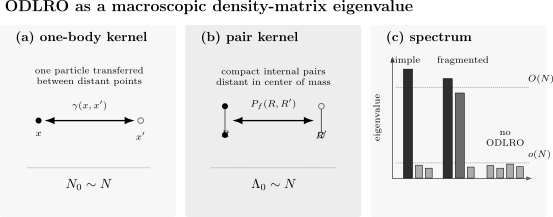
ODLRO is a spectral statement about a reduced density matrix. Bosonic one-body coherence connects distant one-particle configurations and produces . Fermionic pair coherence keeps each pair internally compact while separating its center of mass, producing . One extensive eigenvalue indicates simple condensation; several indicate fragmentation or multiple condensed channels; a wholly subextensive spectrum has no true ODLRO.
The BCS Benchmark
Section titled “The BCS Benchmark”The BCS state provides a transparent illustration, not the definition. Let
and define
For the standard spin-balanced Gaussian BCS state, Wick’s theorem gives
The first term is rank one. Its nonzero eigenvalue is
When remains appreciable over an extensive set of momentum modes,
The diagonal term has bounded entries, so it changes the leading eigenvalue by at most an order-one amount under the standard thermodynamic assumptions. The pair matrix therefore has one extensive eigenvalue.
This calculation separates several objects that are often conflated:
| Object | Role |
|---|---|
| anomalous pair amplitude in a broken-number Gaussian state | |
| self-consistent mean field entering the BCS Hamiltonian | |
| leading eigenvector of | number-conserving condensed pair mode |
| quasiparticle gap | spectral excitation scale |
| occupation scale of the condensed pair mode |
These objects are related within BCS mean field, but they are not definitions of one another. In particular,
is generally not . Weak-coupling Cooper pairs overlap strongly; they are not a gas of distinguishable, tightly bound molecules whose number can be read off by dividing the fermion count by two.
In an exact fixed- state or a number-projected BCS state,
by the number selection rule. The neutral matrix
can still retain its extensive eigenvalue. This is precisely why the density-matrix criterion is more fundamental than the anomalous average.
Basis Invariance and Gauge Covariance
Section titled “Basis Invariance and Gauge Covariance”Ordinary basis changes
Section titled “Ordinary basis changes”Under a one-particle unitary transformation ,
up to the chosen index convention. The eigenvalues are unchanged. The induced transformation on antisymmetric pair space similarly conjugates , so its eigenvalues are unchanged.
A single entry such as
can become diagonal, off diagonal, or zero after a basis rotation. ODLRO cannot be defined by that entry alone.
Global number rotations
Section titled “Global number rotations”Under
the one-point field and pair amplitude transform as
The neutral kernels
and
are invariant under a spatially uniform number rotation. This is why they can diagnose coherence in fixed-number states.
Local gauge transformations
Section titled “Local gauge transformations”For a field of charge , a local gauge transformation acts as
The one-body kernel transforms covariantly:
This is unitary conjugation, so the spectrum is invariant when the one-particle Hilbert space and background fields are transformed consistently. The phase of a spatial matrix element is not itself gauge invariant.
For a compact charged pair,
also acquires an endpoint phase under a local gauge transformation. Define the line integral along a declared path by
and the charge- parallel transporter by
A gauge-covariant comparison is then, schematically,
for the convention
The path, electromagnetic fluctuations, and nonlocal internal pair structure can matter. In a fixed gauge one may study the ordinary pair kernel, but its phase plateau should not be presented as a standalone gauge-invariant observable.
Local gauge redundancy is not an ordinary physical symmetry that must literally break. Superconductivity is established through a consistent collection of number-conserving coherence and electromagnetic-response diagnostics, not by assigning physical meaning to a gauge-dependent field expectation alone.
Finite-Size Scaling
Section titled “Finite-Size Scaling”Leading-eigenvalue regimes
Section titled “Leading-eigenvalue regimes”Let denote a translation-invariant one-body or projected pair kernel over center coordinates. If
then its largest long-wavelength eigenvalue scales as the integrated correlation:
Thus
Since ,
The first line is true ODLRO, the middle two are algebraic or marginal coherence, and the last is integrable short-range order. This table applies to the center-coordinate kernel after fixing or resolving the internal channel. It should not be applied blindly to the full pair-coordinate space.
Spectral indicators
Section titled “Spectral indicators”Useful finite-size quantities include
for bosons and
for fermion pairs. Also inspect
or
with notation adapted to the matrix being studied. A stable isolated leading eigenvalue supports simple condensation; several extensive eigenvalues support fragmentation or multiple condensed channels.
An apparent eigenvalue gap at one size is not decisive. Near a transition, a finite correlation length larger than the simulated box can mimic extensive scaling over a short range of .
Real-space and spectral cross-check
Section titled “Real-space and spectral cross-check”In a homogeneous simple condensate, compare:
with the large-distance one-body plateau, or compare
with a channel-projected pair plateau after matching normalizations. Agreement catches Fourier factors, pair-counting factors, and center-of-mass averaging errors.
The eigenvector should also have the expected symmetry. A large eigenvalue in an unexpected edge-localized, boundary-pinned, or phase-separated mode may not diagnose the proposed bulk condensate.
A Reliable Numerical Workflow
Section titled “A Reliable Numerical Workflow”Choose the body rank
Section titled “Choose the body rank”Use for bosonic one-particle condensation and a fermionic pair matrix for superconducting or molecular pair coherence. Do not search for a fermionic one-body eigenvalue of order .
Declare every index
Section titled “Declare every index”State whether an index includes site, position, momentum, spin, band, orbital, and species. For pair matrices, state whether pairs are ordered or restricted to an antisymmetric basis.
Preserve normalization
Section titled “Preserve normalization”Record
and either
or the corresponding full-index trace. Trace and Hermiticity checks should pass before eigenvalue scaling is interpreted.
Use symmetry without erasing the order
Section titled “Use symmetry without erasing the order”Block diagonalization by conserved momentum, spin, point-group representation, or species can reduce cost and identify the condensed channel. Averaging over a form factor with the wrong signs can instead project the signal away.
Diagonalize and scale
Section titled “Diagonalize and scale”Compute several leading eigenvalues, not only the largest. Scale or across fixed density and comparable shapes. Include uncertainties from Monte Carlo sampling, tensor-network truncation, eigensolver tolerance, and extrapolation.
Inspect the natural mode
Section titled “Inspect the natural mode”Plot the leading orbital or pair wavefunction. Check bulk support, center-of-mass momentum, internal parity, spin structure, nodes, and boundary localization.
Compare a real-space estimator
Section titled “Compare a real-space estimator”Measure the corresponding long-distance kernel with the same channel and normalization. The spectrum is canonical, but the real-space profile reveals whether a large eigenvalue comes from a plateau, algebraic decay, domain structure, or localization.
Cross-check distinct physics
Section titled “Cross-check distinct physics”For a claimed superfluid or superconductor, separately examine stiffness, current response, flux sensitivity, or other appropriate transport and electromagnetic observables. ODLRO and response are complementary, not interchangeable labels.
Finite-Size and Inhomogeneity Caveats
Section titled “Finite-Size and Inhomogeneity Caveats”Shape and boundary conditions
Section titled “Shape and boundary conditions”Keep aspect ratio, boundary conditions, filling, and flux sector controlled. Open boundaries can localize the leading orbital; periodic boundaries can force commensurate momenta; twisted boundaries can split or move condensate minima.
Traps and density profiles
Section titled “Traps and density profiles”A global eigenvalue can be dominated by a dense central region. Compare natural-orbital support with the density profile, and define the trap thermodynamic sequence before extrapolating.
Translation averaging
Section titled “Translation averaging”Pair-center averaging improves statistics in a homogeneous state:
It can hide domains, interfaces, disorder, or boundary localization in an inhomogeneous state. Inspect unaveraged data before imposing translation symmetry.
Pair size versus box size
Section titled “Pair size versus box size”The internal pair extent must remain small compared with for a clean separation between relative and center coordinates. In weak-coupling BCS systems, the coherence length can be large, so boxes smaller than the pair size can strongly distort the eigenvector and scaling.
Competing and degenerate channels
Section titled “Competing and degenerate channels”Nearly degenerate -, -, triplet, valley, or finite-momentum channels can rotate under small perturbations. Track the macroscopic subspace and symmetry quantum numbers rather than matching eigenvectors by raw component overlap alone.
Positivity and noisy estimators
Section titled “Positivity and noisy estimators”Exact reduced density matrices are positive semidefinite. Sampling noise can produce small negative eigenvalues and unstable leading eigenvectors. Symmetrize only in ways justified by exact symmetries, propagate covariance where possible, and report whether positivity was imposed during estimation.
Ensemble and number fluctuations
Section titled “Ensemble and number fluctuations”In a grand-canonical calculation, large number fluctuations can affect both the trace and the apparent leading eigenvalue. Scale against , record
and compare ensembles when fluctuations are anomalously large.
Low-Dimensional Systems
Section titled “Low-Dimensional Systems”Algebraic order is not true ODLRO
Section titled “Algebraic order is not true ODLRO”In many one-dimensional ground states and two-dimensional finite-temperature superfluids,
or
The leading eigenvalue then diverges as
but
This is quasi-long-range order or algebraic coherence, not true ODLRO. A finite system can nevertheless have a very large leading eigenvalue and a visually flat correlation function when is small.
Two dimensions at nonzero temperature
Section titled “Two dimensions at nonzero temperature”For short-range neutral systems with a continuous symmetry, ordinary finite-temperature symmetry breaking and a constant off-diagonal plateau are excluded under the standard assumptions. A Berezinskii–Kosterlitz–Thouless phase can retain algebraic coherence and nonzero stiffness.
Therefore
does not imply
in two dimensions at nonzero temperature.
Zero temperature and three dimensions
Section titled “Zero temperature and three dimensions”The finite-temperature restriction does not automatically forbid a two-dimensional ground-state condensate. Three-dimensional systems can support true ODLRO at nonzero temperature. In both cases, the result remains model and phase dependent; dimensionality permits rather than guarantees condensation.
Low-Dimensional Quantum Gases develops the infrared mechanisms and trap qualifications.
What ODLRO Does Not Establish by Itself
Section titled “What ODLRO Does Not Establish by Itself”Diagonal long-range order
Section titled “Diagonal long-range order”Magnetic or density-wave order is diagnosed by correlations of local number-neutral operators. ODLRO instead concerns reduced-density kernels that transfer a particle or pair between distant configurations. A phase may have either, both, or neither.
Pair binding
Section titled “Pair binding”A negative two-particle binding energy or enhanced short-range pair correlation says that two particles favor being near each other. Pair ODLRO says that pair transfer remains coherent across macroscopic distances. A gas of localized, mutually incoherent bound pairs can have strong binding and no extensive pair-matrix eigenvalue.
Spectral gap and pseudogap
Section titled “Spectral gap and pseudogap”A single-particle gap can arise from band structure, Mott localization, symmetry breaking, or pairing without global phase coherence. A pseudogap regime can retain local pairing correlations while the long-distance pair matrix remains short ranged. Conversely, some condensed phases possess gapless excitations.
Superfluid stiffness
Section titled “Superfluid stiffness”The superfluid density or helicity modulus measures the free-energy response to phase twists or flow. Condensate fraction and superfluid fraction coincide only in special limits. Liquid helium, lattice bosons, disordered systems, and low-dimensional phases make the distinction operationally important.
Meissner response
Section titled “Meissner response”For charged matter, magnetic-field expulsion and electromagnetic rigidity are response properties. Pair ODLRO is an important coherence diagnostic, but a complete superconducting claim must handle gauge covariance and electromagnetic coupling. Ginzburg–Landau Theory gives the material-scale amplitude and field functional, while the Josephson Effect makes a gauge-invariant phase difference operational through weak-link current and interference. One should not infer those response coefficients from one matter-only density-matrix eigenvalue without additional assumptions.
An anomalous average
Section titled “An anomalous average”An anomalous average is representation and phase-sector dependent:
can be useful in a selected mean-field state, while it vanishes in every exact fixed-number state. ODLRO resides in a neutral density matrix and survives number projection.
Fermi-surface coherence
Section titled “Fermi-surface coherence”A normal Fermi sea has algebraic one-body correlations at zero temperature and natural occupations bounded by one. Slow decay alone does not turn its fermionic one-body density matrix into a condensate.
Entanglement
Section titled “Entanglement”Reduced density matrices here are reduced by particle body rank, not necessarily by a spatial tensor-product partition. Their eigenvalues diagnose occupation and coherence, not an entanglement entropy. ODLRO can coexist with little or substantial many-body entanglement.
A coherent state
Section titled “A coherent state”A Glauber coherent state has a nonzero field expectation and Poissonian number fluctuations. A fixed- condensate has the same rank-one one-body density matrix at leading order but a sharp particle number. Condensation is not synonymous with preparation of a coherent state.
Experimental Interpretation
Section titled “Experimental Interpretation”Bosonic one-body coherence
Section titled “Bosonic one-body coherence”For a homogeneous gas, the momentum distribution is the Fourier transform of the one-body kernel:
A macroscopic natural occupation can produce a sharp momentum-space component, and matter-wave interference probes relative phase coherence. Finite imaging resolution, trap inhomogeneity, interactions during expansion, and finite system size broaden the signal. A narrow peak must be scaled before it is called a thermodynamic condensate.
Pair coherence
Section titled “Pair coherence”Pair momentum distributions, pair-transfer interference, noise correlations, and Josephson-type coupling can probe aspects of pair coherence. Most experiments access response functions or projected correlators rather than diagonalizing the complete two-body density matrix. The inferred channel, gauge convention, and dynamical assumptions should be stated.
Charged condensates
Section titled “Charged condensates”For superconductors, phase-sensitive junctions, flux quantization, magnetic response, and electrodynamics provide information not contained in a matter-only equal-time pair matrix. Agreement among coherence, spectroscopy, and response diagnostics is stronger evidence than any single proxy.
Common Mistakes
Section titled “Common Mistakes”Calling any off-diagonal entry ODLRO
Section titled “Calling any off-diagonal entry ODLRO”Individual matrix entries depend on basis and gauge. Diagonalize the reduced density matrix or establish a controlled large-separation limit.
Taking separation to infinity at fixed size
Section titled “Taking separation to infinity at fixed size”A finite torus or box has no independent infinite-distance limit. Extrapolate the thermodynamic sequence first.
Using a bare-orbital occupation in an interacting trap
Section titled “Using a bare-orbital occupation in an interacting trap”The condensate orbital is a natural orbital of , not necessarily the noninteracting ground orbital.
Ignoring fragmentation
Section titled “Ignoring fragmentation”Reporting only the largest eigenvalue can miss several extensive eigenvalues or a symmetry-restored macroscopic subspace.
Seeking fermionic one-body ODLRO
Section titled “Seeking fermionic one-body ODLRO”Pauli exclusion bounds every fermionic natural occupation by one. Superconducting coherence belongs in the two-body pair matrix.
Confusing pair binding with pair condensation
Section titled “Confusing pair binding with pair condensation”Short-distance enhancement, double occupancy, or a two-body bound state does not establish coherence between distant pair centers.
Equating the BCS gap with condensed-pair number
Section titled “Equating the BCS gap with condensed-pair number”The gap, anomalous amplitude, pair eigenvector, and leading pair eigenvalue are distinct quantities even when mean-field equations relate them.
Dropping pair normalization factors
Section titled “Dropping pair normalization factors”Ordered and unordered pair bases differ by factors of two. State the trace convention and normalize eigenvectors on the chosen pair space.
Treating a charged pair plateau as gauge invariant
Section titled “Treating a charged pair plateau as gauge invariant”Specify a gauge or include the appropriate parallel transporter. Physical superconductivity also requires response information.
Fitting an algebraic finite system to a constant
Section titled “Fitting an algebraic finite system to a constant”Slow power-law decay can mimic a plateau. Compare constant, algebraic, and finite-correlation-length fits and scale the leading eigenvalue.
Exercises
Section titled “Exercises”Exercise 1: Positivity, trace, and condensate fraction
Section titled “Exercise 1: Positivity, trace, and condensate fraction”Let
for bosons. Prove that is positive semidefinite and has trace . Explain why one eigenvalue equal to with defines a basis-independent condensate fraction.
Solution
For an arbitrary vector , define
Then
Thus is positive semidefinite. In a complete one-particle basis,
Under a one-particle basis change,
so its eigenvalues are unchanged. Hence
does not depend on which orbital coordinates were used to represent the state.
Exercise 2: Plane-wave occupation and spatial plateau
Section titled “Exercise 2: Plane-wave occupation and spatial plateau”In a periodic translation-invariant box, suppose
and the remaining momentum distribution has a thermodynamic-limit density whose Fourier transform vanishes at large distance. Show that
How does the result change for a condensate at ?
Solution
Separate the macroscopic mode:
By the assumed regularity, the second term vanishes as . Therefore the plateau is .
For a condensate at ,
Equivalently,
Exercise 3: Number conservation does not remove ODLRO
Section titled “Exercise 3: Number conservation does not remove ODLRO”For
compute and . Identify the natural occupations.
Solution
The field changes particle number by one, so orthogonality of different number sectors gives
Decompose
The orthogonal modes are empty, while
Therefore
The sole nonzero natural occupation is , with natural orbital . The state has maximal simple ODLRO despite its vanishing field expectation.
Exercise 4: Pauli obstruction
Section titled “Exercise 4: Pauli obstruction”Show that every eigenvalue of a fermionic one-body density matrix lies in . Why does this rule out fermionic one-body ODLRO but not pair ODLRO?
Solution
For a normalized orbital ,
satisfies
by the canonical anticommutation relations. Its expectation therefore obeys
The largest natural occupation is the maximum of over normalized , so every one-body eigenvalue is at most one. None can scale as .
A normalized pair mode is not a single fermionic orbital, and its occupation operator is not a one-particle projector. Antisymmetry permits the leading eigenvalue of the two-body pair matrix to scale as , so pair ODLRO remains possible.
Exercise 5: Extensive eigenvalue in the BCS pair matrix
Section titled “Exercise 5: Extensive eigenvalue in the BCS pair matrix”Suppose
where and
with . Show that the largest eigenvalue is .
Solution
Write
where is diagonal and
The rank-one matrix has eigenvalues
and zero otherwise. Weyl’s eigenvalue inequalities give
Hence
At fixed density, , so the eigenvalue is extensive.
Exercise 6: Algebraic coherence and pseudo-condensation
Section titled “Exercise 6: Algebraic coherence and pseudo-condensation”Let a translation-invariant center-coordinate kernel in dimensions obey
Estimate the leading eigenvalue and its ratio to . Explain why a large finite-size occupation need not imply true ODLRO.
Solution
The largest long-wavelength eigenvalue scales as
Therefore
The eigenvalue diverges and can be numerically large, but it is subextensive. This is algebraic coherence or pseudo-condensation rather than true ODLRO.
Exercise 7: Gauge covariance of a charged pair correlator
Section titled “Exercise 7: Gauge covariance of a charged pair correlator”Let a compact pair field of constituent charge transform as
while
Find the transformation of
and verify that the Wilson-line-dressed correlator used above is invariant.
Solution
Write the undressed correlator as
It transforms as
The line integral transforms according to
Hence the exponential transporter acquires the inverse endpoint phase,
which cancels the phase of the pair correlator. The dressed product is gauge invariant for the stated conventions.
Exercise 8: Bound but incoherent pairs
Section titled “Exercise 8: Bound but incoherent pairs”Consider orthonormal localized pair modes with
where as . Find the pair-matrix eigenvalues. Does the state have pair ODLRO even though every site can have strong local pair occupancy?
Solution
The pair matrix is
All eigenvalues equal . Its trace is extensive in the number of pair locations,
but no eigenvalue is extensive. The state can contain many localized bound pairs while lacking coherence between different centers.
Pair ODLRO would require off-diagonal coherence that concentrates weight into a collective mode, for example
at large separation, producing an eigenvalue of order .
Key Takeaways
Section titled “Key Takeaways”- ODLRO is a basis-independent macroscopic-eigenvalue property of a reduced density matrix.
- Bosonic condensation appears in the one-body density matrix; fermionic pair condensation appears in the two-body density matrix because Pauli exclusion bounds one-body occupations.
- In homogeneous simple condensates, the spectral criterion becomes a one-body or pair-correlation plateau after the thermodynamic limit is taken first.
- Fixed-number states can have full ODLRO while every number-charged one-point or anomalous average vanishes.
- Natural orbitals and pair eigenvectors reveal the spatial, internal, and finite-momentum structure of the condensate.
- Fragmentation means several extensive eigenvalues, not several large occupations in an arbitrary basis.
- Algebraic coherence produces a divergent but subextensive leading eigenvalue and no true condensate fraction.
- Pair binding, a spectral gap, stiffness, Meissner response, anomalous averages, and entanglement are distinct diagnostics.
- Charged pair kernels are gauge covariant; gauge-invariant claims require consistent background fields or parallel transport and independent electromagnetic response.
Further Reading
Section titled “Further Reading”- Penrose and Onsager give the basis-independent one-body eigenvalue criterion for Bose condensation.
- Yang develops the reduced-density-matrix hierarchy and the two-body criterion for superconducting pair order.
- Coleman analyzes structural constraints and eigenvalue bounds for fermionic reduced density matrices.
- Girardeau clarifies generalized condensation and the order of thermodynamic and separation limits.
- Rensink exhibits the extensive two-body eigenvalue in BCS theory.
- Leggett discusses condensate definitions, broken symmetry, and experimentally relevant Bose-gas distinctions.
Cross-Links
Section titled “Cross-Links”- Bose–Einstein Condensates Overview connects the one-body criterion to trapped-gas order parameters, interference, collective response, and experimental evidence.
- BCS Theory connects fermionic pair coherence to superconducting gaps, thermodynamics, stiffness, and material diagnostics without identifying those observables with one another.
References
Section titled “References”- O. Penrose and L. Onsager, “Bose–Einstein Condensation and Liquid Helium”, Physical Review 104, 576–584 (1956).
- C. N. Yang, “Concept of Off-Diagonal Long-Range Order and the Quantum Phases of Liquid He and of Superconductors”, Reviews of Modern Physics 34, 694–704 (1962).
- A. J. Coleman, “Structure of Fermion Density Matrices”, Reviews of Modern Physics 35, 668–686 (1963).
- M. D. Girardeau, “Off-Diagonal Long-Range Order and Generalized Bose Condensation”, Journal of Mathematical Physics 6, 1083–1098 (1965).
- M. E. Rensink, “Off-Diagonal Long-Range Order in the BCS Theory”, Annals of Physics 44, 105–111 (1967).
- J. Bardeen, L. N. Cooper, and J. R. Schrieffer, “Theory of Superconductivity”, Physical Review 108, 1175–1204 (1957).
- P. C. Hohenberg, “Existence of Long-Range Order in One and Two Dimensions”, Physical Review 158, 383–386 (1967).
- N. D. Mermin and H. Wagner, “Absence of Ferromagnetism or Antiferromagnetism in One- or Two-Dimensional Isotropic Heisenberg Models”, Physical Review Letters 17, 1133–1136 (1966).
- J. M. Kosterlitz and D. J. Thouless, “Ordering, Metastability and Phase Transitions in Two-Dimensional Systems”, Journal of Physics C: Solid State Physics 6, 1181–1203 (1973).
- S. Elitzur, “Impossibility of Spontaneously Breaking Local Symmetries”, Physical Review D 12, 3978–3982 (1975).
- C. N. Yang, “η Pairing and Off-Diagonal Long-Range Order in a Hubbard Model”, Physical Review Letters 63, 2144–2147 (1989).
- A. J. Leggett, “Bose–Einstein Condensation in the Alkali Gases: Some Fundamental Concepts”, Reviews of Modern Physics 73, 307–356 (2001).
- E. J. Mueller, T.-L. Ho, M. Ueda, and G. Baym, “Fragmentation of Bose–Einstein Condensates”, Physical Review A 74, 033612 (2006).