Sub-Doppler Cooling
Sub-Doppler cooling is any laser-cooling mechanism whose stationary motional distribution lies below the two-level Doppler scale
The name describes an achieved regime, not a unique force. Several distinct pieces of physics can evade the assumptions behind the Doppler result:
- polarization gradients make degenerate ground-state sublevels experience different position-dependent light shifts;
- optical pumping can reset an atom preferentially after it has climbed a light-shift potential;
- coherent superpositions can be dark only for selected velocity classes;
- Raman transitions can address kinetic-energy classes without relying on the optical linewidth;
- confinement can resolve discrete motional sidebands and make the vibrational ground state dark to a cooling transition.
These mechanisms do not violate recoil heating or detailed balance. They change where, when, and for which states scattering occurs.
Canonical Scope
Section titled “Canonical Scope”This page owns the conceptual and quantitative bridge from two-level Doppler cooling to four families of sub-Doppler physics:
- polarization gradients in multilevel atoms;
- Sisyphus cooling by light shifts and optical pumping;
- dark-state and gray-molasses cooling;
- free-particle Raman cooling and trapped-particle Raman sideband cooling.
Doppler Cooling owns the friction–diffusion derivation of , including its detuning and saturation dependence. AC Stark Shift owns the general derivation of conservative light shifts. Electromagnetically Induced Transparency owns the full susceptibility and dressed-state treatment of a driven system. Raman Spectroscopy owns two-photon resonance conventions and effective Raman couplings.
Optical Tweezers specializes Raman-sideband and imaging-compatible cooling to individual particles and arrays. Later pages treat optical lattices, ion traps, and platform-specific control. Here they appear only far enough to explain why a motional ladder can replace velocity as the resolved cooling coordinate.
What the Doppler model leaves out
Section titled “What the Doppler model leaves out”The standard Doppler limit assumes a broad, closed, nondegenerate two-level transition and a force obtained from the velocity dependence of its scattering rate. Real alkali ground manifolds instead contain Zeeman and hyperfine sublevels. The coupling strength depends on local polarization, and repeated scattering optically pumps population among those sublevels.
Three omissions are decisive.
Internal degeneracy
Section titled “Internal degeneracy”For total angular momentum , the ground manifold contains states . A local spherical polarization component couples them with Clebsch–Gordan amplitude
Different magnetic sublevels therefore see different light shifts and different optical-pumping rates.
Spatial polarization structure
Section titled “Spatial polarization structure”Counterpropagating beams can have constant total intensity while their local polarization changes on the scale of a wavelength. An atom moving through that field samples a position-dependent internal Hamiltonian even when the scalar intensity is uniform.
Coherence and quantized motion
Section titled “Coherence and quantized motion”The internal steady state need not be an incoherent population. A coherent superposition can decouple from the light, and confinement can quantize motion into states . Neither effect is represented by a two-level rate equation for a continuous velocity.
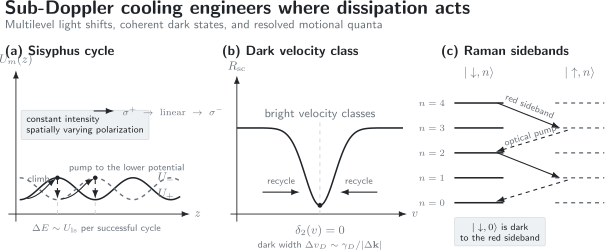
Three different ways to suppress the Doppler floor. In polarization-gradient cooling, optical pumping occurs after an atom climbs a light-shift potential. Dark-state cooling suppresses scattering in a narrow velocity class. Raman sideband cooling removes one trapped motional quantum per cycle and leaves dark.
Scale hierarchy
Section titled “Scale hierarchy”The relevant energy and frequency scales should be written down before a mechanism is named:
Here is the one-photon recoil energy, is a representative differential light-shift depth, is an optical-pumping rate in the far-detuned scaling regime, and is a trap frequency. Numerical factors and Clebsch–Gordan coefficients are transition dependent.
For a broad optical transition,
This separation leaves a large interval between the recoil and Doppler scales. Polarization-gradient cooling commonly occupies that interval. When the distribution approaches a few recoils, momentum changes can no longer be treated as continuous diffusion; dark-state or motional-state descriptions become essential.
Polarization gradients
Section titled “Polarization gradients”Constant intensity does not imply a uniform coupling
Section titled “Constant intensity does not imply a uniform coupling”Consider one-dimensional lin-perpendicular-lin molasses. Two equal-frequency beams propagate along with orthogonal linear polarizations:
Because , the cycle-averaged intensity is independent of :
The normalized Stokes parameters, however, rotate:
Equivalently, up to the convention for handedness,
The polarization changes from linear to circular, back to linear, and then to the opposite circular polarization over a distance . The intensity is flat while the couplings between magnetic sublevels are not.
Position-dependent light shifts
Section titled “Position-dependent light shifts”For atom-minus-laser detuning
red detuning has . In a far-detuned, low-saturation treatment, the ground-state light shift of sublevel is schematically
The sum includes polarization amplitudes, Clebsch–Gordan coefficients, and, when necessary, several excited hyperfine manifolds. The common scalar part does not cool by itself. Cooling comes from differential vector and tensor shifts that make the curves differ.
The same off-resonant coupling produces optical pumping. A representative far-detuned rate scales as
where is a branching factor. Near resonance, the denominator must retain , and interference among excited hyperfine levels may matter.
Sisyphus cooling
Section titled “Sisyphus cooling”The energy ledger
Section titled “The energy ledger”A minimal Sisyphus cycle has four steps:
- the atom occupies a magnetic sublevel whose light shift rises along its trajectory;
- kinetic energy is converted into light-shift potential energy;
- near the crest, optical pumping transfers the atom to a sublevel with a lower local light shift;
- spontaneous emission exports the energy difference, and the cycle repeats.
If the atom climbs through a differential depth before pumping, the mean mechanical energy removed in a successful cycle is of order
This is why the achievable scale is governed by light shifts rather than directly by . Recoil from the pumping photon still heats the motion. The net change per cycle is only favorable when
The spontaneous photon is not an incidental nuisance: it is the irreversible reset that makes repeated downhill transfers possible.
Why timing matters
Section titled “Why timing matters”Let the characteristic polarization period be of order . An atom moving at speed traverses it at rate . Optical pumping acts at rate . Efficient Sisyphus cycles require comparable scales:
If , the atom crosses many hills before its internal state changes. If , it is pumped before climbing appreciably. This gives the rough capture scale
supplemented by the energetic condition that the kinetic energy not greatly exceed the useful potential depth:
These are scaling tests, not universal equalities.
Friction and diffusion
Section titled “Friction and diffusion”At sufficiently low velocity, a polarization-gradient force can again be written
But neither nor the momentum-diffusion coefficient is given by the two-level Doppler expressions. Both must be derived from the multilevel optical Bloch or master equation, including position-dependent couplings and recoil.
In a broad semiclassical Sisyphus regime, a common scaling is
where depends on angular momenta, detuning, polarization geometry, and dimensionality. This scaling explains the often-observed approximately linear dependence of temperature on intensity at low saturation. It should not be promoted to a universal temperature formula.
Lin-perpendicular-lin and circular configurations
Section titled “Lin-perpendicular-lin and circular configurations”The potential-hill picture is clearest for lin-perpendicular-lin light. In a counterpropagating circular-polarization geometry, the local polarization may have constant ellipticity while its orientation or internal-state basis varies. Cooling then involves motion-induced coherences and population transfer among Zeeman sublevels. It is still called polarization-gradient cooling, but a literal scalar hill-and-reset cartoon can be misleading.
The robust statement is:
Motion through a spatially varying multilevel coupling creates a lag between internal-state adaptation and the local dressed-state energy.
That lag can produce friction below the two-level Doppler scale.
Magnetic-field sensitivity
Section titled “Magnetic-field sensitivity”Sub-Doppler coherences and optical pumping operate on scales far smaller than the optical linewidth. A residual magnetic field introduces a Larmor frequency
Cooling is strongly perturbed when becomes comparable to the optical-pumping rate or differential light-shift frequency:
This criterion explains why a field tiny compared with the field required to Zeeman-shift an optical transition by can still destroy sub-Doppler cooling.
Dark-state cooling
Section titled “Dark-state cooling”The Lambda-system dark state
Section titled “The Lambda-system dark state”Consider two ground states coupled to a common excited state:
In the rotating-wave approximation, the interaction is
At two-photon resonance, define
The superposition
obeys
It is dark because the two excitation amplitudes cancel, not because either beam is weak. The orthogonal bright state couples to and scatters.
Velocity selection
Section titled “Velocity selection”For wave vectors and , motion changes the two-photon detuning:
Only a selected velocity class satisfies the dark resonance. If its effective half-width is , the corresponding velocity width scales as
A useful schematic scattering profile is
where is the bright-state scattering scale. Atoms outside the dark window scatter and receive random recoil; some are transferred into the dark velocity class, where scattering is suppressed. Cooling is therefore accumulation in a low-scattering state rather than a simple linear drag.
Ground-state decoherence, differential AC Stark shifts, magnetic-field inhomogeneity, laser phase noise, and collisions all broaden and raise the final kinetic scale.
Velocity-selective coherent population trapping
Section titled “Velocity-selective coherent population trapping”Velocity-selective coherent population trapping, or VSCPT, treats internal and translational states together. In an ideal symmetric one-dimensional model, the dark state near zero mean momentum has the form
The two components absorb into the same excited momentum state, so their amplitudes cancel. Momentum classes away from resonance are bright and are recycled by spontaneous emission.
The resulting distribution can have narrow peaks and long nonthermal tails. Near or below the recoil scale, quoting a single temperature may conceal the relevant physics. Report the momentum distribution, rms width, kinetic energy, and dark-state population.
Gray molasses
Section titled “Gray molasses”Gray molasses combines dark-state protection with polarization-dependent bright-state light shifts. Spatially varying bright and dark eigenstates make moving atoms nonadiabatically enter a bright state, climb a repulsive light-shift landscape, and optically pump back into a dark state. Slow atoms remain dark for longer and scatter less.
In a -enhanced implementation, two optical frequencies address ground hyperfine states through a common excited manifold. Performance is sharply sensitive to the two-photon Raman detuning. The method is especially valuable when unresolved excited structure or small hyperfine splittings make ordinary polarization-gradient cooling inefficient.
Gray molasses is not “Sisyphus cooling without spontaneous emission.” Scattering remains the dissipative reset; the adjective gray means that the low-energy state is weakly coupled rather than uniformly bright.
Raman cooling of free particles
Section titled “Raman cooling of free particles”Two-photon Raman transitions can select velocity much more narrowly than an optical linewidth. For a transition that changes momentum by , energy conservation gives
The last term is the two-photon recoil shift. A cooling sequence uses:
- a velocity-selective Raman pulse that transfers atoms in a chosen moving class to another internal state and changes their momentum toward zero;
- optical pumping that returns the internal state;
- a pulse schedule whose spectral response leaves a narrow dark interval around zero velocity.
The coherent step can remove more directed kinetic energy than the optical pumping step adds on average. By narrowing the unaddressed velocity window over successive pulses, free-particle Raman cooling can produce subrecoil, strongly non-Gaussian distributions.
This is distinct from Raman sideband cooling. Free Raman cooling selects a continuum of velocities. Raman sideband cooling selects discrete vibrational quantum numbers in a trap.
Raman sideband cooling
Section titled “Raman sideband cooling”Resolved motional quanta
Section titled “Resolved motional quanta”Approximate a trapped direction as a harmonic oscillator:
Two long-lived internal states form and . A Raman pair with effective wave-vector difference has Lamb–Dicke parameter
In the Lamb–Dicke regime,
recoil rarely changes the motional state by more than one quantum.
Cooling cycle
Section titled “Cooling cycle”Tune the Raman difference frequency to the red motional sideband:
For small , its Rabi frequency scales as
Optical pumping then resets the internal state,
while approximately preserving in the Lamb–Dicke regime. Each ideal cycle removes . Because
is dark to the red sideband.
The sidebands must be spectrally resolved:
where is the effective linewidth of the Raman or repumping cycle. Otherwise the carrier and blue sideband are driven and heating competes directly with cooling.
Rate model and endpoint
Section titled “Rate model and endpoint”Let and be the single-quantum cooling and heating coefficients. For a thermal-like motional state,
If , the stationary occupation is
The endpoint is therefore set by off-resonant carrier and blue-sideband excitation, repumping recoil, trap-frequency noise, anharmonicity, and background heating. “Ground-state cooled” should be supported by a measured or ground-state probability, not inferred merely from a narrow spatial image.
Sideband thermometry
Section titled “Sideband thermometry”For a thermal oscillator,
In the weak-probe limit, the integrated red- and blue-sideband strengths obey
This asymmetry is a direct motional thermometer when state preparation, probe saturation, line overlap, and detection biases are controlled.
Worked scale audit for rubidium
Section titled “Worked scale audit for rubidium”For the D line, take
The two-level Doppler temperature is
The one-photon recoil scales are
Thus
A measured temperature of is deeply sub-Doppler while still about recoil temperatures. A semiclassical polarization-gradient description may be appropriate there. A distribution with width of order one recoil demands a quantum momentum treatment, and a trapped sample with demands resolved motional-state language. “Sub-Doppler,” “subrecoil,” and “motional ground state” are not synonyms.
Mechanism comparison
Section titled “Mechanism comparison”| Mechanism | Selected coordinate | Dissipative reset | Characteristic endpoint | Necessary signature |
|---|---|---|---|---|
| two-level Doppler | velocity through optical detuning | spontaneous emission | scale | damping plus recoil diffusion |
| polarization-gradient Sisyphus | position and magnetic sublevel | optical pumping | differential light-shift scale | polarization and field dependence |
| gray molasses | local bright/dark dressed state | weak bright-state scattering | dark-resonance width and recoil | sharp Raman-detuning feature |
| VSCPT | internal–momentum superposition | recycling of bright momentum classes | subrecoil width possible | non-Gaussian dark momentum peak |
| free Raman cooling | continuum velocity class | optical pumping between coherent pulses | pulse-defined dark window | velocity-selective Raman spectrum |
| Raman sideband cooling | trapped vibrational number | internal-state repumping | possible | resolved red/blue sideband asymmetry |
The table is a diagnostic map, not a ranking. A practical experiment often uses several rows in sequence: broad-line Doppler capture, polarization- gradient or gray-molasses cooling, trap loading, and then sideband cooling.
Experimental validation
Section titled “Experimental validation”Demonstrate that the sample is actually colder
Section titled “Demonstrate that the sample is actually colder”Use at least one calibrated motional observable:
- time-of-flight expansion;
- release–recapture;
- Doppler or Raman spectroscopy;
- velocity-selective recoil measurements;
- sideband asymmetry;
- spatial width in a calibrated harmonic trap.
At recoil scale, fit the full distribution rather than forcing a Gaussian temperature onto narrow peaks and broad wings.
Vary the mechanism-specific controls
Section titled “Vary the mechanism-specific controls”A sub-Doppler attribution should survive discriminating tests:
- reverse or remove the polarization gradient;
- scan intensity and test light-shift scaling;
- apply a controlled magnetic field;
- scan the two-photon Raman detuning;
- vary the dark time or coherent pulse width;
- change trap frequency and verify resolved-sideband scaling;
- interrupt repumping and test whether cooling stops;
- measure heating after the cooling light is removed.
Account for particle loss and selection
Section titled “Account for particle loss and selection”Cooling can be mimicked by preferential loss of hot particles. Report atom number, phase-space density, capture fraction, and the initial and final distributions. A narrower surviving cloud is not by itself evidence of entropy removal.
Failure modes
Section titled “Failure modes”Calling every low temperature Sisyphus cooling
Section titled “Calling every low temperature Sisyphus cooling”A temperature below establishes that the two-level Doppler model is insufficient. It does not identify the replacement mechanism. Test polarization, magnetic-field, intensity, and Raman-detuning dependence.
Treating the Doppler limit as fundamental
Section titled “Treating the Doppler limit as fundamental”is the equilibrium scale of a declared two-level friction–diffusion model. Multilevel light shifts and dark resonances remove its assumptions.
Treating the recoil temperature as an absolute floor
Section titled “Treating the recoil temperature as an absolute floor”Continual bright-state scattering tends to produce recoil-scale heating, but coherent dark states can suppress scattering for the coldest atoms. Subrecoil distributions are possible. Their quantum and nonthermal nature must be described explicitly.
Ignoring excited hyperfine structure
Section titled “Ignoring excited hyperfine structure”If the detuning is not small compared with excited-state hyperfine splittings, several pathways interfere. A single isolated- model can predict the wrong light shifts, dark states, or cooling sign.
Using a scalar AC Stark shift
Section titled “Using a scalar AC Stark shift”Polarization-gradient cooling depends on differential vector and tensor light shifts and optical pumping. A scalar potential alone cannot encode the internal-state cycle.
Forgetting the magnetic-field scale
Section titled “Forgetting the magnetic-field scale”Comparing a Zeeman shift only with misses the relevant sensitivity. Compare the Larmor frequency with , , and the dark-state linewidth.
Confusing Raman cooling with Raman sideband cooling
Section titled “Confusing Raman cooling with Raman sideband cooling”Free Raman cooling selects velocity classes. Sideband cooling requires a resolved trapped ladder and a Lamb–Dicke parameter. The word Raman names the coherent coupling, not the motional regime.
Inferring ground-state cooling from temperature alone
Section titled “Inferring ground-state cooling from temperature alone”For a quantized trap, the decisive variables are , , and the mode-resolved distribution. A classical temperature can be ambiguous in a nonthermal or anisotropic state.
Analysis workflow
Section titled “Analysis workflow”- State the internal manifold. List , , Zeeman states, branching, and repump pathways.
- Write the optical geometry. Include wave vectors, phases, polarizations, and intensity imbalance.
- Fix detuning conventions. Distinguish one-photon and two-photon detunings.
- Compute local dressed states. Identify light shifts, bright states, and dark states.
- Compare motion with pumping. Evaluate , , , and magnetic precession.
- Choose the motional description. Use semiclassical diffusion only when many recoils occupy the distribution; otherwise retain momentum or trap states.
- Include all heating channels. Recoil, off-resonant excitation, technical noise, collisions, and trap heating belong in the endpoint.
- Predict a discriminating scan. A mechanism claim should imply a measurable dependence that a competing mechanism does not.
References
Section titled “References”- P. D. Lett, R. N. Watts, C. I. Westbrook, W. D. Phillips, P. L. Gould, and H. J. Metcalf, “Observation of atoms laser cooled below the Doppler limit,” Physical Review Letters 61, 169–172 (1988), doi:10.1103/PhysRevLett.61.169.
- J. Dalibard and C. Cohen-Tannoudji, “Laser cooling below the Doppler limit by polarization gradients: simple theoretical models,” Journal of the Optical Society of America B 6, 2023–2045 (1989), doi:10.1364/JOSAB.6.002023.
- Y. Castin, H. Wallis, and J. Dalibard, “Limit of Doppler cooling,” Journal of the Optical Society of America B 6, 2046–2057 (1989), doi:10.1364/JOSAB.6.002046.
- P. J. Ungar, D. S. Weiss, E. Riis, and S. Chu, “Optical molasses and multilevel atoms: theory,” Journal of the Optical Society of America B 6, 2058–2071 (1989), doi:10.1364/JOSAB.6.002058.
- A. Aspect, E. Arimondo, R. Kaiser, N. Vansteenkiste, and C. Cohen-Tannoudji, “Laser cooling below the one-photon recoil energy by velocity-selective coherent population trapping,” Physical Review Letters 61, 826–829 (1988), doi:10.1103/PhysRevLett.61.826.
- M. Kasevich and S. Chu, “Laser cooling below a photon recoil with three-level atoms,” Physical Review Letters 69, 1741–1744 (1992), doi:10.1103/PhysRevLett.69.1741.
- J. Reichel, F. Bardou, M. Ben Dahan, E. Peik, S. Rand, C. Salomon, and C. Cohen-Tannoudji, “Raman cooling of cesium below 3 nK,” Physical Review Letters 75, 4575–4578 (1995), doi:10.1103/PhysRevLett.75.4575.
- C. Monroe, D. M. Meekhof, B. E. King, S. R. Jefferts, W. M. Itano, D. J. Wineland, and P. Gould, “Resolved-sideband Raman cooling of a bound atom to the 3D zero-point energy,” Physical Review Letters 75, 4011–4014 (1995), doi:10.1103/PhysRevLett.75.4011.
- S. E. Hamann, D. L. Haycock, G. Klose, P. H. Pax, I. H. Deutsch, and P. S. Jessen, “Resolved-sideband Raman cooling to the ground state of an optical lattice,” Physical Review Letters 80, 4149–4152 (1998), doi:10.1103/PhysRevLett.80.4149.
- A. T. Grier, I. Ferrier-Barbut, B. S. Rem, M. Delehaye, L. Khaykovich, F. Chevy, and C. Salomon, “-enhanced sub-Doppler cooling of lithium atoms in D gray molasses,” Physical Review A 87, 063411 (2013), doi:10.1103/PhysRevA.87.063411.
- C. N. Cohen-Tannoudji, “Nobel Lecture: Manipulating atoms with photons,” Reviews of Modern Physics 70, 707–719 (1998), doi:10.1103/RevModPhys.70.707.
- W. D. Phillips, “Nobel Lecture: Laser cooling and trapping of neutral atoms,” Reviews of Modern Physics 70, 721–741 (1998), doi:10.1103/RevModPhys.70.721.
- H. J. Metcalf and P. van der Straten, Laser Cooling and Trapping (Springer, 1999), doi:10.1007/978-1-4612-1470-0.
- C. Cohen-Tannoudji and D. Guéry-Odelin, Advances in Atomic Physics: An Overview (World Scientific, 2011), doi:10.1142/6631.
Exercises
Section titled “Exercises”1. Polarization without an intensity gradient
Section titled “1. Polarization without an intensity gradient”For
show that the intensity is constant and derive the circular-component intensities. Identify positions of pure circular polarization.
Solution
Orthogonality eliminates the interference term in the scalar intensity:
Using circular basis vectors, the normalized component intensities are, up to which handedness is called plus,
One component vanishes and the other carries all the intensity when , namely
The handedness alternates between neighboring positions.
2. Energy removed in an ideal Sisyphus cycle
Section titled “2. Energy removed in an ideal Sisyphus cycle”Model two shifted potentials as
An atom begins at a minimum of , climbs to its maximum, and is pumped to . Neglect recoil. How much mechanical energy is removed?
Solution
At a minimum,
At the corresponding crest,
The atom converts of kinetic energy into potential energy while climbing. Optical pumping changes the internal dressed state at fixed position and releases the potential difference to the light field and spontaneously emitted photon. The ideal mechanical energy loss is therefore
Real cycles pump over a distribution of positions and add recoil, so the mean magnitude is smaller.
3. Doppler and recoil scales
Section titled “3. Doppler and recoil scales”Using , , and , calculate , , and their ratio for .
Solution
The wave number is
Then
and
Therefore
The broad transition leaves almost three orders of magnitude between the two-level Doppler and one-photon recoil temperatures.
4. Verify the dark state
Section titled “4. Verify the dark state”For the interaction Hamiltonian in the text, verify that
has no excited-state coupling.
Solution
Only the excitation terms contribute:
The cancellation is coherent. Population loss, dephasing, or unequal two-photon phases can spoil it even when both one-photon couplings remain strong.
5. Dark-resonance velocity width
Section titled “5. Dark-resonance velocity width”Counterpropagating Raman beams have nearly equal wave-number magnitude , so . If the dark resonance has angular-frequency half-width at , estimate the one-dimensional velocity half-width.
Solution
The velocity width is
Using
gives
This is comparable to a single-photon recoil velocity for rubidium, so a continuous classical diffusion model is already becoming questionable.
6. Sideband cooling step
Section titled “6. Sideband cooling step”Show that the Raman transition
followed by recoil-free repumping removes of motional energy. Why does the cycle stop at ?
Solution
The motional energy changes from
to
Their difference is
Ideal repumping changes only the internal state, so this motional reduction survives the reset. The red-sideband matrix element is proportional to and vanishes at ; there is no state .
7. Sideband thermometry
Section titled “7. Sideband thermometry”A weak probe measures
Assuming a thermal mode, find and .
Solution
Let . Since
the mean occupation is
The thermal ground-state probability is
8. Diagnose a mechanism claim
Section titled “8. Diagnose a mechanism claim”An alkali cloud reaches , below its Doppler temperature. The temperature rises sharply with a residual magnetic field, scales nearly linearly with cooling intensity, and changes little when a two-photon Raman detuning is scanned. Which mechanism is best supported, and what additional test would you perform?
Solution
The magnetic sensitivity and approximate light-shift scaling support polarization-gradient Sisyphus cooling. The absence of a narrow two-photon-detuning feature argues against a dark-state mechanism as the dominant effect.
A discriminating test is to change the relative beam polarizations while holding total intensity and one-photon detuning fixed. Suppressing the polarization gradient should weaken the cooling. One should simultaneously measure atom number to rule out velocity-selective loss.