Chemical Potential
Chemical potential is the thermodynamic quantity conjugate to a conserved particle number or charge. It answers several closely related questions:
- how does an equilibrium free energy change when one adds particles under specified conditions?
- how strongly does a reservoir favor one number sector over another?
- which multiplier enforces a prescribed mean number in a maximum-entropy state?
- where does the occupation crossover occur for ideal fermions?
- how close may an ideal-boson reservoir parameter approach the lowest mode?
These are not separate definitions. They are different forms of the same conjugate-variable structure. The important qualifications are the ensemble, the variables held fixed, whether particle number is continuous or integer-valued, and the chosen energy zero.
The slogan “energy required to add one particle” is useful only after those qualifications are supplied. In an interacting system, chemical potential is generally a many-body free-energy difference or derivative, not the energy carried by a particular particle.
Definition at a Glance
Section titled “Definition at a Glance”For a one-component system with internal energy ,
Therefore
Legendre transforms give equivalent derivatives under other reversible constraints:
Here
The symbols beside the derivative are part of the definition. Adding matter at fixed is not the same reversible process as adding it at fixed , even though equilibrium thermodynamics relates the resulting derivatives.
| Setting | Role of |
|---|---|
| macroscopic thermodynamics | derivative of a thermodynamic potential with respect to |
| finite system | addition and removal free-energy differences |
| constrained entropy maximization | Lagrange multiplier for mean particle number |
| grand-canonical ensemble | reservoir control in |
| ideal Fermi gas | center of the thermal occupation crossover |
| ideal Bose gas | parameter bounded above by the lowest mode energy |
| charged matter | chemical contribution to an electrochemical potential |
What “Cost to Add a Particle” Means
Section titled “What “Cost to Add a Particle” Means”At fixed temperature and volume,
reduces to
Thus is the reversible Helmholtz-free-energy change per added particle under those conditions. It includes the energetic and entropic consequences of insertion:
It is therefore not generally a bare interaction energy, kinetic energy, orbital energy, or rest energy. The environment may exchange heat and perform work while the particle is added.
At fixed temperature and pressure,
so is instead the Gibbs-free-energy change per added particle. This is the natural form for phase and chemical equilibrium at fixed .
The phrase “addition energy” should consequently name its conditions. For a small electronic island or quantum dot, a spectroscopic threshold may also include charging energy, level spacing, electrostatic work, and coupling to gates or leads. It need not equal one isolated one-particle eigenvalue.
Integer Particle Number
Section titled “Integer Particle Number”Particle number is discrete in a finite system. Let
be the canonical Helmholtz free energy in the exact -particle sector. Define the removal-side and addition-side chemical potentials by
These need not agree. Their difference,
is a discrete curvature. At zero temperature it becomes an addition–removal or charge-gap diagnostic when is replaced by the ground-state energy .
The smooth derivative
emerges after a suitable interpolation or in a thermodynamic limit where changing by one produces a negligible relative change.
Number-Sector Stability Window
Section titled “Number-Sector Stability Window”In contact with a particle reservoir, compare the sector grand free energies
The sector is favored over both neighbors when
These inequalities are equivalent to
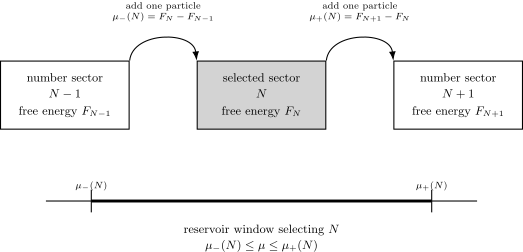
For a finite system, removal and addition thresholds can differ. The sector minimizes against its nearest neighbors when the reservoir parameter lies between and .
If the inequalities are strict and is small compared with both distances to the boundaries, the probability is concentrated near . At a boundary, two neighboring sectors become degenerate in .
This finite interval explains why a gapped system can have no state at energy . Inside an incompressible plateau, changing does not change the equilibrium integer particle number until an addition or removal threshold is crossed.
Chemical Potential as a Lagrange Multiplier
Section titled “Chemical Potential as a Lagrange Multiplier”Suppose the equilibrium state is inferred by maximizing von Neumann entropy subject to normalization, mean energy, and mean particle number:
Extremize the dimensionless functional
Variation with respect to gives
and therefore
The dimensionless multiplier is ; itself has dimensions of energy. Its numerical value is fixed by the mean-number constraint:
This derivation does not make chemical potential arbitrary. The multiplier is determined by the imposed state constraints, just as inverse temperature is determined by the energy constraint.
Maximum Entropy Principle develops the inference argument, independent multipliers, and moment-matching equations in full. The Grand-Canonical Ensemble page owns the complete Fock-space construction and its fluctuation formulas.
Why a Conserved Charge Is Needed
Section titled “Why a Conserved Charge Is Needed”For an ordinary equilibrium chemical potential, the coupled quantity must be conserved by the isolated dynamics:
Then energy and number sectors can be labeled consistently, and a reservoir can exchange the conserved quantity with the system.
More generally, if several commuting conserved charges are constrained, the equilibrium state can take the form
An approximately conserved quantity can support an effective chemical potential over an intermediate timescale. Once reactions or relaxation processes freely change that quantity, its independent multiplier is fixed by the remaining equilibrium constraints and often vanishes.
This distinction matters for quasiparticles. Microscopic atom number may be conserved while phonon number is not. A driven photon population may have a useful effective chemical potential even though blackbody photons in complete thermal equilibrium have .
Grand-Canonical Number Weights
Section titled “Grand-Canonical Number Weights”Decompose the grand partition function into canonical sectors:
Since
the sector probability is
The ratio of neighboring probabilities is
Therefore:
- if , the reservoir suppresses the sector relative to ;
- if , it favors the sector;
- if , the two sectors have equal grand weight before degeneracy factors already contained in are separated out.
For a large smooth system, the dominant sector approximately minimizes
Stationarity gives
This is the bridge between the reservoir multiplier and the free-energy derivative.
Fugacity and Activity
Section titled “Fugacity and Activity”The fugacity is
Then
Because for real , it is often convenient in series expansions and ideal-gas calculations. The mean number follows from
In classical solution thermodynamics, an activity is a dimensionless effective concentration and the chemical potential is commonly written
The standard-state term and the convention used for must be stated. Fugacity and activity encode interactions and reference choices differently in different subfields; neither should be silently identified with a raw particle density.
Exchange Equilibrium
Section titled “Exchange Equilibrium”Consider two subsystems that can exchange energy and particles while the totals are fixed. Their total entropy is
Using
at fixed volume, and
one obtains
Independent exchange equilibrium requires
The more primitive particle-exchange condition is equality of when energy transfer is constrained separately. In ordinary mutual thermal equilibrium, equal temperatures reduce it to equality of chemical potentials.
The phrase “particles flow from high chemical potential to low chemical potential” is an isothermal shorthand. Coupled heat flow, electric work, reaction constraints, and sign conventions for charged carriers can modify the useful transport affinity. Nonequilibrium currents are governed by differences between reservoir parameters and by kinetics, not by equilibrium thermodynamics alone.
Fluctuation and Response
Section titled “Fluctuation and Response”The grand potential is
Its number derivative is
Differentiating again gives
Thus increasing cannot decrease the grand-canonical mean number under the standard equilibrium assumptions. In a homogeneous phase with density , the isothermal compressibility can be written
provided the conventions and other fixed variables are understood.
A plateau of against at zero temperature signals incompressibility. A large derivative signals enhanced number response and, in the grand-canonical ensemble, large number fluctuations. Fluctuations and Susceptibilities develops this structure across energy, number, and magnetization.
Energy-Zero Convention
Section titled “Energy-Zero Convention”For number-conserving matter, shift every one-particle contribution by the same constant . At the many-body level this means
If simultaneously
then
The density operator, occupation factors, and grand partition function are unchanged. Consequently, the absolute sign of is generally not meaningful without an energy-zero convention.
This joint shift is different from adding one global constant to the entire Hamiltonian:
The latter multiplies by and shifts the grand potential, but it leaves the normalized state unchanged without requiring a change in .
Useful physical statements involve differences such as
or a chemical potential relative to a declared band edge, vacuum level, ground-mode energy, or standard state.
Sign in the Grand Hamiltonian
Section titled “Sign in the Grand Hamiltonian”The standard convention is
Positive then favors sectors with larger because their grand energy is lower.
Some sources define a source parameter with the opposite sign, absorb into the Hamiltonian, or use a hole number rather than an electron number. The formulas can all be consistent if the definitions are propagated. Before comparing two expressions, inspect:
- whether the exponential contains or ;
- whether counts particles, holes, charge, or a shifted density;
- whether the one-particle energy zero has been shifted;
- whether or the dimensionless quantity is being differentiated;
- whether electrostatic potential energy has already been included in .
In the Hubbard model, for example,
has particle–hole-symmetric half filling at under standard bipartite assumptions. Rewriting the interaction as
shifts the same symmetric point to a shifted chemical potential of zero. Both statements are correct in their respective conventions.
Chemical and Electrochemical Potentials
Section titled “Chemical and Electrochemical Potentials”For a species with charge in an electrostatic potential , one often defines an electrochemical potential
Its spatial uniformity, rather than that of the chemical contribution alone, characterizes diffusive equilibrium in an electrostatic field.
For electrons, with , so
Voltage, electron energy, conventional current, and electron-number current therefore carry several sign choices. A relation such as
is a convention that must be paired with a definition of and current direction. Mesoscopic Transport states those conventions for reservoir-driven electronic devices.
In solids, the terms chemical potential and Fermi level are sometimes used for the same equilibrium electrochemical energy. In spatially varying or nonequilibrium situations, it is safer to state exactly which quantity is meant.
Fermions
Section titled “Fermions”For an independent fermionic mode of energy ,
At finite temperature,
The chemical potential is the center of the occupation crossover, not the energy possessed by every fermion. Modes well below are nearly occupied and modes well above are nearly empty.
For an ideal fixed-density Fermi gas,
where is the zero-temperature Fermi energy. At nonzero temperature, generally shifts to maintain the prescribed density.
Several distinctions matter:
- Fermi energy usually denotes the ideal or ground-state filling edge at .
- Chemical potential is a thermodynamic derivative or reservoir parameter and can depend on temperature and interactions.
- Fermi level is used variably; in band and device contexts it often means an equilibrium electrochemical potential.
- Quasiparticle energy is an excitation energy in an effective many-body description, often measured relative to .
In an insulator or finite gapped system, may lie anywhere within an interval that leaves the particle number unchanged. No one-particle state need exist at that energy. In an interacting system, addition and removal spectra can have broad continua and different thresholds even though a single equilibrium organizes the thermodynamics.
The occupation-law derivation belongs to Fermi–Dirac Statistics, while the density-dependent low-temperature result belongs to the Ideal Fermi Gas.
Bosons
Section titled “Bosons”For an independent bosonic mode,
The geometric sum defining this expression converges only when
For a finite ideal system with lowest one-particle energy ,
If the energy zero is chosen at the lowest mode, then and the same statement becomes . This negative sign is a convention-dependent consequence of the chosen zero, not a pathology.
At fixed boson number, cooling an ideal gas can drive
while the lowest mode becomes macroscopically occupied. The finite-system inequality remains strict at nonzero temperature; the treatment of a condensate and the equality limit require thermodynamic-limit care.
It is incorrect to conclude that every boson has zero chemical potential. The relevant distinction is number conservation:
- conserved bosonic atoms generally have a nonzero, state-dependent chemical potential;
- equilibrium photons and phonons ordinarily have zero chemical potential because their numbers can change freely;
- driven or approximately conserved quasiparticle populations may admit an effective chemical potential;
- interacting condensates have a thermodynamic chemical potential that need not obey the ideal one-particle bound relative to the same naive energy zero.
For example, in a weakly interacting condensate the Gross–Pitaevskii stationary-state eigenvalue is the many-body chemical potential associated with adding particles. Repulsive interactions can make it positive relative to the bottom of the noninteracting trap. This does not contradict the ideal-gas convergence condition because the interacting Hamiltonian and excitation structure are different.
The mode distribution and its convergence belong to Bose–Einstein Statistics; condensation criteria belong to the Ideal Bose Gas.
Classical Dilute Limit
Section titled “Classical Dilute Limit”When occupations are dilute,
both ideal quantum distributions reduce to
For a homogeneous three-dimensional ideal gas with internal degeneracy ,
where
Hence
In the dilute regime , this expression is negative when the one-particle continuum threshold is chosen as zero. A different energy zero shifts by the same constant.
Classical Limit of Quantum Statistics develops the Maxwell–Boltzmann limit, the energy-zero qualification on , and the leading Bose and Fermi corrections.
Multiple Species and Reactions
Section titled “Multiple Species and Reactions”For several species,
Each independent conserved number has its own chemical potential. If reactions connect the species, only combinations compatible with the conserved charges remain independent.
Consider a reaction written with stoichiometric coefficients :
where products and reactants carry opposite signs by convention. An infinitesimal reaction progress changes
At fixed ,
Chemical equilibrium therefore requires
For a process that freely creates and destroys one unconstrained excitation species, this condition can reduce to . For coupled reactions, individual species may have nonzero chemical potentials while the reaction-weighted combination vanishes.
External Potentials and Local Equilibrium
Section titled “External Potentials and Local Equilibrium”Suppose particles experience an external one-body potential . In a local-density approximation, equilibrium is often expressed as
Equivalently, define the local effective chemical potential
The density at is approximated by that of a homogeneous system at and .
This is an approximation, not a new thermodynamic definition. It requires the external potential and equilibrium density to vary slowly compared with the relevant correlation or microscopic length scales. Near sharp interfaces, critical points, or strongly nonlocal phases, gradient and finite-size effects matter.
Quantum Gases in Traps applies this relation to harmonic Bose and Fermi gases, distinguishes global and local Fermi scales, and states the corresponding semiclassical validity conditions.
Phase Equilibrium
Section titled “Phase Equilibrium”For a one-component material at common temperature and pressure, two phases and coexist when
If one phase had the lower chemical potential, transferring matter into it would lower the appropriate Gibbs free energy until another constraint intervened.
For mixtures, phase equilibrium requires equality of each independently exchangeable species chemical potential across phases:
The full Legendre structure, Gibbs–Duhem relation, and coexistence derivatives belong to Thermodynamic Potentials.
Example: One Fermionic Level
Section titled “Example: One Fermionic Level”For a spinless fermionic level with occupations and energy
the grand energies are
At zero temperature:
- is favored when ;
- is favored when ;
- the two sectors are degenerate when .
At finite temperature,
This equality between a chemical-potential threshold and one orbital energy is special to a noninteracting single-level problem. Adding interactions or additional particles replaces by a many-body free-energy difference.
Example: One Bosonic Level
Section titled “Example: One Bosonic Level”For a bosonic level with ,
The grand sum is
It converges only for
As approaches from below, sectors with arbitrarily large cease to be exponentially suppressed. The divergence is therefore a statement about the entire number-sector sum, not merely a denominator manipulation.
Example: Coulomb-Blockaded Island
Section titled “Example: Coulomb-Blockaded Island”As a schematic model, let an island have electrostatic energy
where is a continuously tunable gate offset. Neighboring addition thresholds are
Their separation is
At low temperature and weak tunneling, the island retains an integer across a finite reservoir-chemical-potential interval. At a degeneracy boundary, sequential tunneling can change the charge. Real devices also involve orbital levels, capacitance conventions, lead coupling, and nonequilibrium rates.
A Practical Diagnostic
Section titled “A Practical Diagnostic”When chemical potential appears in a calculation, ask:
- What does count? Particles, holes, charge, atoms, quasiparticles, or a shifted density?
- Is it conserved? Exactly, approximately, or not at all?
- Which ensemble is used? Fixed , fixed mean , or coupled reservoirs?
- Which potential is differentiated? , , , or a finite-sector free energy?
- What is held fixed? State the derivative subscripts.
- Is discrete? If so, distinguish and .
- What is the energy zero? Quote relative to a declared reference.
- Is the particle charged? Separate chemical and electrostatic contributions.
- Is the system ideal, interacting, or quasiparticle-based? Do not transfer ideal-mode bounds blindly.
- Is the setting equilibrium? Different reservoirs generally imply no single system-wide chemical potential.
Canonical Boundaries
Section titled “Canonical Boundaries”This page owns:
- the unified interpretation of chemical potential;
- derivative, finite-difference, and Lagrange-multiplier forms;
- finite-system addition and removal thresholds;
- energy-zero and sign-convention guidance;
- the conceptual contrast between fermionic, bosonic, and nonconserved excitations;
- brief treatment of electrochemical, reaction, and local chemical potentials.
Other pages own:
- the complete network of thermodynamic potentials and Maxwell relations: Thermodynamic Potentials;
- the Fock-space trace, sector decomposition, and number fluctuations: Grand-Canonical Ensemble;
- equilibrium fluctuation identities and Kubo–Mori covariance: Fluctuations and Susceptibilities;
- named density susceptibility, compressibility normalizations, and local-versus-global source distinctions: Susceptibilities;
- the dilute fugacity and thermal-wavelength criteria: Classical Limit of Quantum Statistics;
- general constrained-entropy inference and multiplier duality: Maximum Entropy Principle;
- occupation-law derivations: Fermi–Dirac Statistics and Bose–Einstein Statistics;
- density-dependent ideal-gas thermodynamics: Ideal Fermi Gas and Ideal Bose Gas;
- the lattice-specific half-filling convention: Hubbard Model;
- atomic occupation intervals and the Mott-lobe convention: Bose–Hubbard Model;
- currents between reservoirs: Mesoscopic Transport.
Common Mistakes
Section titled “Common Mistakes”- Calling the energy of a particular particle.
- Writing “the cost to add a particle” without stating what is held fixed.
- Replacing finite addition and removal differences by one derivative without checking system size.
- Assuming a spectral state must exist at energy .
- Treating a negative chemical potential as unphysical without naming the energy zero.
- Forgetting that requires to preserve .
- Using a chemical potential for a nonconserved excitation number without a timescale or reservoir argument.
- Setting for every bosonic species.
- Applying the ideal-boson bound unchanged to an interacting condensate.
- Assuming always equals the zero-temperature Fermi energy.
- Confusing chemical potential with electrochemical potential for charged matter.
- Reversing signs after switching from electron number to hole number.
- Comparing Hubbard-model values of without checking whether the interaction was particle–hole centered.
- Inferring current direction from equilibrium values while ignoring temperature differences, charge signs, and kinetics.
- Treating the grand-canonical mean as though every number measurement returned that noninteger value.
Exercises
Section titled “Exercises”1. Derivative identities
Section titled “1. Derivative identities”Starting from
derive the chemical-potential derivatives of , , and .
Solution
For ,
Therefore
For ,
so
For ,
hence
2. Finite-sector stability
Section titled “2. Finite-sector stability”Show that the sector minimizes against precisely when
What happens if ?
Solution
Comparing with gives
or
Comparing with gives
or
Both can hold only in the stated interval. If , no reservoir value makes stable against both nearest sectors. The discrete free energy is locally nonconvex, so equilibrium instead favors another sector or a mixture represented by the convex envelope in a macroscopic description.
3. Grand-canonical state
Section titled “3. Grand-canonical state”Maximize von Neumann entropy subject to fixed normalization, mean energy, and mean particle number. Derive the form of and identify the dimensionless number multiplier.
Solution
Vary
The first variation is
Stationarity for arbitrary allowed gives
Writing
produces
The dimensionless number multiplier is .
4. Energy-zero invariance
Section titled “4. Energy-zero invariance”Let and . Show that the grand-canonical state and all ideal-mode occupations are unchanged. Contrast this with .
Solution
For the joint per-particle shift,
The exponential, its trace, and the normalized state are therefore identical. At the mode level,
so Bose–Einstein and Fermi–Dirac occupations are unchanged.
For a global shift,
the Boltzmann operator acquires a scalar factor . It cancels in the normalized density operator but multiplies and shifts by . No change of is needed.
5. One fermionic mode and one bosonic mode
Section titled “5. One fermionic mode and one bosonic mode”For one mode of energy , compare the fermionic and bosonic grand sums. Find their mean occupations and state any restriction on .
Solution
For a fermionic mode, :
Hence
The finite two-term sum converges for every finite real .
For a bosonic mode, :
which requires . Then
The different restriction comes from unbounded bosonic occupation, not from a sign convention alone.
6. Particle exchange
Section titled “6. Particle exchange”Two systems at equal temperature exchange particles while total particle number is fixed. Let . Show that entropy increases when particles move in the direction selected by the chemical-potential difference, and find the equilibrium condition.
Solution
At fixed energy and volume for the particle-transfer step,
Therefore
If , entropy increases for : particles leave and enter under the stated isothermal, energetically decoupled conditions. Equilibrium requires
If energy and particle exchange are coupled, the full entropy differential contains both temperature and chemical-potential affinities.
References
Section titled “References”- H. B. Callen, Thermodynamics and an Introduction to Thermostatistics, 2nd ed., Wiley (1985), especially the treatment of generalized forces, chemical potential, and equilibrium.
- L. D. Landau and E. M. Lifshitz, Statistical Physics, Part 1, 3rd ed., Butterworth–Heinemann (1980), chapters on thermodynamic variables and the grand-canonical distribution.
- R. K. Pathria and P. D. Beale, Statistical Mechanics, 4th ed., Academic Press (2021), chapters on ensembles and ideal quantum gases.
- M. Kardar, Statistical Physics of Particles, Cambridge University Press (2007), chapters on the grand-canonical ensemble and quantum statistics.
- F. Reif, Fundamentals of Statistical and Thermal Physics, Waveland Press (2009 reissue), sections on diffusive equilibrium and chemical potential.
- C. Kittel and H. Kroemer, Thermal Physics, 2nd ed., W. H. Freeman (1980), chapters on chemical potential and ideal gases.
- A. L. Fetter and J. D. Walecka, Quantum Theory of Many-Particle Systems, Dover (2003 reissue), chapters on quantum gases and many-body thermodynamics.
- N. W. Ashcroft and N. D. Mermin, Solid State Physics, Brooks/Cole (1976), discussions of electron chemical potential, Fermi energy, and equilibrium in solids.
- J. W. Gibbs, Elementary Principles in Statistical Mechanics, Yale University Press (1902), the foundational ensemble treatment.