Statistical Ensembles Overview
A statistical ensemble is a rule for assigning a quantum state when only selected macroscopic constraints are controlled. The ensemble determines a density operator, the Hilbert space over which its trace is taken, the quantities that may fluctuate, and the thermodynamic potential adapted to those controls. Use the Quantum Statistical Mechanics gateway for the chapter-wide dependency order and shorter goal routes.
The three standard equilibrium ensembles answer three different physical questions:
- microcanonical: what state represents an isolated system with energy restricted to a narrow shell?
- canonical: what state represents a system that exchanges energy with a reservoir at fixed temperature?
- grand canonical: what state represents a system that exchanges both energy and a conserved particle number with a reservoir?
These are not three microscopic laws. They are three descriptions built from the same Hamiltonian under different constraints and exchange conditions.
Core Comparison
Section titled “Core Comparison”For a system with volume , Hamiltonian , and conserved number operator , the basic map is:
| Ensemble | Controlled quantities | Quantities that fluctuate | Density operator | Trace space | Natural potential |
|---|---|---|---|---|---|
| microcanonical | energy within the chosen shell | fixed- space | entropy | ||
| canonical | energy | fixed- space | Helmholtz free energy | ||
| grand canonical | energy and particle number | Fock space | grand potential |
Here
The symbol denotes the number of states in the microcanonical shell. The separate notation is used for the grand potential so that state counting and thermodynamic potentials are not confused.
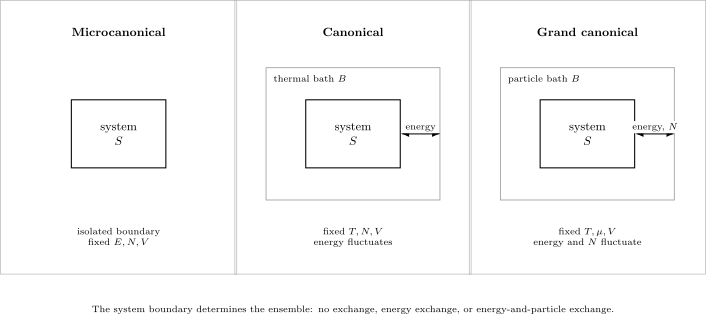
The ensemble follows the permitted exchanges. An isolated system has no reservoir exchange; a canonical system exchanges energy; a grand-canonical system exchanges both energy and a conserved particle number. Volume and other external controls can be generalized separately.
What an Ensemble Is
Section titled “What an Ensemble Is”In quantum mechanics, an ensemble is represented operationally by a density operator . For an observable ,
For a projective measurement with spectral projectors ,
The ensemble therefore specifies the state used in the Born rule. It does not replace the Born rule, and it is not merely a classical list of hidden microscopic states.
The word ensemble is used in two compatible ways:
- as a probability assignment over allowed microscopic states;
- as an imagined collection of identically prepared systems realizing those probabilities.
The first meaning is fundamental for calculation. A laboratory need not contain infinitely many literal copies of the system.
The Constraint–State–Potential Pattern
Section titled “The Constraint–State–Potential Pattern”An equilibrium calculation has three linked layers.
Constraints
Section titled “Constraints”First identify which extensive quantities are fixed exactly and which can be exchanged with an environment. Energy exchange introduces temperature as a control variable. Exchange of a conserved particle number introduces chemical potential.
The constraints determine a normalized density operator. For exponential ensembles this has the general form
where the are constrained observables and the are their conjugate multipliers.
Potential
Section titled “Potential”The logarithm of the normalization generates equilibrium thermodynamics in the variables held fixed by that ensemble. The appropriate potential is not decorative notation: it is the function whose natural variables match the experimental controls.
This pattern is summarized by
The detailed derivative identities live in the pages for each ensemble and in the Ensemble Formula Sheet.
Microcanonical Ensemble
Section titled “Microcanonical Ensemble”The microcanonical ensemble represents an isolated system whose energy is known only to lie in a narrow interval. At fixed particle number, define the spectral projector
The number of states in the shell is
The normalized microcanonical state is
It assigns equal weight to the states in the selected shell:
The associated Boltzmann entropy is
Why an energy shell?
Section titled “Why an energy shell?”For a finite system, the energy spectrum is discrete. Requiring one exact energy may select a single nondegenerate eigenstate, which is usually too narrow to represent a macroscopic energy specification. A shell width is chosen so that:
- is small on the macroscopic energy scale;
- the shell contains many relevant states;
- macroscopic observables are insensitive to modest changes of .
These conditions are limits and modeling choices, not automatic facts for every finite Hamiltonian.
What is fixed?
Section titled “What is fixed?”In the ideal microcanonical construction, , , and the energy shell are fixed. The measured energy can still vary among eigenvalues inside the shell when the shell contains more than one energy. Thus “fixed energy” means restricted to a macroscopically narrow window, not necessarily a delta function at one eigenvalue.
Temperature is derived
Section titled “Temperature is derived”Temperature is not an externally imposed variable in the microcanonical ensemble. It is inferred from the entropy:
Similarly,
These thermodynamic derivatives require an appropriate smooth large-system description. For a small discrete spectrum, finite differences and shell conventions matter.
Canonical boundary
Section titled “Canonical boundary”This overview defines the shell construction only. State counting, entropy definitions, finite-size choices, and isolated-system subtleties belong to the dedicated Microcanonical Ensemble page.
Canonical Ensemble
Section titled “Canonical Ensemble”The canonical ensemble represents a system that exchanges energy with a large thermal reservoir while particle number and external controls remain fixed. Its state is
with
The trace is taken in one fixed- Hilbert space. Energy eigenstates receive Boltzmann weights:
The natural potential is the Helmholtz free energy,
For a simple compressible system,
The canonical ensemble fixes , not the instantaneous energy. Its energy variance is
when has no explicit temperature dependence and the derivative defining is taken at fixed and .
The general Gibbs-operator structure belongs to Thermal Density Operators. Reservoir derivations, fixed- trace conventions, free-energy identities, and energy fluctuations belong to the Canonical Ensemble.
Grand-Canonical Ensemble
Section titled “Grand-Canonical Ensemble”The grand-canonical ensemble represents a system that exchanges both energy and a conserved particle number with a reservoir. Define
The equilibrium state is
where
The trace normally runs over Fock space,
For an equilibrium chemical potential associated with particle number, the standard construction assumes
The natural potential is
Its differential is
The fugacity
organizes the fixed-number sectors:
Both energy and particle number fluctuate. In particular,
The operator controls statistical weights. It is not automatically the physical energy operator that generates real-time evolution. The full Fock-space construction, convergence conditions, sector decomposition, and number fluctuations belong to the Grand-Canonical Ensemble. The derivative, finite-difference, conserved-charge, and sign-convention meanings of belong to Chemical Potential.
One Hamiltonian, Different Trace Domains
Section titled “One Hamiltonian, Different Trace Domains”Choosing an ensemble involves more than changing an exponential.
In a canonical calculation with exactly identical particles,
where is already the bosonic or fermionic -particle space.
In a grand-canonical calculation,
and the trace includes multiple number sectors.
The same formal expression can describe the wrong ensemble if the trace domain is wrong. Writing does not by itself specify whether is fixed.
Exchange Conditions and Reservoirs
Section titled “Exchange Conditions and Reservoirs”The three ensembles can be organized by placing the system inside a larger isolated “universe.”
Isolated total system
Section titled “Isolated total system”If no energy or particles cross the boundary, the total system is described by a microcanonical shell:
Energy reservoir
Section titled “Energy reservoir”Let a small subsystem exchange energy with a much larger bath . For a subsystem energy ,
Expanding the bath entropy to first order gives
Therefore
which yields the canonical ensemble after normalization.
Energy and particle reservoir
Section titled “Energy and particle reservoir”If particles can also move between and , then the bath entropy expansion includes
Because
the subsystem weight becomes
This is the grand-canonical weight.
These reservoir arguments require a bath large enough that its intensive variables change negligibly, weak enough coupling that subsystem energy and particle number are meaningful, and an equilibrium assumption for the composite system.
Maximum Entropy View
Section titled “Maximum Entropy View”The same exponential states follow from constrained entropy maximization. The von Neumann entropy with thermodynamic units is
Maximizing subject to
gives
Adding the mean-number constraint
gives
This establishes the least-committal equilibrium state consistent with the stated expectation values. It does not by itself prove that a particular isolated system dynamically approaches that state. Thermalization is a separate dynamical question. Maximum Entropy Principle owns the general optimization, multiplier duality, exact-versus-mean constraint distinction, and noncommuting-constraint caveats.
Partition Functions as Generating Objects
Section titled “Partition Functions as Generating Objects”The normalization factors contain more than normalization.
For the canonical ensemble,
and
For the grand-canonical ensemble,
and
Second derivatives generate fluctuations and susceptibilities. Derivatives must be taken while holding the correct natural variables fixed. In particular, holding fugacity fixed is not the same operation as holding chemical potential fixed because
The dedicated Partition Functions page owns the systematic trace, factorization, and generating-function treatment. Fluctuations and Susceptibilities develops the static response interpretation, ensemble dependence, and noncommuting quantum correction.
Ensemble Choice Is a Physical Choice
Section titled “Ensemble Choice Is a Physical Choice”Convenience matters, but the physical constraints come first.
Use the microcanonical ensemble when
Section titled “Use the microcanonical ensemble when”- the system is isolated to the desired accuracy;
- total energy and conserved particle number are sharply constrained;
- state counting or entropy as a function of energy is central;
- the finite-width energy shell is specified.
Use the canonical ensemble when
Section titled “Use the canonical ensemble when”- the system exchanges energy with a thermal environment;
- temperature is controlled;
- particle number is fixed;
- the Helmholtz free energy is the natural potential.
Use the grand-canonical ensemble when
Section titled “Use the grand-canonical ensemble when”- both energy and a conserved particle number can be exchanged;
- temperature and chemical potential are controlled;
- occupation-number factorization is useful;
- local subsystems are studied inside a much larger number-conserving system.
Do not force an equilibrium ensemble when
Section titled “Do not force an equilibrium ensemble when”- the preparation is a known pure state;
- the system is undergoing a quench or driven evolution;
- additional conserved quantities remain relevant;
- strong system–bath coupling invalidates the bare subsystem Gibbs state;
- no normalizable partition function exists.
An equilibrium ensemble can still approximate selected observables in some of these situations, but that is a conclusion to test, not a definition to assume.
A Selection Workflow
Section titled “A Selection Workflow”For a new problem:
- Write the Hamiltonian and conserved charges. State whether and identify other exact constraints.
- Draw the system boundary. Decide whether energy, particles, volume, magnetization, or other quantities cross it.
- List controlled intensive variables. Examples include , , pressure, and external field.
- Choose the trace space. Distinguish a fixed- Hilbert space from Fock space.
- Write the normalized state. Verify positivity, unit trace, and convergence of the normalization.
- Match the thermodynamic potential. Use entropy, Helmholtz free energy, or grand potential according to the natural variables.
- Check the finite-size regime. Do not invoke ensemble equivalence before identifying the thermodynamic limit.
- Validate against the preparation. An ensemble is useful only if its constraints and observables match the physical question.
Examples
Section titled “Examples”A spin in a thermal environment
Section titled “A spin in a thermal environment”Consider
If the spin is weakly coupled to a heat bath at temperature , the canonical state is
The energies fluctuate between and . Calling the state microcanonical merely because the Hamiltonian has discrete eigenvalues would be incorrect; the bath and controlled temperature select the canonical ensemble.
If the spin is isolated and prepared in one exact nondegenerate energy eigenstate, its exact-energy microcanonical projector is that pure state. This finite example shows why the thermodynamic meaning of a “microcanonical shell” is richer in a large many-body spectrum.
A fixed-number optical lattice
Section titled “A fixed-number optical lattice”Suppose atoms occupy a lattice described by a number-conserving Hamiltonian. A calculation for the complete isolated cloud at fixed should use the fixed-number sector:
A small region of the cloud can exchange particles with the remainder. Its reduced equilibrium state may be well approximated by a grand-canonical state with an effective , even though the total cloud has exactly fixed particle number.
There is no contradiction. Global and subsystem constraints are different.
A quantum dot connected to leads
Section titled “A quantum dot connected to leads”A quantum dot weakly coupled to large leads at temperature and chemical potential exchanges both energy and charge. The grand-canonical ensemble is the natural equilibrium reference state.
Under a voltage bias, however, the leads have different chemical potentials. The steady state is nonequilibrium and cannot be represented by one global grand-canonical density operator with a single .
Finite Systems and the Thermodynamic Limit
Section titled “Finite Systems and the Thermodynamic Limit”For a finite system, the three ensembles are genuinely different density operators.
In the microcanonical ensemble,
with the precise bound determined by the shell convention.
In the canonical ensemble,
In the grand-canonical ensemble, particle number also fluctuates:
unless the state is supported in one number sector.
For regular short-range systems, matching thermodynamic parameters often makes local observables agree in the thermodynamic limit. If
then
Relative energy fluctuations vanish even though the canonical energy is not exactly fixed.
What Ensemble Equivalence Does Not Mean
Section titled “What Ensemble Equivalence Does Not Mean”Ensemble equivalence does not say that the density operators become identical in every sense. It usually concerns thermodynamic functions or sufficiently local observables after parameters are matched.
Differences can remain in:
- exact global conservation laws;
- fluctuations of extensive quantities;
- finite-size corrections;
- rare-event probabilities;
- observables that scale with the full system size.
Equivalence can fail or require qualification for:
- finite systems;
- long-range or nonadditive interactions;
- nonconcave entropy functions;
- phase coexistence and first-order transitions;
- constrained or fragmented Hilbert spaces;
- integrable systems with additional conserved charges.
The Thermodynamic Limit page explains the limiting procedure. Ensemble Equivalence owns the precise thermodynamic, macrostate, local-state, fluctuation, and failure criteria.
Equilibrium State Versus Thermalization
Section titled “Equilibrium State Versus Thermalization”An ensemble specifies an equilibrium state. Thermalization asks whether dynamics makes selected observables approach predictions of such a state.
For a closed system evolving unitarily,
the von Neumann entropy of the complete state is constant:
Nevertheless, local observables can relax, reduced states can become approximately thermal, and coarse-grained entropy can increase. Those statements require dynamical reasoning involving dephasing, typicality, chaos, integrability, or open-system coupling.
Do not infer thermalization solely from the existence of a Gibbs state.
Thermal Entropy Is Not Entanglement Entropy
Section titled “Thermal Entropy Is Not Entanglement Entropy”For a thermal density operator,
is the thermodynamic entropy when the equilibrium identification is valid.
For a pure bipartite state ,
measures entanglement across the partition, with no factor of in the common information-theory convention.
A global thermal state can have both thermal mixedness and spatial entanglement. The concepts should not be interchanged merely because both use the von Neumann formula.
Beyond the Three Standard Ensembles
Section titled “Beyond the Three Standard Ensembles”Other controls lead to other ensembles:
- fixed temperature and pressure lead to an isothermal–isobaric ensemble;
- fixed temperature and external field lead to magnetic ensembles;
- multiple conserved charges lead to generalized Gibbs ensembles;
- rotation introduces angular-velocity multipliers;
- nonequilibrium steady states require frameworks beyond equilibrium ensembles.
A generalized exponential state may be written
When the charges do not commute, derivative and covariance identities require care; ordinary scalar probability manipulations need not transfer unchanged. The standard microcanonical, canonical, and grand-canonical ensembles remain the foundational cases.
Canonical Boundaries
Section titled “Canonical Boundaries”This page owns:
- the conceptual comparison of the three standard ensembles;
- the relation among constraints, exchanges, trace spaces, fluctuations, and potentials;
- a practical ensemble-selection workflow;
- the distinction between ensemble choice, thermalization, and ensemble equivalence.
Other pages own:
- energy shells, state counting, and microcanonical entropy: Microcanonical Ensemble;
- Gibbs operators and their spectral properties: Thermal Density Operators;
- fixed- free-energy identities and energy fluctuations: Canonical Ensemble;
- particle exchange, fugacity, number fluctuations, and grand-potential identities: Grand-Canonical Ensemble;
- natural variables and systematic Legendre transforms: Thermodynamic Potentials;
- thermal, information-theoretic, entanglement, and coarse-grained entropy distinctions: Entropy in Quantum Statistical Mechanics;
- general constrained-entropy inference and exponential families: Maximum Entropy Principle;
- derivative and cumulant formulas: Partition Functions and Fluctuations and Susceptibilities;
- isolated-system relaxation, ETH, and generalized equilibrium: Nonequilibrium Many-Body Dynamics;
- heat, work, entropy production, and operational thermodynamics: Quantum Thermodynamics.
Common Mistakes
Section titled “Common Mistakes”Identifying an ensemble from the exponential alone
Section titled “Identifying an ensemble from the exponential alone”The trace domain and exact constraints matter. A fixed- trace of is canonical; a Fock-space trace of is grand canonical.
Saying energy is fixed canonically
Section titled “Saying energy is fixed canonically”Temperature is fixed canonically. Energy fluctuates.
Treating chemical potential as a one-particle energy level
Section titled “Treating chemical potential as a one-particle energy level”Chemical potential is conjugate to a conserved number. It enters the statistical weight as .
Using the grand Hamiltonian as the real-time Hamiltonian
Section titled “Using the grand Hamiltonian as the real-time Hamiltonian”organizes equilibrium weights. Real-time evolution is generated by the physical Hamiltonian unless a specified rotating-frame or effective description changes the generator.
Assuming ensembles are equivalent for small systems
Section titled “Assuming ensembles are equivalent for small systems”Equivalence is generally a thermodynamic-limit statement with hypotheses. Finite-system distributions can differ strongly.
Equating maximum entropy with a thermalization proof
Section titled “Equating maximum entropy with a thermalization proof”Maximum entropy selects a state from constraints. It does not establish the dynamics by which a particular system reaches equilibrium.
Forgetting the shell width
Section titled “Forgetting the shell width”A microcanonical state for a finite quantum spectrum requires an exact energy projector or a stated energy window. The result can depend on that choice.
Mixing thermal and entanglement entropy
Section titled “Mixing thermal and entanglement entropy”The same functional form does not imply the same physical role.
Exercises
Section titled “Exercises”Classify four preparations
Section titled “Classify four preparations”Identify the most appropriate equilibrium description, or explain why none is exact:
- a sealed many-body system with sharply specified total energy and particle number;
- a fixed-number spin sample weakly coupled to a thermostat;
- a quantum dot weakly coupled to one equilibrium particle reservoir;
- an isolated pure state immediately after a sudden quench.
Solution
- The microcanonical ensemble is appropriate when the energy shell and fixed particle number are specified.
- The canonical ensemble is appropriate: energy can be exchanged, while particle number is fixed.
- The grand-canonical ensemble is the equilibrium reference: both energy and particle number can be exchanged.
- The exact state is the unitarily evolving pure state, not an equilibrium ensemble. At late times, selected observables may agree with an equilibrium or generalized ensemble, but that requires a thermalization analysis.
Trace-space diagnostic
Section titled “Trace-space diagnostic”A number-conserving Hamiltonian has fixed-sector partition functions
Show how the grand partition function is assembled from these sectors and identify the variable conjugate to .
Solution
Fock space is the direct sum
Therefore
where
The chemical potential is conjugate to particle number; equivalently, fugacity counts number sectors in the generating function.
Derive the canonical weight
Section titled “Derive the canonical weight”Let a subsystem have energy and let the bath multiplicity be . Derive the Boltzmann factor to first order in .
Solution
Write
For a bath much larger than the subsystem,
Using
gives
Normalizing over subsystem states produces the canonical probabilities.
Relative energy fluctuations
Section titled “Relative energy fluctuations”Assume a canonical short-range system has
where and remain finite as . Determine the scaling of the relative root-mean-square energy fluctuation.
Solution
The canonical fluctuation identity gives
Hence
Because ,
Relative fluctuations vanish in the thermodynamic limit, helping explain equivalence for many local thermodynamic predictions. The absolute fluctuation still grows as , and the canonical state never acquires an exactly fixed global energy.
A local grand-canonical state from a fixed total number
Section titled “A local grand-canonical state from a fixed total number”Let a total system have exactly particles. Explain how subsystem can nevertheless be approximately grand canonical.
Solution
Although
is fixed, the subsystem number can fluctuate because particles move between and . If is much larger and remains near equilibrium, its entropy expansion for a transfer of energy and particles supplies the weight
Thus the reduced equilibrium state of can be approximately grand canonical. Exact total-number conservation is fully compatible with local number fluctuations.
Ensemble and measurement uncertainty
Section titled “Ensemble and measurement uncertainty”Suppose a canonical state is diagonal in the energy basis:
For an observable that does not commute with , write the probability of outcome and explain the two sources of uncertainty.
Solution
If is the projector for outcome , then
The weights express the thermal mixture over energy states. For each energy state, the factor
is the Born probability for the measurement of . When , an energy eigenstate need not give a definite value of . Statistical uncertainty in the state and quantum measurement uncertainty can therefore appear in the same prediction.
Cross-Links
Section titled “Cross-Links”- Microcanonical Ensemble
- Thermal Density Operators
- Canonical Ensemble
- Grand-Canonical Ensemble
- Partition Functions
- Thermodynamic Potentials
- Entropy in Quantum Statistical Mechanics
- Maximum Entropy Principle
- Chemical Potential
- Ensemble Equivalence
- Ensemble Formula Sheet
- Thermodynamic Limit
- Density Operators
- Trace Rule for Expectation Values
- Entropy Overview
- Quantum Statistics Overview
- Maxwell–Boltzmann Limit
- Bose–Einstein Statistics
- Fermi–Dirac Statistics
- Fock Space and Occupation Number
- Baths and Reservoirs
- Quantum Thermodynamics
- Statistical Mechanics Checklist
References
Section titled “References”- R. K. Pathria and P. D. Beale, Statistical Mechanics, 4th ed., Elsevier (2021), especially the ensemble formulation and quantum-statistics chapters.
- M. Kardar, Statistical Physics of Particles, Cambridge University Press (2007), chapters 1–4.
- K. Huang, Statistical Mechanics, 2nd ed., Wiley (1987), chapters 6–9.
- H. B. Callen, Thermodynamics and an Introduction to Thermostatistics, 2nd ed., Wiley (1985), chapters 1–7.
- L. D. Landau and E. M. Lifshitz, Statistical Physics, Part 1, 3rd ed., Butterworth–Heinemann (1980), sections 1–35.
- E. T. Jaynes, “Information Theory and Statistical Mechanics”, Physical Review 106, 620–630 (1957).
- D. Ruelle, Statistical Mechanics: Rigorous Results, W. A. Benjamin (1969), chapters 1–3.
- H. Tasaki, Physics and Mathematics of Quantum Many-Body Systems, Springer (2020), introductory discussion of many-body systems and thermodynamic limits.