Tight-Binding Dimer
The tight-binding dimer is the simplest lattice Hamiltonian: one particle can occupy either of two localized site orbitals and can hop between them. It is the two-site version of the same two-level algebra used for coupled wells, but the language is that of lattice sites, hopping amplitudes, and bonding or antibonding orbitals.
The dimer is important because it is the smallest model in which a localized basis and an energy eigenbasis are visibly different. Longer chains and their bands are developed in Tight-Binding Model; interacting many-particle versions lead toward Hubbard models. This page keeps the one-particle two-site problem as the wave-mechanics first encounter.
Site Basis
Section titled “Site Basis”Choose two orthonormal localized orbitals
They may represent two atoms in a molecule, two wells in a double-well device, two quantum dots, or two localized Wannier-like orbitals in a larger lattice. In the one-particle sector, the state is
H₂⁺ Ion gives a microscopic molecular realization. Its gerade–ungerade pair becomes an orthonormal localized pair under a basis rotation, while the raw atom-centered functions overlap and must first be treated with a generalized eigenproblem.
The tight-binding approximation keeps only a small number of localized orbitals and represents motion between them by matrix elements. For the dimer, the Hamiltonian is
with in the standard sign convention. In matrix form,
The diagonal entries are onsite energies. The off-diagonal entries are hopping amplitudes. Hopping is coherent Hamiltonian coupling, not a classical random jump.
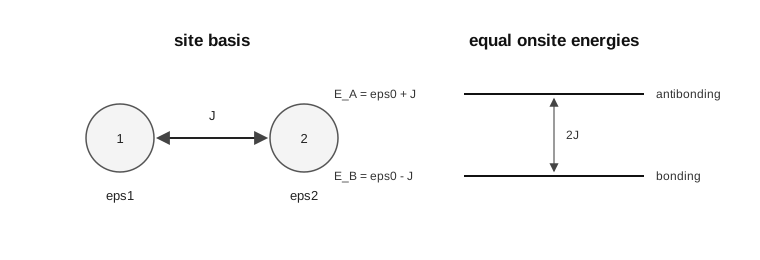
The tight-binding dimer has two localized site orbitals with onsite energies and hopping amplitude . For equal onsite energies, the eigenstates are bonding and antibonding superpositions.
Symmetric Dimer
Section titled “Symmetric Dimer”For equal onsite energies,
the Hamiltonian is
The eigenstates are the bonding state
and the antibonding state
Their energies are
Thus the splitting is
With this sign convention, the bonding state is lower. Changing the sign convention for the hopping changes which displayed superposition is called bonding, but not the physical spectrum once the convention is used consistently.
Biased Dimer
Section titled “Biased Dimer”If the two sites have different onsite energies, define
Then
The energies are
This is the same avoided-crossing formula as the coupled-well model, with the hopping playing the role of the tunneling matrix element. When , the onsite energies cross as changes sign. When , the minimum gap is .
The lower eigenstate is mostly on the lower onsite-energy site far from the crossing. Near , the eigenstates are strongly delocalized over both sites.
Coherent Site Oscillation
Section titled “Coherent Site Oscillation”For the symmetric dimer, suppose the particle starts on site :
Because
the bonding and antibonding components acquire different phases. The probability to find the particle on site at time is
This is the same coherent oscillation as a symmetric double well. Tight-binding language calls the off-diagonal coupling hopping; wave-mechanics language calls it tunneling. In a closed two-site Hamiltonian, both words describe coherent unitary evolution.
Second-Quantized Form
Section titled “Second-Quantized Form”The same one-particle Hamiltonian is often written with creation and annihilation operators:
In the one-particle sector, the basis states are
Acting on this sector, the second-quantized Hamiltonian has exactly the same two-by-two matrix as above. For one particle, bosonic or fermionic statistics do not change this matrix. Statistics and interactions become essential when more particles can occupy the two sites.
The many-particle notation is developed in Occupation-Number Basis and Many-Particle Hamiltonians.
Complex Hopping And Gauge Phase
Section titled “Complex Hopping And Gauge Phase”One may write a more general hopping term as
For an isolated two-site dimer, this phase can be removed by redefining the phase of one site orbital. Therefore the spectrum depends only on .
In a lattice with closed loops, not all hopping phases can be removed at once. Gauge-invariant phases around loops encode magnetic flux and become physically meaningful. That physics belongs to larger tight-binding and quantum-matter models, not to the isolated dimer.
Relation To Coupled Wells
Section titled “Relation To Coupled Wells”The tight-binding dimer and the coupled double-well model are the same effective Hamiltonian in different language:
and
The dimer terminology emphasizes lattice sites and hopping. The coupled-well terminology emphasizes localized wavefunctions and tunneling through a barrier. Both teach that energy eigenstates are generally superpositions of localized basis states.
Common Mistakes
Section titled “Common Mistakes”- Treating the site basis as the energy eigenbasis when .
- Interpreting hopping as irreversible motion rather than coherent Hamiltonian coupling.
- Forgetting that the sign of is partly a convention for a two-site isolated problem.
- Confusing the one-particle dimer with an interacting two-site Hubbard dimer.
- Applying the two-site spectrum to a long chain without accounting for boundary conditions and additional momentum states.
- Ignoring onsite-energy bias, which can localize eigenstates even when hopping is nonzero.
Where This Is Used
Section titled “Where This Is Used”- Coupled Wells and Avoided Crossings gives the wave-mechanics tunneling version of the same matrix.
- Two-State Hamiltonians gives the general diagonalization.
- Pauli-Matrix Hamiltonians writes the dimer as .
- Landau–Zener Problem: First Encounter sweeps a two-level detuning through an avoided crossing.
- Double-Well Potential explains how localized left-right states arise from a continuous potential.
- Many-Particle Hamiltonians introduces hopping terms in second quantization.
- Tight-Binding Model extends the dimer to chains, graphs, boundary conditions, and bands.
- Hubbard Model adds spin, onsite interaction, and many-particle sectors to the two-site hopping problem.
References
Section titled “References”- N. W. Ashcroft and N. D. Mermin, Solid State Physics, Holt, Rinehart and Winston, 1976.
- C. Kittel, Introduction to Solid State Physics, 8th ed., Wiley, 2005.
- M. P. Marder, Condensed Matter Physics, 2nd ed., Wiley, 2010.
- R. Shankar, Principles of Quantum Mechanics, 2nd ed., Springer, 1994.
- D. J. Griffiths and D. F. Schroeter, Introduction to Quantum Mechanics, 3rd ed., Cambridge University Press, 2018.
Exercises
Section titled “Exercises”- Diagonalize the symmetric dimer Hamiltonian
Solution
The vector has eigenvalue
and the vector has eigenvalue
Thus
- Show that the biased dimer has minimum gap .
Solution
The eigenvalues are
The gap is
This is minimized at , where
- For the symmetric dimer, find the first time at which a particle initially on site is certainly on site .
Solution
The site- probability is
The first maximum occurs when
Therefore
- Verify the one-particle matrix from the second-quantized hopping term.
Solution
Use the one-particle basis
The onsite terms give
The hopping term gives
Therefore the one-particle matrix is