Landau–Zener Problem: First Encounter
The Landau–Zener problem is the standard first model of a two-level avoided crossing swept in time. It asks a simple dynamical question: if the Hamiltonian changes from one side of an avoided crossing to the other, does the state follow the instantaneous energy eigenstate, or does it jump to the other branch?
This page states the model and the probability formula without deriving the asymptotics. The graduate treatment and derivation context belong to Landau–Zener Transition.
The Model Hamiltonian
Section titled “The Model Hamiltonian”Use the time-dependent two-level Hamiltonian
Equivalently,
The fixed basis in which the diagonal entries are is called the diabatic basis. If , the two diabatic energies cross at . If , the crossing is avoided.
The parameter is the rate of change of the diabatic energy difference, and is the coupling that opens the gap.
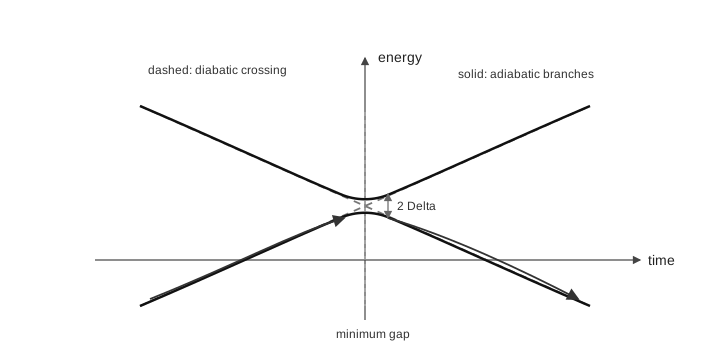
In the Landau–Zener problem, the diabatic energies are swept linearly through a crossing. Coupling turns the crossing into an avoided crossing with minimum gap .
Instantaneous Energies
Section titled “Instantaneous Energies”The instantaneous eigenvalues are
The gap is
It is smallest at , where
Far before and far after the crossing, where , the instantaneous eigenstates are almost diabatic. Near , the two basis states mix strongly.
Diabatic And Adiabatic States
Section titled “Diabatic And Adiabatic States”The diabatic states are the fixed basis states. They are the states that would cross if the coupling vanished.
The adiabatic states are the instantaneous eigenstates of . Their energies avoid crossing. If the system is changed slowly enough and starts in an adiabatic eigenstate far before the crossing, it tends to remain on the corresponding adiabatic branch.
The words “jump” and “stay” are basis-dependent. A state that follows an adiabatic branch changes its diabatic character across the crossing. A state that stays close to one diabatic basis vector may end on the other adiabatic branch. This is why Landau–Zener probabilities must always specify the basis convention.
Probability Statement
Section titled “Probability Statement”In the convention above, suppose the system starts in one instantaneous adiabatic eigenstate at . The probability to make a nonadiabatic transition to the other adiabatic branch after the sweep is
The probability of adiabatic following is therefore
The dimensionless control parameter is
Large means a large gap or a slow sweep. Then is small, so adiabatic following is likely. Small means a small gap or a fast sweep. Then nonadiabatic behavior is likely.
Bloch-Sphere Picture
Section titled “Bloch-Sphere Picture”The Hamiltonian has effective field
On the Bloch sphere, the instantaneous energy eigenstates point along . As passes through zero, the field direction rotates from nearly to nearly , passing through the direction near the minimum gap.
If the field direction changes slowly compared with the level splitting, the Bloch vector can track it. If it changes too quickly near the minimum gap, the state cannot adjust adiabatically and a transition occurs.
This picture is qualitative here; the exact exponential probability comes from the solvable Landau–Zener model.
Physical Meaning
Section titled “Physical Meaning”The Landau–Zener model is useful whenever a control parameter sweeps a two-level system through an isolated avoided crossing. Examples include:
- a tilted double well whose bias is ramped through zero;
- a spin- system in a magnetic field whose longitudinal component changes sign;
- molecular or atomic energy curves near an avoided crossing;
- charge or flux states in a controllable superconducting circuit;
- two quantum-dot levels tuned through resonance.
The model does not say that every sweep is Landau–Zener. It assumes that the crossing is effectively isolated, the detuning is approximately linear near the crossing, the coupling is approximately constant, and coherent two-level dynamics are a good approximation.
Relation To Static Avoided Crossings
Section titled “Relation To Static Avoided Crossings”Coupled Wells and Avoided Crossings describes the spectrum as a static function of a bias. The Landau–Zener problem adds time:
The static minimum gap controls the dynamical transition probability. A larger gap makes adiabatic following easier; a faster sweep makes it harder.
Common Mistakes
Section titled “Common Mistakes”- Quoting the Landau–Zener probability without saying whether it refers to adiabatic or diabatic labels.
- Forgetting that is the slope of the diabatic energy difference in this convention.
- Treating a slow finite sweep as perfectly adiabatic without checking the minimum gap.
- Applying the formula when additional nearby levels participate.
- Ignoring decoherence, relaxation, or noise in experimental systems.
- Confusing the static avoided-crossing diagram with the dynamical transition probability.
Where This Is Used
Section titled “Where This Is Used”- Coupled Wells and Avoided Crossings gives the static wave-mechanics picture.
- Pauli-Matrix Hamiltonians gives the effective-field notation used here.
- Bloch Sphere: Wave-Mechanics Perspective explains two-level motion as Bloch-vector rotation.
- Landau–Zener Transition gives the canonical advanced treatment.
- Landau–Zener Transition Worked Example carries out a convention audit and direct numerical propagation.
References
Section titled “References”- L. D. Landau, “Zur Theorie der Energieübertragung. II,” Physikalische Zeitschrift der Sowjetunion 2, 46-51, 1932.
- C. Zener, “Non-adiabatic crossing of energy levels,” Proceedings of the Royal Society A 137, 696-702, 1932.
- E. C. G. Stueckelberg, “Theorie der unelastischen Stosse zwischen Atomen,” Helvetica Physica Acta 5, 369-422, 1932.
- L. D. Landau and E. M. Lifshitz, Quantum Mechanics: Non-Relativistic Theory, 3rd ed., Pergamon, 1977.
- J. J. Sakurai and J. Napolitano, Modern Quantum Mechanics, 3rd ed., Cambridge University Press, 2020.
Exercises
Section titled “Exercises”- Derive the instantaneous eigenvalues of
Solution
The trace is zero, so the eigenvalues are for some . The determinant condition gives
Therefore
- What happens to if the sweep rate is made smaller while is fixed?
Solution
The probability is
Making smaller makes the exponent more negative, so decreases. The sweep becomes more adiabatic.
- The minimum gap is doubled while is fixed. How does the exponent in change?
Solution
The minimum gap is . Doubling the gap means doubling . Since the exponent contains , its magnitude increases by a factor of four:
The nonadiabatic probability is therefore exponentially smaller.
- Why can the same sweep be described as adiabatic following in one basis and changing diabatic character in another?
Solution
The adiabatic basis is the instantaneous energy eigenbasis, which changes with time. The diabatic basis is fixed. Across an avoided crossing, an adiabatic eigenstate smoothly changes from being close to one diabatic state to being close to the other. Thus following an adiabatic branch can look like changing diabatic character.