Coupled Wells and Avoided Crossings
Coupled wells give a concrete wave-mechanics origin for two-level Hamiltonians. Start with two states localized in separated wells, allow a small tunneling matrix element between them, and then vary a bias that raises one well relative to the other. Without tunneling, the two localized energies can cross. With tunneling, the exact energies repel and form an avoided crossing.
This page is the static energy-level picture. Time-dependent passage through such a crossing is introduced in Landau–Zener Problem: First Encounter.
Localized Basis
Section titled “Localized Basis”Let and denote approximate low-energy states localized in the left and right wells. They are useful when the barrier is high enough that each well still looks like an identifiable subsystem.
Project the full Hamiltonian into the subspace spanned by these two states. After choosing phases so the tunneling amplitude is real, the effective Hamiltonian is
Here and are the energies of the localized states before mixing, while measures tunneling through the barrier. The minus sign is a convention chosen so that, for a symmetric double well, the symmetric combination is lower in energy.
If and are not exactly orthogonal, one should first orthonormalize the two-state subspace or solve the corresponding generalized eigenvalue problem. The simple matrix above assumes that this cleanup has already been done.
Symmetric Limit
Section titled “Symmetric Limit”For a symmetric double well,
Then
The eigenstates are
and
with energies
The splitting is
This is the two-state version of the even-odd splitting explained in Double-Well Potential.
Adding A Bias
Section titled “Adding A Bias”A bias tilts the two wells so their localized energies are no longer equal. Define
Then
This is exactly the Pauli-matrix form of a two-level Hamiltonian, with effective vector
The exact eigenvalues are
When , the energies are just and , so they cross when . When , the minimum gap is
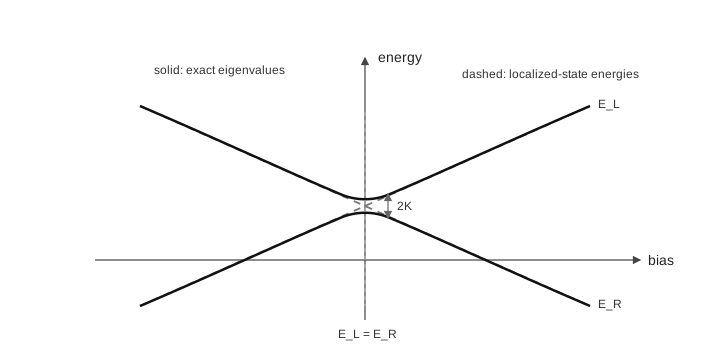
The dashed curves are localized-state energies that would cross if the tunneling matrix element vanished. The solid curves are the exact two-level eigenvalues for , with minimum gap .
Diabatic And Adiabatic Labels
Section titled “Diabatic And Adiabatic Labels”The localized states and are often called diabatic states in avoided-crossing language. Their unmixed energies and are the dashed curves in the figure.
The exact instantaneous eigenstates of are called adiabatic states. They are the solid curves. Far from the crossing, where
the adiabatic states are almost localized. Near the crossing, where , the two wells strongly mix.
For the lower energy eigenstate, the probability of occupying the left localized state is
Thus, as the bias passes through , the lower adiabatic state changes character from mostly left-localized to mostly right-localized. The change is smooth when and abrupt only in the uncoupled limit .
Wave-Mechanics Meaning Of The Coupling
Section titled “Wave-Mechanics Meaning Of The Coupling”The matrix element is controlled by the overlap of the localized wavefunctions in the barrier region. Schematic notation writes
after the phase convention above has been chosen.
For a high and wide barrier, this overlap is small. Semiclassically, it is often exponentially suppressed:
where is a barrier action and is a prefactor. This page uses only the consequence: the avoided-crossing gap is small when the barrier weakly couples the wells.
The detailed Herring, WKB, and instanton estimates for the coupling belong to Tunneling Splittings.
Physical Interpretation
Section titled “Physical Interpretation”Coupled-well avoided crossings appear whenever a control parameter changes which localized configuration is energetically favorable while tunneling keeps the two configurations connected. Examples include:
- a double well tilted by an electric field or mechanical force;
- molecular inversion coordinates with a symmetry-breaking bias;
- semiconductor double quantum wells with gate-controlled detuning;
- superconducting circuits whose effective potential has two relevant minima;
- cold-atom double wells with adjustable barrier height and bias.
The microscopic systems differ, but the two numbers that matter near an isolated crossing are the detuning and the coupling .
Relation To Dynamics
Section titled “Relation To Dynamics”The avoided-crossing diagram by itself is a spectrum as a function of a parameter. If the parameter is slowly changed in time, the system may follow an adiabatic branch. If it is changed quickly, the state may remain close to a diabatic localized state.
For a linear time sweep,
the Hamiltonian becomes the standard Landau–Zener form
up to an irrelevant average energy. The static gap is the same minimum gap that controls the Landau–Zener transition probability.
Common Mistakes
Section titled “Common Mistakes”- Treating localized well states as exact energy eigenstates when .
- Confusing the tunneling matrix element with the full energy splitting away from resonance.
- Calling a level crossing avoided without identifying the coupling that prevents the crossing.
- Forgetting that a large bias can localize eigenstates even when tunneling is nonzero.
- Applying a two-level avoided-crossing model when nearby excited states are also strongly mixed.
- Confusing the static avoided-crossing spectrum with the time-dependent Landau–Zener transition probability.
Where This Is Used
Section titled “Where This Is Used”- Double-Well Potential gives the symmetric wave-mechanics source of the localized basis.
- Two-State Hamiltonians derives the eigenvalues and mixing formulas in general notation.
- Pauli-Matrix Hamiltonians gives the effective-field representation.
- Bloch Sphere: Wave-Mechanics Perspective visualizes the same model as rotation around .
- Tight-Binding Dimer recasts the same Hamiltonian as a two-site hopping model.
- Landau–Zener Problem: First Encounter treats a first time-dependent sweep through the avoided crossing.
- Landau–Zener Transition gives the advanced transition-formula treatment.
- Adiabatic Approximation as a Method develops gap diagnostics, local schedules, and leakage estimates for following an avoided-crossing branch.
References
Section titled “References”- D. J. Griffiths and D. F. Schroeter, Introduction to Quantum Mechanics, 3rd ed., Cambridge University Press, 2018.
- R. Shankar, Principles of Quantum Mechanics, 2nd ed., Springer, 1994.
- C. Cohen-Tannoudji, B. Diu, and F. Laloë, Quantum Mechanics, Wiley, 1977.
- L. D. Landau and E. M. Lifshitz, Quantum Mechanics: Non-Relativistic Theory, 3rd ed., Pergamon, 1977.
- C. Zener, “Non-adiabatic crossing of energy levels,” Proceedings of the Royal Society A 137, 696-702, 1932.
Exercises
Section titled “Exercises”- Diagonalize
What is the minimum gap as varies?
Solution
The trace is zero, and
Thus the eigenvalues are
The gap is
which is minimized at . The minimum gap is
- For the lower eigenstate, evaluate when and when .
Solution
Use
At ,
For ,
so
The lower eigenstate is then mostly right-localized, because the left localized energy is higher.
- Explain why increasing the barrier height reduces the avoided-crossing gap.
Solution
The gap at resonance is . The coupling comes from the overlap of the left and right localized states through the barrier. Raising the barrier reduces that overlap, so becomes smaller. Therefore the avoided-crossing gap narrows.
- What changes when the bias is swept in time rather than held fixed?
Solution
For a fixed bias, the avoided crossing is just a spectrum and a set of stationary eigenstates. When the bias changes in time, the state may or may not follow an instantaneous eigenstate. The transition probability then depends on the sweep rate, the gap, and the initial condition; this is the Landau–Zener problem for a linear sweep.