Bloch Sphere: Wave-Mechanics Perspective
The Bloch sphere is a visualization of normalized pure states in a two-dimensional Hilbert space after global phase has been removed. In this wave-mechanics first encounter, the two basis states may be localized well states, two internal atomic states, two site orbitals, or spin-up and spin-down states. The sphere is not tied to spin until a spin interpretation is added.
Choose an orthonormal basis
A normalized pure state is
Multiplying the whole state by a common phase does not change the physical ray. After using that freedom, every ray can be represented as
with
The angle records the population imbalance. The angle records the relative phase.
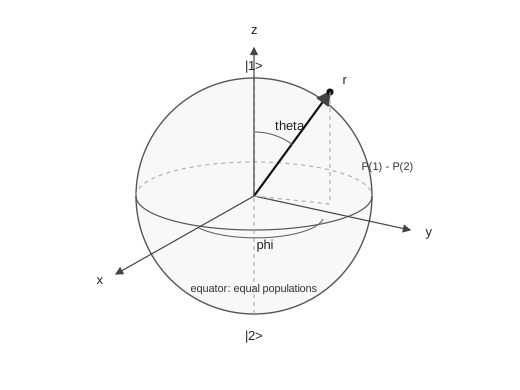
The Bloch sphere represents pure two-level rays. The polar angle fixes the relative populations of and , while the azimuthal angle fixes their relative phase.
From Coefficients To A Sphere
Section titled “From Coefficients To A Sphere”The Bloch vector associated with is
It has unit length:
Thus the two real parameters left after normalization and global phase form the surface of a sphere. The north pole is , the south pole is , and the equator consists of equal-population superpositions.
For example,
lies on the positive axis, while
lies on the positive axis. These two states have the same populations in the chosen basis but different relative phases.
Pauli Expectation Values
Section titled “Pauli Expectation Values”In the chosen basis, use the standard Pauli matrices. The Bloch-vector components are expectation values:
Equivalently, the projector onto the ray is
This formula is often the cleanest bridge between state-vector language and measurement probabilities. The Bloch vector is not an additional hidden variable; it is the same pure state written in Pauli coordinates.
Population, Phase, And Measurement
Section titled “Population, Phase, And Measurement”Measurement in the displayed basis has probabilities
and
So the vertical coordinate is a population imbalance:
The azimuthal angle does not affect these two probabilities, but it affects interference and measurements in other bases. That is why relative phase is physically observable even though global phase is not.
More generally, measuring the Pauli component along a unit direction uses projectors
For a pure state with Bloch vector ,
The measurement reads the projection of the Bloch vector onto the measurement axis.
Hamiltonian Motion
Section titled “Hamiltonian Motion”For a two-level Hamiltonian
the term contributes only a global phase. The vector rotates the Bloch vector according to
Thus precesses around the axis with angular frequency
This is the geometric version of two-state coherent oscillation. If the state starts away from the Hamiltonian axis, its measurement probabilities in a fixed basis oscillate. If it starts aligned or anti-aligned with , it is an energy eigenstate and the Bloch vector is stationary.
The algebra behind this statement is developed in Pauli-Matrix Hamiltonians.
Overlap Geometry
Section titled “Overlap Geometry”Let two pure states have unit Bloch vectors and . Their transition probability is
If the ordinary angle between the two Bloch vectors is , then
Antipodal points on the sphere are therefore orthogonal states. They are not the same physical ray. The removal of global phase has already been done before the sphere is drawn.
Scope Of This Picture
Section titled “Scope Of This Picture”This page uses the Bloch sphere only for pure states in a two-dimensional wave-mechanics model. Several closely related topics have their own canonical homes:
- Bloch Sphere Geometry gives the Pauli-coordinate geometry in a mathematical-toolkit form.
- Bloch Sphere for Density Operators extends the surface to the Bloch ball of mixed one-qubit states.
- Bloch Sphere gives the spin- interpretation.
- Quantum-information gates and protocols belong in the quantum-information volume.
The same two-sphere can be useful in all of these settings, but the physical meaning of its axes depends on the chosen basis and observable conventions.
Common Mistakes
Section titled “Common Mistakes”- Treating the Bloch vector as the state vector itself. The state is a ray in a complex Hilbert space; the Bloch vector is a real-coordinate representation of that ray.
- Confusing global phase with relative phase. Global phase is removed; relative phase becomes the azimuthal angle.
- Thinking every two-level system is literally a spin- particle.
- Forgetting that the Bloch sphere depends on a chosen basis and Pauli-coordinate convention.
- Calling mixed states points on the sphere. Mixed one-qubit states live inside the Bloch ball.
- Assuming higher-dimensional Hilbert spaces have an equally simple spherical pure-state picture.
Where This Is Used
Section titled “Where This Is Used”- Two-State Hamiltonians uses the same two-dimensional algebra for mixing and avoided crossings.
- Pauli-Matrix Hamiltonians identifies the effective field that sets the Bloch rotation axis.
- Rabi Oscillations: First Encounter uses this rotation picture for driven two-level populations.
- Spin-1/2 as a Canonical System: First Encounter uses the same sphere for spin expectation directions in magnetic fields.
- Spin-Half Hilbert Space gives the spin example.
- Bloch Sphere Geometry gives the fuller coordinate identities.
- Bloch Sphere for Quantum Information carries this picture into calibrated measurements, tomography, gates, and noise channels.
- Two-Level System Hamiltonian is the quick reference card.
References
Section titled “References”- F. Bloch, “Nuclear induction,” Physical Review 70, 460-474, 1946.
- J. J. Sakurai and J. Napolitano, Modern Quantum Mechanics, 3rd ed., Cambridge University Press, 2020.
- R. Shankar, Principles of Quantum Mechanics, 2nd ed., Springer, 1994.
- M. A. Nielsen and I. L. Chuang, Quantum Computation and Quantum Information, Cambridge University Press, 2010.
- B. C. Hall, Quantum Theory for Mathematicians, Springer, 2013.
Exercises
Section titled “Exercises”- Find the Bloch vector for
Solution
Compare with
Here
Thus , and
- Show that multiplying a two-level state by a global phase leaves the Bloch vector unchanged.
Solution
Let
Then
All three Pauli expectation values are unchanged, so the Bloch vector is unchanged.
- A pure state has Bloch vector . What are the probabilities for measuring the displayed basis states?
Solution
Use
Since ,
The state is the south-pole state up to a global phase.
- Suppose with , and the initial state has Bloch vector . Find .
Solution
The Hamiltonian vector is , so the Bloch vector rotates around the axis with angular frequency . Therefore