Hubbard Dimer
One-Sentence Description
Section titled “One-Sentence Description”The Hubbard dimer is the exactly diagonalizable two-site, two-spin fermion model in which hopping competes with onsite interaction and turns the half-filled ground state into a correlated mixture of a spin singlet and doublon–hole configurations.
This dossier fixes the finite model, mode ordering, sector decomposition, complete spectrum, exact ground-state observables, limiting regimes, and numerical checks. The Hubbard Model teaching article owns the derivation in the wider lattice context, and MB-B003 owns the stable benchmark contract.
Baseline Model Record
Section titled “Baseline Model Record”Unless a variant is stated explicitly, this dossier uses:
| Field | Baseline choice |
|---|---|
| sites | two sites, labeled and |
| physical modes | one spin- and one spin- fermionic mode per site |
| global mode order | |
| full Hilbert space | four-mode Fock space, |
| primary sector | total particle number , corresponding to one particle per site on average |
| bond list | one undirected bond |
| hopping | real , with matrix element |
| interaction | onsite |
| chemical potential | absent; , not , is diagonalized |
| site offset and bias | absent |
| fields, flux, intersite interaction, and pairing | absent |
| benchmark point | , in the sector |
The primary reference is the repulsive half-filled problem , but the exact formulas below remain valid for attractive . The model has only one physical bond. Writing a two-site periodic sum with two directed site indices and then adding a Hermitian conjugate can double that bond accidentally.
Fermionic Modes and Ordered Fock Basis
Section titled “Fermionic Modes and Ordered Fock Basis”The operators satisfy
Define
The declared mode order defines each bit state:
This ordering is not physical, but it fixes the signs of matrix elements and coordinate representations. A different ordering is equally valid only if basis states, operators, and observables are transformed consistently.
Full and fixed-number dimensions
Section titled “Full and fixed-number dimensions”With four fermionic modes,
The sector with total particle number has dimension
Thus the dimensions for are
Because spin-conserving hopping preserves and separately,
At , the sector decomposes as
Half-filled six-state basis
Section titled “Half-filled six-state basis”In the baseline order, a convenient basis is:
| Bit state | Local-state notation | |
|---|---|---|
1100 | ||
1010 | ||
1001 | ||
0110 | ||
0101 | ||
0011 |
Local-state notation is compact, but the ordered creation-operator definition remains the authoritative sign convention.
Hamiltonian and Conventions
Section titled “Hamiltonian and Conventions”The fixed-number Hamiltonian is
Write
The kinetic term moves one fermion without changing its spin. The interaction counts doublons:
Repulsive raises configurations with a doubly occupied site. Attractive lowers them.
Sign of the hopping
Section titled “Sign of the hopping”The site rephasing
maps for both spins. Because the dimer has no closed loop, the spectrum depends on . Fixing chooses a basis convention, not a distinct physical phase.
Chemical potential and energy offsets
Section titled “Chemical potential and energy offsets”In a grand-canonical calculation,
Every level in sector then shifts by . A uniform onsite energy similarly adds . Neither changes eigenvectors within one fixed- sector, but both matter when comparing particle sectors.
A common particle–hole-centered form is
For the two-site dimer,
In the sector this is simply
Therefore centered and uncentered spectra differ by an energy shift even when they describe the same fixed-sector eigenstates.
Matrix Representation and Fermionic Signs
Section titled “Matrix Representation and Fermionic Signs”Focus first on the block. Define
In the ordered basis
the block is
The relative signs are consequences of fermionic anticommutation in the declared mode order. Replacing every nonzero hopping matrix element by the same sign is not a harmless phase choice.
The two remaining states,
are one-dimensional blocks.
Spin-Adapted Basis
Section titled “Spin-Adapted Basis”Define
The three states
form a spin- triplet. The states , , and are spin singlets.
With the phases above,
The hopping couples the singly occupied singlet to the symmetric doublon combination with amplitude . It annihilates every triplet and does not mix the antisymmetric doublon. Rephasing one basis vector can reverse both entries , but cannot change an eigenvalue or observable.
Symmetries and Conserved Quantities
Section titled “Symmetries and Conserved Quantities”Charge conservation
Section titled “Charge conservation”The total particle number is conserved:
Spin-conserving hopping also gives
The latter pair resolves sectors but does not replace the full spin symmetry.
Spin rotations
Section titled “Spin rotations”Define dimensionless local spin operators
For spin-independent hopping and interaction,
Hence
The threefold zero-energy triplet degeneracy is enforced by spin symmetry. A split triplet in the baseline model is an implementation error, not finite-size physics.
Site exchange and time reversal
Section titled “Site exchange and time reversal”The symmetric dimer is invariant under exchanging sites and , with the induced fermionic signs handled by the unitary mode permutation. Real spin-independent hopping is also time-reversal invariant. A site bias, spin-dependent hopping, magnetic field, or complex flux deformation can reduce these symmetries.
Particle–hole structure
Section titled “Particle–hole structure”On the bipartite dimer, the transformation
leaves the centered Hamiltonian invariant up to a consistent operator convention. It exchanges with . In the uncentered convention this symmetry relates levels with sector-dependent energy shifts; it does not mean the raw spectrum is symmetric about zero.
Exact Solution Status
Section titled “Exact Solution Status”The dimer is a finite exact-diagonalization problem. Every eigenvalue and eigenstate in all 16 Fock states can be obtained analytically. This is exact for the declared two-site Hamiltonian, not an exact solution of a thermodynamic Hubbard lattice.
The nontrivial half-filled calculation reduces to a matrix:
Define
The two mixed singlet energies are
The remaining half-filled levels are
and
for .
For ,
so the ground state is a unique spin singlet for every finite real . A finite dimer has correlation crossovers, not a thermodynamic Mott or magnetic phase transition.
Complete Fock-Space Spectrum
Section titled “Complete Fock-Space Spectrum”In the uncentered Hamiltonian with and no chemical potential, the complete spectrum is:
| Particle number | Sector dimension | Energies including multiplicity |
|---|---|---|
| twice, twice | ||
| ; three times; ; | ||
| twice, twice | ||
The dimensions sum to
At special parameter values, levels in different rows or entries can coincide and increase the total degeneracy. A grand-canonical spectrum follows by subtracting from every level in row .
The sector is the spin-degenerate tight-binding dimer. The sector is its one-hole counterpart shifted by , and the fully occupied state contains one doublon on each site.
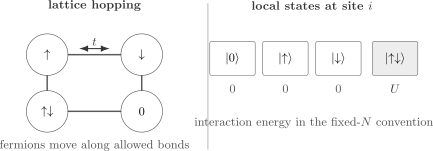
The dimer retains two copies of the four-state local Hubbard space and one hopping bond. At half filling, hopping connects the singly occupied singlet to doublon–hole configurations, while Pauli exclusion blocks the three triplets.
Exact Ground State
Section titled “Exact Ground State”For , write
with and
Equivalently,
For repulsive , and the singly occupied singlet has greater weight. For attractive , and the even doublon has greater weight. At , both weights are equal.
The state is not the classical product
It is a spin eigenstate with coherent charge fluctuations. Suppressing doublon weight at large positive does not remove quantum entanglement between the two spins.
Exact Ground-State Observables
Section titled “Exact Ground-State Observables”Double occupancy
Section titled “Double occupancy”The total doublon operator is . Feynman–Hellmann gives
Site symmetry gives
Kinetic and interaction energies
Section titled “Kinetic and interaction energies”Because ,
The interaction energy is
They add to :
Spin correlation and local moment
Section titled “Spin correlation and local moment”Only the component carries one spin on each site. Therefore
Define the local moment diagnostic
At symmetric half filling,
and
This local moment approaches one at strong repulsion, but a local moment is not by itself long-range magnetic order.
Charge imbalance
Section titled “Charge imbalance”The exact charge-fluctuation identity is
The singly occupied singlet has zero imbalance; either doublon–hole configuration has squared imbalance four.
Excitation and Addition-Energy Diagnostics
Section titled “Excitation and Addition-Energy Diagnostics”For repulsive , the first half-filled excitation is the triplet. The singlet–triplet gap is
The conventional finite-cluster charge gap is
Using
gives
At , this quantity is , the finite bonding–antibonding level spacing. It is not evidence for an interaction-driven bulk insulating phase. A Mott claim requires a thermodynamic sequence and charge-response analysis.
For attractive , the odd doublon state at energy lies below the triplet. The lowest excitation then probes coherent pair motion rather than spin exchange.
Exact Two-Level Dynamics
Section titled “Exact Two-Level Dynamics”The singlet sector is a detuned two-level system. Starting from the singly occupied singlet , the probability of occupying at time is
Repulsion suppresses the maximum doublon probability through the factor . The triplets remain stationary up to an overall phase because hopping cannot create an onsite spin triplet in one orbital.
This coherent oscillation is an exact finite-system result. Coupling to more sites, a bath, disorder, or time-dependent fields introduces additional frequencies or damping mechanisms.
Important Limits
Section titled “Important Limits”Noninteracting limit
Section titled “Noninteracting limit”At ,
The triplets and form a fourfold zero-energy manifold. The ground state contains two opposite-spin fermions in the bonding orbital and has
Atomic limit
Section titled “Atomic limit”At , singly occupied configurations have energy zero and doublon configurations have energy . For , the four states with one particle per site are degenerate. There is no singlet–triplet exchange splitting until virtual hopping is restored.
Strong repulsion
Section titled “Strong repulsion”For ,
and
The doublon weight is
Within the singly occupied subspace, the effective operator is
It assigns energy to the singlet and to the triplet, matching the leading exact dimer spectrum. Effective Hamiltonians in Quantum Matter owns the controlled projection.
Strong attraction
Section titled “Strong attraction”For with ,
The ground state approaches , and
The splitting between even and odd doublon combinations is generated by second-order pair motion. This paired limit is not described by the repulsive Heisenberg reduction.
Minimal Worked Example: Two Fermions at U = 0
Section titled “Minimal Worked Example: Two Fermions at U = 0”Define bonding and antibonding operators
The kinetic Hamiltonian is
At , the ground state is
with energy . Expanding in the ordered site basis gives
The minus sign multiplying comes from restoring canonical creation-operator order. The result is a spin singlet with equal singly occupied and doublon weights, exactly as predicts.
Numerical Benchmark: MB-B003
Section titled “Numerical Benchmark: MB-B003”MB-B003 is the authoritative benchmark contract. It uses the baseline mode order, the full sector, and
Exact targets
Section titled “Exact targets”At this point,
The ordered six-state spectrum is
The singlet–triplet gap is
The ground-state total double occupancy is
Useful additional targets are
Basis-independent matrix checks
Section titled “Basis-independent matrix checks”In the full sector,
and
At the benchmark point,
The implementation must also satisfy
Required validation sequence
Section titled “Required validation sequence”- Enumerate exactly six states and four states.
- Reproduce the complete six-level spectrum with multiplicities.
- Recover one spin triplet of dimension three at energy zero.
- Compare direct with .
- Check the trace and second moment.
- Change the global mode order, transform all operators consistently, and recover the same spectrum and observables.
Use the double-precision reference profile on Benchmark Problems: eigenvalues within in units of , listed ground-state observables within , and normalized residuals within .
Incorrect singlet mixing, a split triplet, or a missing factor of two inside usually indicates a fermionic-sign error, an omitted spin species, or a doubled bond. Agreement obtained only after replacing matrix elements by their absolute values is not a pass.
Reproducibility status
Section titled “Reproducibility status”The artifact catalog reserves
notebooks/many-body-statistical/hubbard_dimer_exact.ipynb
for explicit Fock-basis construction and complete diagonalization. It is planned, not committed or reproduced. Until it passes the release gates on Reproducible Notebooks, MB-B003 and the analytic formulas above remain the validation authorities.
Variants and Handoffs
Section titled “Variants and Handoffs”| Variant | What changes | Canonical route |
|---|---|---|
| site bias | add | inversion is broken and , mix |
| Zeeman field | add | triplet components split |
| intersite interaction | add | extended Hubbard dimer |
| spin-dependent hopping | replace by a spin matrix | spin can be reduced |
| pair hopping | add explicit doublon transfer | changes the paired-sector splitting |
| coupling to leads | attach bath modes | route toward impurity and transport models |
| more sites | extend the bond graph | Hubbard Model and the Hubbard Chain dossier |
| large positive | project to low-energy singly occupied states | Effective Hamiltonians in Many-Body Systems |
| variational doublon suppression | multiply doublon amplitudes by a Gutzwiller factor | Variational Many-Body States |
The dimer can test local algebra and short-range correlation, but it cannot establish a thermodynamic phase, spontaneous symmetry breaking, a bulk transport coefficient, or dimensional scaling.
Common Mistakes
Section titled “Common Mistakes”- Treating site labels as labels of distinguishable fermions.
- Building bit states without declaring a global mode order.
- Reordering modes without transforming fermionic signs.
- Counting the single physical bond twice.
- Omitting one spin species from the hopping sum.
- Replacing signed matrix entries by their absolute values.
- Calling the spin-singlet eigenstate.
- Missing the factor coupling between and .
- Splitting the triplet in a spin-rotation-invariant calculation.
- Comparing centered and uncentered spectra without their energy shift.
- Confusing total double occupancy with double occupancy per site.
- Interpreting suppressed double occupancy as complete localization.
- Calling the large- singlet–triplet gap a first-order hopping scale.
- Dropping the constant when matching the effective dimer spectrum.
- Calling the finite charge gap a Mott gap.
- Treating the attractive paired limit as the repulsive spin-exchange limit.
- Presenting exact diagonalization of 16 states as an exact solution of an infinite Hubbard lattice.
Exercises
Section titled “Exercises”1. Count and classify the half-filled basis
Section titled “1. Count and classify the half-filled basis”Show that the sector has dimension six and decomposes into one spin triplet and three spin singlets.
Solution
Choosing two occupied modes from four gives
The states with one fermion on each site form the tensor product of two spin- spaces:
They therefore contain three triplet states and one singlet. The two doublon–hole states have both fermions in the same spatial orbital and must be spin singlets. Thus
2. Recover the signed four-state block
Section titled “2. Recover the signed four-state block”Using the site-major mode order, act with the hopping Hamiltonian on . Explain the opposite signs of the two resulting separated-spin states.
Solution
The spin-down hop from site to site gives
The spin-up hop gives
The second sign changes because the annihilation and creation operators cross a different number of occupied lower-order modes. Therefore
Repeating the calculation for gives the same singlet coupling. Their symmetric combination couples with amplitude , while their antisymmetric combination decouples.
3. Derive the mixed singlet energies
Section titled “3. Derive the mixed singlet energies”Diagonalize the block and prove that for .
Solution
The characteristic polynomial is
Its roots are
For ,
Hence . Also
Thus and the mixed singlet is the unique half-filled ground state.
4. Connect double occupancy and spin correlation
Section titled “4. Connect double occupancy and spin correlation”Starting from the mixing-angle ground state, derive and . Check the limits and .
Solution
The doublon operator has eigenvalue zero on and one on . Therefore
The spin correlation is on the singly occupied singlet and zero on a doublon–hole state, so
At , the two weights are equal:
As ,
5. Match the strong-coupling spin Hamiltonian
Section titled “5. Match the strong-coupling spin Hamiltonian”Show that
with reproduces the leading repulsive dimer energies.
Solution
For two spin- degrees of freedom,
Therefore
while
With , these match
Using without the constant gives the correct splitting but not the energy zero of the projected Hubbard dimer.
6. Derive the doublon oscillation probability
Section titled “6. Derive the doublon oscillation probability”Start in at and derive .
Solution
Subtract the irrelevant constant from the two-state Hamiltonian:
Its eigenvalue splitting is
For a two-level system with off-diagonal magnitude and detuning , the transition probability is
Thus
At , complete transfer is possible. For , the maximum probability is suppressed as .
Cross-Links
Section titled “Cross-Links”- Model Encyclopedia for the shared dossier contract and model-family map.
- Hubbard Model for the canonical many-site derivation, particle–hole convention, observables, attractive model, and lattice physics.
- Tight-Binding Chain dossier for the free hopping baseline and one-particle matrix conventions.
- Tight-Binding Dimer for the one-particle two-site seed.
- Heisenberg Chain dossier for the spin model reached in the repulsive low-energy limit.
- Effective Hamiltonians in Many-Body Systems for projection methods and controlled strong-coupling logic.
- Variational Many-Body States for a Gutzwiller-factor treatment of the same dimer.
- Benchmark Problems for the authoritative MB-B003 inputs, outputs, tolerances, and failure diagnoses.
- Reproducible Notebooks for the planned artifact and release gates.
- Hubbard Model reference card and Hamiltonian card for compact lookup.
References
Section titled “References”- J. Hubbard, “Electron Correlations in Narrow Energy Bands,” Proceedings of the Royal Society A 276, 238–257 (1963), doi:10.1098/rspa.1963.0204.
- M. C. Gutzwiller, “Effect of Correlation on the Ferromagnetism of Transition Metals,” Physical Review Letters 10, 159–162 (1963), doi:10.1103/PhysRevLett.10.159.
- J. Kanamori, “Electron Correlation and Ferromagnetism of Transition Metals,” Progress of Theoretical Physics 30, 275–289 (1963), doi:10.1143/PTP.30.275.
- A. H. MacDonald, S. M. Girvin, and D. Yoshioka, ” Expansion for the Hubbard Model,” Physical Review B 37, 9753–9756 (1988), doi:10.1103/PhysRevB.37.9753.
- A. Auerbach, Interacting Electrons and Quantum Magnetism, Springer (1994).
- P. Fazekas, Lecture Notes on Electron Correlation and Magnetism, World Scientific (1999).
- F. H. L. Essler, H. Frahm, F. Göhmann, A. Klümper, and V. E. Korepin, The One-Dimensional Hubbard Model, Cambridge University Press (2005).
- P. Coleman, Introduction to Many-Body Physics, Cambridge University Press (2015).
- D. P. Arovas, E. Berg, S. A. Kivelson, and S. Raghu, “The Hubbard Model,” Annual Review of Condensed Matter Physics 13, 239–274 (2022), doi:10.1146/annurev-conmatphys-031620-102024.
- J. P. F. LeBlanc et al., “Solutions of the Two-Dimensional Hubbard Model: Benchmarks and Results from a Wide Range of Numerical Algorithms,” Physical Review X 5, 041041 (2015), doi:10.1103/PhysRevX.5.041041.