Kondo Model
One-Sentence Description
Section titled “One-Sentence Description”The Kondo model couples a fixed localized quantum spin to the spin density of one or more conduction-electron channels, turning weak antiferromagnetic exchange into a nonperturbative low-energy screening problem.
Canonical Scope
Section titled “Canonical Scope”This dossier is the canonical home for:
- a compact, convention-complete specification of the single-impurity Kondo Hamiltonian;
- its degrees of freedom, local-channel normalization, symmetries, and parameter signs;
- the distinction between antiferromagnetic and ferromagnetic flow;
- the model’s controlled limits and exact-solution status;
- the one-channel screening classification and principal variants;
- an observable and method dictionary;
- an exact two-site Kondo-box benchmark.
Kondo Model Preview owns the detailed pedagogical derivations of the logarithmic correction, one-loop flow, Kondo temperature, screening cloud, impurity thermodynamics, local Fermi liquid, and seven worked exercises. Kondo Effect owns dilute-alloy and quantum-dot diagnostics, screening-cloud experiments, and the heavy-fermion bridge. This page records model results only to the depth needed to make the dossier self-contained. Effective Hamiltonians in Many-Body Systems owns the comparative Anderson-to-Kondo charge-path calculation, while Schrieffer–Wolff Transformation owns the general unitary elimination method.
The baseline model below is one spin- impurity, one metallic screening channel, isotropic exchange, a smooth density of states at the Fermi energy, zero magnetic field, and no potential scattering. Every departure from that baseline is stated explicitly.
Model Definition
Section titled “Model Definition”The isotropic single-channel Hamiltonian is
The bath is noninteracting,
and the impurity spin satisfies
With the displayed plus-sign convention,
is antiferromagnetic and
is ferromagnetic.
Historical and modern sources sometimes write the interaction with an overall minus sign. The physical sign must be inferred from the full Hamiltonian, not from the symbol alone.
Degrees of Freedom and Hilbert Space
Section titled “Degrees of Freedom and Hilbert Space”The Hilbert space is
where
and is the fermionic Fock space of the conduction bath.
The impurity is a fixed spin in this model. It has no empty, singly occupied, or doubly occupied charge states. Those degrees of freedom belong to the Anderson Impurity Model dossier.
For spinful bath orbitals, the complete finite-bath dimension is
At fixed conduction-electron number ,
Total spin and spin projection can reduce this further when the bath and exchange are isotropic.
The Local Screening Channel
Section titled “The Local Screening Channel”A pointlike impurity couples only to a particular normalized linear combination of bath orbitals. Define
Then
The local spin density is
The corresponding local density of states per spin is
For the baseline metallic model,
is smooth near the Fermi energy. The dimensionless bare exchange is
Here is per spin. If is used instead, every displayed coefficient involving must be converted consistently.
Flat-band baseline
Section titled “Flat-band baseline”For a normalized local orbital and a symmetric flat band of half-width ,
per spin. A different band shape changes nonuniversal prefactors and may change the physics if the Fermi-level density of states vanishes or diverges.
Optional Terms
Section titled “Optional Terms”Potential scattering is
It is spin independent and, in the ordinary metallic one-channel problem, is marginal. It changes the elastic phase shift and particle–hole asymmetry but does not replace exchange-driven spin-flip physics.
A magnetic field can couple to impurity and bath moments,
The two -factors need not be equal. Susceptibility conventions must state which moment the field probes and which bath background is subtracted.
For axial exchange,
The isotropic baseline has .
Exchange Sign and Spin Transfer
Section titled “Exchange Sign and Spin Transfer”For one local conduction electron and a spin- impurity,
gives
The local exchange energies are therefore
Thus
Antiferromagnetic exchange favors a local singlet. Ferromagnetic exchange favors a triplet. This two-spin calculation fixes the sign convention, but the weak-coupling Kondo state is not a bound state of the impurity with one identifiable bath electron.
The spin-flip part is
It transfers one unit of angular momentum between impurity and bath. Replacing the exchange by removes that dynamical channel and produces a different impurity model.
Symmetries and Conserved Quantities
Section titled “Symmetries and Conserved Quantities”For an isotropic spin-independent bath at zero field:
- conduction-electron number has symmetry;
- impurity plus bath spin has global symmetry;
- time reversal is present;
- the impurity breaks spatial translation invariance;
- particle–hole symmetry may be present for a symmetric bath with .
The conserved conduction number is
The total spin is
and
The impurity spin alone is not conserved:
Screening redistributes spin correlations while preserving the total spin.
Microscopic Origin and Model Boundary
Section titled “Microscopic Origin and Model Boundary”In the local-moment regime of a spinful Anderson impurity,
empty and doubly occupied impurity states are virtual at low energy. A Schrieffer–Wolff transformation generates exchange
in a common normalized-orbital convention, together with potential scattering.
This is a controlled low-energy reduction when hybridization is small compared with both charge-excitation energies. It is not an identity between the Anderson and Kondo Hamiltonians. The Kondo model cannot recover:
- impurity occupancy fluctuations;
- lower and upper charge-transfer peaks;
- mixed-valence behavior;
- gate dependence that crosses a charge degeneracy;
- an impurity electron spectral function at arbitrary energy.
At particle–hole symmetry, , the leading exchange becomes
while the leading potential-scattering contributions cancel.
Scale Generation
Section titled “Scale Generation”The exchange is classically marginal. Quantum spin-flip processes generate logarithms. For a smooth metallic bath and per-spin density of states , define
One-loop scaling gives
Its solution is
For , the running coupling grows and the weak-coupling coordinate reaches a pole. For , it approaches zero from below.
The one-loop antiferromagnetic breakdown scale is
If a spin-summed density is used, the same exponent is
The one-loop pole is not a divergence of an exact observable. It marks the scale where weak-coupling perturbation theory stops being controlled.
No unique numerical Kondo temperature
Section titled “No unique numerical Kondo temperature”Beyond the leading exponential, depends on:
- the bandwidth and cutoff convention;
- the density-of-states normalization;
- higher-order definition of the running coupling;
- whether it is defined by susceptibility, entropy, conductance, or a spectral width.
Different standard definitions are related by fixed factors only after the full model and observable conventions are aligned. A quoted value of without those conventions is incomplete.
Fixed Points and Controlled Limits
Section titled “Fixed Points and Controlled Limits”Zero exchange
Section titled “Zero exchange”At , impurity and bath factorize. A spin- impurity contributes
and a Curie susceptibility at temperatures below any eliminated charge scale.
Weak antiferromagnetic exchange
Section titled “Weak antiferromagnetic exchange”For
the impurity behaves approximately as a local moment with logarithmic corrections. Perturbative scaling is controlled while .
Fully screened one-channel limit
Section titled “Fully screened one-channel limit”For , one channel, and , the infrared state is fully screened. The impurity entropy tends to zero and the low-energy theory is a local Fermi liquid.
At particle–hole symmetry without extra potential scattering, the zero-energy phase shift is
Low-energy corrections to regular scattering observables are quadratic in and .
Strong antiferromagnetic exchange
Section titled “Strong antiferromagnetic exchange”If is much larger than the hopping out of the local bath orbital, the impurity and one local electron form a singlet with exchange energy . The rest of the bath couples perturbatively to this strong-coupling reference state.
The strong-coupling singlet is a useful fixed-point picture. It should not be projected backward into a claim that weak-coupling screening uses one localized electron.
Ferromagnetic exchange
Section titled “Ferromagnetic exchange”Weak is marginally irrelevant. The effective coupling approaches zero from below, and a residual local moment survives with logarithmic corrections. There is no antiferromagnetic Kondo scale of the preceding form.
Finite bath
Section titled “Finite bath”A finite bath has a level spacing . To resolve a continuum-like screening crossover,
is generally required. Bath parity, boundaries, and the local spectral weights also matter. A small exact-diagonalization cluster can validate operators and multiplets without reproducing universal Kondo thermodynamics.
Screening Classification
Section titled “Screening Classification”Let denote the number of equivalent antiferromagnetic screening channels and the impurity spin. Under the standard channel-symmetric metallic assumptions:
| Relation | Screening class | Infrared character |
|---|---|---|
| exactly screened | local Fermi liquid | |
| underscreened | residual moment with singular corrections | |
| overscreened | non-Fermi-liquid fixed point when channel symmetry is maintained |
This table is a classification, not a substitute for an RG analysis. Channel anisotropy can destabilize overscreened fixed points, and a nonmetallic bath can change the phase diagram entirely.
For the baseline , model,
so screening is exact.
Exact Solution Status
Section titled “Exact Solution Status”The phrase “the Kondo model is exactly solvable” requires qualification.
Bethe-ansatz-integrable continuum model
Section titled “Bethe-ansatz-integrable continuum model”After partial-wave reduction, a pointlike isotropic impurity couples to an effective one-dimensional radial channel. Special continuum formulations admit Bethe-ansatz solutions. They yield exact equilibrium thermodynamics, magnetization, susceptibility, and universal crossover information.
The exact solution relies on the integrable structure. Arbitrary band curvature, momentum-dependent exchange, several impurities, generic channel mixing, or nonequilibrium reservoirs need not preserve it.
Toulouse limit
Section titled “Toulouse limit”At a special anisotropic coupling, bosonization and refermionization map the problem to a quadratic resonant-level form. This is an exact solvable point inside the anisotropic family, not the generic isotropic Hamiltonian.
Numerical renormalization group
Section titled “Numerical renormalization group”Wilson’s numerical renormalization group is not a closed-form exact solution. It is a systematically improvable nonperturbative method tailored to exponentially separated impurity scales. Quantitative work must converge the discretization parameter, kept states, broadening, and interleaved discretizations.
What is not exact
Section titled “What is not exact”The one-loop beta function, the leading exponential estimate of , a slave-particle saddle, and a small finite bath are approximations or controlled representations in stated regimes. They should not be promoted to exact solutions of every Kondo variant.
Typical Observables
Section titled “Typical Observables”Impurity thermodynamics
Section titled “Impurity thermodynamics”An impurity contribution is defined by subtraction,
For the fully screened spin- model,
across the crossover.
The high-temperature Curie form is
while is finite in the screened regime.
The low-temperature impurity heat capacity is
With standard normalizations, the spin- one-channel Wilson ratio is
Spin correlations and screening cloud
Section titled “Spin correlations and screening cloud”The real-space screening diagnostic is
Its crossover length is
The cloud is an extended, oscillatory many-body correlation profile. It is not a one-electron orbital.
Scattering and transport
Section titled “Scattering and transport”The conduction-electron -matrix controls impurity scattering. In a dilute metal it produces the logarithmic high-temperature Kondo correction and a finite unitarity-limited low-temperature response. In a quantum-dot realization, conductance additionally depends on lead geometry, hybridization asymmetry, potential scattering, bias, and the parent Anderson model.
Entanglement and finite-size spectra
Section titled “Entanglement and finite-size spectra”Impurity–bath entanglement, total-spin multiplets, finite-size level flows, and boundary-condition changes diagnose the crossover in numerical calculations. Entanglement is partition dependent and should be reported together with the bath mapping and subsystem definition.
Physical Phenomena
Section titled “Physical Phenomena”Resistance minimum
Section titled “Resistance minimum”Spin-flip scattering from dilute magnetic impurities generates logarithmic corrections as temperature is lowered. Combined with a decreasing phonon resistivity, this can produce a resistance minimum. The perturbative logarithm cannot be extrapolated through to zero temperature.
Local-moment screening
Section titled “Local-moment screening”The impurity crosses from a Curie-like moment to an entangled screened state. This is a crossover, not spontaneous symmetry breaking, and it has no local order parameter in the baseline single-impurity problem.
Quantum dots
Section titled “Quantum dots”A Coulomb-blockaded quantum dot with an odd occupancy can enter a local-moment regime and display Kondo-enhanced conductance. The Kondo Hamiltonian describes its low-energy spin sector; charge addition spectra remain properties of the Anderson-type parent.
Heavy-fermion bridge
Section titled “Heavy-fermion bridge”An array of moments introduces interimpurity exchange, lattice coherence, and possible magnetic or heavy-Fermi-liquid phases. Those effects are absent from a single-impurity Hamiltonian. The single-impurity scale remains an input to, not a solution of, the Kondo-lattice problem.
Minimal Worked Example and Benchmark: Two-Site Kondo Box
Section titled “Minimal Worked Example and Benchmark: Two-Site Kondo Box”Consider one spin- impurity and one conduction electron on a two-site open bath:
The fixed- Hilbert space has dimension
Use basis states
where is the electron site, its spin, and the impurity spin.
Because the Hamiltonian is invariant, total spin separates the problem into one singlet orbital block and three identical triplet orbital blocks.
Singlet block
Section titled “Singlet block”In the basis where the electron and impurity form a singlet and the electron occupies site or ,
Its energies are
Triplet blocks
Section titled “Triplet blocks”For each ,
with energies
Each triplet energy is threefold degenerate.
Characteristic polynomial
Section titled “Characteristic polynomial”The complete eight-dimensional characteristic polynomial is
For , the ground state is the lower singlet branch.
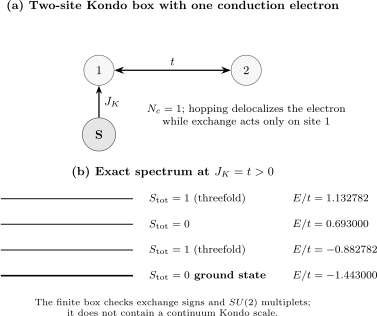
The two-site Kondo box separates into one singlet block and three identical triplet blocks. At , the exact ground state is a singlet. The finite box is an operator and symmetry benchmark, not a discretization fine enough to exhibit an exponentially small continuum Kondo scale.
Numerical target at equal exchange and hopping
Section titled “Numerical target at equal exchange and hopping”Set
The two singlet energies are
or
The triplet energies are
or
each with degeneracy three.
The singlet–triplet gap above the ground state is
Useful complete-matrix invariants are
and
At , the ground-state probability that the conduction electron occupies site is
Only site participates in exchange, so
Hellmann–Feynman gives the same result:
Benchmark contract
Section titled “Benchmark contract”- Build the eight-dimensional fixed- matrix from fermionic operators and Pauli matrices.
- Verify Hermiticity, particle-number conservation, and multiplet degeneracies.
- Reproduce the factorized characteristic polynomial.
- Check the trace, trace-square, and determinant before diagonalization.
- At , reproduce all four distinct energies and their degeneracies.
- Check the ground-state site occupation and exchange correlation independently.
This benchmark does not test the one-loop Kondo temperature, a screening cloud, or the Wilson ratio. Those require a bath with controlled scale separation.
Numerical and Analytical Methods
Section titled “Numerical and Analytical Methods”Poor-man’s scaling
Section titled “Poor-man’s scaling”Shell elimination controls the weak-coupling regime and derives logarithms and the leading exponential scale. It stops being perturbative near .
Numerical renormalization group
Section titled “Numerical renormalization group”NRG logarithmically discretizes the bath and maps it to a Wilson chain whose hoppings fall asymptotically as
Iterative diagonalization then resolves exponentially separated scales. Spectra require additional broadening and discretization checks beyond thermodynamic convergence.
Bethe ansatz
Section titled “Bethe ansatz”Integrable formulations give exact equilibrium results and universal ratios. Their power does not automatically extend to arbitrary real-frequency observables, generic bands, or nonequilibrium driving.
Tensor networks
Section titled “Tensor networks”After star-to-chain or energy-space mappings, tensor networks can resolve screening correlations and finite-size dynamics. Chain length, bath discretization, entanglement growth, and the ratio control reliability.
Quantum Monte Carlo
Section titled “Quantum Monte Carlo”Impurity Monte Carlo is often formulated for an Anderson parent and can be highly accurate on the imaginary-time axis. Analytic continuation remains ill conditioned, and sign or ergodicity behavior depends on the variant.
Exact diagonalization
Section titled “Exact diagonalization”Exact diagonalization is decisive for small-cluster operator checks such as the Kondo-box benchmark. A uniformly spaced bath grows exponentially in size and resolves an exponentially small scale inefficiently.
Principal Variants
Section titled “Principal Variants”Anisotropic Kondo model
Section titled “Anisotropic Kondo model”Independent and produce coupled RG flows and include the Toulouse solvable point. Setting removes spin flips and changes the infrared problem.
Multichannel model
Section titled “Multichannel model”Several conserved bath channels can compete to screen the same moment. Channel symmetry is essential to the canonical overscreened non-Fermi-liquid fixed point.
Higher-spin impurity
Section titled “Higher-spin impurity”Changing changes the channel count required for exact screening. A spin larger than in one channel is underscreened rather than simply a rescaled baseline model.
Two-impurity model
Section titled “Two-impurity model”Two moments experience both Kondo screening and a conduction-mediated RKKY interaction. RKKY Interaction derives that weak-coupling pair term from the host susceptibility. Its competition with screening and special two-impurity critical behavior are absent from the single-impurity Hamiltonian.
Kondo lattice
Section titled “Kondo lattice”A moment on every lattice site introduces coherence, magnetism, and collective Fermi-surface questions. A lattice is not obtained by multiplying a single-impurity thermodynamic function by the number of sites. Kondo Lattices is the canonical treatment of that dense many-body problem.
Pseudogap and structured baths
Section titled “Pseudogap and structured baths”If
the metallic logarithmic flow changes and impurity quantum phase transitions can occur. Superconducting, Luttinger-liquid, and topological baths likewise require separate analyses.
Coqblin–Schrieffer and orbital Kondo models
Section titled “Coqblin–Schrieffer and orbital Kondo models”Larger impurity multiplets and orbital or flavor exchange generalize the spin- algebra. The relevant symmetry group, representation, and number of channels must be declared.
Common Mistakes
Section titled “Common Mistakes”- Quoting without the sign convention used in the Hamiltonian.
- Quoting without the cutoff, band shape, density-of-states convention, and operational definition.
- Mixing per-spin and spin-summed densities of states in the exponential.
- Calling the one-loop pole a physical divergence.
- Treating the screening cloud as one localized electron.
- Assuming ferromagnetic exchange flows to the antiferromagnetic screened fixed point.
- Ignoring impurity spin and channel count when saying “the impurity is screened.”
- Calling the Kondo model and Anderson impurity model identical.
- Looking for impurity charge-transfer peaks in a spin-only Hilbert space.
- Using a tiny exact-diagonalization bath to claim universal Kondo thermodynamics.
- Treating Bethe-ansatz integrability as robust under arbitrary band or interaction changes.
- Extrapolating perturbative logarithmic resistivity to zero temperature.
- Applying a single-impurity result directly to a Kondo lattice.
- Calling the baseline screening crossover spontaneous symmetry breaking.
Summary
Section titled “Summary”- The Kondo Hamiltonian couples a fixed impurity spin to a normalized local conduction channel.
- In the displayed convention, is antiferromagnetic.
- The dimensionless weak-coupling parameter is , with the density-of-states convention stated explicitly.
- Antiferromagnetic exchange is marginally relevant and generates an exponentially small crossover scale.
- Ferromagnetic exchange is marginally irrelevant and leaves a residual moment.
- A spin- impurity with one metallic channel is fully screened and flows to a local Fermi liquid.
- Exact Bethe-ansatz results apply to integrable formulations, not every Kondo variant.
- Finite Kondo boxes are excellent operator benchmarks but poor substitutes for a scale-separated continuum bath.
Exercises
Section titled “Exercises”1. Normalize the local channel
Section titled “1. Normalize the local channel”Starting from
derive the condition on required for canonical anticommutation.
Solution
Using the bath anticommutator,
Therefore is normalized when
The same weights enter the local density of states, so changing them changes both the local orbital and the coupling normalization.
2. Derive the Kondo-box blocks
Section titled “2. Derive the Kondo-box blocks”Explain why the two-site, one-electron benchmark reduces to one singlet block and three identical triplet blocks.
Solution
The hopping is spin independent and the exchange is rotationally invariant, so total spin is conserved. Combining the impurity spin and electron spin gives
For either total-spin value, the remaining orbital coordinate is whether the electron occupies site or site . Hopping contributes between those two orbital states. Exchange acts only on site , with eigenvalue in the singlet and in the triplet. This gives the displayed blocks. The singlet has one spin state, while the triplet has three values and therefore three identical blocks.
3. Check the Kondo-box invariants
Section titled “3. Check the Kondo-box invariants”Use the two block matrices to derive , , and for the complete eight-state benchmark.
Solution
The singlet block has trace and each triplet block has trace . Including three triplets,
For a real symmetric block
the trace of the square is . Hence
Every block determinant is . Four blocks therefore give
4. Ferromagnetic one-loop flow
Section titled “4. Ferromagnetic one-loop flow”Let . Use the one-loop solution to show that the running exchange approaches zero from below as within the perturbative coordinate.
Solution
The solution is
For and , the denominator is
which grows without crossing zero. Thus
as . The exchange is marginally irrelevant and the impurity is not driven to the fully screened antiferromagnetic fixed point.
5. Convert Kondo-scale conventions
Section titled “5. Convert Kondo-scale conventions”Show that the per-spin expression
equals the spin-summed expression
when .
Solution
Substitution gives
so
The exponents are identical. A factor-of-two discrepancy arises only when the symbol changes meaning without a corresponding formula change.
6. Finite-bath resolution
Section titled “6. Finite-bath resolution”A calculation has and a uniformly spaced bath with level spacing . Can it resolve a continuum-like Kondo crossover?
Solution
The ratio is
The bath contains no levels on the scale near the Fermi energy, so it cannot approximate the continuum crossover. It may still provide a valid finite-box spectrum and operator test. A logarithmic discretization, a much larger bath, or another impurity solver is needed to resolve the exponentially small scale.
Cross-Links
Section titled “Cross-Links”- Model Encyclopedia Overview — controlled-scope comparison with pairing, lattice, gas, and impurity models.
- Kondo Effect — material signatures, resistance minima, operational scales, screening evidence, and heavy fermions.
- RKKY Interaction — susceptibility-mediated pair exchange, range functions, Fermi-surface geometry, and ordering.
- Kondo Model Preview — detailed scaling, screening, thermodynamics, cloud, and exercises.
- Anderson Impurity Model — compact parent-model specification, charge regimes, limits, and finite benchmark.
- Anderson Impurity Model Preview — detailed parent-model spectra, thermodynamics, transport, and DMFT.
- Effective Hamiltonians in Many-Body Systems — virtual charge paths and generated exchange.
- Schrieffer–Wolff Transformation — general perturbative block diagonalization and dressed observables.
- Renormalization Group Preview — general flow, fixed-point, and crossover language.
- Fermi-Liquid Theory Preview — quasiparticles, thermodynamics, and Wilson ratios.
- Correlation Functions Overview — impurity–bath correlations and the conduction -matrix.
- Fluctuations and Susceptibilities — Curie response and impurity subtraction.
- Common Many-Body Hamiltonians — compact convention table.
References
Section titled “References”- J. Kondo, “Resistance Minimum in Dilute Magnetic Alloys”, Progress of Theoretical Physics 32, 37–49 (1964) — perturbative spin-flip logarithm and the resistance minimum in the paper’s sign convention.
- J. R. Schrieffer and P. A. Wolff, “Relation between the Anderson and Kondo Hamiltonians”, Physical Review 149, 491–492 (1966) — canonical low-energy transformation from a charge-fluctuating impurity.
- P. W. Anderson, “A Poor Man’s Derivation of Scaling Laws for the Kondo Problem”, Journal of Physics C 3, 2436–2441 (1970) — shell-elimination scaling argument.
- P. Nozières, “A Fermi-Liquid Description of the Kondo Problem at Low Temperatures”, Journal of Low Temperature Physics 17, 31–42 (1974) — local Fermi-liquid fixed-point description.
- K. G. Wilson, “The Renormalization Group: Critical Phenomena and the Kondo Problem”, Reviews of Modern Physics 47, 773–840 (1975) — nonperturbative numerical renormalization-group solution.
- N. Andrei, “Diagonalization of the Kondo Hamiltonian”, Physical Review Letters 45, 379–382 (1980) — exact Bethe-ansatz solution.
- P. B. Wiegmann, “Exact Solution of the s–d Exchange Model (Kondo Problem)”, Journal of Physics C 14, 1463–1478 (1981) — integrability and exact equilibrium properties.
- N. Andrei, K. Furuya, and J. H. Lowenstein, “Solution of the Kondo Problem”, Reviews of Modern Physics 55, 331–402 (1983) — exact-solution framework and thermodynamics.
- A. C. Hewson, The Kondo Problem to Heavy Fermions, Cambridge University Press (1993) — standard monograph on impurity models, scaling, exact methods, and heavy-fermion connections.