Spinless Fermion Chains
A spinless fermion chain is the minimal lattice model in which Fermi statistics, coherent motion, interactions, filling, and one-dimensional collective behavior all matter. Each site carries one fermionic mode, so its local occupation is either zero or one. Nearest-neighbor hopping delocalizes particles, while a nearest-neighbor density interaction favors either alternating occupation or clustering.
The canonical interacting model is the – chain. It is simple enough to solve exactly in important limits, yet rich enough to contain a free Fermi sea, a Luttinger liquid, a charge-density-wave phase, phase separation, boundary-twist responses, and the finite-size parity subtleties that appear when it is mapped to a periodic spin chain.
This page treats the chain as a fermionic model in its own right. Tight-Binding Model owns the general one-body hopping framework, while the Tight-Binding Chain dossier fixes the free nearest-neighbor baseline and validation targets. The XXZ Chain dossier owns the compact spin-chain record and finite-ring benchmark, while XXZ Spin Chain owns the detailed spin-chain phase narrative. Jordan–Wigner Transformation owns the full nonlocal transformation and operator dictionary; here that map is used only to identify the equivalence and its boundary caveat.
Model at a Glance
Section titled “Model at a Glance”| Feature | Spinless – chain |
|---|---|
| local states | , |
| canonical algebra | and |
| kinetic process | nearest-neighbor hopping with amplitude |
| interaction | nearest-neighbor density coupling |
| conserved quantity | total fermion number |
| free point | |
| half-filled critical interval | for |
| repulsive strong-coupling phase | twofold charge-density-wave order for |
| attractive strong-coupling regime | phase separation for |
| spin equivalent | spin- XXZ chain with , up to a staggered gauge choice |
The phase statements in the table assume a uniform nearest-neighbor chain at half filling in the thermodynamic limit. Boundaries, finite size, filling, longer-range couplings, disorder, and pairing terms can change the spectrum or the phase structure.
Local Hilbert Space and Fock Basis
Section titled “Local Hilbert Space and Fock Basis”At site ,
so the allowed eigenvalues are . For an ordered set of sites, a convenient occupation basis is
The ordering is part of the convention. Moving a fermionic operator through occupied earlier modes produces signs. Although each site has the same two-dimensional local vector space as a spin- degree of freedom, the fermionic operator algebra is graded; it is not an ordinary tensor-product spin algebra without additional parity strings.
The full Fock-space dimension is . In a fixed-number sector with fermions,
Number conservation therefore provides a substantial exact-diagonalization reduction. Translation, inversion, and particle-hole symmetry can reduce the problem further when the boundary and couplings preserve them.
The Centered t–V Hamiltonian
Section titled “The Centered t–V Hamiltonian”For an open chain, take and write
The centered densities are not a different interaction. Expanding one bond gives
Relative to , centering shifts the chemical potential and adds a constant. Its advantage is that half-filling particle-hole symmetry is visible at on an even bipartite chain.
The terms have distinct roles:
- coherently transfers a fermion across a bond;
- penalizes equal neighboring density deviations and favors alternation;
- rewards equal neighboring density deviations and favors clustering;
- controls the filling in a grand-canonical description.
The word spinless means that no independent spin label is retained. It may describe genuinely polarized fermions, an effective single-component band, or a model obtained after projecting out other internal states. Pauli exclusion forbids two fermions in the same retained mode, but it does not remove interactions between different sites.
Boundary Conventions
Section titled “Boundary Conventions”For a ring, the bond sum includes , and a twist may be imposed through
Important special cases are
Equivalently, one may distribute the twist uniformly over the bonds,
with strictly periodic operators. A site-dependent gauge transformation moves phase between the boundary and the bonds without changing the total phase accumulated around the ring.
Open and periodic chains are not interchangeable at finite . The open chain has bonds and standing waves. The ring has bonds, translation sectors, and a flux-sensitive momentum grid. Their bulk energy densities usually agree as away from singular limits, but their finite spectra and edge observables differ.
Symmetries and Conserved Quantities
Section titled “Symmetries and Conserved Quantities”For every , , and number-preserving boundary twist,
This global symmetry permits independent diagonalization in each fixed- sector.
Additional symmetries depend on geometry:
- a uniform ring has discrete translation symmetry;
- a uniform open chain has reflection symmetry about its midpoint;
- at zero twist, real couplings preserve spinless time-reversal symmetry by complex conjugation;
- an even bipartite chain at has particle-hole symmetry;
- inversion sends a twist to unless combined with another operation.
On an even chain, define
Then
Nearest-neighbor hopping and centered density interactions are invariant, whereas the chemical-potential term changes sign. Thus is the particle-hole-symmetric point. In a nondegenerate symmetric finite-volume state, it has
The qualification about an even bipartite geometry matters. An odd ring is not bipartite, and a boundary twist may transform nontrivially.
Why This Is the Minimal Interacting Fermion Chain
Section titled “Why This Is the Minimal Interacting Fermion Chain”The free hopping chain is diagonal in momentum space. Adding the nearest-neighbor density term produces quartic operators,
so generic momentum occupations cease to be individually conserved. Yet the interaction is short-ranged, translation invariant, and number conserving. The model therefore isolates the central competition:
In one dimension this competition does not generically produce a conventional Landau Fermi liquid. In the intermediate regime it produces a Luttinger liquid whose elementary low-energy excitations are collective density waves.
Free Chain
Section titled “Free Chain”Set . The Hamiltonian is quadratic, so a one-particle diagonalization solves every fixed-number many-body sector.
Fourier Diagonalization on a Ring
Section titled “Fourier Diagonalization on a Ring”Use
where is the lattice spacing. The twisted boundary condition requires
and hence
The free Hamiltonian becomes
with
The final constant follows from the centered chemical-potential convention and does not affect eigenvectors. A many-body eigenstate is a Slater determinant specified by occupied momenta,
with energy equal to the sum of occupied one-particle energies, plus the displayed constant.
Filling and Fermi Points
Section titled “Filling and Fermi Points”Let
In the thermodynamic ground state, occupied momenta fill a connected interval around . For ,
At half filling,
The Fermi velocity is
Near the two Fermi points, the dispersion is approximately linear:
This pair of right- and left-moving branches is the starting point for the low-energy field theory. The lattice remains essential because it fixes the bandwidth, commensurate fillings, and allowed scattering processes.
Ground-State Energy Density
Section titled “Ground-State Energy Density”For the free chain, the kinetic ground-state energy per site at fixed filling is
At half filling,
The chemical potential obtained from this fixed-density energy is
which is the band energy at . It vanishes at half filling in the centered convention.
Open-Chain Standing Waves
Section titled “Open-Chain Standing Waves”For an open chain, define dimensionless wave numbers
The normalized one-particle orbitals are
and the energies are
At fixed , the free ground state occupies . Translation symmetry is absent, but reflection parity and the node structure of standing waves remain useful.
Exact Free Correlations
Section titled “Exact Free Correlations”At zero temperature in the infinite free chain,
while . The decay is algebraic: the free ground state is gapless whenever the band is partially filled.
Wick’s theorem gives the connected density correlation at distinct sites,
The negative sign is the exchange hole: equal-component fermions suppress nearby joint occupation even without a dynamical repulsion.
At half filling, vanishes for nonzero even and alternates in sign on odd separations. The density correlation contains a uniform part and an oscillatory component at wave number . This structure survives interactions in the Luttinger liquid, but its exponent changes.
Nearest-Neighbor Interaction in Momentum Space
Section titled “Nearest-Neighbor Interaction in Momentum Space”For a ring, the density interaction can be written schematically as
where the nearest-neighbor Fourier component is proportional to
Total momentum is conserved modulo a reciprocal-lattice vector, but individual mode occupations are not. At commensurate filling, the lattice permits momentum transfer by a reciprocal vector. At half filling, , so umklapp scattering can become important and drive the repulsive charge-ordering transition.
The exact phase boundary is nonperturbative. Weak-coupling scattering language explains which process is allowed, while the XXZ equivalence and Bethe ansatz fix the uniform model’s exact transition at .
Relation to the XXZ Chain
Section titled “Relation to the XXZ Chain”Use the Jordan–Wigner convention
with nonlocal strings in . On an open chain, nearest-neighbor strings cancel inside the transverse exchange. After a staggered gauge transformation that reverses the hopping sign, the correspondence is
Thus the fermion density deviation maps to spin magnetization,
The map gives immediate physical translations:
| Fermion language | Spin language |
|---|---|
| hopping | transverse exchange |
| density interaction | longitudinal exchange |
| chemical potential | longitudinal field |
| half filling | zero total magnetization |
| charge-density wave | Néel order along |
| phase separation | ferromagnetic sector after the staggered convention |
| particle current | spin current |
The equivalence does not mean that fermion and spin correlation functions are always identical local objects. Density is local under the map, but a single-fermion operator corresponds to a spin flip multiplied by a nonlocal string. Consequently a simple spin correlator can encode a string correlator in fermion variables, and vice versa.
Use XXZ Spin Chain for the canonical spin Hamiltonian, exact phase structure, Bethe-ansatz orientation, and spin observables.
Half-Filled Phase Diagram
Section titled “Half-Filled Phase Diagram”Assume a uniform chain, , , half filling, and the thermodynamic limit.
| Coupling | Regime | Gap and long-distance behavior |
|---|---|---|
| phase separated | particles and holes form macroscopic domains at fixed half filling | |
| phase-separation boundary | singular endpoint with enhanced degeneracy and quadratic low-energy structure | |
| Luttinger liquid | gapless, compressible, algebraic correlations, central charge | |
| BKT transition | gapless endpoint with logarithmic corrections; | |
| charge-density wave | gapped bulk with two translation-related ordered patterns |
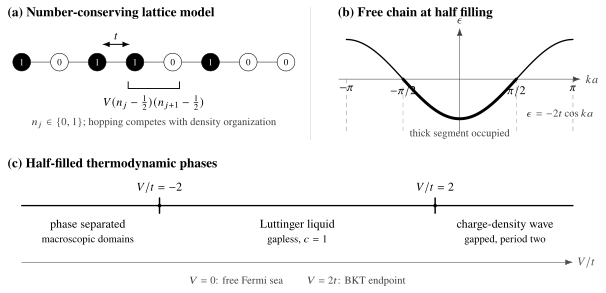
The – chain combines nearest-neighbor hopping and density interaction. At , half filling occupies the cosine band between and , with . At half filling, attraction stronger than produces phase separation, the interval is a Luttinger liquid, and repulsion stronger than produces a gapped charge-density wave.
These are thermodynamic phases, not labels that can be read from one small spectrum. A finite translation-invariant ring does not choose one charge pattern by itself. Near the Berezinskii–Kosterlitz–Thouless transition, the correlation length can be exponentially large and finite-size convergence can be slow.
Luttinger-Liquid Regime
Section titled “Luttinger-Liquid Regime”Luttinger Liquid Preview owns the universal compact-boson Hamiltonian, correlation-exponent dictionary, and perturbation thresholds. This section matches those quantities to the half-filled – chain.
Write
For the half-filled uniform integrable chain with , the exact Luttinger parameter and mode velocity are
and
Checks at the free point are immediate. For , , so
Repulsion lowers from one toward at the charge-ordering transition. Attraction raises and sends it to infinity as the phase-separation endpoint is approached from above.
The long-distance density correlation has the universal structure
where is nonuniversal. The single-particle correlator obeys
At , these powers reduce to the free-fermion results. Away from the free point, there is no quasiparticle jump in the momentum distribution. The low-energy excitations are collective modes even though the microscopic variables are fermions.
The displayed asymptotic formulas describe the leading universal powers. Lattice-scale amplitudes, subleading harmonics, finite temperature, boundaries, and logarithmic corrections at special points require additional care.
Repulsive Strong Coupling and Charge Order
Section titled “Repulsive Strong Coupling and Charge Order”At and , each bond is minimized by opposite centered densities. At half filling on an even ring, the two classical ground patterns are
They are related by translation by one site. A local hop creates neighboring and defects, equivalently a pair of domain walls. In the strict limit, the interaction cost of this local defect pair is .
For finite with , quantum fluctuations dress these patterns but do not remove the thermodynamic charge-density-wave order. Order Parameters gives the general operator construction, while Long-Range Order gives the correlation-limit and finite-size scaling tests. For this model, a useful order parameter is
where the subscript indicates a symmetry-broken thermodynamic state or an explicit order-of-limits prescription.
In a finite symmetric ring, can vanish. The order is then detected through the structure factor
whose peak at grows extensively in the ordered phase.
Attractive Strong Coupling and Phase Separation
Section titled “Attractive Strong Coupling and Phase Separation”For , equal neighboring occupations lower the interaction energy. At fixed intermediate filling and , particles gather into one dense domain and holes into another. Only the interfaces are costly, so a macroscopic cluster wins over a homogeneous arrangement.
Phase separation is not a paired superfluid. The model preserves particle number and has only one spinless orbital per site. The strong attraction reorganizes the density macroscopically; it does not create an onsite pair because is restricted to zero or one.
Finite translation-invariant rings have momentum eigenstates rather than a cluster pinned to a particular location. A localized domain appears after translation symmetry is weakly broken, through measurement conditioning, or in suitable linear combinations of nearly degenerate states.
Density, Current, and Twist Response
Section titled “Density, Current, and Twist Response”The local continuity equation follows from the Heisenberg equation. For the number density,
where the oriented particle current is
The density interaction commutes with every and therefore does not add a separate local transfer term. It changes current expectation values and dynamics through the interacting state.
A boundary twist probes transport around a ring. If is the ground-state energy, the persistent response is obtained by differentiating with respect to the applied flux or twist. A common dimensionless stiffness diagnostic is proportional to
with the precise prefactor depending on charge and convention. A gapless clean Luttinger liquid has nonzero zero-temperature stiffness, while the thermodynamic charge-density-wave insulator does not.
Use Density Operators and Current Operators for the canonical continuity-equation derivation and current conventions.
Boundary Parity from Jordan–Wigner
Section titled “Boundary Parity from Jordan–Wigner”A fermionic ring defined directly can be assigned periodic, antiperiodic, or twisted boundary conditions as part of the model. The situation changes when the fermions are introduced by transforming a periodic spin chain.
With the convention
define total fermion parity
In a fixed-parity sector, a periodic spin boundary is equivalent to
Thus, in this convention,
| Fermion number parity | Effective fermion boundary |
|---|---|
| (even ) | antiperiodic |
| (odd ) | periodic |
A staggered gauge transformation may shift signs or twists, but the invariant lesson is that the fermionic boundary sector is tied to parity. Choosing a momentum grid before fixing parity can therefore shift finite-size energies, degeneracies, and apparent gaps.
This parity constraint belongs to the spin-to-fermion map. It should not be imposed automatically on a microscopic fermion ring whose boundary condition was specified independently. The boundary sign and matching parity projection are derived in Jordan–Wigner Transformation.
Finite-Size Shell Effects
Section titled “Finite-Size Shell Effects”At finite , the location of allowed momenta relative to matters. A level can lie exactly at the Fermi energy for one twist but not another. This changes ground-state degeneracy without changing the thermodynamic phase.
For example, a periodic four-site free ring has momenta
with energies
At , one fermion occupies and the other can occupy either zero-energy mode. Antiperiodic boundary conditions instead give ; the two negative-energy orbitals are both occupied, and the free ground-state energy is
The two choices approach the same bulk energy density. Their small-system spectra differ because they sample the cosine band differently.
Entanglement as a Phase Diagnostic
Section titled “Entanglement as a Phase Diagnostic”For a periodic critical ground state described by a conformal field theory, the interval entanglement entropy scales as
The – Luttinger liquid has . In a gapped phase, the entropy instead saturates with interval size once exceeds the correlation length, apart from finite-size and symmetry-sector effects.
Near , logarithmic and BKT crossover corrections can make a naive central-charge fit misleading. Entanglement should be combined with gap scaling, density correlations, stiffness, and structure factors. Use Entanglement Entropy for the canonical definitions and scaling framework.
What Is Exactly Solvable
Section titled “What Is Exactly Solvable”Several different statements are sometimes compressed into “the chain is solvable”:
- At , Fourier or standing-wave modes diagonalize the Hamiltonian completely.
- For uniform nearest-neighbor and , the XXZ correspondence makes the model Bethe-ansatz integrable.
- Exact integrability determines thermodynamic and excitation properties, but extracting a desired finite-size correlator may still require substantial work.
- Generic next-nearest-neighbor hopping, longer-range interactions, quasiperiodicity, or disorder usually destroy Bethe-ansatz integrability.
- Jordan–Wigner changes variables; it diagonalizes only those mapped models that become quadratic after the transformation.
Integrable does not mean noninteracting. For , two-body scattering changes momentum quantization and the elementary low-energy excitations are collective.
Numerical Approaches
Section titled “Numerical Approaches”The best method depends on the question.
| Method | Natural use | Main limitation |
|---|---|---|
| exact diagonalization | spectra, symmetry sectors, quenches on small chains | growth |
| free-fermion correlation matrices | all Gaussian observables at | not valid for interacting states |
| matrix-product states and DMRG | ground states and low excitations of long open chains | critical entanglement and real-time growth increase cost |
| time-evolving tensor networks | local quenches and transport at moderate times | entanglement growth limits reachable time |
| Bethe ansatz | exact uniform-chain thermodynamics and benchmarks | specialized and fragile under generic perturbations |
| quantum Monte Carlo after a spin mapping | selected equilibrium observables | boundary and sign properties depend on representation and perturbations |
Useful numerical checks include:
- reproduce the exact free dispersion before turning on ;
- work in fixed- and, when available, momentum or reflection sectors;
- record whether the ring is periodic, antiperiodic, or twisted;
- compare several sizes and both open and periodic geometries when diagnosing a bulk phase;
- verify the sum rule in a consistent Fourier convention;
- distinguish a symmetry-partner splitting from the first bulk excitation gap.
Common Variants
Section titled “Common Variants”The minimal model can be extended in controlled directions:
Here frustrates the simple cosine band and generally breaks integrability, introduces competing density order, and can represent a trap, superlattice, quasiperiodic potential, or disorder.
A pairing term such as
breaks number conservation to fermion parity and leads toward the Kitaev-chain setting. That is a different canonical model, not merely another parameter value of the number-conserving – chain.
Worked Example: Exact Interaction Parameter
Section titled “Worked Example: Exact Interaction Parameter”Take the half-filled uniform chain with . Then
The exact Luttinger parameter is
and the velocity is
Because , the interaction is repulsive but still inside the gapless phase. The leading density term decays as
more slowly than its free-chain counterpart.
Common Mistakes
Section titled “Common Mistakes”- Treating “spinless” as “noninteracting.” It removes a spin label, not the density interaction.
- Forgetting that makes an onsite density self-interaction trivial for one spinless mode.
- Mixing centered and uncentered interaction conventions without shifting the chemical potential and constant.
- Calling every half-filled state a charge-density-wave insulator. The interval remains gapless.
- Calling the attractive phase an onsite paired phase even though double occupation is impossible.
- Saying Jordan–Wigner solves the chain for arbitrary . The mapped density interaction remains.
- Imposing the spin-derived parity boundary rule on a fermion ring whose boundary was independently specified.
- Inferring thermodynamic symmetry breaking from a nonzero one-point order parameter in a finite symmetric eigenstate.
- Ignoring shell effects when comparing small periodic chains.
- Using free-fermion Wick factorization once .
- Confusing the BKT endpoint at with an ordinary power-law gap opening.
- Reporting a Luttinger parameter without stating the Hamiltonian and field normalization conventions.
Exercises
Section titled “Exercises”Exercise 1: Twisted momentum grid
Section titled “Exercise 1: Twisted momentum grid”Derive the allowed momenta and dispersion of the free ring with .
Solution
A one-particle plane wave has amplitude . The boundary condition gives
so
Therefore
Acting with the hopping Hamiltonian on the plane wave gives
The twist shifts the sampled momenta but not the cosine function itself.
Exercise 2: Open-chain eigenmodes
Section titled “Exercise 2: Open-chain eigenmodes”Show that diagonalizes the free open chain. Explain the fictitious boundary nodes.
Solution
The one-particle difference equation is
For ,
so
An open chain is represented by fictitious nodes
The second condition requires . Discrete sine orthogonality gives the normalization .
Exercise 3: Particle-hole symmetry
Section titled “Exercise 3: Particle-hole symmetry”For an even bipartite chain at zero twist, verify that leaves the and terms invariant and reverses the sign of .
Solution
The density transforms as
Hence . A product on a bond is invariant, while the chemical-potential sum changes sign.
For nearest neighbors, . Also, for ,
The sublattice sign and anticommutation sign cancel, mapping each hopping term into its Hermitian partner. Therefore the kinetic term is invariant. The full Hamiltonian obeys
At , the spectrum is particle-hole symmetric around half filling.
Exercise 4: Exchange hole
Section titled “Exercise 4: Exchange hole”Use Wick’s theorem to derive the free connected density correlation for .
Solution
For distinct sites,
Subtracting the product of mean densities gives
Using
one obtains
The minus sign follows from exchange and requires no repulsive .
Exercise 5: XXZ parameter map
Section titled “Exercise 5: XXZ parameter map”An open – chain has and in common energy units. Identify the corresponding XXZ anisotropy and use the exact phase diagram to classify its half-filled thermodynamic ground state.
Solution
After the removable staggered hopping-sign transformation,
Because , equivalently , the half-filled fermion chain is in the gapped charge-density-wave phase. In spin language this is the easy-axis Néel regime.
Exercise 6: Luttinger data at moderate repulsion
Section titled “Exercise 6: Luttinger data at moderate repulsion”Evaluate and at half filling for . What is the leading power of the oscillatory density correlation?
Solution
Here
so . Therefore
and
The leading density term decays as .
Exercise 7: Parity and boundary conditions
Section titled “Exercise 7: Parity and boundary conditions”Under the Jordan–Wigner convention used above, determine the fermion boundary condition induced by a periodic spin chain in sectors with and . State why this rule need not apply to a directly defined fermion ring.
Solution
For ,
and , so the fermions are antiperiodic.
For ,
and , so the fermions are periodic.
The rule arises because a nonlocal Jordan–Wigner string crosses the spin-chain boundary. A microscopic fermion model does not inherit that string automatically; its boundary condition is an independent part of its definition.
Exercise 8: Current from continuity
Section titled “Exercise 8: Current from continuity”Derive the bond current for the hopping Hamiltonian and show that the density interaction contributes no explicit source term.
Solution
Only the two hopping bonds adjacent to site fail to commute with . Using
the right bond gives an outward term and the left bond an inward term. Collecting them yields
with
Every density operator commutes with every other density operator, so
The interaction affects current dynamics through the state and through , but it creates no local violation of number conservation.
Key Takeaways
Section titled “Key Takeaways”- The – chain is the minimal number-conserving interacting model of one spinless fermionic mode per site.
- At , the cosine band is exactly diagonalized by plane waves or open-chain standing waves.
- Fermi statistics alone produce a negative connected density correlation, the exchange hole.
- At half filling, is a gapless Luttinger liquid, is a gapped charge-density wave, and phase separates.
- The XXZ correspondence identifies after a removable staggered hopping-sign transformation.
- The Luttinger parameter changes continuously from at the free point to at the repulsive BKT endpoint.
- Periodic spin boundaries induce parity-dependent fermion boundaries under Jordan–Wigner; a directly defined fermion ring need not obey that constraint.
- Small-system spectra depend strongly on the twist and shell filling, so bulk phases require finite-size scaling and multiple diagnostics.
Further Reading
Section titled “Further Reading”- Lattice Models Overview
- Tight-Binding Chain dossier
- Tight-Binding Model
- XXZ Chain dossier
- XXZ Spin Chain
- Fermionic Operators in Many-Body Models
- Density Operators and Current Operators
- Correlation Functions Overview
- Quantum Phase Transitions
- Why Many-Body QM Leads to QFT
- Common Many-Body Hamiltonians
References
Section titled “References”- P. Jordan and E. Wigner, “Über das Paulische Äquivalenzverbot”, Zeitschrift für Physik 47, 631–651 (1928).
- E. Lieb, T. Schultz, and D. Mattis, “Two Soluble Models of an Antiferromagnetic Chain”, Annals of Physics 16, 407–466 (1961).
- H. Bethe, “Zur Theorie der Metalle. I. Eigenwerte und Eigenfunktionen der linearen Atomkette”, Zeitschrift für Physik 71, 205–226 (1931).
- C. N. Yang and C. P. Yang, “One-Dimensional Chain of Anisotropic Spin-Spin Interactions. I. Proof of Bethe’s Hypothesis for Ground State in a Finite System”, Physical Review 150, 321–327 (1966).
- C. N. Yang and C. P. Yang, “One-Dimensional Chain of Anisotropic Spin-Spin Interactions. II. Properties of the Ground-State Energy per Lattice Site for an Infinite System”, Physical Review 150, 327–339 (1966).
- C. N. Yang and C. P. Yang, “One-Dimensional Chain of Anisotropic Spin-Spin Interactions. III. Applications”, Physical Review 151, 258–264 (1966).
- A. Luther and I. Peschel, “Calculation of Critical Exponents in Two Dimensions from Quantum Field Theory in One Dimension”, Physical Review B 12, 3908–3917 (1975).
- F. D. M. Haldane, “‘Luttinger Liquid Theory’ of One-Dimensional Quantum Fluids. I”, Journal of Physics C 14, 2585–2609 (1981).
- T. Giamarchi, Quantum Physics in One Dimension, Oxford University Press (2004).
- M. Takahashi, Thermodynamics of One-Dimensional Solvable Models, Cambridge University Press (1999).