Fermionic Operators in Many-Body Models
Fermionic creation and annihilation operators make antisymmetric many-particle states usable in a mode basis. A bilinear transfers a fermion from mode to mode , a density product detects double occupancy, and ordered strings of operators build hopping, interactions, currents, and pairing terms.
The canonical algebra is
This page assumes that algebra and develops its many-body use. Fermionic Anticommutation Relations owns the foundational derivation and Occupation-Number Representation owns basis indexing and sparse matrix construction. The Hubbard Model owns the full physics of the canonical lattice example.
Fermionic minus signs are not optional bookkeeping. They are the occupation-space representation of antisymmetry, and they must follow one declared ordering convention from states through operators and observables.
Conventions
Section titled “Conventions”Unless stated otherwise:
- label complete orthonormal one-particle modes;
- a spin-orbital, not merely a spatial orbital, is one fermionic mode;
- creates and removes a fermion in mode ;
- is the mode occupation;
- the modes have a fixed total order ;
- a number state is written with creation operators in ascending mode order;
- operator products act on kets from right to left;
- an unordered lattice bond is counted once.
Other mode orders are equally valid. Mixing two orders inside one calculation is not.
One Fermionic Mode
Section titled “One Fermionic Mode”For one mode,
The occupation operator
is a projector:
Its spectrum is therefore
The complementary projector is
These identities express Pauli exclusion for one complete mode. Two fermions may occupy the same spatial site or orbital when another label, such as spin, makes their complete modes distinct.
Ordered Number States
Section titled “Ordered Number States”With the convention , define
where every is or . The same occupied set written with a different creation-operator order can differ by a sign.
For mode , define the parity count
Then
The occupation factors enforce that an empty mode cannot be annihilated and an occupied mode cannot be filled again. The parity factor counts occupied modes crossed while moving the operator to its ordered position.
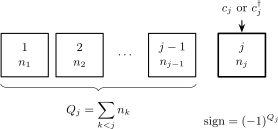
The action of or depends on the parity of occupied modes preceding in the declared order. The count produces the sign . Changing the mode order changes basis phases and intermediate signs, but physical matrix elements remain unchanged when states and every operator are transformed consistently.
Why the Sign Cannot Be Dropped
Section titled “Why the Sign Cannot Be Dropped”Different fermionic creation operators anticommute:
The minus sign is the operator version of exchanging two columns in a Slater determinant. Removing it changes interference between many-body amplitudes, matrix elements around loops in configuration space, exchange energies, and correlation functions.
An overall phase assigned to one basis vector is unobservable. Relative signs between paths connecting basis vectors are observable. A mode reorder is therefore a valid basis transformation, while deleting parity signs from only some operations is a change of theory.
Fermions Are Not Hard-Core Bosons
Section titled “Fermions Are Not Hard-Core Bosons”Both a fermionic mode and a hard-core bosonic mode have occupation or . Their algebras differ between distinct modes:
whereas distinct hard-core boson operators are usually chosen to commute.
Equal local dimensions do not imply equal many-body operator algebras. Mapping fermions to spins or hard-core bosons requires nonlocal parity strings, boundary-condition choices, or other structure that preserves the exchange signs.
Bilinear Transfer and Its Sign
Section titled “Bilinear Transfer and Its Sign”For , define the number of occupied modes strictly between and :
Then
The result is nonzero only when the source is occupied and the destination is empty. Unlike bosonic transfer, there is no square-root enhancement. The nontrivial factor is the parity sign.
Modes adjacent in the chosen order have , but neighboring lattice sites need not correspond to adjacent entries in a spin-orbital ordering.
Worked Sign Example
Section titled “Worked Sign Example”Use the site-major order
and the bitstring state
Consider moving the fermion into the empty mode:
The modes strictly between and contain the occupied mode, so
Therefore
The minus sign would change if a different bit ordering were used, together with a corresponding phase change of the basis vectors. The Hamiltonian spectrum would not.
General One-Body Terms
Section titled “General One-Body Terms”A number-conserving one-body Hamiltonian is
with
for Hermiticity. Diagonal terms are mode energies,
while off-diagonal terms transfer fermions between modes.
The matrix can include kinetic energy, lattice hopping, spin-orbit coupling, orbital hybridization, Zeeman terms, or external potentials. Its indices must cover every label on which the one-particle operator acts.
Spinful Hopping
Section titled “Spinful Hopping”For spin-preserving lattice hopping,
Each unordered bond is counted once. The Hermitian-conjugate term moves the fermion in the reverse direction.
Spin-dependent hopping is represented by a matrix,
Hermiticity requires
in spin space. Off-diagonal spin entries describe spin flips or spin-orbit-coupled hopping and need not conserve and separately.
Complex Hopping and Gauge Choice
Section titled “Complex Hopping and Gauge Choice”Under a local rephasing
the coefficient representation changes as
Individual bond phases depend on the orbital convention. Products of phases around closed loops are gauge invariant modulo and can represent magnetic or synthetic flux.
Fermionic parity signs from the Fock basis and Peierls phases from hopping coefficients are different structures. Both can appear in one matrix element, and neither should be silently absorbed into the other.
Bond Current
Section titled “Bond Current”For one spin-preserving bond,
define current from to by
for the contribution of that bond. The Heisenberg equation gives
Thus directed transport depends on the imaginary part of the hopping coherence. Density Operators and Current Operators owns the full continuity equation and spin-current conventions.
Complete Spin-Orbital Labels
Section titled “Complete Spin-Orbital Labels”A spinful lattice mode is labeled by the pair
The canonical algebra is
At each site,
The four local states are
The doubly occupied state contains two fermions in different complete modes. Pauli exclusion forbids two copies of or two copies of , not one of each.
Local Spin Operators
Section titled “Local Spin Operators”For spin- fermions, define the dimensionless onsite spin generators
where is a Pauli matrix. Explicitly,
and
Physical angular momentum is in this convention. These operators are fermion bilinears and preserve total particle number. They vanish on the empty and doubly occupied single-orbital site, while acting as spin- generators on the singly occupied subspace.
Coupling a separate localized spin to one such conduction-electron bilinear gives the exchange term in the Kondo Model Preview.
Hubbard Onsite Interaction
Section titled “Hubbard Onsite Interaction”The single-band Hubbard interaction is
The double-occupancy operator
is a projector:
It has eigenvalue one only on . Therefore penalizes double occupancy and favors it relative to singly occupied configurations.
Penalizing a doublon with finite and removing it from the Hilbert space are different operations. The latter produces the projected, noncanonical fermion operators defined in the t–J Model Preview.
In normal-ordered ladder-operator form,
The displayed order is important. Reordering one pair without its compensating minus sign produces the wrong operator.
Hubbard Assembly Example
Section titled “Hubbard Assembly Example”The standard single-band grand Hamiltonian is
The operator roles are:
| Term | Action | Structural consequence |
|---|---|---|
| hopping | transfers one fermion without changing spin | delocalization; parity sign from the chosen mode order |
| onsite interaction | projects onto double occupancy | couples opposite-spin densities on one site |
| chemical potential | weights total particle number | controls filling in a grand-canonical treatment |
The Hubbard Model owns its symmetries, exact limits, elementary spectrum, observables, strong-coupling bridge, and physical interpretation. This page owns the operator action and sign discipline used to construct it.
Limiting checks
Section titled “Limiting checks”- At , the Hamiltonian is quadratic and can be diagonalized at the one-particle level.
- At , every site occupation configuration is an eigenstate.
- In a fixed- calculation, uniform is a constant.
- In the one-particle sector, the Hubbard interaction vanishes.
- Hopping preserves total number and, without spin mixing, preserves and separately.
General Two-Body Interactions
Section titled “General Two-Body Interactions”With unsymmetrized product-basis matrix elements,
Hermiticity and exchange symmetry of the first-quantized interaction imply
Fermionic theory often uses antisymmetrized matrix elements
Then the same operator is commonly written
The factors and belong to different coefficient conventions. Combining an antisymmetrized coefficient with the unsymmetrized prefactor is a factor-of-two error. The foundational lift is derived in Two-Body Operators, while the many-body application guide owns the extended convention, reduced-density-matrix, and validation workflow.
Density, Exchange, and Pair-Hopping Terms
Section titled “Density, Exchange, and Pair-Hopping Terms”A density interaction between distinct modes, with symmetric coefficients , is
or when unordered bonds are counted once.
Multi-orbital models can also contain exchange and pair-hopping structures. For two orbitals , representative terms include
and
Their signs depend on the displayed operator order. A shorthand such as “exchange plus Hermitian conjugate” is safe only when the reference ordering is explicit.
Particle Number and Fermion Parity
Section titled “Particle Number and Fermion Parity”The total number operator satisfies
A monomial with equal numbers of creation and annihilation operators conserves . The corresponding global transformation is
Fermion parity is
It acts on odd fermionic operators as
Hamiltonians built from even fermionic monomials preserve parity. They may still break number conservation by changing in steps of two.
Pairing Terms
Section titled “Pairing Terms”A quadratic pairing Hamiltonian can be written
Because
only the antisymmetric coefficient part contributes:
when are complete spin-orbital labels.
This does not mean the spatial part of every Cooper-pair wavefunction is odd. For spin singlets, antisymmetry can reside in spin while the spatial or orbital factor is symmetric. The complete pair amplitude must be antisymmetric under exchange of all one-particle labels.
Pairing terms do not conserve , but they preserve fermion parity. Their diagonalization requires a Bogoliubov transformation in Nambu space and careful handling of constant terms. Bogoliubov Theory gives the general canonical construction and boson–fermion contrast; BCS Mean-Field Theory derives the self-consistent fermionic pairing saddle.
Normal Ordering and Reordering
Section titled “Normal Ordering and Reordering”Moving one fermionic operator past another produces a minus sign unless their anticommutator contributes a delta term. For example,
For , this is pure sign change. For , it also produces the identity.
Never reorder a long fermionic monomial by visual symmetry alone. Use adjacent swaps, canonical anticommutation relations, or a symbolic routine that tracks both parity and contractions. Normal Ordering owns the creation-left convention; Normal Ordering in Many-Body QM develops filled-reference contractions and Hamiltonian decompositions.
Even and Odd Operators
Section titled “Even and Odd Operators”An operator containing an even number of fermionic ladder operators has even parity. Number operators, hopping bilinears, spin densities, and ordinary interaction quartics are even. A single or is odd.
Even operators localized on disjoint mode sets commute. Odd operators on disjoint sets anticommute. This distinction is why observable Hamiltonian terms can remain local even though a qubit representation of an individual fermion operator carries a parity string.
When partitioning a fermionic system into subsystems, tensor-product intuition must be matched to the chosen parity structure. One should not treat odd operators in separated regions as ordinary commuting subsystem observables.
Jordan–Wigner Preview
Section titled “Jordan–Wigner Preview”For a qubit chain with occupation convention
one Jordan–Wigner representation is
The string records the same parity that appears in occupation-space action. Dropping it turns fermions into commuting hard-core degrees of freedom.
The string length depends on mode ordering, which is why orbital ordering affects qubit locality and tensor-network cost even though it does not change the fermionic physics.
Jordan–Wigner Transformation owns the full algebra proof, inverse dictionary, nearest-neighbor cancellations, higher-dimensional locality caveat, and periodic-boundary parity sectors.
Momentum-Space Preview
Section titled “Momentum-Space Preview”For a periodic lattice,
Translation-invariant hopping becomes
Local interactions become momentum-space quartic sums that conserve total crystal momentum modulo a reciprocal lattice vector. The fermionic anticommutation relations are unchanged by the unitary Fourier transform.
A basis that diagonalizes hopping usually spreads local interactions over many momentum labels. Momentum-Space Representation owns the systematic transform and normalization choices.
Mode Truncation
Section titled “Mode Truncation”Fermionic occupation needs no artificial local cutoff: each retained mode is exactly empty or occupied. The approximation enters through which one-particle modes are retained.
Projecting to a finite band, orbital, active space, or momentum window can:
- renormalize one-body coefficients;
- induce longer-range or many-body interactions;
- alter locality;
- break symmetries if the retained subspace is not invariant;
- change the accuracy of different observables unequally.
Pauli exclusion makes each local mode finite-dimensional, but it does not make a mode truncation automatically controlled.
Mean-Field Decoupling Is Not an Identity
Section titled “Mean-Field Decoupling Is Not an Identity”An interaction such as
can be approximated in density, magnetic, or pairing channels. For a density decoupling,
This is an approximation tied to a chosen channel and self-consistency condition. Other channels can be essential, and Fock exchange terms appear when the interaction and indices permit them.
Constant subtraction terms prevent double counting in the mean-field energy. Omitting them can leave eigenvectors unchanged while giving incorrect thermodynamic potentials and phase comparisons.
Observable Operator Patterns
Section titled “Observable Operator Patterns”Common fermionic observables include:
| Observable | Operator form | Comment |
|---|---|---|
| occupation | probability that complete mode is occupied | |
| double occupancy | onsite opposite-spin pair probability | |
| one-body coherence | one-body density matrix and hopping coherence | |
| spin density | local spin polarization under stated normalization | |
| pairing amplitude | number-breaking or phase-referenced anomalous average | |
| bond current | oriented transport convention |
The operator ordering in correlation functions must be retained. In general,
They are related by the anticommutator, not by casual reordering.
Building a Fermionic Hamiltonian Reliably
Section titled “Building a Fermionic Hamiltonian Reliably”- Flatten every label into a complete mode list. Include site, spin, orbital, band, and species labels.
- Declare the total mode order. Document both analytical and bit-storage conventions.
- Write each monomial in a canonical operator order. Use the same order when coefficients are generated.
- Apply operators from right to left. Update occupations before evaluating the next parity count.
- Reject forbidden occupations. Creation into an occupied mode and annihilation from an empty mode give zero.
- Add Hermitian conjugates explicitly. Check complex coefficients and bond counting.
- Match two-body prefactors to matrix-element conventions. Distinguish unsymmetrized and antisymmetrized coefficients.
- Test conserved charges and parity. Compare commutators with numerical block structure.
- Unit-test tiny systems. Two modes and two sites expose most sign errors.
- Repeat after any mode reorder. Basis permutation phases must be applied to both states and operators.
Common Mistakes
Section titled “Common Mistakes”- Omitting the parity factor in occupation-space ladder actions.
- Treating a fermionic bitstring as an unordered set of occupied labels.
- Using a site order for states and a spin-major order for operators.
- Replacing anticommutation by hard-core-boson commutation because both occupations are or .
- Forgetting that Pauli exclusion applies to complete spin-orbitals, not spatial sites alone.
- Declaring Hermitian without its conjugate for .
- Confusing Fock-basis parity signs with Peierls hopping phases.
- Reordering a quartic term without counting adjacent swaps.
- Combining antisymmetrized two-body matrix elements with the wrong prefactor.
- Assuming a pairing matrix can be symmetric in complete fermion labels.
- Dropping Jordan–Wigner parity strings in a qubit representation.
- Treating a finite orbital active space as exact because each retained mode is two-dimensional.
- Calling a mean-field decoupling an operator equality.
- Comparing mean-field energies after omitting constant subtraction terms.
Summary
Section titled “Summary”- Fermionic modes satisfy canonical anticommutation relations and have occupations or .
- A total order of complete spin-orbitals fixes the phase convention for number states.
- Ladder and transfer operations carry parity signs determined by occupied preceding or intervening modes.
- Bilinears build hopping, hybridization, spin operators, and currents; quartics build interactions and exchange processes.
- Opposite-spin fermions can share a site because they occupy distinct complete modes.
- The Hubbard interaction is the double-occupancy projector multiplied by .
- Number-conserving terms have equal numbers of creation and annihilation operators.
- Pairing breaks number conservation but preserves fermion parity and has an antisymmetric complete-label coefficient.
- Fermions and hard-core bosons require different intermode algebras.
- Mode truncation, operator reordering, and coefficient conventions must all be audited explicitly.
Exercises
Section titled “Exercises”Exercise 1: Projector identities
Section titled “Exercise 1: Projector identities”Starting from and , prove
and identify .
Solution
Compute
The anticommutator also gives
Thus projects onto the occupied state and projects onto the empty state.
Exercise 2: Ordered ladder action
Section titled “Exercise 2: Ordered ladder action”For mode order , compute
and
Solution
For , the occupied preceding modes are and , so
Mode is occupied, hence
For , only mode precedes the target and it is occupied:
Mode is empty, so
Exercise 3: Sign of a transfer
Section titled “Exercise 3: Sign of a transfer”With order , evaluate
Check the result both by sequential ladder actions and by counting occupied modes strictly between and .
Solution
First apply . The occupied preceding modes are and , so the annihilation sign is positive:
Next apply . Mode is occupied, giving a minus sign:
Equivalently, the modes strictly between and are and , with occupations and . Thus
which gives the same negative sign.
Exercise 4: Double occupancy in ladder form
Section titled “Exercise 4: Double occupancy in ladder form”Show that
Solution
Begin with
For distinct spin modes,
Therefore
Using supplies a second minus sign and yields
Exercise 5: Number and parity classification
Section titled “Exercise 5: Number and parity classification”Classify the following operators by whether they conserve and whether they preserve fermion parity:
Solution
The bilinear has one creation and one annihilation operator, so it conserves and parity.
The pair-creation operator changes by two. It does not conserve number, but it preserves parity because even and odd sectors are not mixed.
The single annihilation operator changes by one, so it conserves neither number nor parity.
The quartic interaction has two creation and two annihilation operators. It conserves and therefore also preserves parity.
Exercise 6: Antisymmetry of the pairing matrix
Section titled “Exercise 6: Antisymmetry of the pairing matrix”Show that the symmetric part of contributes nothing to
Solution
Decompose
where and . For the symmetric part, relabel :
The expression equals its negative and is therefore zero. Only the antisymmetric part contributes.
Exercise 7: One-site Hubbard spectrum
Section titled “Exercise 7: One-site Hubbard spectrum”For the one-site grand Hamiltonian
find the energies of , , , and .
Solution
The empty state has no particles or double occupancy:
Each singly occupied state has one particle and no double occupancy:
The doubly occupied state has two particles and :
This elementary spectrum is a useful sign and chemical-potential check for Hubbard implementations.
Exercise 8: Why the parity string matters
Section titled “Exercise 8: Why the parity string matters”Using
explain qualitatively why deleting the string makes operators on distinct sites commute instead of anticommute.
Solution
The local lowering factors on distinct qubits act on different tensor factors and therefore commute. If one represented and by only those local factors, exchanging their order would produce no minus sign.
The string records the occupation parity of all earlier modes. For , the local lowering at anticommutes with the contained in the string of . This supplies exactly one minus sign when and are exchanged:
The nonlocal string is therefore the qubit representation of fermionic mode-order parity.
References
Section titled “References”- A. L. Fetter and J. D. Walecka, Quantum Theory of Many-Particle Systems, Dover (2003).
- J. W. Negele and H. Orland, Quantum Many-Particle Systems, Westview Press (1998).
- P. Coleman, Introduction to Many-Body Physics, Cambridge University Press (2015).
- G. D. Mahan, Many-Particle Physics, 3rd ed., Springer (2000).
- A. Altland and B. Simons, Condensed Matter Field Theory, 2nd ed., Cambridge University Press (2010).
- A. Auerbach, Interacting Electrons and Quantum Magnetism, Springer (1994).
- J. Hubbard, “Electron correlations in narrow energy bands,” Proceedings of the Royal Society A 276, 238–257 (1963), doi:10.1098/rspa.1963.0204.
- F. H. L. Essler, H. Frahm, F. Göhmann, A. Klümper, and V. E. Korepin, The One-Dimensional Hubbard Model, Cambridge University Press (2005).
- S. Bravyi and A. Kitaev, “Fermionic quantum computation,” Annals of Physics 298, 210–226 (2002), doi:10.1006/aphy.2002.6254.