Competing Orders
Competing orders are distinct collective organizations close enough in free energy that developing one changes the stability, amplitude, phase coherence, or spatial texture of another. Antiferromagnetism and superconductivity, charge order and superconductivity, nematicity and magnetism, or two flavor-polarized moiré states may share microscopic degrees of freedom while breaking different symmetries.
Competition does not mean that two orders can never be nonzero in the same region. A positive coupling can suppress both amplitudes yet still permit a homogeneous coexistence phase. Conversely, two anomalies in one bulk sample do not establish microscopic coexistence: different domains, surface and bulk regions, disorder distributions, or fluctuating order can contribute separate signals.
The central inference problem is therefore sharper than “which phase wins?” One must determine:
- the operator and broken symmetry of every proposed order;
- the symmetry-allowed couplings among them;
- the topology of the equilibrium phase diagram;
- the spatial and temporal scale on which coexistence is claimed;
- whether selective perturbations obey one coupled theory.
Canonical Scope
Section titled “Canonical Scope”This page is the canonical home for coupled-order thermodynamics and material evidence for competition, cooperation, coexistence, and exclusion. It owns the minimal two-order Landau functional, bicritical and tetracritical topologies, the distinction between microscopic coexistence and phase separation, and comparative examples in cuprates, heavy fermions, and moiré systems.
Order Parameters owns the general construction and symmetry classification of an order parameter. Landau Theory owns the single-order expansion, stability, and critical baseline. Charge and Spin Density Waves owns finite-wavevector order, reconstruction, collective modes, and density-wave probes. Ginzburg–Landau Theory owns superconducting gauge coupling, coherence lengths, critical fields, and vortices. Quantum Criticality owns zero-temperature endpoints and scaling fans; Heavy Fermions owns the material-specific Kondo and magnetic ledger.
The next page, Pair-Density Waves and Exotic Orders, will own finite-momentum pairing and its induced charge-, charge-density, and nematic orders. Here such states appear only as examples of symmetry-allowed coupling.
Why Several Phases Sit Nearby
Section titled “Why Several Phases Sit Nearby”Strongly correlated materials rarely have a single isolated instability. Kinetic energy, Coulomb repulsion, exchange, spin–orbit coupling, lattice strain, and entropy can favor different organizations at comparable scales. A control parameter such as pressure , carrier density , magnetic field , or twist angle changes several microscopic coefficients at once.
For each candidate order , record an operator , ordering wavevector , broken symmetry, conjugate field , and direct probe. The free-energy susceptibility is
If symmetry forces at zero field, nonlinear responses such as the covariance of and can still reveal coupling. A phase diagram assembled only from resistivity labels lacks this operator-level information.
| Relation | Operational meaning | Typical signature |
|---|---|---|
| Proximate | Free energies are close, but direct coupling is not yet established | Small tuning changes the ground state |
| Competitive | Increasing one order raises the effective mass or lowers the amplitude of another | Selective suppression of one enhances the other |
| Cooperative | One order lowers the effective mass of another | Both onsets or amplitudes reinforce one another |
| Coexisting | Both thermodynamic order parameters are nonzero in the specified volume | Bulk and local probes agree below both transitions |
| Intertwined | Symmetry and dynamics couple orders beyond simple amplitude repulsion | Induced harmonics, phase locking, composite order, or common defects |
“Intertwined” should name a demonstrated coupling structure, not serve as a synonym for a crowded phase diagram.
The Minimal Coupled-Order Functional
Section titled “The Minimal Coupled-Order Functional”Let and denote real scalar amplitudes for two orders whose symmetries forbid a bilinear coupling. The uniform free-energy density through quartic order is
with . For vector or complex orders, replace squares by invariant norms and add the independent quartic invariants allowed by symmetry.
The stationary equations are
The disordered solution has . The two pure solutions are
Define
When , the formal coexistence solution is
It is a stable homogeneous minimum only when both squared amplitudes are positive and . The Hessian determinant at that solution is
Competition can coexist
Section titled “Competition can coexist”For , either order raises the other’s effective quadratic coefficient:
This is amplitude competition. If , however, and a coexistence region is possible. Competition means mutual suppression relative to uncoupled amplitudes, not logical exclusion.
If , the mixed stationary point is unstable. Two pure phases can then meet along a first-order boundary where their free energies are equal:
For , the orders reinforce one another. If , the quartic truncation is unbounded along a mixed direction and sixth-order terms are required. The resulting transition is often first order, but its topology depends on those higher terms.
Symmetry decides more than the sign of one coefficient
Section titled “Symmetry decides more than the sign of one coefficient”The biquadratic term is generic when and break unrelated symmetries. Other couplings carry stronger information:
- A bilinear is allowed only if the two fields transform compatibly after explicit symmetry breaking. It hybridizes the modes, so the original fields need not label independent transitions.
- A trilinear is allowed when the product transforms as a scalar. Condensing two fields then acts as a source for the third.
- A term can induce a secondary order without a separate instability.
- Gradient terms couple domain walls, vortices, strain textures, and finite-wavevector order even when the uniform amplitudes repel.
- Quenched disorder can randomize local masses and convert a sharp bulk topology into spatially distributed onsets.
Deriving this invariant list from symmetry is more reliable than choosing a coupling because it produces a desired phase diagram.
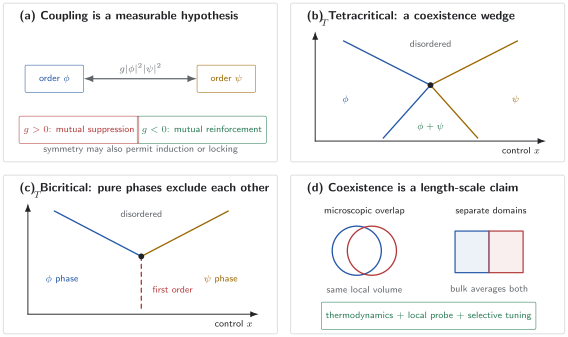
Minimal phase topologies for two orders. A biquadratic coefficient predicts mutual suppression or reinforcement, but stable coexistence also depends on . A tetracritical point admits a homogeneous coexistence wedge; a bicritical point joins two continuous boundaries to a first-order boundary between pure phases. Bulk detection of both orders must be supplemented by local co-location and selective tuning.
Phase-Diagram Topologies
Section titled “Phase-Diagram Topologies”Write the leading masses near two bare transition lines as
The crossing of and does not by itself give the observed topology. The coupling and fluctuations decide what replaces that crossing.
Tetracritical behavior
Section titled “Tetracritical behavior”For a stable mixed minimum, four phases can meet: disordered, pure , pure , and coexistence. Each boundary may be continuous at mean-field level. Entering the mixed phase from the pure- phase occurs when
because renormalizes the mass. The analogous boundary follows by exchanging the fields.
Bicritical behavior
Section titled “Bicritical behavior”When mutual repulsion destabilizes the mixed minimum, the two continuous disorder-to-order lines meet a first-order line separating pure phases. Hysteresis, latent heat, discontinuous order-parameter jumps, and two-phase coexistence may occur along that line. Finite sweep rates and disorder can broaden these signatures, so absence of visible hysteresis is not proof of continuity.
Fluctuation corrections
Section titled “Fluctuation corrections”Mean-field topology is a starting hypothesis. Near a multicritical point, order-parameter fluctuations renormalize , , and . Depending on component numbers and dimension, the infrared behavior may approach an isotropic, biconical, or decoupled fixed point, or run toward a fluctuation-driven first-order transition. A proposed enlarged symmetry such as SO(5) requires matching susceptibilities, scaling dimensions, and symmetry-breaking perturbations; visual similarity between two domes is not enough.
Long-range strain, Coulomb interactions, metallic damping, quenched disorder, and coupling to gapless fermions can all invalidate the short-range classical functional. Quantum Criticality develops the zero-temperature and dynamical extensions.
First-order slopes are thermodynamic data
Section titled “First-order slopes are thermodynamic data”Let a tuning field have conjugate density . Along a first-order line , equality of the two free energies gives
The sign and magnitude constrain proposed phase assignments. A kink in transport that violates known entropy and magnetization or volume jumps is unlikely to be the claimed equilibrium boundary.
What Coexistence Means
Section titled “What Coexistence Means”Homogeneous, microscopic coexistence
Section titled “Homogeneous, microscopic coexistence”Both order parameters are nonzero within the same thermodynamic phase and the same microscopic volume. Examples include a magnetic superconductor in which the same electronic fluid supports a superconducting condensate and a static internal magnetic field. The strongest evidence combines a bulk superconducting volume fraction with a local magnetic probe whose entire spectral weight participates.
Phase separation
Section titled “Phase separation”Different spatial regions realize different pure phases. Macroscopic separation obeys ordinary coexistence thermodynamics. Mesoscopic domains can arise from strain compatibility, disorder, interfacial energy, or long-range Coulomb frustration. A diffraction experiment whose beam covers many domains reports both Bragg signals even if no unit cell contains both orders.
Textured coexistence
Section titled “Textured coexistence”Include gradients,
For , suppressing in a vortex core, domain wall, defect halo, or surface lowers the local mass of . The second order may therefore nucleate only in those textures. This is real spatial coexistence but not a uniform mixed phase.
Fluctuating coexistence
Section titled “Fluctuating coexistence”Two susceptibilities may be large while neither order has a static expectation value. A probe with integration time can call fluctuations “static” when their correlation time exceeds . Every coexistence statement should therefore report spatial resolution, time window, and volume fraction.
| Observation | What it establishes | What remains unresolved |
|---|---|---|
| Two bulk anomalies | Two thermodynamic or crossover scales may exist | Same microscopic volume or separate fractions |
| Two diffraction peaks | Both correlations occur in the illuminated volume | Co-location below the beam size |
| Full local-probe volume plus bulk order | Strong evidence for microscopic coexistence | Which microscopic electrons carry each order |
| Anticorrelated local maps | Spatial competition at the mapped resolution | Equilibrium coupling versus disorder landscape |
| One order rises when another is selectively suppressed | Evidence for positive effective coupling | Direct effect of the tuning field on both orders |
| Pump-induced transient enhancement | Nonequilibrium access to another basin | Equilibrium free-energy ordering |
A Practical Evidence Protocol
Section titled “A Practical Evidence Protocol”- Name the operators. State wavevector, representation, broken symmetry, and whether the signal is static or dynamic.
- Use thermodynamic criteria. Map transitions with heat capacity, magnetization, elastic response, or another equilibrium derivative, not resistance alone.
- Measure volume and co-location. Combine bulk probes with NMR, NQR, SR, microscopy, coherent scattering, or another local or spatially resolved method.
- Choose a selective perturbation. Field, pressure, uniaxial strain, screening, and disorder generally couple to both orders; calibrate those direct effects.
- Test reciprocal response. A coupled model should predict how suppressing changes and how suppressing changes .
- Track amplitudes and coherence separately. Peak intensity, correlation length, phase stiffness, and volume fraction need not move in the same direction.
- Check history and equilibrium. Hysteresis, cooling rate, aging, and pump delay distinguish metastability from an equilibrium phase.
Inside the stable coexistence phase, the minimal model gives
For , making less negative suppresses and increases . This reciprocal derivative is more discriminating than the mere adjacency of transition lines.
Material Case Studies
Section titled “Material Case Studies”Cuprates: superconductivity and charge order
Section titled “Cuprates: superconductivity and charge order”In underdoped YBaCuO, resonant and hard x-ray scattering found that charge-density-wave correlations grow on cooling toward and are reduced inside the zero-field superconducting state. A magnetic field that weakens superconductivity enhances charge order and, at high field, stabilizes a more three-dimensional CDW. Those amplitude trends are consistent with competition.
The scalar picture is incomplete in useful ways. Charge order is spatially inhomogeneous, vortex halos alter the local balance, and spin, nematic, lattice, and possible pair-density-wave channels are nearby. A 2026 cross-family resonant-scattering analysis reported that superconductivity can suppress CDW amplitude while strengthening phase coherence and wavevector locking. Amplitude competition and phase-level reinforcement can therefore occur simultaneously; “CDW intensity decreases below ” is not a complete coupling diagnosis.
The Charge and Spin Density Waves page owns the ordering vectors, reconstruction, and probe conventions. Here the lesson is methodological: compare intensity, width, dimensionality, field response, and local texture rather than compressing them into one order-parameter number.
Heavy fermions: magnetism and superconductivity
Section titled “Heavy fermions: magnetism and superconductivity”Pressure-tuned CeRhIn develops superconductivity while antiferromagnetism survives over part of the phase diagram. NQR line splitting together with a bulk Meissner response supplied microscopic-coexistence evidence near 1.75 GPa. Field and pressure mapping later exposed a line separating the mixed phase from pure superconductivity and a tetracritical structure.
CeCoIn supplies a different topology. Its high-field, low-temperature magnetic order exists only inside the superconducting phase and collapses when superconductivity is destroyed. That is not captured by simple mutual exclusion; symmetry-allowed coupling to a modulated superconducting component or another composite channel is implicated.
Pressure also changes Kondo hybridization, Fermi volume, dimensionality, and magnetic exchange. A two-scalar fit can organize boundaries without proving a microscopic pairing mechanism. Heavy Fermions and Kondo Lattices provide that wider scale ledger.
Moiré materials: tunability without a universal parent phase
Section titled “Moiré materials: tunability without a universal parent phase”Magic-angle twisted bilayer graphene initially displayed correlated insulating states near integer filling and neighboring superconducting domes. Their proximity motivated parent-insulator narratives. Screening experiments subsequently suppressed prominent insulating states while leaving superconducting domes with comparable transition temperatures, showing that adjacency alone does not establish that one order is the necessary parent of the other.
Moiré phase diagrams are unusually sensitive to twist-angle variation, heterostrain, dielectric screening, alignment with hexagonal boron nitride, displacement field, density calibration, and contacts. Flavor polarization, nematicity, Chern states, compressibility cascades, and superconductivity can exchange small condensation energies. Consequently:
- a resistance peak is not yet an identified symmetry-breaking insulator;
- two devices at nominally equal filling need not share Landau coefficients;
- a dome around an integer filling does not prove fluctuation-mediated pairing by the neighboring order;
- local twist and density maps are part of phase-diagram metrology, not optional characterization.
Moiré systems are powerful precisely because screening and electric fields can test coupled-order hypotheses. Their tunability should be used to overconstrain the theory, not to assign a universal sequence prematurely.
Common Mistakes
Section titled “Common Mistakes”Inferring competition from neighboring domes
Section titled “Inferring competition from neighboring domes”Two phases can be adjacent because the tuning parameter changes band structure or carrier density, even if their order parameters barely couple. Establish reciprocal response or a shared free-energy fit.
Equating competition with exclusion
Section titled “Equating competition with exclusion”A positive suppresses amplitudes. Stable coexistence remains possible when and both mixed amplitudes are positive.
Equating two signals with microscopic coexistence
Section titled “Equating two signals with microscopic coexistence”Bulk probes average over domains. State the spatial resolution, local volume fraction, and correlation length.
Treating every secondary signal as an independent phase
Section titled “Treating every secondary signal as an independent phase”A symmetry-allowed linear or trilinear coupling can induce a secondary order at the primary transition. Look for a separate singularity and independent soft mode before assigning another phase boundary.
Reading bare Landau coefficients as universal observables
Section titled “Reading bare Landau coefficients as universal observables”The coefficients depend on coarse-graining scale, temperature, and tuning. Fluctuations can change topology or drive first-order behavior.
Calling a transient state an equilibrium winner
Section titled “Calling a transient state an equilibrium winner”Different relaxation times can trap a driven system in a metastable basin. Pump fluence, delay, heating, and recovery must be modeled before redrawing an equilibrium phase diagram.
Exercises
Section titled “Exercises”1. Derive the coexistence solution
Section titled “1. Derive the coexistence solution”Starting from the two-order free energy, solve for a stationary point with and , and determine its local stability condition.
Solution
Dividing the stationarity equations by the nonzero amplitudes gives
Inverting the matrix yields
where . Both expressions must be positive. At the stationary point,
Its diagonal entries are positive and , so local stability requires .
2. Classify two multicritical points
Section titled “2. Classify two multicritical points”Take . Compare and near a crossing of the bare transition lines.
Solution
For ,
A stable mixed solution can occupy a wedge where both squared amplitudes are positive. The mean-field topology is tetracritical. For ,
The mixed stationary point is unstable. The pure phases exclude each other and meet along a first-order boundary, giving bicritical topology. Because , the quartic energy remains bounded for nonnegative and despite the negative determinant.
3. Integrate out an induced secondary order
Section titled “3. Integrate out an induced secondary order”Let a noncritical field couple to a primary order through
Eliminate and state the effect on the quartic coefficient of .
Solution
Minimization gives
Substitution yields
If the original quartic term is , then
The secondary field is induced rather than independently ordered, and sufficiently strong coupling can make the effective quartic negative, requiring sixth-order stabilization and allowing a first-order transition.
4. Predict a selective-tuning response
Section titled “4. Predict a selective-tuning response”Inside a stable coexistence phase with , a perturbation raises while leaving the other bare coefficients fixed. What happens to both amplitudes?
Solution
Differentiating the mixed solution gives
The perturbation directly suppresses and releases from positive biquadratic competition. Observing this response supports only if the perturbation’s direct coupling to is independently bounded.
5. Audit a coexistence claim
Section titled “5. Audit a coexistence claim”A sample shows a superconducting resistive transition and a magnetic diffraction peak. Is microscopic coexistence established? Design a stronger test.
Solution
No. A percolating superconducting path can produce zero resistance while a different volume fraction produces magnetic diffraction. Establish bulk superconductivity through heat capacity, magnetic shielding with demagnetization control, or superfluid stiffness. Then use a local magnetic probe such as NMR, NQR, or SR to determine whether essentially the same sample volume develops static magnetism. Spatially resolved diffraction or microscopy should bound domain size, and pressure or field sweeps should test whether both signals follow a common equilibrium boundary.
6. Use a first-order slope
Section titled “6. Use a first-order slope”Two phases meet along . The entropy and conjugate-density jumps are and . Derive the slope and interpret the case , .
Solution
Along coexistence, and
Equating differentials gives
so
If both jumps are positive, the line has negative slope: increasing temperature favors phase 2 entropically, so coexistence requires a smaller value of the field that also favors phase 2.
Research Status and Open Problems
Section titled “Research Status and Open Problems”The symmetry logic and mean-field topologies are standard. The unresolved work is material-specific and dynamical:
- Which apparent multicritical points flow to stable fixed points, and which are weakly first order over experimentally inaccessible scales?
- How can strain, disorder, and Coulomb-frustrated textures be separated from intrinsic homogeneous coexistence?
- Which cuprate observables require intertwined phase locking rather than simple amplitude competition?
- In heavy fermions, when does the same critical magnetic sector both compete with static superconductivity and promote pairing fluctuations?
- Which moiré orders have been identified by symmetry-resolved probes rather than inferred from transport incompressibility?
- Can pump–probe experiments reconstruct a quantitative nonequilibrium free-energy landscape without conflating selective melting with heating?
- When does an apparent enlarged symmetry survive lattice, gauge, and fermionic perturbations?
The durable standard is to report the order parameters, coupling invariants, resolution scale, equilibrium checks, and status of alternatives. “Competing” and “intertwined” are conclusions of that analysis, not substitutes for it.
Connections
Section titled “Connections”- Unconventional Superconductivity owns the superconducting order’s internal zero-momentum representation and evidence; this page retains coupled-order thermodynamics, coexistence, exclusion, and phase-separation tests.
- Landau Theory supplies the free-energy, stability, and continuous-versus-first-order baseline.
- Order Parameters develops representations, conjugate fields, composite order, and finite-size diagnostics.
- Ginzburg–Landau Theory owns superconducting gradients, magnetic coupling, vortices, and characteristic lengths.
- Charge and Spin Density Waves owns density-wave operators, ordering vectors, reconstruction, phasons, and scattering evidence.
- Pair-Density Waves and Exotic Orders owns finite-momentum pair fields, induced charge and charge-4e composites, fractional defects, and material evidence.
- Quantum Criticality treats zero-temperature phase boundaries, crossover fans, and scaling collapses.
- Heavy Fermions and Kondo Lattices connect coupled orders to Kondo coherence, Fermi-volume changes, and magnetic exchange.
- Disorder in Quantum Matter supplies the disorder ensemble and spatial-control ledger needed before assigning intrinsic phase separation.
References
Section titled “References”- J. M. Kosterlitz, D. R. Nelson, and M. E. Fisher, “Bicritical and tetracritical points in anisotropic antiferromagnetic systems”, Physical Review B 13, 412–432 (1976). Multicritical topology and scaling.
- P. C. Hohenberg and B. I. Halperin, “Theory of dynamic critical phenomena”, Reviews of Modern Physics 49, 435–479 (1977). Order-parameter dynamics and conservation classes.
- C. A. Balseiro and L. M. Falicov, “Superconductivity and charge-density waves”, Physical Review B 20, 4457–4464 (1979). Early microscopic treatment of competing superconducting and density-wave gaps.
- K. Binder, “Theory of first-order phase transitions”, Reports on Progress in Physics 50, 783–859 (1987). Metastability, nucleation, and finite-size signatures.
- P. Calabrese, A. Pelissetto, and E. Vicari, “Multicritical phenomena in O()+O()-symmetric theories”, Physical Review B 67, 054505 (2003). Renormalization-group fixed points beyond mean field.
- T. Mito et al., “Coexistence of antiferromagnetism and superconductivity near the quantum criticality of the heavy-fermion compound CeRhIn”, Physical Review Letters 90, 077004 (2003). NQR and bulk evidence for microscopic coexistence.
- E. Demler, W. Hanke, and S.-C. Zhang, “SO(5) theory of antiferromagnetism and superconductivity”, Reviews of Modern Physics 76, 909–974 (2004). Enlarged-symmetry framework and experimental tests.
- F. Ronning et al., “Pressure study of quantum criticality in CeCoIn”, Physical Review B 73, 064519 (2006). Pressure evolution near a heavy-fermion superconducting quantum critical regime.
- T. Park et al., “Hidden magnetism and quantum criticality in the heavy fermion superconductor CeRhIn”, Nature 440, 65–68 (2006). Field–pressure phase diagram and tetracritical structure.
- M. Kenzelmann et al., “Coupled superconducting and magnetic order in CeCoIn”, Science 321, 1652–1654 (2008). Magnetic order dependent on superconductivity.
- R. M. Fernandes et al., “Unconventional pairing in the iron arsenide superconductors”, Physical Review B 81, 140501(R) (2010). Microscopic coexistence as a pairing-symmetry constraint.
- G. Ghiringhelli et al., “Long-range incommensurate charge fluctuations in (Y,Nd)BaCuO”, Science 337, 821–825 (2012). Charge correlations reversed below .
- J. Chang et al., “Direct observation of competition between superconductivity and charge density wave order in YBaCuO”, Nature Physics 8, 871–876 (2012). Magnetic-field release of charge order.
- S. Gerber et al., “Three-dimensional charge density wave order in YBaCuO at high magnetic fields”, Science 350, 949–952 (2015). Field-induced three-dimensional CDW.
- E. Fradkin, S. A. Kivelson, and J. M. Tranquada, “Colloquium: Theory of intertwined orders in high temperature superconductors”, Reviews of Modern Physics 87, 457–482 (2015). Symmetry, stripes, pair-density waves, and defects.
- B. Keimer, S. A. Kivelson, M. R. Norman, S. Uchida, and J. Zaanen, “From quantum matter to high-temperature superconductivity in copper oxides”, Nature 518, 179–186 (2015). Cuprate phase landscape and evidence status.
- H. Yamase, A. Eberlein, and W. Metzner, “Coexistence of incommensurate magnetism and superconductivity in the two-dimensional Hubbard model”, Physical Review Letters 116, 096402 (2016). Microscopic model coexistence.
- Y. Cao et al., “Correlated insulator behaviour at half-filling in magic-angle graphene superlattices”, Nature 556, 80–84 (2018). Initial correlated-insulator phase diagram.
- Y. Cao et al., “Unconventional superconductivity in magic-angle graphene superlattices”, Nature 556, 43–50 (2018). Neighboring superconducting domes.
- J. Choi et al., “Spatially inhomogeneous competition between superconductivity and the charge density wave in YBaCuO”, Nature Communications 11, 990 (2020). Distinct CDW regions and spatial competition.
- P. Stepanov et al., “Untying the insulating and superconducting orders in magic-angle graphene”, Nature 583, 375–378 (2020). Screening test of the parent-insulator narrative.
- E. Y. Andrei and A. H. MacDonald, “Graphene bilayers with a twist”, Nature Materials 19, 1265–1275 (2020). Moiré phase landscape and device sensitivity.
- J. S. Hofmann, E. Berg, and D. Chowdhury, “Superconductivity, charge density wave, and supersolidity in flat bands with a tunable quantum metric”, Physical Review Letters 130, 226001 (2023). Controlled flat-band coexistence example.
- S. Sun and A. J. Millis, “Transient trapping into metastable states in systems with competing orders”, Physical Review X 10, 021028 (2020). Nonequilibrium basin selection and timescale effects.
- H. Lee, C.-T. Kuo, M. Fujita, C.-C. Kao, and J.-S. Lee, “Superconductivity reinforces charge-density-wave phase coherence across cuprates”, Physical Review Letters 136, 186502 (2026). Distinct amplitude and phase-coherence response below .
Summary
Section titled “Summary”Competing orders are diagnosed by coupled thermodynamics, not by visual proximity in a phase diagram. For two symmetry-distinct fields, a positive biquadratic coupling produces mutual amplitude suppression, while determines whether a stable homogeneous coexistence phase is possible. Tetracritical topology contains a coexistence wedge; bicritical topology joins two continuous boundaries to a first-order boundary between pure phases. Bilinear, trilinear, gradient, disorder, and fermionic couplings can instead induce, lock, or texture the orders. In materials, bulk anomalies must be combined with local co-location, volume fractions, selective perturbations, equilibrium checks, and reciprocal response. Cuprates, heavy fermions, and moiré systems demonstrate why competition, cooperation, and intertwining can operate in different observables at the same time.