Many-Body Localization Preview
Many-body localization, or MBL, is a proposed regime of interacting, isolated, strongly disordered quantum matter in which local observables retain memory, transport is suppressed, and highly excited eigenstates fail the eigenstate thermalization hypothesis. Its distinctive phenomenology combines localization with interaction-induced dephasing: particles or spins can remain locally constrained even while entanglement spreads slowly across increasing distances.
That concise definition needs an unusually careful status label. Finite chains and finite-time experiments display a robust collection of MBL-like signatures. Quasilocal-integral, or l-bit, models explain those signatures coherently. A rigorous construction exists for a restricted one-dimensional random spin chain under an additional level-statistics assumption. Yet the existence and boundary of a generic asymptotic MBL phase, especially in higher dimensions or near a putative transition, remain active questions because rare resonances and thermal avalanches can occur on scales far beyond exact diagonalization and current experiments.
This page therefore separates three statements:
Purpose and Canonical Scope
Section titled “Purpose and Canonical Scope”This page owns the stable entry layer:
- a benchmark interacting disordered spin chain;
- the distinction between Anderson localization and many-body localization;
- operational tests of thermalization failure and retained local memory;
- the quasilocal-integral description and what it predicts;
- eigenstate, spectral, transport, quench, and entanglement diagnostics;
- the avalanche mechanism as a stability constraint;
- finite-size, finite-time, and disorder-averaging failure modes;
- a status ledger separating established, model-dependent, and frontier claims.
Neighboring pages retain their own canonical roles:
- Relaxation and Thermalization defines equilibration, thermalization, constrained ensembles, and evidence standards.
- Eigenstate Thermalization Hypothesis owns the ETH matrix-element ansatz and its generic nonintegrable regime.
- Integrability and Generalized Gibbs Ensembles Preview owns extensive translation-compatible charge hierarchies and generalized Gibbs states.
- Area Laws and Volume Laws own entanglement-scaling definitions.
- XXZ Spin Chain owns the clean model, its Bethe structure, and equilibrium phase diagram.
- Many-Body Localization is the quantum-matter bridge for platform comparison, interaction and isolation controls, experimental claim ladders, and method-specific limitations.
- A later Research Frontiers article owns rapidly changing verdicts about transition universality, numerical extrapolations, mobility edges, and the ultimate dimensional stability of MBL.
Epistemic Status
Section titled “Epistemic Status”The most reliable way to read the subject is by claim type.
| Claim | Status on this page |
|---|---|
| Strongly disordered finite interacting chains can retain local memory for very long accessible times | established numerically and experimentally for specified models and windows |
| Interactions distinguish MBL-like dynamics from a noninteracting Anderson insulator through slow dephasing and entanglement growth | standard phenomenology |
| A complete quasilocal conserved-operator description explains a fully localized regime | controlled in special constructions and a powerful effective description more broadly |
| The conventional random-field spin chain has a sharp, accessible MBL transition at a quoted disorder value | model-, method-, size-, and energy-window dependent |
| Generic one-dimensional random systems possess an asymptotically stable MBL phase | active question with restricted rigorous results and competing extrapolations |
| Generic fully MBL phases survive in spatial dimension greater than one | strongly constrained by avalanche arguments and not established |
| A many-body mobility edge is asymptotically stable | active and especially vulnerable to rare thermal regions |
The label active is not a synonym for “anything goes.” It means that conclusions must carry their Hamiltonian, dimension, disorder ensemble, interaction range, energy density, system-size window, time window, and order of limits.
What Must Be Distinguished
Section titled “What Must Be Distinguished”Anderson localization
Section titled “Anderson localization”Anderson localization is a single-particle interference phenomenon. For a noninteracting lattice Hamiltonian with sufficiently localized one-particle orbitals ,
the mode occupations
are conserved. A many-fermion Slater determinant then retains memory because each occupied localized orbital remains occupied. Entanglement created from a product state typically spreads only over one-particle localization lengths and saturates rapidly.
Many-body localization
Section titled “Many-body localization”MBL asks whether localization-like memory can survive interactions at finite energy density. Interactions invalidate independent one-particle occupations, but in a fully localized effective description they dress those occupations into quasilocal conserved pseudospins. Interactions then produce configuration-dependent phases and dephasing without efficient transport.
Slow thermalization
Section titled “Slow thermalization”A thermal system can relax extremely slowly. Griffiths regions, approximate conservation laws, bottlenecks, kinetic constraints, small diffusion constants, and prethermal plateaus can all imitate localization over a finite window. A decaying observable is not localized merely because the fitted exponent is small.
Integrability
Section titled “Integrability”Clean integrable systems fail ordinary Gibbs thermalization because an extensive structured charge hierarchy survives. MBL phenomenology instead relies on spatially quasilocal memory tied to disorder. Both can show Poisson-like level statistics and ETH failure, so neither diagnostic identifies the mechanism alone.
Fragmentation and scars
Section titled “Fragmentation and scars”Hilbert-space fragmentation disconnects sectors through constraints. Quantum scars concern atypical states within an otherwise thermal spectrum. A fully MBL claim concerns typical states in a declared finite-energy-density window, not a small exceptional subspace.
| Regime | Interactions | Spatial disorder required | Local memory | Typical entanglement feature |
|---|---|---|---|---|
| Anderson insulator | no | commonly yes | yes | rapid saturation after a product-state quench |
| MBL-like regime | yes | random or quasiperiodic in canonical examples | yes over the tested window | slow, often logarithmic growth |
| clean integrable system | yes or no | no | charge-dependent | quasiparticle- and ensemble-dependent |
| prethermal regime | yes | no requirement | temporary | growth followed by eventual thermalization |
| fragmented system | yes | no requirement | sector-dependent | controlled by accessible component |
| thermal chaotic system | yes | no requirement | no generic local plateau | typically rapid growth toward a thermal value |
Benchmark Random-Field Spin Chain
Section titled “Benchmark Random-Field Spin Chain”A standard numerical test bed is the spin- XXZ chain with a longitudinal random field,
For a common random ensemble,
The specification is incomplete until it also states:
- open or periodic boundaries;
- the anisotropy and energy unit ;
- the conserved total magnetization sector;
- the distribution of and whether its width is or ;
- the target energy density;
- the number of disorder realizations;
- whether observables are averaged arithmetically, geometrically, or through their full distribution.
The Hamiltonian conserves
Every spectral statistic must therefore be computed inside a fixed magnetization sector. Additional exact spatial symmetries must also be resolved when they survive a special disorder realization or boundary choice.
Fermion representation
Section titled “Fermion representation”Under the Jordan–Wigner transformation, write
For open boundaries, the model becomes
At , this is a noninteracting one-dimensional disordered hopping problem. Its localized one-particle orbitals give an Anderson insulator. At , the density–density term couples occupations and supplies the interaction needed for MBL phenomenology.
This comparison is unusually valuable because it changes one structural ingredient while preserving disorder:
The clean uniform XXZ chain is Bethe-ansatz integrable. Generic random fields break translation invariance and that conventional clean-chain integrability. Calling the random-field model “integrable” merely because a finite matrix has spectral projectors would erase the locality criterion that matters.
Operational Meaning of Localization
Section titled “Operational Meaning of Localization”No finite isolated system literally converges forever: its spectrum is discrete and recurrences occur. MBL diagnostics are therefore statements about local probes, scaling, and ordered limits.
Let be a local operator and prepare . A connected memory correlator can be written
A localization claim seeks a nonvanishing asymptotic local component after finite-size recurrences have been excluded. Schematically,
with the thermodynamic limit taken first for bulk dynamics. A finite- time average can still be useful, but it is not the same object.
For subsystem thermalization, compare
with the thermal reduced state selected by the conserved densities. MBL-like behavior means that local late-time data depend on more information about than energy, particle number, and ordinary global symmetries retain.
Fully localized and energy-window claims
Section titled “Fully localized and energy-window claims”A fully many-body-localized model is intended to have localized structure throughout its many-body spectrum, apart from explicitly excluded sectors or exceptional states. An energy-window claim is weaker: it concerns a declared range of energy density.
This distinction matters because a thermal band elsewhere in the spectrum can act as a source of resonances. Proposed many-body mobility edges therefore require more scrutiny than a finite-size plot separating two spectral regions.
Quasilocal Integrals of Motion
Section titled “Quasilocal Integrals of Motion”The l-bit description is the central phenomenological language of a fully localized regime. Suppose a quasilocal unitary dresses physical spins into conserved pseudospins,
After a normalization choice, one often uses Pauli-like operators satisfying
Quasilocality means that the operator has exponentially decreasing tails away from site . For an expansion over operators with support reaching distance ,
It does not mean that acts on one site exactly.
Effective diagonal Hamiltonian
Section titled “Effective diagonal Hamiltonian”If the form a complete commuting set, the Hamiltonian can be expanded as
The couplings decay with the diameter of their support. A schematic bound is
Every many-body eigenstate is labeled by a string
The effective Hamiltonian contains no or terms, so the pseudospin populations do not flip. The interaction terms nevertheless make each pseudospin’s precession frequency depend on distant pseudospin configurations. That produces dephasing and entanglement without ordinary transport.
What the l-bit picture does not guarantee
Section titled “What the l-bit picture does not guarantee”The expansion is not a theorem for every strongly disordered Hamiltonian. Its limitations include:
- resonant clusters where perturbative dressing is not local;
- nonuniqueness under quasilocal redefinitions of conserved operators;
- possible breakdown near a transition;
- rare thermal inclusions that invalidate a global complete set;
- sensitivity to long-range interactions and unbounded local Hilbert spaces;
- exact destruction by generic coupling to an external bath.
Spectral projectors always commute with a finite Hamiltonian. They are highly nonlocal and do not count as l-bits.
Why ETH Fails in the Localized Description
Section titled “Why ETH Fails in the Localized Description”A physical local operator overlaps with nearby l-bits. Schematically,
where the coefficients decrease with distance and contains terms off diagonal in the l-bit basis.
The diagonal expectation value in an eigenstate depends on nearby labels,
Two adjacent-energy eigenstates need not share those local labels. Their local expectations can therefore remain different as grows, contrary to diagonal ETH smoothness.
After a quench, the diagonal ensemble retains the initial weights of many l-bit configurations. An energy-only Gibbs state discards that spatially resolved memory. This is not the same as the generalized Gibbs ensemble of a clean Bethe-integrable model: the conserved objects, spatial structure, disorder ensemble, and stability questions differ.
Eigenstate Diagnostics
Section titled “Eigenstate Diagnostics”Excited-state entanglement
Section titled “Excited-state entanglement”In a fully localized l-bit picture, a quasilocal unitary maps product pseudospin eigenstates to physical eigenstates. Across a cut, only dressing terms near the boundary contribute appreciably, suggesting an excited-state area law in one dimension,
for a fixed cut and typical localized eigenstates.
A thermal finite-energy-density eigenstate instead has
when is smaller than its complement and ETH assumptions hold. Area-law eigenstates are strong evidence, but integrable, constrained, or specially constructed states can also be low entangled.
Adjacent-gap ratio
Section titled “Adjacent-gap ratio”Let sorted levels within one irreducible symmetry sector have gaps
Define
For an uncorrelated Poisson spectrum,
For the Gaussian orthogonal ensemble,
The GOE benchmark applies only when the antiunitary symmetry class and sector choice match it. Poisson-like statistics are compatible with localization, but also with integrability, unresolved block structure, or accidental degeneracy. Many-Body Quantum Chaos Preview owns the broader gap-ratio, random-matrix, long-range-correlation, and Thouless-scale workflow.
Local matrix elements
Section titled “Local matrix elements”Useful ETH-breaking tests include:
- broad eigenstate-to-eigenstate fluctuations of local diagonal elements;
- off-diagonal elements inconsistent with ETH entropy scaling;
- nonthermal reduced density matrices;
- persistent overlap between local operators and conserved quasilocal components.
No one small-system statistic establishes an asymptotic phase.
Quench Diagnostics
Section titled “Quench Diagnostics”Quenches make local memory directly observable. Prepare a simple product state, evolve under the disordered interacting Hamiltonian, and record several independent channels.
Density imbalance
Section titled “Density imbalance”For a charge-density-wave preparation, let and be populations on initially occupied and initially empty sublattices. The imbalance is
An ideal thermalizing system without a symmetry protecting the pattern has
in the appropriate ordered limits. A nonzero plateau signals memory over the observed window. It does not by itself distinguish an asymptotic MBL phase from Anderson localization, a prethermal plateau, kinetic constraints, or very slow thermalization.
Local autocorrelation
Section titled “Local autocorrelation”At zero total magnetization, a common infinite-temperature spin diagnostic is
Thermal diffusion, subdiffusion, localization, and finite-size saturation produce different long-time structures. Fits must vary the lower time cutoff, system size, boundary conditions, and disorder ensemble.
Transport and number fluctuations
Section titled “Transport and number fluctuations”Localization should constrain more than one pattern. Examine:
- spreading of a domain wall or density packet;
- mean-square displacement;
- particle-number fluctuations across a cut;
- dc and low-frequency conductivity;
- response to boundary reservoirs;
- energy transport when energy is the relevant conserved density.
Slow particle transport and slow entanglement are logically distinct. An interaction can transmit phase information without carrying a conserved particle across the same distance.
Logarithmic Entanglement Growth
Section titled “Logarithmic Entanglement Growth”The clearest conceptual distinction between Anderson and MBL-like dynamics is interaction-induced dephasing.
Assume effective two-l-bit couplings decay as
Two l-bits a distance apart accumulate an order-one relative phase when
Solving for the dephasing distance gives
If the initial state has nonzero diagonal entropy density in the l-bit basis, the entangled region near a cut grows with this distance:
over the l-bit regime before finite-size saturation.
This argument explains a hierarchy:
The coefficient is not universal. Higher-body couplings, initial-state structure, rare resonances, interaction range, Rényi index, and proximity to a crossover all matter.
Extensive saturation is not thermalization
Section titled “Extensive saturation is not thermalization”For a finite bipartition, logarithmic growth can eventually reach an extensive value,
The coefficient can remain below the thermal entropy density and depend on the initial state. A volume-law late-time state therefore does not by itself prove ETH or transport.
Logarithmic light cone
Section titled “Logarithmic light cone”Inverting the dephasing relation gives
This exponentially large time for distant influence is often called a logarithmic light cone. It is much slower than a ballistic front, but it still represents unbounded spreading in an ideal infinite l-bit model.
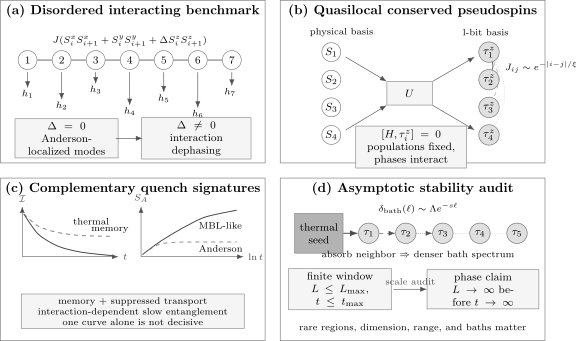
The logic of an MBL claim. Random fields and interactions define the benchmark, quasilocal conserved pseudospins organize the effective description, memory and logarithmic dephasing supply complementary finite-time signatures, and a thermal-inclusion audit tests whether those signatures can persist as .
A Diagnostic Ledger
Section titled “A Diagnostic Ledger”| Observable | Thermal expectation | MBL-like expectation | Main confound |
|---|---|---|---|
| imbalance | decays to zero | nonzero long-time memory | slow crossover or Anderson localization |
| local autocorrelation | decays | persistent component | finite-size plateau |
| adjacent-gap ratio | random-matrix value | Poisson-like value | integrability or mixed sectors |
| eigenstate entropy | thermal volume law | area law in fully localized regime | atypical states or small sizes |
| quench entropy | rapid growth | slow, often logarithmic growth | broad preasymptotic window |
| particle transport | finite transport coefficient or hydrodynamic spreading | absent in ideal localized regime | tiny coefficient below resolution |
| local ETH fluctuations | shrink with size | remain broad | insufficient disorder samples |
| local response to perturbation | spreads and thermalizes | quasilocal memory | approximate conservation |
A persuasive analysis uses several rows and tests whether one parameter regime explains them consistently.
Disorder Averages and Typicality
Section titled “Disorder Averages and Typicality”Quenched disorder makes observables random variables over samples. The arithmetic mean
can be dominated by rare realizations. For positive , a typical value is often represented by
Neither summary replaces the distribution. Near a putative transition, report:
- median and quantiles;
- sample-to-sample variance;
- the number and selection of realizations;
- whether samples are paired across system sizes;
- bootstrap or other uncertainty intervals;
- sensitivity to rare-event trimming;
- arithmetic and typical behavior when physically meaningful.
A long-tailed distribution is physics, not merely inconvenient noise.
Random and quasiperiodic potentials
Section titled “Random and quasiperiodic potentials”Random disorder contains arbitrarily atypical regions in the infinite system. A quasiperiodic field such as
is deterministic for fixed phase and lacks the same random rare-region statistics. It can still localize and exhibit long-lived interacting nonergodicity, but its transition and stability need not share the random problem’s universality.
Calling a quasiperiodic potential “random disorder” hides precisely the distinction that avalanche and Griffiths arguments use.
Resonances
Section titled “Resonances”Localization perturbation theory fails when two configurations and satisfy
An isolated resonance can be diagonalized as a larger local block. The harder question is whether resonances remain sparse and localized or connect into structures that thermalize an unbounded region.
The many-body density of states grows exponentially with volume. Consequently, a region can have an exponentially small level spacing even when every microscopic coupling is modest.
Thermal Avalanches
Section titled “Thermal Avalanches”Consider an internally thermal inclusion of length with entropy density . Its many-body level spacing scales schematically as
where is a microscopic bandwidth scale. Its coupling to a localized degree of freedom a distance away may scale as
If the coupling and bath matrix elements overcome the relevant level spacing, the neighboring degree of freedom hybridizes with the inclusion. The enlarged bath then has a smaller level spacing and may absorb the next degree of freedom:
This positive feedback is a thermal avalanche.
What the argument establishes
Section titled “What the argument establishes”Avalanche reasoning provides a stringent consistency test:
- a rare thermal region cannot be treated as a passive defect;
- stability depends on localization length, entropy density, dimension, and matrix-element scaling;
- an apparently localized finite chain may lie below an enormous avalanche length;
- thermal and localized regions must be coupled self-consistently.
What it does not establish automatically
Section titled “What it does not establish automatically”The schematic inequalities do not supply one universal critical disorder. Matrix elements, spectral functions, conserved quantities, geometry, correlations in the disorder, and back reaction all matter. Numerical toy baths can test the mechanism without proving that a rare seed occurs with the required probability in the original model.
Dimensional caution
Section titled “Dimensional caution”In higher dimensions, the boundary of a growing thermal inclusion expands and avalanche constraints become more severe. Generic fully MBL phases with random short-range disorder in are therefore not established and are widely viewed as unstable under plausible assumptions.
One-dimensional systems remain subtler. Restricted rigorous constructions and l-bit phenomenology support localization in particular settings, while large finite-size drifts and avalanche scales make generic extrapolation difficult. The appropriate stable statement is not a universal yes or no; it is a model- and assumption-indexed status report.
Mobility Edges Require Extra Caution
Section titled “Mobility Edges Require Extra Caution”A many-body mobility edge would separate localized and thermal eigenstates by energy density. Suppose a finite spectrum appears to contain both. Then a localized region of the spectrum may couple through many-body resonances to thermal states or thermal spatial inclusions.
Before claiming an edge, test:
- whether the apparent crossing drifts with ;
- whether energy-window widths shrink consistently;
- whether the thermal region can seed an avalanche;
- whether the disorder ensemble admits rare inclusions;
- whether the diagnostic agrees across spectra, eigenstates, and dynamics;
- whether a long-lived crossover explains the same data.
An energy-resolved finite-size crossover is a valid observation. Calling it an asymptotic mobility edge is the additional claim.
Finite-Size Scaling Audit
Section titled “Finite-Size Scaling Audit”Exact diagonalization commonly reaches only a few dozen spin- sites, while the Hilbert-space dimension in a half-filled sector is
This exponential growth creates a dangerous mismatch: the hypothesized crossover or avalanche length may exceed every simulated .
Crossing plots
Section titled “Crossing plots”For a dimensionless diagnostic , one may try
A stable inference requires more than a visually pleasing crossing:
- omit successively smaller sizes and track parameter drift;
- vary the fitting interval and polynomial order;
- include irrelevant corrections only when the data constrain them;
- propagate disorder-sampling uncertainty;
- compare random and quasiperiodic ensembles separately;
- check whether the extracted exponent respects applicable disorder bounds;
- report covariance and goodness of fit.
If moves systematically as the minimum size increases, the drift is part of the result.
Time-window fits
Section titled “Time-window fits”Suppose an imbalance is fit to
A tiny does not prove a plateau. Repeat the fit while moving both endpoints, compare power-law, logarithmic, stretched-exponential, and plateau-plus-decay models, and inspect residuals. If the inferred asymptote changes with the window, only a crossover has been measured.
Boundary and conservation effects
Section titled “Boundary and conservation effects”Open boundaries can thermalize or localize differently from the bulk on accessible sizes. A conserved charge introduces hydrodynamic structure on the thermal side. Long-range interactions can connect distant resonances. Each feature belongs in the scaling variables, not in a footnote.
Restricted Rigorous Results
Section titled “Restricted Rigorous Results”Imbrie’s one-dimensional spin-chain construction is a landmark because it builds a sequence of local rotations that diagonalizes a strongly disordered interacting Hamiltonian and controls resonant regions. The proof assumes a bound on level attraction and applies to a particular class of random chains.
It establishes neither:
- a theorem for every random-field Heisenberg or XXZ chain;
- the numerical location of a transition in the benchmark model;
- stability in arbitrary dimensions;
- stability under arbitrary long-range interactions;
- exact localization after coupling to an environment.
The correct lesson is positive but bounded: many-body localization is mathematically realizable in an interacting one-dimensional setting under explicit assumptions.
Coupling to an Environment
Section titled “Coupling to an Environment”Exact MBL is an isolated-system concept. Let
For a generic bath with a continuum of available frequencies, gives l-bits finite transition rates. Even weak coupling can eventually erase local memory:
in a weak-coupling golden-rule regime.
An experiment can still display a broad intrinsic MBL-like window when
This is valuable nonequilibrium physics, but the environmental lifetime must be measured rather than silently sent to infinity. Open Quantum Systems owns the reduced-dynamics framework, and Decoherence Timescales owns the timescale ledger.
Experimental Evidence and Its Scope
Section titled “Experimental Evidence and Its Scope”Quantum simulators can prepare low-entanglement states, tune disorder and interactions, and measure site-resolved observables. Their strongest contribution is direct access to dynamical mechanisms.
Quasiperiodic fermions
Section titled “Quasiperiodic fermions”The 2015 optical-lattice experiment by Schreiber and collaborators observed persistent charge-density-wave imbalance in interacting fermions subject to a quasiperiodic potential. Comparing interacting and noninteracting evolution helped separate simple Anderson memory from interaction-dependent dynamics.
The measured plateau established nonergodic behavior over the available sizes and times. The experiment did not by itself take the thermodynamic and infinite-time limits.
Two-dimensional and long-range platforms
Section titled “Two-dimensional and long-range platforms”Experiments have reported slow relaxation and memory in two-dimensional optical lattices and programmable trapped-ion chains with power-law interactions. These platforms widen the phenomenology, but they also change the stability problem: dimension and interaction range are not harmless implementation details.
Entanglement measurements
Section titled “Entanglement measurements”Interference of identical copies and randomized measurements have enabled access to Rényi entropies and correlations. Observing continued slow entanglement growth while particle transport remains suppressed supports the interacting-dephasing picture more strongly than imbalance alone.
Engineered thermal inclusions
Section titled “Engineered thermal inclusions”The 2023 cold-atom avalanche experiment coupled a tunable thermal inclusion to a localized region and observed site-resolved spreading of thermalization. This probes the avalanche mechanism directly. It is evidence about how a prepared seed acts, not by itself a measurement of the probability of spontaneous rare seeds in an infinite disorder ensemble.
Minimum experimental ledger
Section titled “Minimum experimental ledger”Report:
- the microscopic Hamiltonian and calibration uncertainty;
- random versus quasiperiodic potential;
- preparation fidelity and initial-state energy distribution;
- system size and boundary inhomogeneity;
- observation window in tunneling times;
- interaction, disorder, and bath timescales;
- atom loss, heating, and dephasing controls;
- disorder or phase averaging protocol;
- more than one memory, transport, or entanglement observable.
Variants and Boundaries
Section titled “Variants and Boundaries”Quasiperiodic localization
Section titled “Quasiperiodic localization”Quasiperiodic systems remove conventional random rare regions but introduce phase, commensurability, and finite-approximant effects. They deserve their own scaling analysis rather than being pooled with random chains.
Long-range interactions
Section titled “Long-range interactions”If couplings decay algebraically,
distant resonances are parametrically stronger than in a short-range l-bit model. Stability depends on , dimension, conservation laws, and whether interactions or hopping carry the long-range tail.
Stark and disorder-free localization
Section titled “Stark and disorder-free localization”Strong gradients, kinetic constraints, gauge sectors, and fragmentation can produce long-lived nonergodic dynamics without quenched disorder. These mechanisms may imitate selected MBL diagnostics but do not inherit the full random l-bit argument automatically.
Driven systems
Section titled “Driven systems”Periodic driving removes ordinary energy conservation and can lead to heating, prethermal behavior, or proposed Floquet-localized regimes. The later Floquet page owns those cases. Static-MBL formulas should not be copied into a driven problem without replacing energy eigenstates by Floquet eigenstates and auditing drive-induced resonances.
Evidence Workflow
Section titled “Evidence Workflow”For a new localization claim:
- Specify the Hamiltonian. Include disorder distribution, interaction range, dimension, boundary, and conserved quantities.
- Choose the claim. Distinguish a finite-time localized regime, an energy-window crossover, and an asymptotic phase.
- Resolve sectors. Compute spectral statistics only within irreducible symmetry blocks.
- Use independent diagnostics. Combine memory, transport, eigenstate, matrix-element, and entanglement tests.
- Retain distributions. Compare averages, medians, tails, and sample-level behavior.
- Scale size and time separately. Do not trade a longer time at one small for the thermodynamic limit.
- Test fit drift. Vary windows, minimum sizes, and correction terms.
- Audit rare regions. Examine thermal inclusions, quasiperiodicity, and avalanche criteria.
- Audit the environment. Establish that the observed window is shorter than loss, heating, and decoherence times.
- State the residual ambiguity. Name which larger sizes, longer times, or stronger diagnostics could reverse the conclusion.
Common Mistakes
Section titled “Common Mistakes”- Defining MBL as “Anderson localization plus interactions” without specifying what remains localized.
- Calling any slowly decaying imbalance a nonzero asymptotic plateau.
- Using Poisson level statistics without resolving every ordinary symmetry sector.
- Treating l-bits as strictly on-site operators.
- Counting spectral projectors as useful local integrals of motion.
- Equating logarithmic entanglement growth with absence of all information spreading.
- Assuming an extensive late-time entanglement entropy is automatically thermal.
- Quoting one critical disorder without the disorder convention, energy density, and size window.
- Combining random and quasiperiodic data in one universality claim.
- Inferring a mobility edge from finite spectra without an avalanche audit.
- Ignoring rare samples because they complicate an average.
- Treating a weak external bath as irrelevant at arbitrarily long times.
- Promoting a finite-time experimental observation to an infinite isolated-system theorem.
- Applying a restricted one-dimensional rigorous result to every disordered interacting model.
Worked Microexamples
Section titled “Worked Microexamples”Two interacting l-bits
Section titled “Two interacting l-bits”Consider
Prepare each pseudospin in a superposition of its eigenstates. The conditional precession frequency of pseudospin 1 is
Because the phase of pseudospin 1 depends on , the initially factorized state becomes entangled on a timescale
Neither nor changes. This is dephasing without pseudospin transport.
Local memory from conserved overlap
Section titled “Local memory from conserved overlap”Decompose a local operator using the Hilbert–Schmidt inner product at infinite temperature,
The conserved component remains:
After dephasing removes generic oscillatory cross terms, the autocorrelation retains a contribution proportional to . A nonzero local overlap with a quasilocal conserved operator therefore explains persistent memory.
Exercises
Section titled “Exercises”Exercise 1: Identify the interaction
Section titled “Exercise 1: Identify the interaction”Map the random-field XXZ chain to spinless fermions and identify which term disappears at the Anderson limit.
Solution
Jordan–Wigner gives
and turns the transverse exchange into nearest-neighbor hopping. The Hamiltonian is
The density–density term is the interaction. At , the problem is quadratic and its one-particle eigenmodes can Anderson-localize.
Exercise 2: Derive the Poisson gap-ratio mean
Section titled “Exercise 2: Derive the Poisson gap-ratio mean”For independent exponential gaps with unit mean, show that
has mean .
Solution
By symmetry, integrate over and double:
Set , with and :
Since
we obtain
Exercise 3: Recover logarithmic dephasing
Section titled “Exercise 3: Recover logarithmic dephasing”Suppose . Find the largest separation that can acquire an order-one interaction phase by time .
Solution
The phase scale is
Setting gives
If each newly dephased layer contributes a roughly constant entropy density across a one-dimensional cut, then
The derivation assumes exponentially decaying effective interactions and a suitable initial superposition in the l-bit basis.
Exercise 4: Separate transport from entanglement
Section titled “Exercise 4: Separate transport from entanglement”Explain how the two-l-bit Hamiltonian can generate entanglement while every l-bit population remains fixed.
Solution
Because
the probabilities for do not change. The interaction
nevertheless assigns different phases to the four joint configurations. Starting from a product of transverse superpositions, those configuration-dependent phases prevent the state from remaining factorizable. Entanglement grows through conditional dephasing, not through transfer of the conserved populations.
Exercise 5: Diagnose an apparent plateau
Section titled “Exercise 5: Diagnose an apparent plateau”A chain of sizes shows an imbalance close to at the latest measured time, but the late-time decay exponent decreases from to when the fitting window is moved later. What can be concluded?
Solution
The data establish long-lived memory over the simulated window. They do not establish a nonzero asymptotic plateau. The changing exponent shows that the chosen power law is not stable under the time-window audit.
Useful next tests are:
- extend time and size independently;
- compare plateau-plus-decay, logarithmic, power-law, and stretched-exponential models;
- inspect sample-level distributions;
- test transport and entanglement in the same regime;
- compare boundary conditions;
- estimate whether the accessible sizes lie below a proposed avalanche or crossover length.
Exercise 6: Thermal-bubble threshold
Section titled “Exercise 6: Thermal-bubble threshold”A thermal inclusion has level spacing and couples to its nearest localized neighbor with matrix element . Find the minimum seed length for which .
Solution
The hybridization condition is
Taking logarithms gives
This is only the first absorption criterion. A complete avalanche analysis must update the bath size, matrix elements, conserved sectors, and coupling to each subsequent neighbor.
Exercise 7: Random versus quasiperiodic
Section titled “Exercise 7: Random versus quasiperiodic”Why can two potentials with comparable one-site histograms have different localization crossovers?
Solution
A one-site histogram does not encode spatial correlations. Independent random fields produce arbitrarily rare low-disorder or high-disorder regions in an infinite sample. A quasiperiodic potential has deterministic long-range correlations and does not generate the same probability distribution of rare thermal inclusions.
Consequently, Griffiths dynamics, avalanche seeding, finite-size drift, and critical scaling can differ even when the marginal distribution of field values looks similar.
Exercise 8: Design an experimental claim
Section titled “Exercise 8: Design an experimental claim”An optical-lattice experiment observes nonzero imbalance for tunneling times. List the additional evidence needed before calling this an observation of an asymptotic MBL phase.
Solution
At minimum, establish:
- scaling across available system sizes and observation times;
- stability of the apparent plateau under later fitting windows;
- an interaction-dependent distinction from the noninteracting Anderson limit;
- a second channel such as entanglement, number fluctuations, or packet spreading;
- controls for heating, loss, dephasing, and trap inhomogeneity;
- the random or quasiperiodic character of the potential;
- sample or phase distributions rather than only an average;
- consistency with thermal-inclusion and rare-region tests.
Even then, the experimentally precise claim is finite-time, finite-size MBL-like dynamics unless the asymptotic limits are independently controlled.
Compact Status Ledger
Section titled “Compact Status Ledger”Established within stated models or windows
Section titled “Established within stated models or windows”- Anderson localization supplies localized noninteracting orbitals.
- Strongly disordered interacting finite systems can retain local memory for long times.
- Interactions can generate slow dephasing and entanglement growth without comparable particle transport.
- L-bit Hamiltonians provide a coherent effective account of fully localized phenomenology.
- Experiments can resolve imbalance, correlations, entanglement, and engineered thermal inclusions.
- Generic bath coupling supplies a route to eventual relaxation.
Model-dependent
Section titled “Model-dependent”- the disorder scale at which a finite chain crosses from random-matrix to Poisson-like statistics;
- the coefficient and duration of logarithmic entanglement growth;
- transport exponents on the thermal side;
- differences between random and quasiperiodic chains;
- the relevance of long-range couplings, conservation laws, and boundaries;
- the size at which avalanche behavior becomes visible.
Active frontier
Section titled “Active frontier”- the asymptotic phase diagram of canonical random interacting chains;
- universal critical scaling at a putative MBL transition;
- the stability and meaning of many-body mobility edges;
- generic localization in dimensions greater than one;
- the complete relation among resonances, rare regions, and avalanches;
- controlled extrapolation from present numerical and experimental scales.
Key Takeaways
Section titled “Key Takeaways”- MBL is a claim about interacting isolated systems, local memory, transport, eigenstates, and ordered limits, not merely slow dynamics.
- The random-field XXZ chain connects cleanly to Anderson localization at zero interaction and to interacting dephasing away from that limit.
- Quasilocal conserved pseudospins explain ETH failure, area-law eigenstates, memory, and logarithmic entanglement growth in a fully localized effective description.
- Poisson statistics, imbalance plateaus, or slow entanglement are individually insufficient; use a diagnostic ledger.
- Rare thermal inclusions can grow through avalanches, making finite-size localization and asymptotic stability different questions.
- Random and quasiperiodic potentials must be analyzed separately.
- A restricted one-dimensional rigorous construction establishes realizability, not a universal theorem for every disordered model.
- Experiments establish finite-time dynamical facts directly; infinite-time thermodynamic claims require additional inference.
Further Connections
Section titled “Further Connections”- Anderson Localization is the canonical noninteracting baseline: localized one-particle orbitals, bounded spreading, transfer-matrix lengths, participation ratios, and typical conductance.
- Anderson Insulators treats phonon-assisted hopping and Coulomb-gap transport in an open localized solid, clarifying why these are not many-body localization.
- Mobility Edges owns single-particle energy-resolved coexistence and explains why it does not establish an interacting many-body mobility edge.
- Glasses and Spin Glasses distinguishes slow, history-dependent glassy kinetics from eigenstate nonthermalization in an isolated interacting system.
- Nonequilibrium Overview for the global map of equilibration, memory, transport, and driving.
- Quantum Quenches for preparation and observable-evolution conventions.
- Relaxation and Thermalization for the operational thermalization test.
- Eigenstate Thermalization Hypothesis for the matrix-element structure that MBL violates.
- Integrability and Generalized Gibbs Ensembles Preview for a distinct conserved-charge mechanism of thermalization failure.
- Entanglement Entropy for subsystem entropy definitions.
- Area Laws and Volume Laws for eigenstate and quench scaling.
- Time-Dependent Correlations for autocorrelations, spectra, and stationary limits.
- Number Operators and Conserved Quantities for local and global conservation bookkeeping.
- Tensor Networks Preview for the numerical consequences of slow entanglement growth.
- Many-Body Localization for a platform-facing evidence workflow across cold atoms, trapped ions, superconducting qubits, and solid-state claims.
References
Section titled “References”- P. W. Anderson, “Absence of Diffusion in Certain Random Lattices,” Physical Review 109, 1492–1505 (1958). doi:10.1103/PhysRev.109.1492
- L. Fleishman and P. W. Anderson, “Interactions and the Anderson Transition,” Physical Review B 21, 2366–2377 (1980). doi:10.1103/PhysRevB.21.2366
- I. V. Gornyi, A. D. Mirlin, and D. G. Polyakov, “Interacting Electrons in Disordered Wires: Anderson Localization and Low- Transport,” Physical Review Letters 95, 206603 (2005). doi:10.1103/PhysRevLett.95.206603
- D. M. Basko, I. L. Aleiner, and B. L. Altshuler, “Metal–Insulator Transition in a Weakly Interacting Many-Electron System with Localized Single-Particle States,” Annals of Physics 321, 1126–1205 (2006). doi:10.1016/j.aop.2005.11.014
- V. Oganesyan and D. A. Huse, “Localization of Interacting Fermions at High Temperature,” Physical Review B 75, 155111 (2007). doi:10.1103/PhysRevB.75.155111
- A. Pal and D. A. Huse, “Many-Body Localization Phase Transition,” Physical Review B 82, 174411 (2010). doi:10.1103/PhysRevB.82.174411
- J. H. Bardarson, F. Pollmann, and J. E. Moore, “Unbounded Growth of Entanglement in Models of Many-Body Localization,” Physical Review Letters 109, 017202 (2012). doi:10.1103/PhysRevLett.109.017202
- M. Serbyn, Z. Papić, and D. A. Abanin, “Universal Slow Growth of Entanglement in Interacting Strongly Disordered Systems,” Physical Review Letters 110, 260601 (2013). doi:10.1103/PhysRevLett.110.260601
- M. Serbyn, Z. Papić, and D. A. Abanin, “Local Conservation Laws and the Structure of the Many-Body Localized States,” Physical Review Letters 111, 127201 (2013). doi:10.1103/PhysRevLett.111.127201
- D. A. Huse, R. Nandkishore, and V. Oganesyan, “Phenomenology of Fully Many-Body-Localized Systems,” Physical Review B 90, 174202 (2014). doi:10.1103/PhysRevB.90.174202
- B. Bauer and C. Nayak, “Area Laws in a Many-Body Localized State and Its Implications for Topological Order,” Journal of Statistical Mechanics: Theory and Experiment 2013, P09005 (2013). doi:10.1088/1742-5468/2013/09/P09005
- V. Ros, M. Müller, and A. Scardicchio, “Integrals of Motion in the Many-Body Localized Phase,” Nuclear Physics B 891, 420–465 (2015). doi:10.1016/j.nuclphysb.2014.12.014
- D. J. Luitz, N. Laflorencie, and F. Alet, “Many-Body Localization Edge in the Random-Field Heisenberg Chain,” Physical Review B 91, 081103(R) (2015). doi:10.1103/PhysRevB.91.081103
- J. Z. Imbrie, “On Many-Body Localization for Quantum Spin Chains,” Journal of Statistical Physics 163, 998–1048 (2016). doi:10.1007/s10955-016-1508-x
- W. De Roeck and F. Huveneers, “Stability and Instability towards Delocalization in Many-Body Localization Systems,” Physical Review B 95, 155129 (2017). doi:10.1103/PhysRevB.95.155129
- D. J. Luitz, F. Huveneers, and W. De Roeck, “How a Small Quantum Bath Can Thermalize Long Localized Chains,” Physical Review Letters 119, 150602 (2017). doi:10.1103/PhysRevLett.119.150602
- T. Thiery, F. Huveneers, M. Müller, and W. De Roeck, “Many-Body Delocalization as a Quantum Avalanche,” Physical Review Letters 121, 140601 (2018). doi:10.1103/PhysRevLett.121.140601
- A. Morningstar, L. Colmenarez, V. Khemani, D. J. Luitz, and D. A. Huse, “Avalanches and Many-Body Resonances in Many-Body Localized Systems,” Physical Review B 105, 174205 (2022). doi:10.1103/PhysRevB.105.174205
- P. Sierant and J. Zakrzewski, “Challenges to Observation of Many-Body Localization,” Physical Review B 105, 224203 (2022). doi:10.1103/PhysRevB.105.224203
- T. Szołdra, P. Sierant, M. Lewenstein, and J. Zakrzewski, “Catching Thermal Avalanches in the Disordered XXZ Model,” Physical Review B 109, 134202 (2024). doi:10.1103/PhysRevB.109.134202
- D. A. Abanin, E. Altman, I. Bloch, and M. Serbyn, “Colloquium: Many-Body Localization, Thermalization, and Entanglement,” Reviews of Modern Physics 91, 021001 (2019). doi:10.1103/RevModPhys.91.021001
- P. Sierant, M. Lewenstein, A. Scardicchio, L. Vidmar, and J. Zakrzewski, “Many-Body Localization in the Age of Classical Computing,” Reports on Progress in Physics 88, 026502 (2025). doi:10.1088/1361-6633/ad9756
- M. Schreiber et al., “Observation of Many-Body Localization of Interacting Fermions in a Quasirandom Optical Lattice,” Science 349, 842–845 (2015). doi:10.1126/science.aaa7432
- J.-y. Choi et al., “Exploring the Many-Body Localization Transition in Two Dimensions,” Science 352, 1547–1552 (2016). doi:10.1126/science.aaf8834
- J. Smith et al., “Many-Body Localization in a Quantum Simulator with Programmable Random Disorder,” Nature Physics 12, 907–911 (2016). doi:10.1038/nphys3783
- A. Lukin et al., “Probing Entanglement in a Many-Body-Localized System,” Science 364, 256–260 (2019). doi:10.1126/science.aau0818
- A. Rubio-Abadal et al., “Many-Body Delocalization in the Presence of a Quantum Bath,” Physical Review X 9, 041014 (2019). doi:10.1103/PhysRevX.9.041014
- J. Léonard et al., “Probing the Onset of Quantum Avalanches in a Many-Body Localized System,” Nature Physics 19, 481–485 (2023). doi:10.1038/s41567-022-01887-3
- S. Gopalakrishnan, M. Müller, V. Khemani, M. Knap, E. Demler, and D. A. Huse, “Low-Frequency Conductivity in Many-Body Localized Systems,” Physical Review B 92, 104202 (2015). doi:10.1103/PhysRevB.92.104202
- A. C. Potter, R. Vasseur, and S. A. Parameswaran, “Universal Properties of Many-Body Delocalization Transitions,” Physical Review X 5, 031033 (2015). doi:10.1103/PhysRevX.5.031033