Atomic Term Symbols
An atomic term symbol is a compact label for angular momentum, spin multiplicity, and often parity. In its familiar Russell–Saunders form,
it can identify an entire pattern of magnetic behavior and transition constraints in a few characters. It is not a wavefunction, an electron configuration, or a guarantee that and are exact quantum numbers.
The notation is useful precisely because it records a controlled approximation. A good reader should be able to decode a symbol, test whether its angular momenta are mutually consistent, recover parity from the configuration, and recognize when configuration or coupling admixture makes the label approximate.
Canonical Scope
Section titled “Canonical Scope”This page owns the working language of atomic terms and levels: multiplicity, orbital and total angular momentum, parity, magnetic states, and the distinction between and notation. Electron Configurations owns subshell occupations, Aufbau reasoning, closed-shell notation, and configuration mixing. Angular Momentum Coupling Schemes owns the general basis-choice logic. LS Coupling owns the atomic Russell–Saunders regime, while jj Coupling owns relativistic-subshell labels, equivalent-electron restrictions, and diagnostics for the complementary limit. Hund’s Rules owns approximate energy ordering among allowed free-atom terms and levels. Fine Structure owns the energy splitting within a term, and Atomic Selection Rules owns the use of these labels in transition problems.
Deriving every allowed term of an equivalent-electron configuration is a separate many-electron problem. It requires antisymmetry, parentage, and configuration-state functions; the relevant foundations are Pauli Exclusion Principle, Spin and Spatial Wavefunctions, and Slater Determinants. Slater Determinants in Atoms gives the practical determinant-to-CSF construction. Here those results are used to interpret labels rather than rederived in full.
Configuration, Term, Level, and State
Section titled “Configuration, Term, Level, and State”Atomic spectroscopy uses a hierarchy of labels. The distinctions matter because different interactions resolve different layers.
| Object | Labels in an description | What is grouped together |
|---|---|---|
| configuration | states with the same orbital occupations | |
| term | states with common , , and parity | |
| level | a fixed total electronic | |
| magnetic state | $ | \gamma\mathcal C LSJM_J\rangle$ |
The auxiliary label stands for whatever else is needed to distinguish repeated terms: parent terms, seniority, configuration labels, or an enumeration index. In informal usage, “term symbol” often means the full level label including . Strictly, denotes a term and the subscript selects one fine-structure level of that term.
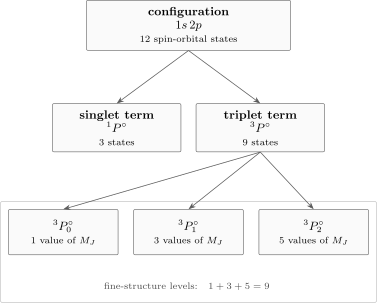
The configuration has spin-orbital states. In coupling they separate into a three-state term and a nine-state term. The latter contains levels with , , and magnetic states, respectively.
The hierarchy also clarifies terminology for spectral features. A transition array connects configurations, a multiplet connects terms, a line connects levels, and a resolved Zeeman or hyperfine component connects individual states. Real spectra do not always resolve every layer.
The Grammar of an LS Label
Section titled “The Grammar of an LS Label”A sufficiently explicit label may be written schematically as
Each piece answers a different question:
| Symbol | Meaning | Typical check |
|---|---|---|
| dominant electron configuration | occupations obey Pauli exclusion | |
| spin multiplicity | ||
| total electronic orbital angular momentum | capital letter maps to a nonnegative integer | |
| total electronic angular momentum | $ | |
| total electronic parity | for a configuration | |
| additional ancestry or state identifier | needed when the other labels recur |
Nuclear spin is not included. Coupling electronic to nuclear produces hyperfine , treated on Hyperfine Structure. Likewise, labels a magnetic substate but is normally omitted from the zero-field level name.
Total L, S, and J
Section titled “Total L, S, and J”In coupling, individual orbital and spin angular momenta are added separately:
The corresponding eigenvalues are
For fixed and , angular-momentum addition permits
Each level contains
magnetic states before hyperfine interactions or external fields are resolved. Across the complete term,
This identity is an excellent consistency check: changing from the uncoupled basis to the coupled basis cannot change the dimension of the space.
Spectroscopic Letters
Section titled “Spectroscopic Letters”The total orbital quantum number is written as a capital letter:
| 0 | 1 | 2 | 3 | 4 | 5 | 6 | 7 | |
|---|---|---|---|---|---|---|---|---|
| term letter |
The letter is skipped in this sequence to avoid confusion with total angular momentum. Lowercase labels a one-electron subshell with angular momentum ; uppercase labels the total of all electrons. Thus a configuration can contain an , , or term.
The symbol , for example, means
The level has magnetic states. It is one member of an term whose allowed values are , , , and .
Multiplicity
Section titled “Multiplicity”The left superscript is
called the spin multiplicity. Common names are
| Name | ||
|---|---|---|
| singlet | ||
| doublet | ||
| triplet | ||
| quartet | ||
| quintet |
Multiplicity counts the possible values of spin . It does not generally equal the number of magnetic states of a level, which is . It also need not equal the number of levels in a term: the latter is
Only when does that number equal . For instance, has multiplicity five but only one level, , because forces .
Parity Notation
Section titled “Parity Notation”Each one-electron orbital has parity . A configuration therefore has total electronic parity
Closed subshells contribute even parity, so in practice only open subshells need to be counted. Standard atomic notation usually leaves even parity unmarked and appends a degree sign to an odd-parity term:
Databases may use an asterisk in plain-text output because a superscript degree sign is unavailable. Some tables instead print explicit and parity labels, especially when no reliable assignment exists.
The term letter does not determine parity. Two electrons give
so a level is even. By contrast, an level is odd because is odd. Confusing the letter with parity is one of the most common notation errors.
For the usual electromagnetic atomic Hamiltonian, parity and often remain exact even when configuration mixing makes and approximate. External electric fields can mix opposite parities; Stark Effect in Atoms develops that failure mode.
Helium Examples
Section titled “Helium Examples”Helium shows how configuration, antisymmetry, terms, and levels fit together.
Ground configuration
Section titled “Ground configuration”The ground configuration has and even parity. Because both electrons occupy the same spatial orbital, Pauli antisymmetry permits only the spin singlet. The level is
A hypothetical would have a symmetric spin state and the same symmetric spatial occupation, so it is excluded.
Excited 1s2s configuration
Section titled “Excited 1s2s configuration”The electrons occupy nonequivalent orbitals, and both spin couplings occur:
Both are even because . Exchange and correlation give the singlet and triplet different energies; that energy ordering is not encoded in the symbols themselves.
Excited 1s2p configuration
Section titled “Excited 1s2p configuration”Here and parity is odd. The allowed terms and levels are
The singlet contributes magnetic states. The triplet contributes , accounting for all states of the configuration. In a pure model, electric-dipole transitions approximately conserve , which is why singlet and triplet systems have sharply different line strengths. The precise hierarchy of exact and approximate rules is given in Atomic Selection Rules.
Alkali Examples
Section titled “Alkali Examples”An alkali atom has one valence electron outside closed subshells. The core has and even parity, so the term labels reduce to those of the valence electron:
The sodium ground level, for example, is . Its resonance-line upper configuration produces the two fine-structure levels and . Their separation is the familiar alkali doublet. Alkali Atoms explains the effective one-electron picture, while Fine Structure develops the splitting mechanism.
This simplicity is special. For multiple open subshells, the same configuration can support several and values, and equivalent-electron antisymmetry removes some combinations that naive vector addition would allow.
Equivalent Electrons: A Counting Check
Section titled “Equivalent Electrons: A Counting Check”Pauli Principle in Atoms derives the exchange-parity restriction that selects the allowed terms. Here the result is used as a notation and state-counting check.
For a configuration, one subshell contains six spin-orbitals. Choosing two gives
antisymmetric determinants. The allowed levels are
Their magnetic-state counts are
The count closes, and every term has even parity because the two electrons contribute . This example is useful as a diagnostic, but it does not replace the antisymmetrized construction that determines which terms survive.
LS Coupling, jj Coupling, and Intermediate Coupling
Section titled “LS Coupling, jj Coupling, and Intermediate Coupling”The superscript-multiplicity notation assumes that and are useful labels. That is most natural when residual electrostatic interactions organize the spectrum more strongly than individual-electron spin–orbit interactions.
| Regime | Coupling order | Natural label |
|---|---|---|
| coupling | , , then | |
| coupling | each , then | configuration with subscripts and coupled |
| intermediate coupling | diagonalize across several basis labels with the same exact symmetries | dominant-component label plus composition data |
A schematic two-electron basis is
For example, a closed pair in a relativistic subshell may be labeled . There is no generally useful spin multiplicity in that label because and are not coupled first. The full construction and its Pauli restrictions are developed in jj Coupling.
Real atoms often lie between the limits. A level of exact and parity may have an expansion
If one weight dominates, its term is a useful short name. If several weights are comparable, a single symbol hides important physics: nominally spin-forbidden lines can gain strength, Landé factors shift away from pure- values, and labels may exchange character through an avoided crossing. The Hamiltonian has not changed when the basis notation changes; only the most informative description has.
Reading and Validating a Label
Section titled “Reading and Validating a Label”Use the following sequence when reading a table or assigning a calculated level:
- Write the configuration. Check occupations and identify closed versus open subshells.
- Compute parity. Evaluate and compare it with the printed degree sign, asterisk, or label.
- Identify the coupling scheme. Do not decode a label as though it were an symbol.
- Decode multiplicity and . Recover from and map the capital letter to .
- Test . Require in unit steps.
- Apply equivalent-electron restrictions. Vector addition alone does not enforce Pauli antisymmetry.
- Distinguish term, level, and state. Add for a level and only for a magnetic state.
- Inspect composition when precision matters. A database assignment may identify the leading eigenvector component rather than an exact eigenstate.
The NIST Atomic Spectra Database reports configurations, terms, , and level energies separately. That separation is valuable: it prevents a compact term label from being mistaken for a complete state specification and makes uncertain assignments visible.
Common Mistakes
Section titled “Common Mistakes”- Reading lowercase and uppercase as the same object.
- Calling the degeneracy of a level.
- Assuming a term has odd parity.
- Omitting the configuration when several configurations contain the same term.
- Treating every angular-momentum sum as Pauli-allowed for equivalent electrons.
- Assuming fixes the energy ordering; Hund’s Rules are additional approximations.
- Treating and as exact in a strongly mixed or relativistic spectrum.
- Putting nuclear or its projection into the electronic term symbol.
- Losing the odd-parity degree sign when transcribing a database’s plain-text output.
Exercises
Section titled “Exercises”Exercise 1: Decode and check a quartet
Section titled “Exercise 1: Decode and check a quartet”Decode . Give , , , parity, the allowed values of the term, and the number of magnetic states in the displayed level.
Solution
The multiplicity gives
The letter means , and the subscript gives . The degree sign marks odd parity. Angular-momentum addition permits
The displayed level has
magnetic states.
Exercise 2: Multiplicity is not level degeneracy
Section titled “Exercise 2: Multiplicity is not level degeneracy”Compare and . State the multiplicity, number of fine-structure levels in the complete term, and number of states in the displayed level.
Solution
For , and . The multiplicity is five, but only is possible, so the term has one fine-structure level. That level has magnetic states.
For , and . Its multiplicity is three and the complete term has , hence three fine-structure levels. The displayed level has five magnetic states. The same number five appears for two different reasons in these examples.
Exercise 3: Count the helium 1s2p states
Section titled “Exercise 3: Count the helium 1s2p states”Show that the and levels account for all product states with one electron in and one in .
Solution
The orbital supplies two spin-orbitals. The subshell supplies orbital projections times spin projections, or six spin-orbitals. With one electron in each subshell, there are
states. The singlet term has only and contributes states. The triplet term contributes
Thus . All levels are odd because the configuration has parity .
Exercise 4: Parity of a p-squared configuration
Section titled “Exercise 4: Parity of a p-squared configuration”A table lists the levels , , and . Determine their parity and verify that their magnetic-state count matches the number of two-electron determinants in a subshell.
Solution
Two electrons have
so all listed levels are even despite the term letter. A subshell has six spin-orbitals, giving
determinants. The singlet level contributes one magnetic state, the singlet level contributes five, and the triplet levels contribute . Their sum is .
Exercise 5: One valence electron
Section titled “Exercise 5: One valence electron”Write the level labels and parities for an alkali valence electron in , , and orbitals, assuming an even-parity closed core.
Solution
The valence spin is , so every term is a doublet. The closed core contributes no angular momentum. Therefore
The parity follows from , and the two levels for have .
Exercise 6: A mixed level
Section titled “Exercise 6: A mixed level”Suppose a normalized odd-parity eigenstate is approximated by
Which labels are exact in a rotationally and parity-invariant Hamiltonian, and how should the level be named?
Solution
Both basis components have and odd parity, so those labels can remain exact. The state is not an eigenstate of : singlet and triplet are approximate component labels. If a short name is needed, the dominant-component convention gives , accompanied by the composition singlet and triplet. Omitting the composition would hide the mechanism that can open an intercombination transition.
Cross-Links
Section titled “Cross-Links”- Term Symbol Reference is the side-by-side decoder for atomic LS and jj labels, molecular term symbols, and distinct parity conventions.
- Atomic Physics
- Helium Atom
- Electron Configurations
- Pauli Principle in Atoms
- Atomic Orbitals Revisited
- Alkali Atoms
- Fine Structure
- Atomic Selection Rules
- Hyperfine Structure
- Stark Effect in Atoms
- Angular Momentum Coupling Schemes
- Spin–Orbit Coupling
- Pauli Exclusion Principle
- Spin and Spatial Wavefunctions
- Slater Determinants
- Slater Determinants in Atoms
- LS Coupling
- jj Coupling
- Hund’s Rules
- Parity Selection Rules
- Applications to Atomic Spectra
- AMO Physics Roadmap
References
Section titled “References”- W. C. Martin and W. L. Wiese, “Atomic Spectroscopy: An Introduction,” in G. W. F. Drake, ed., Atomic, Molecular, and Optical Physics Handbook, AIP Press, 1996; NIST online revision, accessed 2026-07-21.
- A. Kramida, Yu. Ralchenko, J. Reader, and the NIST ASD Team, NIST Atomic Spectra Database, version 5.12, National Institute of Standards and Technology, 2024, DOI: 10.18434/T4W30F, accessed 2026-07-21.
- International Union of Pure and Applied Chemistry, “Term Symbols,” Compendium of Chemical Terminology, 5th ed., version 5.0.0 (2025), DOI: 10.1351/goldbook.T06277.
- E. U. Condon and G. H. Shortley, The Theory of Atomic Spectra, Cambridge University Press, 1935.
- R. D. Cowan, The Theory of Atomic Structure and Spectra, University of California Press, 1981.
- I. I. Sobelman, Atomic Spectra and Radiative Transitions, 2nd ed., Springer, 1992.
- W. R. Johnson, Atomic Structure Theory: Lectures on Atomic Physics, Springer, 2007.
- C. J. Foot, Atomic Physics, Oxford University Press, 2005.
- B. H. Bransden and C. J. Joachain, Physics of Atoms and Molecules, 2nd ed., Pearson, 2003.
- A. R. Edmonds, Angular Momentum in Quantum Mechanics, Princeton University Press, 1957.