Parametric Down-Conversion
Spontaneous parametric down-conversion (SPDC) is a second-order nonlinear optical process in which a pumped medium creates correlated excitations in two lower-frequency field modes. The outgoing photons are conventionally called the signal and idler. In the simplest bookkeeping,
and phase matching selects wavevectors and polarizations that add coherently through the device.
SPDC is valuable because one physical interaction can prepare several different resources:
- a time-correlated photon pair;
- a heralded single photon, conditioned on detecting its partner;
- a polarization-, path-, frequency-, orbital-angular-momentum-, or time-bin entangled pair;
- a two-mode squeezed state when more than one pair sector matters.
These outputs are not automatic consequences of writing . Their quality depends on the pump mode, susceptibility tensor, phase matching, crystal or waveguide geometry, spatial collection, spectral filtering, loss, detector response, and whether unobserved degrees of freedom reveal which creation alternative occurred.
The word spontaneous means that no coherent signal or idler seed is injected: the interaction acts on vacuum fluctuations in those modes. It does not mean that energy or momentum conservation is abandoned, and it does not make the source deterministic. At useful low gain, most pump pulses produce no collected pair; raising the pump also raises unwanted multipair probability.
Canonical Scope
Section titled “Canonical Scope”This page is the canonical home for source-level SPDC:
- the pump-to-pair interaction and low-gain biphoton state;
- energy, momentum, polarization, and geometry constraints;
- the meaning of signal and idler labels;
- the joint spectral amplitude and heralded-state purity;
- Type-0, Type-I, and Type-II source distinctions;
- polarization and time-bin entanglement architectures;
- heralding, coincidence, brightness, purity, and multipair metrics;
- a practical source-design and characterization workflow;
- uses and limitations in quantum information experiments.
Nonlinear Quantum Optics owns the nonlinear-polarization expansion, mode-overlap derivation, generic three-wave-mixing Hamiltonian, parametric amplification, four-wave mixing, and Kerr processes. Squeezed Light owns optical quadrature conventions, homodyne verification, decibel reporting, and continuous-variable applications. Photon Number States owns the general counting and Fock-state framework. Abstract entanglement measures, Bell inequalities, and quantum protocols remain canonical in the entanglement volume.
Pump Photon Conversion
Section titled “Pump Photon Conversion”Selected-mode Hamiltonian
Section titled “Selected-mode Hamiltonian”After the pump, spatial modes, polarizations, and nearly resonant frequencies have been selected, the interaction can reduce to
The complex coupling contains the classical pump amplitude, the relevant component of , a mode-overlap integral, a phase-matching factor, and normalization constants. Its phase sets the phase of the created-pair amplitude. This Hamiltonian creates or annihilates signal-idler pairs and conserves the number difference,
Starting from vacuum therefore populates equal-number sectors.
The description “one pump photon splits into two photons” captures the energy bookkeeping, but it should not be read too literally in the usual undepleted-pump model. There the pump is replaced by a prescribed coherent field, so individual pump quanta are not tracked. A fully quantized three-mode Hamiltonian restores pump-number conservation and pump depletion, but the classical-pump approximation is excellent for weak conversion from a strong laser field.
Low-gain biphoton limit
Section titled “Low-gain biphoton limit”For a short or weak interaction, first-order perturbation theory gives
where is a normalized two-photon state and is the collected pair probability to leading order. A normalized expression must retain the vacuum coefficient; writing only describes the state conditioned on pair production, not the unconditional optical output.
At low gain, the pair amplitude is linear in pump field amplitude, while the pair probability is linear in pump pulse energy or continuous-wave pump power, provided repetition rate, pulse shape, collection, and phase matching are held fixed. This scaling fails when gain, pump depletion, thermal loading, photorefractive effects, or detector saturation becomes important.
The term contains two-pair amplitudes. It cannot be omitted when a protocol is sensitive to false heralds, accidental coincidences, or four-photon events.
Beyond one pair
Section titled “Beyond one pair”For one ideal signal-idler mode pair, the exact undepleted-pump state can be written
where
Its pair-number distribution is geometric:
Thus increasing the mean pair number also increases the relative weight of the sectors. A pulsed traveling-wave source generally contains several independent Schmidt-mode pairs rather than one ideal pair. The total pair-number distribution then depends on the modal weights and can look less thermal as more weakly occupied modes contribute.
Spontaneous and stimulated operation
Section titled “Spontaneous and stimulated operation”With vacuum signal and idler inputs, pair production is spontaneous. Injecting a seed into one output mode stimulates coherent emission into the partner mode; the same device then operates as an optical parametric amplifier or difference-frequency converter, depending on frequencies and selected rotating-wave terms.
Stimulated measurements can efficiently probe parts of the spontaneous transfer function, but a classical intensity measurement alone does not determine every phase or quantum-noise property of the emitted biphoton state. The measurement model must say which complex response is reconstructed.
Energy and Momentum Matching
Section titled “Energy and Momentum Matching”Energy matching
Section titled “Energy matching”For a monochromatic stationary pump,
In vacuum wavelengths this becomes
The relation does not say that signal and idler must have equal frequency. The process is degenerate when and nondegenerate otherwise.
A pulsed pump has a finite spectrum. Exact stationarity is replaced by the pump envelope,
which weights a band around the central sum frequency. Shorter pump pulses usually broaden that allowed sum-frequency band.
Vector phase matching
Section titled “Vector phase matching”Efficient buildup also requires the polarization-dependent wavevectors to match:
Here is zero for ordinary birefringent phase matching and is a reciprocal vector for quasi-phase matching. For a periodically poled device,
where is the poling period and is the grating order. Temperature, angle, wavelength, and polarization change the refractive indices and therefore tune .
Energy matching prevents rapid temporal phase winding. Phase matching makes emission from different positions add coherently. Both are required for an efficient, well-defined source.
Finite interaction length
Section titled “Finite interaction length”For a uniform collinear device of length , the longitudinal amplitude is
with . The corresponding intensity envelope is
A longer device gives a larger on-axis amplitude but a narrower phase-matching acceptance. “Longer is brighter” is therefore incomplete: dispersion, focusing, walk-off, absorption, propagation loss, and collection bandwidth can reverse the expected improvement.
Group-velocity structure
Section titled “Group-velocity structure”Near central frequencies, write
For collinear down-conversion,
where is the inverse group velocity. The pump envelope and phase-matching function therefore occupy different directions in the plane. Group-velocity engineering can make their product nearly factorable; poor alignment produces strong spectral entanglement.
Geometry and polarization types
Section titled “Geometry and polarization types”Several labels answer independent questions:
- Type-0: pump, signal, and idler use the same polarization family.
- Type-I: signal and idler share a polarization, with the pump using a different allowed tensor channel.
- Type-II: signal and idler have orthogonal polarizations.
- Collinear or noncollinear: output wavevectors do or do not share the pump axis.
- Degenerate or nondegenerate: output frequencies are or are not equal.
- Bulk, waveguide, resonator, or integrated: the spatial eigenmodes and density of states differ.
These terms should not be collapsed into one another. A source can be degenerate but noncollinear, Type-II but frequency nondegenerate, or quasi-phase-matched and collinear.
For a focused pump, transverse momentum conservation has a finite width:
where denotes transverse wavevector. Focusing increases intensity but broadens angular content and can couple spatial and spectral variables. Birefringent spatial walk-off and polarization-dependent group delay can also record which alternative occurred unless compensated.
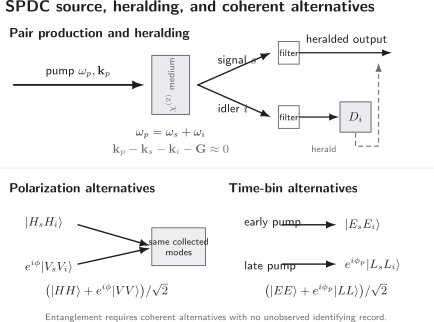
SPDC source logic. Energy and phase matching select a correlated signal-idler pair, while an idler click declares rather than creates the partner already propagating in the signal arm. Polarization and time-bin entanglement arise only when the displayed creation alternatives remain coherent and no unobserved degree of freedom identifies which alternative occurred.
Signal and Idler Photons
Section titled “Signal and Idler Photons”Labels, not a causal order
Section titled “Labels, not a causal order”“Signal” and “idler” are bookkeeping labels inherited from parametric amplification. Either photon may be used as the herald, and neither is fundamentally created first. In a nondegenerate source, the labels are often assigned by wavelength or experimental role. In a degenerate Type-I source, spatial output ports may be the only labels.
If every degree of freedom is identical and both excitations occupy the same mode, the state is a two-photon Fock state of that mode rather than a tensor product of intrinsically named particles. The subsystem decomposition comes from modes, not particle serial numbers.
Biphoton state
Section titled “Biphoton state”Restricting attention to one signal and one idler spatial-polarization family, the normalized two-photon component is
with
The joint spectral amplitude (JSA) has the schematic form
where contains polarization, spatial overlap, collection, and normalization factors.
The joint spectral intensity (JSI),
does not reveal the full JSA. Spectral phase can change temporal correlations, purity after interference, and pulse shape while leaving the JSI unchanged. A claim of complete state characterization from intensity alone therefore requires additional phase assumptions or measurements.
Schmidt modes and heralded purity
Section titled “Schmidt modes and heralded purity”A Schmidt decomposition writes
Tracing over an unresolved idler gives
The ideal spectral purity and Schmidt number are
A factorable JSA has one nonzero Schmidt coefficient and produces an ideally pure heralded spectral mode. Spectral correlation makes the conditional signal mixed when the herald detector does not resolve the correlated idler mode.
Narrow filtering can raise purity by discarding correlated modes, but usually reduces brightness and heralding efficiency. Dispersion and pump engineering can instead rotate and shape the pump and phase-matching functions toward a factorable product. Spatial filtering must be included in this reasoning: spatial-spectral coupling can spoil a calculation that treats only frequency.
Pair timing and correlations
Section titled “Pair timing and correlations”SPDC pairs are produced within a joint temporal amplitude set by pump coherence, phase matching, propagation, and filtering. The historical phrase “simultaneous photons” refers to a narrow relative detection-time correlation after path delays are accounted for. It does not imply two infinitely short wave packets or a perfectly known absolute creation time.
A normalized cross-correlation is
At low brightness it can be very large because pair detections dominate over independent singles. A large cross-correlation certifies strong correlation, not by itself entanglement. Entanglement requires coherence across alternatives and an appropriate witness, tomography, or Bell test.
Polarization Entanglement
Section titled “Polarization Entanglement”Coherent creation alternatives
Section titled “Coherent creation alternatives”Polarization entanglement is produced when the source coherently superposes two pair-creation alternatives. A common target family is
For , the Schmidt coefficients in polarization are equal and the state is maximally entangled, provided no other degree of freedom carries which-alternative information. Type-II geometries often target
The superposition, not the mere presence of orthogonal polarizations, creates entanglement. A source that emits the two alternatives incoherently produces a classical mixture with the same populations in the basis.
Hidden distinguishability
Section titled “Hidden distinguishability”Let and denote all unobserved spectral, spatial, and temporal degrees of freedom associated with two nominal polarization alternatives:
Define their overlap by
After tracing out the hidden modes,
Its purity is
Perfectly matched hidden modes give and preserve polarization coherence. Orthogonal hidden records give and erase the off-diagonal terms. Compensation plates, pump shaping, narrow collection modes, and spectral engineering are therefore part of the state preparation, not cosmetic alignment.
Source architectures
Section titled “Source architectures”Several established architectures create the required alternatives:
- Type-II cone intersections. Orthogonally polarized photons from two indistinguishable emission alternatives are collected where phase-matching cones intersect. Spatial and temporal walk-off require careful compensation.
- Crossed Type-I crystals. Orthogonally oriented crystals convert two coherent pump-polarization components into and . Relative pump amplitude and phase tune and .
- Sagnac sources. Counterpropagating pump components drive pair production in a common-path loop. The geometry can be intrinsically phase stable, but it still requires polarization, dispersion, and collection calibration.
- Waveguide and chip interferometers. Distinct nonlinear paths or mode conversions are recombined coherently. Propagation loss and fabrication imbalance become part of the entangled-state model.
No architecture is automatically postselection free. The claim depends on whether every generated event in the declared output modes belongs to the target state or whether a subset is selected after detection.
Verification
Section titled “Verification”Correlations in the basis establish the expected populations but do not establish coherence. At minimum, measurements in complementary bases are needed. Full two-qubit polarization tomography reconstructs a density matrix, while an entanglement witness can answer a narrower question with fewer settings.
A high interference visibility in one basis is not synonymous with high Bell fidelity, and neither alone closes the assumptions of a Bell test. Report background subtraction, accidentals, detector efficiencies, setting choices, statistical uncertainty, and whether the quoted state is raw or corrected.
Time-Bin and Energy-Time Entanglement
Section titled “Time-Bin and Energy-Time Entanglement”Time-bin preparation
Section titled “Time-bin preparation”An unbalanced pump interferometer can place one coherent pump pulse into distinguishable early and late time bins. If either alternative produces a pair and the source does not reveal which one occurred, the pair state is
The bin separation should be long enough that early and late wave packets are operationally distinguishable, yet the pump interferometer must preserve their relative phase. The SPDC device must respond identically to the two pump bins apart from that controlled phase.
Each photon can be analyzed with an unbalanced interferometer having the same delay. In the central coincidence-time class, two histories overlap:
- an early pair takes the long paths;
- a late pair takes the short paths.
Their coincidence probability depends on a phase combination of the pump and the two analyzers. With one common convention,
where includes mode overlap, phase noise, background, and multipair effects. Changing beam-splitter or propagation-phase conventions changes signs but not the observable phase dependence.
Energy-time is related but distinct
Section titled “Energy-time is related but distinct”In energy-time entanglement, a long-coherence pump leaves the pair’s absolute creation time uncertain over a continuous interval while energy conservation correlates the frequencies. Franson interferometers convert that joint creation-time coherence into two-photon interference.
Time-bin entanglement instead deliberately prepares a discrete early/late superposition, usually from a pulsed pump. Both can be analyzed with unbalanced interferometers, but their pump-coherence conditions, event classification, and security analyses are not interchangeable.
Standard Franson measurements discard distinguishable short-long and long-short events. That postselection creates loopholes if the setup is presented as a device-independent Bell test. A quantum-communication demonstration and a loophole-resistant nonlocality test can use related hardware while requiring different assumptions.
Propagation and stabilization
Section titled “Propagation and stabilization”Time-bin encoding is robust against slowly varying polarization rotation in single-mode fiber, but it is not immune to:
- analyzer phase drift;
- chromatic dispersion and pulse broadening;
- polarization-dependent loss inside interferometers;
- detector timing jitter and dead time;
- overlap of neighboring clock cycles;
- unbalanced loss between early and late alternatives.
“Robust in fiber” means that the relevant relative time-bin phase and overlap can often be maintained more conveniently than a free polarization reference, not that calibration is unnecessary.
Heralded Single Photons
Section titled “Heralded Single Photons”Conditional state
Section titled “Conditional state”Let be the signal-idler state and let represent the idler herald outcome. The conditioned signal state is
where
The detector model matters. A threshold detector distinguishes no click from one or more detected photons; a number-resolving detector has different POVM elements. Dark counts can herald vacuum in the signal arm, while idler loss can hide a multipair event.
The idler measurement does not launch a signal photon after the electronic click. The two fields have already propagated from the source. The click provides a classical declaration and conditions the state assignment used for subsequent signal measurements.
Multipair contamination
Section titled “Multipair contamination”For the ideal single-Schmidt-mode distribution
an ideal threshold herald accepts every event. The conditioned pair-number distribution is
The conditional multipair probability is therefore
Reducing improves the single-pair fraction but lowers the herald rate. Real losses, dark counts, background fluorescence, several Schmidt modes, and finite detector recovery alter these formulas. A source cannot be optimized by brightness alone.
Spectral purity and indistinguishability
Section titled “Spectral purity and indistinguishability”Heralding removes the vacuum contribution but does not automatically produce a pure photon. If signal frequency is entangled with unresolved idler frequency, the heralded signal is mixed. If polarization is correlated with spatial mode, filtering one variable can change the state of another.
High purity also does not guarantee that photons from two independent sources are identical. Indistinguishability requires matched density operators in all degrees of freedom relevant to the interference measurement. Hong–Ou–Mandel visibility is a useful operational test when multipair events, splitting ratio, timing, polarization, and detector effects are included in the model.
Source Metrics
Section titled “Source Metrics”A trustworthy source report defines the reference plane and counting model for every number. Useful metrics include the following.
Pair probability and brightness
Section titled “Pair probability and brightness”For a pulsed source, state the mean generated or collected pair number per pulse and the repetition rate. For a continuous source, state a pair rate and the temporal-mode or coincidence-window convention.
Brightness may be quoted per pump power, bandwidth, spatial mode, or device output. These normalizations are not interchangeable. Internal generation rate, chip-output rate, fiber-coupled rate, and detected coincidence rate answer different questions.
Heralding or conditional efficiency
Section titled “Heralding or conditional efficiency”With idler as herald, a background-corrected Klyshko-style estimate of the signal-arm conditional efficiency is
Here is the coincidence rate, the accidental rate, the idler singles rate, and its dark/background rate. The result includes signal-path collection, transmission, and detection at the declared reference planes. It is not the nonlinear conversion efficiency and is not automatically the detector’s intrinsic quantum efficiency.
Coincidence-to-accidental ratio
Section titled “Coincidence-to-accidental ratio”For approximately stationary independent singles rates and a coincidence window ,
A common convention is
Some authors use instead. State the definition. CAR depends on brightness, window width, jitter, background, dead time, and repetition structure; it is not an intrinsic material constant.
Heralded second-order correlation
Section titled “Heralded second-order correlation”Splitting the heralded signal and measuring triple coincidences estimates . An ideal one-photon Fock state has zero normally ordered two-photon coincidence probability. A nonzero value reveals multiphoton contamination, but its estimator depends on detector model, gates, backgrounds, and loss assumptions.
For the ideal threshold-conditioned single-mode distribution above,
At low gain this is approximately . Multimode statistics and non-number-resolving herald loss change the relation.
Modal and entanglement metrics
Section titled “Modal and entanglement metrics”Depending on the intended resource, also report:
- JSA or JSI bandwidths and whether spectral phase was measured;
- Schmidt number or heralded-state purity, with filtering assumptions;
- Hong–Ou–Mandel visibility between independent heralded photons;
- polarization or time-bin density-matrix fidelity, purity, and uncertainty;
- Bell parameter or entanglement witness, including raw and corrected values;
- collection, propagation, coupling, and detector efficiencies separately;
- long-term rate and phase stability rather than only the best short run.
A complete specification makes tradeoffs visible. Narrow filtering may improve purity while reducing heralding efficiency. Higher pump power may improve detected rate while degrading CAR and .
Uses in Quantum Information
Section titled “Uses in Quantum Information”Heralded state preparation
Section titled “Heralded state preparation”One photon declares the presence and timing of its partner. This supports single-photon calibration, memory loading, feed-forward, and experiments in which vacuum trials would otherwise dominate. The source remains probabilistic unless active multiplexing, storage, or another architecture is added.
Interference between independent photons
Section titled “Interference between independent photons”Spectrally engineered SPDC can prepare high-purity photons that interfere at a beam splitter even when they came from independent sources. This is central to photonic gates, entanglement swapping, and measurement-induced interactions. Pair timing alone is insufficient; the full detected modes must overlap.
Entanglement distribution and Bell tests
Section titled “Entanglement distribution and Bell tests”Polarization, time-bin, energy-time, path, and frequency-bin pairs can distribute entanglement between distant stations. They support quantum teleportation, entanglement swapping, quantum networking experiments, and tests of local realism.
Source entanglement, detector locality, random setting choices, loss, and postselection are separate ingredients of a Bell experiment. A bright high-fidelity source is necessary in many designs but does not by itself close detection, locality, freedom-of-choice, or coincidence-time loopholes.
Quantum communication
Section titled “Quantum communication”Entangled-pair and heralded-photon sources can be used in quantum key distribution and network links. Security depends on a complete source and detector model, including multipair emission, side channels, basis dependence, loss, and finite statistics. Calling a source “single photon” does not justify discarding its vacuum and multiphoton sectors from a security proof.
Metrology, imaging, and spectroscopy
Section titled “Metrology, imaging, and spectroscopy”Pair correlations enable coincidence imaging, dispersion-sensitive interferometry, calibration, and spectroscopy across unequal wavelengths. Whether a task has a quantum advantage requires comparison at fixed resources and under the same loss and detector constraints. Correlated illumination alone is not proof of advantage.
Scaling limitation
Section titled “Scaling limitation”Single-pass SPDC combines room-temperature operation, broad wavelength coverage, and flexible entanglement engineering, but pair generation is probabilistic. Pumping harder increases multipair errors, while pumping weaker reduces simultaneous success across many sources. Multiplexing can trade additional switching, loss, detectors, and control for a higher delivery probability; it does not make those costs disappear.
A Reliable Source Workflow
Section titled “A Reliable Source Workflow”- Declare the target resource. Specify output modes, wavelength, bandwidth, polarization or time-bin state, purity, rate, and acceptable multipair probability.
- Choose the nonlinear channel. Select material, tensor element, propagation geometry, Type-0/I/II polarization, and bulk, waveguide, or resonator platform.
- Model pump and phase matching together. Compute the complex JSA or its higher-dimensional extension, including pump bandwidth, device length, dispersion, focusing, and quasi-phase matching.
- Design collection as part of the source. Include apertures, fiber modes, filters, interfaces, and spatial-spectral coupling in the predicted state and efficiency.
- Remove identifying records. Compensate group delay, spatial walk-off, polarization phase, and path imbalance between coherent alternatives.
- Write the detector POVM and timing logic. Include efficiency, dark counts, jitter, dead time, number resolution, gates, and coincidence windows.
- Measure rates versus pump. Check low-gain scaling and identify saturation, fluorescence, Raman background, or multipair onset.
- Characterize the intended state. Use correlations, tomography, interference, , or a protocol-specific witness rather than a single favorable count ratio.
- Report reference planes and corrections. Separate generated, collected, transmitted, and detected quantities and retain raw data alongside background- or loss-corrected estimates.
Common Mistakes
Section titled “Common Mistakes”Treating every pump photon as a successful trial
Section titled “Treating every pump photon as a successful trial”The undepleted coherent pump does not provide a labeled sequence of pump photons that each either splits or fails. Pair probability is defined for a declared temporal and spatial mode or experimental window.
Imposing energy matching but ignoring phase matching
Section titled “Imposing energy matching but ignoring phase matching”Many frequency pairs satisfy the sum rule but do not build coherently through the device. Refractive-index dispersion and polarization are essential.
Equating degeneracy with entanglement
Section titled “Equating degeneracy with entanglement”Equal output frequencies do not imply a coherent superposition across subsystems. Conversely, strongly nondegenerate photons can be highly entangled.
Treating signal and idler as distinguishable particle species
Section titled “Treating signal and idler as distinguishable particle species”They are mode labels. When all mode labels coincide, bosonic symmetrization and occupation-number language replace particle naming.
Assuming a herald click prepares a pure one-photon state
Section titled “Assuming a herald click prepares a pure one-photon state”Dark counts, loss, multipair emission, and unresolved spectral or spatial correlation can leave vacuum, multiphoton, or mixed components.
Treating filters as free
Section titled “Treating filters as free”Filtering can improve conditional purity while lowering rate and heralding efficiency. It can also lengthen wave packets and change timing correlations.
Inferring the JSA from the JSI
Section titled “Inferring the JSA from the JSI”Intensity omits spectral phase. Two sources with identical JSI can have different temporal states and interference performance.
Calling a large CAR entanglement
Section titled “Calling a large CAR entanglement”CAR measures coincidence contrast under a stated timing model. Classical correlations can be strong, and entanglement requires phase-sensitive evidence.
Calling one high visibility a Bell test
Section titled “Calling one high visibility a Bell test”Visibility in one setting neither reconstructs the state nor addresses Bell test assumptions and postselection.
Calling the photons exactly simultaneous
Section titled “Calling the photons exactly simultaneous”The source has a joint temporal amplitude and finite detector resolution. Path-corrected relative-time correlation is not an infinitely sharp common creation time.
Quoting corrected performance without raw performance
Section titled “Quoting corrected performance without raw performance”Loss inversion and accidental subtraction can be model dependent. Report both detector-plane observations and inferred source values.
Connections
Section titled “Connections”- Nonlinear Quantum Optics derives the susceptibility, overlap, phase-matching, and parametric-gain machinery used here.
- Photon Number States develops threshold heralding and multipair counting in the optical Fock basis.
- Squeezed Light owns quadrature squeezing and continuous-variable characterization of the same pair-creation unitary.
- Quantum Illumination uses broadband signal–idler pairs for noisy target-channel discrimination and owns the receiver bounds, error exponents, and sensing evidence.
- Correlation Functions gives the normal-ordering and detector assumptions behind .
- Photon Counting develops click POVMs, loss, dark counts, dead time, and count-statistics inference.
- Beam Splitters and Interferometers provide the transformations used for Hong–Ou–Mandel, polarization, and time-bin analysis.
- Mode Decompositions supplies the subsystem bookkeeping behind Schmidt modes and multimode heralding.
- Entanglement in Quantum Optics places photonic encodings, witnesses, Bell tests, and protocols in the broader entanglement framework.
Exercises
Section titled “Exercises”Exercise 1: Find the partner wavelength
Section titled “Exercise 1: Find the partner wavelength”A narrowband pump at produces a nondegenerate pair. The signal is centered at .
- Find the idler’s vacuum wavelength.
- Find the degenerate output wavelength for the same pump.
- Explain why wavelength, rather than wavelength difference, must be handled through frequency or reciprocal wavelength.
Solution
Energy matching gives
Therefore
so
At degeneracy, each output photon has half the pump frequency and hence twice the pump wavelength:
Photon energy is . Energies therefore add as frequencies or reciprocal wavelengths, not as wavelengths. The incorrect rule would not conserve energy.
Exercise 2: Finite-length phase matching
Section titled “Exercise 2: Finite-length phase matching”A uniform collinear crystal has length
and longitudinal amplitude
- Find the magnitude of the first nonzero phase mismatch at which the intensity vanishes.
- Find the intensity relative to perfect phase matching when .
- State how the first-zero acceptance scales with .
Solution
The first zero of occurs at . Hence
which gives
For ,
When , the sinc argument is , so
The first-zero mismatch scales as . Increasing the interaction length narrows the phase-matching acceptance.
Exercise 3: Singles, coincidences, and conditional efficiency
Section titled “Exercise 3: Singles, coincidences, and conditional efficiency”In each pump pulse, a low-gain source produces one collected pair with probability and vacuum otherwise. The signal and idler detection efficiencies are
Ignore dark counts, multipairs, and dead time.
- Find the signal-click, idler-click, and coincidence probabilities per pulse.
- Find the probability of a signal click conditioned on an idler click.
- Compute the click-based ratio and explain what it does not prove.
Solution
The click probabilities are
Conditioning on the idler click gives
The click correlation is
It is large because independent detections would coincide only with probability of order , whereas true pair coincidences are of order . These number correlations alone do not measure coherence between creation alternatives and therefore do not by themselves certify entanglement.
Exercise 4: Threshold heralding and multipairs
Section titled “Exercise 4: Threshold heralding and multipairs”An ideal single-mode SPDC source has
with . An ideal threshold idler detector clicks for every event.
- Find the herald probability.
- Find the conditional multipair probability.
- Find the conditional mean signal photon number.
- Find the ideal heralded second-order correlation on this page.
Solution
The vacuum probability is , so
The conditional distribution is
Thus
The mean of this shifted geometric distribution is
Finally,
The source is strongly single-photon-like after heralding, but it is not an exact one-photon source. Raising increases the click rate and the multiphoton contamination together.
Exercise 5: Hidden-mode distinguishability
Section titled “Exercise 5: Hidden-mode distinguishability”The polarization state before tracing over hidden modes is
with
- Find the reduced polarization purity.
- Find its fidelity with before compensating the hidden overlap phase.
- Find the largest Bell-state fidelity obtainable by a polarization phase correction.
Solution
The hidden-mode overlap has magnitude . The reduced polarization purity is
For the uncompensated target phase, the fidelity is
A polarization phase correction can cancel but cannot increase its magnitude. The best fidelity is therefore
Phase compensation corrects a coherent phase error. It cannot recover the remaining loss of coherence caused by .
Exercise 6: Time-bin analyzer fringe
Section titled “Exercise 6: Time-bin analyzer fringe”For one central coincidence output, suppose
where
and .
- Find the maximum and minimum coincidence probabilities.
- Verify that their visibility is .
- Identify the two histories that interfere in this time class.
Solution
At ,
At ,
The fringe visibility is
The two indistinguishable histories are an early-created pair taking both long analyzer paths and a late-created pair taking both short analyzer paths. Short-long and long-short events occupy different relative-time classes and do not contribute to this central-bin interference.
Exercise 7: Heralding efficiency and accidentals
Section titled “Exercise 7: Heralding efficiency and accidentals”A continuous-wave experiment records
The coincidence window is and the idler background rate is .
- Estimate the accidental coincidence rate.
- Find the background-corrected signal conditional efficiency.
- Find CAR using the convention on this page.
- Give one reason these numbers are not intrinsic properties of the nonlinear material.
Solution
The stationary accidental estimate is
The conditional signal efficiency is
Thus the declared signal-arm conditional efficiency is about . With the convention used here,
Both quantities depend on collection, transmission, detector efficiency, timing window, and background. Changing the detectors or collection optics changes them without changing the material’s .
Exercise 8: Why the joint spectral intensity is incomplete
Section titled “Exercise 8: Why the joint spectral intensity is incomplete”Consider two normalized JSAs,
with real .
- Show that the two sources have the same JSI.
- Write the heralded signal density-matrix kernel for each source.
- Explain why their heralded purity or temporal interference can differ.
Solution
The phase factor has unit magnitude, so
Thus every intensity-only joint spectrum is identical.
For an unresolved ideal idler herald, the signal kernel is
For the second source, the integrand acquires
When , this phase generally depends on and changes the integral’s off-diagonal coherence. The two reduced density operators can therefore have different purity and temporal-mode structure despite identical JSI. Intensity data alone cannot reconstruct spectral phase.
References
Section titled “References”- J. A. Armstrong, N. Bloembergen, J. Ducuing, and P. S. Pershan, “Interactions between light waves in a nonlinear dielectric,” Physical Review 127, 1918–1939 (1962).
- D. C. Burnham and D. L. Weinberg, “Observation of simultaneity in parametric production of optical photon pairs,” Physical Review Letters 25, 84–87 (1970).
- C. K. Hong and L. Mandel, “Theory of parametric frequency down conversion of light,” Physical Review A 31, 2409–2418 (1985).
- D. N. Klyshko, Photons and Nonlinear Optics (Gordon and Breach, 1988).
- L. Mandel and E. Wolf, Optical Coherence and Quantum Optics (Cambridge University Press, 1995).
- R. W. Boyd, Nonlinear Optics, 4th ed. (Academic Press, 2020).
- C. Couteau, “Spontaneous parametric down-conversion,” Contemporary Physics 59, 291–304 (2018).
- C. K. Law, I. A. Walmsley, and J. H. Eberly, “Continuous frequency entanglement: Effective finite Hilbert space and entropy control,” Physical Review Letters 84, 5304–5307 (2000).
- W. P. Grice, A. B. U’Ren, and I. A. Walmsley, “Eliminating frequency and space-time correlations in multiphoton states,” Physical Review A 64, 063815 (2001).
- P. J. Mosley et al., “Heralded generation of ultrafast single photons in pure quantum states,” Physical Review Letters 100, 133601 (2008).
- W. P. Grice, R. Erdmann, I. A. Walmsley, and D. Branning, “Spectral distinguishability in ultrafast parametric down-conversion,” Physical Review A 57, R2289–R2292 (1998).
- P. G. Kwiat et al., “New high-intensity source of polarization-entangled photon pairs,” Physical Review Letters 75, 4337–4341 (1995).
- P. G. Kwiat, E. Waks, A. G. White, I. Appelbaum, and P. H. Eberhard, “Ultrabright source of polarization-entangled photons,” Physical Review A 60, R773–R776 (1999).
- T. Kim, M. Fiorentino, and F. N. C. Wong, “Phase-stable source of polarization-entangled photons using a polarization Sagnac interferometer,” Physical Review A 73, 012316 (2006).
- J. D. Franson, “Bell inequality for position and time,” Physical Review Letters 62, 2205–2208 (1989).
- J. Brendel, N. Gisin, W. Tittel, and H. Zbinden, “Pulsed energy-time entangled twin-photon source for quantum communication,” Physical Review Letters 82, 2594–2597 (1999).
- J.-W. Pan et al., “Multiphoton entanglement and interferometry,” Reviews of Modern Physics 84, 777–838 (2012).
- M. D. Eisaman, J. Fan, A. Migdall, and S. V. Polyakov, “Invited review article: Single-photon sources and detectors,” Review of Scientific Instruments 82, 071101 (2011).
- R. S. Bennink, “Optimal collinear Gaussian beams for spontaneous parametric down-conversion,” Physical Review A 81, 053805 (2010).
- S. Castelletto, I. P. Degiovanni, V. Schettini, and A. Migdall, “Spatial and spectral mode selection of heralded single photons from pulsed parametric down-conversion,” Optics Express 13, 6709–6722 (2005).
Frontier Context
Section titled “Frontier Context”Quantum Optics Frontiers evaluates current source-rate tradeoffs, multiplexing, integrated non-Gaussian resources, and end-to-end system claims. This page remains the canonical home for SPDC kinematics, state structure, mode engineering, and heralding calculations. Photonic Qubits carries those source quantities into multiplexed processor rates, multiphoton error budgets, fusion networks, and detector-conditioned operation.