Dressed States
A dressed state is an eigenstate of a Hamiltonian that includes both a matter system and its coherent coupling to a field. The word “dressed” emphasizes that the interaction changes both the energies and the state vectors. The eigenstates are no longer bare atomic states, and, when the field is quantized, they are generally not product states of an atom and a definite photon number.
For the standard near-resonant two-state Hamiltonian,
the dressed-state separation is
The same square-root spectrum appears in one excitation manifold of the Jaynes–Cummings model, with the replacement
That resemblance is powerful, but it must be interpreted carefully. A semiclassical rotating-frame eigenstate, a joint atom–photon eigenstate, and a Floquet mode are related descriptions, not literally the same object.
Canonical Scope
Section titled “Canonical Scope”This page owns the dressed-state basis transformation and its physical interpretation:
- diagonalization of a coherently driven two-level Hamiltonian;
- mixing angles, bare-state weights, phases, and avoided crossings;
- sudden versus adiabatic preparation and bare-state readout;
- dressed-state interpretation of fixed-excitation manifolds in the Jaynes–Cummings model;
- photon-number-dependent splitting and atom–field entanglement as examples of quantized dressing;
- the controlled connection among semiclassical, quantized-mode, and Floquet descriptions;
- how probe and decay matrix elements reveal dressed states;
- the cavity-QED connection and the limitations imposed by loss, counter-rotating terms, and multilevel structure.
Nearby pages retain distinct responsibilities:
- Two-Level Atom owns the projection of a multilevel system, rotating-frame convention, and rotating-wave approximation.
- Rabi Oscillations owns time-domain population cycling and pulse calibration.
- AC Stark Shift owns far-detuned branch shifts, optical potentials, and the Bloch–Siegert correction.
- Dynamic Polarizability owns the full multilevel frequency-dependent response.
- Floquet Theorem in Quantum Mechanics owns the general theorem for periodic Hamiltonians and quasienergy-zone structure.
- Jaynes–Cummings Model owns the model-specific derivation, exact block spectrum and propagator, vacuum Rabi oscillations, and collapse and revival. The present page uses its manifolds to explain the more general dressed-state concept.
- Cavity QED owns loss, input–output fields, cooperativity, and experimental strong-coupling criteria.
The next page, Autler–Townes Splitting, owns the weak-probe spectrum of a strongly driven transition, including resolvability, line strengths, and the distinction from electromagnetically induced transparency. Here it appears only as an operational preview of dressed-state spectroscopy.
Three Meanings of Field Dressing
Section titled “Three Meanings of Field Dressing”The phrase “atom plus photons” is often used before the field model has been declared. Three common constructions should be separated.
Semiclassical RWA. The state space is the atomic Hilbert space, and the stationary object is a rotating-frame eigenvector. There is no extra field index.
Classical periodic drive. Floquet analysis extends the atomic space by Fourier harmonics. The stationary object is a Floquet mode, and the extra integer labels a harmonic or quasienergy zone.
Quantized single mode. The state space is the atomic Hilbert space tensored with oscillator Fock space. The stationary object is a joint atom–mode eigenvector, and the extra integer is a physical mode occupation.
For a prescribed classical drive, the source is not a quantum subsystem of the model. The rotating-frame dressed vectors live only in the matter Hilbert space. A Floquet construction introduces a Fourier index, sometimes drawn as a photon ladder, but that index is bookkeeping in an extended space.
For a quantized cavity mode, by contrast, and are physical tensor-product states. Their superpositions can entangle the atom with the mode, and photon-number fluctuations can produce dynamics with no deterministic classical-drive counterpart.
These descriptions agree in overlapping limits. They answer different questions outside those limits.
Semiclassical Dressed States
Section titled “Semiclassical Dressed States”Convention ledger
Section titled “Convention ledger”Use bare matter states satisfying
with
The drive has angular frequency , phase , and atom-minus-laser detuning
Thus red detuning means . In the ordered basis , after removing a common quasienergy, use
where . Frequencies, detunings, couplings, and decay rates are angular frequencies unless explicitly labeled otherwise.
Changing the sign convention for , reversing the basis order, or absorbing into a bare state changes the displayed formulas. It does not change consistently computed gaps or probabilities.
Mixing angle
Section titled “Mixing angle”Define
and choose a mixing angle in the range through
This definition remains unambiguous on both sides of resonance. The normalized eigenvectors may be chosen as
They satisfy
An overall phase on either eigenvector is arbitrary. The relative phase inside a dressed state is not arbitrary once the phases of the bare basis and drive have been fixed.
Bare-state content
Section titled “Bare-state content”The excited-state weights are
The corresponding ground-state weights are obtained by subtraction from one. Equivalently,
Each dressed state points along or opposite the effective field on the Bloch sphere.
On resonance,
so the states are equal-weight superpositions:
up to an overall phase and the sign convention used to label the branches. The gap is .
For large positive detuning,
the upper state becomes excited-like and the lower state becomes ground-like. For large negative detuning, their bare character is exchanged. A branch label such as “ground-like” is therefore local in parameter space; the fixed labels and denote upper and lower quasienergies.
Inverting the transformation
Section titled “Inverting the transformation”The bare states can be expanded in the dressed basis:
This inverse relation explains resonant Rabi flopping. A suddenly prepared bare state is generally a coherent superposition of two stationary dressed states. Their relative phase evolves at , and transforming back to the bare basis produces population oscillation.
The dressed-state picture and the Bloch-sphere picture are therefore not competing explanations. One emphasizes stationary eigenvectors and phase accumulation; the other emphasizes precession about the same effective Hamiltonian vector.
Avoided Crossings
Section titled “Avoided Crossings”With , the rotating-frame bare quasienergies are
They cross at . A nonzero coupling replaces this crossing by
whose minimum separation is
An avoided crossing records two facts at once:
- the eigenvalues repel because the states are coupled;
- the eigenvectors exchange their bare-state character across resonance.
The second fact is easy to miss if only the energy curves are plotted. Hellmann–Feynman differentiation exposes it:
Far from resonance, a branch slope approaches the slope of one bare state. At resonance both slopes vanish because each branch contains equal bare weight.
The avoided-crossing plot and exact far-detuned expansion are developed for light shifts on AC Stark Shift. The important lesson here is about basis identity: following an eigenvalue continuously is not the same operation as holding a bare label fixed.
Preparing and Reading a Dressed State
Section titled “Preparing and Reading a Dressed State”Sudden turn-on
Section titled “Sudden turn-on”Suppose the system begins in and a constant drive is switched on much faster than . The state does not instantaneously rotate into an eigenvector. Immediately after the switch it is still , which is a superposition of and . Subsequent interference produces Rabi oscillations.
This is a quench into the dressed basis, not preparation of one dressed state.
Adiabatic turn-on
Section titled “Adiabatic turn-on”If and change slowly while the dressed gap stays open, an initial instantaneous eigenstate follows its branch up to dynamical and geometric phases. For the phase-fixed two-state model,
and a useful local condition is
The off-diagonal coupling in the instantaneous dressed basis is proportional to . The condition is most demanding near the smallest gap.
At exact resonance, turning on from begins at a degeneracy. There is then no unique resonant dressed branch for the ordinary nondegenerate adiabatic theorem to select. A finite initial detuning, an explicit symmetry-breaking term, or a deliberately prepared superposition is needed to define the outcome.
For a linear sweep
the ideal infinite-time Landau–Zener probability to remain on the same diabatic branch is
The derivation, finite-time corrections, and convention checks belong to Landau–Zener Transition.
Switch-off and basis mapping
Section titled “Switch-off and basis mapping”An abrupt switch-off projects the state onto the bare basis. An adiabatic switch-off maps each dressed branch onto whichever bare state it approaches along the chosen path. These protocols answer different experimental questions:
- sudden release measures the instantaneous bare-state composition;
- adiabatic release measures branch population;
- a phase-controlled ramp can convert dressed coherence into a bare-state population signal.
Statements such as “the atom is half excited” are incomplete unless the switch-off and measurement protocol are specified.
Quantized Mode: Atom Plus Photons
Section titled “Quantized Mode: Atom Plus Photons”This section uses the Jaynes–Cummings manifold as the canonical example of quantized field dressing. For the derivation from the quantum Rabi interaction, exact propagator, number-statistics dependence, and collapse and revival, see the Jaynes–Cummings Model.
Jaynes–Cummings Hamiltonian
Section titled “Jaynes–Cummings Hamiltonian”Let one quantized mode of angular frequency have annihilation operator . For a two-level system of transition frequency , the Jaynes–Cummings Hamiltonian is
The coupling is taken real and nonnegative by a phase convention. The model already assumes:
- a two-level matter reduction;
- one selected bosonic mode;
- a near-resonant rotating-wave approximation;
- a closed system unless loss terms are added separately.
The conserved excitation operator is
Conservation of divides the Hilbert space into independent blocks.
Fixed-excitation manifolds
Section titled “Fixed-excitation manifolds”For each integer , the excitation- manifold is spanned by
The two basis states have the same total excitation count. The interaction matrix element is
The square root is the bosonic ladder factor. In this ordered basis, define the cavity detuning
The block Hamiltonian is
The first term shifts both levels equally. The second has exactly the semiclassical two-state form with
Photon-number-resolved dressed doublets
Section titled “Photon-number-resolved dressed doublets”Define
and
A convenient eigenbasis is
The corresponding energies are
The state
is an uncoupled eigenstate with energy . There is no partner state .
On resonance,
the th doublet becomes
with splitting
The first doublet, , is split even when the cavity initially contains no photon. This is the vacuum Rabi splitting: the state can exchange its excitation with the vacuum mode to become .
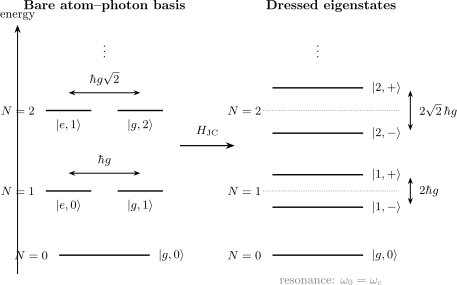
At atom–cavity resonance, the interaction couples and within each fixed-excitation manifold. Their symmetric and antisymmetric combinations form a doublet separated by . The vacuum state remains unpaired.
Avoided crossings in each manifold
Section titled “Avoided crossings in each manifold”As is swept through zero, every manifold has an avoided crossing. Its minimum gap is
The bare content changes with detuning:
Thus the same spectral curve contains both a coupling measurement and a state-composition map. Measuring only the separation does not by itself determine which bare component a branch contains; the sign of detuning and the branch convention are also required.
Entanglement in Quantized Dressed States
Section titled “Entanglement in Quantized Dressed States”For a physical quantized mode, the resonant state
is not an atomic superposition multiplied by a field state. The two photon states are orthogonal, so the atom and mode are entangled.
Tracing over the field gives
There is no off-diagonal atomic coherence in this reduced state, even though the joint state is pure. The entanglement entropy is
where
At resonance, and . Far from resonance, one component dominates and the entropy tends to zero.
This is a sharp difference from a semiclassical dressed state
which is a pure state of the atom because the classical source is not part of the Hilbert space. Replacing a quantized field by a classical amplitude can therefore reproduce mean coherent dynamics while discarding atom–field entanglement.
Semiclassical Limit of a Quantized Mode
Section titled “Semiclassical Limit of a Quantized Mode”Let the mode begin in a coherent state with
The Jaynes–Cummings interaction samples many excitation manifolds. Near the center of a large photon-number distribution,
so the corresponding classical Rabi-frequency coefficient is
This is a local, large-occupation correspondence, not an operator identity. A coherent state has photon-number variance
and therefore contains a spread of frequencies . At short times and large , the fractional spread is small and a classical drive is accurate. At longer times, the components dephase and can later rephase, producing collapse and revival of the inversion. That photon-number-resolved behavior is absent from a deterministic single-frequency classical field.
The precise large-field limit must also specify what is held fixed. Taking at fixed makes the drive diverge. A controlled semiclassical scaling keeps finite while suppressing relative field fluctuations.
Floquet and Dressed-State Dictionary
Section titled “Floquet and Dressed-State Dictionary”For a classical periodic Hamiltonian,
Floquet states have the form
The quasienergy is defined modulo :
Expanding in Fourier harmonics produces an extended matrix with repeated bare levels shifted by . Near a one-photon resonance, retaining the nearly degenerate pair gives the same RWA matrix that defines the semiclassical dressed states.
This establishes a useful dictionary:
| Quantized single mode | Classical Floquet drive |
|---|---|
| $ | g,n\rangle |
| physical photon occupation | harmonic bookkeeping index |
| joint energy eigenvalue | quasienergy modulo |
| atom–field entanglement possible | no source subsystem in the model |
| number fluctuations are physical | drive amplitude prescribed |
The analogy is strongest for a highly occupied, nearly monochromatic mode and near-resonant dynamics over times for which back-action and photon-number dispersion are negligible.
Outside the RWA, a Floquet calculation can retain many harmonics and reveal multiphoton avoided crossings and the Bloch–Siegert shift. A fully quantized Rabi model can retain counter-rotating terms. These extensions are again related, but their state spaces and observables should not be conflated.
How Dressed States Become Observable
Section titled “How Dressed States Become Observable”Eigenvectors are not observed directly. A measurement accesses transition frequencies, line strengths, time evolution, or correlations.
Weak-probe spectroscopy
Section titled “Weak-probe spectroscopy”Suppose a weak probe couples a third state only to the bare state . If
then the dressed-state matrix elements are
In the ideal weak-probe limit, the relative line strengths therefore scale as
At resonance the two branches have equal bare weight and, under these selection assumptions, equal strength. Far from resonance one line becomes bright and the other dark.
The observed peaks are separated by dressed energy differences only when the relevant linewidths, probe back-action, populations, and interference paths are included consistently. The full three-level spectrum belongs to Autler–Townes Splitting.
Time-domain interference
Section titled “Time-domain interference”If a bare state is prepared suddenly, the two dressed components acquire a relative phase
Bare-state population oscillations are an interferometric measurement of that phase. The frequency reveals the dressed gap, while the oscillation contrast reveals the mixing angle and state preparation.
Emission and dressed-state transitions
Section titled “Emission and dressed-state transitions”Spontaneous emission acts through an operator such as . Written in the dressed basis, this operator has several matrix elements between neighboring atom–photon manifolds. Consequently, a strongly driven two-level emitter can radiate at more than one dressed transition frequency. In the resonant, well-resolved regime this underlies the Mollow triplet.
The radiative reservoir, linewidths, and fluorescence spectrum are not contained in the Hermitian two-state eigenproblem alone. They require the open-system treatment developed in Spontaneous Emission and Optical Bloch Equations.
Cavity QED Connection
Section titled “Cavity QED Connection”In cavity QED, the quantized dressed doublets can be spectroscopically resolved because the atom repeatedly exchanges an excitation with a long-lived resonator mode. In the one-excitation sector, a useful non-Hermitian pole model is
where is the atomic population-decay rate into noncavity channels and is the cavity energy-decay rate in this convention. Its complex poles are
The real parts locate idealized resonances and the imaginary parts encode decay. At exact resonance, the square root has a nonzero real part when
That algebraic pole-splitting condition is not, by itself, a universal criterion for visibly resolving two peaks. Resolvability depends on the combined widths, drive and detection port, background, and fitting model. Likewise, the cooperativity
tests coherent coupling against dissipation but answers a different question from peak separation.
The closed dressed-state spectrum supplies the organizing skeleton. Cavity QED develops the mode overlap, linewidth conventions, dissipative spectrum, Purcell limit, and measured transmission or reflection. The open-system cavity-QED map continues to conditional output records and trajectories.
Beyond the Ideal Two-State RWA
Section titled “Beyond the Ideal Two-State RWA”Counter-rotating terms
Section titled “Counter-rotating terms”The quantum Rabi Hamiltonian contains
Besides the Jaynes–Cummings exchange terms, it includes
These terms do not conserve . The independent two-dimensional manifolds disappear; only a parity symmetry remains in the ideal Rabi model. Perturbatively they produce shifts such as the Bloch–Siegert correction. In ultrastrong coupling, the exact eigenstates contain contributions from many bare excitation sectors and the phrase “one photon in the dressed ground state” becomes measurement-model dependent.
Multilevel matter
Section titled “Multilevel matter”A real atom or molecule may have several nearby states coupled by the same field. Then the dressed Hamiltonian is larger than , and dark states, multiple avoided crossings, tensor light shifts, and leakage can appear. The two-state mixing angle remains useful only after the neglected levels have been shown to be perturbative.
Near-degenerate magnetic or hyperfine manifolds are especially sensitive to polarization and selection rules. A measured splitting cannot be assigned to one until the complete coupled subspace has been checked.
Spatial and motional dependence
Section titled “Spatial and motional dependence”If the coupling varies with position,
then the dressed energies define position-dependent adiabatic potentials. Atomic motion can also drive transitions between local dressed branches. The relevant small parameter compares motional matrix elements of the position-dependent basis to the local dressed gap. Treating as ordinary scalar potentials without those derivative couplings can fail near nodes and avoided crossings.
Dissipation and noise
Section titled “Dissipation and noise”Hermitian dressed eigenstates are not generally eigenmodes of a Lindblad generator. Relaxation, dephasing, drive noise, and cavity loss change the steady state and broaden transitions. In weak dissipation, the Hamiltonian dressed basis is often a useful starting point for a secular master equation. Near degeneracies or for structured reservoirs, secularizing in that basis may erase important interference.
The phrase “dressed-state lifetime” must therefore identify:
- the prepared branch;
- the decay and dephasing channels;
- whether the quoted quantity is a population lifetime, coherence time, or spectral linewidth;
- the approximation used to transform the bath coupling operators.
A Reliable Dressed-State Workflow
Section titled “A Reliable Dressed-State Workflow”- Declare the model. State whether the field is prescribed, Floquet-periodic, or a quantized physical mode.
- Fix conventions. Record basis order, detuning sign, drive phase, peak versus RMS field, and the factor used in or .
- Identify the near-degenerate subspace. For a quantized mode, label the conserved excitation manifold before writing a matrix.
- Remove only common offsets. Energy differences survive; absolute quasienergy representatives depend on frame and Floquet zone.
- Diagonalize vectors as well as values. Record mixing angles and bare weights, not only the square-root gap.
- Track branches operationally. Specify sudden preparation, adiabatic continuation, or a fixed upper/lower eigenvalue label.
- Transform the observable. Probe strengths and decay channels depend on matrix elements in the dressed basis.
- Add open-system physics before comparing with spectra. A gap does not guarantee resolvable peaks.
- Audit discarded states and terms. Check spectator levels, counter-rotating couplings, motion, and field fluctuations.
- Test limits. Recover equal mixing on resonance, bare states far away, in a resonant Jaynes–Cummings manifold, and the uncoupled state.
Common Mistakes
Section titled “Common Mistakes”Calling every coherent superposition a dressed state
Section titled “Calling every coherent superposition a dressed state”A dressed state is an eigenstate, or an instantaneous eigenstate, of a specified coupled Hamiltonian. A generic superposition produced during a pulse is not automatically dressed.
Treating rotating-frame quasienergies as unique absolute energies
Section titled “Treating rotating-frame quasienergies as unique absolute energies”Floquet quasienergies are defined modulo , and rotating-frame Hamiltonians may differ by common offsets. Observable transition frequencies require a consistent zone and operator bookkeeping.
Using a photon label for a classical field literally
Section titled “Using a photon label for a classical field literally”The Fourier index of a classical Floquet calculation is not a measured photon occupation. Atom–field entanglement requires a quantized field subsystem.
Losing the factor of two
Section titled “Losing the factor of two”With the convention
on resonance, the semiclassical dressed gap is . In a Jaynes–Cummings block the off-diagonal element is , so the resonant gap is .
Choosing the wrong mixing-angle quadrant
Section titled “Choosing the wrong mixing-angle quadrant”An ordinary one-argument arctangent jumps to the wrong branch when . Define and , or use a two-argument arctangent.
Following a bare label through resonance
Section titled “Following a bare label through resonance”The upper and lower dressed branches exchange bare character. “The excited branch” is ambiguous near and across the avoided crossing unless the tracking prescription is stated.
Assuming an avoided crossing proves a visible doublet
Section titled “Assuming an avoided crossing proves a visible doublet”The closed-system eigenvalues may split while dissipation and instrumental resolution merge the measured response into one feature. Conversely, interference can create a narrow spectral structure without the same strong-coupling interpretation.
Preparing at a degeneracy adiabatically
Section titled “Preparing at a degeneracy adiabatically”At , the gap closes and there is no unique nondegenerate eigenstate to follow. An adiabatic ramp must specify a path that resolves the degeneracy.
Ignoring the observable
Section titled “Ignoring the observable”One dressed branch may have negligible matrix element for a chosen probe. An eigenvalue in the Hamiltonian does not guarantee a bright spectral line.
Extending Jaynes–Cummings manifolds into ultrastrong coupling
Section titled “Extending Jaynes–Cummings manifolds into ultrastrong coupling”Counter-rotating terms mix excitation sectors. The conserved- block picture then ceases to be exact.
Key Results
Section titled “Key Results”For the semiclassical RWA Hamiltonian,
and the bare-state weights are set by
For the th Jaynes–Cummings manifold,
At resonance,
The common structure is a coupled avoided crossing. The physical meaning of the basis, however, depends on whether the field is classical, Floquet periodic, or quantized.
Further Connections
Section titled “Further Connections”- Cavity QED Simulation Notebook numerically tracks the first two Jaynes–Cummings avoided crossings and validates their gaps and phase-insensitive eigenvector composition.
- Rotating-Wave Approximation derives the controlled removal of counter-rotating terms.
- Floquet Operators explains one-period eigenphases and quasienergy branch choices.
- Rabi Model records the counter-rotating extension of the quantized two-state model.
- Strong Coupling separates coherent exchange from simple weak-coupling decay.
- Adiabatic Theorem gives the general gap and matrix-element criterion behind branch following.
- Interactions and Coupling Terms develops the tensor-product meaning of interaction-induced entanglement.
- Autler–Townes Splitting turns control-dressed eigenvalues and matrix elements into a dissipative weak-probe spectrum.
- Electromagnetically Induced Transparency develops the dark superposition, destructive response pathway, and light–matter polariton.
- STIRAP follows a time-dependent dark dressed state to transfer population while suppressing occupation of a lossy intermediate state.
References
Section titled “References”- C. Cohen-Tannoudji, J. Dupont-Roc, and G. Grynberg, Atom–Photon Interactions: Basic Processes and Applications (Wiley, 1992), especially Chapters IV and VI.
- C. Cohen-Tannoudji, “Manipulating atoms with photons,” Reviews of Modern Physics 70, 707–719 (1998).
- E. T. Jaynes and F. W. Cummings, “Comparison of quantum and semiclassical radiation theories with application to the beam maser,” Proceedings of the IEEE 51, 89–109 (1963).
- B. W. Shore and P. L. Knight, “The Jaynes–Cummings model,” Journal of Modern Optics 40, 1195–1238 (1993).
- S. H. Autler and C. H. Townes, “Stark effect in rapidly varying fields,” Physical Review 100, 703–722 (1955).
- J. H. Shirley, “Solution of the Schrödinger equation with a Hamiltonian periodic in time,” Physical Review 138, B979–B987 (1965).
- H. Sambe, “Steady states and quasienergies of a quantum-mechanical system in an oscillating field,” Physical Review A 7, 2203–2213 (1973).
- B. R. Mollow, “Power spectrum of light scattered by two-level systems,” Physical Review 188, 1969–1975 (1969).
- S. Haroche and J.-M. Raimond, Exploring the Quantum: Atoms, Cavities, and Photons (Oxford University Press, 2006).
- A. Blais, A. L. Grimsmo, S. M. Girvin, and A. Wallraff, “Circuit quantum electrodynamics,” Reviews of Modern Physics 93, 025005 (2021).
Exercises
Section titled “Exercises”1. Diagonalize with a complex drive phase
Section titled “1. Diagonalize with a complex drive phase”Starting from
verify the eigenvalues and eigenvectors given above. Then show explicitly that changing does not change the eigenvalues.
Solution
The characteristic equation is
The phase cancels because the product of the off-diagonal entries is . Hence
Write
For the proposed upper state, represented by the column
the matrix multiplication gives
Using
the half-angle identities yield
and
Therefore the vector is an eigenvector with eigenvalue . The orthogonal column
similarly has eigenvalue .
Changing rotates the eigenvectors about the bare axis but leaves the spectrum unchanged.
2. Recover Rabi oscillations from dressed phases
Section titled “2. Recover Rabi oscillations from dressed phases”Take and prepare suddenly at . Use the dressed basis to find the excited-state probability for constant and .
Solution
The inverse transformation gives
After time ,
Projecting onto gives
Therefore
The oscillation is interference between stationary dressed components. Detuning increases the phase-evolution frequency but reduces the mixing factor .
3. Track branch identity across resonance
Section titled “3. Track branch identity across resonance”For fixed , determine the limiting bare character of and as and . Explain why “the excited dressed state” is an unsafe global label.
Solution
When ,
so
When ,
so
The upper and lower eigenvalue branches are continuous, but each exchanges its bare identity through the avoided crossing. A label based on bare character must therefore include the side of resonance or an explicit adiabatic path.
4. Adiabaticity of a detuning sweep
Section titled “4. Adiabaticity of a detuning sweep”Let be constant and sweep
Find , locate its maximum, and obtain a simple local adiabaticity condition. For
estimate the Landau–Zener diabatic probability. Convert all quantities consistently to angular units.
Solution
For constant ,
It is largest at resonance:
Comparing this with the minimum gap frequency gives
Numerically,
and
The exponent is
Thus
The transfer is highly, though not perfectly, adiabatic in the ideal infinite-sweep model.
5. Diagonalize a Jaynes–Cummings manifold
Section titled “5. Diagonalize a Jaynes–Cummings manifold”Starting from , derive the matrix in the basis , . Show that the resonant splitting scales as , and evaluate the first three doublet splittings in units of .
Solution
The diagonal matrix elements are
Their mean is
and their difference is . The coupling follows from
so the off-diagonal matrix element is . This gives
At resonance,
For , the splittings in units of are
The nonuniform ladder is a signature of the quantized oscillator matrix element.
6. Entanglement away from resonance
Section titled “6. Entanglement away from resonance”For the state , compute the atomic purity
Evaluate it on resonance and in the limit .
Solution
The reduced atomic probabilities are
Hence
Using
one finds
At resonance,
the minimum purity for a two-level reduced state, corresponding to maximal atom–mode entanglement in this two-term Schmidt decomposition.
For ,
so . The dressed state approaches a bare product state.
7. Predict weak-probe line strengths
Section titled “7. Predict weak-probe line strengths”A third state couples only to . Find the ideal relative probe strengths to and for
What additional information is needed before claiming that two peaks will be visible?
Solution
The condition gives
Therefore
and
Under the stated selection rule,
Two eigenvalues do not guarantee two visible peaks. One must also know the dressed separation, homogeneous and inhomogeneous linewidths, dressed-state populations, probe strength, competing matrix elements, interference paths, instrument response, and signal-to-noise ratio.
8. Separate Floquet harmonics from photons
Section titled “8. Separate Floquet harmonics from photons”Consider a two-level atom driven by a prescribed classical periodic field. A Floquet calculation labels basis vectors by an integer . Decide which of the following statements are valid, and justify each answer:
- measuring the cavity photon number measures ;
- quasienergies differing by represent equivalent Floquet zones;
- a Floquet state necessarily entangles the atom with the source;
- a highly occupied coherent quantized mode can approximate the semiclassical Rabi coefficient.
Solution
- Invalid. A prescribed classical drive has no cavity Hilbert space or photon-number operator. The integer labels a Fourier harmonic in extended Floquet space.
- Valid. Multiplying the periodic part by shifts the quasienergy by without changing the physical solution.
- Invalid. The classical source is not a subsystem of the model, so atom–source entanglement is undefined there. The atomic state may still be a coherent superposition.
- Valid with qualifications. For a coherent state with large , the matrix element near the distribution center gives . The approximation is limited by photon-number dispersion, back-action, and the timescale of interest.