Exchange and Correlation
Direct interaction, exchange, and correlation are three ways in which the same many-electron problem is organized. They are not three fundamental forces.
- The direct Coulomb contribution is the density–density average of the electron–electron interaction.
- Exchange is the crossed contribution forced by fermionic antisymmetry.
- Correlation, in the conventional quantum-chemistry sense used here, is what remains when the exact interacting state is compared with the best single Slater determinant for the same Hamiltonian.
This distinction matters because each layer has different spin dependence, mathematical structure, and approximation error. Hartree theory contains a direct mean field but no exchange. Hartree–Fock contains direct and exchange effects exactly within its determinant trial space, but it omits correlation beyond one determinant. Kohn–Sham density-functional theory groups several residual contributions into an exchange-correlation functional, without making exchange and correlation the same mechanism.
Canonical Scope
Section titled “Canonical Scope”This page is the canonical atomic guide to:
- the physical distinction between direct Coulomb, exchange, and correlation contributions;
- two-orbital direct and exchange integrals;
- singlet–triplet exchange splitting at fixed orbitals;
- the exchange hole and the correlation hole;
- dynamical and static correlation in atoms;
- why exchange is not a new classical force;
- how Hartree, Hartree–Fock, post-Hartree–Fock, and Kohn–Sham DFT account for these effects.
Hartree–Fock Approximation owns the full determinant variational derivation, Fock operator, self-consistency equations, and orbital-energy bookkeeping. Hartree–Fock for Atoms owns the spherical and open-shell atomic specialization, radial representations, and atomic Koopmans interpretation. Slater Determinants owns determinant construction. Helium Atom owns the quantitative two-electron benchmark. This page instead supplies the conceptual accounting needed to read atomic term splittings and electronic-structure results correctly.
One Hamiltonian, Different State Structure
Section titled “One Hamiltonian, Different State Structure”In atomic units, with a fixed point nucleus of charge , the nonrelativistic electronic Hamiltonian is
The last term is the only electron–electron potential in this model:
Neither an exchange potential nor a correlation potential has been added to the microscopic Hamiltonian. Those names describe structures that appear when is evaluated in an antisymmetric state and when the allowed state family is enlarged beyond a mean-field reference.
The separation is therefore a separation of state-dependent contributions and approximations, not a decomposition into independently acting microscopic forces.
Direct Coulomb Interaction
Section titled “Direct Coulomb Interaction”Let and be orthonormal spatial orbitals. Their direct Coulomb integral is
This is the classical electrostatic interaction between the two normalized orbital densities. For the repulsive Coulomb kernel,
If is the one-electron part of the Hamiltonian and
then the distinguishable-particle product
has energy
The direct term knows about the spatial charge distributions but not about exchange symmetry. It is present for same-spin and opposite-spin electron pairs.
From pair repulsion to a mean field
Section titled “From pair repulsion to a mean field”For a total density , the Hartree potential is
and the Hartree energy is
The factor avoids double counting pairs. This density product is an average-field object: it does not equal the exact pair density of an interacting atom.
Written in terms of the total one-electron density, also contains terms in which an orbital density interacts with itself. A correct many-electron treatment must cancel or avoid that self-interaction. Exact determinant exchange performs the cancellation orbital by orbital.
Exchange from Antisymmetry
Section titled “Exchange from Antisymmetry”The exchange integral for the same two spatial orbitals is
In two-particle notation,
The labels return to the same orbital in and are crossed in . Exchange is therefore sensitive to orbital coherence and overlap, not merely to the two orbital densities.
For the Coulomb kernel, is nonnegative. One way to see this is to define the transition density
Then is the Coulomb quadratic form of . In Fourier space,
Orthogonality gives , but it does not make the entire transition density vanish.
Spin-adapted two-electron states
Section titled “Spin-adapted two-electron states”The normalized symmetric and antisymmetric spatial combinations are
For a spin-independent Hamiltonian,
Fermionic antisymmetry pairs:
- the symmetric spatial state with the antisymmetric spin singlet;
- the antisymmetric spatial state with the symmetric spin triplet.
Thus, at fixed orbitals,
and
The lower triplet energy in this model is not caused by an additional attractive force. The symmetric and antisymmetric spatial states sample the same Coulomb operator with different interference terms.
A spin-orbital nuance
Section titled “A spin-orbital nuance”For spin-orbitals
the exchange integral contains the spin factor
It vanishes for orthogonal and spin functions. A single determinant containing and is generally not an eigenstate of total ; spin adaptation combines determinants to form the singlet and the triplet. There is therefore no contradiction between:
- “Fock exchange vanishes between orthogonal spin-orbitals,” and
- “different-orbital singlet and triplet states can be exchange split.”
They refer to different state representations.
Self-interaction cancellation
Section titled “Self-interaction cancellation”For a determinant of occupied spin-orbitals, the electron–electron energy is
Since
every contribution cancels. An electron does not Coulomb-repel itself in exact Hartree–Fock exchange. Approximate density functionals need not preserve this cancellation exactly.
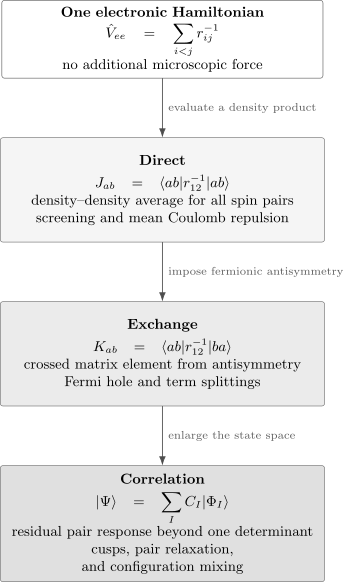
The electron–electron Coulomb operator is unchanged. Direct and exchange contributions appear when it is evaluated in an antisymmetric determinant; correlation describes the residual pair response available beyond the best determinant. No extra microscopic force is introduced.
Exchange Splitting in Atoms
Section titled “Exchange Splitting in Atoms”The two-orbital result gives the cleanest exchange-splitting model. For helium’s and configurations, it explains why corresponding triplet terms commonly lie below the singlets before smaller relativistic splittings are resolved.
The fixed-orbital formula is not a precision prediction by itself. Singlet and triplet states can have different optimized radial orbitals and different correlation energies. Their measured separation is more accurately organized as
The relative importance of these terms depends on the atom, configuration, and requested accuracy.
More than two electrons
Section titled “More than two electrons”In a many-electron configuration, electrostatic term energies are expressed through angular coefficients and radial Slater–Condon integrals. Several direct and crossed matrix elements contribute, and configuration interaction can mix states with the same exact quantum numbers. There is generally no single number that equals an observed multiplet splitting.
Exchange supplies an important tendency behind Hund’s first rule: within a configuration, large total spin often permits greater same-spin spatial avoidance and lowers the electrostatic energy. The rule is not a theorem for arbitrary Hamiltonians or configurations. Radial relaxation, near-degeneracy, spin–orbit coupling, and correlation can alter or reverse simple ordering arguments. Hund’s Rules develops the fixed-orbital derivation, the relaxed-energy caveat, and the other two free-atom ordering rules.
Atomic Term Symbols explains the labels. Pauli Principle in Atoms derives which equivalent-electron terms survive antisymmetrization.
The Exchange Hole
Section titled “The Exchange Hole”Exchange has a direct pair-probability signature. For a determinant, define the spin-resolved one-body density matrix
and the spin density
The ordered spin-resolved pair density is
The second term removes same-spin pair probability. At coalescence,
as required by antisymmetry.
Conditioned on a spin- electron at , the determinant exchange hole is
For an idempotent determinant with integer occupations,
One same-spin electron’s worth of conditional probability is removed and redistributed. The exchange hole is a statement about pair statistics; it is not a cavity excavated by a mechanical force.
Opposite-spin pairs have no determinant exchange hole in a collinear spin basis. Coulomb interaction can still create an opposite-spin correlation hole.
Correlation Beyond Mean Field
Section titled “Correlation Beyond Mean Field”The word correlation has several legitimate meanings:
- In probability theory, any failure of a joint distribution to factorize is correlation.
- In a broad many-body usage, the exchange hole itself is a statistical correlation caused by antisymmetry.
- In conventional electronic-structure theory, electron correlation excludes Hartree–Fock exchange and means the physics missing from the best single determinant.
This page uses the third meaning unless a broader phrase such as “exchange-correlation hole” is written explicitly.
Correlation energy
Section titled “Correlation energy”For the same Hamiltonian, symmetry constraints, and one-particle space, define
where is the exact ground-state energy and is the global Hartree–Fock minimum. The variational principle gives
This definition requires a specified reference problem. Changing the Hamiltonian, basis, frozen core, relativistic treatment, or symmetry restrictions changes the comparison. A merely converged self-consistent solution may be a local minimum or saddle and should not automatically be used as .
Correlation energy is not itself an observable. It is a method-defining energy difference. Two states can have similar correlation energies while differing substantially in contact densities, transition amplitudes, polarizabilities, or other correlation-sensitive quantities.
Wavefunction structure
Section titled “Wavefunction structure”A correlated state generally requires structure beyond one determinant:
Alternatively, the ansatz may depend explicitly on interelectronic distances, use coupled-cluster amplitudes, a tensor network, a Green function, or stochastic many-body sampling. The essential point is not a particular algorithm. It is that the pair response is no longer fixed completely by one occupied projector.
Coulomb cusp
Section titled “Coulomb cusp”For two opposite-spin electrons, the spherical average of an exact nonrelativistic Coulomb wavefunction obeys the electron–electron cusp condition
in atomic units. A finite expansion of smooth orbital products represents this nonanalytic local slope inefficiently. Explicitly correlated factors such as
build the leading opposite-spin coalescence response directly into the state.
The same-spin wavefunction already vanishes linearly at coalescence because of antisymmetry, so its cusp statement must be formulated after factoring out that node. Exchange and Coulomb correlation therefore constrain short-distance behavior in different ways.
Correlation hole
Section titled “Correlation hole”For the exact interacting state, write the conditional deficit relative to its one-electron density as an exchange-correlation hole,
For a fixed- state,
In the standard Kohn–Sham partition, the reference determinant reproduces the same density and its exchange hole also integrates to . The resulting correlation hole therefore satisfies
Correlation moves conditional probability rather than removing another electron. It produces a negative region near unfavorable pair configurations and compensating positive regions elsewhere. The detailed hole depends on spin, position, state, and interaction strength.
Dynamical and Static Correlation
Section titled “Dynamical and Static Correlation”The distinction is diagnostic rather than mathematically absolute, but it is useful.
| Regime | State structure | Atomic signature | Typical warning sign |
|---|---|---|---|
| Dynamical correlation | many small corrections to a dominant determinant | short-range avoidance, radial and angular response, core–valence polarization | slow convergence of energies or contact properties with excitation rank and angular basis |
| Static correlation | several determinants with comparable weights | near-degenerate open subshells or competing configurations | no determinant has a dominant weight; symmetry breaking lowers a mean-field energy |
Hydrogen Molecule provides the canonical molecular comparison: its equilibrium state has substantial dynamical correlation, whereas stretching the bond drives and configurations toward equal importance and exposes static correlation.
Atomic examples
Section titled “Atomic examples”- Helium ground state: one determinant is qualitatively dominant, but explicit dependence is needed for accurate energy and coalescence properties. This is primarily dynamical correlation.
- Beryllium ground state: the and configurations are close enough that a single closed-shell determinant misses important near-degenerate mixing.
- Open and shells: several configurations and angular couplings can be competitive, producing substantial multireference structure.
- Core–valence observables: hyperfine constants, isotope shifts, and contact densities can be sensitive to small correlated changes near the nucleus even when their contribution to the total energy is modest.
Relativistic, recoil, QED, finite-nuclear-size, and correlation effects are separate layers of an atomic prediction. A discrepancy with experiment should not be labeled “correlation” until those other approximations and numerical errors have been audited.
Why Exchange Is Not a Classical Force
Section titled “Why Exchange Is Not a Classical Force”Several equivalent checks prevent a misleading force picture.
No new term in the Hamiltonian
Section titled “No new term in the Hamiltonian”The microscopic nonrelativistic Hamiltonian contains Coulomb repulsion. Exchange appears after imposing antisymmetry on the state.
It survives without interactions
Section titled “It survives without interactions”An ideal Fermi gas has an exchange hole and same-spin anticorrelation even when . Its exchange energy with respect to Coulomb interaction is then absent because the interaction has been switched off, but its exchange statistics remain.
It depends on the state representation
Section titled “It depends on the state representation”Individual and values depend on the chosen orbital representation, although the determinant energy is invariant under unitary rotations of the occupied orbitals. A fundamental pair force would not depend on such bookkeeping.
Spin enters through total-state symmetry
Section titled “Spin enters through total-state symmetry”For a spin-independent Hamiltonian, there is no magnetic spin–spin force in . Spin labels determine which spatial exchange symmetry is compatible with total fermionic antisymmetry.
Effective exchange Hamiltonians are reduced descriptions
Section titled “Effective exchange Hamiltonians are reduced descriptions”Operators such as
can faithfully reproduce low-energy singlet–triplet splittings after orbital degrees of freedom are projected out. Their coupling is an effective parameter and should not be confused with the direct Coulomb integral . Sign conventions vary; for the displayed convention, places the singlet below the triplet.
Method Accounting
Section titled “Method Accounting”| Method or object | Direct Coulomb | Exchange | Correlation beyond one determinant |
|---|---|---|---|
| Hartree product | yes, as an average field | no | no |
| Single Slater determinant | yes | yes, exactly within that determinant | no |
| Hartree–Fock | self-consistently optimized | exact determinant exchange | omitted |
| Configuration expansion or correlated ansatz | yes | exact through antisymmetry | included to the chosen truncation |
| Exact nonrelativistic solution | yes | exact | exact for the stated Hamiltonian |
| Kohn–Sham DFT | explicit Hartree functional | part of | part of |
“Exact” in the last two rows has a scope. It does not silently include relativity, QED, nuclear motion, or finite nuclear size if those terms are absent from the Hamiltonian.
Connection to Hartree–Fock
Section titled “Connection to Hartree–Fock”Hartree–Fock minimizes the energy over normalized Slater determinants. Its energy has the form
Orbital variation yields a nonlocal exchange operator and self-consistent equations. The antisymmetry and exchange inside the determinant are exact; the approximation is the restriction to one determinant.
This wording matters. It is incorrect to say “Hartree–Fock neglects electron–electron interaction” or “Hartree–Fock neglects exchange.” It treats Coulomb interaction through direct and exchange mean fields and neglects the residual correlation allowed by a more flexible many-electron state.
Post-Hartree–Fock methods enlarge the state or response space in different ways. Perturbation theory, configuration interaction, coupled cluster, explicitly correlated methods, quantum Monte Carlo, and tensor networks do not define different kinds of Coulomb force. They approximate the residual many-electron response with different parametrizations and convergence properties.
Connection to Density-Functional Theory
Section titled “Connection to Density-Functional Theory”The exact Hohenberg–Kohn universal functional is
Kohn–Sham theory rewrites the ground-state energy as
Here is the kinetic energy of a noninteracting system reproducing the density. Formally,
Therefore contains more than a correction to the Coulomb energy. It also contains the difference between the interacting and Kohn–Sham kinetic energies.
One may further write
after specifying a Kohn–Sham exchange convention. Exact Kohn–Sham exchange has the determinant-like crossed form built from occupied Kohn–Sham orbitals. Correlation contains the remaining interaction and kinetic pieces.
The hyphenated phrase exchange-correlation is thus functional bookkeeping, not a claim that exchange and correlation share one physical origin. Approximate local, semilocal, hybrid, and orbital-dependent functionals model this bookkeeping differently. Their results can contain self-interaction, delocalization, static-correlation, and derivative-discontinuity errors even though a term labeled is present.
Kohn–Sham orbitals are auxiliary variables constrained to reproduce a density. Except for results protected by exact theory, their individual eigenvalues and shapes should not automatically be interpreted as exact removal energies or unique physical electron trajectories.
What to Look for in Atomic Data
Section titled “What to Look for in Atomic Data”Different observables probe different parts of the accounting:
- configuration-average energies strongly reflect direct Coulomb screening;
- singlet–triplet and multiplet separations are sensitive to exchange and state-specific correlation;
- fine and hyperfine structure add relativistic, magnetic, recoil, and nuclear effects;
- contact densities probe short-range correlation and the wavefunction near coalescence or the nucleus;
- polarizabilities and dispersion coefficients probe correlated virtual excitations;
- transition amplitudes can be sensitive to orbital relaxation and correlation even when level energies look accurate.
A useful comparison states the Hamiltonian, reference space, correlation treatment, basis or radial representation, relativistic order, nuclear model, and convergence uncertainty. Agreement in one transition energy does not certify all these layers.
Common Mistakes
Section titled “Common Mistakes”“Exchange is another repulsive force”
Section titled ““Exchange is another repulsive force””Exchange is an antisymmetry contribution to amplitudes and pair probabilities. It can lower a triplet relative to a singlet without adding an attractive potential to the Hamiltonian.
“Opposite-spin electrons are distinguishable”
Section titled ““Opposite-spin electrons are distinguishable””All electrons are identical fermions and the total state must be antisymmetric. What vanishes for orthogonal spins is a particular Fock exchange integral between two spin-orbitals.
“Exchange and correlation are synonyms”
Section titled ““Exchange and correlation are synonyms””In broad probability language, exchange produces correlations. In standard quantum-chemistry energy accounting, Hartree–Fock exchange is part of the reference and correlation means the residual beyond that reference.
“Correlation is just Coulomb repulsion”
Section titled ““Correlation is just Coulomb repulsion””The direct mean field already represents an average Coulomb repulsion. Correlation is the additional state-dependent pair response beyond the optimal determinant.
“Correlation energy measures entanglement”
Section titled ““Correlation energy measures entanglement””is an energy difference relative to Hartree–Fock. Entanglement depends on a subsystem or mode partition and is quantified by reduced-state properties. The two can be related without being identical.
“A DFT exchange-correlation functional is the correlation energy”
Section titled ““A DFT exchange-correlation functional is the correlation energy””includes exchange and interacting-kinetic corrections as well as Coulomb correlation. An approximate functional is not guaranteed to equal the exact decomposition.
“Every residual error is electron correlation”
Section titled ““Every residual error is electron correlation””Basis incompleteness, numerical error, recoil, relativity, QED, nuclear size, and experimental uncertainty must be separated before a residual is assigned to correlation.
Exercises
Section titled “Exercises”Exercise 1: Derive the exchange splitting
Section titled “Exercise 1: Derive the exchange splitting”For orthonormal spatial orbitals and , evaluate and identify the spin state paired with each spatial symmetry.
Solution
Expanding the two bra terms against the two ket terms gives two diagonal contributions and two crossed contributions. The normalization factor then yields
The symmetric spatial state must multiply the antisymmetric spin singlet. The antisymmetric spatial state must multiply a symmetric triplet spin function. Hence
This is a fixed-orbital result; state-specific relaxation and correlation can change the observed separation.
Exercise 2: Spin selection in a determinant
Section titled “Exercise 2: Spin selection in a determinant”Show that the exchange integral between and vanishes for a spin-independent interaction, while the direct integral need not vanish.
Solution
The spin part of the exchange matrix element is
The direct matrix element instead contains
Thus the spin-orbital exchange integral vanishes and the direct Coulomb term remains. This does not make the electrons distinguishable; the determinant is still antisymmetric.
Exercise 3: One-electron self-interaction
Section titled “Exercise 3: One-electron self-interaction”Insert a single occupied spin-orbital into the determinant expression for . What result should any exact one-electron theory reproduce?
Solution
With only ,
Because ,
A one-electron system has no electron–electron interaction energy. Hartree energy alone is positive, so exact exchange must cancel it. Failure of an approximate functional to achieve this is one form of self-interaction error.
Exercise 4: Normalize the exchange hole
Section titled “Exercise 4: Normalize the exchange hole”Use orthonormal occupied orbitals to show that
Deduce the exchange-hole sum rule.
Solution
Expand both density matrices:
Orthonormality reduces the integral to , leaving
Therefore
Exercise 5: Sign and scope of correlation energy
Section titled “Exercise 5: Sign and scope of correlation energy”Why is for a ground state? Give two changes of convention that prevent correlation energies from being compared directly.
Solution
The exact ground state is varied over a state space containing all normalized determinants, while Hartree–Fock varies over only the determinant subset. Therefore
and .
Direct comparison fails if, for example, one value uses a frozen core and another correlates all electrons, or one uses a finite orbital basis while another refers to the complete-basis nonrelativistic limit. Different Hamiltonians, symmetry restrictions, and relativistic models also define different reference problems.
Exercise 6: Identify dynamical and static correlation
Section titled “Exercise 6: Identify dynamical and static correlation”Classify the leading difficulty in each case: the helium ground state, stretched , and an atom with two nearly degenerate configurations of the same symmetry.
Solution
The helium ground state is dominated by one determinant, while many small corrections reproduce radial, angular, and cusp response: primarily dynamical correlation.
At stretched , two covalent determinants become comparably important, so the restricted one-determinant reference fails qualitatively: static correlation.
Near-degenerate atomic configurations of the same symmetry likewise require substantial configuration mixing and are a static or multireference problem, usually accompanied by additional dynamical correlation.
Exercise 7: What belongs in the DFT remainder?
Section titled “Exercise 7: What belongs in the DFT remainder?”Starting from
subtract . Which two physical differences remain in ?
Solution
The result is
The first line is the interacting kinetic correction. The second contains exchange and Coulomb correlation beyond the Hartree density product. Thus is not merely an empirical version of the quantum-chemistry correlation energy.
Key Takeaways
Section titled “Key Takeaways”- Direct Coulomb, exchange, and correlation arise from one electronic Hamiltonian but different levels of state description.
- Exchange is exact antisymmetry physics within a determinant; correlation conventionally means what the best determinant misses.
- The fixed-orbital singlet–triplet splitting is , but precision splittings also contain relaxation, correlation, relativistic, and radiative effects.
- Exchange produces a normalized same-spin hole. Correlation redistributes pair probability and also acts between opposite-spin electrons.
- Hartree–Fock includes direct and exchange mean fields but omits beyond-determinant correlation.
- Kohn–Sham contains exchange, interaction correlation, and an interacting-kinetic correction.
- Exchange is not a new classical force, and correlation energy is not an observable or an entanglement measure.
Cross-Links
Section titled “Cross-Links”- Multi-Electron Atoms
- Atomic Correlation Methods Overview
- Helium Atom
- Electron Configurations
- Pauli Principle in Atoms
- Hund’s Rules
- Hartree Method
- Hartree–Fock for Atoms
- Atomic Term Symbols
- Exchange Interactions in Quantum Matter
- Slater Determinants
- Hartree Approximation
- Hartree–Fock Approximation
- Variational Many-Body States
- Perturbation Theory in Many-Body Systems
- Entanglement in Quantum Chemistry
- Reduced Density Matrices
References
Section titled “References”- V. Fock, “Näherungsmethode zur Lösung des quantenmechanischen Mehrkörperproblems,” Zeitschrift für Physik 61, 126–148 (1930), doi:10.1007/BF01340294.
- J. C. Slater, “Note on Hartree’s Method,” Physical Review 35, 210–211 (1930), doi:10.1103/PhysRev.35.210.2.
- P.-O. Löwdin, “Correlation Problem in Many-Electron Quantum Mechanics I,” Advances in Chemical Physics 2, 207–322 (1959), doi:10.1002/9780470143483.ch7.
- T. Kato, “On the Eigenfunctions of Many-Particle Systems in Quantum Mechanics,” Communications on Pure and Applied Mathematics 10, 151–177 (1957), doi:10.1002/cpa.3160100201.
- P. Hohenberg and W. Kohn, “Inhomogeneous Electron Gas,” Physical Review 136, B864–B871 (1964), doi:10.1103/PhysRev.136.B864.
- W. Kohn and L. J. Sham, “Self-Consistent Equations Including Exchange and Correlation Effects,” Physical Review 140, A1133–A1138 (1965), doi:10.1103/PhysRev.140.A1133.
- J. P. Perdew and A. Zunger, “Self-Interaction Correction to Density-Functional Approximations for Many-Electron Systems,” Physical Review B 23, 5048–5079 (1981), doi:10.1103/PhysRevB.23.5048.
- L. J. Sham, “Exchange and Correlation in Density-Functional Theory,” Physical Review B 32, 3876–3882 (1985), doi:10.1103/PhysRevB.32.3876.
- A. Szabo and N. S. Ostlund, Modern Quantum Chemistry: Introduction to Advanced Electronic Structure Theory, Dover (1996).
- T. Helgaker, P. Jørgensen, and J. Olsen, Molecular Electronic-Structure Theory, Wiley (2000), doi:10.1002/9781119019572.
- R. G. Parr and W. Yang, Density-Functional Theory of Atoms and Molecules, Oxford University Press (1989).
- R. D. Cowan, The Theory of Atomic Structure and Spectra, University of California Press (1981).
- E. U. Condon and G. H. Shortley, The Theory of Atomic Spectra, Cambridge University Press (1935).
- NIST, Atomic Spectroscopy: Atomic States, Shells, and Configurations.