Hydrogen Molecule
The hydrogen molecule, H₂, is the smallest neutral molecule and the smallest molecular system with electron–electron repulsion. Adding one electron to H₂⁺ changes the problem qualitatively: the electronic equation is no longer separable, the total state must be antisymmetric under electron exchange, and no single orbital product gives both an accurate equilibrium bond and the correct neutral-atom dissociation limit.
That combination makes H₂ the canonical laboratory for covalent bonding and electron correlation. Its ground state is simple enough that localized and delocalized descriptions can be related algebraically, yet rich enough to expose distinctions that remain important in large molecules:
- spin symmetry versus spatial symmetry;
- covalent and ionic structures versus molecular-orbital configurations;
- exchange required by antisymmetry versus correlation beyond a determinant;
- dynamic correlation near equilibrium versus static correlation during dissociation;
- a qualitatively useful orbital picture versus a quantitatively converged wavefunction.
Canonical Scope
Section titled “Canonical Scope”This page is the canonical home for:
- the clamped-nuclei two-electron Hamiltonian of H₂;
- the singlet and triplet exchange-symmetry conditions;
- the Heitler–London covalent states and their exchange splitting;
- the minimal molecular-orbital and restricted Hartree–Fock descriptions;
- the restricted-Hartree–Fock dissociation failure and the Coulson–Fischer remedy;
- the exact relation among covalent, ionic, , and configurations;
- dynamic and static correlation in the smallest molecular example;
- minimal-basis configuration interaction and explicitly correlated H₂ wavefunctions;
- benchmark Born–Oppenheimer energies and carefully distinguished dissociation conventions.
Valence Bond Theory owns the general nonorthogonal spin-coupled formalism, resonance structures, and modern VB methods. Molecular Orbitals owns general LCAO equations, orbital labels, occupations, and frontier language. Hartree–Fock Approximation owns the self-consistent-field derivation, and Exchange and Correlation owns the broader many-electron distinction. Chemical Bonding owns the general stability criteria and diagnostic hierarchy. Electronic Structure Overview generalizes the H₂ dissociation diagnostic into a molecular method-selection and validation map. Here those ideas are made explicit for one molecule.
Two Electrons and Two Nuclei
Section titled “Two Electrons and Two Nuclei”Place protons and at and define
for electrons . In Hartree atomic units, the clamped-nuclei electronic Hamiltonian excluding nuclear repulsion is
The Born–Oppenheimer potential for a normalized electronic state is
The term couples the electron coordinates and prevents the separation that works for H₂⁺. Even with clamped nuclei, the exact state is a function of six spatial coordinates and two spin variables,
In the infinite-nuclear-mass convention, two separated ground-state hydrogen atoms have energy
That threshold is the reference for the Born–Oppenheimer well depth . It is not the finite-mass dissociation energy from a specific rovibrational state.
Symmetries of the ground state
Section titled “Symmetries of the ground state”The nonrelativistic electrostatic Hamiltonian commutes with total electronic spin, inversion through the midpoint, rotations about the internuclear axis, and electron exchange. The ground electronic term is
Thus it has total spin , zero orbital projection on the molecular axis, even inversion parity, and positive reflection parity. The total electronic wavefunction must also satisfy
Nuclear exchange and ortho/para H₂ enter when proton spin and nuclear rotation are restored. They do not alter the electronic antisymmetry condition.
Spin and Spatial Symmetry
Section titled “Spin and Spatial Symmetry”For two spin- electrons, the normalized spin singlet is
It is antisymmetric under electron exchange. The three triplet spin functions are symmetric:
Fermionic antisymmetry then imposes the complementary spatial symmetry:
| Spin sector | Required spatial exchange symmetry |
|---|---|
| singlet, | symmetric: |
| triplet, | antisymmetric: |
The ground state has the form
For a triplet spatial function,
This exchange node creates a same-spin Fermi hole. The singlet spatial function need not vanish at electron coalescence, so opposite-spin Coulomb avoidance must be represented by correlation in its spatial dependence.
Spin labels do not assign a persistent up electron to one proton and a persistent down electron to the other. Electron indices are argument slots. Every physical state remains antisymmetric and treats the two electrons as indistinguishable.
Heitler–London Picture
Section titled “Heitler–London Picture”Let and be normalized real hydrogenic orbitals centered on and , with overlap
Use the shorthand
The normalized covalent spatial combinations are
The plus spatial function pairs with the spin singlet, while the minus spatial function pairs with a triplet spin function:
These are the Heitler–London states. Each product term places one electron in an orbital associated with each nucleus, but the two assignments occur coherently. The sum is not a classical mixture of “electron 1 on ” and “electron 1 on .”
Direct and exchange matrix elements
Section titled “Direct and exchange matrix elements”Define
The fixed-nuclei Heitler–London energies are
Their splitting is
Near the physical bond length, the symmetric spatial state is lower. Its spin partner is therefore a singlet. The splitting vanishes exponentially as the atoms separate because overlap and exchange matrix elements vanish.
Calling this an “exchange force” can be misleading. No additional force has been added to the Coulomb Hamiltonian. The energy difference arises because antisymmetry restricts singlet and triplet states to different spatial subspaces, whose kinetic and Coulomb expectation values differ.
Strength and limitation
Section titled “Strength and limitation”Heitler–London theory has the correct neutral dissociation structure:
It omits ionic charge-fluctuation structures,
as well as orbital contraction, polarization, and explicit dependence on . Ionic configurations are energetically important near equilibrium even though their amplitude must disappear appropriately at neutral dissociation. A pure covalent ansatz therefore gets the asymptote right but is not quantitatively complete in the bonding region.
Molecular-Orbital Picture
Section titled “Molecular-Orbital Picture”Form normalized bonding and antibonding orbitals
For H₂ these are the minimal and orbitals. The simplest closed-shell molecular-orbital state doubly occupies :
In a self-consistent calculation this is the restricted Hartree–Fock ansatz: the and electrons share one optimized spatial orbital. Its minimal-basis spatial part expands as
The state mixes covalent and ionic structures automatically. Near equilibrium, that flexibility and orbital optimization make the restricted MO description compact and useful. Its simple orbital bond order is
The bond-order count describes the configuration; it is not a derivation of the binding energy and does not guarantee correct dissociation.
Exact minimal-basis identities
Section titled “Exact minimal-basis identities”Define unnormalized gerade singlet structure sums
Then
At finite , and are nonorthogonal:
Consequently, squared coefficients of finite- covalent and ionic structures are not unique probabilities. Orthogonalization or another population prescription must be declared before numerical “weights” are interpreted.
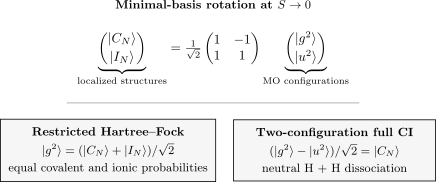
At , the molecular-orbital configurations and localized structure basis are related by a rotation. Restricted Hartree–Fock retains only and therefore contains equal covalent and ionic amplitudes. Minimal-basis full CI combines and with opposite signs to recover the neutral covalent dissociation state.
Heitler–London and MO are basis languages
Section titled “Heitler–London and MO are basis languages”The two pictures are not competing exact theories. Within a complete one-electron basis and a complete many-electron expansion, localized and delocalized orbitals are related by invertible transformations and represent the same Hilbert space. Their practical difference comes from truncation:
| Truncated description | Compact strength | Principal weakness |
|---|---|---|
| covalent Heitler–London | neutral dissociation and spin coupling | insufficient ionic, polarization, and dynamic-correlation flexibility |
| restricted determinant | equilibrium orbital picture and efficient mean field | fixed ionic contamination at dissociation |
| configuration interaction | correct static-correlation channel in the minimal space | still limited by the one-electron basis |
Exchange and Covalent Bonding
Section titled “Exchange and Covalent Bonding”H₂ binds because a symmetry-allowed correlated electronic state has a lower total energy than two separated H atoms over a range of . Several mechanisms appear when that total-energy change is analyzed:
- coherent mixing of the two electron assignments and ;
- constructive amplitude in the internuclear region;
- relaxation and contraction of one-electron functions;
- redistribution of kinetic and electron–nuclear energy;
- ionic charge fluctuations at finite separation;
- opposite-spin avoidance of short-range electron repulsion;
- balance against proton–proton repulsion.
These are not independent fundamental forces. Energy partitions depend on the chosen orbitals and decomposition scheme, although the total energy, density, pair density, and observable response do not.
Effective spin coupling
Section titled “Effective spin coupling”When one localized electron is associated with each center, the low-energy singlet and triplet pair can be represented by
For this convention,
The ordinary H₂ bond has in its bonding region, so the singlet lies lower. This effective Hamiltonian reproduces the two-state splitting but not the charge fluctuations, orbital relaxation, or excited electronic spectrum from which that splitting arises. As , and the isolated atomic spins become degenerate.
Density alone is not the whole bond
Section titled “Density alone is not the whole bond”The one-electron density is
It shows where electronic charge is distributed but integrates out the electron–electron geometry. The pair density
retains that information. Two approximations can have similar and substantially different pair densities, correlation energies, and dissociation behavior. A picture of charge accumulation between nuclei is therefore evidence to interpret, not a complete microscopic definition of a covalent bond.
The Dissociation Problem
Section titled “The Dissociation Problem”At large separation the exact ground state must produce two neutral hydrogen atoms while remaining a total-spin singlet and an inversion eigenstate. In the limit, define normalized covalent and ionic structures
The normalized MO configurations obey
Restricted Hartree–Fock retains only . It therefore assigns one-half probability to the ionic sector at strict dissociation, even though the physical ground channel is H H.
Quantitative fixed-orbital failure
Section titled “Quantitative fixed-orbital failure”For isolated hydrogenic orbitals,
In at , the probability that both electrons occupy the same center is . The electron–electron contribution is consequently
The two one-electron energies sum to , so the fixed- restricted result tends to
The error is not a small basis-set imperfection: the ansatz has the wrong charge-fluctuation structure. Orbital optimization changes the numerical plateau but cannot remove the restricted determinant’s qualitative dissociation defect.
Three repairs with different tradeoffs
Section titled “Three repairs with different tradeoffs”| Method | Large- behavior |
|---|---|
| Heitler–London or spin-projected localized pair | preserves singlet symmetry and yields neutral fragments |
| unrestricted Hartree–Fock | reaches the neutral-fragment energy by localizing opposite spins, but breaks spin symmetry |
| two-configuration CI or multiconfigurational SCF | mixes and and preserves both neutral dissociation and total spin |
In unrestricted Hartree–Fock, a determinant such as becomes energetically favorable beyond a basis-dependent Coulson–Fischer point. At infinite separation it has the correct energy and charge density, but it is not an eigenstate of :
For two electrons this corresponds to equal singlet and triplet contamination. Broken symmetry can be a useful mean-field device, but its determinant is not the exact spin state.
The exact dissociation state is entangled
Section titled “The exact dissociation state is entangled”The spin-adapted neutral limit can be written schematically as
No single spin-orbital determinant with one localized electron on each center represents this pure singlet. In the symmetry-adapted MO basis, the same fact appears through equal-magnitude and amplitudes. The spatial natural-orbital occupations approach
rather than the restricted-determinant values , . The multiconfigurational character is therefore basis-invariant at the level of the one-body density-matrix spectrum, even though particular “covalent” and “ionic” weights are not.
Correlation and Configuration Interaction
Section titled “Correlation and Configuration Interaction”At a fixed geometry, the conventional correlation energy is
where both energies use the same nonrelativistic clamped-nuclei Hamiltonian and each is converged in its respective complete one-electron basis. Because Hartree–Fock is variational,
For H₂, two regimes are especially clear.
Dynamic correlation near equilibrium
Section titled “Dynamic correlation near equilibrium”Near , the determinant is dominant, but it treats opposite-spin repulsion only through an average field. The exact wavefunction suppresses configurations in which the electrons approach one another and enhances configurations in which they avoid each other. At electron coalescence, the singlet spatial function satisfies the electron–electron cusp condition
Products of smooth one-electron orbitals do not reproduce this linear cusp efficiently. Orbital configuration interaction converges toward it through many angular momenta, while explicitly correlated , Hylleraas, James–Coolidge, or Jastrow factors include directly.
Static correlation during dissociation
Section titled “Static correlation during dissociation”As increases, the and orbital energies approach degeneracy. The and configurations must then enter with comparable amplitudes. This is static, nondynamic, or strong correlation: more than one configuration is required before short-range dynamical avoidance is considered.
The distinction is diagnostic rather than absolute. Near equilibrium, many small excitations improve the Coulomb hole; near dissociation, one particular double excitation becomes order one. A method designed only for small corrections to one determinant can therefore work near and fail catastrophically as the bond is stretched.
Minimal-basis full CI
Section titled “Minimal-basis full CI”In the gerade singlet sector of the two-orbital minimal basis, use the orthonormal configurations
The full-CI Hamiltonian in this symmetry sector is
Define the mean diagonal energy and half-difference by
The lower eigenvalue is then
The eigenvector
is exact only within the chosen two-orbital one-particle space. Near equilibrium dominates. At dissociation,
which cancels the ionic structure and leaves .
Full CI means all symmetry-allowed determinants or configuration-state functions in a specified finite orbital basis. It removes determinant truncation error in that basis but not basis-set error. For two electrons, the space is small enough to make that distinction unusually transparent.
Explicitly correlated H₂ wavefunctions
Section titled “Explicitly correlated H₂ wavefunctions”The high-accuracy route does not stop at a two-orbital CI. James–Coolidge and related bases use the two-center coordinates
and include explicitly. A schematic basis function is
followed by the required exchange and inversion symmetrization. Increasing the polynomial space gives variationally convergent Born–Oppenheimer energies. Explicit powers resolve the Coulomb cusp far more efficiently than a determinant expansion built only from smooth orbitals.
Quantitative Benchmarks
Section titled “Quantitative Benchmarks”Accurate nonrelativistic clamped-nuclei calculations give, near the minimum,
Relative to two infinite-mass hydrogen atoms,
At , representative complete-basis values are
so
This correlation energy is evaluated at one geometry. It should not be silently combined with an independently optimized Hartree–Fock minimum or a finite-mass experimental threshold.
For comparison, the dissociation energy from the level of ordinary H₂ is approximately
The difference from includes nuclear zero-point motion and finite-mass, adiabatic, nonadiabatic, relativistic, and radiative effects under the chosen convention. Ortho-H₂ begins at and therefore has a different quoted ; isotope and rotational state are part of the datum.
Common Mistakes
Section titled “Common Mistakes”- Treating the two arrows in an orbital diagram as distinguishable electrons. The physical state is antisymmetrized; labels 1 and 2 do not follow particles.
- Saying opposite spins make the Pauli principle irrelevant. The complete two-electron state must be antisymmetric in every spin sector.
- Calling the Heitler–London terms a classical mixture. and are coherent amplitudes whose cross matrix element changes the energy.
- Equating exchange with a new non-Coulomb force. Exchange energy results from symmetry restrictions on states of the Coulomb Hamiltonian.
- Reading squared VB coefficients as unique probabilities. Covalent and ionic structures are nonorthogonal at finite overlap.
- Assuming bond order one guarantees correct dissociation. Restricted has bond order one and the wrong ionic asymptote.
- Calling unrestricted Hartree–Fock exact because it reaches . Its broken-symmetry determinant is spin contaminated.
- Calling minimal-basis FCI exact H₂. It is exact only in the selected orbital basis and lacks most dynamic correlation.
- Using correlation energy without a common Hamiltonian, geometry, and basis limit. The difference is convention-sensitive unless those are fixed.
- Comparing with as though they were the same observable. Nuclear motion and precision corrections separate them.
Exercises
Section titled “Exercises”1. Antisymmetry and spin
Section titled “1. Antisymmetry and spin”Show that a symmetric spatial function multiplied by is antisymmetric under complete electron exchange. What spatial symmetry must accompany ?
Solution
Let and . Then
The product is therefore fermionically antisymmetric. Because is symmetric, it must multiply an antisymmetric spatial function .
2. Normalize the Heitler–London states
Section titled “2. Normalize the Heitler–London states”Starting from normalized orbitals with , derive the normalization factors of .
Solution
The diagonal product norms are one, while
for real orbitals. Therefore
Dividing by gives the normalized functions.
3. Derive the singlet–triplet splitting
Section titled “3. Derive the singlet–triplet splitting”Use the direct and exchange matrix elements to derive . Why does nuclear repulsion not appear in the final splitting?
Solution
Subtracting the two variational energies gives
The same scalar is added to both electronic symmetry sectors, so it cancels in their difference.
4. Expose the ionic component of restricted MO theory
Section titled “4. Expose the ionic component of restricted MO theory”At , expand in normalized covalent and ionic structures. What ionic probability follows in this orthonormal limit?
Solution
With ,
Using
and
one obtains
At these structures are orthonormal, so the ionic probability is . At finite , their nonorthogonality prevents this direct probability interpretation.
5. Restricted-Hartree–Fock dissociation limit
Section titled “5. Restricted-Hartree–Fock dissociation limit”Use to derive the fixed-hydrogenic- restricted energy at .
Solution
The two one-electron hydrogen energies contribute . In the state, both electrons occupy the same atom with total probability . Hence
The total is
It lies above the correct neutral threshold .
6. Minimal CI and neutral dissociation
Section titled “6. Minimal CI and neutral dissociation”Show that becomes the normalized covalent state as . What happens for the plus combination?
Solution
At zero overlap,
Therefore
whereas
The relative minus sign cancels ionic amplitudes; the relative plus sign cancels covalent amplitudes.
7. Natural occupations as a correlation diagnostic
Section titled “7. Natural occupations as a correlation diagnostic”Compare the limiting spatial natural-orbital occupations of restricted with those of the exact neutral singlet at dissociation. Why can no orbital rotation turn the latter into one determinant?
Solution
For a doubly occupied determinant,
For the dissociated pure singlet,
Natural occupation numbers are eigenvalues of the one-body reduced density matrix and are invariant under orbital basis rotations. A single closed-shell determinant has one occupation equal to two and all others zero. Since the dissociated singlet has two nonzero occupations, no orbital rotation can make it a single determinant.
8. Correlation and dissociation conventions
Section titled “8. Correlation and dissociation conventions”At , use the quoted Hartree–Fock and accurate Born–Oppenheimer energies to calculate . Then explain why subtracting the spectroscopic from the Born–Oppenheimer is not merely a measure of electronic correlation.
Solution
At the same geometry,
This is about . By contrast, includes nuclear zero-point energy, finite nuclear masses, nonadiabatic effects, and precision relativistic and radiative corrections. It compares different physical models and energy levels, not Hartree–Fock with an exact electronic solution at one geometry.
References
Section titled “References”- W. Heitler and F. London, “Wechselwirkung neutraler Atome und homöopolare Bindung nach der Quantenmechanik,” Zeitschrift für Physik 44, 455–472 (1927), doi:10.1007/BF01397394.
- R. S. Mulliken, “The Assignment of Quantum Numbers for Electrons in Molecules. I,” Physical Review 32, 186–222 (1928), doi:10.1103/PhysRev.32.186.
- H. M. James and A. S. Coolidge, “The Ground State of the Hydrogen Molecule,” Journal of Chemical Physics 1, 825–835 (1933), doi:10.1063/1.1749252.
- C. A. Coulson and I. Fischer, “Notes on the Molecular Orbital Treatment of the Hydrogen Molecule,” Philosophical Magazine 40, 386–393 (1949), doi:10.1080/14786444908521726.
- W. Kołos and C. C. J. Roothaan, “Accurate Electronic Wave Functions for the H₂ Molecule,” Reviews of Modern Physics 32, 219–232 (1960), doi:10.1103/RevModPhys.32.219.
- T. Kato, “On the Eigenfunctions of Many-Particle Systems in Quantum Mechanics,” Communications on Pure and Applied Mathematics 10, 151–177 (1957), doi:10.1002/cpa.3160100201.
- J. S. Sims and S. A. Hagstrom, “High Precision Variational Calculations for the Born–Oppenheimer Energies of the Ground State of the Hydrogen Molecule,” Journal of Chemical Physics 124, 094101 (2006), doi:10.1063/1.2173250.
- K. Pachucki, “Born–Oppenheimer Potential for H₂,” Physical Review A 82, 032509 (2010), doi:10.1103/PhysRevA.82.032509.
- J. Liu et al., “Determination of the Ionization and Dissociation Energies of the Hydrogen Molecule,” Journal of Chemical Physics 130, 174306 (2009), doi:10.1063/1.3120443.
- M. Puchalski, J. Komasa, and K. Pachucki, “Nonadiabatic QED Correction to the Dissociation Energy of the Hydrogen Molecule,” Physical Review Letters 122, 103003 (2019), doi:10.1103/PhysRevLett.122.103003.
- P.-O. Löwdin, “Quantum Theory of Many-Particle Systems. III. Extension of the Hartree–Fock Scheme to Include Degenerate Systems and Correlation Effects,” Physical Review 97, 1509–1520 (1955), doi:10.1103/PhysRev.97.1509.
- A. Szabo and N. S. Ostlund, Modern Quantum Chemistry: Introduction to Advanced Electronic Structure Theory (Dover, 1996), Chapters 2–4.
- P. W. Atkins and R. S. Friedman, Molecular Quantum Mechanics, 5th ed. (Oxford University Press, 2011), Chapters 8–9.
- R. McWeeny, Methods of Molecular Quantum Mechanics, 2nd ed. (Academic Press, 1992), Chapters 4–7.