Hartree Method
The Hartree method replaces the instantaneous interaction among atomic electrons by self-consistent direct Coulomb fields. Each orbital is solved in a potential generated by the densities of the other occupied orbitals; the resulting orbitals generate new densities, so the procedure must be iterated to a fixed point.
For an electron in orbital , the central idea is
with
The subscript matters: the electron must not be included in its own direct field.
Hartree’s construction introduced the self-consistent-field way of thinking that still underlies modern atomic calculations. Raw Hartree theory is not, however, a complete fermionic theory. A product of labeled electron orbitals is generally not antisymmetric, so it omits exchange and does not provide a valid variational family for identical electrons. Hartree–Fock repairs that structural defect by using a Slater determinant.
Canonical Scope
Section titled “Canonical Scope”This page is the canonical home for the atomic specialization of the Hartree method:
- the product-state approximation for atomic electrons;
- the direct Coulomb energy and self-excluded orbital potential;
- spherical configuration averages and radial Hartree equations;
- the Poisson form and asymptotic screened charge;
- the atomic self-consistent-field loop;
- total-energy versus orbital-energy bookkeeping;
- variational status, convergence diagnostics, strengths, and failures;
- the special relation between spatial Hartree and restricted Hartree–Fock for a two-electron closed shell.
Hartree Approximation owns the general product-state derivation for distinguishable particles and bosons, time-dependent Hartree theory, controlled mean-field limits, and non-atomic benchmarks. Central-Field Approximation owns the broader interpretation of screened local atomic potentials. Exchange and Correlation owns the distinction between direct, exchange, and correlation effects.
Atomic Hamiltonian
Section titled “Atomic Hamiltonian”In atomic units, for a fixed point nucleus of charge ,
The exact electronic wavefunction depends jointly on all electron coordinates. The Coulomb term prevents a separation into independent one-electron eigenproblems.
Hartree theory chooses a separable ansatz,
with
The index labels a factor in the product, not a permanently identifiable physical electron trajectory. Factorization asserts that the joint spatial probability is a product:
It therefore contains no connected position correlation.
Fermionic warning
Section titled “Fermionic warning”Under exchange of two electron coordinates,
does not generally acquire the required minus sign. Imposing orbital occupations or orthogonality by hand does not antisymmetrize the product. Consequently:
- the raw Hartree product is not an admissible many-electron wavefunction for generic electronic states;
- its optimized energy is not guaranteed to be an upper bound to the physical fermionic ground-state energy;
- Pauli exclusion and exchange splitting do not follow from the ansatz.
The direct Hartree field remains a meaningful component of Hartree–Fock and density-functional equations. The defect lies in using the direct-only product as the full electronic state.
Hartree Energy Functional
Section titled “Hartree Energy Functional”For the product ansatz, define the direct integral
The Hartree energy is
The restriction removes one-electron self-interaction. The factor then prevents double counting because .
Equivalently,
There is no crossed exchange integral in this functional.
Relationship to the Variational Principle
Section titled “Relationship to the Variational Principle”Introduce one Lagrange multiplier for each normalization condition:
Varying with respect to gives
where
Each orbital is therefore an eigenfunction of an operator built from all the other orbitals. The equations are nonlinear as a coupled system.
What the multipliers mean
Section titled “What the multipliers mean”The enforce normalization and become one-electron eigenvalues of the converged Hartree operators. They are not separately protected by the many-body variational theorem and are not exact ionization energies.
No automatic orthogonality
Section titled “No automatic orthogonality”The raw product variation imposes normalization but not
Practical atomic constructions may impose orthogonality to maintain a shell basis, or obtain it when several orbitals solve the same Hermitian central operator. In self-excluded Hartree theory, different orbitals generally see different operators, so orthogonality is not automatic. Adding it is an extra modeling constraint and still does not replace antisymmetry.
Variational status
Section titled “Variational status”For distinguishable particles, or for a bosonic problem where the product has the correct symmetry, minimizing this functional gives an upper bound within an admissible trial family. For generic electrons, the labeled product lies outside the antisymmetric Hilbert space. Its stationary energy must not be advertised as a fermionic variational upper bound.
A converged self-consistent solution is only a stationary point of the chosen constrained functional. It can be a local minimum, an excited fixed point, or a saddle.
Spherical Atomic Form
Section titled “Spherical Atomic Form”For a central-field description, write a normalized spatial orbital as
with
For a spherically averaged configuration with electrons in subshell ,
The normalization is
For a specific electron in subshell , the configuration-average density of the other electrons is
If electrons occupy that subshell, this subtraction changes its contribution from to .
Configuration average
Section titled “Configuration average”A partially filled open shell need not have a spherical density in a state with specified magnetic quantum numbers. The formula above averages occupations over magnetic substates. It gives a central potential and preserves radial shell language, but it erases term-dependent angular structure.
This is a model choice, not a theorem that every oriented atomic state has a spherical instantaneous density. Averaging over a complete degenerate magnetic multiplet does produce a spherical density.
Effective Hartree Potential
Section titled “Effective Hartree Potential”For a spherical density, the angular integral can be performed exactly. The self-excluded Hartree potential is
The first term is the contribution from charge inside radius ; the second is the constant potential inside the outer spherical shells.
With
and define the radial kinetic operator
The radial Hartree equation is
Regular bound solutions obey
and decay at large radius when .
Poisson equation
Section titled “Poisson equation”The direct potential satisfies
For a spherical field,
Either the integral formula or this boundary-value problem can be used numerically. Their agreement is a useful implementation check.
Screening and the Asymptotic Tail
Section titled “Screening and the Asymptotic Tail”The self-excluded density contains electrons, so
The combined effective potential behaves as
For a neutral atom, , and therefore
This is the residual attraction of a singly charged ionic core seen by a distant electron.
If one instead builds the direct field from the full -electron density without subtracting orbital , the neutral-atom tail approaches zero:
That is a clear self-interaction failure. It distorts weakly bound and Rydberg orbitals especially strongly.
Near the nucleus, the Hartree potential remains finite for a regular density, while the nuclear term retains the singular behavior . Core penetration and nodal structure therefore remain controlled by both the nuclear cusp region and the self-consistent screening profile.
Self-Consistency
Section titled “Self-Consistency”The orbitals determine the fields that determine the orbitals. A practical atomic iteration is:
- choose a configuration and trial radial orbitals;
- normalize them and form the spherical occupation density;
- subtract the appropriate self-density for each orbital;
- build each direct potential;
- solve the radial eigenvalue equations with the required node counts and boundary conditions;
- mix new and old orbitals, densities, or potentials;
- repeat until energy, density, orbital residuals, and boundary behavior have converged.
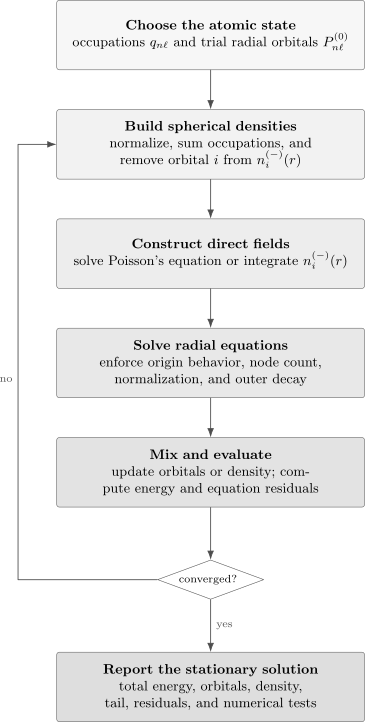
An atomic Hartree iteration alternates between occupied radial orbitals and their self-excluded direct fields. Convergence requires more than a small energy change: the radial residuals, density, normalization, node counts, and asymptotic tail must also stabilize.
Mixing is numerical, not physical
Section titled “Mixing is numerical, not physical”A simple linear density update is
Small can damp oscillations, but it does not change the target stationary equations. More elaborate acceleration methods likewise alter the route to a fixed point rather than the defining Hartree functional.
Multiple fixed points
Section titled “Multiple fixed points”Different initial orbitals can converge to different stationary configurations. An iterative solver can also cycle or diverge. A small change between two successive iterates is not enough if:
- the residual of the radial equation remains large;
- the density is drifting slowly;
- a symmetry or occupation changed unintentionally;
- a lower stationary solution exists;
- the grid or radial box is not converged.
Total Energy and Orbital Energies
Section titled “Total Energy and Orbital Energies”Multiply each Hartree equation by and integrate:
Summing over occupied orbitals gives
The interaction appears twice because each pair contributes to both orbital equations. The total energy is
Adding occupied orbital eigenvalues without the subtraction double counts the direct interaction.
Energy is not enough
Section titled “Energy is not enough”At a well-resolved stationary solution of a purely Coulombic problem, uniform coordinate scaling gives the virial relation
where includes nuclear attraction and electron–electron repulsion. A poor virial ratio can expose basis, grid, boundary, or self-consistency errors.
The converse is not guaranteed: a plausible total energy and virial ratio do not prove that exchange, correlation, or term-dependent angular structure has been captured.
Two-Electron Closed-Shell Exception
Section titled “Two-Electron Closed-Shell Exception”The helium ground-state symmetry exposes an important nuance. Let two electrons occupy the same spatial orbital and combine into the antisymmetric spin singlet . The total state is
Although its spatial factor is a product, the full spin-space state is antisymmetric and is exactly one Slater determinant built from and .
Its energy functional is
where
Variation gives
Each electron sees the density of the one other electron. In this special two-electron closed-shell case, the spatial Hartree equation coincides with restricted Hartree–Fock: opposite orthogonal spins have no mutual Fock exchange integral, while each orbital’s self-interaction is canceled.
The approximation still misses electron correlation. The product spatial factor cannot respond explicitly to and does not satisfy the exact opposite-spin Coulomb cusp. Helium Atom develops the resulting energy and spectroscopy benchmark.
What the Method Captures
Section titled “What the Method Captures”Atomic Hartree theory can capture:
- self-consistent direct screening rather than a fixed empirical charge;
- radial orbital relaxation when occupations change;
- qualitative shell and subshell structure in a central field;
- the correct self-excluded ionic tail;
- a transparent decomposition into one-electron and direct Coulomb energies;
- a useful initial orbital set for Hartree–Fock or configuration-based methods;
- a controlled direct-field baseline against which exchange and correlation can be identified.
Its historical importance is larger than its modern role as a final quantitative electron theory. The language of density, effective potential, radial eigenproblem, and iteration survives in more complete methods.
What It Misses
Section titled “What It Misses”Fermionic antisymmetry
Section titled “Fermionic antisymmetry”A generic Hartree product is not antisymmetric. Exclusion must be imposed externally and exchange matrix elements are absent.
Exchange splitting
Section titled “Exchange splitting”Two states built from the same orbital densities but different spin-adapted exchange symmetry have the same Hartree direct energy. Raw Hartree theory therefore cannot produce the singlet–triplet splitting.
Correlation
Section titled “Correlation”The product fixes the pair density as a product of one-electron densities. It cannot represent conditional radial or angular motion, Coulomb cusps, dispersion, or multireference mixing.
Open-shell angular structure
Section titled “Open-shell angular structure”Spherical configuration averaging suppresses anisotropic multipoles and term dependence. Different terms of one configuration need treatment beyond one averaged direct field.
Automatic orthogonality and shell identity
Section titled “Automatic orthogonality and shell identity”Orbital-specific self-excluded operators need not share orthogonal eigenfunctions. Orthogonality and occupation labels added for practical atomic organization are extra constraints, not consequences of the raw product ansatz.
Exact spectra
Section titled “Exact spectra”Hartree orbital multipliers are not exact addition, removal, or excitation energies. Transition energies require total-state comparisons and may be sensitive to relaxation, exchange, correlation, relativity, recoil, QED, and nuclear structure.
Hartree, Central Field, and Hartree–Fock
Section titled “Hartree, Central Field, and Hartree–Fock”| Construction | Effective operator | State interpretation | Main omission |
|---|---|---|---|
| fitted central field | chosen local | model orbitals | transferability and no unique many-body state |
| Hartree | self-consistent local direct field | labeled product, except special admissible cases | antisymmetry, exchange, and correlation |
| Hartree–Fock | direct plus nonlocal exchange | optimized Slater determinant | correlation beyond one determinant |
Every Hartree field is an effective central field after spherical averaging, but not every central field is Hartree: a model or fitted potential need not be generated by its own orbitals.
Hartree–Fock is also not “Hartree plus an empirical exchange force.” Replacing the product trial family by determinants changes the variational manifold, and the exchange operator follows from evaluating the same Coulomb Hamiltonian in that antisymmetric state.
Reliability Checklist
Section titled “Reliability Checklist”Before accepting an atomic Hartree result, verify:
- State scope: Is the product admissible for the stated particle symmetry, or is the calculation only a direct-field baseline?
- Self-exclusion: Does orbital see electrons rather than the full density?
- Normalization: Do all radial orbitals and the total density have the intended norms?
- Boundary conditions: Are origin behavior, node counts, radial box, and large- decay correct?
- Residuals: Does each output orbital satisfy its own final Hartree equation?
- Self-consistency: Are energy, density, and potential converged under tighter thresholds and different mixing?
- Stationarity: Were alternative initial guesses and occupation patterns tested?
- Energy accounting: Was direct-interaction double counting removed?
- Resolution: Are grid spacing, box size, and interpolation errors controlled?
- Physics omitted: Are exchange, correlation, open-shell anisotropy, relativity, and nuclear effects stated separately?
Common Mistakes
Section titled “Common Mistakes”Including the electron in its own field
Section titled “Including the electron in its own field”The orbital equation contains , not an uncorrected total-density potential. The one-electron limit must have zero electron–electron field.
Calling any screened potential Hartree
Section titled “Calling any screened potential Hartree”A fitted or model core potential can be useful without being self-consistent. Hartree means that the occupied orbitals generate the direct field in which they are stationary.
Treating convergence as exactness
Section titled “Treating convergence as exactness”SCF convergence solves the approximate nonlinear equations. It does not restore exchange or correlation.
Summing orbital energies
Section titled “Summing orbital energies”The sum double counts every direct pair. The Hartree total energy requires the explicit subtraction.
Assuming orthogonality restores Pauli exclusion
Section titled “Assuming orthogonality restores Pauli exclusion”Orthogonal product factors remain a product. Fermionic antisymmetry requires a determinant or an equivalent antisymmetric construction.
Reading orbital energies as the spectrum
Section titled “Reading orbital energies as the spectrum”The multipliers organize the one-electron equations. Atomic levels and transition frequencies are differences between many-electron state energies.
Assuming spherical averaging is harmless
Section titled “Assuming spherical averaging is harmless”It is appropriate for a configuration average or a closed shell, but it removes term-dependent angular information in open shells.
Exercises
Section titled “Exercises”Exercise 1: Derive the orbital equation
Section titled “Exercise 1: Derive the orbital equation”Vary the Hartree energy with respect to while preserving the normalization of every orbital. Explain why no factor of remains in the field.
Solution
The terms containing are and the pair contributions with either index equal to . Since , differentiating
produces two equal halves. The result is
Including the normalization multiplier gives
The pair factor prevents double counting in the energy; the orbital feels the full field of every other density.
Exercise 2: Derive the spherical potential
Section titled “Exercise 2: Derive the spherical potential”Starting from a spherical density , show that
has the inside-plus-outside form used above.
Solution
The angular average of the Coulomb kernel is
Splitting the radial integral at gives
The interior charge acts as if concentrated at the origin; every exterior spherical shell contributes a spatially constant potential inside that shell.
Exercise 3: Check the neutral-atom tail
Section titled “Exercise 3: Check the neutral-atom tail”An orbital in an -electron atom sees the self-excluded density. Derive the asymptotic effective charge and compare with an uncorrected total-density Hartree field.
Solution
The other-electron density integrates to , so
Combining it with nuclear attraction gives
For , this is . An uncorrected total density instead contributes and cancels the nuclear tail of a neutral atom. That spurious cancellation is a one-electron self-interaction error.
Exercise 4: Recover the total energy
Section titled “Exercise 4: Recover the total energy”Given
express in terms of occupied orbital multipliers.
Solution
Summing gives
The Hartree functional contains only half of the ordered pair sum. Therefore
Equivalently, subtract one for every unordered pair.
Exercise 5: One-electron limit
Section titled “Exercise 5: One-electron limit”Apply the Hartree equations to a hydrogenic ion with . What direct potential and total energy must result?
Solution
The sum over is empty:
The orbital equation is exactly the one-electron Coulomb equation,
There is no pair energy, so for the occupied state. Any nonzero electron–electron contribution signals that the electron has been included in its own field.
Exercise 6: Why helium is special
Section titled “Exercise 6: Why helium is special”Explain why the spatial product can be part of an admissible fermionic state for the helium ground configuration, yet the corresponding approximation still lacks correlation.
Solution
The spatial product is symmetric. Multiplying it by the antisymmetric spin singlet makes the full spin-space wavefunction antisymmetric:
This is the determinant of and . Its optimized equation contains the direct density of the one opposite-spin electron and coincides with restricted Hartree–Fock for a two-electron closed shell.
The spatial factor still separates into one-electron functions and has no explicit response. It cannot reproduce the exact Coulomb cusp or conditional radial and angular motion, so correlation remains missing.
Exercise 7: Diagnose false convergence
Section titled “Exercise 7: Diagnose false convergence”An SCF run changes its total energy by less than hartree, but the largest radial-equation residual is hartree and doubling the radial box changes the outer orbital substantially. Is the calculation converged?
Solution
No. A small change between successive energies can result from heavy mixing, stagnation, or cancellation. The large orbital residual shows that the reported orbitals do not solve their final equations, and sensitivity to the radial box shows that the boundary representation is unresolved.
The calculation should tighten the radial solve, enlarge the box, check the asymptotic tail, and repeat the SCF cycle. Energy, density, potential, and residual criteria must be satisfied together.
Key Takeaways
Section titled “Key Takeaways”- Hartree theory replaces pair interaction by self-consistent direct fields generated by other occupied densities.
- The self-exclusion is essential; for a neutral atom it produces the correct outer tail.
- Spherical configuration averaging converts the method into coupled radial Schrödinger–Poisson equations but suppresses open-shell angular structure.
- The Hartree energy is stationary under product-state variations, but a generic product is not an admissible fermionic trial state.
- Occupied orbital energies double count direct interactions when summed.
- SCF convergence requires equation residuals, density, boundaries, and alternative stationary points to be checked.
- A two-electron closed-shell singlet is a special case in which the spatial Hartree equation coincides with restricted Hartree–Fock, while correlation remains absent.
Cross-Links
Section titled “Cross-Links”- Multi-Electron Atoms
- Helium Atom
- Electron Configurations
- Pauli Principle in Atoms
- Exchange and Correlation
- Hartree–Fock for Atoms
- Central-Field Approximation
- Atomic Orbitals Revisited
- Atomic Units and Scales
- Hartree Approximation
- Hartree–Fock Approximation
- Mean-Field Theory
- Variational Principle
- Variational Estimate for the Helium Atom
- Radial Schrödinger Equation
References
Section titled “References”- D. R. Hartree, “The Wave Mechanics of an Atom with a Non-Coulomb Central Field. Part I. Theory and Methods,” Proceedings of the Cambridge Philosophical Society 24, 89–110 (1928), doi:10.1017/S0305004100011919.
- D. R. Hartree, “The Wave Mechanics of an Atom with a Non-Coulomb Central Field. Part II. Some Results and Discussion,” Proceedings of the Cambridge Philosophical Society 24, 111–132 (1928), doi:10.1017/S0305004100011920.
- J. C. Slater, “Note on Hartree’s Method,” Physical Review 35, 210–211 (1930), doi:10.1103/PhysRev.35.210.2.
- V. Fock, “Näherungsmethode zur Lösung des quantenmechanischen Mehrkörperproblems,” Zeitschrift für Physik 61, 126–148 (1930), doi:10.1007/BF01340294.
- C. Froese Fischer, The Hartree–Fock Method for Atoms: A Numerical Approach, Wiley (1977).
- R. D. Cowan, The Theory of Atomic Structure and Spectra, University of California Press (1981).
- W. R. Johnson, Atomic Structure Theory: Lectures on Atomic Physics, Springer (2007).
- B. H. Bransden and C. J. Joachain, Physics of Atoms and Molecules, 2nd ed., Pearson (2003).
- A. Szabo and N. S. Ostlund, Modern Quantum Chemistry: Introduction to Advanced Electronic Structure Theory, Dover (1996).
- NIST, Atomic Spectroscopy: Atomic States, Shells, and Configurations.