Population Inversion
A population inversion exists on a laser transition when the upper and lower populations are arranged so that stimulated emission exceeds absorption for the selected optical mode.
For upper level and lower level , the operational condition is
Here and are effective emission and absorption cross sections for a declared frequency, polarization, propagation mode, and sublevel distribution. This gain condition is more general than the slogan “more particles upstairs than downstairs.”
When the levels have degeneracies and , equal normalized lineshapes give the reduced-population criterion
The comparison is population per coupled sublevel, not necessarily total population. A laser calculation that ignores degeneracy, reabsorption, or polarization can claim inversion while the actual mode still sees loss.
Population inversion is not an energy source by itself. A pump and relaxation network must create and maintain it against spontaneous decay, nonradiative loss, stimulated extraction, collisions, and transport. The useful question is therefore:
What nonequilibrium population flow makes the upper-to-lower laser transition amplifying under the conditions of the experiment?
Canonical Scope
Section titled “Canonical Scope”This page owns:
- the gain-based and degeneracy-aware definitions of inversion;
- the thermal detailed-balance obstruction at positive temperature;
- the steady two-level rate and optical-Bloch ceilings;
- the precise sense in which a “two-level laser is impossible” in the simplest model;
- three-level, four-level, and quasi-three-level pumping cycles;
- optical, electrical, collisional, transfer, chemical, and semiconductor pumping mechanisms;
- pump-efficiency, branching, reabsorption, and spatial-overlap checks;
- the distinction among inversion, gain, amplified emission, and laser oscillation.
Stimulated Emission owns the microscopic factor, gain cross sections, and saturation derivation. Einstein Coefficients owns the full detailed-balance and spectral-density convention ledger. Laser Principles owns the round-trip threshold and saturated operating-point construction.
The present page supplies the material population needed by those laser equations. It does not duplicate cavity threshold, resonator modes, or multimode rate-equation dynamics.
Convention Ledger
Section titled “Convention Ledger”Use:
- for number density in level or manifold ;
- for its degeneracy;
- for conserved active-particle density when the model has no loss from the active manifold;
- and for upper and lower laser levels;
- for a pump level;
- for an effective pump rate per available lower-state particle;
- for a population lifetime;
- and for mode-specific stimulated-emission and absorption cross sections;
- for small-signal material power gain;
- only when equal degeneracies and equal cross sections make this simple difference meaningful.
“Level” can denote one eigenstate, a degenerate manifold, or an effective collection of rapidly thermalized sublevels. A mature model states which. Fast relaxation within a manifold may impose a Boltzmann distribution even while populations of different manifolds remain far from equilibrium.
Gain, Inversion, and Transparency
Section titled “Gain, Inversion, and Transparency”The small-signal material gain is
This separates three regimes:
Transparency is not laser threshold. At transparency, material absorption and stimulated emission cancel, but cavity output coupling and parasitic losses remain. Laser threshold requires
for the relevant mode in an ordinary lossy cavity.
Degeneracy-aware transparency
Section titled “Degeneracy-aware transparency”Einstein detailed balance gives
Under matching lineshape and polarization conventions, transparency occurs when
or
Positive gain requires the upper reduced population to exceed the lower reduced population. If selection rules couple only some magnetic sublevels, the relevant populations and degeneracy factors belong to those coupled subspaces, not automatically to the full term.
Reabsorption changes the practical criterion
Section titled “Reabsorption changes the practical criterion”In many solid-state and molecular media, lower laser sublevels are thermally occupied and remains substantial at the laser wavelength. The mode sees net gain only after stimulated emission exceeds that reabsorption.
A quoted upper-state population alone is therefore insufficient. One needs:
- upper and lower manifold populations;
- their internal thermal distributions;
- absorption and emission spectra at operating temperature;
- field polarization;
- mode overlap with the pumped region.
Thermal Equilibrium Does Not Invert an Optical Transition
Section titled “Thermal Equilibrium Does Not Invert an Optical Transition”At positive temperature , thermal populations obey
Because ,
The medium absorbs rather than amplifies under the corresponding detailed-balance assumptions. Raising a positive temperature moves the reduced populations toward equality but never reverses them.
At optical frequencies and ordinary temperatures,
so the thermal upper-state fraction is often very small. A laser pump does not merely “heat the medium enough.” It creates a selective nonequilibrium population flow.
What negative temperature means
Section titled “What negative temperature means”For a bounded energy spectrum that has internally equilibrated under suitable constraints, an inverted Boltzmann form can be described by
Then higher-energy states carry larger reduced population. Such a negative temperature is hotter than every positive temperature in the thermodynamic ordering; it is not colder than zero kelvin.
The phrase requires care:
- the relevant subsystem must have an upper energy bound;
- internal equilibration must be meaningful;
- the inversion must be representable by one thermodynamic parameter;
- coupling to the external environment must be treated explicitly.
Many laser media are pumped open systems with level-specific flows and do not possess one well-defined negative temperature. “Population inverted” is the safer and more general statement.
The Steady Two-Level Obstruction
Section titled “The Steady Two-Level Obstruction”The standard impossibility statement concerns a closed two-level transition driven continuously and resonantly by the same ordinary radiation that causes both absorption and stimulated emission.
Incoherent rate model
Section titled “Incoherent rate model”Let be the stimulated transition rate per particle in either direction, and let the upper level decay irreversibly at rate . With
the upper population obeys
At steady state,
Therefore
and
As , the populations approach equality. The same field that pumps upward also stimulates downward transitions. Spontaneous decay makes the upper population smaller still.
Coherent steady drive
Section titled “Coherent steady drive”The optical Bloch equations reach the same conclusion while retaining coherence. With population-relaxation time , coherence time , detuning , and Rabi frequency , define one common saturation parameter
Under the corresponding convention, the steady excited-state population is
The exact appearance of varies with Rabi-frequency and decay conventions, but the steady-state ceiling does not. Optical Bloch Equations owns the derivation.
Why this is not a universal no-go theorem
Section titled “Why this is not a universal no-go theorem”A coherent resonant pulse can transfer an initially lower-state two-level system to the upper state:
That is transient coherent inversion, not a continuously pumped steady-state laser cycle. After the preparation pulse ends, decay and any growing laser field deplete the inversion.
Likewise, a hypothetical irreversible pump that transfers particles only from to can invert a two-state rate model. But the irreversibility comes from additional reservoir degrees of freedom, so the complete physical system is no longer “only one closed transition driven by one reciprocal field.”
The accurate statement is:
A closed two-level system cannot maintain steady inversion when one ordinary resonant field drives both directions and decay favors the lower level.
Three- and Four-Level Cycles
Section titled “Three- and Four-Level Cycles”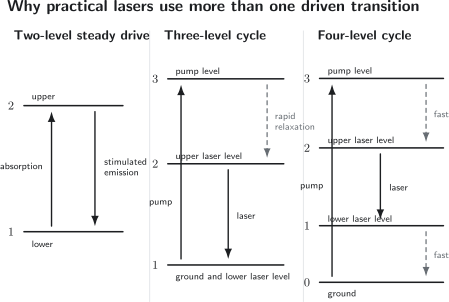
A steady resonant field on a closed two-level transition drives absorption and stimulated emission toward equal populations. A three-level cycle pumps out of the lower laser level itself, so substantial depletion is needed. A four-level cycle terminates the laser transition on a rapidly emptied level, making the gain condition much easier to reach.
The diagrams are kinetic templates, not literal universal spectra. Real media can have broad pump bands, many Stark or rotational sublevels, collisional transfer, nonradiative decay, and several competing laser lines.
Three-Level Lasers
Section titled “Three-Level Lasers”Use:
- level as ground state and lower laser level;
- level as the pump level or band;
- level as a relatively long-lived upper laser level.
The intended cycle is
Fast relaxation keeps the pump level weakly populated, while a long level-2 lifetime stores excitation. The laser transition returns particles to the ground state.
Why the threshold is demanding
Section titled “Why the threshold is demanding”For equal laser-level degeneracies and equal cross sections,
If pump-level population is negligible,
Transparency requires
Laser threshold requires still more upper population because finite cavity loss demands . A three-level laser may therefore need to pump more than half of the active population out of its ground state.
Effective below-threshold pump model
Section titled “Effective below-threshold pump model”After eliminating a rapidly emptied pump level, use
with
The steady upper fraction is
For equal laser-level degeneracies, requires
This effective pump is treated as one-way only because rapid relaxation and spectral separation suppress return through the pump channel. A model of the actual pump transition must include pump stimulated emission, depletion, and branching where relevant.
Ruby as the historical example
Section titled “Ruby as the historical example”The first laser used chromium ions in ruby. A flashlamp excited broad absorption bands; rapid relaxation populated a metastable upper manifold; the 694.3 nm transition returned population to the ground manifold. Because the lower laser level was the ground state, substantial pump energy was required, and the original device operated in pulses.
Calling every solid-state laser “three level” is incorrect. The classification refers to the active cycle at the operating wavelength, temperature, and pump scheme.
Four-Level Lasers
Section titled “Four-Level Lasers”Use:
- level as the ground or terminal reservoir;
- level as the pump level;
- level as the upper laser level;
- level as the lower laser level.
The intended cycle is
The decisive feature is rapid emptying of level . If
then
Only enough upper population to overcome cavity and internal losses is needed. The ground reservoir can remain highly occupied without absorbing on the laser transition because it is not the lower laser level.
A minimal lifetime comparison
Section titled “A minimal lifetime comparison”Suppose an effective pump injects population into level at volumetric rate , upper population flows through the laser manifold with lifetime , and lower population empties with lifetime . Below threshold and in the weak-depletion limit,
At steady state,
Thus
A rapidly emptied lower level,
supports inversion efficiently. This model ignores stimulated extraction, finite ground depletion, branching, and pump saturation; it is a lifetime design rule, not a complete laser rate equation. Rate-Equation Lasers adds the selected-mode photon reservoir, gain clamping, and transient dynamics.
Examples and complications
Section titled “Examples and complications”The 1064 nm transition of neodymium-doped YAG is commonly treated as a four-level laser because the lower laser manifold relaxes rapidly toward the ground manifold. Helium–neon operation uses collisional energy transfer from metastable helium to neon and rapid depopulation of the lower neon laser states; its real level network is richer than a four-line sketch.
Four-level operation does not mean zero threshold. Finite gain is still required to overcome output coupling, absorption, scattering, diffraction, and mode mismatch.
Quasi-Three-Level Media
Section titled “Quasi-Three-Level Media”The three-versus-four classification can depend on temperature and wavelength. If the lower laser sublevel lies close enough to the ground manifold to be thermally occupied, it reabsorbs laser light. The system behaves as a quasi-three-level laser even if its diagram has four named manifolds.
The lower population may follow
within a thermalized ground manifold. Cooling can reduce reabsorption, whereas heating can raise transparency and laser thresholds.
Ytterbium-doped lasers are a standard setting in which pump and laser spectra, Stark-sublevel populations, temperature, and reabsorption must be treated together. “Four levels are easier” remains useful intuition, but the actual gain equation decides.
Pumping Mechanisms
Section titled “Pumping Mechanisms”Pumping means transferring free energy into the active subsystem in a way that favors the upper laser level.
| Pump mechanism | How excitation enters | Representative media | Important checks |
|---|---|---|---|
| optical absorption | pump photons excite a band or pump transition | ruby, Nd:YAG, ytterbium fiber, dye | absorption overlap, quantum defect, pump brightness |
| gas discharge | electron collisions excite atoms or molecules | He–Ne, argon-ion, CO | electron-energy distribution, collisions, gas flow |
| resonant energy transfer | one species is excited and transfers energy to another | He–Ne and sensitized solids | transfer rate, back transfer, quenching |
| current injection | electron and hole quasi-Fermi populations are driven apart | diode and quantum-well lasers | carrier confinement, nonradiative recombination, heating |
| electron-beam excitation | energetic electrons deposit excitation | excimer and high-power gas systems | deposition profile, charging, efficiency |
| chemical pumping | exothermic reactions populate emitting species | chemical lasers | reaction kinetics, flow, safety, byproducts |
| gas-dynamic pumping | rapid expansion produces nonequilibrium vibrational populations | molecular gas lasers | flow time, vibrational relaxation, temperature |
The pump frequency need not equal the laser frequency. Indeed, separating pump and laser transitions is what makes multilevel inversion practical.
Optical pumping
Section titled “Optical pumping”Optical pumping is effective when:
- the pump overlaps a strong absorption band;
- relaxation feeds the upper laser level with high branching efficiency;
- the upper level stores excitation long enough;
- the lower laser level empties rapidly or is weakly occupied;
- pump light overlaps the laser mode volume.
The absorbed pump power, not merely incident pump power, enters the population budget.
Electrical discharge and collisional transfer
Section titled “Electrical discharge and collisional transfer”In a gas discharge, electrons acquire energy from an electric field and transfer it through collisions. The electron-energy distribution can favor particular excited states. In He–Ne lasers, helium metastables are excited by the discharge and transfer energy resonantly to neon upper laser states.
The phrase “electrically pumped” hides a kinetic network involving electron temperature, pressure, collision cross sections, diffusion, wall loss, and gas composition.
Semiconductor injection
Section titled “Semiconductor injection”In semiconductors, inversion is described by nonequilibrium electron and hole distributions. Optical gain appears when quasi-Fermi-level separation is sufficient for stimulated recombination to exceed absorption at a photon energy.
This is not well represented by a few isolated atomic levels. Band structure, density of states, carrier statistics, confinement, and recombination enter. Semiconductor Lasers Overview develops the quasi-Fermi-level gain condition, heterostructure confinement, and injection-diode threshold.
Pump-Efficiency Ledger
Section titled “Pump-Efficiency Ledger”Creating upper-state population is a chain of conditional efficiencies.
Pump absorption
Section titled “Pump absorption”For unsaturated uniform absorption,
so
The absorbed fraction is
only under that simple geometry. Double-pass pumping, transverse pumping, bleaching, and spatially varying dopant density change it.
Branching and storage
Section titled “Branching and storage”Not every absorbed pump excitation reaches the upper laser level. Define a branching or transfer efficiency . Population can instead leave through:
- fluorescence on other transitions;
- multiphonon relaxation;
- concentration quenching;
- energy-transfer upconversion;
- excited-state absorption;
- ionization or dissociation;
- migration to defects or surfaces.
The upper-state lifetime must be long compared with the pump time needed to accumulate threshold inversion, but not every long lifetime is beneficial: slow unwanted decay can trap population in dark bottleneck states.
Quantum defect
Section titled “Quantum defect”If one absorbed pump photon at frequency produces at most one laser photon at , the energy-conversion ceiling from photon energies is
The missing energy becomes heat or other excitations. This quantum-defect factor is only one part of total efficiency and does not apply unchanged to multi-photon, transfer, chemical, or quantum-cascade cycles.
Spatial overlap
Section titled “Spatial overlap”Let be the local pump deposition rate and the laser-mode intensity profile. A useful pump creates inversion where the laser mode samples it. Pump power deposited outside that volume can produce heat and amplified spontaneous emission without helping the desired mode reach threshold.
A local inversion calculation is therefore more informative than one total excited-particle number.
Worked Three-Level Versus Four-Level Comparison
Section titled “Worked Three-Level Versus Four-Level Comparison”Consider active-particle density
equal laser-level degeneracies, cross section
and required threshold gain
The threshold inversion density is
This is only
of the active-particle density.
Three-level fraction
Section titled “Three-level fraction”For
and
the required upper fraction is
Almost half the entire active population must first be moved merely to reach transparency; the extra gain above transparency is small in this numerical example.
Four-level fraction
Section titled “Four-level fraction”If the lower laser level is empty,
then
The cavity requires the same inversion density, but the population rearrangement needed to create it is radically different. This comparison explains the low-threshold advantage of a true four-level cycle.
How Inversion Is Measured
Section titled “How Inversion Is Measured”Fluorescence is evidence of upper-state population, not by itself proof of inversion or gain.
Weak-probe transmission
Section titled “Weak-probe transmission”A calibrated weak probe at the laser frequency measures
Pump-on transmission exceeding the passive transmission indicates reduced absorption; net probe amplification is stronger evidence of gain. The probe must remain weak enough not to saturate the transition.
Absorption and emission spectroscopy
Section titled “Absorption and emission spectroscopy”With calibrated cross sections and sublevel distributions, absorption and fluorescence spectra can constrain and . Absolute inference requires path length, collection efficiency, branching, lineshape, and radiation-trapping corrections.
Time-resolved pump–probe measurements
Section titled “Time-resolved pump–probe measurements”After a pump pulse, a delayed probe can follow the creation and decay of gain. This separates pump absorption, transfer time, upper-state lifetime, lower-state emptying, and stimulated depletion.
Laser threshold as indirect evidence
Section titled “Laser threshold as indirect evidence”Sustained ordinary laser oscillation implies that the selected mode achieved enough net gain to balance loss. It does not uniquely reveal the underlying population distribution unless the cross sections, cavity loss, mode overlap, and possible coherence effects are known.
Beyond Ordinary Population Inversion
Section titled “Beyond Ordinary Population Inversion”Population inversion is sufficient for ordinary reciprocal population-based gain, but it is not logically necessary for every optical amplifier.
Gain without inversion
Section titled “Gain without inversion”In coherently driven multilevel systems, quantum interference can suppress absorption pathways more strongly than emission pathways. The medium can then show gain even though the relevant bare-state upper population does not exceed the lower population.
This is lasing without inversion, not a failure of the two-level rate argument. The model has additional states, coherences, drive phases, and interfering pathways that the two-population description discarded.
Raman and parametric gain
Section titled “Raman and parametric gain”Raman lasers and optical parametric oscillators transfer energy from a pump through coherent nonlinear interactions. Their output gain need not be described as population inversion on the output optical frequency. The energy source and phase-matching or Raman-coherence conditions replace the simple upper-minus-lower population picture.
Free-electron and collective sources
Section titled “Free-electron and collective sources”Free-electron lasers extract kinetic energy from electron bunches through collective interaction with a radiation field and periodic magnetic structure. No pair of bound material levels needs to be inverted.
The general laser principles remain energy supply, gain, feedback or cooperative field growth, mode selection, loss, and nonlinear saturation. Population inversion is the standard material implementation, not the definition of all coherent radiation sources.
A Reliable Inversion Workflow
Section titled “A Reliable Inversion Workflow”- Name the laser transition. Specify upper and lower manifolds, degeneracies, frequency, polarization, and participating sublevels.
- Write the operational gain. Use before applying a simpler inversion slogan.
- Draw every pump and decay path. Include return paths, branching, bottlenecks, and losses from the active manifold.
- Identify fast and slow variables. Justify any adiabatic elimination of pump or lower levels.
- Separate transparency from threshold. Add cavity, propagation, and output-coupling losses after finding net material gain.
- Resolve space and spectrum when needed. Pump depletion, inhomogeneous broadening, and reabsorption make inversion local.
- Add stimulated depletion above threshold. Below-threshold populations cannot be extrapolated unchanged into lasing operation.
- Validate with a weak probe or calibrated spectroscopy. Fluorescence brightness alone does not establish gain.
Common Mistakes
Section titled “Common Mistakes”Defining inversion only as more total particles upstairs
Section titled “Defining inversion only as more total particles upstairs”Degeneracy and unequal cross sections matter. Use the mode-specific gain criterion.
Saying a strong two-level drive eventually inverts
Section titled “Saying a strong two-level drive eventually inverts”A reciprocal steady drive equalizes populations. It does not push the upper fraction above one half.
Turning the two-level result into a universal theorem
Section titled “Turning the two-level result into a universal theorem”A coherent pulse can create transient inversion, and extra reservoirs can create effective one-way pumping. State the steady-state and closure assumptions.
Equating inversion with negative thermodynamic temperature
Section titled “Equating inversion with negative thermodynamic temperature”Negative temperature requires a bounded, internally equilibrated subsystem. Many pumped laser media are not described by one temperature.
Calling fluorescence proof of gain
Section titled “Calling fluorescence proof of gain”An upper population can fluoresce while lower-state absorption remains larger. Probe the net stimulated response.
Ignoring lower-level emptying
Section titled “Ignoring lower-level emptying”The lifetime and thermal repopulation of the lower laser level often decide whether a nominal four-level medium acts as a true four-level or quasi-three-level system.
Using incident rather than absorbed pump power
Section titled “Using incident rather than absorbed pump power”Unabsorbed or poorly overlapped pump light does not create useful inversion.
Assuming inversion guarantees lasing
Section titled “Assuming inversion guarantees lasing”The net modal gain must still exceed output coupling and every parasitic loss, and a resonator mode must satisfy its phase condition.
Forgetting amplified spontaneous emission
Section titled “Forgetting amplified spontaneous emission”ASE can deplete inversion before the intended cavity mode reaches threshold, especially in large or high-gain media. Parasitic optical paths can lase too.
Cross-Links
Section titled “Cross-Links”- Lasers gives the chapter-level map.
- Laser Principles converts gain into round-trip threshold, saturation, and useful output.
- Absorption and Emission develops source, attenuation, and detector forward models.
- Line Shapes and Broadening explains which subensembles a pump and laser field address.
- Spontaneous Emission develops radiative lifetime and branching into field modes.
Exercises
Section titled “Exercises”1. Thermal reduced populations
Section titled “1. Thermal reduced populations”An optical transition has and degeneracy ratio . Find in thermal equilibrium. Is the transition inverted in the degeneracy-aware sense?
Solution
Thermal equilibrium gives
The total upper population is much smaller than the lower population. More fundamentally,
The reduced populations are not inverted.
2. Two-level steady-state ceiling
Section titled “2. Two-level steady-state ceiling”A closed two-level system is driven incoherently at . Find and at steady state.
Solution
The population ratio is
The upper fraction is
The drive is strong, but the upper fraction remains below one half. Taking only approaches equality.
3. Resolve the π-pulse apparent contradiction
Section titled “3. Resolve the π-pulse apparent contradiction”Explain why a resonant pulse that transfers does not contradict the statement that a closed two-level system cannot sustain steady inversion under one resonant drive.
Solution
A pulse is a finite-time coherent rotation. At the end of the ideal pulse, an initially pure lower state can occupy the upper state with unit probability. The drive is then removed or changed before the system reaches a driven steady state.
The no-inversion result assumes continuous reciprocal driving plus relaxation. Absorption and stimulated emission then act simultaneously and the steady upper fraction is at most one half.
Transient preparation and steady pumping are different dynamical questions. A transiently inverted two-level ensemble can release energy, but sustaining repeated laser operation requires repumping and a complete reservoir cycle.
4. Degeneracy-aware transparency
Section titled “4. Degeneracy-aware transparency”The upper and lower manifolds have and . Under matching lineshape conventions, find the total population ratio at transparency. What ratio is required for gain?
Solution
Transparency requires equal population per sublevel:
Thus
Positive gain requires
The upper manifold can contain more particles than the lower and still fail to provide gain if its degeneracy is proportionally larger.
5. Three-level pump requirement
Section titled “5. Three-level pump requirement”In the effective three-level model,
Find needed for . Compare it with the transparency point for equal laser-level degeneracies.
Solution
Solve
For ,
Transparency occurs at , corresponding to
The extra pump above unity produces positive gain available to overcome cavity loss.
6. Lower-level emptying
Section titled “6. Lower-level emptying”In the minimal four-level lifetime model, let and . Find below threshold. What fraction of the upper population contributes to the simple inversion ?
Solution
The steady populations are
Therefore
The inversion is
Rapid lower-level emptying makes nearly the full upper population available as inversion in this simplified equal-cross-section model.
7. Quantum-defect ceiling
Section titled “7. Quantum-defect ceiling”A one-pump-photon/one-laser-photon system is pumped at and lases at . Find the quantum-defect energy-efficiency ceiling.
Solution
The maximum photon-energy conversion is
Thus at most about of absorbed pump photon energy can emerge as laser photon energy in the ideal one-for-one cycle. Real optical-to-optical efficiency is smaller because of incomplete absorption, branching, fluorescence, internal loss, imperfect extraction, and heat.
8. Diagnose an inversion claim
Section titled “8. Diagnose an inversion claim”A pumped sample fluoresces brightly, but a weak probe at the intended laser wavelength is attenuated less than in the unpumped sample and is not amplified. Which conclusions are supported?
Solution
Bright fluorescence supports the presence of excited population. Reduced probe attenuation shows that pumping has bleached some absorption or moved the medium toward transparency.
The observations do not establish positive net gain because the probe is still attenuated. Possible reasons include:
- insufficient upper population;
- residual lower-state reabsorption;
- poor pump–probe spatial overlap;
- polarization or sublevel mismatch;
- background loss larger than material gain;
- spectral mismatch;
- probe saturation or calibration error.
One should measure pump-on and pump-off transmission with a calibrated weak probe, separate passive loss from stimulated response, and model the actual cross sections and sublevel populations.
References
Section titled “References”- A. Einstein, “Zur Quantentheorie der Strahlung,” Physikalische Zeitschrift 18, 121–128 (1917).
- N. F. Ramsey, “Thermodynamics and Statistical Mechanics at Negative Absolute Temperatures,” Physical Review 103, 20–28 (1956).
- A. L. Schawlow and C. H. Townes, “Infrared and Optical Masers,” Physical Review 112, 1940–1949 (1958).
- T. H. Maiman, “Stimulated Optical Radiation in Ruby,” Nature 187, 493–494 (1960).
- A. Javan, W. R. Bennett Jr., and D. R. Herriott, “Population Inversion and Continuous Optical Maser Oscillation in a Gas Discharge Containing a He–Ne Mixture,” Physical Review Letters 6, 106–110 (1961).
- M. O. Scully, S.-Y. Zhu, and A. Gavrielides, “Degenerate Quantum-Beat Laser: Lasing without Inversion and Inversion without Lasing,” Physical Review Letters 62, 2813–2816 (1989).
- E. S. Fry et al., “Atomic Coherence Effects within the Sodium Line: Lasing without Inversion via Population Trapping,” Physical Review Letters 70, 3235–3238 (1993).
- W. E. van der Veer et al., “Experimental Demonstration of Light Amplification without Population Inversion,” Physical Review Letters 70, 3243–3246 (1993).
- A. E. Siegman, Lasers, University Science Books (1986).
- O. Svelto, Principles of Lasers, 5th ed., Springer (2010), doi:10.1007/978-1-4419-1302-9.
- P. W. Milonni and J. H. Eberly, Laser Physics, Wiley (2010), doi:10.1002/9780470409718.
- M. O. Scully and M. S. Zubairy, Quantum Optics, Cambridge University Press (1997), doi:10.1017/CBO9780511813993.
- W. Demtröder, Laser Spectroscopy 1: Basic Principles, 5th ed., Springer (2014), doi:10.1007/978-3-642-53859-9.