Cloud Chambers and Particle Detection
Cloud chambers are particle detectors that make the paths of charged particles visible through condensation. A charged particle ionizes a supersaturated vapor. The ions seed tiny droplets, and the droplets trace a record of where the detector exchanged energy and charge with the particle.
This page treats cloud chambers as an experimental technique, not as a full theory of particle detectors. The goal is to explain why visible tracks were powerful evidence, how track geometry became quantitative, and why a track should not be confused with a literal photograph of a quantum trajectory. For the scattering formalism behind cross sections, see Cross Sections. For the modern measurement framework, see Measurement in the Formalism.
Visible Tracks
Section titled “Visible Tracks”A cloud chamber contains vapor in a state where condensation is ready to occur but has not yet formed everywhere. When a charged particle passes through the chamber, it leaves a trail of ionization clusters. Droplets form preferentially around those clusters, producing a visible track that can be photographed.
The historical achievement was not merely visual drama. A cloud-chamber photograph carried several kinds of information at once:
- the event occurred in a definite region of space and time;
- the particle was charged, or produced charged secondaries;
- the track length and density gave clues about energy loss and range;
- curvature in a magnetic field gave charge sign and momentum information;
- sudden changes, forks, or secondary tracks suggested scattering, decay, conversion, or nuclear interaction.
This made cloud chambers especially important in cosmic-ray and nuclear physics. They connected microscopic events to macroscopic records before electronic detectors became dominant.
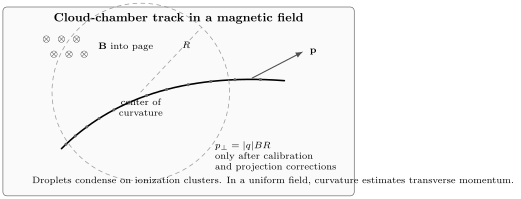
A charged particle leaves ionization clusters that seed droplets. In an approximately uniform magnetic field, the projected curvature of a track estimates the transverse momentum through , subject to calibration, multiple scattering, and projection corrections.
Ionization Trails
Section titled “Ionization Trails”The basic physical mechanism is energy loss by ionization and excitation. A charged particle moving through matter interacts electromagnetically with atoms and molecules. Some encounters remove electrons, leaving ion pairs. In a supersaturated vapor those ions act as condensation nuclei.
The detector therefore records a sequence of interactions, not the particle as an extended luminous object. A rough logical chain is
Track density is not a direct measure of the wavefunction. It is a detector response. Slow heavily ionizing particles tend to make dense tracks; fast minimum-ionizing particles make thinner tracks. Near the end of a charged particle’s range the ionization can increase, producing a thicker terminal part of the track. Real tracks also fluctuate because ionization energy loss is statistical.
The detailed stopping-power formula belongs to detector physics and relativistic charged-particle interactions. For the present purpose, the central point is simpler: a track is a classical-looking record produced by many microscopic quantum interactions with a macroscopic medium.
Momentum From Curvature
Section titled “Momentum From Curvature”If the chamber sits in a magnetic field , the Lorentz force bends a charged particle’s path. For motion perpendicular to a uniform magnetic field, the force magnitude is
where is the radius of curvature and is the relativistic momentum magnitude. Thus the transverse momentum is
In practical high-energy units,
The sign of the curvature, once the magnetic-field direction is known, gives the sign of the charge. The radius gives momentum, not kinetic energy by itself. To infer energy one must know the mass or combine the track with range, ionization, time-of-flight, calorimetry, or other information.
Several caveats matter:
- the photographed track is a projection of a three-dimensional path;
- the magnetic field may not be perfectly uniform;
- low-momentum particles undergo multiple Coulomb scattering;
- the track can be distorted by chamber conditions and measurement uncertainty;
- neutral particles leave no direct ionization track, though they may be inferred from charged decay products or missing momentum.
These caveats are not defects in the method. They are the reason detector evidence is quantitative only after calibration and reconstruction.
Particle Discovery Context
Section titled “Particle Discovery Context”Cloud chambers made particle evidence unusually persuasive because they produced spatially resolved event records. In early nuclear and cosmic-ray work, they helped show that microscopic processes could be reconstructed from tracks rather than inferred only from currents, scintillations, or photographic darkening.
Several historical roles are especially important:
| Context | What the chamber contributed | Caution |
|---|---|---|
| Alpha and beta radiation | Visible ranges, scattering, and ionization differences | Track appearance alone is not an identity proof |
| Nuclear scattering | Event-by-event geometries for collisions and recoils | Cross sections require many events and acceptance corrections |
| Cosmic rays | Rare energetic events could be photographed | Atmospheric origin and detector bias needed separate analysis |
| Positron discovery | Curvature and energy-loss evidence for a positively charged electron-mass particle | The interpretation depended on magnetic-field calibration, material geometry, and comparison with alternatives |
| Pair production and showers | Multiple tracks revealed conversion and cascade structure | A photograph is a record of final charged tracks, not the whole quantum process |
The positron case illustrates the method’s strength. A track curving with the positive charge sign, together with energy-loss and absorber information, could support the interpretation of a particle with electron-like mass but opposite charge. The discovery was not “seen” without theory; it was reconstructed by combining track geometry, detector conditions, and conservation laws.
Cloud-chamber photographs also made the event character of microscopic physics hard to ignore. They showed localized marks and individual histories. At the same time, quantum theory was developing a formalism of amplitudes and probabilities. The coexistence of localized records and nonclassical propagation is one reason detector pages must connect to Born Rule and Interpreting the Wavefunction.
Limits of Classical Track Intuition
Section titled “Limits of Classical Track Intuition”A cloud-chamber track looks like a tiny classical path. That visual impression is useful for reconstruction, but it can mislead if promoted to ontology too quickly.
What the chamber directly records is a chain of localized detector interactions. The particle state before detection may be delocalized relative to detector resolution, entangled with fields and material degrees of freedom, or part of a scattering superposition. Once many ionization events occur, the environment has amplified position information into a stable macroscopic record. That record is why the final photograph looks classical.
The right lesson is therefore two-sided:
- tracks justify using classical reconstruction variables such as , , range, and vertex location in suitable regimes;
- tracks do not imply that every quantum process is fundamentally a pre-existing classical trajectory.
This distinction is the same one that appears in Double-Slit Experiment. Individual detections can be localized while the probability distribution is governed by amplitudes. A cloud chamber adds a dense sequence of localized interactions, which strongly suppresses interference between macroscopically different track alternatives.
From Cloud Chambers to Later Detectors
Section titled “From Cloud Chambers to Later Detectors”Cloud chambers were eventually joined or replaced by other detector technologies, each optimized for a different balance of density, rate, timing, automation, and precision:
- nuclear emulsions recorded tracks with high spatial resolution in photographic material;
- bubble chambers used boiling in a superheated liquid rather than droplet condensation in vapor;
- scintillators converted deposited energy into light pulses;
- Geiger counters and proportional counters converted ionization into electrical signals;
- spark chambers, wire chambers, drift chambers, time-projection chambers, and silicon detectors enabled large-scale electronic tracking.
The conceptual continuity is important. A modern tracking detector no longer produces a misty photograph, but it still reconstructs charged-particle trajectories from many localized interactions. The mathematics of state evolution and measurement is quantum; the reconstructed event display is a calibrated classical record.
Common Mistakes
Section titled “Common Mistakes”- Treating a cloud-chamber photograph as a direct image of a wavefunction.
- Inferring particle identity from track thickness alone.
- Forgetting that curvature gives transverse momentum only after field, geometry, and projection are known.
- Assuming neutral particles are absent whenever no direct track appears.
- Reading every track as a fundamental classical trajectory rather than as a detector record assembled from many interactions.
- Confusing event-by-event reconstruction with the statistical work needed to measure a cross section or branching fraction.
Cross-Links
Section titled “Cross-Links”- Experimental Techniques and Instruments
- Rutherford Scattering
- Compton Scattering
- Electron Diffraction
- Double-Slit Experiment
- Born Rule
- Measurement in the Formalism
- Cross Sections
References
Section titled “References”- C. T. R. Wilson, “On a Method of Making Visible the Paths of Ionising Particles through a Gas,” Proceedings of the Royal Society A 85, 285-288, 1911.
- C. T. R. Wilson, “On an Expansion Apparatus for Making Visible the Tracks of Ionising Particles in Gases and Some Results Obtained by Its Use,” Proceedings of the Royal Society A 87, 277-292, 1912.
- C. D. Anderson, “The Positive Electron,” Physical Review 43, 491-494, 1933, DOI: 10.1103/PhysRev.43.491.
- P. M. S. Blackett and G. P. S. Occhialini, “Some Photographs of the Tracks of Penetrating Radiation,” Proceedings of the Royal Society A 139, 699-727, 1933.
- N. N. Das Gupta and S. K. Ghosh, “A Report on the Wilson Cloud Chamber and Its Applications in Physics,” Reviews of Modern Physics 18, 225-290, 1946, DOI: 10.1103/RevModPhys.18.225.
- W. R. Leo, Techniques for Nuclear and Particle Physics Experiments, 2nd ed., Springer, 1994.
- C. Grupen and B. Shwartz, Particle Detectors, 2nd ed., Cambridge University Press, 2008.
Exercises
Section titled “Exercises”- A singly charged particle makes a circular track with projected radius in a uniform magnetic field . Estimate in .
Solution
Use
for . Thus
- Why does a cloud chamber mainly reveal charged particles?
Solution
The visible droplets form around ionization clusters. Charged particles ionize the gas directly through electromagnetic interactions. Neutral particles do not leave such tracks directly, though they can be inferred if they decay into charged particles, scatter to produce charged recoils, or create missing momentum in a well-constrained event.
- Explain why a cloud-chamber track is not a direct photograph of a quantum wavefunction.
Solution
The photograph records droplets formed after many localized interactions between the particle, the gas, and the detector environment. A wavefunction is a probability amplitude, not a visible material density. The track is a macroscopic record conditioned on detector interactions; it is compatible with quantum mechanics but is not itself the wavefunction.
- What information is needed to infer charge sign from a curved track?
Solution
One must know the direction of the magnetic field, the direction of particle motion along the track, and the track curvature. The Lorentz force then fixes the sign of . Without the field direction or the time direction of the track, the same curve can be ambiguous.