Lasers as Quantum Technology
Lasers are quantum technology in a direct sense: they depend on stimulated emission, discrete energy levels, population inversion, and optical feedback. They also became one of the main tools for making quantum mechanics experimentally precise, from laser spectroscopy and atom cooling to optical clocks, ion traps, quantum optics, and coherent control.
This page is a technique overview. It does not replace the formal treatment of driven transitions, light-matter Hamiltonians, coherent states, or quantum optics. For nearby canonical material, see Harmonic Perturbations, Rabi Oscillations: First Encounter, Coherent States, and Rabi Model.
Stimulated Emission
Section titled “Stimulated Emission”An atom, molecule, ion, or solid-state emitter with upper and lower energy levels can emit radiation by two conceptually different processes. In spontaneous emission, an excited system emits without an already present resonant field. In stimulated emission, an incoming field at the transition frequency induces emission into the same optical mode.
For a transition with
stimulated emission adds a photon to a mode already carrying the phase, direction, frequency, and polarization selected by the field. That mode selectivity is the seed of laser coherence.
A schematic rate description uses Einstein coefficients:
where is the spectral energy density and are level populations. The details depend on degeneracy, linewidth, and the medium, but the central competition is clear: absorption scales with the lower-state population, while stimulated emission scales with the upper-state population.
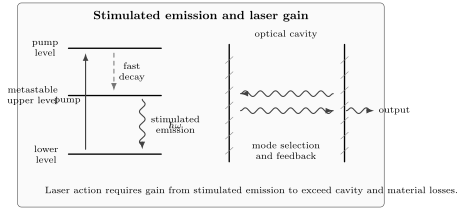
A laser medium is pumped to create population inversion. Stimulated emission amplifies a selected optical mode, while the cavity provides feedback and frequency selection. Real lasers include losses, linewidths, saturation, and noise beyond this schematic.
Population Inversion
Section titled “Population Inversion”In thermal equilibrium, lower levels are more populated than higher levels. For a simple two-level system with energies ,
Such a medium absorbs more than it amplifies. Laser action requires a non-equilibrium population inversion, roughly
for a simple nondegenerate transition. With degeneracies and line strengths included, the precise gain condition is modified, but the physical idea remains: the medium must provide net stimulated emission rather than net absorption.
This is why practical lasers use pumping schemes. A pump moves population into an upper manifold. Fast decay can then place population in a metastable upper laser level while the lower laser level is depleted. Three-level, four-level, semiconductor, fiber, gas, dye, and solid-state lasers implement this logic in different ways.
Population inversion is not a violation of thermodynamics. It is a driven non-equilibrium state maintained by an external pump and accompanied by heat, loss, and entropy production elsewhere.
Cavity and Threshold
Section titled “Cavity and Threshold”A laser is not just a gain medium. An optical cavity supplies feedback and selects modes. In a simple two-mirror cavity of length , longitudinal mode frequencies are approximately
for vacuum propagation and idealized mirrors. The free spectral range is
Laser threshold occurs when round-trip gain exceeds round-trip loss. A schematic condition is
Below threshold, the device may fluoresce or amplify weakly. Above threshold, stimulated emission into cavity modes dominates and the output becomes narrowband, directional, and highly coherent compared with ordinary thermal light.
The word “threshold” should not be overinterpreted as an infinitely sharp ideal transition in every device. Finite size, noise, multimode operation, gain saturation, and measurement bandwidth all matter.
Coherence
Section titled “Coherence”Lasers are valued because they can produce light with high temporal and spatial coherence. Temporal coherence means the phase remains predictable over a relatively long time or path difference. Spatial coherence means fields at different transverse points have stable phase relations.
In a rough first-order model, high visibility in an interferometer signals coherence:
Lasers can have close to one in well-controlled interferometers, but no real laser is perfectly monochromatic or noiseless. Phase noise, amplitude noise, spontaneous-emission noise, technical vibrations, thermal drift, and mode competition all affect coherence.
Quantum mechanically, an ideal coherent state is often a good model for a stabilized laser mode. But “laser light is a coherent state” is a model statement, not a universal fact about every laser under every condition. Photon statistics, linewidth, and phase reference conventions matter.
Spectroscopy and AMO Physics
Section titled “Spectroscopy and AMO Physics”Lasers transformed spectroscopy because they provided narrow, bright, tunable, and controllable radiation. Compared with lamps or discharge sources, lasers made it possible to:
- drive selected transitions with high spectral resolution;
- saturate transitions and remove Doppler broadening in suitable geometries;
- cool and trap atoms using momentum transfer and velocity-dependent scattering;
- manipulate internal states with pulses;
- stabilize frequencies to atomic or molecular references;
- build optical frequency combs and precision clocks;
- probe weak transitions and small shifts.
The connection to Spectroscopy is direct: line positions, line shapes, transition strengths, and selection rules became measurable with much greater control.
The connection to Atomic Beams and Interferometry is equally important. Laser beams became state selectors, beam splitters, mirrors, phase references, cooling fields, and readout tools.
Quantum Optics Bridge
Section titled “Quantum Optics Bridge”Lasers helped create quantum optics as an experimental field. They made it possible to study:
- photon counting and shot noise;
- coherence functions and correlation measurements;
- squeezed light;
- cavity quantum electrodynamics;
- single-atom and single-ion control;
- nonlinear optical processes;
- entangled photon-pair generation;
- quantum-limited interferometry.
Lasers also forced a useful distinction. A strong laser field can often be treated as a classical drive in a Hamiltonian such as
where is an electric-dipole operator. That semiclassical description is extremely useful for driven transitions. But questions about photon statistics, spontaneous emission, squeezing, and field quantization require a quantum field description. The right model depends on the observable.
Coherent Light gives the quantum-state version of the laser approximation, including Poisson statistics, phase diffusion, reference frames, and finite-bandwidth caveats.
Common Mistakes
Section titled “Common Mistakes”- Saying a laser is just “very bright light”; brightness alone is not coherence, mode selection, or stimulated emission.
- Assuming any population inversion automatically produces a useful laser; gain must exceed loss in supported modes.
- Treating laser light as perfectly monochromatic.
- Forgetting that many lasers are multimode, noisy, pulsed, or technically limited.
- Saying stimulated emission creates photons from nothing; energy comes from the pumped medium.
- Using a classical field model for questions that require photon statistics.
- Overstating technological inevitability: lasers became central because quantum physics, materials, cavities, electronics, and metrology all matured together.
Cross-Links
Section titled “Cross-Links”- Experimental Techniques and Instruments
- Spectroscopy
- Interferometry
- Atomic Beams
- Magnetic Resonance
- Einstein’s Light-Quantum Hypothesis
- Light Quanta to Photons
- Harmonic Perturbations
- Rabi Oscillations: First Encounter
- Coherent States
- Coherent Light
- Rabi Model
- Entanglement in Quantum Optics
References
Section titled “References”- A. Einstein, “Zur Quantentheorie der Strahlung,” Physikalische Zeitschrift 18, 121-128, 1917.
- A. L. Schawlow and C. H. Townes, “Infrared and Optical Masers,” Physical Review 112, 1940-1949, 1958, DOI: 10.1103/PhysRev.112.1940.
- T. H. Maiman, “Stimulated Optical Radiation in Ruby,” Nature 187, 493-494, 1960, DOI: 10.1038/187493a0.
- A. E. Siegman, Lasers, University Science Books, 1986.
- W. Demtröder, Laser Spectroscopy: Basic Concepts and Instrumentation, 4th ed., Springer, 2008.
- M. O. Scully and M. S. Zubairy, Quantum Optics, Cambridge University Press, 1997.
- C. J. Foot, Atomic Physics, Oxford University Press, 2005.
Exercises
Section titled “Exercises”- A simple two-mirror cavity has length . Estimate its free spectral range .
Solution
Use :
The free spectral range is about .
- Estimate the photon energy of light with wavelength using .
Solution
Use
- Why is a two-level atom in thermal equilibrium not enough to make a laser?
Solution
In thermal equilibrium the upper level is less populated than the lower level, so absorption exceeds stimulated emission for the transition. Laser gain requires a non-equilibrium population inversion or an equivalent gain mechanism. A pump and additional levels or bands are needed to maintain that condition against losses.
- When is it reasonable to model a laser as a classical drive?
Solution
It is often reasonable when the laser mode has a large photon occupation, stable phase relative to the experiment, and the observable of interest is a driven transition rate or coherent state evolution of matter. It is not enough for questions about photon counting statistics, squeezing, spontaneous emission, or field quantization itself.